Peak Oil

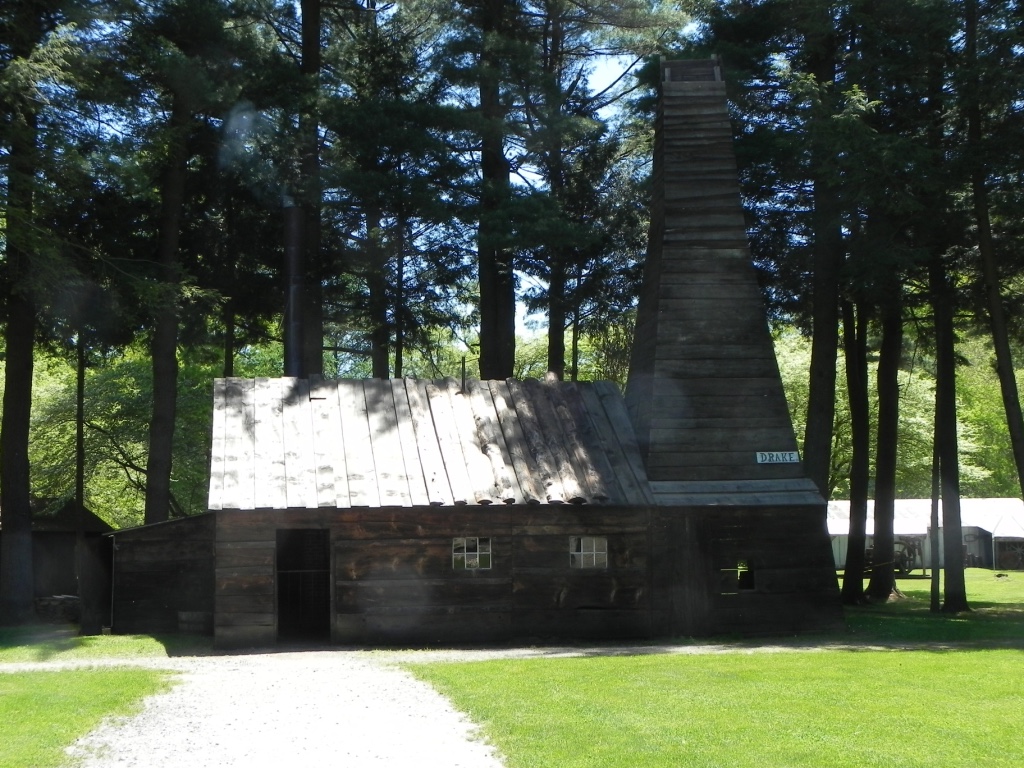
Having no control over where we’re born, people nevertheless often feel a connection with their native region. My family had no roots in western Pennsylvania, and the consensus on why we ended up here focuses around jobs. My grandparents settled here because of a job. While working here on a job my father, from the south, met my mother. My brothers and I all consider ourselves Pennsylvanians. One of the places we liked to visit as children was Drake Well. We knew that the oil industry began in western Pennsylvania, and we knew that famous people like George Washington had traveled through the region during the various wars of the nation’s early years. The towns where I grew up are not exactly affluent, and one of them seems in danger of becoming a ghost town. Drake Well, however, the birthplace of commercial oil, still draws visitors from the region and from around the country. On a recent visit to the site, I was interested to see how religion interplayed with petroleum in Victorian Era western Pennsylvania.
thumb_DSCN5064_1024

Among the displays was one showing the various means used to find oil. In the days before geological surveys, finding something hidden underground required more than just technical knowledge. More precisely, it often utilized different forms of technology—some scientific, some not. Dowsing was popular, and spirits were consulted. Access to the supernatural world was not uncommon. The oil industry really took off during the same era that spiritualism began to become popular. Religion and science co-existed in a way that is difficult to imagine today. Indeed, Drake Well was established in 1859, the same year Darwin’s Origin of Species was published. The means used to reach the oil were, however, unabashedly scientific and technical. Nitroglycerin fatalities were just another fact of life.

Looking over the triumphal displays about fracking, it became clear that in the realm of petroleum production the spirit has made way for a technology with unknown consequences. The museum at Drake Well is pretty straightforward that other energy forms pose a threat to an industry that was, and currently remains, massive. We have technologies that can utilize cleaner forms of energy, but powerful oil interests have maintained the focus on more and more invasive ways to keep things going the way they are, pulling in more profits while the limited supply lasts. We know petroleum will run out. We’ve deeply integrated it into our way of life and instead of looking ahead to the next step, we’ve been reaching back to pad our fat pockets. Gone are the dowsers and spiritualists and in have charged the corporate executives. And in western Pennsylvania, the towns where the industry began struggle to stay alive as thinking that allowed for spirits has acquiesced to that which has loyalty to Mammon alone.

The Importance of Being Published

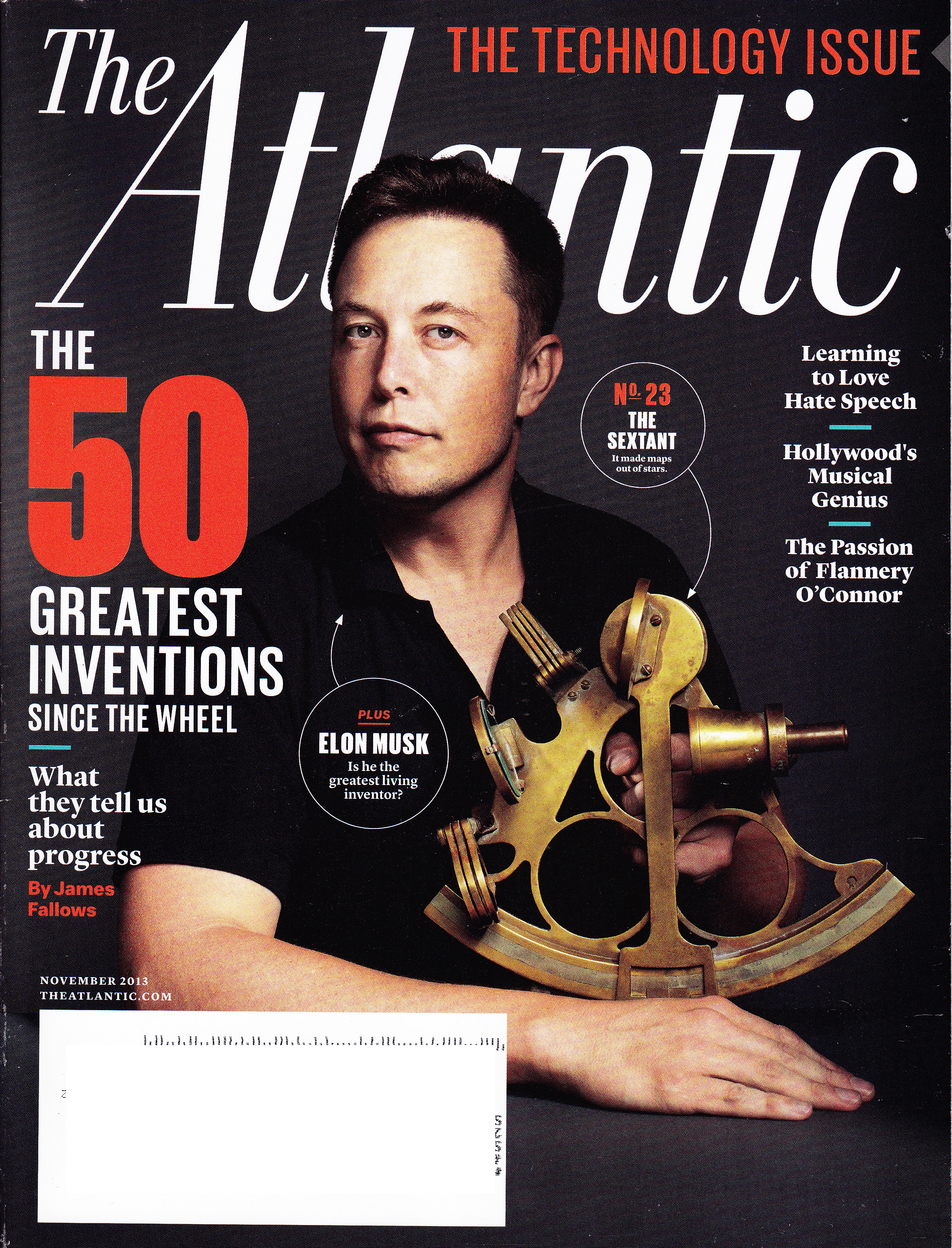
AtlanticThe crowd over at The Atlantic Monthly magazine are a formidable lot. Even with a Ph.D. and a modicum of writing ability, I’ve been frightened off from ever submitting to such an intellectual periodical. These are people whose opinions count. When The Atlantic named, in last month’s issue, the fifty most important inventions since the wheel how could I not peek? Especially when number 39 included a picture I recognized from my childhood in the cradle of the oil industry: Col. Edwin Drake standing outside a fledgling oil derrick in Titusville, Pennsylvania—just the next town up route 8. I felt like I might be somebody, by association. We all know that number one is best, so I wondered, as I flipped through the pages, what the most important invention was, although I suspected I already knew. The printing press, dating back to the 1430s, is certainly a contender, and was Atlantic‘s winner. Those of us historically inclined tend to think in regressions. The internet has forever changed our lives, but what is the internet without reading? (Okay, well, it is lots of funny pictures of cats and pornography, but you still have to be able to type in “cat” or “nude” or whatever, to bring you there.) It took the printing press to catapult reading from the academy to the hearth, and to reach that critical mass so that the Kindle could surpass the printed book.

My interest in studying the Hebrew Bible for a doctorate actually included an ulterior motive. You see, the Bible was among the first books printed. As much as western civilization owes to the New Testament, my regressive thinking insisted that the New Testament was based on the Old. As I learned in seminary, the Old was based on an older, and that on an even older, in a pleasing kind of regression. I ended up in Ugaritic, the earliest known alphabetic language. The alphabet, I might contend, vies with the printing press for most important invention since the wheel. Before the alphabet writing was so cumbersome that only very skilled specialists could read written languages cobbled together from signs that represented letters and symbols and entire words and entire classes of words. But, ah, it was writing! Mesopotamians seem to have brought the idea into existence, specifically, those of ancient southern Mesopotamia that we call the Sumerians, who, incidentally, also invented the wheel.

Those of us in the book industry feel a constant worry in our stomachs when we look at book sales figures. Even in the most highly literate of social periods a very small percentage of people would actually purchase books (especially in the New World). With electronic media, that number has declined alarmingly. Still, the internet—number 9 on The Atlantic list—owes its life to good old paper (number 6) and pen (which failed to make the list at all). And paper wouldn’t have evolved without clay—the very substance of which early written myths claim that humans are made—and stylus. Thoughts locked in our clay heads cry out for expression. Some of us are compelled to put them in the form of written words for others to see. It’s just that we know our place and wouldn’t presume to send them to The Atlantic Monthly, or any other magazine, where they would be certain not to make the cut.


Sonoco

sonoco2

What do God and great pools of gooey, flammable, decomposed ancient biomass have in common? Quite a lot apparently. A picture in this morning’s paper of a Caribbean Petroleum Corp. storage facility explosion took me back to my childhood. I was born in the same place as the oil industry, although I think it was in different hospitals. Northwestern Pennsylvania is where the industrial use of oil was discovered (ancients had learned that the stuff was extremely flammable and used it for cruel weapons, but never figured how to grease an axle with it). One day my brothers and I were playing outside and noticed flames jetting up from an adjacent hillside. We saw giant ashes, some nearly the size of dinner plates, floating down on a summer day and it seemed like a strange gray snow was falling. A funny smell was in the air. That night on the news we learned that a local oil refinery had exploded and when we went to the site to gawk, it was amazing to see colossal storage tanks melted like so many ten-ton candles. It is an image I’ll never forget.

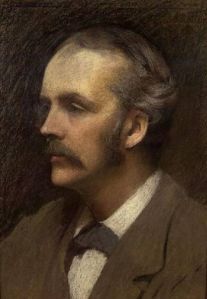
Lord Balfour envisions chariots of fire

Lord Balfour envisions chariots of fire

My wife’s favorite historian is Barbara Tuchman. We’ve read most of her books. Bible and Sword, however, was especially eye-opening for me. This book describes, step-by-step, how the British Empire forged its alliance with Israel. Tuchman is a meticulous historian, noting minute details that add understanding to the overall picture. One of the key motivating factors that led Lord Arthur James Balfour in his support of a homeland for the Jewish Diaspora was his belief that a physical Israel was required before the Second Coming of Christ could take place. This is a sentiment that has been shared by some recent, very highly ranking American politicians.

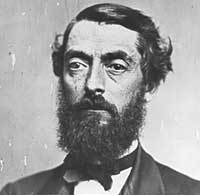
Enter Col. Edwin Drake. Drake was the first person to have the idea of drilling for oil. Several local prospectors scampered through the hills of Pennsylvania looking for oil streams where petroleum could be skimmed off the water and refined into kerosene. As an alternative to whale oil, petroleum was much easier to collect and didn’t involve peg-legs spearing great white whales — oh wait, wrong story. As an alternative to whale oil, petroleum made a market impact and soon other uses were descried. There was an oil boom near Titusville, Pennsylvania when Drake hit oil, and soon the industry that give birth to Quaker State, Pennzoil, and Enron was up and running. As uses for petroleum multiplied demand shot through the roof. Drake died in poverty and the industry he helped found rolled ever forward.

Col. Edwin Drake envisioning a drink

Col. Edwin Drake envisioning a drink

After the Second World War, vast oil beds were discovered in the Middle East. Israel was declared a nation, and world-wide demand for petroleum was astronomical. Not all nations of the former Ottoman Empire welcomed the sudden interest in their natural resources or the presence of an allied nation in their midst. Although the roots go deeper and are much more complex, the scenario was set for a crisis that has lasted for my entire life and shows no signs of slowing down.

So what does God have to do with a complex mix of hydrocarbons and other organic compounds? The unbelievable wealth generated by petroleum products has been under-girded with a religious gullibility and deeply held faith that Jesus needs some help in returning. As long as we’re waiting, we might as well get filthy rich. Politicians with connections to Big Oil and the Big Guy have it all figured out. Take all that you can and wait for the God who has blessed you so richly to come home. I still remember that refinery explosion, and some childhood memories have become paradigms and parables that have as many applications as petroleum itself. When the oil beds run dry, what will grease the axles of Kingdom Come?

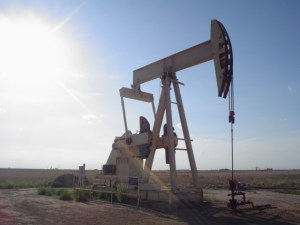
Mechanical worshiper bowing down to a subterranean god

Mechanical worshiper bowing down to a subterranean god