Glowing Television

I saw some colleagues rather cagily recommending I Saw the TV Glow when it came out.  Considered psychological horror, it is a bewildering film.  This surreal story revolves around a television show, The Pink Opaque, which is ninth-grader Maddy’s favorite program.  She meets Owen, who’s in seventh grade, and asks if he’s watched it.  Since it’s on past his bedtime, he has to sneak to Maddy’s house to watch it with her.  Like her, he become hooked on it.  Maddy, however, has trouble distinguishing the show from real life.  Two years later she runs away from home, ostensibly to find reality in The Pink Opaque.  After a decade, Maddy finds Owen again.  He’s taken a dead-end job but feels that he knows what reality really is.  His parents dead, he carries on in his lackluster job.  Maddy tries to convince Owen that what he thinks is the real world is a television show and that The Pink Opaque is reality.  She wants to bury him alive so he can awaken to reality.
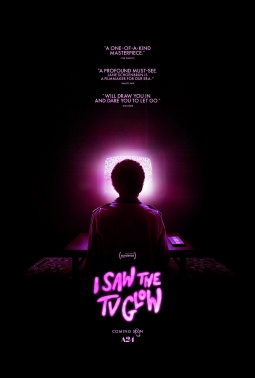
After twenty more years, Owen is still in the same degrading job, suffering in physical health and, apparently, mental as well.  After a breakdown at work, he discovers a television inside his chest.  It’s a bizarre tale, which is a clue that something more than meets the eye is going on.  A little reading reveals that Jane Schoenbrun, the writer/director, is trans and discovering that reality is what the film is about.  That does help make sense of it.  I tend not to read about movies before I see them, but I’d had this one recommended to me by a couple people whose judgment I trust.  Anyone who’s had an epiphany of self-discovery will probably be able to relate, at least in part.

There are some horror moments in the movie.  The implications of being buried alive—which comes up for four characters—is Edgar Allan Poe-nightmare material.  The ice cream man, in the original showing, is creepy.  And cutting open your chest to access a television inside is scary.  Also some characters have their hearts cut out.  All of this is surrounded by a pink glow and a pretty amazing soundtrack.  Unless a viewer has specific triggers though, I can’t see I Saw the TV Glow being especially frightening for anyone.  It’s not that kind of horror movie.  If, however, you are prone to existential horror, and sometimes wonder if reality is real, this could give you a bit of a jolt.

The Horseman

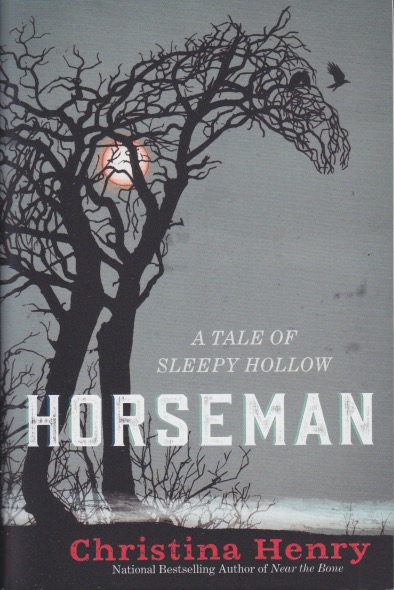
Washington Irving’s tale, “The Legend of Sleepy Hollow,” perhaps due to its being the earliest literary American ghost story, has been retold time and again.  When I saw that Christina Henry had a take on it that came out last autumn, I knew I’d be reading it.  I’d read her The Girl in Red late last year, but I couldn’t wait until fall to read this one.  Henry has a way of taking traditional stories and making them relevant.  Horseman is set two generations after Ichabod Crane and Brom Bones and Katrina Van Tassel, but they all appear in it.  According to Irving’s story—and this is often changed in cinematographic treatments—Brom and Katrina wed.  The narrator of this tale is Ben, who in today’s terms would be considered transgender.  He (his preferred pronoun) is the grandchild of Brom and Katrina.

Henry is a master of magic realism.  There really is something in the woods of Sleepy Hollow and it’s taking children’s heads.  Some influence from Tim Burton’s film version is found here, but the story has its own trajectory and inner logic.  Ben actually sees the monster, but nobody will believe him.  Not until it’s too late.  The one person who does believe is Katrina, Ben’s grandmother.  She, however, wants Ben to act like a girl because he was born female.  She wants him to stay home and learn sewing and cooking.  Ben’s hero, however, is Brom.  He’s a good man, if rowdy.  He married Katrina for love, not wealth.  Ichabod Crane does appear, later in the story, but since how he appears is a spoiler I’ll need to let you read for yourself.

Americans are often raised with the wrong-headed notion of canon as the one way a story goes.  Retelling is as ancient as writing itself.  Homer, Apollodorus, and Ovid were retelling stories.  So were many Bible writers.  People tell one another tall tales.  Washington Irving didn’t invent the Headless Horseman out of whole cloth.  Neither did the people of Tarrytown.  How the story goes is a matter for discussion.  Bet yet, it’s also a matter for retelling.  Henry’s version could be made to fit with Irving’s, but with a bit of prior assumption, some posthumous collaboration.  Hers, however, is a tale for our times.  Just like in Red, the protagonist isn’t conventional, according to conservative sexual standards.  Both are, however, authentic.  And although both may be flawed in various ways, there’s no denying that they’re heroes.