Evolution of Psychology

We are a fragile species.  Those of us who experienced childhood trauma carry it all our lives, even if it only seems to pop out unexpectedly from time to time.  This gets me to thinking about the evolution of psychology.  Not the discipline psychology, but of the human mental map.  Things that can upset a roomful of people these days would’ve washed over an entire village unnoticed yesteryear.  Did people then really feel as angry and breakable as we do now?  Please understand, I’m not advocating the view that people of previous ages were better, or even stronger than we currently are.  I just wonder if their circumstances made it so that what we think of as therapy wasn’t really necessary.  For one thing, much of human history has been dominated by short lifespans.  Historically, many women died in childbirth in their twenties.  The majority of men, until modernity, didn’t make it to fifty.  Sitting here musing, I’ve got ten-plus years on that and yet I wonder.

Those facts of life would’ve had to have affected people’s outlooks.  Our extreme squeamishness around reproduction also didn’t exist in antiquity.  Privacy, as we know it, wasn’t part of their world.  How many people see a therapist these days because of sexuality issues?  When did this turning point take place?  If we go back to early Cro-magnon, perhaps living in caves, did they come back traumatized from the hunt?  Surely they must’ve seen death on a nearly daily basis.  Today it’s difficult to get anyone to consider the mortuary sciences for a career.  We don’t like to think about death.  We pick up the phone and dial our therapists. 

When I was still teaching I thought often about how differently people framed their lives in the past.  It’s only now, however, that I’ve come to wonder about the psychological support we require.  I suspect life was, for most people, a literal daily struggle to survive.  Agriculture tamed the environment somewhat, and if current evidence is taken into account, religious gathering looks to have developed even in advance of that.  Perhaps the larger issues, what we still recognize as religion, helped to cope with the constant uncertainties of life.  Unfortunately, there’s no way for us to really get their mental maps.  We can read ancient writings, many of them pro forma or religious in nature.  We start to get some insight in pieces such as the Gilgamesh Epic, but that is so very brief.  I wonder when we started to require help going out the door in the morning or facing another day of the same old, well, you know.  Psychology had to evolve but it left so very few traces.  I, however, have an advantage in years great enough that I ponder our mental states.


For the Camera

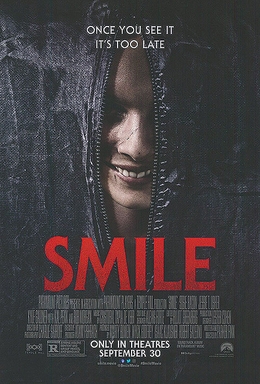
Smile 2 is getting some good critical notice and I hadn’t seen Smile (1) yet.  Psychological horror often bothers me, but I figured I’d grin and bear it.  I’m glad I did.  The ideas in the film, which participates in “the stigma trope,” are disturbing because it’s unclear if Rose (the protagonist) is mentally ill or not.  The stigma trope posits that something has infected someone either by having seen something they shouldn’t (as in Ringu) or by physical contagion (It Follows) and the victim can’t shake it.  Smile may trigger viewers with suicidal phobias since the premise is that an entity feeding on trauma passes from person to person by having the new victim witness the previous victim’s suicide.  Rose is a therapist who hasn’t gotten over the trauma of her mother’s death.  Rose witnesses a patient die by suicide, and who smiles just before she does it.

The patient told Rose that she’d watched one of her professors die by suicide.  Rose subsequently learns that the professor also witnessed a suicide and so on and so on.  Each prior victim had watched someone else die.  Now Rose has to figure out how to break the cycle, otherwise she’ll perpetuate it.  The idea of inadvertently obtaining a “sticky” entity is pretty scary, and a very human concern.  One of the more frightening aspects of possession movies is the belief that now that demons know that you know, they will target you.  Interestingly, what makes this film provocative is that the victim has to have suffered trauma before.  As such, it is a study of trauma and its lasting effects.  I suspect most people don’t intentionally traumatize others (world leaders excepted).  Trauma can be dealt with (or not) in very different ways.

Smile did quite well at the box office.  I suspect there are a lot of us traumatized people around.  Capitalism encourages traumatizing others through slow violence, if not the more obvious quick way.  People don’t easily walk away from events that scarred them, particularly if they happened at an early age.  Such people, if experience is anything to go by, find themselves in vulnerable positions in life and rather thoughtless people, often for religious reasons, end up traumatizing them even further.  I have to admit that there were triggers for me in Smile.  I still struggle with a few of my own traumas that were never resolved.  Like Rose, I sometimes don’t know who can really be trusted with such things.  This is a perceptive movie.  I guess now I can put on a happy face and see Smile 2.  But first I’d better talk to my therapist.


Dryad?

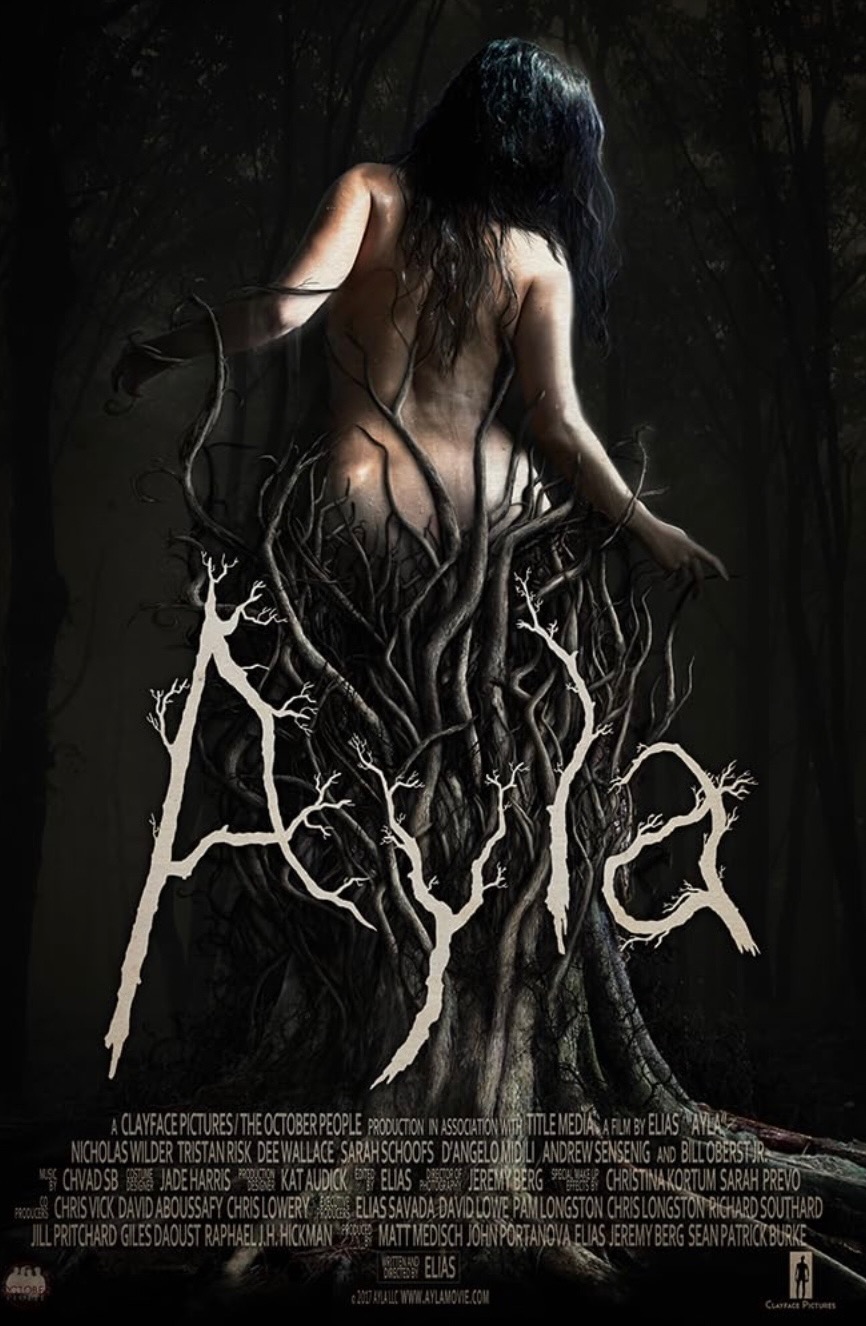
There are so many movies out there.  The prudent horror fan knows not to be nickeled and dimed to death by renting/buying everything available, so you stick with a streaming service and take what they offer.  That’s how I find many of the movies I discuss on this blog.  It’s how I found Ayla.  You won’t find much information on this indie, art-house horror beyond IMDb, and it doesn’t say much.  Although the ratings are low the premise is good and it is beautifully filmed.  It is a little weird, though.  Elton, a mentally disturbed man, has never gotten over the death of his sister when she was four.  He supports himself by working in a bookstore and has a regular girlfriend, Alex, but he hasn’t let his sister go.  Going to a remote, dilapidated house that Alex showed him, he digs under a tree until he finds an adult Ayla.

Ayla’s alive but she doesn’t talk and can’t tolerate solid food.  She seems to be part of the tree where Elton found her.  His brother and mother tell him this woman isn’t his sister.  Alex, who lost a brother when she was a child, doesn’t say whether Ayla’s Elton’s sister or not.  Accepting that this woman now lives with him, she’s just not sure if the dead do come back.  Elton quits his job and tries to move home with his mother, but it doesn’t work out.  While driving at night, Ayla, ahem, distracts him, and his car hits a tree.  Elton understands that Ayla has returned to the tree and begins digging for her, but doesn’t find her.  Alex finds evidence that Elton has begun to turn into whatever it was “Ayla” is.

Apart from being a study of grief—very much like A Ghost Story in that way—Ayla also explores mental illness and incest.  This is done with a high degree of artistry, however.  Those who rate the movie poorly probably haven’t considered metaphors much.  To me, there’s a lot going on in this film.  It’s the kind of movie where you want to talk to somebody about it after it’s over.  Was Ayla really a dryad?  She’s found in a nymph (insect variety) state and quickly transforms to, apparently, Elton’s missing sister.  Meanwhile, his family doesn’t give him the affirmation he requires.  Metaphorically, it seems, like Outpost, to be a movie about dealing with trauma.  Such films are well worth watching and pondering.  And they make me thankful for streaming services that occasionally bring good, if obscure, movies to light.


End the Stigma

I’ve been a lifelong fan of Edgar Allan Poe.  I bought books about him (and by him) from a young age, fascinated by a person who expressed himself so beautifully in the face of trauma.  Of  a different era, and mindset, was Rod Serling, creator of The Twilight Zone.  Another childhood hero of whom I made the assumption of some trauma.  One thing interesting about both of these influential writers is that relatives have written about them claiming that they weren’t as haunted as they seemed.  I wonder, however, if they write such things because we still, we are still stigmatizing trauma.  We’re great victim-blamers.  Perhaps it’s because we want to distance ourselves from the scary forces at play.  We fear that unhappy master, whom, in Poe’s words, “Unmerciful disaster followed fast and followed faster.”  We don’t want to attract such things to ourselves.

Reflecting on my father recently—I didn’t know him well at all—I was thinking about his experience in the Korean War.  I don’t know what happened to him there and I never had the opportunity to ask him about it.  But I do believe that, like Rod Serling, he may have been traumatized by combat.  War leaves trauma in its wake.  Few, I suspect, come out of such situations without deep scars that haunt them the remainder of their lives.  And still we fight.  I knew, already at a young age, that I could never be a soldier.  This despite growing up with G. I. Joe.  Some of us spend our lives trying not to harm others.  Trauma follows on from that since the world has its share of unmerciful disasters.

There are those who claim Poe wasn’t the experiencer of doom and gloom about which he wrote so eloquently.  He lost those close to him to disease.  Even now there are many stigmatized diseases.  That’s one of the reasons employers are insistent that conditions suffered by employees not be revealed.  Our whole medical privacy mindset plays into the stigmatizing those who face illness.  Tuberculosis was only one of many widespread diseases during Poe’s life, and it’s still widespread in parts of the world because companies like Johnson & Johnson and Danaher price gouge the well-understood cures to maximize profits.  And we blame the victims.  I return to Poe at intervals in my life.  I also watch episodes of The Twilight Zone.  And I think of my father.  There is trauma in the world, and some of it, at least, is preventable.  We must stop blaming the victims.