How to Type a Stereo

In the early days of publishing, type was set by hand. Individual letters, inserted backward onto plates, were used for printing the positive of a page. Printers could make as many pages as desired, but once the letters were released, it was time-consuming and costly to arrange them all again. If a book (principally) was expected to sell well enough for reprints, a plaster or papier-mâché mold was made of the page. This could be used to cast a solid metal plate of the pages to store for future print runs. This solid plate was known as a stereotype. Every copy from the plate would be exactly the same. When the plate was no longer needed it could be melted down and recast. The origin of stereotyping is a useful reminder of what happens when we preconceive a notion. For example, if I write “computer programmer” there is probably an image that comes to mind. No matter how many stereotypes confirm that mental picture, it isn’t true to the original.

Photo credit: Roger and Renate Rössing, Deutsche Fotothek, via Wikimedia Commons.

A piece by Josh O’Connor on Timeline, “Women pioneered computer programming. Then men took their industry over,” tells the story. Back in the early days of computing, when programming was seen as the menial labor of swapping out cables and plugs, it was “women’s work.” When it became clear how complex this was, and how many men didn’t understand it, the job was upgraded to “men’s work” and women in the industry were replaced. Stereotyping wasn’t just for boilerplate any more. The unequal assumptions here have led to a situation where computer engineering jobs still overwhelmingly go to men while women take on more “gender appropriate” employment. Any task that requires mental calculus benefits from input from both genders. One’s reproductive equipment is hardly a measure of what a mind is capable of doing.

Stereotyping is so easy that only with effort can we force ourselves to stop and reevaluate. The computer industry is only one among many that has been remade in the image of man. Our archaic view of the world in which everything is cast metal should be softening with the warming of intellectual fires. A large part of the electorate in our technically advanced nation admitted it just wasn’t ready for a woman in the role Trump is daily cocking up. It will take more hard lessons, perhaps, before even men can be made to admit that women can do it just as well, if not better. Stereotypes, after all, are eventually melted down to make way for new words. This may be one case where literalism might be a reliable guide.
Size and Its Matters

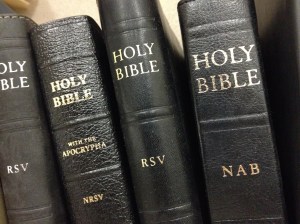
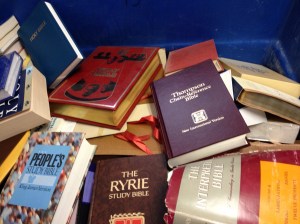
Have you ever wondered where your Bible came from? No, I mean physically. There are many possible answers to such a query, so the other day I was searching for Bible printers on the web. A great many Bibles are printed by Royal Jongbloed, in the Netherlands. They specialize in the super-thin paper used in much Bible printing. The reason the paper is thin is purely pragmatic. The Bible is an economy-sized book and if printed with “regular” paper it would be large and unwieldy—something desirable only by those with nefarious purposes, I suspect. Bible paper, by the way, was developed originally by Oxford University Press. And in case you’re wondering, the convention of printing Bibles in two-column format is also a space-saving convention. So I was looking over the Jongbloed site, wondering if they’re nervous at all about the increase of Nones. Then I remembered that in many parts of the world Christianity is actually growing, so there should be security in the Bible printing market for some time.

The Netherlands had a large role to play in the development of Protestantism and its love of the Bible. Many English non-conformists found it a welcoming place. Bibles were welcome. But Bibles aren’t all that Jongbloed does. They print scientific manuals too. Now that caught my attention. There’s nothing mercenary going on here—some scientific manuals are really big and are printed on (of all ironies) Bible paper. Is there some kind of conflict on interest going on here? I mean, which is it—science or religion? Or maybe there’s a third way. Maybe it’s not an either/or proposition. Maybe Occam shaves a little too closely.

The craziness flooding out of the District of Columbia has us all worried. Science is being attacked. If you’re being attacked you look around for your enemies. Religion! But wait, is religion really science’s enemy? How easy it is to forget that science developed from alchemy and astrology, both religious practices. Even today many scientists see no inherent disagreement between the two. If we want to be effective in warding off the pressing insanity we need to realize who the real enemy is. Science and religion can both be honest searches for the truth of this universe we inhabit. No, the natural enemy of science is personal greed. It’s also, if we take any kind of religion at it’s word, the enemy of religion as well. What we see bursting the floodgates of Foggy Bottom is the desire for personal gain cloaked as governance for the masses. We should never forget that the Netherlands facilitated a movement that changed everything. Besides, it’s just too expensive to print Bibles in a land badly in need of a Reformation.


Ironically

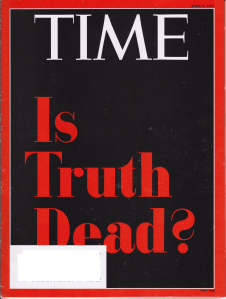
Irony is a national resource that’s in abundant supply. Those who inadvertently create it may be the least equipped to appreciate it, but that’s ironic, isn’t it? Time magazine used to be considered conservative. That was before the days when telling the truth was, by definition, liberal. A few weeks ago the famed news magazine ran a cover that was aimed at those of us who remembered the same cover that same week 51 years earlier. It read: Is God dead? That cover ran in the wake of a new wave of theology that perhaps may have been the last time that discipline held any public interest. Some thinkers had been tinkering with the idea that God might not be there. That was newsworthy.

Nature doesn’t work in round numbers, so just over a half-a-century later we found ourselves in a possibly even more dire world than one without God. This one has no deity, but it does have Donald Trump. Addicted to lies like they’re opiates, our commander-in-chief contradicts himself at 45 rpm. Comey was fired for mishandling the Clinton files. Then, moments later it was because of Russia. Then, moments later, I had been planning it all along. Kellyanne applauds from her alternative fact bunker. No truth may penetrate here. And we call this the free world. Where there is no truth there can be no freedom. Mitch McConnell and Paul Ryan, riding on the tsunami of disinformation, are loving the surf. Not a word from the thumbs of the president can be trusted.

Truth used to be an anchor. Now ships just drift. You can never tell whether they’re headed to North Korea or not. The GOP, in true American style, is attempting to rig the voting mechanism of this country so they can never lose power again. “It’s democracy,” they lie. They propose new health-care laws to which they will be exempt. Somewhere deep in these twisted pipes is a value long rusted shut. It’s rusty because it’s made of irony. And should that valve ever be wrenched open again we’d understand that draining swamps is a very bad idea. Yes, mosquitoes and other bloodsuckers may abound, but they’re all a part of the natural order of things. The dragonflies eat the mosquitoes and the fish eat the dragonflies. The greatest fish story of all is that the Republican Party believes in anything beyond its own supremacy over the entire nation it is lawfully bound to serve. Ironically, God’s not here to see this.


Sideliners

Sidelines can be interesting places to sit. You’re close to the action, and you’re privileged with a close view that few others have. You can’t, however, play the game. Sidelines are familiar to biblical scholars. I can’t count the number of times and/or ways the input of those who spend their lives trying to comprehend the Good Book are, well, sidelined. In the publishing world those who work with Bibles are simply ignored by most others, despite the enormous revenue Bible sales generate. In the academy religion departments overall are fair game for any potential budget cuts. And since what religion study survives tends to be intercultural, the Bible faculty are deemed somewhat less necessary than other sub-disciplines. It’s easy to forget that Christianity is the largest organized religion in the world and that some 2.2 billion persons claim that name. The Bible’s their foundational book. It tells us what motivates them. And yet, it’s easier simply to ignore the whole thing. Then something insane like an Evangelical-fueled Trump election, and everyone continues to say, “we can safely ignore this.”

I recently saw an article by scientists which explored why people engage in dangerous behaviors. The main idea was that although we know certain things are bad for us individually or as a planet, we still do them. We do them with the full knowledge that they’re deadly and will likely hasten our demise. Ignoring religion (and in the case at hand, the Bible) is very much like that. A well-armed true believer can ruin your day pretty quickly. Religion, in recent years, has generated over $82 billion in revenue per year. At least those in the dismal science ought to sit up and take notice of that! Hey, for once, the numbers are with us! Statistically, religion is very important. Sounds like a good thing to pretend doesn’t exist.

Having grown up a Fundamentalist, I often ponder this state of affairs. The Bible, we all knew, was the most important thing. Studying it formally does tend to force new ways of considering it, but few Bible scholars would want to dismiss the Good Book out of hand. It still means too much to too many people simply to ignore. Far safer is the proper handling of Holy Writ. This is much easier to instill when institutions support it. It really is a necessary kind of education. Still, it gets sidelined for industries with lesser profits and lesser baggage. I grew into a career defined by the Bible, but even if I hadn’t I’d hope that I’d be able to recognize that some things just shouldn’t be ignored. Yet I’m on the sidelines cheering on those who consider such a career a tragic mistake.


Earth vs. the GOP

They used to call her “Mother Earth.” Now she’s simply a commodity to be liquidated into cash at the country club where rich white men play. That’s why I’m spending Earth Day on my third protest march of the year. Of all the things the Republican Party has done to show its true colors the clearest has been to participate in the destruction of the world we all share. There’s only one word that answers the question “why,” and it used to be considered one of the seven deadly sins. Greed. These acts of planetary terrorism are carried out by men who believe lining their own pockets is the highest possible good. Even moderate Republicans have locked in their goose step to keep in the good graces of madmen who want to cram as much lucre into their coffers as they can before they die. When the planet’s a smoldering ruin their grandchildren will surely thank them.

Son, behold thy mother.

Don’t knock tree-hugging unless you’ve tried it. Trees tend to be much better company than Republicans anyway. Never have I had the feeling that I’ve had to celebrate Earth Day with such a blend of angst and anger. That one that your teacher always warned you about—the one who ruins it for everyone—now has control of the country. Immediately he insisted we start dumping coal waste into our streams and rivers. Burn more coal so he can play a few more holes with what passes for a clean conscience in a filthy soul. I march because I must. We can’t sit silently and let the darkness fall. If you can see through the coal dust you’ll understand that the planet weeps. It’s her that we celebrate today.

Matricide used to be considered a heinous crime. Now it’s just good business. If we were an honest species we’d admit it’s been bad business from the beginning. We’d never elect a businessman with inherently conflicting interests to the White House. The goods of the few outweighs the good of the many. The commodification of nature is the worst kind of unnatural selection. Here science and common sense agree—in order to survive we must preserve our planet. I confess that I’m unapologetic in this regard. So, although I’ll be spending this Earth Day in the artificial environment of Manhattan, marching in the cause of science, and if push comes to shove I’ll be the one hugging a tree.


Ode to Hubris

One-hundred-five years ago today, one of modernity’s great achievements sank alone in the icy waters of the chilled North Atlantic. While the ultimate cause of Titanic’s demise may have been an iceberg, the proximate cause was surely much more common. Human arrogance, we’re reminded daily, never learns its lesson. Despite what elected officials tell us, arrogance at the top will always lead according to its surfeit of self-confidence. After all, there are no icebergs this far south so late in the year. It seems that we’ll never forget Titanic and the hundreds of needless deaths, but somehow we’re not very good at transferring the lesson to other media. Let me give just a small example.

Yesterday I was in New York City. My family came during the day to celebrate my wife’s birthday. One of the benefits of New Jersey Transit is that after 7 p.m. on a Friday, a monthly bus pass also works on the train. I can meet up with my family after work and we can ride home in comfort instead of taking the bus, such as I usually do. We didn’t know that at 3:30 that afternoon a train had broken down in one of the limited number of tunnels under the Hudson. (Governor Chris Christie had famously stopped work on another set of tunnels to ease the commute.) About twelve-hundred passengers sat for an amazing three hours with no lights, air conditioning, or announcements. No trains could make it into New York’s Penn Station. When we arrived, oblivious, just before 7 p.m. there were people pouring out of the station. Coats and clothing were strewn all over the steps, as if the homeless had been raptured. The police told my wife and daughter not to go down. A few minutes later they said, “Definitely no shots were fired.” When we got to the platform all the monitors read about half-past five. Discarded clothing was everywhere. It was only when we finally got on a train that we learned that in the anxious terminal where crowds were restless, Amtrak police had tazed a man. People thought shots had been fired, and panicked. The video taken by those in the station shows people running, dropping clothes, luggage, and shoes in their haste to flee. Just after this, we’d arrived.

Titanic, it seems to me, is about building something so massive that it can’t be controlled. Human arrogance is like that. This week we heard about United Airlines security beating up a passenger to make room for company employees who needed to be on an oversold flight. Just a couple weeks back another New Jersey Transit train derailed in Penn Station, disrupting for days the insane commute some of us undertake daily. Who’s the captain of this ship? Oh. But we don’t have to worry. There are no icebergs this far south this late in the year.


Whither the Weather?

The weather which we’re having, showing the impact of imaginary global warming, has been quite dramatic of late. I recently had occasion to be out driving during one of the more intense weather events when the sun broke through only to reveal an impressive array of clouds heading in—all the way from the ground to the gray ceiling of the firmament itself. It was quite beautiful in a threatening way. Of course, I’ve been fascinated by the weather for years, going so far as to write a book about weather in the Bible. A friend recently sent me a story reminding me of an under-recognized aspect of witchery. Our standard cultural myth suggests witches are all about casting spells on your cow, or your family. In reality, many witchcraft accusations were about bad weather.

The story by Pollyanna Jones, “Storm Callers—The Art of Weather Magic,” describes beliefs in witches and weather magic. I couldn’t help but think of our current situation. We live in an age of empowered climate change deniers who also happen to be misogynists. Can this be mere coincidence? 45 and others of his caliber seems to think that women are the cause of all masculine problems, which are, after all, the only problems that really matter. The red states do seem to have a preference for the dark ages, overall. I don’t need to worry about them reading this because electricity is of the Devil and the internet doesn’t really exist. It’s amazing how liberating blinders can be. February was spring this year and April feels like January. Must be some woman to blame.

The truly tragic aspect of this tiresome repetition of misogyny parading as righteousness is that the myths behind it have been thoroughly debunked. The atmosphere’s so complex that even with all our understanding of fluid dynamics and chaotic systems we still can’t be sure what tomorrow’s weather will be like. The atmosphere, by definition, is larger than the surface of the earth and is constantly trying to adjust itself like a passenger on a long-distance commute. Yet we go from McCarthyism to Watergate to Reaganomics to 45 rpm, each one as tawdry as the previous attempts to blame the poor for the woes of the rich. “He maketh His sun to rise on the evil and on the good, and sendeth rain on the just and on the unjust,” Scripture saith. That doesn’t sit well with true believers, however. It’s much easier to hunt for witches than to deal with facts.


Basic Training

I recently sat through Sexual Harassment Prevention training. Not because of anything I’ve done, mind you, but because organizations have long realized that if training isn’t mandated, lawyers are ready to pounce when someone does do something illegal. I first started taking these trainings at Nashotah House and I’ve had them just about everywhere I’ve worked since then. Even so I sometimes see people who just don’t “get it,” even after training. Workplace harassment is, unfortunately, something we do need to be concerned about. I couldn’t help but think, however, while sitting in the training—does having a Commander in Chief with a history of sexual harassment make all of this merely academic? Sexual harassment is against the law, but the one who swears to uphold this law with an oath on the Bible breaks that very law. There are very deep implications here.

It might’ve been a different story if all of this weren’t known before going into the election, but it was. In the twenty-first century, who in good conscience could vote for a man on the record as a sexual harasser? In many situations you’d lose your job for less. In this case masses of hate-filled rhetoric topped common sense: don’t do as I say, don’t do as I do. I want to be your leader. This cultural schizophrenia takes its toll on our family values. Where all people are not treated equally there are no human values. I’m sitting in this training room being told of court case after court case where companies dismissed individuals for doing something the leader of the free world just doesn’t see as wrong.

How little it takes to undo the progress of centuries. I suppose that’s what we might expect when a bunch of educated people put democracy in place for a nation that prides itself on being anti-intellectual. Perhaps this was inevitable. We’ve become a nation where we have to try to lead our leadership. Politicians long out of touch with the quotidian training in the pedestrian lives of the masses. We know—and hopefully knew before we attended that seminar—that all people have a right not to be harassed based on gender or any other immutable characteristic. Instead we’ve become a nation where “President” is supposed to be a protected category and where, outside a very small Oval Office, the rest of the country is left to fend for itself.


Animal Fights

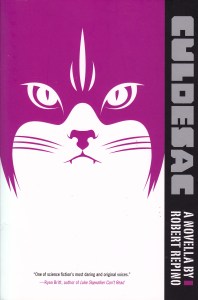
What does it mean to be human? The answer’s not as straightforward as it might seem. Reading Robert Repino’s Culdesac, that question came back to me time and again. This novella takes off from the story of Mort(e), about which I blogged shortly after its publication. Humans and animals that have acquired some human characteristics are at war. Most see those on the other side as inferior and that can make a human being reading the tale just a touch uncomfortable. We don’t have a great track record when it comes to dealing with non-human animals. We are all, after all, members of the same “kingdom.” Even down to the level of phylum and genus many of us show more general similarity than stark differences. Culdesac is a morphed bobcat who remembers all too well how humans treated animals before the war. And memory is a powerful thing.

Repino has a way of sweeping the human reader (here the enemy) into the story and making those foundational questions ring as if struck with a hammer. What does it mean to be human? Granted, reading such provocative work under the current administration adds a layer of poignancy that wasn’t there when Mort(e) stood alone. In fact, it is a question that we have to ask just about every day when we see the headlines. There’s no leadership on this point coming from above. The idea of other humans as chattels has a long and disgraceful history. You can differentiate anyone on some basis or another: female or male or intersex, black or white or brown, rich or middle class or poor, large or average or small. Differences working together might be the very definition of culture. Culdesac shows what can happen when one sees only the distinguishing characteristics rather than the commonalities. It’s a parable.

Education, the one weapon in our arsenal that actually dismantles prejudice and intolerance, was one of the first targets our government sought to dismantle after 11/9. Indeed, the antipathy—if not downright hostility—toward education has been a characteristic of which Americans have long been unduly proud. We are not self-made, none of us. We all had our teachers. We all had our books. As we stand on the rim of this smoking crater and wonder how hatred toward one’s own species could be allowed to be nominated, let alone win, I believe the answer lies in our personal belief in education. We must all use the opportunities we have to educate. Get caught reading a book. Or helping a stranger. Or just being kind. As Culdesac emphasizes, wars are long-term events. Results won’t change after only one skirmish. If we all valued education—reading, learning—enough such aberrations as this could never happen. If you’re casting about for something to read that will make you ponder things at a most human level, I would suggest Culdesac.


Informed Deceit

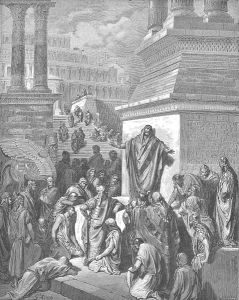
I sign a lot of petitions. That’s because the job of prophet doesn’t pay well enough to support a family any more. What it does mean is that I get a lot of emails from causes looking for supporters. I don’t sign blindly. That was brought home to me the other day when I had an email from the “White House.” A more obvious effort at trying to scramble for table scraps of respectability I cannot imagine. Already since January our government has swooped to new lows of deception and now false news comes right to your inbox. This email informed me that Neil Gorsuch has overwhelming bipartisan support for his Supreme Court nomination. Being an individual with a working brain, I know that’s not true. The “White House” wanted me to sign a petition supporting Gorsuch when I’ve already signed several protesting his candidacy. It’s clear that our government wants a court prophet.

Isn’t it odd, I mused, that a government that has no intention of listening to the majority is sending a petition to support one of its own? We know that the Russian Party (formerly known as the GOP) will support anything Thurston Howell the President hands them. Such a petition is only a way of saying “I told you so.” I miss the days when Isaiah could walk right into king Hezekiah’s bedroom and say “Thus saith the Lord…” These days the Lord tweets and the chirplings in the nest beg for more worms. You see, court prophets know which side their palms are crossed on. This isn’t Ash Wednesday, it’s Ash Administration.

Court prophets, in ancient times, were those paid by the government to support what the king wanted to do. It was a cushy job. What the reigning Trump wants at the moment he or she (for the modern court prophet can double-cross her own gender) proclaims it as God’s will. No experience necessary. The thing about the Bible, though, is that court prophets are pretty roundly condemned. The real prophet could generally be told by the fact that he (less commonly she in those days) was dead. Or soon to be. Those in power seldom care for criticism. Especially when skeletons are fighting each other for elbow room in their closets. Even so, Holy Writ says, figuratively, that it’s better to be a living politician than a dead prophet. If that doesn’t sound biblical, read the words of the prophet: “Nevertheless the sun hides not Virginia’s Dismal Swamp… and break the green damp mould with unfathomably wondrous Solomon.”


Sell-by Date

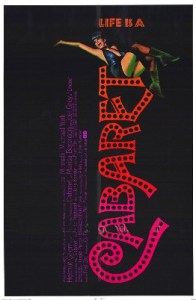
Labels give us the information we need to enact our prejudices immediately. Having been on the receiving end of great cruelty by “conservatives,” for example, I’m immediately cautious of anyone bearing that brand. A strange confession, perhaps, from someone who grew up in that camp. I struggle to remind myself that a label’s not a person. For example, I had a very good education at Grove City College, a conservative school. It wasn’t uniformly that way, of course. Now having a better sense of higher education politics I can see how this might happen—how a school committed to a doctrine might inadvertently challenge that view in the name of education. Quite a few things swayed me to broaden my view as a religion major at Grove City. One of those collegiate experiences was watching Cabaret.

Enough time has passed that I can’t recall the exact context of the film. I suspect it was a weekend entertainment required by some humanities intro course. For a kid from the sticks, seeing a ménage à trois on the big screen made a deep impression when I’d always thought of the world in binary terms. The larger message of the film was not lost on me, however, that those who are prejudiced will always find ways of expressing their hatred, if society will let them. Last night I watched Cabaret again. As a movie it hasn’t aged a day. Society, however, seems to have regressed back to those days when a Nazi could stand and proudly sing at a social gathering and others, distressed by economic hardship, would willingly  overlook the evil that lay in plain sight in the hope of change.

Back when the film was made I suspect the Vietnam War was on the public mind. We thought we’d safely gotten beyond the fascist threat. In the scene where the boarding house residents are complaining about conspiracies between “Jewish bankers and Communists” it became clear that people fall for the same tactics time and again. Rumors, fear, and economic disappointment are a dangerous combination in a democracy. The players have changed but the fact of fascism hasn’t. We can see it being enacted plainly, as it has been every day since 11/9. Accommodation is more deadly than conservatism. As the story opens Nazis aren’t welcome at the Cabaret. By the end they predominate there. Their hateful agenda had been accommodated, normalized by the press. And who can forget the song that could well be the anthem of the current administration, “Money Makes the World Go Round”? There’s an accurate label for that, I’m sure.