Real ID

On the DVDs of the complete The Twilight Zone (or at least the edition I bought over a decade ago), the opening sequence of seasons 3 and 4 both have a voice-over from episode “Five Characters in Search of an Exit,”  calling out “Who are we?”  In context, the disparate characters in a shapeless prison are, in reality, toys that have gained consciousness (and this well before Toy Story).  Having gone through a traumatic scam, and trying to piece life back together, I spend a lot of time on the telephone trying to verify my identity.  This isn’t a simple matter for a guy like me who constantly asks myself the question, “Who am I?”  Descartes, going back to Aristotle, opined we enter life as a tabula rasa, a blank slate.  Those of you who look around the other pages of this website will see that I have as a six-word biography “Missed the first day of school.”  That must’ve been the day when they told us who we were.

Some people have a clear idea of who or what they are.  The surround themselves with tchotchkes of their favorite animal, or symbol, or even screen idol.  Or deity (deities).  Others of us, it seems, are constantly searching, never quite satisfied that we’ve discovered our essence.  I’ve mentioned before that during the CB craze of the eighties my handle was “Searcher.”  I have an innate curiosity and I crave depth of knowledge.  How do you symbolize that?  How is it even an identity?  I ask with Rod Serling’s characters, “Who are we?”  I’m not sure who might answer that.
When I first started this blog I had some hope that I might once again become an academic researching ancient Semitic mythology.  Working a 9-2-5 to acquire material for the company long ago meant that the full-time research needed to keep abreast of the field could not happen.  For several years this blog consisted of wry interpretations of various political- or travel- or reading-related observations about life.  As it became less focused on the world of the Bible I lost most of my original readers.  I thought there might be potential in writing about my fascination with scary stuff.  That caught my wife a bit off-guard since during the time we met, married, and began this journey together, that interest had been dormant.  It revived when I lost the job that I thought defined me.  I still write about horror but have recently felt the draw of dark academia.  Meanwhile the representative from the bank is on the phone asking me to verify my identity.  “It’s complicated,” I want to say.

Dangers of Dark Shadows

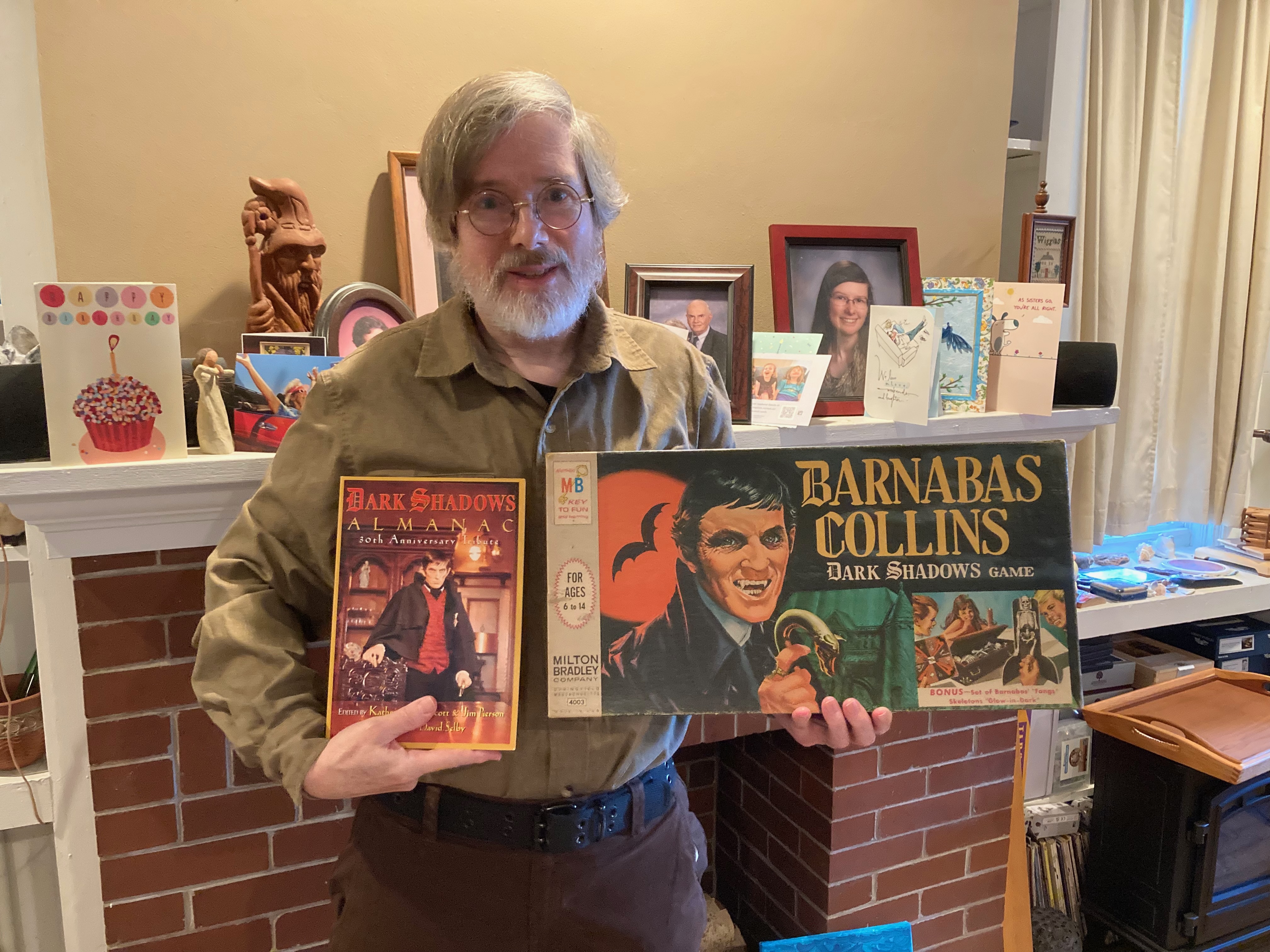
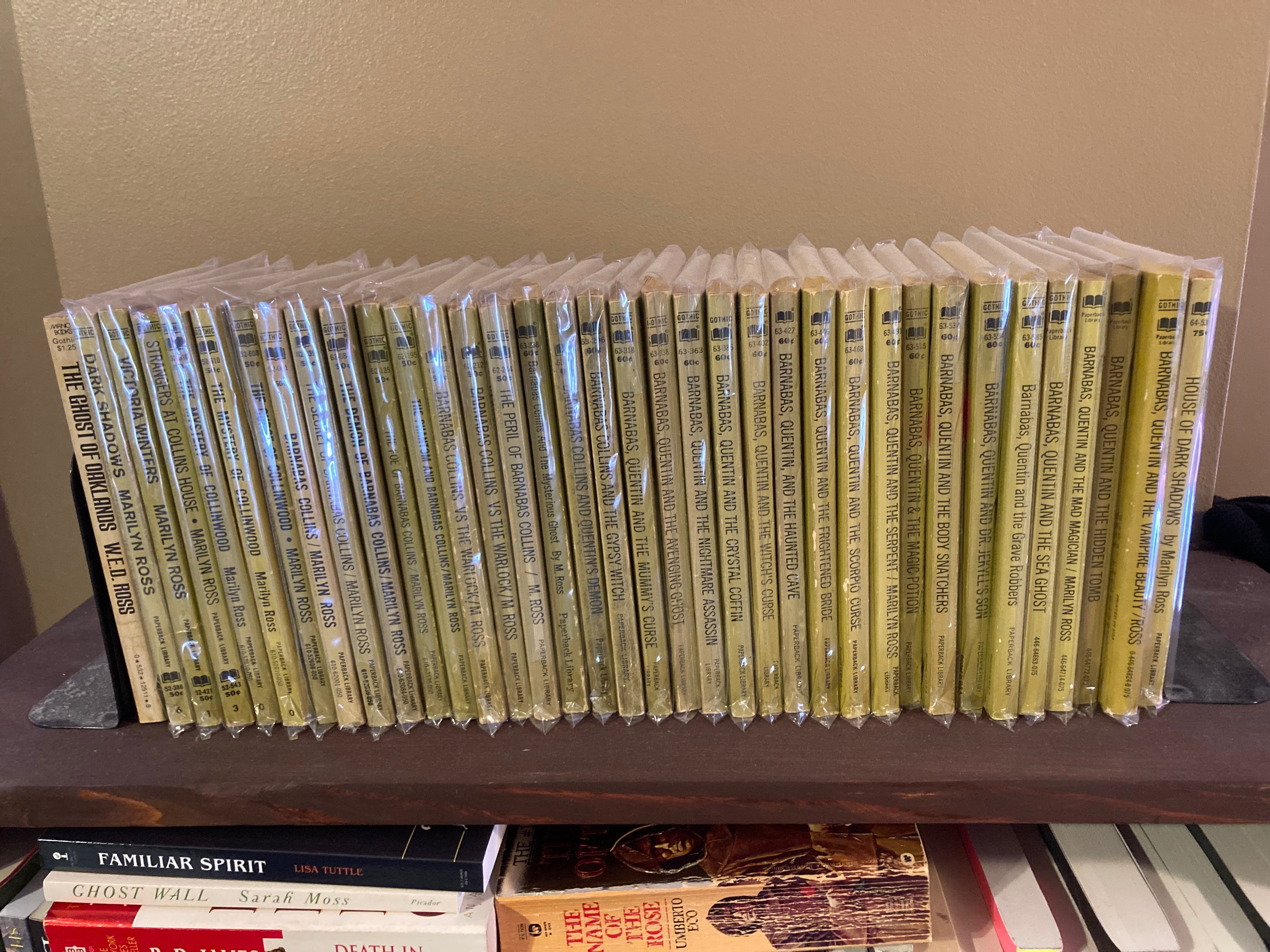
A friend’s recent gift proved dangerous.  I wrote already about the very kind, unexpected present of the Dark Shadows Almanac and the Barnabas Collins game.  This got me curious and I found out that the original series is now streaming on Amazon Prime.  Dangerous knowledge.  Left alone for a couple hours, I decided to watch “Season 1, Episode 1.”  I immediately knew something was wrong.  Willie Loomis is shown staring at a portrait of Barnabas Collins.  Barnabas was introduced into the series in 1967, not 1966, when it began.  Dark Shadows was a gothic soap opera and the idea of writing a vampire into it only came when daily ratings were dismal, after about ten months of airing.  Barnabas Collins saved the series from cancellation and provided those wonderful chills I knew as a child.  But I wanted to see it from the beginning.

I’ve gone on about digital rights management before, but something that equally disturbs me is the re-writing of history.  Dark Shadows did not begin with Barnabas Collins—it started with Victoria Winters.  There were 1,225 episodes.  Some of us have a compulsion about completeness.  The Dark Shadows novels began five volumes before Barnabas arrived.  Once I began collecting them, I couldn’t stop until, many years later, I’d completed the set.  I read each one, starting with Dark Shadows and Victoria Winters.  Now Amazon is telling me the show began with Barnabas Collins.  Don’t get me wrong; this means that I have ten months of daily programming that I can skip, but I am a fan of completeness.

You can buy the entire collection on DVD but it’s about $400.  I can’t commit the number of years it might take to get through all of it.  I’m still only on season four of The Twilight Zone DVD collection that I bought over a decade (closer to two decades) ago.  I really have very little free time.  Outside of work, my writing claims the lion’s share of it.  Even with ten months shaved off, I’m not sure where I’ll find the time to watch what remains of the series.  The question will always be hanging in my mind, though.  Did they cut anything else out?  Digital manipulation allows for playing all kinds of shenanigans with the past.  Ebooks can be altered without warning.  Scenes can silently be dropped from movies.  You can be told that you’ve watched the complete series, but you will have not.  Vampires aren’t the only dangerous things in Dark Shadows.


Childhood TV

It’s probably safe to say that most Americans my age were influenced by television when they were young.  Since I’m a late boomer, I fit into the “monster boomer” category and I suspect that if you gathered us all in a room you’d discover we had some of the same watching habits.  I confess to having watched a lot of TV.  I will also admit that some of it was absorbed particularly deeply.  I mean, I liked shows like Scooby-Doo, Jonny Quest, Get Smart, Gilligan’s Island, and even The Brady Bunch.  While I still quote from a couple of these from time to time, they never penetrated as deeply as a number of other early fascinations.  I saw nowhere near every episode of The Twilight Zone, but those I did see absolutely riveted me.  They still do.  As an adult I’ve read many books on or by Rod Serling.  There’s depth there.

Another strong contender for real influence is Dark Shadows.  Again, I never saw all the episodes but it created in me a feeling that no other television show did.  My breath still hitches, sometimes, when I think of it.  I watched the show and I bought used copies of the novels by Marilyn Ross.  As an adult I even collected and read the entire lot of them.  And I’ve read a book or two about Dark Shadows.  And one about Dan Curtis, the creator of the series.  Recently a good friend, aware of this particular predilection, sent me the Barnabas Collins game and a copy of The Dark Shadows Almanac.  I have to admit that it was difficult to work the rest of that day!

Probably the last very influential television show—more from my tween Muppet Show era—was In Search of…  This I watched religiously, and, like Dark Shadows, I went out and bought the tie-in books by Alan Landsburg.  One thing all three of these series (Twilight Zone, Dark Shadows, and In Search of…) have in common in my life is that I purchased the accompanying books.  Those that I foolishly got rid of when I was younger I have reacquired as an adult.  Sure, there’s some nostalgia there, but these shows were more than mere entertainment.  They have helped make me who I am today (whoever that is).  I rediscovered my monster boomerhood after losing my tenuous foothold in academia and saw that other religion scholars were writing books about these somewhat dark, and deep, topics.  So I find myself with friends ready to help indulge a fantasy and a shelf full of books that many my age would be embarrassed to admit having read.  But chances are they too were influenced by television, even if they hide it better.


Zoning In

Born Jewish, and Unitarian by choice, Rod Serling believed in the inherent worth and dignity of all human beings.  Like many people, even Serling believed that season four of The Twilight Zone, which went to an hour format from the usual half, didn’t really work.  Nevertheless, the fourth episode of that season,“He’s Alive,” really should be required watching of every person in the United States.  This episode was written by Serling and it focuses on a young American fascist who’s having trouble gaining a following.  A shadowy figure then reads to him from what sounds exactly like Trump’s playbook, and soon decent people are raging along with him about foreigners and those who are different.  When the shadowy figure is finally revealed, we’re not surprised to learn it is Hitler.

The young man obeys without question, and soon it looks like he could be elected.  He has one of his best friends killed as a martyr to the cause.  He murders an old Jewish man who has cared for him since his youth.  He declares himself made of steel, with no feelings.  And when he ends up dead (everyone knows how Hitler’s career culminated), the spirit of Hitler rises from his body as Serling warns that wherever hatred exists, Hitler still lives.  Now this episode aired in 1963 but it could’ve been 2016, or 2024.  Prescient people, like Rod Serling, knew that mob thinking could be easily exploited.  Even in the first segment after the introduction the instructions are laid out.  Play on people’s fear of those who are different.  No matter how good things may be, people will be unsatisfied.  Add any power-hungry individual and you’ve got the recipe for a fascist overtaking.

The episode made me wonder if we could ever become a just society.  Ironically, that which calls itself “Christianity” these days stands in the way.  In its day, The Twilight Zone was amazingly influential.  It had a great impact on what was to follow and it’s still regularly referred to, even by those who’ve never seen an episode.  If only we’d pay attention to its message.  I’ve been making my way through the entire series, slowly, over the years.  Now and again an episode will really hit home.  I have to admit that I was physically squirming during “He’s Alive.”  It’s not that it is the greatest episode of the series, but its message is extremely timely.  The requirement for a better world is simple, but seemingly impossible to reach.  Treat others as you wish to be treated.


Burial Zone

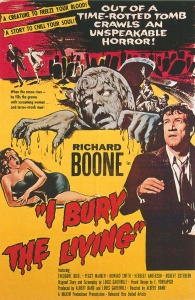
I don’t always believe the statistics.  Numerically, the number of horror films—depending on how the term is defined—declined into men (and sometimes women) in rubbery suits in the 1950s.  Indeed, it’s often opined that had not Hammer joined the horror business in the mid fifties that the genre born only twenty-something years earlier might’ve died out.  There seem to have been some good horror films made then, though, even if overlooked because of their B status.  A friend recently directed me to I Bury the Living, after reading my post about Carnival of Souls.  I have to confess to having never heard of I Bury the Living.  (Stephen King mentions it in Danse Macabre.)  Produced as a B movie it was itself buried among the various other efforts of the late fifties.  It’s not a bad movie, however.  In fact, it’s better than the title might lead you to believe.

The plot is something of a period piece—a well-respected department store supports a cemetery committee for Immortal Hills, the town’s graveyard.  Robert’s turn as chairman of the committee arises and he tries unsuccessfully to get out of the duty.  The caretaker, Andy, doesn’t want to retire, but he’s aging out.  The movie, however, revolves around the map.  The sold plots are marked with white pins while the plots already occupied have black.  When Robert accidentally puts black pins into newly purchased plots and the couple dies, he believes he’s cursed with an ability to kill those he black pins.  He substitutes a black pin for a white one at random.  The person dies.  In all, seven people succumb.  Convinced he’s murdered them, Robert decides to bring them back to life but putting the white pins back.  Only at this point does Andy confess that he’s been killing the victims in retaliation for being forcefully retired.

The ending is a little weak, but the psychological tension as it builds up is believable.  One critic compared it to an extended episode of The Twilight Zone, a comparison that has also been made for Carnival of Souls.  I would concur with that observation.  Although Twilight Zone wouldn’t air for another year, that kind of unsettling tale was already in the air.  No zombies appear, but the palpable belief that they might is what really makes the horror work in this instance.  The first half is an eerie story, but when Robert sticks in that first white pin a shift takes place.  Of course, modern viewers have been primed by Night of the Living Dead, so we know the possibilities.  Perhaps the power of Night gives life to older movies.  After all, anything can happen in the Twilight Zone.


Two-Eyed Cyclops

You can probably tell, if you read me regularly, that I’ve been going through an older movie kick.  A lot of these are easier to find for free on streaming services, so that’s been the path of least resistance.  So it was that I came to watch Doctor Cyclops.  I’d completely forgotten that I’d watched it about fourteen years ago.  In any case, a kind of precursor to The Incredible Shrinking Man, it’s the story of the deliberate shrinking of five people by a mad scientist with an endless supply of radium at hand.  The movie made a splash because of the use of Technicolor in a horror film (with no blood, however).  The story is a touch dull and the shrunken people (three scientists among them) spend most of their down time running around and saying very little.  They do face an alligator, which is kind of fun, and the big hand that holds the pompous Dr. Bulfinch is distinctly unnerving.  The movie received an Oscar nomination for visual effects.

There’s something distinctly enjoyable about these early sci-fi horror films that don’t explain much but nevertheless manage to employ some impressive cinematography.  The use of oversized props and forced perspective make much of this possible, perhaps making up for the simplicity of the tale.  Even by 1940 the “scientist goes mad and must be stopped” narrative was getting old.  The Second World War was underway but nuclear power wasn’t yet harnessed either for bombs or energy.  Interestingly, the source of the mad doctor’s radium is pitchblende, which one of the characters notes, is a source of uranium.  Of course, many movies were to follow where radiation mutated life forms in various ways, including shrinking them.

Coincidentally—it was a rainy Sunday afternoon—I watched the Twilight Zone episode “The Little People” later in the day.  Here was another story about the large oppressing the small.  This one, however, has a stranded astronaut who discovers the little people thinking that he is their god because he has the power to harm them.  The message here is much more profound, even if told with more brevity.  No clear motive is given for Dr. Cyclops’ work beyond his interest in pure science.  By the way, his real name isn’t “Cyclops.”  That refers to his being a giant with one eye—the latter because one of his glasses lenses gets broken.  Don’t worry, the shrunken people learn that the effect is temporary—their brush with radioactivity leaves no lasting harm.  There is, however, a decided danger to desiring to return to a “simpler time,” as Mr. Serling steps in to remind us.


TV Zone

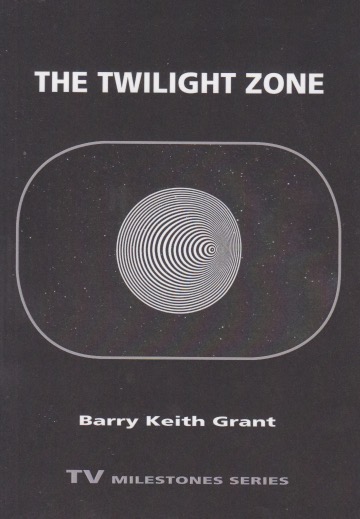
An unenviable task, it must be, to try to sum up The Twilight Zone.  Barry Keith Grant, however, has done an admirable job in this TV Milestones volume.  He addresses in a forthright way one of the questions on my mind quite a bit as of late—what are the borders of genre?  For a creative species such as our own, with imaginations that range far and high, we blend unlikely ingredients.  The Twilight Zone had finished its initial run before I ever watched television, but I was around to catch early reruns.  Their focus on the weird, the unusual, the twist ending, informed my childhood love of the strange.  They also helped shape my imagination.  This little book helps to capture some of that.

I haven’t watched every episode of the series yet.  I’ve been making my way through it slowly since I really don’t have much time for watching, and I tend to give priority to movies.  Still, The Twilight Zone was one of the most influential television programs of all time, as Grant demonstrates.  Although he tries, it may be impossible to determine just why so many people use it as a frame of reference.  Even with my penchant for analyzing, I can’t work out what it was about those disparate, discrete episodes that so captured me.  Perhaps like most influences, it was specific episodes that hit very deep.  That showed new ways of thinking about things.  That opened up worlds of possibilities.

I was exposed to Serling’s stories not only through my own reading, but also through school.  I have no hope of remembering what grade it was in, but in one of my English classes we were assigned “The Monsters Are Due on Maple Street.”  I was probably lost in the haze of puberty and adolescence at the time, but I remember well how that story made me feel.  And the teacher pointing out how people behaved when they were afraid.  Perhaps appropriately, Grant ends his book with a quote from that very episode.  Others, however, stayed with me as well.  Perhaps that’s the thing that’s so remarkable about the Zone—some episodes are not easily forgotten.  We’re accustomed to the flood of anodyne media that dowses us with entertainment of little consequence.  Some Twilight Zone episodes were that way as well.  But when we experience something significant, we tend to remember it and remember it well.  So many episodes did that kind of work on a mind too young to make lasting life decisions.  I guess I’m still waiting for Mr. Serling to step into frame and explain it.


Revisiting the Zone

Like many people in the early eighties, I heard about the terrifying accident that killed Vic Morrow, Myca Dinh Le, and Renee Shin-Yi Chen during the filming of Twilight Zone: The Movie.  Because of that I steered away from ever seeing it.  I grew up loving The Twilight Zone, and I was probably enough of a self-assured critic at twenty to suppose the movie would never have been as good as the original series had been.  Still, it didn’t leave my consciousness.  Not entirely.  There have been a couple of television reboots of the series—most recently by Jordan Peele—and it seems that those of the present day still see the cultural value in the original.  Peele’s relaunch, although short-lived, brought the movie back to mind and I finally decided to watch it when I learned that one of the segments was based on “Nightmare at 20,000 Feet,” given my recent gremlin kick.

I knew the film was an anthology and those are always dicey.  I also knew I’d be watching an actor in his final role—the scene in which he and the children actually died was not used in the movie, of course.  I didn’t realize how many stars were in the cast, and I didn’t even know what the other three episodes were.  Critics (paid and un) have opined that the episodes increase in appeal as the movie progresses, and the opening segment has been hailed as one of the scariest introductions among films.  So some forty years after it released I watched it.  I actually found it to be largely in the spirit of Rod Serling.  I don’t know what he would’ve thought of the movie, but it seems to have continued his message.  The first segment, the one in which Morrow starred, wasn’t based on a single original Twilight Zone episode as the other three were.  A few “Easter eggs” exist for fans, such as Burgess Meredith narrating and Helen Foley saying she’s headed to Willoughby on the remake of “It’s a Good Life.”  No doubt, “It’s a Good Life” and “Nightmare at 20,000 Feet” are among the most famous of the episodes in the series.

Part of me is surprised that the film was released at all.  Deaths have occurred, of course, in the making of other movies.  Some in which millions of dollars had already been invested.  Still, watching a final performance like this has a haunted quality to it.  At times it seems that acting can be a dangerous profession.  And certain movies may always be difficult to watch because of it. But should we expect anything different from this Twilight Zone in which we live?


New Gremlins

I haven’t seen the movie Gremlin in years.  I’m adding it to my Christmas list this year, however.  Probably because I watched Shadow in the Cloud recently.  And although that gremlin wasn’t cute, it led me on a journey of discovery, and that counts for something.  I have to admit, first of all, that I’d never heard of Roald Dahl before a kind family member sent us some of his books when our daughter was young.  We became rather hooked.  His novel The Gremlins was among those we read but there was something I didn’t know (one of trillions of somethings, of course).  And that is that Roald Dahl was probably the reason anyone outside the Air Force knew about gremlins at all.  Dahl was a pilot with the Royal Air Force.  His first children’s book was the aforementioned Gremlins.

Image credit: US Government, public domain, via Wikimedia Commons

I first learned about gremlins from The Twilight Zone.  “Nightmare at 20,000 Feet” came close to giving me literal nightmares.  (And Nope reminds us that there may be things in the atmosphere that we really know nothing about.)  That particular episode was based on a short story by Richard Matheson.  It was also incorporated into the 1983 Twilight Zone movie which I have, unaccountably, never seen.  Of course, I saw Gremlins in a theater back in my college days.  That was before I understood, or really had any interest in holiday horror.  This is one of those instances where the birth of a monster can be traced and its lore can be watched to grow, in real time.

Dahl took something he’d heard about—gremlins weren’t believed to exist by anyone—and made it literal, in the form of a children’s book.  Soon after, other vendors, such as cartoon creators, picked it up.  In the Twilight Zone it began its transition to horror.  Then a regular horror movie was made of them.  All of this has taken place since World War II and there are plenty of people alive who were around at the time.  Shadow in the Cloud was a reboot of a monster generally underused.  There are few times people feel as vulnerable as when they’re flying.  Heck, climbing a tall ladder is enough to give me the willies.  And the movies have shown us that even on the ground we’re not really safe from the monsters of our imagination.  That’s why it seems like a good idea to me to watch Gremlins again.  And to dream of the monsters we invented.


Shadowy Clouds

Okay, so it had Chloë Grace Moretz in it, and her face is on the cover of Holy Horror.  And it was tagged as action horror.  And apart from many highly improbable situations, Shadow in the Cloud is a perfectly serviceable movie.  Part “Nightmare at 20,000 Feet,” part Aliens, and part Indiana Jones and the Last Crusade, with any generic war movie thrown in, the movie is fun and a tribute to indy productions.  The plot is, admittedly, convoluted.  Moretz’s character (“Maude Garrett”) is a pilot officer who comes aboard a B-17 on a top secret mission.  She has a high priority parcel that must be kept safe.  The all-male crew use just about every sexist trope in the book but one of the crew takes her seriously.  While in the ball turret, she spies a gremlin.

This is a real gremlin, as implied in “Nightmare at 20,000 Feet.”  Set in World War II, the film has other threats.  Japanese Zeros find them and a dogfight begins.  In the meanwhile it’s revealed that the one crew member who doesn’t dismiss “Garrett” had an affair with her and the secret parcel is actually their infant son.  Meanwhile, the gremlin and the Zeros keep up their attacks, killing several of the crew, including the pilot.  Maude takes charge, and oversees the crash landing of the bomber and when the gremlin, still angry at being shot and hacked by her, steals the baby.  This leads Maude to beat the gremlin to death with her bare hands.  Improbably, both her lover and baby survive intact, along with two other not too bad crew members.

The film manages to be pretty heavy on social commentary, and even shows archival footage of women in various Air Force roles during the closing credits.  The production values and the message are what really save this from being a bad movie.  I mean, this entire mission would’ve ended with everyone dead if not for Maude, driven by maternal instinct, keeping her baby alive.  She’s a pilot, a dedicated mother, an acrobat, and, if you’ll pardon the expression, a total badass.  The film is kind of a tribute to women who served in the military despite the innate sexism of the period.  And it has a monster, so what’s not to like?  From the first few minutes on there’s nothing really believable in the plot, but a woman leading the way, both as the star and as her character, is reason enough to pay attention.


Disappearing

It might be easy to suppose that horror uses religion gratuitously.  Or it may be that the connection runs much deeper.  Yes, many people are still religious as growing numbers are becoming less so, but both kinds watch horror.  As is usual for a guy who doesn’t get out much, I learn about movies often by reading about them in various analyses.  That’s how I came across the box-office flop, Vanishing on 7th Street.  While various critics point out its flaws, to me it watches like an extended Twilight Zone episode, exploring interpersonal dynamics when a bad situation overcomes a community.  For reasons unexplained, people without a light source disappear.  This is somewhere not too far from Chicago, but we don’t know exactly where.  Five people have managed to survive and four of them end up in a bar that has power because of a back-up generator.

Jim, an African-American boy, is waiting for his mother to return to the tavern.  She was the bar tender but had run to the local church to find other people because the lights were on.  She didn’t return and three other people make their way to the bar.  Disagreeing on a course of action, or what has happened, they try to work together to stay in the light.  Jim eventually makes a break for the church.  He alone manages to survive there until daylight reveals a young girl named Briana, spotted throughout the movie, with a solar-powered flashlight.  The others have all vanished, so Jim and Briana decide to try to make it to Chicago together as night falls.

Wikipedia calls the film “post-apocalyptic,” but I would say it’s more metaphorical.  The only two characters to survive do so by finding refuge in a church.  No prayers are said, but candles keep the darkness and its dangers at bay.  There’s plenty to reflect on here, even though we don’t know what has led to this situation or why the shadows snatch people, leaving rapture piles of clothes all over the place.  Not a fast-paced movie, it’s a film with only one jump-startle and plenty of time to think.  That was my take on it.  Not all horror has to be slasher-oriented.  I was really puzzled why this one ended up with an R rating.  Sometimes horror just makes you think.  Often that thinking involves reflections on the meaning of life.  Some would call that philosophy, but those who consider the light and its relationship to darkness tend to call it religion.


Twilight on Christmas

We have too many ornaments for the single Christmas tree we can afford.  There are few reasons for this.  One is that I married into a family with Christmas ornaments.  While on my own I never set up a tree and I owned very little beyond books and some LPs.  Besides, I went home for Christmas.  Another reason is that although I seldom think of Christmas before December, we tend to buy ornaments as souvenirs.  Not for everywhere we go, but we did start a ship sub-collection when visiting coastal locations.  We also have a moose sub-collection.  I spent quite a bit of my early adulthood out in the woods looking for moose, generally in Maine.  Then there’s the “other sub-collection.”  The one that’s be relegated to it’s own mini-tree.

To understand this, let me begin by noting that Christmas is the birthday of Rod Serling (shoutout to my friend John Morehead for pointing this out).  Rod Serling is one of the reasons—he can’t take all the blame, of course—that I’m interested in strange things.  The Twilight Zone affected me profoundly as a child, and probably had more impact on my life trajectory than I might’ve realized.  The “other sub-collection” consists of the weird ornaments.  It began with a Cthulhu ornament I found online a few years back.  Then, at a fair trade shop in Ithaca, I found a yeti ornament.  How could I not support fair trade?  This year at Christkindlmarkt I found an alien head made from a recycled Christmas tree trunk round.  It seems my strange Christmas ideas aren’t unique.

Bethlehem styles itself “Christmas City.”  The celebration in the Lehigh Valley is palpable.  My family generally spends a December Saturday strolling up and down Main Street, visiting the quaint shops.  Last year one of them had ornaments of sasquatch skiing.  I didn’t buy it, thinking someone might pick up on my pointing it out.  This year I went back to the store but they didn’t have it any longer.  A quick online search, however, revealed many options for a cryptid Christmas.  What can I say?  These things make me happy!  This year I’ve been thinking quite a bit about ghosts and the holidays.  It’s an ancient connection that has been lost to the commercialization of Yule and Saturnalia and other December celebrations.  So, Rod Serling was actually born on Christmas day.  I hope that however you celebrate this day it will bring you joy, no matter how weird.


Layers of Brick

If, like me, you can’t see a neighbor’s brickwork without thinking of “A Cask of Amontillado,” then I need not explain why I watch horror films.  I know that as of late some literary scholars have challenged the idea that Edgar Allan Poe wrote horror.  There is now, and always has been, a bias against the genre.  In fact, many would point out that Rod Serling’s Twilight Zone wasn’t really horror, no matter how creepy some of the episodes were.  Some would cast Ray Bradbury into that lot as well, and others would not.  I spend a lot of time pondering this because those of us who enjoy some of what’s called horror are often cast as misfits.  And misfits have a lot in common with monsters.

The connection with religion is a palpable, yet intangible one.  It does seem that religion has its origins in fear and as it branched out it came to have different emphases.  Jesus, for example, apparently stressed love, at least according to the gospel of John.  That religion of love came, eventually, back around to fear.  Calvinism, especially, is suffused with it.  There’s a reason that it is the religion expressed in particularly effective horror.  Apparently they meet similar needs, but psychology is not an exact science, and our tastes in it differ.  Even our interpretations do so.  As the bricklayer puts down row after row of masonry, the thoughts get walled up in days where work prevents serious consideration of the deeper questions.

It’s been years since I’ve read “A Cask of Amontillado.”  The story has stayed with me, however, whether it’s horror or not.  Stories about imprisonment are like that.  The other day a police car stopped outside our house.  We live in a working-class, but descent neighborhood.  From the bits and pieces glimpses out the window revealed, there was a problem with a car that had been parked on the street for quite a while, and that didn’t belong to any of the local residents.  The natural response to seeing that car just outside was fear.  We fear criminals and we fear the police.  We fear what Covid-19 is doing to us, even to those of us who’ve managed not to contract it.  Traditional religion would tell us punishment comes from the Almighty.  These things are all related.  And across the way the bricklayer keeps up his work, row after row.


The Tube

I’m sitting in a medical facility waiting room.  I’m not afraid of dying, but medical stuff terrifies me.  To calm me down, inane daytime television is on.  I may be one of the very few who brings a book to such places, but I can’t read with the insipid chatter going on.  This time, since I’m waiting for someone else, I brought my laptop.  Nevertheless, I can’t help but think of Ray Bradbury at times like this.  Many people think Fahrenheit 451 is about burning books.  Bradbury did write about burning books in his short stories, and it does happen in Fahrenheit 451, but that’s not what the book is about.  In interviews he said that he intended, as is pretty obvious from a straightforward reading of the text, to warn about the invasive nature of television.  It was, metaphorically, burning books.

Waiting rooms always bring that to mind.  Not only that, but it’s Valentine’s Day and all the talk shows are going on about how it’s “the day of love” (every day should be).  It’s not a day off work; I had to cash in a sick day to be here.  The word “holiday” keeps cropping up on the television, to which I have my back. Ever since leaving Nashotah House I haven’t watched television.  On our recent move to Pennsylvania our cable company didn’t offer a non-television option.  It was unthinkable.  We pay for something we don’t use.  Burning books.  I don’t have time for television.  I see shows that have proven their worth via DVD well after they’re off the air.  And that only when I can read or write no more in a day.  I guess I’m a Bradbury disciple.

Like any disciple, I have changed certain teachings of my leader.  Bradburyism is a religion objecting to ubiquitous television.  At the same time, I grew up watching the tube, and to this day I’ll stop just about anything to watch DVDs of The Twilight Zone.  Rod Serling, however, selected stories and teleplays that were well written.  This was a literate show.  Besides, my daily life often feels like the Twilight Zone.  Like Valentine’s Day in a waiting room.  The book beside me remains unopened.  It’s the same when I take the car to the garage, or go in for an oil change.  You can’t escape it, even though everyone else is paying attention to their phones.  How long until we learn to switch off?  Of course, medical waiting rooms are the places where I may need brainless distraction the most.

Photo credit: Smithsonian Institution


Religion, He Wrote

A friend recently sent me the New York Times obituary for Carol Serling, the wife of one of my heroes, Rod Serling.  Perhaps it’s a personal weakness, but I often wonder about the religion of my favorite writers.  More often than not I discover that they’re affiliated with tolerant faiths, sometimes unattached to any specific tradition.  Rod Serling grew up Jewish but became a Unitarian-Universalist by marriage, and—it doesn’t stretch the imagination—remained one by conviction.  I’ve read a bit about the UU tradition, and it is based primarily on values rather than beliefs.  In fact, the idea that religion is a matter of what you believe is only one way of defining it.  Historically one’s religion was a matter of what one did, not necessarily what she or he believed.

Authors that I read often deal with religious issues.  It’s important to confess that I don’t select fiction based on its having religious themes.  Anyone who’s read more than one or two of my posts will know my reading is eclectic and many of the books represented here have shown up because of wildly different circumstances.  Reading challenges, friends’ recommendations, and preparations for educational presentations are often driving forces.  In the fictional realm I’m drawn to the speculative, but also often to the catch-all category called “literary.”  Stories that feel authentic in either category have an element of religion in them.  Life portrayed without it doesn’t seem believable.  I’ve been re-reading some Ray Bradbury.  There’s often suggestive material there.

Raised a Baptist, Bradbury is often also claimed as a Unitarian-Universalist.  Apparently he didn’t like the label, but his behavior was more a selection of tenets that he found compelling from various religions.  All of this may sound strange in a context where “religion” is increasingly a dirty word.  (To be honest, it has been doing much to earn such a reputation.)  Still, it is a very deep part of being human.  Rod Serling’s stories advocated fair treatment of all people and often his sense of justice landed him in trouble with advertisers for The Twilight Zone.  Religions comfortable with maintaining prejudice, or turning a blind eye to lawbreaking in the name of false virtue would certainly not understand refusing to take money from questionable sources.  I suppose there’s a reason I enjoy the stories from the days when America still had a conscience.  The legacies of such writers, it is to be hoped, will outlast what passes for religion these days. 

Any other gods before me…