Re-untold

In retrospect, Universal’s Dark Universe, itself a shadowy concept, could have been a thing.  With the budget behind it, Dracula Untold could’ve been spectacular.  As so often happens, however, poor writing seems to have brought Vlad the Impaler to his knees.  I suppose it was rather tacky of me to fall asleep during it when a friend showed it to me shortly after it was available on streaming.  My excuse was that we started late and I’m a very early riser.  Finding it on a network to which I have access, and on a free weekend, I decided to give it another try.  I didn’t fall asleep the second time, but I did end up disappointed.  Action-horror is a tough sub-genre to pull off well.  As some critics pointed out, if Dracula could defeat 1,000 men singlehandedly (which he does shortly after being turned), then why does he not do so when it’s crucial?
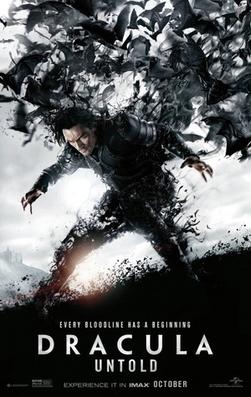
What I did find intriguing is the older vampire that lives in Broken Tooth Mountain.  What is his backstory?  And why, if Dracula can just die, does the older vampire not do so himself, when he clearly wishes to?  He just has to step out on a sunny day.  The menace of the classic vampire isn’t on the battlefield, but in the one-on-one situations.  At night, when you’re sleeping.  Or otherwise unable to protect yourself.  The movie does have some good moments—and with a budget like that, it should have—but overall it struggles.  

Part of the difficulty is understanding Vlad the Impaler being, at heart, a nice guy.  Although he impaled thousands of people, he really just wants peace and a domestic life with his wife and son.  He’s reluctant to challenge the Turks until one taunts him upon taking his son hostage.  He tries to protect his people, but when they help save him (as vampires that he personally has turned), he destroys them all when it’s over.  The question of motivation hangs unanswered over the whole thing.  Dracula is never evil, not even when he declares himself the son of the Devil.  He attacks only in self-defense and although he does shed unnecessary blood, it is only in the fog of war.  And the motivation issues also apply to his pre-vampiric allies.  They don’t seem to be able to make up their minds whether Vlad is a good guy or not.  They try to kill him then they fight next to him.  There’s a lot going on here—maybe too much—and it seems that the story wasn’t thought out well enough to make it all work.  Vampires, it seems, don’t always cooperate.


Vlad Fest

I may or may not have read at least part of this book before.  When I found it at a used book sale somewhere, it looked familiar.  Having read it, I’m not sure if it was the same one as before.  There are certain parts that I would’ve thought a high schooler would have remembered.  I recognize the names of the authors, Raymond T. McNally and Radu Florescu.  You see, one of my senior term papers in high school was on vampires.  Unable to afford books, my research was done in the school library and this book is old enough to have been in the collection.  While the subtitle, A True History of Dracula and Vampire Legends, may seem to indicate a book primarily about vampires, In Search of Dracula is mainly about Vlad Tepes, or Vlad the Impaler.  I can’t imagine myself wading through all the Romanian history in high school.

You see, I remember reading a book on the history of vampires.  The strongest memory is of reading it in our church sanctuary.  Lest you get the wrong idea, I was very involved in our youth group.  We occasionally had chaperoned sleepovers at the church and I had already had a leadership role, serving on church committees and district and conference-level events.  Nobody had a problem with me sitting in the sanctuary.  On one of the sleepovers, I awoke early (as I have always tended to do), and I went to the sanctuary to read the book by the dawn’s early light streaming through the stained-glass window.  I have kept a look out for the book, and I thought this might have been it.

I’m pretty sure it wasn’t.  While this history does have a good summary of vampire customs and even movies, it takes a stout stomach to read the material about Vlad III’s reign.  Although he is a Romanian hero, he was a cruel man and his infamy was well established during his own lifetime.  I’m pretty sure that he would’ve been diagnosed with a mental disorder, had psychology existed then.  This book does trace his history and surveys various places associated with him.  One thing that might’ve been helpful would have been more maps.  The authors are clearly well versed in Transylvanian geography, but the average reader may not be able to find some of the many place names on the one map they include.  Otherwise, this is quite an informative book, mostly about Vlad, but with useful chapters on Bram Stoker and the vampire in the media up to the early seventies.


Not Archives

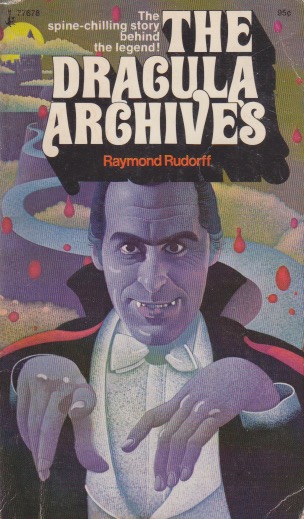
There was a historical Dracula.  The cognomen of Vlad Tepes, or Vlad III of Wallachia, Dracula’s association with vampirism surprisingly dates back only to Bram Stoker’s Dracula.  And much of what I read about Vlad III as a child has been reevaluated, with much of it being reassigned to exaggeration.  (I often wonder if this isn’t part of the reason so many of my generation have become conservative—it can be unsettling to have the certainties with which you were raised topple like so many dominoes.)  In any case, I started reading about vampires when I discovered our high school library had historical books on them, and so I recently picked up Raymond Rudorff’s The Dracula Archives at a book sale, despite its lurid cover.  The reason?  The back cover classification is “nonfiction.”

Clearly that was a marketing ploy, and although the book cost me merely pennies on the dollar for a mass-market paperback from that era (1973), I was a little disappointed to find it was a novel.  I figured it out within a page.  (You have to understand—at a book sale the normal rational faculties don’t always apply.  Anyone who’s been to a library book sale in Scotland knows that little old ladies throw elbows to get at a book they want, and you have to think fast if you’re on the fence.)  So The Dracula Archives is intended to be the prequel to Dracula.  Mirroring the latter, Rudorff’s work is comprised of diary entries and letters, slowly building up a fictional identity for Stoker’s titular character.  It isn’t as fast paced as the cover blurbs indicate, but it does manage to sound historical although it’s clearly not.

Reading such a book during a crisis of truth makes me question the marketing wisdom of the back cover label.  Yeah, it’s kinda cute, I admit.  And Trump didn’t seem like a national threat in the seventies.  But still, the mixing of the fundamental category of book (fiction or non) doesn’t seem quite fair.  Of course, caveat emptor applies to small purchases as well as large.  I go into book sales with a list, and I try to limit myself to it.  But then, I’ve not heard of every book—not by a long shot—and finding an unknown treasure is part of the draw.  Raymond Rudorff wrote several books but hasn’t merited a Wikipedia page yet.  This one is by far his most famous novel.  It’s a fun read and a reasonable prequel, but it won’t likely scare anyone as much as Republican politics do these days.


November’s Vampires

It may have been the year without a Halloween here in the northeast coastal region of the United States, but it looks like some of the spirit has persisted into November. My daughter was disappointed when, due to storm damage, our local borough cancelled Trick-or-Treating for this year. So I was intrigued when I spotted a news story yesterday discussing Prince Charles’ relationship to Vlad the Impaler, the historical Dracula of yore. (And a good Christian by his own reckoning.) I wondered about the timing of the story until I noticed the gothic script on Google’s search page and realized that yesterday was Bram Stoker’s 165th birthday. Well, it would have been, supposing that he has remained dead since 1912. Completely unrelated to this anniversary, I read Dracula again in September through October and realized just how religiously charged a story it is. The Church of Ireland, to which Stoker’s family belonged, was Anglican in name and identified with both Catholic and Protestant traditions. In Dracula the more Catholic side seems to predominate.

Prince Charles’ connection to Vlad Tepes suggests perhaps a deeper meaning. The short news clip I saw (I can’t recall which network it was on) noted that the connection is being promoted by Romanian tourist agencies. Nevertheless, Prince Charles appears in the material acknowledging his hereditary connection to Vlad III, and noting that Transylvania has much to teach us. (He goes on to explain that the people of Romania have a lot to teach other Europeans about sustainable practices.) I could not help but note the irony of a member of the royal family, however, inviting comparison with a character who came to be known as the drainer of other people’s blood. Taking that which by no rights belongs to them.

Perhaps it never occurs to those with great wealth that what they amass is absconded from others. In a world that holds to a social contract that values money—which is merely a symbol—for some to have excess means that others will have less than adequate amounts. I’ve always had trouble understanding such selfishness. Perhaps it was being raised in a Christian environment with siblings with whom I was expected to share. Maybe it was just a part of the sober assessment of the social injustice I began to notice when I was a teenager. Somehow I’ve never felt entitled to much, but I do wonder how others can justify taking more than they need while knowing that many others suffer from real want. It is a matter of degrees, I realize, and we all do it to some extent. I have never complained about taxes because I know that my eyes too may be blinded by the beguiling glitter of gold. When the very wealthy don’t pay taxes (not pointing any particular fingers here), they too, like Prince Charles, may claim to be true descendants of Dracula.

Just add vampire of choice


Holy Amos, Holy Micah, Pray for Us

The semesters when I teach the prophets invariably find me filled with a holy rage toward injustice of all stripes. Unfortunately there is plenty of cause for basic human indignation caused by greed, cupidity, and elitism. I see New Jersey, my current home, as a microcosm. In this little version of the universe, a highly diverse population with over-crowded highways and endless financial woes, I see reflected some of the great challenges facing the human race. When such a delicate balance is guided by a self-serving government the human cost will always be high.

Our current governor, Chris “Slash” Christie, has made himself a national reputation by cutting the basic services required to buoy up a state where the underprivileged seek an opportunity to get ahead. The governor’s favorite target, naturally, is public education. Public school and university funds have been chopped with a zeal to impress Vlad the Impaler (the governor’s children attend private school, thank you). The Associated Press today, however, reports that the number of the governor’s staff who “earn” more than six figures has nearly doubled since our last governor’s term ended. We the taxpayers are being asked to fork over an extra two million dollars to the state budget to support those who live in comfort while our children are being systematically targeted as luxuries the state simply can’t afford. When will people say “enough is enough”?

The Republican Party, since it has shamelessly crawled into bed with religious conservatism, has flouted the message of the Bible in the name of the Bible. Only by ignoring the biblical characters known as prophets, and one guy from Nazareth who went by the name of Joshua, is it possible to see any right in feathering the nest of public “servants” while stealing from the children of their constituencies. I am glad Amos and Micah are dead. If they were alive and in New Jersey they would be suffering torment beyond words.