In the Cult

The word “cult” has fallen out of favor with religionists.  The reason for this is the problematic claim that any one religion makes to being the “only true” religion.  If that religion then sets about to study other religions there is a built-in bias that the study is being done from the perspective of those who know the truth looking somewhat bemusedly toward other religions.  A cult was defined as a relatively new religion with a fairly small number of adherents.  The more correct term is a “New Religious Movement.”  The idea of brainwashing is controversial, but it is clear that people can be made to follow the leader against their better judgment.  We’ve seen this time and time again and not just in places like Jonestown or Waco.  The word “cult” seems to fit.

Branch Davidian compound in Waco; photo credit: FBI, courtesy Wikimedia Commons

A friend recently pointed me to the work of the psychologist Jeremy E. Sherman.  Sherman has been studying the behavior of Trump followers and has illustrated quite well how it is a cult.  This is one place where the use of the term becomes essential.  I’ll lay aside my objections to the word to point out that a cult denotes a group that follows a leader without critical assessment of that leader.  You’ll have noticed that Democrats are quite critical of one another.  They think about and assess what each other say and do.  When someone like Trump, who is well known as a Pez-dispenser of lies, becomes a saintly paragon of his party, capable of no wrong, we’re in the land of cults.  What Sherman does that I can’t, is suggest how to deal with such thinking.

Most of us try to reason with our interlocutors.  If reason is turned off, as in blind following, it simply falls on deaf ears.  The public record of Trump’s doings speaks for itself.  Those who refuse to see it or engage it will never be reasoned out of it.  The parallels with Hitler’s Germany are extremely frightening.  Not even a decade after his death Hitler was understood to have been clearly unstable and driven by evil impulses.  Many of those alive today overlapped with the lifetime of this dictator.  There’s no doubt that Nazism behaved like a classic cult.  Presented with credible evidence of breaking the law while within office, Trump’s followers blithely acquitted him.  Those who study cults would expect no less.  We need to arm ourselves with knowledge of how religious thinking works.  To do otherwise is dangerous, despite what our economically driven bastions of higher education may say.  (See?  I’m critical of those on my side!)  Or we can lay down reason and simply follow.

Mountain Tops

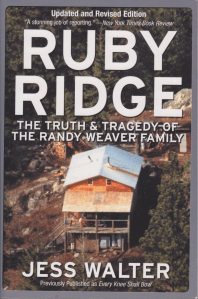
Idaho can be a peaceful place. I’ve spent parts of many summers there. I grew aware, over time, that the northern panhandle had an association with white supremacists, but if you stick to the touristed areas you don’t run into them. During the Ruby Ridge standoff I was busy trying to establish my teaching career in Wisconsin while living in Illinois—I guess my commuting life began all the way back then. I didn’t have much time for the news, and I don’t recall hearing much about the tragedy. It was shortly eclipsed by Waco. Jess Walter’s Ruby Ridge: The Truth and Tragedy of the Randy Weaver Family presents perhaps more than you need to know about this story with no winners and much strange theology. In case you missed it too, here are the basics:

Randy and Vicki Weaver were an Iowa couple who were drawn into the Christian Identity movement. This was a white separatist, apocalyptic survivalist faith. Convinced the world was going to end, they moved to a remote part of northern Idaho and built a cabin on a rocky ridge and stockpiled guns. Being a white supremacist was actually considered bad in the 1990s (now it’s mainstream Republican ideology) and federal marshals and the FBI got involved. The Weavers had four children and that complicated things. Predictably, the government attempt to shoot an extremist family out of their religion ended tragically. The Weavers’ only son Samuel was the first killed, and then Vicki. The locals, including many skinheads, gathered at the base of the mountain in support of the Weavers as the feds led a military operation into a nearly two-week standoff.

Apart from being too long, Walter’s book is an important reminder of many things at this time. Even though America had a Republican president in 1992, white supremacy was considered dangerous and was characterized as domestic terrorism. The standoff at Ruby Ridge quickly became a cause célèbre for religious freedom, no matter how strange beliefs might be. Ironically, even as the trial was going on the Branch Davidian compound in Waco was being stormed. Now we have a “president” who makes it plausible that a “k” has somehow dropped out of Waco, or at least has been tripled. The national narrative is America is for whites only. It’s as if Martin Luther King Jr., Woody Guthrie, and Abraham Lincoln never existed. I would say “How the mighty are fallen,” but that might sound a little too religious for some. Even the Religious Right has, since that time, left the Bible out of the equation.


Colorful States

red_state_poster

Kevin Smith is one of New Jersey’s own. I’ve always considered it one of life’s great ironies that Loki and Bartleby, the fallen angels in Dogma, move from Wisconsin to New Jersey, the exact same route my career took. (Feel free to read into this.) I was therefore curious when I heard, a few years back now, that Smith had come out with a horror movie. Now I’m not a fan of horror for its own sake as my sensibilities are more towards the ambiguities of gothic, but I finally decided to view Red State. I had no prior idea what the movie was about, but it speaks volumes that the title suggests quite a bit with just a simple adjective and noun. If there’s anyone out there even slower in getting to movies than me, and who is hoping to watch Red State, consider this a spoiler alert. Read further at your own risk.

Red State deals with religious fundamentalists—the Five Points Trinity Church, to be exact. The group is loosely based on the Fred Phelps gang, and the film actually makes reference to Phelps to say that Abin Cooper’s group is even worse. They’re weaponized. You’re probably starting to get the picture already. Cooper’s congregation is his extended family, and they’ve been protesting against homosexuality and other forms of what they consider immorality, but in an extreme way. They lure sinners into one of their sting operations, incapacitate them, and then murder them during church ceremonies. When the Feds discover evidence of a murder, a Waco-like Branch Davidian stand-off occurs with the predictably bloody gun fight that follows. There are moments of humor, but it is a bleak parable—yes, there is a wholesome message here—that speaks loudly about intolerance.

Analysts, well actually just some analysts, have realized that horror movies and religion are very close compatriots indeed. Reading the Bible may be a little easier on the eyes, but even some parts of the Good Book can inspire nightmares. Indeed, as Adin Cooper’s sermon emphasizes, fear of God is very important. As is fear of fear of God. The regression can go back as far as you wish. Religions develop in response to fears. Not only in response to fears, but clearly this is part of the mix. Horror movies show us what we fear the most. Is it any wonder that they cross paths with religion so often? The only unusual aspect for Red State is that it is so explicit about it. It is a traumatizing film in many ways. Maybe because (spoiler alert) the one who concocts the whole religion is alive and well at the end and is the last character that we see. Such are parables.