Book Ends

Screen Shot 2014-12-30 at 12.40.34 PM

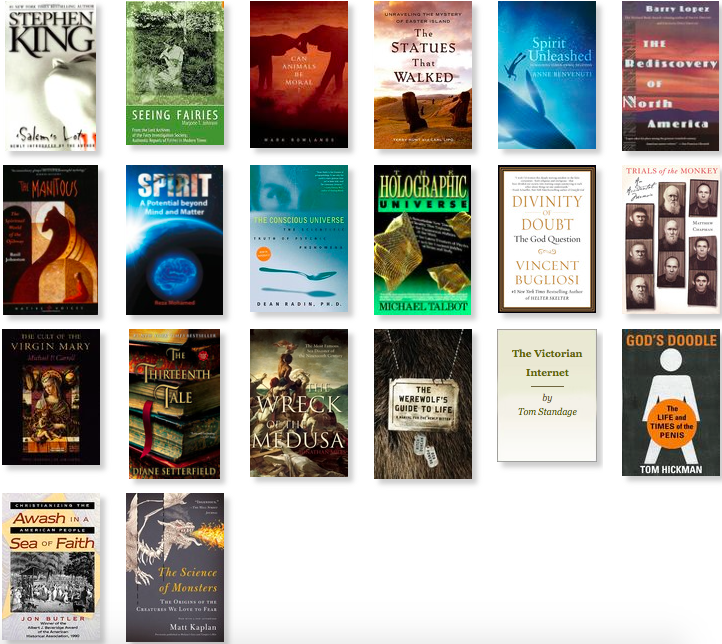
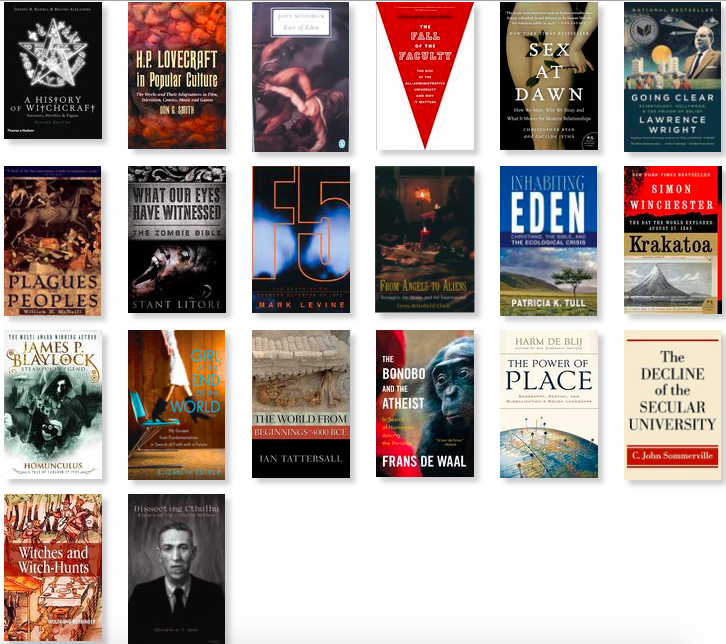
It’s the end of another year of reading. Since Goodreads keeps track of my booklist, I see by their accounting I finished 95 books in 2014. The final day of the year seems an appropriate time to reflect on those that made the greatest impact on me. Starting at the beginning, Jacques Berlinerblau’s The Secular Bible immediately struck me as a book of high importance. In an era when religion is constantly considered irrelevant, Berlinerblau gives this trite brushoff the lie. Likewise Jeff Kripal and Sudhir Kakar’s Seriously Strange opens questions that must be addressed if we ever hope to find the truth. Frans de Waal’s The Bonobo and the Atheist and Christopher Ryan and Cacilda Jethá’s Sex at Dawn both raise, in fundamental ways, the question of what it means to be human. Benjamin Ginsberg’s The Fall of the Faculty is essential to understanding the current crisis in higher education. Edward Ingebretsen’s Maps of Heaven, Maps of Hell is a roadmap through the genre of horror and its importance to society. The Miracle Detective by Randall Sullivan again highlights the question of what counts as reality. Nonbeliever Nation by David Niose shows the importance of separating politics from religion. Dean Radin’s The Conscious Universe brings science to bear on unanswered questions.
Screen Shot 2014-12-30 at 12.41.24 PM

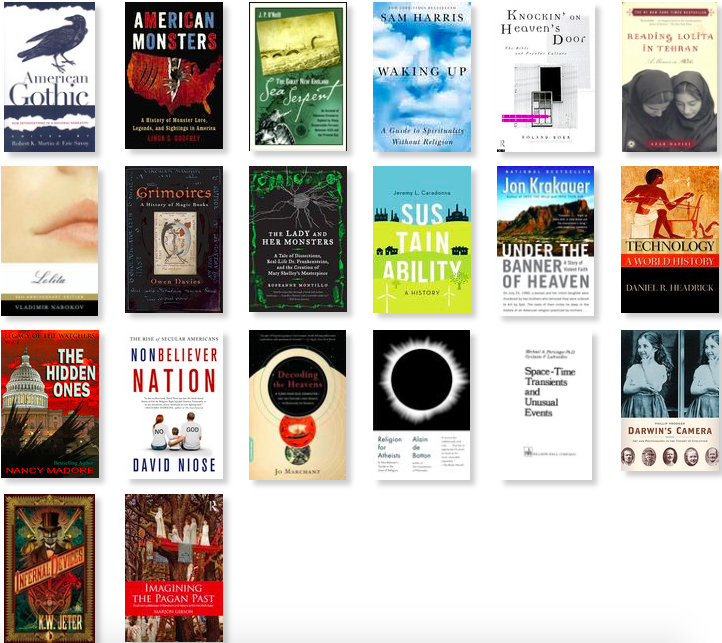
Books specifically concerning religion also deserve some highlighting. Karen McCarthy Brown’s Moma Lola is crucial for comprehending, in a sympathetic way, voudun in a major city. Patricia Tull’s Inhabiting Eden makes a clarion call for religions to pay attention to the needs of the environment. Going Clear by Lawrence Wright is a good introduction to Scientology, while Jon Krakauer’s Under the Banner of Heaven serves a similar function in regards to Mormonism. Sam Harris’s Waking Up shows the need even atheists have for spirituality, complicating the sharp divide we are offered most of the time. Religion for Atheists, by Alain de Botton, also demonstrates the continuing usefulness of religion in a secular age. Vincent Bugliosi’s Divinity of Doubt calls both theists and atheists to task. Spirit Unleashed by Anne Benvenuti allows animals to have souls.
Screen Shot 2014-12-30 at 12.42.12 PM

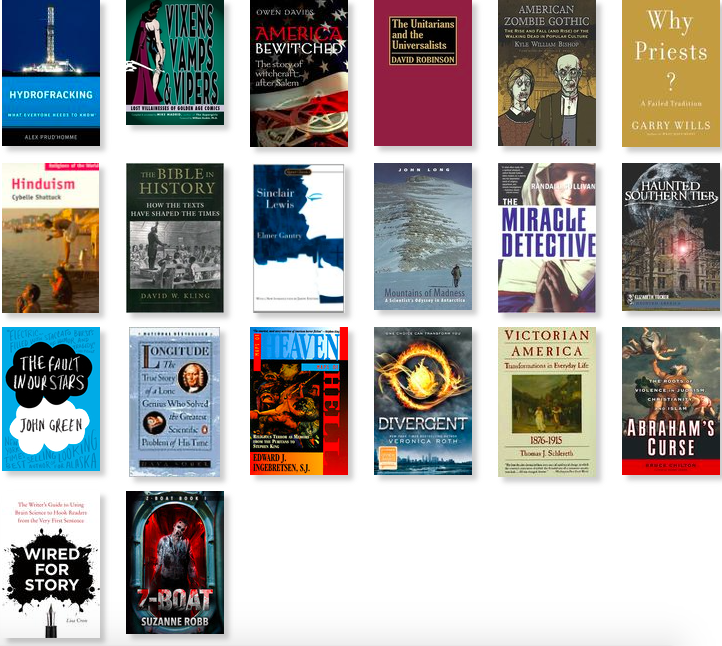
Fiction always makes a part of each year’s reading as well. This year found me reading several ponderous tomes, but I very much enjoyed the lighter fare by Ransom Riggs, in Hollow City. James P. Blaylock’s Homunculus and K. W. Jeter’s Infernal Devices slaked my steampunk thirst temporarily. John Green’s The Fault in Our Stars and Vladimir Nabokov’s Lolita were both difficult to read as a father, but important literature nevertheless. All of these books and more have individual posts dedicated to them on this blog. I always feel compelled to make clear that I find the books I read, whether highlighted here or not, one of the most rewarding aspects of my year. The long daily commute I normally endure would be torture without my books. Each year, each day I’m thankful for those who write them, and I look forward to an equally stimulating 2015 spent with my face buried in books.
Screen Shot 2014-12-31 at 5.04.15 AM


Growing Up

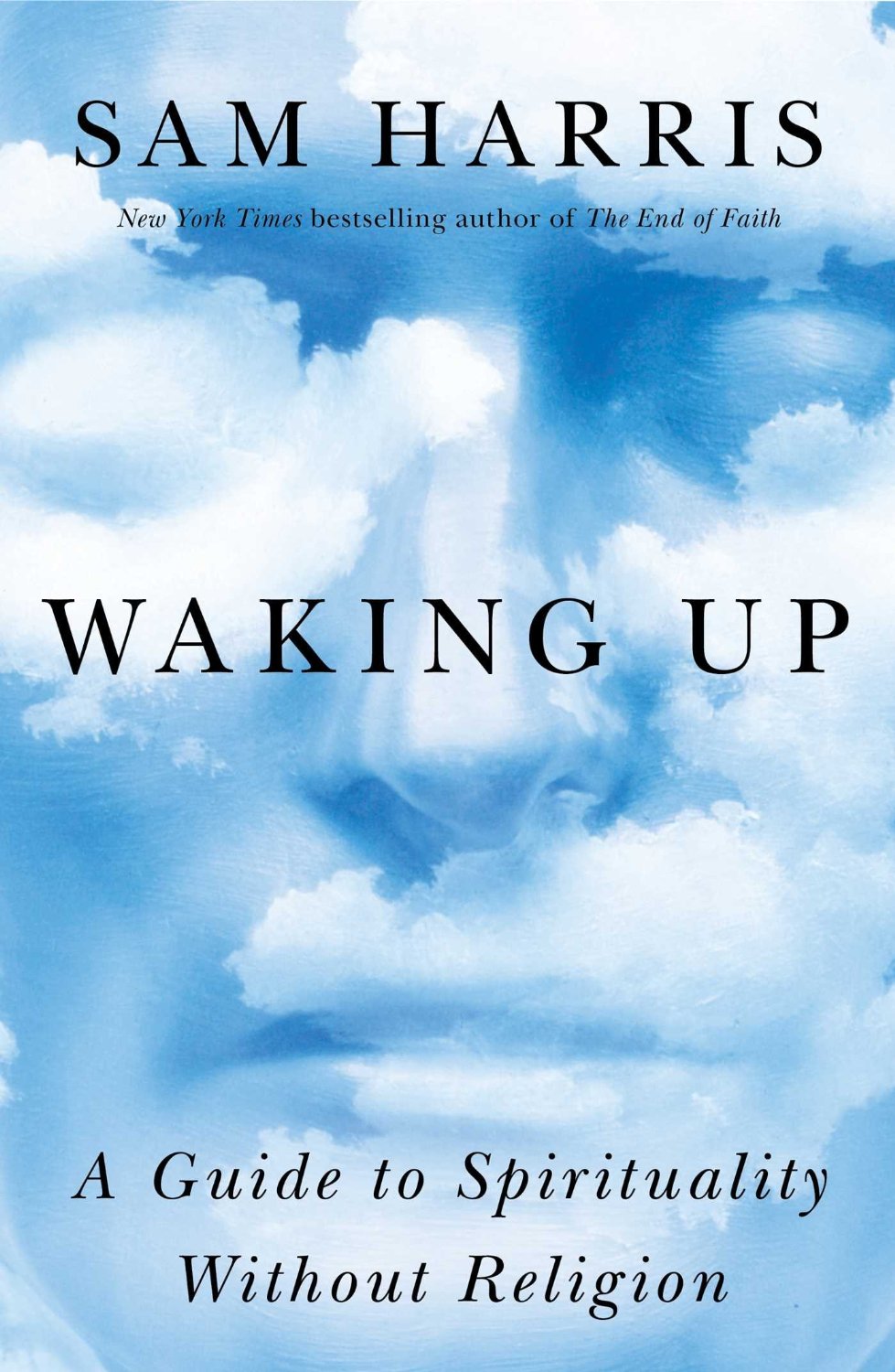
WakingUpI am in two minds about Sam Harris’s Waking Up. Literally. I haven’t read Harris since The End of Faith, and I have to admit that I found Waking Up to be a very engaging book. I can’t agree with everything Harris writes—that’s an occupational hazard of acquiring advanced degrees—but to have a scientist, an atheist no less, praise spirituality felt incredibly genuine. Spiritual experiences happen. I’ve had a few doozies over the years. I’ve also read a number of scientists who tell me they’re all an illusion. Harris admits that consciousness is a mystery. His use of “mind” instead of “brain” won me over from the beginning. I discovered that the atheist can also be a seeker. Dogmatism, of whatever stripe, is the enemy.

Harris has considerable experience meditating. This is no activity for posers or wimps. It is, despite minimal physical demands, hard work. Throughout the book we get the sense that Buddhism is among the least objectionable religions, when divested of its myths. I do wonder, however, if demythologized Christianity was ever given a fair chance. From my own experience, some of the selflessness advocated by Harris can be found in taking aspects of Christianity seriously. I understand, I think, Harris’s objections to religion. It can, and does, lead to horrors both obvious and subtle. Yet, every once in a perhaps great while, it does offer redemption. Meditation, for example, has its roots in religious practice. It is this that Harris calls spirituality. And it is good.

A Guide to Spirituality without Religion is an apt subtitle for this brutally honest and open book. Harris’s knowledge as a neuroscientist endows his ideas with great authority. He opines, and he is not alone, that meditation demonstrates that “I” is only an illusion. This loss of self will haunt me for some time. For decades I is all I seem to have. Still, I am pleased to find an open-minded scientist on this same path I tread. Raised to be both spiritual and religious set the trajectory of my otherwise logic-driven life. You can’t go back and change all that, but you can grow up. To read of Harris’s spiritual experiences in the geography of great spiritual masters as well as in the laboratory instill in this reader a profound hope. Whether or not this reader is merely an illusion. There may be morning after this long night, after all.


Waking Up in Galilee

One voice can’t be heard. Unless, of course, it has a publicist. For years, it seems, I have been suggesting in my obscure corner of the internet that we’re not quite ready for the death of religion yet. I’ve never really doubted science, but I have noticed that science frequently draws the same conclusions as religion. Evolutionary biologists and neuroscientists exclaim, with some surprise, that religion has a survival advantage. Of course, big men with white beards sitting on thrones in the sky just won’t do, but the underlying concept has utility. So we’re told. Now Sam Harris, author of The End of Faith, one of the four horsemen of the new atheists, tells us that it’s okay to experience what has been known as, conventionally, a religious experience. Call it transcendent (I always do), but no matter what the chemical mix you concoct in the brain, it will feel good. Perhaps better than anything merely biological ever will. You’ll sell a million books. If you’ve got a publicist.

To me it seems that the religion question is a no-brainer. It wouldn’t persist if we had no need of it. Unlike the appendix, which seems not to have taken the hint that it is entirely vestigial, religion helps people (and perhaps some animals) survive. It doesn’t have to be sitting on an uncomfortable pew on a Sunday morning. It might be in the giddy heights of the Rocky Mountains where you can see to eternity and beyond and the rarity of the oxygen makes you lightheaded with a hologram of immortality. It might be the piercing peace that comes with light refracted through a glass so blue that superlatives fail you. It might be in imaginary vistas of an ice-bound Arctic where, you’re just certain, Nordic gods linger just out of sight. Transcendence can even come from traditional religious experiences, or so the stories of the saints proclaim. Anyone can participate. Those who have never forget.

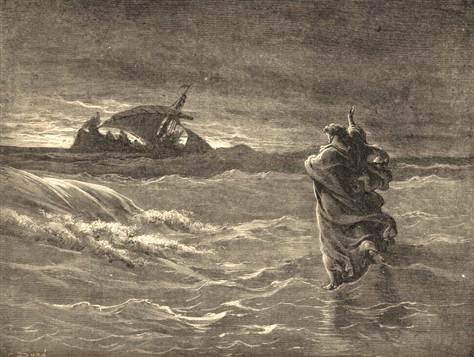
The New York Times, in the Sunday Review piece by Frank Brunl (Between Godliness and Godlessness) introduces Sam Harris’s new book, Waking Up. I know I’ll read it. According to the article, Harris discusses his own experience of transcendence. When Harris has such a revelation, it is a best seller. Or it will be. For those of us who quietly suggest moderation between bombastic religion and bombastic science, it is merely another day in the life of the quiet ones who observe without being heard. True, it takes courage in this culture to dole religion a knock on the head. It is not, however, going to send faith to a premature grave. We still need our religion. We might not call it that any more. Name it spirituality, or transcendence, or mystic mumbo-jumbo, but when it hits you it’s like an atheist in Galilee. Some call it a electrochemical reaction in the brain. Others call it walking on water.

Dore Walk on Water