Becoming American

Image credit: John Wesley Jarvis, via Wikimedia Commons

I love reading literary scholars if they write accessibly.  William L. Hedges did, mostly, in Washington Irving: An American Study, 1802–1832.  There were several moments in my reading when I had to pause and consider the connections he was making.  This was his only book of note, but noteworthy it is.  You see, as a young person I had a difficult time figuring out what I was supposed to be as an American.  I read a lot about Europe and considered the various identities in the long histories there.  I tended to read European literature while having a lifelong soft spot for Poe.  Over time I began to read more American classics—ironically this wasn’t much part of my formal education in rural Pennsylvania.  Mostly I picked things up on my own.

Hedges, nevertheless, ties many of these things together in discussing Irving’s writing.  As he did so I started to realize that an American is a distinct kind of being.  Now, intellectually I’ve known that since childhood.  I was born and raised here, after all, as were the generations before me.  Still, recognizing the guilt of taking someone else’s land, it has taken many years to appreciate the literary accomplishments of the various writers who helped shape our national identity.  Hedges addresses many aspects of this through his analysis of Irving, but he’s at his best when he’s tying him together with Poe or Melville.  These early American literary lights offered a view of a nation haunted by history, but also funny at the same time.

This book was published three years after I was born.  Of course, I really didn’t start reading about Irving until about a decade ago.  You get the sense that he wasn’t sure of himself as a writer, but like many of us he had a thin skin when it came to criticism.  You see, writing is putting yourself out there for others to see.  It’s only worth doing if you believe you have something to say and you want others to hear it.  For many writers that means being discovered after death.  Today many make livings writing acclaimed novels.  They can only do so, however, because Irving and his generation suggested something new: you didn’t have to have a traditional job and just write on the side.  You could, if chance cooperated, create literary works that others would purchase and support yourself that way.  And then, more than a century after you’d gone, someone else would write about what you had written.  Thankfully, sometimes accessibly.

Irving the Writer

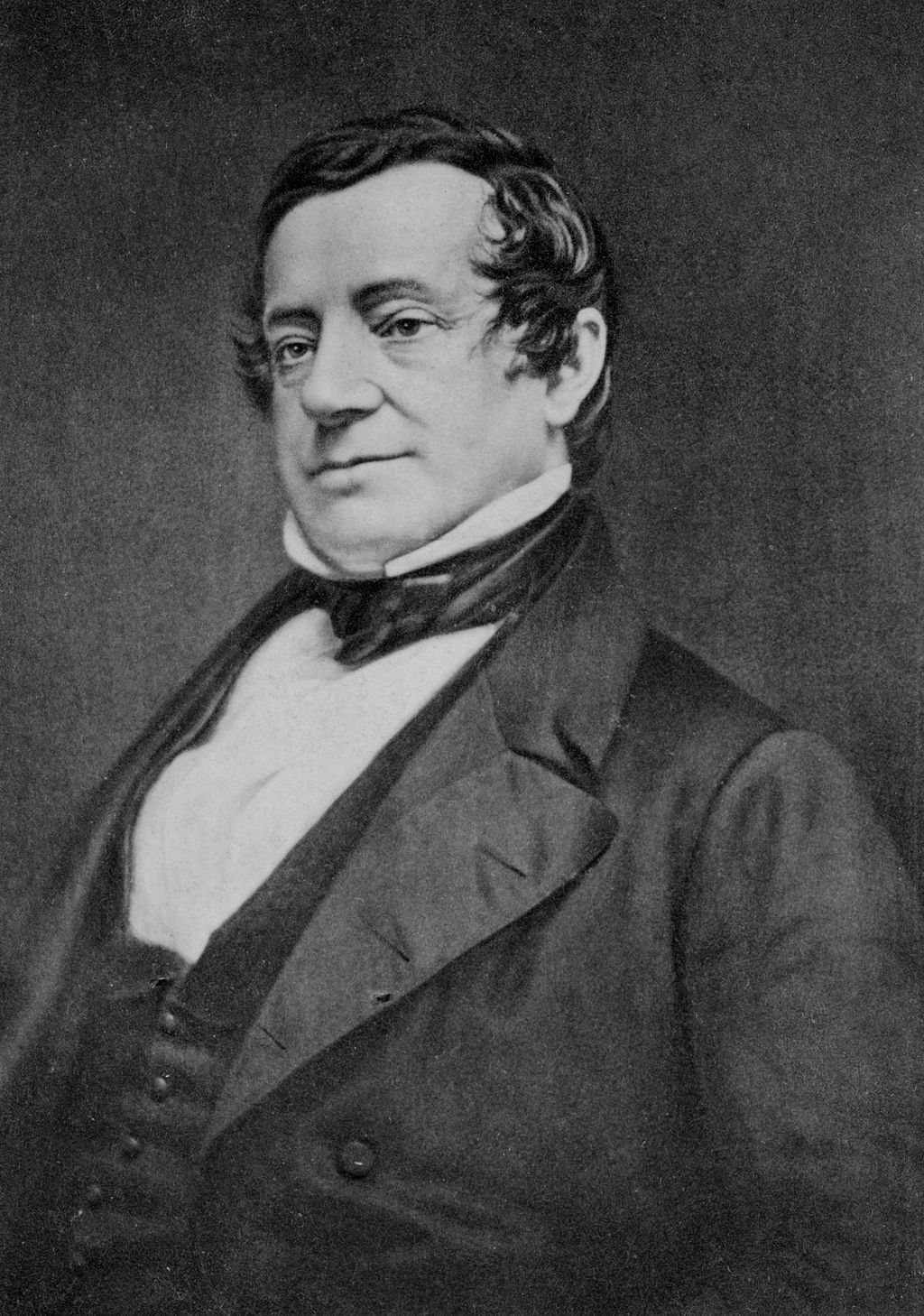
From the Library of Congress, via Wikimedia Commons

No writer is “on” all the time.  I often marvel that, with the busy lives they lead, they manage to finish any books at all.  Even so, not all are uniformly good.  Following up a biography of Washington Irving with a book by that eponymous title, this was my first foray into the Twayne’s United States Authors Series.  Written by Mary Weatherspoon Bowden, this volume (Washington Irving) seems fair-minded and honest about Irving and the irregularities of his writing.  My impression, not having read all his work, is that he started out great and became good further down the line.  Not that I’m in any position to judge.  We read and we like what we like.  Bowden pretty much goes through all of Irving’s writings—sometimes story by story—giving a sense of what they’re all about. (The book was released in cloth with no real cover image, so enjoy Irving’s smile instead.)

As famous and influential as Irving was, his reputation as a writer has been in decline for many decades.  One reason for this is that his first major twentieth-century biographer, Stanley T. Williams, apparently despised him.  So much so that he wrote a two-volume biography demonstrating his faults as a writer.  This demolition job meant that works like Bowden’s had to try to counter the prevailing opinion of Irving’s ability.  Bowden shows how carefully planned out many of his works were without denying that Irving had to try to make money from his writing.  The thought at the time seems to have been that literary pursuits were best left to the wealthy—those with leisure to indulge in letters.  Irving showed that it was possible to write your way to a reasonable living.

Of course, not all of his writing is that good.  And several volumes of it are “history.”  Today you have to earn an advanced degree, or at least a masters, before you can pass yourself off as a historian.  Irving did it the old fashioned way.  He read as much as he could get his hands on and synthesized it.  Today he’s not really remembered as an historian, or as a statesman.  He’s known as the author of a few, mostly brief, American classics.  Even though Bowden writes of Irving appreciatively, she doesn’t really inspire you to run out and read all his work.  He did have a tremendous output for the time and was an extremely influential author.  Nevertheless, others came and surpassed him, even as they were his contemporaries.  Still, it seems there ought to be some credit in being first, and some integrity in actually managing to live by the written word.  Irving is worth another look.


Knickerbocker

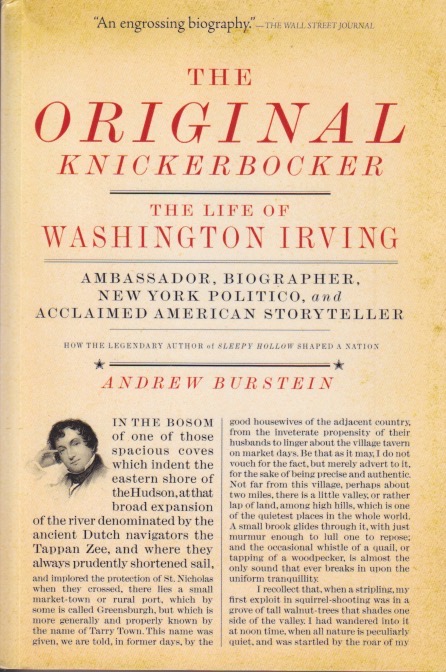
Washington Irving is one of those people with an outsized influence on American history who nevertheless has become ignored.  He met nearly every US president from Jefferson through Franklin Pierce, and what’s more, most of them knew who he was.  Sometimes decried as a less-than-original writing talent, Irving nevertheless led a remarkable life and through it all, treated others with respect and gentility.  He’s also a bit of a mystery.  All of this is captured quite well in Andrew Burstein’s biography, The Original Knickerbocker.  Burstein does go off on some diversions from time to time, but most of them are quite interesting.  One of the facts that astounded me was just how many early American political leaders were writers.

I don’t mean wealthy individuals hiring ghost writers to praise them in their “autobiographies,” but actual writers.  Fiction and all.  These were, pardon the period phrase, “men of letters.”  Writing was a way of not only influencing people, but of improving one’s mind.  Some of these individuals became presidents, others cabinet ministers, or foreign diplomats.  Once his literary star ascended, Irving could get struggling writers a government post by a letter sent to the chief executive.  It was a different day than that in which we live.

In my mind, Irving also stands out in that his fame came early and his later writings, while perhaps selling better, never eclipsed his early fame.  And honestly, never reached his earlier shine.  It began with his satirical History of New York.  This book established him as a wit and a gifted writer.  Since his family ran a secure business, Irving was able to travel without working for several years and didn’t produce his next book for another decade.  The Sketch Book of Geoffrey Crayon, Gent. may not be known to many today, but two of its sketches are still told and retold.  One is “Rip Van Winkle” and the other is “The Legend of Sleepy Hollow.”  This book also helped to establish the American celebration of Christmas, something begun in his History.  Although he would write many more books, he’s still best remembered for two short stories from his second.

Burstein takes his cues in this biography from “Rip Van Winkle.”  This particular story is kind of a parable of Irving’s life.  Irving couldn’t know this, of course, having published the story when he was about 36.  His subsequent books sold well enough, and apart from a stint as American minister to Spain, he was able to make his living through his pen.  There’s quite a lot in Burstein’s treatment that I’ll come back to, I’m sure.  But for the moment, it left me feeling as if I’d met a great, if struggling, writer in person.


The Romantics

It takes one to know one—or so they used to say.  My current preoccupation has me learning about the Romantics.  This isn’t the same as “romance,” although both words derive from the Old French for “verse narrative.”  Novel, in German, is Roman.  In any case, Sir Walter Scott cordially embraced Washington Irving when the latter arrived unannounced at Abbotsford.  Reading the account in Irving’s own words, it sounds like a bromance, and some modern interpreters—inclined as they are to look for genital contact—have suggested Irving, a lifelong bachelor, might’ve been a homosexual.  Although there’s nothing wrong with that, I do wonder if it misunderstands the language of the Romantics.  To borrow a sentence from Andrew Burstein (more to come anon): “This had to do with intimacy, not sex as we understand it.”

I recently gave a talk about Herman Melville’s spiritual orientation.  I mentioned his close friendship with Nathaniel Hawthorne.  During the discussion period the question of whether they might’ve been lovers was raised.  I’d read this before.  I don’t know what went on in Melville’s bedroom—it’s none of my business—but I think the Romantics were all about intimacy.  We’re now familiar with the genre of bromance.  Guys, usually two, pairing off for pursuits of significance to both of them.  Or two women. I think of all the great same-sex pairings throughout literary history and wonder where we’d be without them.  Since our culture has long demonized sex, our mind is constantly creeping between the sheets.  Who touched whom?  Where and when?  Isn’t intimacy enough any more?  Where’s the Romance?  I’m no prude, but I wonder if we misread sex and the Romantics.

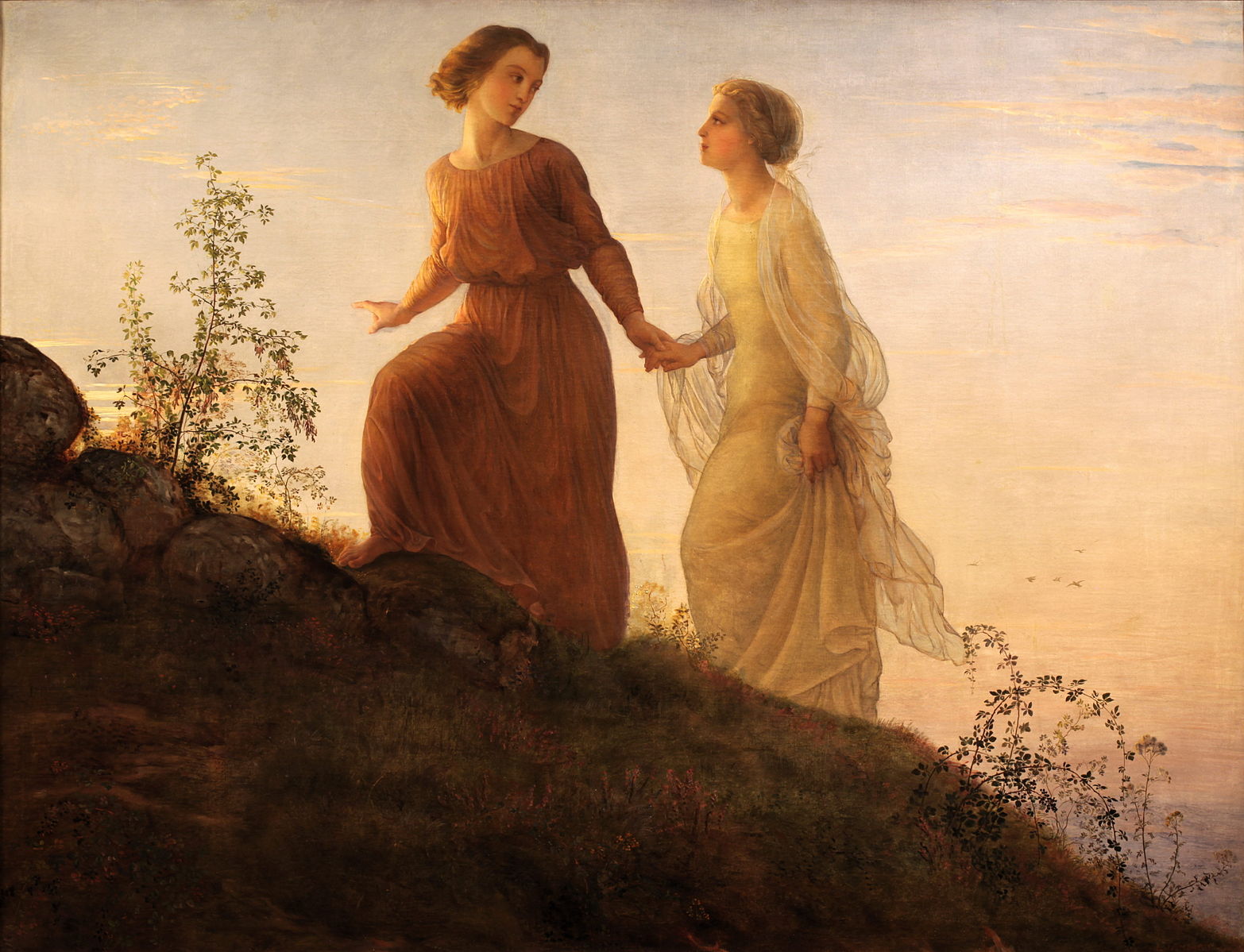
Louis Janmot, Poem of the Soul – On the mountain, public domain (via Wikimedia Commons)

The Romantic Movement produced the culture I taught myself living in a run-down house with no spending money.  I borrowed recordings—actual records—of Beethoven symphonies from the library that I had to listen to with headphones because nobody else wanted to hear that kind of thing.  I read Poe.  I read about Poe.  Gothic, a subset of Romanticism, became my muse.  I had no intimate friends with which to share this.  Not until seminary—that place where such unusual, unspoken things occur.  Of course I was in Boston, the most Romantic of American cities with New Bedford to the south and Salem to the north.  To the east the boundless ocean.  We still read the Romantics.  We still read about them.  I can’t help but think we might misunderstand them.  Yes, Irving and Scott were together “from morning to night,” but thinking back to my own Romantic ideals as a teenager, I suspect they just talked.  Intimately.


Not Sleepy Yet

Working on a doctorate changes the way you think.  Or at least it’s supposed to.  Easy answers have to be examined closely, and sources critically scrutinized.  One of the side-effects of this is that many Ph.D.s tend to think that only others of that status are able to do good research.  An essential piece of research, however, is passion.  This part isn’t always logical and can’t always be explained.  A recovering academic, I first resisted Gary DenisSleepy Hollow: Birth of the Legend because it was self-published.  I’ve had bad experiences with self-published books before but what I discovered here is that Denis is quite a capable researcher, driven with a passion for Washington Irving’s tale.  The execution may be a little rough, but the data-gathering is very good.  He tries to point out where accounts have problems and attempts, where possible, to resolve them.

Denis is driven by the question of what in Irving’s story is factual, if anything?  This is probably not a question an academic would ask, presuming that fiction is fiction.  Still, there is data.  The first four chapters are very good.  Here he lays out the background to the region, Irving, and stories of headless horsemen.  I learned quite a lot from it.  The final three chapters turn to the main characters of the story—Ichabod Crane, Katrina Van Tassel, and Brom Bones—asking who they might’ve been based on.  The best drawn of these is the first and there’s good reason to suppose Irving based Crane’s situation on that of his friend, Jesse Merwin.  The other two, however, are sketched rather hastily and lots of people have suggestions for who might’ve been behind them.

Clearly aware that authors borrow and make things up, Denis knows that Katrina and Brom may well be pretty much imaginary.  He also knows that Irving did indeed borrow much from previously known stories and legends.  Irving’s real genius was in the way he expressed these stories in colloquial English, making American literature a blend.  Although Irving wrote many books, his fame was largely due to two of his stories published early in his career.  One of those stories, “The Legend of Sleepy Hollow,” has left quite a paper trail and Denis leaves no rock unturned in his efforts to collect data on it.  I’ve read a fair number of self-published books over the years—they’ve been easy to produce since the internet began—and I’m wary of them.  This book, however, is one that I’m glad I found and it serves as a useful reminder that good research isn’t limited to the privileged few in the academy.


Sleepy Hollow West

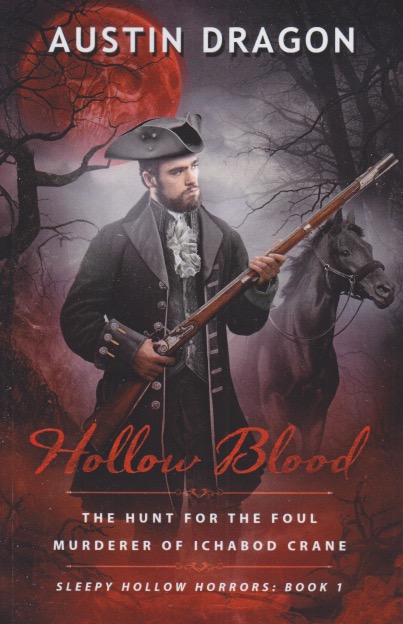
You’ve got to admire those who are determined to be writers on their own terms.  As someone who’s tried and tried again to break into even indie presses, I know few established publishers will even consider fiction from someone who’s not already established.  As my regular readers know, I’ve been reading a lot about the Legend of Sleepy Hollow lately.  So I came across Austin Dragon’s Hollow Blood.  Part of a two-volume novel set, the story takes a creative approach while retaining several of the original characters, even having clever nods now and again to the wording in the original.  Although clearly self-published, Dragon is able to let his imagination go on this one.  Julian Crane, Ichabod’s nephew, is out to avenge his uncle’s death.

In Sleepy Hollow he confronts Brom Bones with the crime, but wrongly.  It turns out that the Marshal—there are elements of the old west in this too, with cowboys and showdowns—knows where Crane has settled and offers to take the nephew to him.  So unfolds a story that feels a bit more like a western than a horror story at points.  I don’t want to give away too much since Dragon, like most of those who make their living by writing, needs to move copies to stay solvent.  The thing is, Sleepy Hollow seems to be an evergreen subject.  America keeps coming back to it.  Many writers try to take it on as the basis for more modern reboots.  Of course, I have to read the second volume to find out how it really ends.

I can’t help but think that the internet has made it difficult for writers by allowing anyone to establish him or herself as one.  If you can build a fan base, you can make a living at it.  The publishing industry faces problems of its own, of course.  Paper shortages are a problem.  Not only the pandemic, but the assumption that ebooks were going to spell the death of print led paper mills to cut production.  Funny thing—print has been seeing a resurgence of interest.  Large media seems surprised, scratching its metaphoric head and saying “People like actual books—who knew?”  But I digress.  The simple tale of a love triangle in the 1790s with a ghost on the loose has spawned a great number of offspring.  Some published the traditional way, and others on a writer’s own terms.  It’s a story worth the retelling.


Novelization

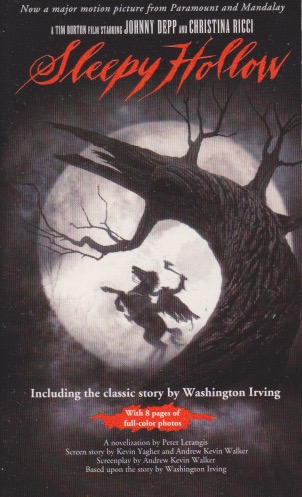
It must be both difficult and easy writing the novelization of a movie.  I suppose it depends on the movie as well.  Sleepy Hollow is a film based on a story already, but Washington Irving’s tale isn’t a novel and the movie was a collaboration between Irving’s original, re-envisioned by Kevin Yagher, Andrew Kevin Walker, and Tim Burton.  The novelization was done by Peter Lerangis and it, naturally enough, follows the movie.  As a novelizer, however, you need to try to make sense of some scenes where a film only implies what’s going on.  Now, in this case I’ve seen the movie many times and any deviations come across as “that’s not the way it goes” moments.  Still, it’s competently done.  It  even helped me make sense out of some things that had me puzzled since the start of the millennium.

In the “book or movie” debate I tend to think a book should be read first.  Sometimes it should go the other way around.  Novelizations are, of course, intended to increase the profits for a film.  You’ve got the box office take, and if there are advertising tie-ins or other merch, you can add to the haul.  A novelization can also help.  In this case, the movie has a somewhat complex plot with revenge and double-crossing, and so a novel helps to make all that clear.  However, when the novelist asks you to accept what a character is thinking you may have already come up with your own ideas on that point and any postmodernist would tell you that your opinion is just as valid as that of the writer.

Movie scripts tend to be a bit short for novels—if the movie isn’t based on a novel, of course—and sometimes extra material is needed.  This novelization includes the public domain story by Irving as well, even though the movie completely recasts all the characters into unfamiliar roles.  Brom, for example, is a minor part, whereas Katrina is a witch and Ichabod a constable from New York City.  All of that having been said, there really aren’t many surprises here.  I read this because I’m interested in the life of “The Legend of Sleepy Hollow.”  Its many retelling and re-envisionings.  The original story was published less than fifty years after American independence and has memories closer to the time.  It tells us something of what it was like in those early days.  And this novel both retells and redacts a movie already a couple decades old itself.


Aging Writers

The fact that V. C. Andrews didn’t have any success as a novelist until her late fifties (a benchmark that has already slipped for me), gives me hope.  Another thing I didn’t realize about Cleo Virginia Andrews is that she was confined to a wheelchair.  She didn’t want that fact advertised and she didn’t want peoples’ pity.  She wanted to write.  Many of the books published under her name were ideas she had but that were only brought to fruition by others after her death.  She became a legacy.  Writers are fascinating people.  I only recently learned that Anne Rice was transgender.  I had assumed from her public persona something that I had taken for granted.  Gender is a complex thing, no matter how loudly religions shout.  The sheer number of people born intersex should make that obvious.

Writers express the human experience.  Some perspectives aren’t really considered worth pursuing, as I know from personal experience.  But learning about writers’ lives always gives me hope.  There are those whose lives will always contain mystery—was Washington Irving homosexual or just inept with women?  What really happened to Edgar Allan Poe in Baltimore?  Who was Homer, really?  No matter how much those of us inclined to write do so, there are still huge swaths of life that are left off the page.  (Much of it boring, spent at work, or mowing the lawn.  I try to imagine Herman Melville on a riding mower, but I just can’t do it.)  Writing successfully involves a publisher or agent willing to take a chance on you.  But if you’re old enough to be a one-hit wonder (sorry John Kennedy Toole), they don’t see dollar signs down the road, so move on down to the next door, please.

I had a novel under contract a decade and a half ago.  It never materialized, so don’t look for it.  My nepenthe consists of learning about writers, whether one-hit wonders or not.  I can still look to the Frank McCourts, Laura Ingalls Wilders, and Harriet Doerrs of the literary world.  For most writers it’s the story of what happened before success that is the most compelling part.  Especially those who were older and just kept on trying.  Some had to die, ironically, before the world realized they had something important to say.  You can’t blame the world.  The world’s busy.  But the fact is nobody would remember what it was like if somebody hadn’t bothered to write it down.  So we continue to chronicle the human experience.


Sacred Hudson

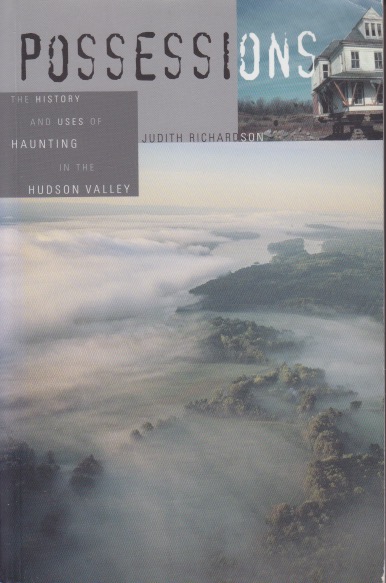
As scientific as we may wish to be, there’s no denying that there is a sense of place.  We know that some animals, at least, also feel it.  Whether theirs is a more pragmatic desire to return to where conditions were favorable to be born, or whether something deeper draws them there, we have no way of knowing.  People feel it too, this sense of place.  We know where we’re from, and if we don’t we often want to find out.  The space is somehow part of us.  There’s a compelling exploration of this in Judith Richardson’s Possessions: The History and Uses of Haunting in the Hudson Valley.  While not America’s first haunted location, the Hudson Valley was singled out for this treatment by Washington Irving.  He, however, didn’t invent it.

I’m not from the Hudson Valley.  I could never afford to live there.  That doesn’t mean the area can’t speak to me.  Richardson’s approach is academic yet readable and she considers how hauntings fill needs and how they play a role in that ever-contentious enterprise of land claims.  Ranging through literary treatments, whether the fiction of Irving or tour books of the next generation, or indeed, more recent literary efforts, Richardson deftly guides the reader through American Indian and Dutch and other inhabitants’ stories of themselves.  Race inevitably plays a part, and her tracing of the origins of some traditional tales is really remarkable.  Who owns the land?  Who truly owns anything?   

Similar treatments (I can’t help but feel somehow lesser) must exist of other haunted locations.  Richardson doesn’t engage in arguments over whether ghosts are factual since ghosts serve so many other functions.  Our lives are the stories we tell about ourselves.  Many of those tales involve the place we are or places we’ve been.  In our highly mobile society, few of us, it seems, can make a living where we’re from.  Those of us born in small towns range far and wide to find employment.  In many cases we may not want to go live where the drama of our childhoods unfolded.  Yes, there are pleasant memories there, but there are also ghosts.  Richardson explores how this plays out in one small stretch of the country.  Indeed, it’s a small stretch of New York state.  Stories of hauntings continue in that particular valley.  Uncanny, perhaps, but there are places in this world like that, and this book is a sure road post on this particular overgrown trail.


The Horseman

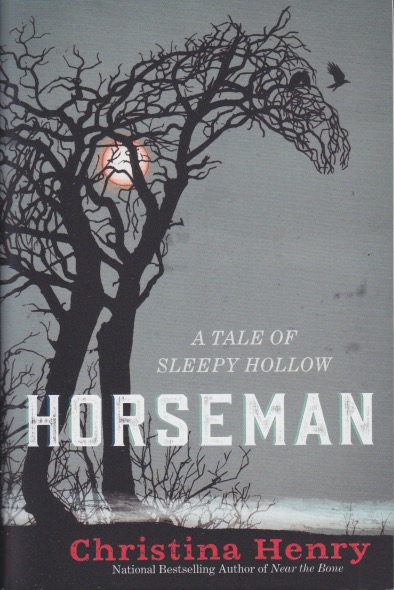
Washington Irving’s tale, “The Legend of Sleepy Hollow,” perhaps due to its being the earliest literary American ghost story, has been retold time and again.  When I saw that Christina Henry had a take on it that came out last autumn, I knew I’d be reading it.  I’d read her The Girl in Red late last year, but I couldn’t wait until fall to read this one.  Henry has a way of taking traditional stories and making them relevant.  Horseman is set two generations after Ichabod Crane and Brom Bones and Katrina Van Tassel, but they all appear in it.  According to Irving’s story—and this is often changed in cinematographic treatments—Brom and Katrina wed.  The narrator of this tale is Ben, who in today’s terms would be considered transgender.  He (his preferred pronoun) is the grandchild of Brom and Katrina.

Henry is a master of magic realism.  There really is something in the woods of Sleepy Hollow and it’s taking children’s heads.  Some influence from Tim Burton’s film version is found here, but the story has its own trajectory and inner logic.  Ben actually sees the monster, but nobody will believe him.  Not until it’s too late.  The one person who does believe is Katrina, Ben’s grandmother.  She, however, wants Ben to act like a girl because he was born female.  She wants him to stay home and learn sewing and cooking.  Ben’s hero, however, is Brom.  He’s a good man, if rowdy.  He married Katrina for love, not wealth.  Ichabod Crane does appear, later in the story, but since how he appears is a spoiler I’ll need to let you read for yourself.

Americans are often raised with the wrong-headed notion of canon as the one way a story goes.  Retelling is as ancient as writing itself.  Homer, Apollodorus, and Ovid were retelling stories.  So were many Bible writers.  People tell one another tall tales.  Washington Irving didn’t invent the Headless Horseman out of whole cloth.  Neither did the people of Tarrytown.  How the story goes is a matter for discussion.  Bet yet, it’s also a matter for retelling.  Henry’s version could be made to fit with Irving’s, but with a bit of prior assumption, some posthumous collaboration.  Hers, however, is a tale for our times.  Just like in Red, the protagonist isn’t conventional, according to conservative sexual standards.  Both are, however, authentic.  And although both may be flawed in various ways, there’s no denying that they’re heroes.


Keeping Your Head

Horror is a gift that keeps on giving.  Not many horror fans are among my regular readers, but I like to keep a finger in the pie nevertheless.  Just earlier this month it was announced that Paramount has hired Lindsey Beers to direct a new big screen Sleepy Hollow.  It’s early days, of course, and the movie hasn’t been titled, let alone filmed.  Beers is just wrapping up a prequel for Pet Sematary (not yet titled) that I’ll be eager to see.  Women horror directors tend to bring refreshing angles to the genre—and why shouldn’t they?  Women writers were crucial in developing the Gothic genre that evolved into horror as we know it.  No matter what the Supreme Court says, they are just as important—probably more—than males.

I’ve been reading quite a lot about Sleepy Hollow over the past several months, which is how I came across the intelligence about this new movie.  It’s nice to know that the Hudson Valley is evergreen.  My visits there have offered brushes with the uncanny, but nothing explicit.  A weekend near the ice caves of Sam’s Point, geocaching in the woods outside Poughkeepsie, a visit to Sleepy Hollow itself to visit Irving’s grave and tip my hat to the Old Dutch Church.  With deep family roots in upstate New York, I’ve always thought it would be a great place to live.  Alas, not on an editor’s salary.  It’s been too long since I’ve given the area a visit.

John Quidor, The Headless Horseman Pursuing Ichabod Crane, via Wikimedia Commons

There have been many takes on Washington Irving’s “The Legend of Sleepy Hollow.”  Even in the silent era movies were made of it.  In retrospect, it seems odd that it took so long for Tim Burton to bring it back to the big screen.  There were some television movies, usually with plodding plots to draw the story out to commercial length.  Disney had early on devoted half a feature to it, as if the story couldn’t support its own weight.  For better or worse, that film was probably the first introduction to the tale that many people had—the story itself was written for adults.  Of course, many written kids’ versions have come out since then.  The satirical original was meant for a somewhat sophisticated readership with a sense of humor.  The story lends itself to horror treatments, however, if they’re done well.  It may have been an early viewing of the Disney tale that set me moving in this direction.  I like to think I’ve kept my head over it, however.


Dutch Treat

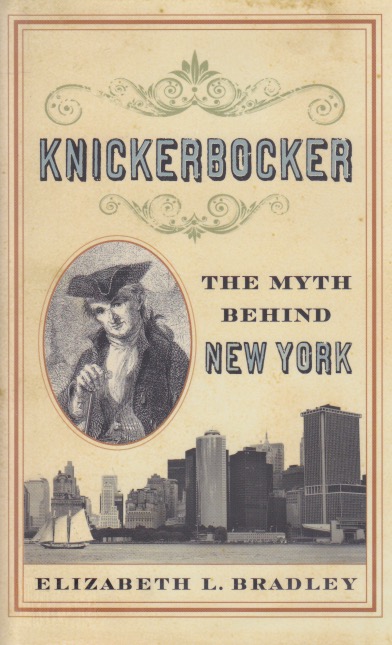
It was back when I was researching my first religion and horror paper that I learned it.  Since the paper was about Sleepy Hollow, I’d been reading about Washington Irving.  I knew little about him beyond that he’d written this story and also “Rip Van Winkle.”  I had no idea that he was the one responsible for the nickname Knickerbocker for all things New York.  Since then I’ve been quite curious about Irving and his world.  A glance at the books noted on this blog over the last few months will demonstrate this.  I found out about Elizabeth L. Bradley from an interview about Sleepy Hollow during the heart of the pandemic.  Irving was first sent to Sleepy Hollow because of a yellow fever outbreak in New York.  It led to his introduction to the lore and folk of the region.

Bradley’s book isn’t about that, however.  She’s writing about how Knickerbocker went from Irving’s nom de guerre to essentially a trademark for Manhattan, and New York City more broadly.  Knickerbocker graces hotels, sports teams, and once upon a time, a brand of beer.  And much more.  All of this is because of a volume I’ve never read, A History of New York by Diedrich Knickerbocker.  Irving was a satirical writer and this history is an extended satire.  He wasn’t Dutch, but he was born in Manhattan and cut his writing teeth there.  An older sibling to America’s other fledgling writers, he gained fame enough to be able to retire near Sleepy Hollow.  That particular story, along with Rip, made him a household name.  Of course, he wrote much else but it’s not talked about so much.

This book is a brief tour of the city and its love affair with Irving’s pseudonym.  Even having commuted to New York for about seven years of my life, I feel I only know very little about Irving’s hometown of Manhattan.  I do know that on my walks across midtown hurrying either to the office or to the bus, I found a quirky little view of the city emerging.  Little sites of significance only to myself—plaques on a seldom-used street, a church nestled between towers for capitalism, a quiet restaurant that made you forget the millions of others just outside.  It gives me hope that a writer can make such an impact on an ever-evolving entity like New York.  And this quick introduction contains much to help one reflect on the enormity of it all.


Updating Irving

Movie quality is measured by many standards.  It’s pretty clear that budgets can make a difference—Hollywood movies generally outshine television movies.  Streaming services, like Netflix and Hulu, have been gaining ground here, but they still lack some of the qualia that come from long-term players in the industry.  Often this was measured, pre-pandemic, by box office success.  I’m not sure how it’s all quantified now, but I’m sure it still comes down to money.  To me, the deciding factor about the quality of a movie is often the writing.  Even with a modest budget excellent writing can make up a lot of ground.  Headless Horseman originally aired on the SciFi channel (now Syfy) in 2007, and I wrote a tiny bit about it in a former post.  I recently rewatched it with an eye toward how religion is integrated in it.

Headless Horseman is not a great movie.  Its writing doesn’t inspire and it leaves too many gaps in the narrative to carry the viewer along easily.  Still, religion plays an important role in the story.  This one resets Washington Irving’s tale in the south—from the license plates, Missouri.  The horseman is a serial killer who offered his victim’s heads to the hydra, the serpent that guards the entrance to Hell.  When the killer is stopped and his body sent through the gateway, he comes back every seven years to chop heads.  The town where all this takes place has the biblical name of Wormwood, and everyone in it is literally family.  So every seven years they have to trap seven outsiders to make their offering.  The person who originally stopped the killer was the local priest.

Even this brief synopsis reveals how deeply religion is engrained in this retelling.  Irving’s classic story is set in an overtly religious period (particularly Protestant, of the Reformed variety), and wears this lightly.  Everyone can be assumed to go to church and the Headless Horseman is a Hessian mercenary decapitated by a cannonball during the Revolutionary War.  Over time, with many retellings, the horror becomes more and more involved with religion.  To the point that the religion itself is the real engine of fear.  A town protecting a Hell-guarding hellion doesn’t exactly make them Satanists, but it does mean they’re not far from it.  The in-breeding is, however, a bit insensitive.  My recent rewatching wasn’t with an eye toward the Bible, as my last viewing was.  When retelling the story, however, it seems religion will surface where once it was only in the background.


Annotating Irving

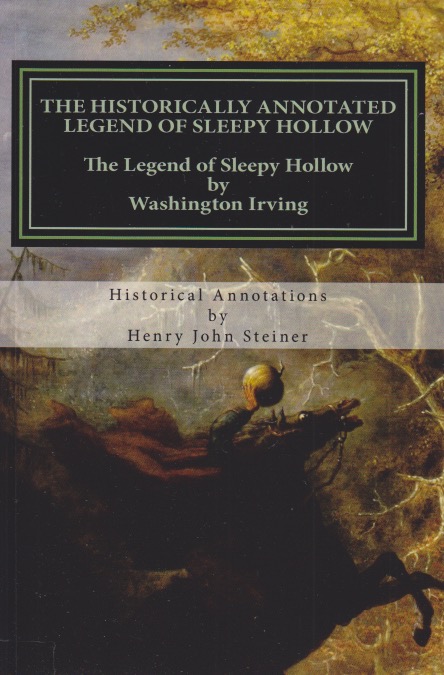
Really concentrating on a short story is sometimes difficult to do.  I don’t have a degree in literature (I took a few courses, but my specialization was religion).  I’ve been on a bit of a Sleepy Hollow kick lately and I wanted to move beyond just the short story by Washington Irving.  Although I’m sure working through the entire Sketch Book of Geoffrey Crayon, Gent., the book in which “The Legend of Sleepy Hollow” was published, would probably be rewarding, it would also be time consuming.  Irving was trying to find his way as a writer and this particular story has been his lasting contribution.  So I turned to local historian Henry John Steiner’s annotated edition.  It has a useful introduction, but still wouldn’t be “book length” without several pages of photos and a large font size.

Sleepy Hollow may lay claim to several signs of historical importance.  It featured in the Revolutionary War.  Washington Irving did eventually settle there.  As a getaway it attracted the wealthy and powerful from New York City because it’s not that far from Manhattan.  Several movie and television renditions have been made of Irving’s story.  This book generally provides local place connections in the annotations.  A visitor to Sleepy Hollow might wonder where this or that event in the story was set.  This book will help with that.  Still, it left me looking for a bit more substantial treatment.  Not necessarily a literary-theory kind.  Let’s face it, academic writers tend to write for other academics. No, a bit more of the folklore, I suppose.

It did allow me to slow down and really concentrate on the story.  Books have an endpoint that really helps in that regard.  This little book (as was the one I recently read on the Old Dutch Church) was published when the Fox series Sleepy Hollow was taking off.  That all-important media tie-in helps to sell books.  Interestingly, the details of a closer reading are revealing.  This isn’t, in origin, a Halloween story.  It’s a tall tale told American style.  Steiner indicates it was based on an older legend—this is something I’d be interested in hearing more about.  Writers are great recyclers.  I suppose a book on the folklore of the lower Hudson Valley might have more of what I’m seeking.  Nevertheless I came away from this edition feeling as if I’d gotten to know the story better.  Irving’s “Rip Van Winkle” also appears in his Sketch Book, but perhaps it’s asking too much to have both analyzed together.


Old Churches

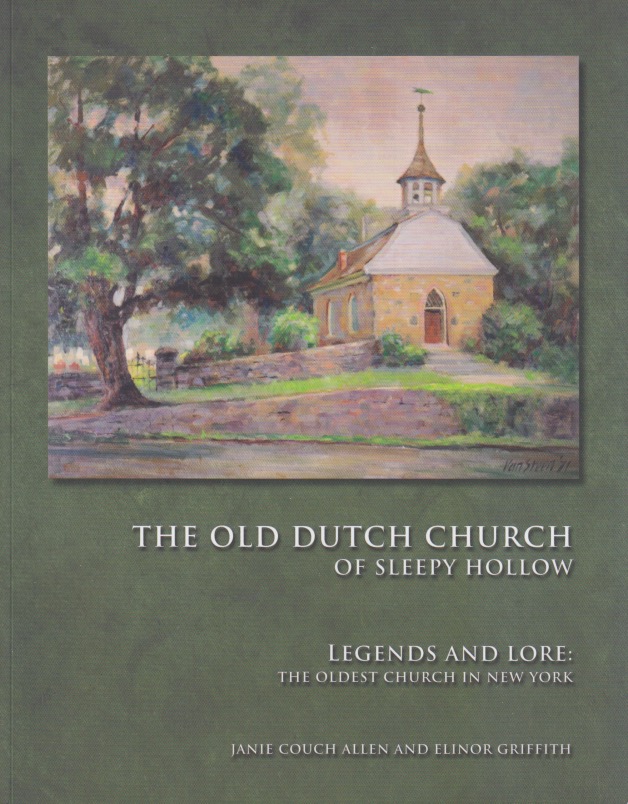
I doubled its authenticity, but it was revered in a way similar to the Shroud of Turin.  The old guide, a priest if I recall, showed us an actual lantern hung for Paul Revere’s ride.  This was the Old North Church in Boston, of course.  Its history is so storied that children across the country learned about it in school.  A similar feeling comes from reading The Old Dutch Church of Sleepy Hollow by Janie Couch Allen and Elinor Griffith.  Subtitled Legends and Lore: The Oldest Church in New York, it is clearly a celebratory work, printed in full color and with pictures on every page.  This church’s claim to fame isn’t as much historical as it’s the result of the imagination of Washington Irving.  It features in his short story “The Legend of Sleep Hollow.”

Built in 1685, it was already an old building by the time Irving had settled in North Tarrytown.  Being early enough, Irving had immense influence on the culture of a young country.  Although born in New York City, and although he lived for many years overseas, he came to represent the voice of the emerging American literary tradition.  America has been home to many writers since then, some successful, many not.  But this book is about the church, not Irving.  Irving does play a big part in its story, although he was never a member.  I kept thinking as I read how influential a single story can become.  And even a small Dutch Reformed Church can benefit from it.  This book gives a high-level overview of the history of the area and some of its colorful characters.  It turns a few times to the Headless Horseman, but it also explains the trials and triumphs of a small church.

Although most towns can’t claim such a storied structure, American churches have had an outsized influence on who we are as a people.  I’ve sat through meetings lamenting the lack of funds for the operating budget as money grows tighter even as the worldview of ancient Palestine effaces.  As an historian of religion I tend to look back.  I don’t believe our future will be entirely electronic or virtual.  If it is, I think I’d rather find myself on a chill, uncomfortable pew in the Old Dutch Church lit by candles on a Christmas Eve, shivering but still alive.  No matter what a person believes—and with the varieties of churches we can’t all be right—we know that it’s part of what makes us human.