Weather Psalm

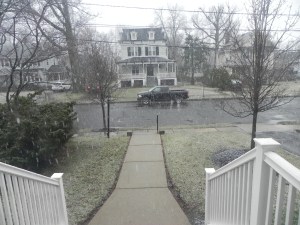
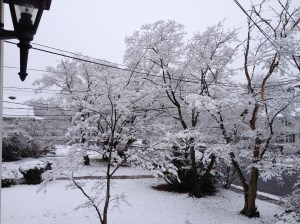
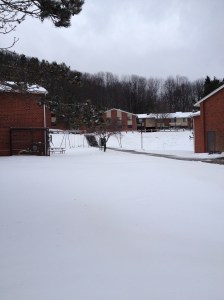
As the northeast coast digs out from yesterday’s nor’easter at least we can thank God that no business days were lost. At least none based on the status of New York City schools. Some NYC businesses base their decision on whether an adult snow day is in effect or not on the decision of whether or not to close the public schools. If kids are expected to make it to school, well, pull your socks up, thrash through the snow, and get some work done. I was fortunate enough to be able to work from home during the event that began like a snoreaster. By the time I would’ve usually been on the bus it wasn’t snowing. Roads were wet, but it seemed like a normal day. So it continued until about 10:00 a.m. Then it really did snow.

I’ve commuted long enough to know that, as grueling as getting up early and trying to get to the city may be, the evening commute is always worse. It may seem hard to believe that there are traffic jams before 7:00 a.m. most days, but around 5:00 p.m. all bets are off. The news vendors were lamenting the fate of those who had to find their way home in a foot of snow, even as it was still coming down swiftly. Nature doesn’t abide by our work schedules. Many companies don’t care if you can’t get out—you chose to work in the city. If it takes you three hours to get home, that’s not a work problem. It’s a personal thing. On personal time. Choose wisely.

All of this makes me reflect on the way we think of work these days. Commuting into the city shouldn’t be a dangerous job like being on an Alaskan fishing boat is. Chances are the actual daily work consists of sitting in a cubicle staring at a screen. Eye strain, carpal-tunnel syndrome, and boredom are the only real dangers here. Unless you’re taking the George Washington Bridge, carpool tunnel is a far more sinister threat. If you make it home in time to come back in tomorrow, then it’s all good. We do this so that we can earn money to spend, mostly online. We haven’t quite got to the point yet where we can wire our physical bodies to the internet so that we can stay at home and work 24/7. But it’s coming, just like the next nor’easter. In the meantime, I have a bus to catch.


Emulating Icarus

According to a story by Sarah Kaplan in the Washington Post, NASA is preparing to send a probe closer to the sun than any human-made object has been before. If you’re like me, this might conjure those childhood fascinations of being blasted by impossible heat—maybe in a science fiction story of a colony on Venus, or a crew hurtling out of control in a capsule being pulled inexorably toward the inferno of the heavens—on a hot summer’s day. The Post story makes an inevitable reference to Icarus, the character from Greek mythology who flew too close to the sun. The tale has long been a parable for human overreach, but this time it seems that scientists are taking it literally. The technology used to shield the craft from Old Sol is incredibly impenetrable, and it may have applications as we try to figure out how to escape this planet we seem bent on ruining completely.

Earth flies around its personal star in what’s become known as the Goldilocks Zone—that place where it’s neither too hot nor too cold for life. But don’t wander outside in the northern hemisphere in February without a coat. The weather down here can be fatal. We live on that teeter-totter of the extremes in which our frail bodies can survive. Temperatures range from -88 degrees at Oymyakon, Siberia (at this point whether Celsius or Fahrenheit hardly matters, but for the record, it’s -126 F) to 136 in the Libyan Desert. In this incredible range of 262 degrees people can be found at all shades between. Stepping out my front door one January in Nashotah, Wisconsin the thermometer read -42. That was without wind chill. It was the kind of cold you could feel immediately through all the layers. Humans can’t survive it without artificial means of heat. And yet we have a star overhead where temperatures reach 27 million degrees in its core. Out beyond Pluto our universe reaches near absolute zero, at -459 and change, on the Fahrenheit scale.

It’s a universe of extremes. That friendly sun in the sky was recognized as a deity from earliest times. Even the Bible retains hints of clandestine solar worship. Icarus, however, lost his fear of extremism. There was nothing too outrageous to try. As long as wings of wax can hold you aloft, why not attempt to reach all those zeroes? Millions sound great until they’re exceeded by billions. At that point even the sun isn’t hot enough for some.


Gaston Avenue Freeze-Out

I was not, as yesterday’s post indicated, looking forward to the renewed commute into New York City. We’ve been having a cold snap here in the Northeast, and although it’s nothing by Midwest standards, standing in it waiting for a bus isn’t the most comfortable of situations. It was cold enough that I didn’t dare take my gloves off to check the time, but my body clock told me the bus was late. The cold was creeping through all my layers and the thermometer said it was in the single digits, and breezy. I’d been a human popsicle for about a quarter of an hour when a pair of headlights pulled in the parking space nearest me. The driver got out—one of the regular commuters on my line—came over and said, “The bus is running late, won’t you sit in my car?” I was truly touched.

It’s easy to think people just don’t care. Those of us on the early morning commute know each other by sight, but not by name. We all awake far too early and put up with expensive, but unreliable bus service. We don’t talk on the bus, each of us using the time as we see fit. It feels like being alone. This offer of kindness was a welcome start to 2018. Many women would be rightfully leery of letting a man they don’t know sit in their car in the dark. Human kindness, however, is a quality that overlooks differences in times of need. She asked what line of work I was in. When I said “publishing” she replied “Ah, so that’s why you read all the time!” I was surprised she even knew that about me. Commuters touch only at the edges, like marbles in a jar.

In the Middle Eastern desert regions there’s a law of hospitality. If you find anyone lost in the wilderness, you help them. It doesn’t matter if they’re a friend, enemy, or stranger. Knowing that anyone might find themselves in such a hostile environment needing help, the tradition is to give assistance. You give water to the person in need. In these days of foreigner-bashing, I feel compelled to note that this woman is not a native-born American. Standing in the exposed cold of my shelterless bus stop I was at the mercy of the weather and human kindness. In a nation bent on expelling “the other” I could’ve had an even more uncomfortable long wait for an expensive government service for which I handsomely pay and which often doesn’t deliver. There are parables everywhere for those with eyes to see.


Photographic Evidence

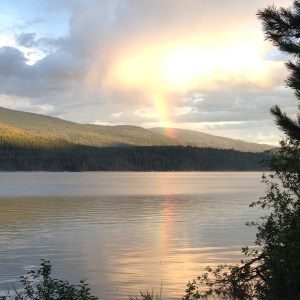
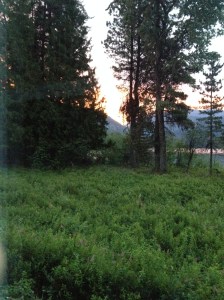
All photographs are lies. That moment preserved, formerly on celluloid but now with electrons, is gone for good as soon as the shutter is snapped. The camera doesn’t see as the eye sees. I was reminded of this during a mountain thunderstorm. I awoke early, coated with jet lag and the residue of my regular early morning schedule. It was still dark, but the reddish sunlight soon wrestled through a valley fed by a creek across the lake. The color was impressive, but my camera washed it out to a diluted Creamsicle orange. In reality the clouds were roiling overhead and lightning was streaking through a thunderhead like synapses firing violently in a massive brain. Thunder in the mountains can’t be photographed. Nor can it be forgot.

My work used to require quite a bit of travel. Before I would visit a campus I would spend some time on faculty pages, trying to put faces together with names. Impressed with how young these professors were, I’d knock on doors armed with foreknowledge of who might greet me. I wondered who these older people were when the door actually opened. It’s disconcerting to see someone age before your eyes. I would think back to the photographs online that had assured me this person would be much younger. The picture was a fossil. A moment frozen in time. The very next second after the photo capture that smiling face had changed. The best that we can hope for is a gross approximation.

Perceptions of reality, as all religions teach us, contain a healthy dose of illusion. While it contains ethereal beauty, this vision I’ve captured in my lens is only part of the picture. There is something deeper, more meaningful behind it. Photographs enhance memory. In the days before Photoshop they could be submitted as proof of an occurrence. They are a form of art. Whatever else they may be, they are also lies. Lies need not be of evil intent. Religions try to explain what some privileged individual realized was the truth. These who found a way of looking behind the photograph. The streaking lightning outside evades the slowness of my finger on the button. The thunder rolling and re-echoing through these valleys will remain in my head long after the sound waves cease to reverberate. Reality is more than it seems. Even my experience of this mountain thunderstorm is that of a single individual seeking enlightenment. Elsewhere others are up early, observing it too. What they experience may be something very different from me indeed. I have a photograph to prove it.


Weather Vain

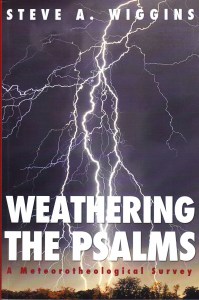
The other day I was awakened by a severe thunderstorm. It’s been quite a while since that’s happened. Unlike when we lived in the Midwest, thunderstorms in New Jersey tend to be widely scattered and somewhat uncommon. (It’s all a matter of perspective, I know.) My basis of comparison is how often I notice such storms. I’ve never been able to sleep through one. Thankfully this one came at around 4:30 a.m., past when I’m usually awake on a weekend. I’d forgotten the raw power of just how loud and bright such a storm can be. Danger seems all around. The feeling is primal and urgent. As I got out of bed and walked into the dark kitchen, windows filled with electric blue followed by and tremendous blast, I thought once again of Weathering the Psalms and the story behind it.

By the way, when I speak to young scholars about publishing I tell them this isn’t the way to go about finding a topic. That having been said, my book was born in the Midwest. Life at Nashotah House revolves around required chapel twice daily. Weather does not stop it. In fact, holding the daily office by candlelight because a storm had knocked out the power was not uncommon. Morning and evening prayer—indeed, all of the canonical offices—are built around the recitation of the Psalms. Reading the Psalter in slow, stately tones while thunder raged outside, rattling the ill-fitting stained-glass windows, left an indelible impression. It was only natural in such circumstances to notice how often the Psalms mention the weather. Thus a book was born.

I’m currently at work on a new book. I can’t say the topic just yet because someone might be able to beat me to it. (Knowing the way I come up with book ideas, however, I doubt it.) Sitting in my darkened living room, in my writing chair with the fury just outside, I was strangely inspired by the storm. Then it was over. Silence followed by birds singing, just like in Beethoven’s sixth symphony. The thunderstorm is one of nature’s psalms. As at Nashotah House, in the Midwest we had perhaps too many of that particular kind of psalm. Nevertheless, in the silence that followed I was left strongly in touch with my muse. These are the states that lead to poetry and song. Every great once in a while they might even lead to a book idea. As I tell students, just don’t expect that anyone else will get it.


Whither the Weather?

The weather which we’re having, showing the impact of imaginary global warming, has been quite dramatic of late. I recently had occasion to be out driving during one of the more intense weather events when the sun broke through only to reveal an impressive array of clouds heading in—all the way from the ground to the gray ceiling of the firmament itself. It was quite beautiful in a threatening way. Of course, I’ve been fascinated by the weather for years, going so far as to write a book about weather in the Bible. A friend recently sent me a story reminding me of an under-recognized aspect of witchery. Our standard cultural myth suggests witches are all about casting spells on your cow, or your family. In reality, many witchcraft accusations were about bad weather.

The story by Pollyanna Jones, “Storm Callers—The Art of Weather Magic,” describes beliefs in witches and weather magic. I couldn’t help but think of our current situation. We live in an age of empowered climate change deniers who also happen to be misogynists. Can this be mere coincidence? 45 and others of his caliber seems to think that women are the cause of all masculine problems, which are, after all, the only problems that really matter. The red states do seem to have a preference for the dark ages, overall. I don’t need to worry about them reading this because electricity is of the Devil and the internet doesn’t really exist. It’s amazing how liberating blinders can be. February was spring this year and April feels like January. Must be some woman to blame.

The truly tragic aspect of this tiresome repetition of misogyny parading as righteousness is that the myths behind it have been thoroughly debunked. The atmosphere’s so complex that even with all our understanding of fluid dynamics and chaotic systems we still can’t be sure what tomorrow’s weather will be like. The atmosphere, by definition, is larger than the surface of the earth and is constantly trying to adjust itself like a passenger on a long-distance commute. Yet we go from McCarthyism to Watergate to Reaganomics to 45 rpm, each one as tawdry as the previous attempts to blame the poor for the woes of the rich. “He maketh His sun to rise on the evil and on the good, and sendeth rain on the just and on the unjust,” Scripture saith. That doesn’t sit well with true believers, however. It’s much easier to hunt for witches than to deal with facts.


Blizzard Warning

The dangers of prognostication were well known in antiquity. Most prophets, who didn’t so much tell the future as warn about probable outcomes, weren’t the most popular of people. They knew that feeling of walking into a crowded room and announcing their career had something to do with religion only to have the place fall silent. Cricket chirps. We all have our secret sins we’d rather not have some stranger judge. So it is with the weather. Something like this must’ve been in the back of my mind as I was trying to write Weathering the Psalms. I lived in Wisconsin in the days before Paul Ryan and, like said Ryan, tornados could strike at any time, unannounced. My family and I spent an anxious afternoon or two in the spider-infested basement based on the inherently uncertain predictions of how a nearby tornado might move.

Those of us in the northwest are sitting here wondering about this monster nor’easter. It’s been in the making for several days and the forecasters, unlike the prophets of old, have been hedging their bets. If this massive cold front from the midwest fails to meet up with the intense storm off the east coast we could end up with only a smattering of snow. If the two collide, well, Isaiah, Jeremiah, and Ezekiel together can’t help us. It’ll be like the book of Revelation. Only colder and with far more snow. Oh to be able to predict the future! It would certainly help when it comes to deciding whether to climb onto that bus or not. I mean a simple rainstorm can add two hours to the homeward commute without the threat of a meteorological Trump coming our way. I thought Punxsutawney Phil didn’t see his shadow.

Although predicting the future wasn’t really what prophets did, it didn’t take long before people thought that’s what they were up to. People have always wanted to have the advantage of being able to see disasters before they arrived. Wouldn’t it have been helpful to know the results of 11/9 before Thurston Howell the President was elected? We could’ve bought our Russian grammars and dictionaries before there was a run on the local Barnes and Noble. At the same time I politely dispute the saying that hindsight is 20/20. If we could see anything that clearly we would be such Untied States at the moment. Right now the glass seems to be falling and the wind’s picking up from the northeast. What does it mean? Nobody really knows.


Seeing Thinks

Look, up in the sky! It’s a bird! It’s a dude! What what is it? It’s actually a cloud. I enjoy the entries on Mysterious Universe, but sometimes a cigar is just a cigar. It seems like decades since I laid down on the ground and looked at the clouds, seeking shapes. The sky is nature’s cerulean canvas and although they’re just water vapor, clouds take on endlessly fascinating shapes. Since religion has historically been projected onto the sky, many people take signs in the sky as somehow divine. The photo on Mysterious Universe is of a cloud that some thought was Jesus and others thought was Mary. Herein lies the rub of pareidolia. You see what you want to see.

There is, in traditional Christian thought, a world of difference between Jesus and Mary. You really don’t want to mix the two up. I mean one is divine and the other is only venerated. Don’t want to cross that line into worship because idolatry leads to all kinds of trouble. So who’s in the sky? Someone that we should perhaps think sacred: water. In a world quickly running out of fresh water (of course since now, officially, there is no global warming we’ll have to find another way of explaining our disappearing ice caps) we should all perhaps worship our clouds. The harbingers of fresh water. It won’t last forever.

I, for one, complain when it rains too much. I suppose that’s because I’ve lived most of my life in the rainy climates of the eastern United States and Scotland. Days can pass without a glimmer of sunshine. I get depressed and truculent. Yet the freshwater falls. Water tables are replenished. In much of the world—indeed, in much of the United States—it is not so. Water shortages are bad and are growing worse. We use far too much and when the ice caps are gone, the largest reserves of freshwater on the planet will be empty. Then again, capitalists have never been too keen on saving up for the future. Most of us alive today, at least in the rainy climes, will have our lifetime supply. The future, however, looks pretty hot and thirsty. So who is it in the sky? Could be either gender—wearing robes makes it hard to tell at this level of detail—but whoever it is, let’s hope they’ve brought plenty of friends with them.

Look like anybody you know?

Look like anybody you know?


My Stranger’s Keeper

img_3106

He was a bearded young man, maybe in his twenties. He kind of reminded me of my own youth, only cooler. I was at a stop sign on a snow-covered hill with tires honestly a little more worn than they should’ve been. Three times I tried to get some traction only to have to reverse and give it just a touch more gas. He walked by and called out “On the count of three, okay?” I shouted my thanks. It took him a couple of minutes to get me moving and as much as I wanted to stop and give him something for his efforts I knew that if I did I’d be right back where we’d started. Once I got moving, I had to keep going. I’ve driven in snow since I earned my Pennsylvania license in the snow belt of Lake Erie and I’ve helped drivers stuck in snow a time or two, but I was touched by this young man helping an older guy in a neighborhood he didn’t know get out of a jamb. That’s what I think of Americans as being like.

Seeing the utter selfishness of those “elected” officials posturing over the last few days I say to myself they didn’t grow up in the snow and cold. Nothing compels a young man with better things to do to help a frazzled older guy except for common human decency. Those who grow up with hardship know the value of their fellow human beings. We help each other because that’s what people do. Those born to wealth and power help themselves and only themselves. They need to learn the message of snow. Nature is our most natural teacher.

I don’t know his name. He didn’t have any idea that I had four hours to drive through snow, sleet, and freezing rain, but he helped me despite that. He didn’t ask for any money and I’m sure he expected nothing so coarse. I’m old enough to miss such kindheartedness and to cherish it deeply when I encounter it. Snow and hills and bald tires aren’t a winning combination, but the human capacity for goodness mixes well with any conditions. On a cold winter’s day I encountered the warmth of human concern for a guy in trouble. I need to listen to what the weather is saying more closely. More than that, I need to step out of my car more often and throw my shoulder against a stranger’s hatchback. It’s what makes us human.


Sundog

IMG_2784

Spring has been taking its time to arrive here in the northeast. Just when things seem to have set on a course of identifiable progress, the temperature drops twenty degrees and the rain sets in again. It’s been great weather for toadstools. There are bright patches, however. I read on the bus, but one day last week as we were trundling toward New York City I glanced out the window. The sky was mostly clear and a sundog shone brightly to the north like my own personal star of Bethlehem. Sundogs feel like good omens. I’ve read enough about meteorology to know that they are merely a refraction of sunlight due to ice crystals high in the atmosphere. Depending on your angle of view, they might appear as a halo all the way around the sun, at which point they’re no longer dogs, or, at certain times of day they may appear as a solid beam coming down to earth in the form of a sun-pillar. It’s only ice and light.

Those of us who stare long at the sky know that the weather is merely a metaphor. The earth spins. It revolves. It rotates. It’s cold at the tips and warm in the middle. The laws of physics—unbreakable they tell us—state that all bodies seek equilibrium. A constant California temperature. If humans should survive long enough we might find our globe of uniform temperature, smooth as a billiard ball, and utterly lifeless. We need the variations of our weather. The chill of a spring that just won’t warm up. The heat of a summer that wilts down to the roots. Ice and light.

I’m heading into a large city. It’s a quotidian trip that some might suppose to be void of meaning. The sundog follows us for a while until it’s lost in the skyscrapers of human devising. Towers that over-reach but which the gods have to bend down to see. Nobody knows the origin of the term “sundog.” My favorite explanation is from Norse mythology where wolves pursue the sun and moon to consume them. This feels so appropriate to me as I enter the artificial canyons of hubris, glass, and concrete. As the day progresses the sundogs appear to disappear. Towers continue to grow. Beyond them, high in the sky, ice and light will continue their play, even if the dogs never do reach the sun. Refraction of light may cause things to manifest as other than they truly are.


Under the Weather

A friend, knowing my penchant to watch the skies, sent me a story about the British and the weather. The story by Alastair Sooke on the BBC’s cultural page is discussing Alexandra Harris’s book Weatherland. I have to admit that I haven’t read the book (yet) but the report of it appeals to someone who’s written a book on the weather, but for a much older timeframe. According to Harris, according to Sooke, the British are rumored to be obsessed with the weather. While living in the United Kingdom, my wife and I observed this. It is not merely casual conversation when someone discusses the weather. It is a serious topic. For a nation so accustomed to rain and gloomy skies, the weather has a religious import. It rarely goes without comment. I suppose that’s the point I was trying to make in my book. The weather is important. Vital, in fact, to human survival.

What really caught my attention here, however, was Harris’s observation that weather is used to characterize mood. Sooke mentions ice and snow and melancholy. The image is vivid: early Anglo-Saxons turing a wary eye to a winter sky with its low clouds and preternatural chill. It is so universal, it seems, not to require comment. Yet at the same time, weather can be a great trickster. C. S. Lewis once wrote that the image of the Arctic north filled him with an inexplicable joy. Winter can be fickle that way. In the world of the Psalmists, rain was a blessing and a weapon. How you look at it depends, well, on your mood.

DSCN0904

The British may take their weather more seriously, on a day-to-day basis, than those of us across the Atlantic. We tend to treat the topic casually. In reality, it is just as serious here. Drought, which has gripped the western half of the country for about half a century now, is a serious concern. Winter storms, hurricanes, tornadoes. A lightning storm can still be a theophany. (One awoke me in the middle of the night, just hours ago.) Weather impacts our bodies as well as our moods. It is all-pervasive, but we generally don’t like to articulate it. I suspect our understanding of the weather says more about us than we’re willing to admit. Our British colleagues, however, are less squeamish about the topic than we tend to be. There’s more to the sky than it might appear.


Illusions

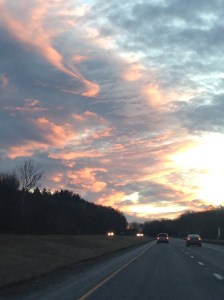
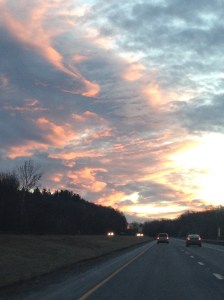
While out driving one winter evening, the sun was setting below a distant horizon that I couldn’t see. Trees lined the sides of the road and, while creating not exactly a tunnel, they blocked the actual view of the orb itself. The day had been partly sunny with cloud forms shifting between layers of the atmosphere. Even though I had studied weather pretty intensely for a number of years, I couldn’t readily identify the cloud types. Thin, smooth lengths of cloud seemed to be suddenly rising up into cumulus banks, heavy with snow. Not far away, the sky was clear. As the sun was going down, these dramatic clouds were lit with the colors of fire: yellows, oranges, and reds. Further to the west, a high, broken bank of clouds glowed a rosy red against a twilight sky. Since the highway we were on was straight, I had a fairly consistent view of the warm tones of the sun highlighting the impressive clouds. My camera couldn’t hope to catch the intensity of the palette revealed to my eyes. When the sun finally fell beyond the range of the clouds, they appeared gray and prosaic against a darkening sky. They had been alight only moments ago, and now they were dull, and not even white.

IMG_2657

What I’d learned of physics reminded me that even these colors were not inherent to the clouds—colors are simply reflections of light rays and the range that we see depends on our eyes. An object’s color, in other words, is a kind of illusion. It’s an illusion we share, and although some people are color-blind, we make the conventions of color part of everyday life. Red means stop, and green mean go, for example. Objective reality is simply the fact that objects reflect different wavelengths of color. Depending on the light source, they appear a specific color to us. While we take colors for granted, they are actually a way of conveying meaning that isn’t entirely real.

Ancient people looking at the colors in the sky could only understand them as caused by the activity of the gods. Bright hues in the clouds suddenly diminished to gray could be the basis for a myth of heavenly conflict. A rainbow, according to Genesis, is a sign that such a conflict is finally over. I don’t know what the gods might have been doing overhead that night, but as the sun disappeared and a full moon rose, throwing soft, but pervasive light from the broken clouds that have only moments before had appeared red, another reality seemed to be taking over. I suspect that we have lost much by no longer watching the sky. My daily work generally involves sitting in a windowless room, and in Midtown the sky is occluded with human attempts to climb to heaven. When I can see the sky for an extended period of time, it seems that the gods are putting on a show, if only we’d watch.


Silent Light

One of the first things I notice during and after a snowstorm is the silence. Part of it, I suspect, is the dampening effect the blanket of snow has on ambient sounds, but another part of it is the lack of usual frenetic human activity. Here in New Jersey it often feels like being in a perpetual motion machine. People are always going some place. Movement is constant and even if I have to head to the airport at 3 a.m. there is other traffic on the road. We are all too busy. Snow has the power to make one stop and reflect.

We live on a fairly busy street since we’re just a couple blocks from the county hospital. Further along our street in the other direction are the county jail and social services offices. People are going by constantly. When yesterday’s snow began, the traffic died down. For once people seemed to take forecasters seriously—driving would be dangerous, and the snow would keep coming well into the night. By mid-afternoon we had more snow in my town that I’d ever seen at a single time during my decade in New Jersey. It was as if winter came in a single day. But it was quiet. Very occasionally a snow plow would rumble by, but most of the day our busy street was deserted. A few kids ventured out, but not many since this was a blizzard (the definition of which is that wind is strong enough to lift snow off the ground and make it airborne again). The silence was almost disorienting. It was like living at Nashotah House once again.

DSCN6193

Silence has long been understood to be a spiritual virtue. Both eastern and western religious traditions recognize the value of listening. The noise may be internal or external, but it is nearly constant. Taking time to try to shut it out, if only for a few minutes a day, can be a spiritual exercise. A snowstorm can help to quiet the constant reminders that we have to do this or that, or that we have to be here or there. During a snowstorm we only have to be where we are, and we only have to do what we’re doing. Soon enough the roads will be cleared and the traffic will begin again. Until it does, however, it is worth exploring what the silence has to offer.


Storm Watch

Nothing encourages sleeping in like a blizzard. Although it’s a talent I’ve largely lost over the years, hearing the bellows of the wind and seeing the white reflecting through the blinds, and being a Saturday morning form the perfect recipe for letting my brain relax enough to fall back asleep after I’ve awoken. It’s a guilty pleasure that I had, quite honestly, nearly forgotten. Unlike several winter storms predicted last year, this one has actually come to pass. Prediction of the future may be one of those “God-of-the-gap” things, but meteorologists are modern-day prophets. In a society driven by work uniformity, days off are unwelcome, so a weekend blizzard might just seem to come from God. The highly anticipated list of school closings simply doesn’t apply. Many businesses still recognize the sanctity of the weekend, and we can just roll over and go back to sleep.

In ancient times the weather was anything but natural. The sky—so large and so far away—was purely the realm of the divine. The only way to impact it from down here was to pray and sacrifice and hope that it would behave. Getting back to that view of the world is nearly impossible here in the twenty-first century. We are so accustomed to natural causation that it is just one of those “butterfly effect” things. In truth, though, we know that human activity also has to share some blame with the butterfly.

Winter storms in January are not uncommon in the northern hemisphere, of course. January hurricanes, however, are. And as political rhetoric heats up and we once again ponder what it would be like to have another clown in the White House, global warming is dismissed as just another bad joke. As a nation we’ve been enamored of those who can provide the most entertaining gaffs and still claim they know enough to lead the nation. I have a hard time believing those who voted for Reagan had any success at separating fiction from fact. I still can’t convince myself that W was legitimately elected. The second term of both of these actors freezes me as much as the chill draft making its way through my apartment. The meteorologists nailed this one with their predictions. I’ll stay inside and huddle under my blankets until the all clear. And that may not be until well after November.

DSCN6166


Rutgers Presbyterian

It is indeed an honor to be invited to address a church group on topics that matter. While I didn’t directly address global warming in my book, it was in my mind as I wrote it. Early in my teaching career, I wasn’t sure how to cinch up the gap between the lexicography I was attempting and the real world issue that it should address. The seminar portion of yesterday’s program focused on topics associated with the weather, and I was gratified to hear that many of those present felt that a profound weather event had made an emotional impact upon them. Weather has a way of reminding us that we’re small and that forces beyond our control still exist. I’d forgotten how nice it is to while away a few hours with intelligent people who think about the world we all inhabit. I only wish I could have recorded all the wisdom I heard. We tend to think if someone’s not speaking to us from a major media outlet they’re not worth listening to. I am glad to be reminded that this is not so.

IMG_2515

During our discussion of global warming, the question arose as to what we could call “climate change” to make it appropriately terrifying. Various suggestions were made such as poisoning the sky, suffocating the earth, and old-fashioned, and to-the-point air pollution. We are a species that seems bent on its own destruction. The atmosphere is so incredibly large, but, as our host reminded us, so very thin. Life is supported only in what might be considered, in his words, a thousand-story tower. Beyond that, life runs out. We need to take the limited nature of this small envelope of gas surrounding us seriously.

I’ve come to realize that my fascination with the weather largely derives from looking at the sky. Such an activity is so basically human and so profound, that we simply overlook it most of the time. The sky is superior to us. It was, for most of human history, far out of reach. We have stretched our hands up to the realm of the gods and smeared it with our industrial filth. Many of those present, although not Catholic, applauded the Pope’s insistence that the world must be view holistically and that we must stop polluting our home. Pollution used to be an ugly word, but we have been taught to change our language to add ambiguity. “Climate change” is so neutral, with no one to blame. But it’s not at all accurate when it comes to the real costs. We’ve already impacted the weather for a millennium into the future at least. And I, for one, left our session optimistic that intelligent people cared enough to spend a beautiful Saturday afternoon discussing it.