
 Those of us with scientifically oriented minds, but with affinity for the less quantifiable aspects of life, tend toward academic study of the humanities. It is not unusual for someone with a background in the hard sciences to dismiss such “softer” fields as less rigorous at best, or, at worst, a sheer waste of time. Many people in the humanities cower under this cloud of being considered somehow inferior for not being able to put numbers to everything. I suspect that’s why I find neuroscience so fascinating. While still teaching at Nashotah House, I would prompt students to think that whatever decisions they made about ancient texts, those decisions were mediated, in a very real way, by their brains. We don’t understand brains completely, but I’m amazed at what we have discovered so far. Years ago I read the book, Why God Won’t Go Away. It was an eye-opening study of what brain mapping reveals during states of religious inspiration, or at least, intense meditation or prayer. We can, to an extent, see inside someone’s head while they are communing with the other.
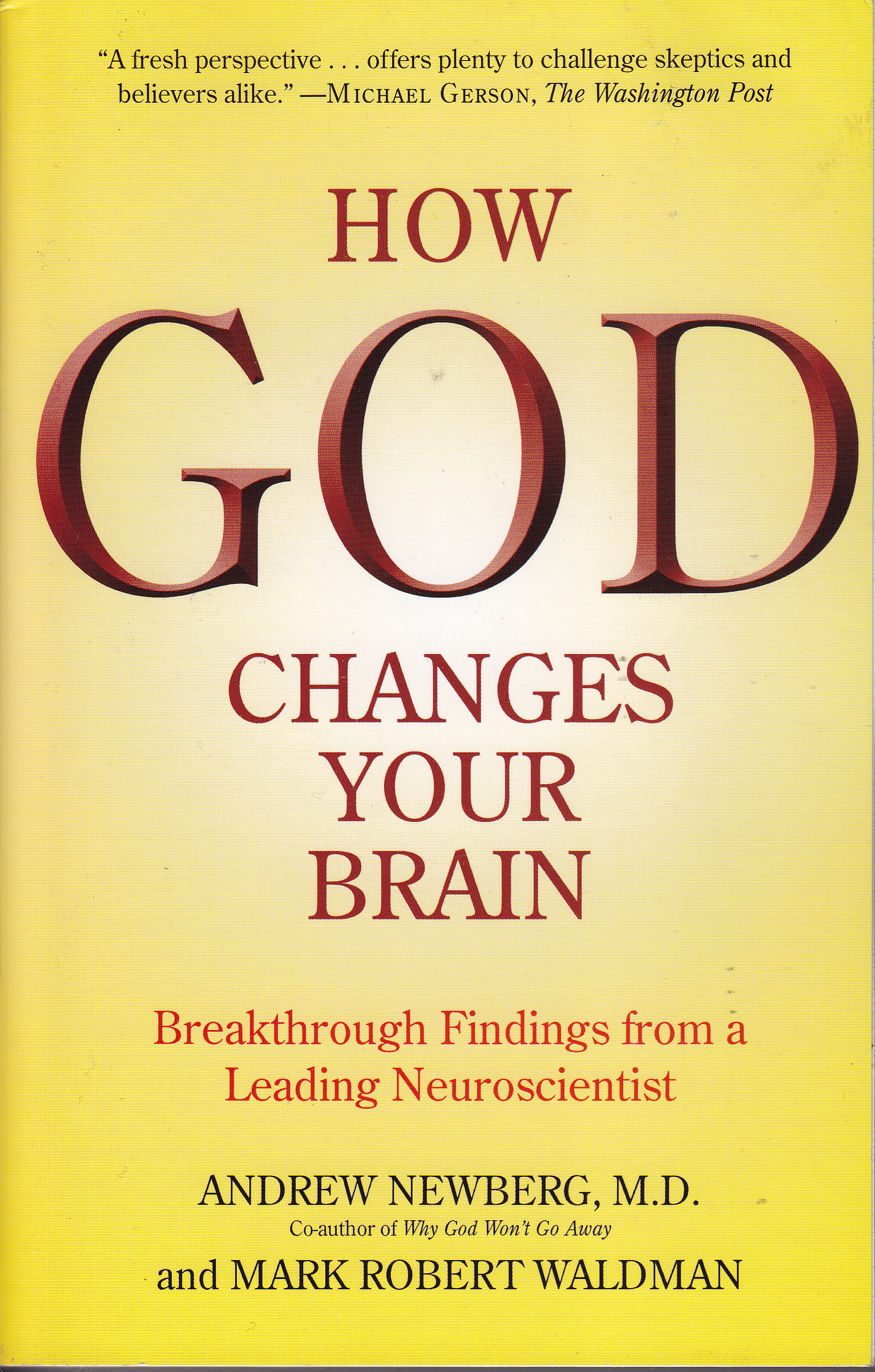
I recently became aware of the new book by Andrew Newberg (lead author on Why God Won’t Go Away) and Mark Robert Waldman, How God Changes Your Brain: Breakthrough Findings from a Leading Neuroscientist. I was a bit nervous at first, since I couldn’t recall how reductionistic Newberg was in his initial book on the subject. Neuroscientists sometimes perceive the world as being, in a sense, as all in our heads. I was pleased to see that Newberg and Waldman recognize that the “God question” is an open one. They address it right up front. I was drawn to the book because of one of their conclusions that had leaked into the footnote of something else I’d been reading: the brain changes as soon as it is introduced to the concept of God. Brain wiring is continually changing, but the takeaway here is that as soon as we introduce our children to the God concept, their brains will not unlearn it. It stays with us for life. Changing concepts about God is therefore quite difficult. Few even try.
This book, however, doesn’t see this as necessarily negative. In fact, the authors challenge the horsemen of atheism in that all studies seem to indicate that religion is actually good for you. Particularly meditation. In a world that is increasingly run on stress (just ask any business-person) this is an important reminder that prayer, or meditation, can actually heal some of the brain damage caused by life in a stressful environment. The nice thing about this is that the empirical evidence seems to be pretty strong. Our brains seem to be telling us to relax, step back, and not take all of this so seriously. Those are layman’s terms, of course, filtered through my brain. Even reading this book made me feel much more relaxed. It reminded me why, for much of my life, monastic living has seemed so very appealing. Instead, I live in the secular world with its many rewards and stresses. If I learned anything from this wonderful little book, I will be spending a bit more quiet time each day, and won’t be feeling guilty about it at all.

 Steve A. Wiggins