Tambora Crisis

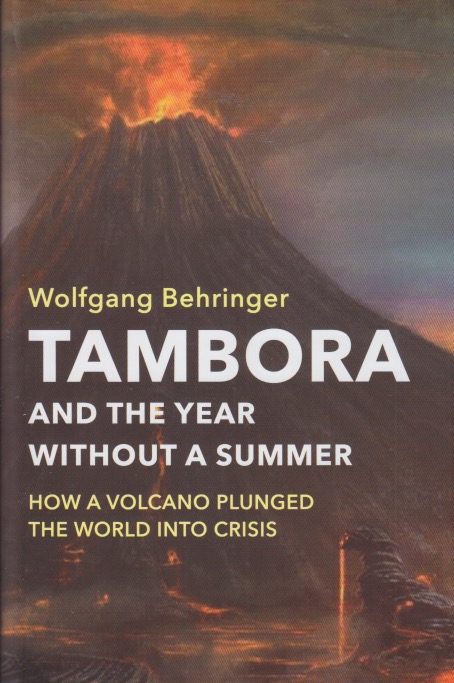
The name Wolfgang Behringer was familiar to me from his book Witches and Witch-Hunts, which I read several years back.  I’ve been interested in volcanoes lately, and Tambora in particular.  So when I saw his Tambora and the Year without a Summer I decided to indulge.  What Behringer attempts here, as indicated by his subtitle, How a Volcano Plunged the World into Crisis, is a massive undertaking.  The result is a rather rambling history that covers many of the troubles of the early nineteenth century, which, ultimately, were influenced by the crisis triggered by Tambora.  For context, the eruption of Tambora in 1815, in what is now Indonesia, was the largest volcanic eruption in recorded history.  It famously led to “the year without a summer” in many parts of the world, but, as the book points out, the effects were uneven.  Western Europe was cold and wet.  North America was cold and dry.  Both of these situations led to famines and many people died.

Nature doesn’t play favorites, though. Weather is variable, and local.  Eastern Europe, and Russia, experienced nearly ideal conditions for agriculture.  There was enough food to go around, but what was lacking was the infrastructure.  Western Europe was still putting itself together after the disruption of Napoleon and his wars.  The Americans were still recovering from fighting off the British.  And, being German, Behringer spends a lot of time explaining what was happening in Germany.  Reading this kind of spurred me onto a little genealogy kick, since much of what he describes took place in the regions where my mother’s ancestors were from.  That’s why I try to read widely—it has a Gumpian outcome, sometimes.  

The inherent problem with a global history is that the world is simply too big, and human history too long and voluminous, to fit it all into one place.  There were no doubt many crises caused by the atmospheric changes to which Tambora contributed.  There were also many innovations.  Behringer makes a good case that the Tambora crisis led to the development of meteorology as we know it.  The regular and meticulous keeping of weather records began around then.  Savings banks also emerged.  As always, those who suffered the most from the famine were those who couldn’t afford food.  In response, governments encouraged people to save up for a rainy day (or year).  And the early development of life insurance, again to help people weather financial difficulties with the death of a wage earner, began.  More about the crisis than the volcano itself, this is nevertheless, a chilling examination of how one crisis can change history.


Any Witch Way

Witches&WitchHuntsIt’s easy to feel smug over the past. At every moment of human civilization we deem ourselves higher than those who came before. There’s no doubt that the eradication of the thought-processes that led to the witch hunts of past centuries seems decidedly positive for all parties involved. Wolfgang Behringer’s Witches and Witch-Hunts, however, is a surprising book. I’ve read a fair number of studies of those dark ages when people were cruelly tortured and murdered in horrendous ways because they were deemed to be in league with Satan. As usual in such books, Behringer begins with that history. What makes his study surprising, however, is that he doesn’t stop in the eighteenth century when, in what we’re usually told, the witch trials ended. Behringer points out that witch hunts are still happening, and that the rates of those killed perhaps rival those, per capita, of the numbers during the Middle Ages. How can this be? In an era of global awareness, we sometimes forget that the focus isn’t always on Europe or America.

In many parts of the world, witches are still part of local belief systems. Not all of these are women, by the way. Many cultures favor the male witch. What these cultures do have in common, however, is their natural fear of black magic being suppressed by colonialism. More “civilized” westerners came and enacted laws which, to the minds of the locals, protected the witches! Local tradition of eradicating those who practice black magic was considered righteous, and now the government forbids it? That seems strange, especially when many of the colonizing forces were also interested in Christianizing as well. Missionaries wanted to affirm belief in the supernatural, and, ironically, often became the vehicles that allowed beliefs in witchcraft to continue. As Behringer points out, some populations converted to Christianity precisely because it allowed the continued belief in physical evil—therefore witches—and the eradication thereof.

This creates a vexing problem. When cultures meet they inevitably attempt to assert their values. When the technologically superior force their ways of life on those behind on that front, a kind of pressure of misunderstanding builds. Instead of bringing witches to trial, they lynch them instead. It seems we may have underestimated the pull that belief in witches has on people. Traditional societies uninfluenced by the developments in Europe also came up with the idea of witchcraft independently. Witches, it seems, stand for the classic issue of theodicy—explaining why things go wrong in a world that should be ordered by deities. Coincidence is always cold comfort in explaining loss. Even the rule of law breaks down. At the same time, how can it be right to allow the murdering of those suspected of witchery even in the enlightened twenty-first century? This fear is one of our most abiding demons, and the solution remains out of reach, unless, of course, we allow ourselves to resort to magic.