
Yarihk Finally Gets a Drink

594px-Full_Moon_Luc_Viatour

Gnu moon

Yarihk once again makes the news as NASA announced yesterday that they have discovered a substantial amount of water on the moon. I’m still reeling as if I’d joined Yarikh at the Marzeah. Although the local paper only deemed it page 2-worthy, this is a paradigm-shifting discovery! The arid, airless, lifeless, dead rock daily racing around our world has suddenly blossomed with new potential. Water on the moon? It seems as unlikely as satisfactory jobs for all graduate students.

Students are generally surprised to learn that in the Ancient Near East the moon was often considered superior to the sun. Given our knowledge of astronomy and physics it is difficult to look behind the curtain to see that it is not self-evident that the moon reflects sunshine without the subsequent development of a scientific outlook. For ancients the moon provided the gentler light that illuminated night — when you really need some light anyway — and was responsible for generating dew, a necessary source of water in regions where summer rains are unheard of. The benevolent moon waxes and wanes, forming a perfect circle and, by degrees, the crescent shape of the horns of divinity, and finally disappearing completely to start the cycle all over.

At Ugarit Yarikh is a thirsty character in text 114. He marries a foxy Hurrian goddess in the myth of Nikkal, a princess much above his station, then he easily fades into the background from the dearth of textual sources. Some have suggested a lunar connection for El as well, the very head of the gods. If El was lunar, perhaps Yahweh also drove the moon. Whoever is in charge, however, thought to pack water for the journey and as we further explore our nearest astronomical companion we will discover that Yarikh is just as interesting as the denizens of Ugarit had suggested.
Who’s Your Daddy?

Is there an epigrapher in the house?

Is there an epigrapher in the house?

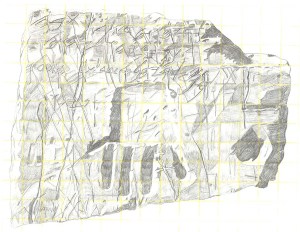
As long as I’ve broached the issue of Yahweh and his Asherah, it would be fitting to consider the supporting evidence of Khirbet el-Qom. The attention of William Dever was drawn to this burial site as long ago as 1969 by a badly striated inscription purchased from an antiquities dealer that had been traced to the location. Indeed, the exact spot of the excised inscription was discovered where it had been removed from a pillar near a tomb. Dever originally translated the inscription with no reference to Asherah and with an admission of its poor state of preservation. It was only after Kuntillet Ajrud was discovered (see yesterday’s post) that scholars began reading Asherah back into this extremely difficult epigraphic puzzle.

Since that time, Kuntillet Ajrud and Khirbet el-Qom have become the requisite two witnesses to seal the case: Yahweh had a wife named Asherah. Now slow down a bit! What does the second witness say? The Khirbet el-Qom inscription is extremely problematic; those who’ve examined it closely do not all agree that “asherah” occurs in it at all. If asherah appears here it is grammatically unwieldy: “blessed be Uriyahu by Yahweh for from his enemies by his asherah he has saved him,” and that’s only if the word really is “asherah.” Although Dever has gone on to write a book about God’s wife, he has never changed his original translation sans asherah. I followed his publications on the topic to see his revised translation, but surprisingly, he defers to others, some of whom have never seen the original. Am I the only one who sees something odd here? Only after “Asherah” appears in a grammatically awkward way from Kuntillet Ajrud does she get back-read into Khirbet el-Qom, in an even more awkward syntactic construction, and voila! Yahweh is happily wed!

My scholarship suffers from no conservative agenda, and I cannot be accurately classified as conservative by any stretch of the imagination, but I simply cannot
abide sloppy scholarship (and I’m the one without a full-time job!). It seems to me that if Yahweh was married, even if so considered by a tittering band of heterodox Israelites who liked to hang out in tombs and scrawl graffiti on public property, we would find some solid indication. So far all we have is ambiguous references to Yahweh of Samaria (and Tema) and “his asherah” at Kuntillet Ajrud and a badly defaced inscription from Khirbet el-Qom that may or may not even mention “asherah.” I cannot see this as strong evidence for a case of divinely wedded bliss.


Here Comes the Bride – Maybe

Kuntillet

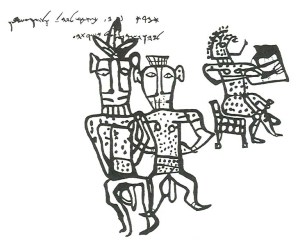
This is one of my favorite doodles from the ancient world. Its rich ambiguity lends to its appeal — some see it as salacious, while others see it as sacred. For those of you unfamiliar with the graphic details of the Asherah debate, this image is an ancient graffito from a desert way-station called Kuntillet Ajrud, a one-period site from the eighth century BCE. Like any number of other ancient drawings, this one would have probably remained in the obscure curios-portfolio of ancient scholars if it hadn’t overlapped an inscription that mentions “Yahweh of Samaria and his asherah.” Discovered in 1975–1976, this inscription, along with a couple others, revolutionized many scholarly assessments of ancient Israel’s religion. Yahweh had a soft side after all, a wife no less, the old god!

I’ve taken some flak in my circumscribed academic career for suggesting that this inscription, and a perhaps somewhat similar one from Khirbet el-Qom, are ambiguous. Sure, I’d like to see Yahweh happily married as much as the next guy, but is that what is going on here? Yahweh and Asherah, sittin’ in a tree? My doubts don’t stem from a squeamish conservatism (come on!) but from a concern of over-interpreting ambiguous evidence. Asherah, as a goddess, was rediscovered with the excavation of Ugarit. Forgotten by time with only cryptic references in the Hebrew Bible to some kind of cultic item called an “asherah,” scholars were excited to learn that she had a body and a personality. Many aspects of that personality fit, circumstantially, with a lovely pairing with Yahweh; wherever Asherah appears she is the consort of the high god, she is royal, matronly, and never showy.

The image above, however, has nothing to do with the inscription it overlaps. The two larger figures in the foreground are clearly Bes, the minor Egyptian protective deity. The characteristics are so clichéd that only the will to see Yahweh and Asherah arm-in-arm suggests anything different. Scholars like a happy ending just as much as anybody else, but I am obligated to state that, taken objectively, Asherah simply isn’t in the picture here.


Of Cats and Goddesses

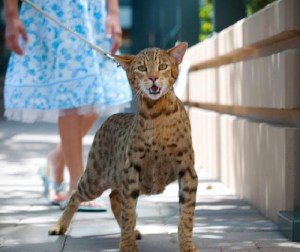
During one of my periodic forays into current Asherah lore on the web, I discovered a new breed of cat. Well, actually, I didn’t discover it, I just became aware of it. Because of a misspelling on a website I learned that the Ashera (trademarked name!) is the most expensive cat in the world, retailing for $22,000. A blend of three species (the mind boggles), the African Serval, Asian Leopard, and domestic cat, this feline comes in at least three varieties, including the especially appropriate Royal Ashera. If you’ve come into an inheritance and want to waste a few grand, take a look at Lifestyle Pets to see the wonder.

According to Kirta she has a temper!

According to Kirta she has a temper!

Curious, I searched to find if anyone would tip a hand as to where the name of the cat was derived. Choosing the name of the queen of the Ugaritic divine world seemed a little too much coincidence for me, but then again, homophones happen. When the Prince of Egypt, Dreamworks’ answer to The Ten Commandments, was released, I had several people ask me why the Israelites were singing about “Asherah” after they crossed the Red Sea. I had to watch the movie very closely, but I figured out that they were singing “I will sing,” which, in Hebrew, sounds suspiciously like “Asherah.” I never did discover Ashera’s origins.

Cats, however often maligned as associated with witches and vampires and other creatures of the night, are certainly among the most divine of domesticated pets. If I were free to purchase an animal companion the Ashera would be in the ranking (after I’d won the lottery, of course). Whether intentional or not, who would not want to own a cat named after the only goddess to be mentioned in connubial relations both to El and perhaps even to Yahweh? (The latter association, like the naming of the cat, is entirely open to question!)