Confidential Hazing

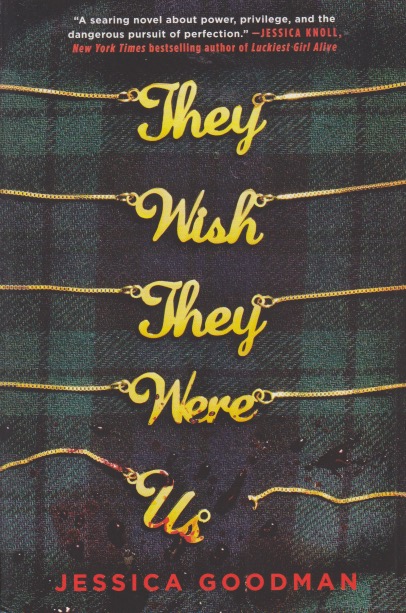
Set in a Long Island prep school, among a somewhat secret society called the Players, this is a dark academia tale of murder and discovery.  The Players, usually numbering eight in the senior class at Gold Coast Prep, are down to six.  One of their number was murdered and the one who confessed to that murder has been jailed.  Most of the students are extremely wealthy, but Jill Newman isn’t really rich.  This is what lies behind They Wish They Were Us by Jessica Goodman.  Although technically a young adult novel there are several disturbing elements here, some worthy of Lord of the Flies.  For that we need to dig a bit deeper.  To become a member of the Players, hazing is involved.  Since this isn’t an official program of the school, the hazing is entirely controlled by the seniors who are Players, to initiate their underclassmen into the club.

Some of the hazing is pretty intense, even for an adult reading the novel.  Kids aren’t always good about thinking through the consequences of traumatic activities on other kids.  People tend to be resilient, but at the same time scars heal in different ways.  In the course of one of the hazing tasks, something goes wrong and one of Jill’s friends, her best friend, ends up dead.  Since there’s a lot of drinking and drugs involved, it isn’t always easy to piece together what might’ve happened.  The crisis occurs for Jill when her younger brother joins the Players.  She has to watch him face the hazing, and at the same time comes to have suspicions about what really happened to her best friend.  Things get pretty tense.

As adults we can easily place ourselves, in our minds, back to our teenage years.  This is something that we didn’t appreciate as teens, and even now most teens don’t realize this about adults.  Wisdom, hopefully, comes with age.  In this fictional setting, rich adults are seldom around.  Their kids, with access to nearly unlimited money, can set their own rules.  Even the police treat them differently.  I’m deliberately not saying too much about the story since it would be too easy to give away the ending.  The school officials in the book care more about preserving the reputation of Gold Coast Prep than they do about the welfare of their students, even if this leads to blackmail to maintain its good name.  And this is something that teens will come to understand only once they start to work for a company with its own secrets.

Club Frankenstein

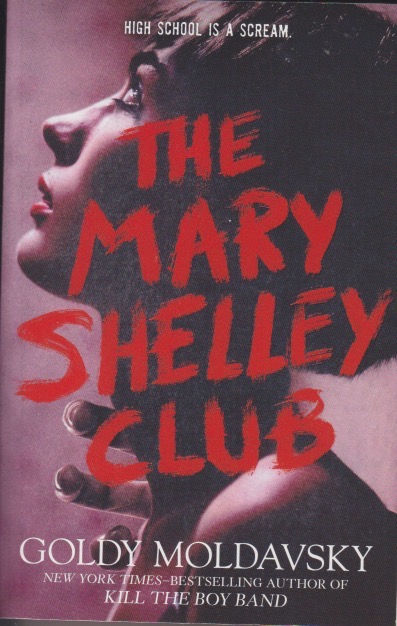
Reading YA novels once in a while reveals that younger folk have quite a good selection of literature from which to choose.  Goldy Moldavsky’s The Mary Shelley Club is a good pick for horror fans as it takes several cues from horror movies and mixes them with the anxieties of high school.  Rachel Chavez is a new student at Manchester Prep in New York City.  Her mother moved her there after a break-in and attack at their old home on Long Island.  With really only one friend at her new school, she finds out about the secretive Mary Shelley Club which meets to watch horror movies—or so she thinks.  Rachel then learns that the club’s real raison d’être is to play a game called Fear Test in which a targeted student is frightened, sometimes to death.  Rachel settles in the the club, being a horror fan, but grows increasingly uncomfortable with the game.

I won’t say much more than that about the plot, but I will say it is compellingly written and a page turner.  I didn’t quite buy the resolution, but that’s often true of horror movies.  It captures well the anxiety of high school, and of moving to a new location.  And Moldavsky certainly knows her horror movies.  I sometimes ponder what makes a novel YA.  I suppose it’s the focus on high school/college kids and a restrained vocabulary, shall we say.  While there’s no explicit sex scenes, there is some making out with intent here (this isn’t a romance), and there are a few f-bombs dropped.  And there is a body count.  Still, for horror, it doesn’t feel as gristly as “adult novels.”  Young people seem to lack the more developed evil of their elders.

My motive for reading it, apart from the horror aspect, was that The Mary Shelley Club is occasionally cited as an example of dark academia.  It’s easy enough to see why.  An exclusive school, wealthy families, and a dark subtext involving a secret society.  These are often hallmarks of the genre.  Dark academia may blend with horror, as it does here, or other genres.  That’s part of its appeal.  In this case the school, Manchester Prep (the name borrowed, it seems, from Cruel Intentions) may not be the center of the story, but it is what brings the main characters together, even if the horror is extra-curricular.  It was a fairly quick read, despite its size, and it bodes well for other good reading while exploring this particular aesthetic.