
The internet bores me sometimes. I can’t keep up with the pace of blogs that chug away like a neverending newsfeed. Information comes at me so fast I want to cower in a corner and start constructing my own printing press from scraps of lumber and bits of broken screws and bent nails. Slow things down a bit. Write something of substance. Of course, electronic information has its advantages – I frequent online dictionaries and thesauri where looking up words is much quicker than flipping countless pages. While hovering on the thesaurus.com page this morning, I noticed one of the blog entries entitled “Relax, Bill Cosby isn’t dead — it was a hoax. Is it true that the origin of ‘hoax’ mocks Christianity?” I’m glad for Bill Cosby’s sake, but what really caught my attention was the subtitle. We are all subjected to hoaxes almost as regularly as we are fed real news. Was this blurb suggesting that Christianity originated hoaxes or had given us the word “hoax”? Okay, too much information, but I had to find out.
The blog post states, in part, “The Eucharist, a central Christian prayer, contains the Latin ‘hoc est enim corpus meum,’ meaning ‘for this is my body.’ Jesus is said to have spoken these words at the Last Supper. The British clergy John Tillotson speculates in 1694 that hocus pocus is not only a corruption of this key Latin phrase, but a parody in keeping with the occasionally vulgar humor of prestidigitators.” Having taught for more than a decade at the avowed queen of “Anglo-Catholic” seminaries, I’d heard the gist of this before. For a blog on a website supporting grammar, however, I winced at “a central Christian prayer” and “The British clergy John…” phrasing. The Eucharist is not a prayer, but a sacrament, part of which is the Eucharistic prayer. Clergy is a collective, not an individual. Not to mention that if one was speculating in 1694 it ought to have been in the past tense.
In any case, the story as I received it was that Protestants coined the phrase “hocus pocus” to abjure the idea that anything “magical” was happening at the Eucharist. Protestants generally held communion to have been symbolic rather than a literal act of changing bread to flesh and wine to blood. So it seems that from a Protestant point of view the Eucharistic prayer was a hoax, but from a Catholic viewpoint it was salvation. As with most things religious, it is a matter of perspective. The word “hoax,” it turns out, likely derives from “hocus.” Having found this gem nestled in among so many grammatical errors, however, shakes my confidence a bit. That, however, is just my perspective.
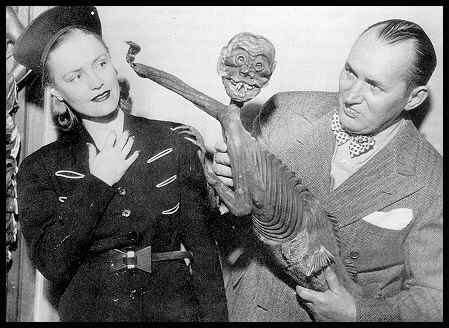
A hoax or Dagon's sister?
 Steve A. Wiggins