
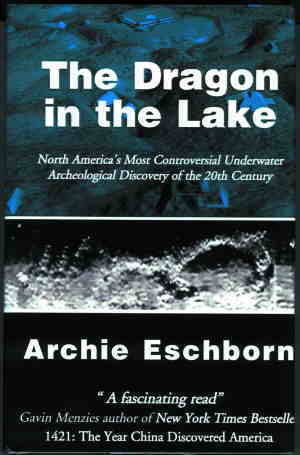
 Confession time: I have little patience for scholars who have already made up their minds before examining the evidence. Anyone who has put themselves through the ordeal of reading my academic publications will know that I do not advocate sloppy research or slipshod thinking. Nevertheless, if we are to be honest about our world, we must follow the evidence. It is for this reason that I sometimes read unconventional material. I am well aware that untrained amateurs sometimes misinterpret what they see (so do trained professionals), but when evidence exists, why deny it? I just finished reading Archie Eschborn’s The Dragon in the Lake. Chalk this up to my having lived for many years in southern Wisconsin, and maybe a touch of nostalgia. I first learned of Eschborn’s book while teaching for a year in the Anthropology and Religion Department at the University of Wisconsin, Oshkosh. The chair of the Anthropology Department had me in his office one day and showed me this book by a “crackpot” amateur underwater explorer who really believed the claims that Rock Lake – between Madison and Milwaukee – actually housed underwater Native American structures.
I visited Rock Lake during my years in Wisconsin, along with the nearby prehistoric site of Aztalan State Park. There is no doubt that Aztalan was a major settlement of Native American mound builders. The structures there, while not quite rivaling Cahokia in southern Illinois, are quite impressive. Aztalan is three miles east of Rock Lake. Rumors of “pyramids” in Rock Lake have circulated for many, many years. The lake, however, is clouded with marine growth and sediment, and although there are undoubtedly underwater features the official line is that they are glacial artifacts rather than human constructions. Eschborn’s book is an attempt to demonstrate the artificial nature of these features. At his own expense and effort, the author built up a small research society, purchased a boat, and spent several early springs and late falls (when the water is clearest) sending divers and sonar scanners into the water to document what is there. While the book was self-published (and could have used some professional editorial attention) it nevertheless lays out solid evidence that Rock Lake does house a mystery worthy of exploration.
While I can’t accept all of Eschborn’s conclusions, I would insist that his evidence demands the attention of those who deny it is even worth investigation. This is less a struggle of evidence versus absence of evidence than it is a struggle against academic arrogance: professionals know better and need not be bothered with evidence. I have personally witnessed this in my own field many, many times. It is what Eschborn calls “ipsi dicit” [sic]; ipse dixit, “he himself said it,” is the assumption that a well-respected authority may be accepted as uttering the truth in principle, based on reputation. Many professionals in this country make their living based on this faulty premise. Eschborn died prematurely shortly after his book was published, before he could launch the next phase of his investigations. While his interpretation of the data may reach too far, the world suffers for the loss of a truly open mind, and the establishment ruling, as usual, still stands.
 Steve A. Wiggins