
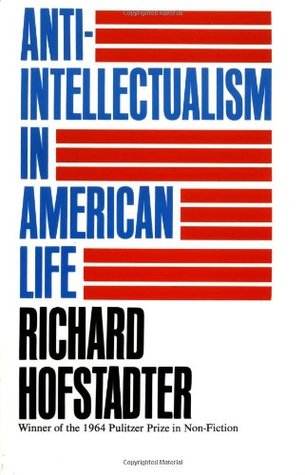
It would only be with the most tentative and hesitant of reservations that a person might call her or himself an intellectual. The denotation carries with it such possibilities and potentialities of arrogance that even being seen reading Richard Hofstadter’s Pulitzer Prize-winning Anti-Intellectualism in American Life in public could be cause for considerable timidity. The end result, however, is so rewarding that it is worth the risk. Seldom have I read a single book that explained so much of what continues to define our society. As an historian, Hofstadter was acutely aware of American self-perception—so much so that it seems foolhardy to distrust him. Although the book was published in 1962, it seems as though the five decades of my life haven’t had time to transpire—things are shockingly similar to the myth of the 1950s that still drives the Religious Right. Hofstadter could be lurking in the corner with his pen even now. I turned to this book because I had grown weary of having felt set upon by a society I have only ever wanted to improve. In tracing the roots of anti-intellectualism Hofstadter clearly demonstrates that the distrust is felt on both sides of the divide. Having not had the dubious benefits of an affluent rearing, I simply followed where my limited talents led. What future is there for a poor boy who likes to read and write? My earliest and most honest aspirations were to become a janitor. At least in that job you can see the filth being scrubbed away.
Expecting an objective historical account of intellectual history, I was surprised to discover that the first section of the book dealt with the privileged place of evangelicalism in early America. I’m not so obtuse as to have overlooked the obvious mockery that the intellect receives so freely from the coffers of Christendom; one need only glimpse the headlines or listen to street-corner evangelists for a fraction of a minute to learn that. I had supposed that my limited experience had made me naïve in assuming religion stonewalls free inquiry. The problem, it seems, is endemic. Those who would suggest that brains are actually meant to be taken out of the box and played with incur the wrath of the almighty.
Hofstadter resisted keeping the gaze too long upon the faithful, for there are clearly other forces at work. The rugged, self-made individualism of a nation that consisted of frontier until comparatively recent times also plays into this suspicion against the self-proclaimed sages. We have all had the displeasure of knowing the self-impressed, and their sticky indulgence in immodesty clings to many who simply can’t turn off the motor in their heads. Instead of walking away from the book feeling justified, I instead felt reflective. My own perceptions have led me down the path of trusting the guidance of the soul (whatever it may be), but the perceptions of others raised in different circumstances lead to materialistic assumptions, or the hunger for power. Deep down inside, though, I know that I shifted perceptions by the slow, steady influence of education. There is no unlearning that. And education has brought us this far. And a little intemperance in appreciating intellectual life may be the most venial of sins.
 Steve A. Wiggins
One thought on “I Pledge Allegiance”