Mediated Reality

According to the Good Book, Methuselah lived nearly a millennium. For all that, the information on him in Genesis occurs in a mere five verses, in a span of seven. We learn when he married, whom he sired, and how long he lived. Not much information of the last antediluvian, especially considering how much time he had. When I searched for him on the web the other day, the information box that showed up on Google had, at the very top, a picture of Anthony Hopkins. I immediately recognized his makeup from Noah, a movie that I just can’t make myself love. The fault for having no other image may be the failure of human imagination—where do we find an image of a thousand-year old?
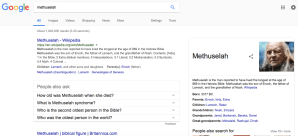
The internet mediates our reality. One of the points of both my books now in the works is that modern understanding of the Bible is largely media based. Few people have the time or inclination to read such a big book. (Given the continued evangelical support of Trump, it’s pretty clear that most of them haven’t read it either.) We want other people to do the heavy lifting and give us a summary in neat little boxes at the top of the screen. There’s far too many things to do in this tangled web to be spending months reading a ponderous, outdated tome, even if it does have plenty of sex and violence. Even if it influences the lives of each and every person living in America every single day. We’d rather have someone else—preferably not some egghead with a Ph.D.—give us the executive summary.

Once I did the math. If you add up the dates in what I used to call “Genesis years,” the year Methuselah died was the year of the flood. The Bible doesn’t say that old Methuselah drowned when the windows of heaven were opened, but it’s a reasonable conjecture. Nature abhors, it seems, a human being living so long. Our bodies just aren’t built for it. Some trees, on the other hand, have been alive for thousands of years. Botanists call them “Methuselah trees” (I told you the Good Book influences everything!). The pity is we know so very little about this ancient human being from days of yore. Was he a good man? He seems to have been washed out in the sluice gates of what became one great universal sewer at the time. Although we know little, his life would make quite an epic movie, I think. We already have an actor lined up, for Google tells me so.

Updates

So, I’m getting ready to update this website. I’ll give you a warning before things change. Another update, however, is in order. I’ve been promising that I’d let you know when my forthcoming book with McFarland received its final title. Well, drum roll please! The final title is actually the first title I proposed—Holy Horror: The Bible and Fear in Movies. And it has an ISBN: 978-1-4766-7466-7. And a cover design too, but I can’t share that just yet. It is appropriately lurid, matching the subject. But in all seriousness, the book makes a case for the fact that many people understand their religion via popular media. Being a bad boy, I look at it through horror movies.

The title Holy Horror was a play on Douglas Cowan’s excellent book, Sacred Terror. I recall reading that book, starting the night I bought it as SBL, curled up in the swank conference hotel bed, turning pages until I couldn’t hold my eyes open any longer. It had honestly never occurred to me that religion scholars could get away with writing about horror movies. Cowan had the natural advantage of being a Canadian, something I’ve always longed to be. He also has a secure university post. I was, at the time, just a guy trying to feel secure in what seemed like (and turned out in reality to be) a threatening seminary position that was shortly to end.

It may be difficult to understand how horror can be consoling. It can. I’m a squeamish guy. I don’t like blood and gore. I hate being startled. Nevertheless, I took comfort in this genre as my career was falling apart. Holy Horror was a cathartic book for me to write. There’s more than a little metaphor in it. One thing that will become clear to readers is that the Bible is no stranger to horror movies. Ironically, many of them are strangely conservative—Carol J. Clover’s classic Men, Women, and Chainsaws (which I’ve reviewed on this blog) made that point clearly. Horror often has the same message as your typical Disney film, although it’s presently slightly differently. How so? Well, I can’t say very much here or you’ll have no reason to read my book. McFarland does a great job with publishing this kind of title. You won’t find it in Barnes and Noble, and not likely in your local indie either, but it’ll be available on Amazon and these days that’s enough. And before long these pages will change to reflect its coming.


Scientists, Unplugged

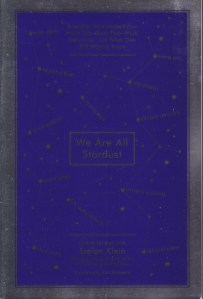
Feeling inferior is common among religionists. When cultures list their brightest and best, scientists often top the list and those who specialize in religion are nowhere to be found. This situation gives the lie to the fact that many scientists think about, and are influenced by, religion. That became clear to me in reading Stefan Klein’s We Are All Stardust. Not Klein’s best-known book, this is a collection of interviews with well-known scientists, unplugged. There are many big names in here, such as Richard Dawkins and Jane Goodall, as well as some less familiar on a household level. Klein, himself a Ph.D.-holder in physics, asks them somewhat unconventional questions, with the goal of bringing a more human face to scientists.

When asked directly, scientists admit to thinking quite a bit about religion. Of those interviewed, several are hostile to it while others accept some tenets of one faith system or another. Most of them indicate that either religion or morality plays an important role in society, if not in science itself. The sad part is almost none of them seem to realize that the study of religion can be (and among the university-trained, generally is) scientific. In academia, religious studies is often vaguely tossed in with the humanities, while others would suggest it fits under social sciences—as a sub-discipline of anthropology, for example. Few understand the field, in part because many specialists enter it for initially religious reasons, somehow tainting it.

While I enjoyed the book quite a lot—it was a quick read with plenty of profound ideas—it also had a disturbing undercurrent. The explanation that many of the interviewees gave for why they went into science was “curiosity.” The implication was that those who can’t stop asking questions, and have intelligence, go into science. Again, this feature is true of most academic fields, if they’re understood. Greatly tempted to go into science myself, I simply didn’t have the mathematical faculties to do it. While I took advanced math in high school I wouldn’t have gotten through without my younger brother explaining everything to me. My real concerns lay along the line of ultimates. Learning about Hell at a young age, it made the most sense to me—very curious and scientifically inclined—to avoid going there. To do so, the proper target of my science should be religion. While many scientists in We Are All Stardust are friendly to philosophy, religion is considered a far less worthy subject by not a few. True, religion often behaves badly in public. It doesn’t bring the money into universities that megachurches reap. But unplugged even scientists still think about it.


Re-reading the Rite

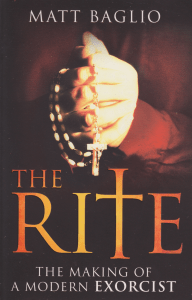
I’ve written on The Rite before. My current book project, however, led me to reread this account after watching the movie based on it a couple of times. The film dramatizes, of course, the somewhat understated demonic activity in the book. The protagonist loses about 30 years in age and isn’t yet a priest. As is usual, the book is better than the movie. Matt Baglio’s story follows Fr. Gary Thomas from parish ministry in California to his discovery of possession and appointment as an exorcist. As part of the Vatican initiative to have an exorcist appointed in every diocese, Fr. Thomas was sent to Rome to take a course on exorcism. His experience was all academic until he began to attend actual exorcisms with an unconventional Capuchin monk. Very little described in the book is difficult to believe.

This time around the curses nabbed my attention. Among exorcists of the Roman Catholic stripe, there is a strong belief in the reality of curses. Not only the reality of curses, but the belief that curses can lead to demonic possession. Knowing that Catholicism has struggled with accusations of being unsophisticated and behind the times, the fact that this isn’t more widely known is pretty self-explanatory. Growing up Protestant, I was always taught that curses are make-believe. They don’t really have any influence on a person’s life. The world of demons, however, is a supernatural one and the concept of curses still holds sway in this universe, as the book shows.

Another arcane aspect that resurfaced when I reread this book is just how elaborate the Catholic backstory is. Many Catholics, it’s clear, distance themselves from such topics as the Devil and demons, but there’s no escaping the Virgin Mary and the drama of Jesus versus the powers of evil, as well as the intercession of saints. The problem is that many of the players are personified in the Bible. It’s pretty hard to say the Good Book got it wrong. That worldview lends itself to belief in supernatural impingement on this sphere. Not that that’s a bad thing. Many people, however, would rather believe in a materialist world with physical cause and effect being the main operating paradigm. Demons complicate all that. But then, so does the idea of Mary being a perpetual virgin, and even the patrilineal heritage of Jesus himself. The Rite brings to the light something many would perhaps prefer to be kept under a bushel. Strange things do happen in this world, and they do tend to respond to the backstory that’s been told. That makes such books difficult to classify, even with the backstory.


Canadian Care

Amazon, probably not purely out of kindness, gives some customers access to the most read stories in the Washington Post. Apart from talking to my wife, this is about the only way I learn about what’s happening in the world (mine is a small world after all). I have no idea what Amazon’s metrics are for determining which stories to share, but I was amazed at one focusing on doctors in Canada. The story also appeared in Newsweek and other media sources. Unlike many medical professionals, these Canadian physicians are petitioning the government for lower salaries. They say they already have enough money and other healthcare workers aren’t being paid adequately. Why not share when you have extra? I’ve always thought Canada was far ahead of its southern neighbor in the ethics department, and this about clinches it.

Don’t get me wrong—I’m grateful for doctors. (You should see how much money I give them!) Nobody wants to go through life with this or that hurting or aching all the time. Most of the doctors I’ve met have been kind and descent people. Seldom as strapped for cash as I am, but then my doctorate is in a more intellectual field; serves me right. What really becomes a star in my personal firmament is that somewhere in this world enamored of capitalism, a privileged class has said, “this isn’t right.” Economists have been warning us for years that unbridled capitalism isn’t sustainable, but that falls on deaf ears in this country. Maybe our political leaders should see an otolaryngologist? Maybe they’ve got some wax build-up in there.

Doctors work hard. They have long hours and have to put up with smelly and messy situations. There’s a reason we have to pay so much to compel them to look where the rest of us are told to avert our eyes. At the same time, every other major developed nation in the world has some form of socialized medicine—it is a basic human right. Everywhere but here. If you drive through New Jersey you can’t help but be taken by the palatial campuses of the pharmaceutical companies that call this state home. There’s gold in them thar hills. As I gaze at them from the highway, my thoughts are driving across the border to a land that’s both affluent and caring. When’s the last time we heard an American entrepreneur say, “I’ve got enough—give the rest to someone else”? When too much is never enough, that’s something it’s going to take a Canadian doctor to treat, I fear.


Woodland Creatures

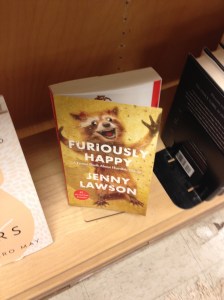
Maybe I watch too many zombie movies, but the story of zombie raccoons was just too good to pass up. A story by Marwa Eltagouri in the Washington Post described a spate of recent “zombie raccoon” incidents in eastern Ohio, not far from where I grew up. While the likely explanation is distemper, one of the behaviors of these raccoons stands out—they walk on two feet. Since I also enjoy the occasional non-fiction book by Linda Godfrey—who’s made a name writing about anomalous animals in North America, particularly bipedal dogs, or wolves—I found this aspect of the raccoons particularly interesting. That’s the thing, you see. Bipedalism suggests other human-like traits. Think great apes. Or penguins. (Although birds are generally bipedal, they tend to be squat and more horizontally inclined than vertical. The penguin not only dresses for our most formal occasions, but waddles around like many of us do after having been a bit too generous at the dinner table.) But bipedal raccoons—now that’s scary.

As a species Homo sapiens seem to have a need to believe themselves unique. Over the centuries any number of traits have been claimed as unique to us. Bipedalism, the ability to speak, being relatively naked so that we have to wear clothing, being able text with our opposable thumbs—we’re not like other animals. We’re special. So when animals that normally go on all fours walk on two legs we instantly think they’re trying to be like us. They want to have all the rights and privileges of our species so they can elect alt-right leaders and destroy everything they’ve built. Uppity critters! We have trouble reconciling ourselves with our animal origins.

Other animals, it seems, are beginning to note the advantages of walking on their hind legs. I’ve watched enough zombie movies to know that it’s the intention that’s the real problem. They want to be like us. Notice the accounts of bipedal animals—witnesses say there’s something in their eyes. Global domination. Yes, they’ve been watching us and now they want the same things we want. They want to take over the world. I know enough about World War Z to know that you can’t save everyone. Hard choices will have to be made. And maybe I’ve watched too many movies, but I’ve noticed the bipeds are from red states: the dog-men of Michigan and Wisconsin, the raccoon-men of Ohio. If we can’t save everyone, we need to make wise choices. Why not let them have Washington, DC? They certainly can’t be any worse than what we’ve got there right now.


Knowing It All

Reading about the Trump administration underscores once again the traditional American contradiction of, love of, but mostly hatred toward, experts. When you’re lying on that operating table, you stake your life that an expert is going to perform the surgery. When you buy that airline ticket, you’re banking that the pilot will be an expert. If you’re electing the most powerful individual in the world, you’ll excoriate experts and defer to the guy with the weird hair that says whatever he pleases and has never been a public servant a day in his life. This observation isn’t original with me, of course. I’m only an editor. Nevertheless, the same dilemma comes down to my little world of academic publishing as well. Most academics don’t understand this business—I was an academic at one time and I certainly didn’t—and yet don’t like to bow to the expertise of those who do.

Please don’t misunderstand. I’m making no grand claims to understanding this industry into which I unwittingly stumbled. I have been involved in it for over a decade now and I’m still learning. One of the things I’m learning is that many academics don’t trust experts. In part it’s academic culture. A doctoral program, if it’s a good one, will make you question everything. Sometimes even experts forget when to engage the brakes. When dealing with the experts at a publishing company, many academics doubt the expertise of those who do this day in and day out for a living. Books, however, have measurable sales records. There’s hard data for analysis. Not that it’s foolproof (but what is?), such metrics are time-tested and based on reasonable data sets. Often that’s not enough to convince an expert that other experts know more than they’re revealing. A personal philosophy, but one which I pursue with appropriate skepticism, is that other people should be left to do their jobs. As I frequently note, those who talk to the bus driver, freely giving advice, often make the situation worse for everyone.

The case of religion, however, is a special can of worms. There are no experts in this field, even among those of us who are experts. Had I realized this when I was younger, I’m not sure it would’ve made much of a difference in what I ended up doing with my life. You see, religion is all about ultimates. The big questions. The sine qua non of every single thing. When I read about things like politics, or entrepreneurship, I think to myself, “That’s all fine and good, but at the end of the day, is it what really matters?” If life is a search for meaning, why not grab it by both hands and try to become an expert at it? Some would say that’s the job of the philosopher, but let’s face it, religionists and philosophers deal in the same currency. One is more abstract than the other, to be sure. Still, don’t take my word for it. Please consult an expert.


Upstate Goddesses

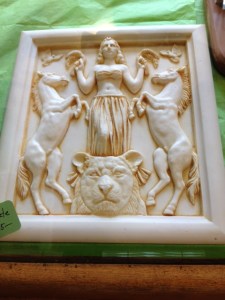
Goddesses give you connections. Here in Ithaca, all kinds of specialty shops abound. University towns are like that. This one had lots of goddesses. Ever since writing my dissertation on Asherah I’ve been interested in female divinities. Part of the reason for this is that I fail to understand how many men don’t see the power of women in their lives and insist that men should rule. Goddesses remind us that women have as much to contribute as do men, and they should be honored and respected just the same. Deities, after all, are projections of humanity. In any case, I found myself in a shop with many goddesses. The proprietor noticed my interest and struck up a conversation. This was ironic because where I live no one asks about my academic background; I have to travel to find interested takers, I guess.

She told me of an upcoming conference that would like to hear my thoughts on the topic of Asherah. Since my book on the goddess has been plagued with high prices, it remains hidden down three or four pages on Amazon, while lower priced dissertations easily float above it. My conversation with this stranger brought out that I had planned to write on other goddesses. A friend had done his dissertation on Anat, so I began working on book on Shapshu, the Ugaritic goddess associated with the sun. Some cultures made the sun male, the people of Ugarit, however, knew the true nature of brightness. I was going to make an academic career of goddesses.

Every great once in a while an academic will ask me about Asherah. Chances are their book or article will fail to cite my work, but they do seem to know to make queries. In my hopes to get a job beyond Nashotah House I followed the advice of colleagues to write a biblical book before finishing another book on “pagan” deities. In the career vicissitudes that followed, goddesses had to fall by the wayside. Although there can be money in deities, as this shop in which I stood proved, they aren’t really a marketable commodity in the realm of making an academic living. Now that I’ve found my way back to writing books again, perhaps I’ll return to my goddesses. That brief encounter in an Ithaca store resurrected some of the fascination of learning about the inner lives of divine women. The need to remind the world, it appears, has only become greater since I first wrote about Asherah decades ago.


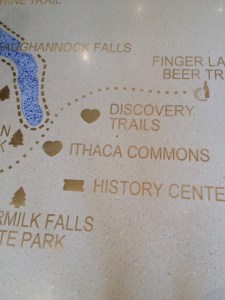
Ithaca Musings

Ithaca may be the ultimate hippie town. Open and accepting of diversity, it’s a place where anyone can speak out against what’s going on in the government and not worry about finding any objectors. Yesterday when I was in Buffalo Street Books, customers openly vented their frustrations with the way Washington’s handling things, and others joined in. There’s a sense of righteous anger here that hasn’t been fashionable since the days of the biblical prophets. You have heard it was said Watergate was a bad thing, but verily I say unto thee something much worse than Watergate is here. And although winter is still holding on in upstate New York, nobody doubts global warming is real.

From my first visit here, I knew that I wanted to live in Ithaca, but it is one of those places you can’t afford to live. Amazing how the liberal cities are the places people want to reside. Places where you can’t just turn off the realities of a diverse world just because some things make you uncomfortable. Places where if you notice that other people are different you are reminded that you, in their eyes, are the different one. There is no static, monochrome, cookie-cutter American. Why is this an idea so hard to sell? Capitalism leads to and fuels the desire to own. And owning leads to the desire to own more. I’ve often noticed this since being out of higher education—even within your own company others want what you have. The basic civility of the socialist is missing. That’s where the “me first” attitude leads.

In upstate New York, as in many parts of the nation, the very names remind us that others “owned” the land before Europeans arrived. Native American concepts of ownership were so different from the capitalist ones that forcefully landed on these shores that those views were forced, under firearms and steel, to assimilate to the foreigners’ ways. Capitalism takes no prisoners. Turnabout, they used to say, is fair play. We no longer feel that way as a nation. The interlopers have taken over. We’ve made the country in our own image. And it certainly isn’t any more noble for it. Being in a place like Ithaca always makes my spirits ebullient. The very concept of ownership is an odd one, I realize. Mere mortals can never really own anything. We can pretend to, or perhaps we can take a more enlightened view. We are all borrowing things here. And I would love to borrow a piece of real estate here in Ithaca.


Power in the Bus

“You’re not in control on a bus” my friend Marvin once wrote, in his short story “O Driver.” The commuter is the consummate captive. I don’t like to beat dead horses—we might need all the horses we can get before this is all done—but some commuters need to learn silence is golden. I take a very early bus with some hope that we might beat the inevitable traffic jams coming into New York in the morning. Every minute counts. Some people, however, feel compelled to comment when they think the bus is early. They’re already sitting on the bus, so what’s the problem? There’s another coming in 30 minutes and those of us concerned with getting in before the traffic make a point of being at the bus stop, well, early. The other day a guy got in at the stop after mine. He told the driver that the bus was running early (it actually wasn’t) but the driver obligingly sat for several minutes. The commuter’s always right, right? We got into the Port Authority late that morning. All because of one man’s mouth and his inability to keep it shut. I wonder why they even have that sign saying not to talk to the driver. That only applies when the bus is in motion. So…

The very next day the driver on the route was new. She was on time. Until. To understand this, you need to know my route is an express—it is entirely highway except for one short jog into another town about 10 miles down the road. My driver was doing great. “You missed the turn,” another passenger said. The driver apologized. A three-point-turn in a bus just isn’t possible on the highway, so she had to drive to an exit, wait for the light, and turn around. We were now speeding west, heading to New York City. The passenger, now acting as GPS, didn’t know this area very well. “Take the next exit,” she instructed. The driver dutifully did. It was a ramp with no reentry to the highway. We were touring rural New Jersey for some time before the driver found a place to make another U-turn. “Missing the turn,” the passenger now said, “That turn’s inconsequential. There’s another bus that comes just after this one.” She’s right. No less than three routes into New York follow that jog. But it was too late for us now. Finding our way to the highway, we again headed west. This time our driver took the correct exit, apologizing all the way. The next day we had a new driver.

Actions have consequences. For each and every action there’s an equal and opposite reaction. I learned the latter in physics class. The former is a life lesson that might properly be called the mother of morality. When you talk on the bus you’re taking charge of about fifty lives. It has become clear to me through my years of commuting that most people shouldn’t have that kind of power.


Americanism

I’m a bit too much of a contrarian to be a regular bestseller reader. I do occasionally bow to curiosity though, and I do have a lot of time on the bus. But that wasn’t the reason I turned to Michael Wolff’s Fire and Fury: Inside the Trump White House. Purchasing this book was a statement. Another in a long line of protests in which I’ve taken part since January of 2017 (and even before). You see, I mourn. I mourn what our country has become. My first indication that I should write (which I of course ignored) was the winning of a statewide essay contest my senior year in high school. The topic of the essay was “Americanism.” My piece was respectfully cynical; I was surprised I won. This was in the days before personal computers and I didn’t think to keep a typed, or even hand-written copy.

The essay was cynical not because I don’t believe in America, but because I do. I’ve been confronted on this issue concerning my blog occasionally. My jeremiads. You see, you only get this fed up with things when you love them deeply. I sometimes rail about higher education, for example, because I care about it. Fire and Fury created in me a—to borrow from the book’s vocabulary—Kafkaesque bewilderment about how a nation based on high principles could possibly sink so low. Politicians are perhaps the most self-serving of human beings, but at least they try to make sure the country doesn’t go off the rails. This train leapt the tracks months ago, and our elected officials refuse to do anything about it, each playing their own angle, hoping personally to come out of it ahead. Worth a jeremiad, I’d say.

I was a Republican in high school. I wasn’t old enough to vote, so that party affliction was never official. When I did register at 18 it was as an independent (remember, contrarian). As a Fundamentalist I was ahead of the Tea Party, at the time. Even with this level of patriotism I wrote an essay taking my country to task. I was raised in a poor family. Told an education would improve my chances, I found myself facing predatory loan officers and others eager to wring my blue collar until it was possible to twist no further. If I had no money, my future money would do. I’d already had a taste of that as a high schooler. That was three-and-a-half decades ago now. I kinda hoped the country might improve in all that time. And I kinda wish I’d kept a copy of that essay as a memento of more optimistic days. Fire and Fury sells so well, I suspect, because I’m not really alone in feeling this way.


Urban Evolution

They say ten city blocks are a mile. They also say the internet is fast. Putting these two theorems to the text, I’ve logged several foot-miles in Manhattan to find things that aren’t there. I don’t mind the exercise, but apparently the web can’t keep up with Midtown. I’ve been working in Manhattan for going on seven years now. I very seldom leave the office during the day, eating at my desk and trying to give the man his due. Once in a great while there’s something I’m either compelled to see, or that I must find for various reasons. Almost without fail, such lunchtime expeditions lead to frustration. I recently had to visit a business that shall remain nameless (conflict of interests, you see). According to Google Maps it was a mere ten blocks—a mile—from my office. At a brisk pace I could make it there, transact my business, and return to my cube all well within an hour. As I grew close, I got that sinking feeling I recognize now as internet ghosting. Nothing remotely like my goal was at this location.

I walked in and smiled at the man at the security desk. He was even older than me. “Ah, they used to be here,” he said, “but they left a long time ago. Long time ago.” Apologizing in advance, I asked if he had any idea where they might’ve gone. “I heard they moved across from Bryant Park, on 6th Avenue. But I heard they moved from there, too. You might try it, though.” Since this was roughly in the direction of my office from where I was, I decided to swing by. When I worked for Routledge I went by here every day, and I didn’t recall ever seeing this particular business there. Their security guard was equally as friendly. “I’m afraid there’s nothing like that here.” I had to return to work. When I got back to my office and googled their store locator, the website froze. This was truly unobtainable via the internet.

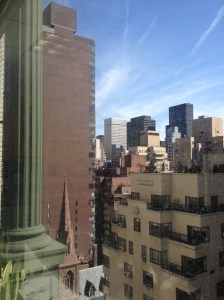
Some times you’ve just got to let your feet do the walking. Things aren’t always where the internet says they will be. I’ve come to realize that New York City is constantly changing. Buildings now stand where mere holes in the ground used to be when I began working here. Commuting in daily all these years is like time-lapse photography of a plant growing. Buildings emerge behind the green plywood walls, and next thing you know what used to be a synagogue is a new retail opportunity. It may not, however, be the business you’re looking for. Before spending your lunch hour walking a mile to get there, you might try calling first.


Good Company

It’s a matter of scale. If you read this blog chances are you like books. If you like books you probably know about remainders. When you walk into a bookstore and see a shelf or section of really cheap new books, you’ve found the remainders. This happens when a publisher overprints and, instead of pulping books (that hurts even to type!) the remaining stock is sold at just above cost so that retailers can add a small markup and make a marginal profit. Most authors don’t like to see their books remaindered, since it means demand wasn’t as high as the publisher anticipated. Expectation was that the book would do better than it did, now the publisher and bookseller just want to recoup some of their losses. Often there’s a marker stroke across the bottom pages of the book so you can’t return it for the retail price.

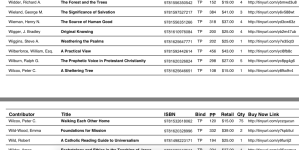
For those of us whose books sell in the double digits, seeing yourself on a remainder list would be kind of a thrill. The other day I looked at Wipf & Stock’s 50 percent off sale to find a copy of Weathering the Psalms listed. Probably it was overprinted for the AAR/SBL annual meeting, since I saw that they did have copies there again last November. If they hadn’t bothered to print out a bunch, I would never be on the remainder shelf in Eugene. I don’t mind because I’m in good company. Looking at the list I feel like I belong in some kind of academic crowd in the reduced bin. There’s a sense of community among the overprinted.

Turnabout, they say, is fair play. I’ve bought plenty of remaindered books in my life. Lately I buy used academic books because the new editions are out of the reach of an independent scholar who isn’t independently wealthy and who doesn’t have access to a university library. If I buy others cheaply, I turn the other page and expect the same back. Most of us who write academic books aren’t in it for the money. We want to be remembered for our contributions to the discussion. We took the many months and years it takes to research, write, and polish a book, and we want others to take an interest in what we have to say. It’s all about the dialogue. It’s all about the community. For those of us who never really found a home among the established academy, publication can mean a lot. It doesn’t matter that the books are sold cheaply—in fact, that’s good, because it means somebody might just read what you wrote. It’s all a matter of scale.


Easter Monday

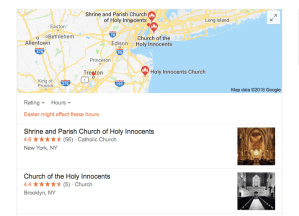
This year has been a comedy of liturgical errors. Ash Wednesday fell on Valentines Day and Easter on April Fools. Notwithstanding the clash of sacred and secular, the ironies seem to grow each day. I arise early to write. Even on weekends. Before the time to head out for any religious service, I’m sitting at my keyboard, letting my thoughts have their free-range time before penning them back up again for either being with other people or beginning the long work week. On my way to work, I frequently pass Holy Innocents. A Roman Catholic church on West 37th Street, it stands out among the more commercial ventures on either side. Yesterday, Easter morning, I decided to google it. I’ve always been curious about churches, and I’ve never been inside this one.

Google gave me a map of Midtown Manhattan, along with a statement of when this business would be open. “Easter might affect these hours” it helpfully noted in orange letters. An orange-letter day! Easter might affect these hours. Those who champion Artificial Intelligence may need to come up with a way of having “that talk” with their computers. How could any intelligence unaware of the deep-seated human need for the transcendent understand the difference between a church and a business? (Okay, I can hear the more cynical saying there is no difference, but you know what I mean!) How would any algorithm know that Easter is the holiest day of the Christian year and that, at least for some churches, yes, they will be open for business?

Some parishes, we must explain in 0s and 1s, begin this service at midnight on the cusp between the last and first days of the week. Others will gather sleepy-eyed parishioners on top of a hill, out in nature, to watch the sun rise. Still others will eschew any holiday and treat it like any other Sunday. The reasons for these stances are nuanced and not easily understood even by human beings. Our robot overlords, let us hope, are programmed to understand this peculiarity of our species. We relish the thought of Easter, at least in this hemisphere, as telling us that winter is indeed over. Although snow may still settle on the crocuses, it will not last. Days are longer than nights now, as they must, of a mathematical certainty, be after the Vernal Equinox. We are entering the light phase of the year. So much hope and anticipation are wrapped up in this brightly colored, pastel holiday that we have trouble explaining it rationally. Today, of course, everything is open for business today. Except a few churches, as Google may fail to let you know.


Two Cities

Augustine of Hippo wrote that there were two cities. If you’re reading this blog you probably know what they are. Today, according to some, is Easter. For others it’s not quite there yet. Call that one city. It’s also very near that other national holiday—tax day. That’d definitely be the other city. Now, I’m not going to go into any detail here, but I’ve always done my own taxes. If you’re old enough to remember going to the public library to pick up two or three copies of the paper forms, sitting at home with a pencil, eraser, pen, and TI-30, and spending an entire Saturday reading through the instructions and scribbling, you know what I’m talking about. These days everything’s online.

I can’t recall how many years I’ve used TurboTax. It was free, easy, and generally led to a refund. I miss those days. This year when I sat down with Intuit’s child, it started asking questions I didn’t understand. Perhaps you’ve run into some industries that do this—they make up their own vocabulary and if they use the words in a way the dictionary doesn’t, well, it’s the dictionary’s fault for not keeping up. TurboTax started doing that. And unless you want to pay even more than they’ve already sold you up for, there’s no way to ask questions. The answers online use the same obscure lexicon. So this year I had to do probably the most adult thing I’ve ever done. I got an accountant.

Setting up the appointment for after work, it was a matter of looking at dates both my wife and I, and more importantly, the accountant, had free. It was only as judgment day dawned that I realized it was Good Friday (for some). Arranging to work from home that day so I could get to the office before the buses rumble out of New York, I ran into a traffic jam. No doubt people out to do their last minute Good Friday shopping. We were meeting the accountant for the first time, and I wanted to make a good impression. Be punctual. I had neglected to coordinate the two cities on my calendar. The accountant was understanding. He commented on how easy our taxes were, compared to many. Turns out TurboTax had been closing off many perfectly legal options and charging us for the privilege. So now it’s Easter. Taxes are due in a couple of weeks. There are two cities, and if either is neglected there’ll be Hell to pay in the end.