Book and Bell

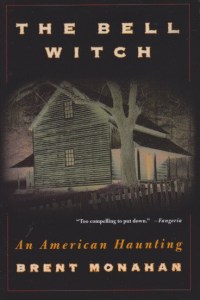
The Bell Witch: An American Haunting, by Brent Monahan, is a book I’ve read before.  The subtitle was used for a cinematic version.  I discovered the book, however, through what might be considered a chance encounter with the author.  He was teaching a course on offering distance education courses at Rutgers University, and, as an adjunct teaching over eight classes per year, I’d been selected for the distance education program.  (As life goes, of course, I was hired by Routledge for a full-time job before I could actually deliver the course.)  By a strange irony, I had watched An American Haunting just the weekend before the course, and I had no idea who would be teaching it.  Neurotically punctual, I was the first one there for the class, and as Dr. Monahan and I talked, I knew I’d need to read the book.  I posted on it back when I did, but this time I decided to pay better attention than one can on a bus.

Of course, when you watch the movie first, which I had, you know “the reveal” well before it comes late in the novel.  In case you’ve done neither, I won’t give it away.  The tale is based on an historical haunting, attested in sources from near the period.  And it is a strange kind of possession story.  The “witch” is actually a demon conjured by a trauma, and although book wraps things up nicely, it leaves a few questions at the end.  I suppose that’s appropriate for a scary book.  One of my current projects involves tracing the accounts behind fictionalized narratives to their originals.  The Bell Witch was well researched, and is a good example of how the line between fiction and fact can be effectively blurred.

The Bell Witch legend is credited with influencing several horror films, including The Blair Witch Project and others which tellingly have “Bell Witch” in their titles.  The story has a fairly incredible longevity, given that it was a localized legend from early in the nineteenth century.  Monahan’s novel is written as a “confession” from the schoolmaster, and historical personage Richard R. P. Powell.  This blurring of the lines makes for the kind of ambiguity that gives horror its particular ability to stand between fact and fiction.  The early versions of the lore, combined with elements intended to offer verisimilitude, leave plenty of queries at the end.  So much so that I’ve occasionally contacted the author for clarification.  What really happened?  It depends which side of the line you prefer.


Scrolls Not Living

Of the many ancient finds in Western Asia, none captured the imagination like the Dead Sea Scrolls.  The timing and romance of the find itself, the scandals that almost immediately broke out, and the subsequent “secrecy” over the contents made the secular news.  I’m convinced that a large part of the mystique has to do with the somewhat spooky name—Qumran scrolls never caught on, even though it is more accurate for many of the documents.  Their discovery came after the Second World War when people were wanting good news, and, perhaps, an indication that all of this stuff was somehow predicted.  Enter the scrolls.  No doubt, these documents gave us quite a lot of information on the Second Temple Period—the time from the rebuilding of the Jerusalem temple in the sixth century BCE until its destruction under the Romans in the first century CE.  Now the scrolls are back in the news.

A story by Nicola Davis in The Guardian announces that the origin of the scrolls is once again open to interpretation.  The reason is somewhat technical—scrolls that were written on vellum (animal skins) had to be prepared for writing.  One of the steps involved chemically treating the writing surface with a fine powder (the details are beyond me) so that it could be written upon.  We’ve reached the point where the salts left behind can be tested for place of origin.  The Guardian story notes that the Temple Scroll—one of the important non-biblical texts—was not prepared at Qumran (the site where most of the scrolls were found).  That means that the scroll itself came from elsewhere, depending upon with whom you speak.  The scrolls gather controversy like the Ugaritic tablets gather dust.  

Part of the charm here is that there are many unanswered questions about these ancient texts.  Who exactly wrote them is debated.  Their find-spot suggests they were hidden away by the quasi-monastics who lived in nearby Qumran, but this doesn’t mean they necessarily wrote them.  It’s still debated whether the Qumran community was made up of Essenes or not.  One thing we do know about them is that they were able librarians.  The scrolls themselves are symbolic of the strife in the region, having been discovered just as Israel was declared a nation.  The scrolls were quickly politicized.  They were kept under the auspices of a small group of academics and priests for many decades.  And they still have a way of catching headlines.  Even when its a matter of who powdered their faces.


Not so Hollow

It is difficult to say how an idea might grab you.  I really have no idea why Washington Irving’s “The Legend of Sleepy Hollow” took my childhood imagination prisoner and has kept it stoutly locked up over all these years.  Perhaps it was the Disney version seen as a child that left me with shivers of wonder akin to a species of joy.  The autumnal setting, the implied ghost, the ambiguity of the final scene.  I used to be as avid a philatelist as one can be in a small town, and the Sleepy Hollow stamp of 1974 held me transfixed long before I ever encountered Tim Burton’s vision of the legend.  After having watched the silent Headless Horseman a couple of times, I went back to The Sketch Book of Geoffrey Crayon, Gent., and read the original again.  This time I followed it up with the appendix in my edition, written a decade or two after the story by an older Irving.

The 1922 movie runs fairly close to the literary original (for the most part), especially when you add the appendix.  The appendix (in the edition I have—The Modern Library, 2001) is an essay titled “Sleepy Hollow.”  It reflects on Irving’s recollections of what Sleepy Hollow was like in his youth (he returned to the area to settle later in life).  The village church, which features in “The Legend,” provides a source of much of his reverie and this is incorporated into the early cinematic version as well, in the Sunday morning scene.  I also noticed how frequently psalmody enters the original story.  The tale does not mention the Bible, but psalmody was an early form of church music, and “The Legend” has Ichabod use it when he’s afraid as well as for teaching students to sing, for a few shiny shillings.

Washington Irving is sometimes credited with the invention of the short story as a literary form.    His younger contemporary Edgar Allan Poe worked in that format, and the two of them contended with making a living (the former more successfully) purely as literary writers.  Irving’s spooky tales, however, often have something of the comic about them.  His story-telling style uses folksy, folkloric exaggeration and humor to prevent it from becoming too dark.  Poe would snuff the candle and let the fear be unhindered.  I knew of Sleepy Hollow before I discovered Poe, and this recent resurgence is perhaps a way of exploring my own literary roots.  It’s nearly half-way through September already, and Tarrytown beckons. 


Write Brothers

Work interferes with my concentration.  I suspect I’m not alone among writers in this regard.  Just last week I had two fiction pieces accepted for publication (one of which won honorable mention), but the little time I can allot to writing is divided between fiction and non.  Up until now the non has been more successful at finding publishers, but last week might’ve tipped the balance a bit.  As someone who works well more than eight hours daily, culling that time for creative enterprises can be difficult.  I’m told that Isaac Asimov, in the days before personal computers, kept three typewriters, each with one of his projects ready to go.  He would work on the one he felt like at any given time without having to reload a single typewriter with a half-finished piece.  My laptop has the dubious advantage of keeping multiple windows open in which several projects are simultaneously active.

At the moment I have three book projects going; two nonfiction and one that will become novel number seven, if it ever gets finished.  Not only that, but my short stories file has many contenders for my rationed time.  Long ago I lost track of just how many tales there are—some are on disc and others are on paper.  Some are finished, awaiting revision, and others have just begun clawing their way into written form.  The problem is finding the time to work on them.  The oft-heard lament of the working writer is that life is more working than writing.  And having had some minor affirmation of my fictional functionality recently, I’d love to explore that a bit more, but who has time right now?  Even as I finish typing up my blog post for the day the hour to begin work is looming.

Stephen King’s advice to wannabe writers is to read.  A lot.  Although I do my best to keep this dictate among my personal commandments, I run into the immobile object of nine-to-five-plus repeatedly.  If I take a vacation (which is seldom) it is often “to get away,” but writing is more a matter of aging in place.  Finding your comfortable spot where your thoughts flow freely and where the coffee pot’s just in the kitchen and if an idea catches you before sunrise you can spend time wrestling it even after light filters in through the curtains.  Those are rare days since weekends are for doing the chores neglected in your forty-five-plus hour work week.  And settling between fiction and non is never an easy decision, especially when one has just received a vote of confidence before login time on a Monday morning.  For now, however, I have to concentrate on work.


Permanent Change

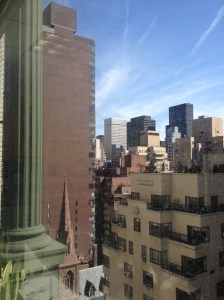
Maybe you’ve experienced it too.  The sense of change in a large city like New York is palpable.  Although I don’t commute in much any more, I noticed it when I made daily treks to the city—change is constant.  If the skyline’s forever evolving, on street level things are more than keeping pace.  In the seven years of my daily commuting I saw buildings built and razed in the same location.  Scaffolding is a constant hazard.  Public art pieces are placed and then replaced.  Change.  I was reading about Yijing, better known as I Ching, the other day.  One of the spiritual classics of China, this “Book of Changes” reflects a worldview common in eastern Asia that is quite at odds with that that developed in ancient Greece.  Many Greeks believed permanence was reality, those in China who read the spiritual masters believed that change was reality.  The older I get the more I think the author(s) of Yijing got it right.

I’m not an expert on the religions of southern or eastern Asia, but I have studied the major ones.  To those outside the field of religious studies, it may be surprising that the field is as large as it is.  In the United States alone there are an estimated 40,000 denominations, and that’s just within Christianity.  To be an expert in any one takes years of study.  Add in the many religions of other locations, such as Africa and Asia, and you’ve got more than one lifetime’s worth of work lined up.  A common—the most common, in fact—course in collegiate religion curricula is “World Religions.”  I’ve taught it myself.  The problem is nobody’s an expert in all of them.  Still, I found reading about what used to be called “eastern religions” (with that poisonous cultural bias that the unchanging west is the correct vantage point) full of surprises.

Scientists well into last century liked the idea of a steady-state universe.  Permanence.  When Edwin Hubble noticed other galaxies were moving away from ours (and, by the way, first noticed that there were other galaxies), the Big Bang theory developed to explain this motion.   Change, it turns out, is constant.  It may be slow at times, and at others it’s like the skyline of a major city like New York, shifting several times in a single lifespan.  I’ve read some of the spiritual classics (in translation) and I always come away with a new sense of wonder about the many ways of understanding the world.  And I ponder what it will take to change the attitude that religions aren’t worth studying.


The New Purple

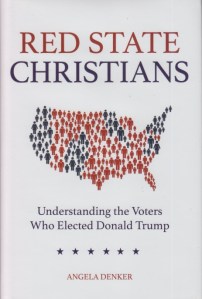
Those of us who grew up Evangelical hold an unusual place among our liberal peers.  We’re often able to peer around, over, and under that wall that has been built between those who want a faith-based nation and those who want a free one.  Angela Denker is a fellow traveler on this road, and her book Red State Christians: Understanding the Voters Who Elected Donald Trump is a useful roadmap.  Some of us fall further from the tree than others, but one of Evangelicalism’s more endearing traits, when taken seriously, is the love of those who are different from you.  That love is often forgotten in the political rhetoric daily whipped into a froth by an unstable president being used by his party to install agendas that hardly fit the moniker “Christian.”  That’s why books like this are so important.

I confess that reading studies such as this make me uncomfortable.  Uncomfortable because my Evangelical past haunts me worse than any ghost, but also because Denker is clearly right that basic humanity is being left in the garbage as battle lines are drawn up in what could be a great, diverse nation if a leader were determined to work for unity.  I recently wrote about lunar landings.  Kennedy was a Catholic who had to work to bring a nation together around a common goal.  Instead of tearing the country apart for his personal aggrandizement, he pointed to the moon.  Sure, there was a xenophobia concerning the Soviet Union, but at least in this pocket of the world there was a sense that we should work together.  When religion entered politics with Richard Nixon and his followers, a deep rift opened up.  The two topics you were never to discuss—religion and politics—were now in the same bed.

Red State Christians is an extended road trip on which Denker interviews people who largely fall under the Evangelical umbrella.  Some of them are Catholic.  Some of them are Hispanic.  Some of them are less concerned with social issues, but are hard-working laborers often overlooked by the Democratic Party.  The resulting pastiche is one in which Americans are cast not in sharp relief, but rather with the hazy edges that are a far more accurate way of understanding human beings.  Many, it becomes clear, elected Trump out of fear, or out of fear of his opponent.  These aren’t bad people, but they are people afraid.  This wasn’t an easy book to read, but it is an important one.  And those who want to work for a future that might include realms beyond the moon might find this work a small step in the right direction.


Upstate Reading

In terms of cash flow I don’t fall into the wealthy bracket.  My assets are largely in pre-printed paper form, and when I visit the local Little Free Library it’s generally to donate books rather than to take them.  Over Labor Day weekend I was in Ithaca.  One of the more famous features of the town is its weekend Farmers’ Market.  Indeed, the north-south corridor through town is a continuous traffic jam during Market hours.  Not only are there farm stands in the permanent open-sided structure, but there are a few craft booths and several places to buy al fresco fair from local restaurants.  In the summer parking can be hard to find, but the place has a carnival-like atmosphere nevertheless.  It also has a Little Free Library.  I’ve been to the Market many times but I’d never noticed it before.

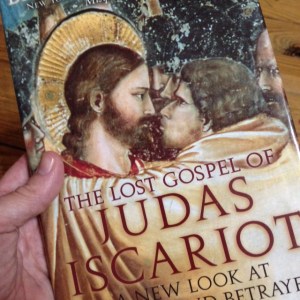
Upstate New York is beautiful but it tends toward the conservative end of the political spectrum.  Ithaca is a pixel of blue in a screen of red, and that strangely showed in the Little Free Library.  Many of the books were either Bibles or popular kinds of devotional titles.  Given that Cornell isn’t known for its religion department (Ithaca College has a respectably sized philosophy and religion department, however) these books aren’t the kind you’d expect to find in an institution of higher education.  That’s why I was surprised to see a near mint copy of Bart Ehrman’s The Lost Gospel of Judas Iscariot on the shelves.  The Gospel of Judas hasn’t been big news for a few years now, but this was a book that suggests a different demographic than your average evangelical readership.

Like Ehrman, I once made a living as an adjunct at Rutgers University.  Indeed, it was this commonality that helped me to get to know him a bit.  He’s gone on to a kind of fame rare for biblical scholars.  Indeed, to have a sufficient number of copies of your book printed to end up in a Little Free Library—in other words, you have to have more cachet than your garden variety Ph.D.  In my local community LFL I like to leave books for others to take.  Just last week I stopped by and noticed that the summer had depleted the stock.  Ironically, I had noticed one of Neal Stephenson’s novels in the same circumstances as Ehrman’s.  I’m glad to see intelligent works on offer for the reading public.  And trading books with no money involved suggests to me that there’s a better form of economy than material greed.  All it takes is a Little Free Library and a little good will.


Pointing to the Moon

The failure of India’s  Chandrayaan 2 to maintain contact, intended to make India the fourth nation to successfully conduct a lunar landing, sent me reading about the moon.  I remember the first manned landing, which happened when I was six, so the idea that we could make it that far seemed less impressive than it really is, I suppose.  I was fascinated by early space travel, and part of this may have been because of the moment of silence announced in school the day Apollo 13 safely returned to earth after the oxygen tank explosion that made its landing impossible.  As I was reading about the many moon missions that took place before I was born, I was surprised to learn how many nations are still attempting to reach our nearest neighbor.  This year alone China, Israel, and India have all attempted to land up there.

Israel’s mission called its lunar lander Beresheet.  It was the first attempt to land the Bible on the moon.  Beresheet is the Hebrew title of Genesis.  The US missions were named Pioneer, Ranger, Surveyor, and Apollo.  Ironically for the persistently religious nation, our only supernatural title was the name of a Greek deity.  Israel was true to its roots with its naming convention, but there is kind of a paradox involved.  In the world of the Bible the earth is the center of the universe and the moon is a quasi-living being circling about our stationary fix in this fictional view of the cosmos.  That’s not to say our own views may not some day be regarded as fictional as well, but simply that we now know the view in Genesis is incorrect.

Of course, the word “genesis” can mean a purely secular beginning as well.  It is a compound word that is often translated as “in the beginning.”  As such, it is appropriate for the first attempt at a moon landing, or any other great venture.  Still, it is instantly recognizable as the first word in the Bible, indicating a kind of strange juxtaposition where the biblical moon—which is not the same as the astronomical moon—are brought together.  Unlike the book of Genesis, the moon has been reached many times by others before.  The old and the new meet in this attempt to reach into space.  Meanwhile our problems continue down here.  Maybe that’s why we continue to attempt to reach the heavens.  And in that sense, no better title applies than that of the book that somehow defies rational explanation.


Horseman Horror

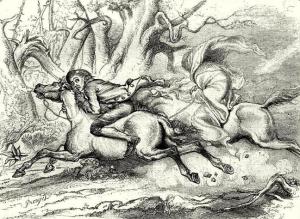
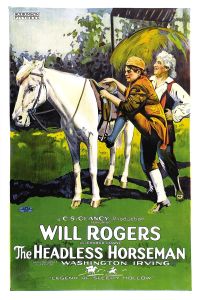
Yesterday was distinctly autumnal around here.  Cloudy and cool, the overcast was definitely moody although the equinox is still a couple weeks away.  Still, the mood was right for the Legend of Sleepy Hollow.  The earliest full cinematic adaptation of Washington Irving’s story is the 1922 silent feature The Headless Horseman, starring none other than Will Rogers.  Now, Irving’s story is fairly brief, and to get nearly a full seventy-five minutes out of it, the tale lends itself to some padding.  The film makes a great deal of Ichabod Crane knowing Cotton Mather’s A History of Witch-Craft, and even being accused of being in league with the Devil that leads to a  disturbing scene where he’s nearly tarred and feathered.  In reality Mather’s book was Wonders of the Invisible World, but the point of the film is better made with the fictional title.

Having watched Tim Burton’s 1999 version—Sleepy Hollow—many times, I was taken by the introduction of the Bible into the story.  The groundwork, however, was laid by Edward D. Venturini’s version.  True to the story, Ichabod teaches Psalmody in his role as schoolmaster.  Venturini’s film has a contrived scene in the church on Sunday that includes a lengthy sermon with everyone—even the usher—falling asleep.  The episode, which is lacking in Irving’s original rendition, introduces the Bible into the narrative.  The connection is thin, but nevertheless present.  Burton picked up on the religious element and built it firmly into the plot as Ichabod Crane’s backstory as a skeptic, raised by “a Bible-black tyrant.”

As someone interested in the integration of religion and horror, early examples, despite the comic aspect of Venturini’s version, are often instructive.  The comedic spirit is actually in the original; Irving’s tale gives a caricature description of Crane that gives the lie to the handsome protagonists beginning with Jeff Goldblum on through Johnny Depp and Tim Mison.  Will Rogers plays the homely image to its hilt, and although lighthearted, the movie has some classic horror elements.  To arouse his dozing parishioners, the minister yells “Fire!” When they awake asking where, he states “In Hell,” which sleeping churchgoers can expect.  Although the eponymous headless horseman is shown to be Brom Bones, a remarkably effective early scene presents a skeletal, ghostly rider that haunts at least the imagination.  The sun is out this morning, and the brooding skies of yesterday have passed.  They will be back, however, as the season for ghost tales is only just beginning.


Plumbing Depths

This past week we had a plumber here for a day.  Our house has been owned by a succession of DIY weekend warriors who had more confidence than ability when it came to things like electric and water (which, I’ve learned, you want to keep apart).  Somehow our home inspector failed to spot these costly fixes, and I try to think of them all as investments—a concept foreign to a guy with my background of living paycheck to paycheck.  In any case, all this plumbing has me thinking deep thoughts about water.  And depth.  Things are seldom what they seem—there’s more below the surface, and those who struggle with the depths often come up with sayings we call profound.  And they often express them in poetic form because, when you get deep enough, words themselves break down.

I often consider this in the context of science.  Physicists break things down into formulas.  There’s a certain uniformity, they tell us, until you reach the quantum level, then the rules change.  I sometimes see this as an analogy with the staid nature of scientific prose versus the depth of good poetry.  Or even, dare I suggest it, profound fiction.  These sometimes explain our world better than the accepted facts of mundane existence, such as water always seeking the lowest point.  There comes a profundity, however, at which down becomes up.  The behavior of water, which we want in our houses but only in controlled locations, is somehow indicative of this.  “Deep calls unto deep” as one ancient source says.  And the plumber walks away with a good chunk of your cash.

Learning about science in school, I was always taught that good science is elegant—there should be beauty in a theory that explains the world.  I’ve often wondered how this fits in with a reality that is often messy—chaotic even.  Ancient peoples from the area that produced our Bible believed water to be chaotic.  It had to be controlled by the gods.  It is vital for life, we need it and yet it wreaks havoc on dry land as those who experience hurricanes know all too well.  The world into which I was born was one of indoor plumbing.  Once water gets in, as our leaky roof attests, it introduces chaos in a place we want to stay dry.  When water won’t behave like we want it to, however, we no longer call on the gods.  We call a plumber and pay our offering with profound reverence.

Young Dr. Wiggins contemplates chaos


Correct Auto

I’ve tried turning it off, but it sometimes doesn’t work.  Every time there’s a system update (about every other hour, now) the new system reloads autocorrect.  True, my weary fingers are glad for the help when they just can’t spell hypocoristic, but it does seem that autocorrect, although the results are often funny, has no sense of humor.  As a writer I often use ironic misspellings.  I sometimes have my irony interpreted as ignorance, but if writers aren’t misunderstood they’re not doing their jobs, I suppose.  The thing that gets to me is that those who program autocorrect—although sometimes they’re right—can’t let us express ourselves as we wish.  The other day I wrote something with  a deliberate misspelling.  When I hit the “post” button I realized I’d been autocorrected to a nonsense word in the context.  I thought I’d turned autocorrect off.

Now don’t get me wrong—I’m not the world’s greatest speller.  Sometimes I use words with the slightly wrong connotation.  My choices, however, are generally deliberate.  Unless my device has selected them, that  is.  I suspect that autocorrect is appreciated by those who type on tiny screens.  The affluent, I notice, wear iWatches.  I wonder if they carry tiny people in their pockets whose thumbs can fly across such minuscule surfaces.  “No,” someone told me, “it has voice recognition technology.”  I was reminded of some embarrassing mispronunciations I’ve made.  In seminary the homiletics professor had an individual session with me.  “Given your educational background,” he told me, “you don’t mispronounce many words.”  Oh, but I do.  I just save them for the most embarrassing situations.

My inner critic’s a pretty active guy for his age.  He doesn’t need autocorrect to make me realize how little I know.  That’s the thing about technocrats, though.  They like to correct us based on the most common combinations of these letters.  Sometimes I glance back at something I wrote and find a word I don’t even know replacing something that was, in fact, correctly typed in the first place.  I write in a program called Scrivener.  My Mac’s too old to run Word, and Pages isn’t bad, but it doesn’t allow for the complex architecture of my thoughts (and I’m no architect; I can’t even spell it).  In other words, I have to turn autocorrect off not only on my device, but also in the individual applications I run.  But then there are days when verisimilitude just won’t flow the way it should without it.


Power of Parables

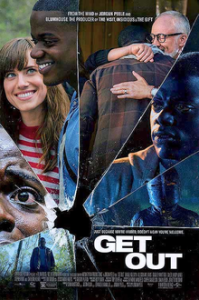
Parables come in all sizes and shapes, horror movie-shaped, some of them.  In my perpetual struggle to catch up, I finally got to see Get Out.  One of the raft of well-made, intelligent horror films that have been released recently, it’s been out long enough that I suspect my spoilers will be well known.  The Armitage family, resident in upstate New York, has been kidnapping and using African-Americans to make up for the perceived weaknesses of their family and friends.  One of their main means of obtaining victims is through their daughter Rose, who brings her boyfriends home for the weekend so they can be hypnotized by her psychiatrist mother and operated on by her neurosurgeon father.  The reveal comes slowly, but the discomfort begins early on.

Released early in the Trump White House tenure, the movie is a study in an intense xenophobia that nestles somewhere between Guess Who’s Coming to Dinner and The Stepford Wives.  It’s inherently uncomfortable watching Chris Washington, the protagonist, being treated as if his very presence requires constant comment in the world of white privilege.  He, of course, had misgivings before ever climbing into Rose’s car, but her convincing display of liberalism was enough to overcome his hesitation.  For me, watching the film made it clear that privilege is something assumed, even when it isn’t had in any explicit way.  The Armitage family and their friends are well-to-do but even if the setting were more mundane the message would still have worked—our culture imposes and reimposes its message of white superiority in subtle ways that the camera captures here.

Quite apart from its nature as a parable, Get Out is a demonstration of the social consciousness of horror.  Its reputation as a debased, low-brow appeal to all that’s unsavory to watch is misplaced at times.  While Get Out is uncomfortable it’s that way for a reason.  Were it not, it would lose its important message.  All privileged people need to be able to see through the eyes of those who are culturally disenfranchised, and although the “us versus them” mentality is problematic it has to be faced honestly and openly.  The very fact that a human construct like race could be used as the basis for a horror film in America raises questions that ought to make all of us squirm.  Setting the story in New York, where prejudice might be supposed not to remain only underscores how deeply its roots have grown.  Horror with a conscience is perhaps as much a vehicle for social change as it is a genre more honest than often supposed.  That’s how parables tend to be.


Burger Impossible

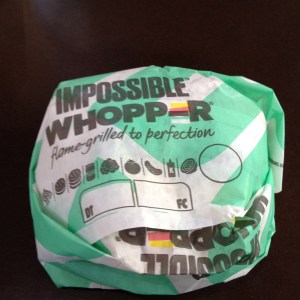
On the way home from Ithaca, we’ve learned the hard way to avoid I-80 through the Poconos on a holiday weekend.  Past experience indicates that about 80 percent of the population of New Jersey (to be fair, a percentage of that may be those from New York City) tries to squeeze through the Delaware Water Gap at just about dinner-time the day before work starts again.  There is a longer alternate route, I-476, the turnpike, which you catch north of Scranton and exit in Allentown.  The only issue with this plan is that, unless you want to exit the turnpike to try to find food in rural Pennsylvania, there’s only one travel plaza between our entrance and exit.  It’s a nice enough stopping point, but for a vegan on the road options are limited.  As we pulled in we noticed there was a Burger King.  Would they have the much touted “impossible burger”?

It turns out that they did.  Having last had a whopper well over two decades ago, mouth memory may have faded a bit, but I can honestly say this was like the whopper I remembered.  If you hold the cheese and mayo, you have a vegan version.  This discovery made me strangely happy.  For years at remote locations (and some urban) we’ve stopped when the only other options are meat based and had the BK veggie burger.  It’s not too bad most of the time, but if you want to think you’re eating meat while not contributing to the massive environmental degradation of industrial farming, the impossible burger seems like a reasonable option.  This is one area of technology that I’m glad seems to be catching up with ethics.

I often ponder how much our western point-of-view is based on the Bible.  Our reluctance to include animals in our ethics is another example of how the hard line between species has been applied.  Even scientists are susceptible to worldview bias.  When we realize we’re all part of a continuum of biological relatedness, it’s a lot more difficult to argue for our special place in the divine eye.  At the same time, insisting one’s ethics be applied to all is a form of fascism.  I’m just glad my conscience can be assuaged with some plant-based food options.  After all, I’ve been on the road for a few hours and I’m sitting here happy to be eating at Burger King.  It’s a matter of perspective.


Masked Reality

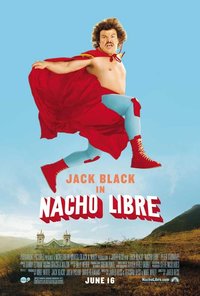
Before I make my confession you need to consider that I spent much of my professional life as a seminary professor.   Never ordained, I nevertheless donned the cassock and taught future priests what they’d be assumed to know (the Bible) while trying to earn an academic reputation through my publications.  It was a double life in which one half involved the church.  Shortly after that job ended I saw trailers for Nacho Libre, a movie in which Jack Black plays a monk who moonlights as a luchador, a Mexican professional wrestler.  I never saw the film, but I had been raised on a white trash diet of World Wrestling Federation fandom, back in the day when that involved gathering around the television to watch grown men posturing and preening while knowing that none of it was really real.  I secretly wanted to see Nacho Libre.

Recently I visited friends who had the movie.  They warned me that it was corny, but I had already supposed that.  What I didn’t realize until after it was over (for movie viewing is now followed by internet viewing) is that it is based on a true story.  “Based on a true story” doesn’t mean, of course, that a movie accurately portrays events, but I had no idea that a Mexican priest had actually supported an orphanage for over two decades as a masked wrestler under the name of Fray Tormenta.  I followed up the movie with a little web research because the film was remarkably respectful of the church.  The character of Ignacio never criticizes Catholicism, and he clearly cares for the orphans for whom he serves as the cook.  His wrestling winnings go toward purchasing better food for them.

Earlier in the day we watched the movie I’d talked to one of my friends about how religious life, no matter how seriously it’s taken, involves acting.  People generally put on masks before going to church (or any other function in which they interact with others).  Religion requires a level of piety impossible to sustain in the real world.  Early in the history of Christianities it became clear that the church would hire some religious specialists to try to take on the lifestyle toward which all faithful should aspire.  I’ve trained many priests.  I’ve seen them when they’re in mufti.  I know that in the vestibule, at the altar, or in the pulpit they’re wearing masks.  Many of them have the heart of Nacho Libre, but outside the church doors they still have bills to pay and family and friends who know them as they really are.  As we slipped the DVD in I didn’t know what the movie might be like, but it was based on a true story in more ways than one.


Significant Places

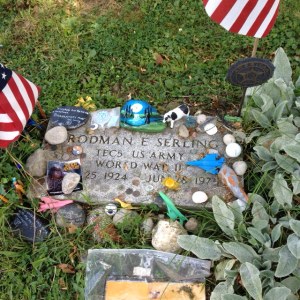
Upstate New York may not get the attention that the state’s largest city does, but it is a place of wonder.  One of those sources of significance is the unique blend of individuals who’ve impacted both American culture, and, in turn, my life, that called this region home.  It’s difficult to describe what I’m feeling as I’m standing next to Rod Serling’s grave.  This is a man who held a profound influence over my outlook by letting his imagination go where it would.  It’s more than the Twilight Zone—although its theme is one of the ringtones on my phone—it’s the sense that I somehow knew this man I never met.  It’s also the sense that his gravesite is so humble, in a rural area outside a small town, the kind that often featured in the stories he wrote and presented.  It’s the sense of connection.

As I young person I practiced writing short stories based on the mood set by the Twilight Zone, with a dash of Ray Bradbury thrown in.  From a small town myself, imagination was my means of enlarging my world.  We didn’t have the money to go many places but the magic box in our living room could take me to weird places alive with transcendence.  The results were beyond price and there was something deep and liberating here, even for a kid whose religion said it was all nonsense.  Even religion requires escaping sometimes.  I know the publishing world has moved beyond what was fashionable in the sixties and seventies, but that can’t dislodge the shard in my chest right now.  If there are spirits in cemeteries, they are here.

Some time ago I began, as I had time, uploading my photos of famous writers’ graves (along with those of other recognized names) on Pinterest.  On the way to Interlaken, I wondered aloud why nobody seemed to show an interest.  I find cemeteries peaceful places, and sacred spaces are those where people significant to us have been, in some form, at some time.  I know Rod Serling loved upstate New York.  It was his escape from the busy life of a writer whose cachet was marketable back in the days when anything seemed possible.  Retreats are those places we go to restore ourselves when work simply won’t allow creative people to have unstructured time.  I wasn’t expecting a huge mausoleum or towering monument here.  Others have found their way to this place nevertheless.  I am in a sacred place and the quiet here is kind of a prayer.