Aging Goddesses

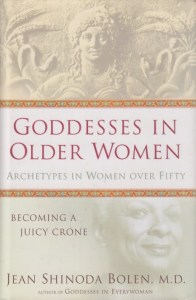
While not a woman, I am over fifty and I have both a personal and professional interest in goddesses.  Some friends recently asked how I came to write a dissertation on a goddess, and thinking about that has revealed some aspects about my outlook, but those will need to wait a little.  We read Goddesses in Older Women by Jean Shinoda Bolen because my wife wanted my opinion on it.  We read books together while washing dishes—we’ve been doing this since we married over thirty years ago—and despite my not requiring the subtitle, Becoming a Juicy Crone, I was game.  I have been curious about the experience of others since I was quite young.  Since half the others in the world are female, it makes sense to be in dialogue and to be willing to learn.

Bolen uses classical goddesses as Jungian archetypes to help post-menopausal women sort out their feelings and spirituality in what has been called the “crone” phase of life.  This is part of an antique triad that many would rather dismiss: virgin, mother, crone.  Still, Bolen embraces it as fairly common in women’s experience.  Men, although they can be elected to the White House while doddering old fools, don’t pass through such distinctive stages.  In fact, some never mature.  Women’s lives are defined by reproductive capabilities in ways men’s simply aren’t.  Instead of dismissing half of human experience as irrelevant, we should listen to the accumulated wisdom of women.  Bolen, who is an M.D., isn’t an historian of religion, but her remarks about the various goddesses explored (Asherah isn’t one of them) are insightful.  I listened as my wife read, and this was quite a learning experience.

We have, as a species, often failed our females.  Males, using that “might makes right” physiology and theology, have often assumed masculine agendas are the only ones that matter.  Look around the world today and see where that’s gotten us.  We’re killing our own planet in the name of greed and ignorance just so that nobody can be richer than me.  I think it’s time we let the women have a chance to run things.  Even though ancient mythologies often reflect the patriarchies under which they were written, many allow women more powerful and authentic roles than they currently have.  Even El, the head of the Ugaritic pantheon, could change his mind when approached by Asherah.  I learned much from this book, just as we learn so very much by listening to those who differ from ourselves.  And the goddesses, almost always, are the ones who possess true wisdom.


I Swear

The ongoing political fiasco of our nation (and within several states as well), raises a very basic issue.  We trust our legislators to do what we pay them to do (they’re our employees) because they take an oath to uphold the Constitution.  Problem is, liars don’t keep their word.  When an elected official opts to lie pathologically rather than to tell the truth, how can we expect him (or her) to uphold an oath they took?  Doesn’t lying behavior suggest that they were lying when they took that oath?  A hand on the Bible means nothing if you don’t suppose God is waiting with a lightning bolt in the metaphorical Heaven described, none too clearly, in the Good Book.  This is the greatest crisis a democracy can possibly face—lying leaders.

This isn’t just alarmist talk.  Societies—even capitalistic ones—rely on a great deal of trust.  Those who don’t mean what they say end up on the business end of the Better Business Bureau, or fail to stay solvent.  There are laws that ensure you are protected if someone sells you a false bill of goods.  What then, if the highest office in the land is occupied by someone who can’t be trusted?  Instead of appealing to the rule of law to set such a person on the right path, the Republican (Church) Party has decided that lying is now a commandment.  I may be lying, but how can you tell?  If no one has the backbone to stand up and declare that the whole system has toppled, what can a nation do?  An even more worrisome fact is that there’s no going back once this has happened.  The Republican Church has instilled this behavior for three years and is showing no sign of repentance.

Oaths were taken very seriously in the world of the Bible.  Violating one (lying intentionally) was considered the surest way to arouse God’s anger.  Ironically the Republican Church, which claims to be biblically based, is, according to its own Scripture, angering God.  I often consider myself a cynic, but my cynicism falls far short of this.  Psychological studies have demonstrated that the average person is reluctant to outright lie when the idea of God is introduced into conversation.  God’s Own Party, however, has inured itself to that minor phobia.  The Good Book, after all, says God’s the father of lies, right?  If they’d bother to open that book they’re thumping, I think they’d discover that that is truthfully the worst kind of blasphemy a human can utter.


Gods and Fans

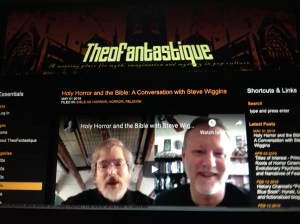
The blog Theofantastique started a couple of years before this one.  I remember that sense of childhood wonder that flooded me when I first saw its posts about books and movies with monsters—the kinds of things l always liked to read and watch.  But it was more than that.  This particular blog presents the very tangible connection between religion and horror.  Not only horror, though.  As the title indicates, this is a place for genre fiction of three closely related kinds: science fiction, fantasy, and horror.  The three are separated by mere degrees of semantics, and all three play very near to the third rail we call religion.  In my way of thinking, horror is probably the closest of the three, but I shift among this secular trinity and often wonder in which genre I am at the moment.

For someone who grew up being taught that religion was all about history—including a history of the future, mapped, plotted, and planned just as carefully as a summer vacation—seeing the connection with genres that are all acknowledged to be fiction was, at first, a little shocking.  I’d been taught in literature classes that genre fiction wasn’t really literature at all.  “Pulps” were printed on cheap paper because, as you might again guess from the name, they weren’t worth much.  Many of those books are now collectors’ items and cost a pulp mill to purchase.  My list of books from my childhood that I’d like to recover has me looking with some worry toward my bank book.  The thing is, these are often insightful statements about religion.

Monsters were always a guilty pleasure for me.  Being small, shy, and insecure, it was easy to understand things from the monster’s point of view.  And very often religion was implicated.  Sitting in my apartment in New Jersey, at times unemployed, I began to explore the connection between religion and horror.  I thought I was the only one.  Eventually I discovered kindred souls, and soon came to understand that monsters are perhaps the purest representations of what religion can do.  Even after writing two books about this subject, Theofantastique is a place unlike any other I know.  It has far more readers than I ever will, but this isn’t Godzilla v. Mothra.  No, we’re all in this together.  And we’re gathered together for one purpose.  In any other circumstances you’d say it was religious.


Assume Nothing

You know what I’m talking about.

It’s rude.

Disorienting, isn’t it?

One of my greatest bêtes noires is the email that only gives enough information to frustrate or irritate.  I get them all the time, mainly from business-people.  Look, I know you’re busy.  We’re all busy.  A single-sentence email that doesn’t explain anything is rude and exasperating.  One of the reasons, if I might speculate, that I always received very good teaching evaluations boils down to a simple trick: good explaining assumes little on the part of the listener/reader.  When I write an email, for work or for whatever life outside work is called, I explain why I’m emailing and I use common courtesies such as “Dear X,” and “Best wishes.”  They take me all of seconds to type, and they make the receiver, I believe, feel human.

The other day I sent such an email and received a one-sentence response that assumed I knew a lot more about the topic than I did.  It frustrated me so much that I had to write this blog post before going back to it and asking, yet again, that sender explain (in this case) himself.  What was he trying to say?  Who was he, even?  I’d been asked to contact him by someone else.  I had no idea who he was (I briefly explained who I was in my initial email).  Electronic communication, IMHO, even if brief, need not be rude.  If we’re all that busy maybe it’s time to step back and consider that life’s too short for generating hurt feelings and generating negativity.  Emails without niceties are rude.

Of course, there are people you know well and that you contact frequently.  I still try always to give them the courtesy of opening, body, and closing.  I grew up in the generation of letter writing.  One thing even businesses knew in those days was that rude behavior lost you customers and/or clients.  Now in Generation Text rudely apocopated emails are standard and I have to wonder if anyone’s done a study on how much business money is wasted on the time it takes to recover from receiving a rude email.  The writer may not be intending to be rude.  Many of us were taught growing up that a “please,” “thank you,” or “I’m sorry,” went a long, long way in avoiding hurt feelings.  Go ahead and call me a snowflake.  But remember, it’s December.  So I’ve just had to spend a quarter-hour of my busy day writing this rant before responding to an email that made me mad by its brevity.  I’m not a texter, and I think I’m discovering why.


Jeremiah’s Lamentations

Fundamentalists live in a supernatural world, otherwise their view of the Bible simply can’t hold up.  I’ve read or studied about the Bible for well over forty years now and I’m still learning things.  Interesting and strange things.  Some time back I wrote about the bizarre world of the many books of Ezra/Esdras in various versions of the Bible, some canonical, some not.  While chasing up a reference the other day I had to delve into the similarly complex sphere of Jeremiah.  Jeremiah is the only prophet who names his secretary, a man called Baruch.  This fact led to a series of books pseudepigraphically written by Baruch, but before we get there the book of the prophet himself is also confusing.  Since Jeremiah is the prophet whose life is said to most resemble Jesus, for Fundies this is important information.

The book of Jeremiah isn’t in chronological order.  This always throws introductory-level students, for it shows clear evidence of editing.  Now, at least Jeremiah does tell us about Baruch, so we can blame his poor organizational skills and still maintain a divine aura for the book.  The earliest translation of Jeremiah, the Greek Septuagint, lacks some material.  Indeed, the Greek is about an eighth shorter than the Hebrew, raising the question of whether an original (reflected in the Greek) was expanded or whether some of the confused original in Hebrew was cut.  Protestant Bibles assume, by their placement, that Lamentations was written by Jeremiah but it clearly wasn’t.  It doesn’t match his theology at all and the “of Jeremiah” in the title was made up some time after the book was written, and this is only a start.

The Apocrypha, or Deuterocanon of the Catholic, Orthodox, and Anglican churches, contains a book called the Letter of Jeremiah (not written by Jeremiah), and a book called Baruch.  I went looking for a reference to Baruch only to find it was in the Apocalypse of Baruch.  When I had trouble finding it, I had to consider that two books bear this title, 2 Baruch and 3 Baruch.  The former is in Syriac and the latter in Greek and they aren’t the same.  Because of these two (also pseudepigraphic) books, plain old Baruch is also known as 1 Baruch.  And there’s also a 4 Baruch.  None of the Baruchs were written by Baruch and Lamentations and the Letter of Jeremiah weren’t written by Jeremiah.  Neither was his own book because he tells us Baruch wrote it down.  I never did find my reference, and I realized that only in a supernatural world would any of this make sense.


Making Memories

I’m a little suspicious of technology, as many of you no doubt know.  I don’t dislike it, and I certainly use it (case in point), but I am suspicious.  Upgrades provide more and more information to our unknown voyeurs and when the system shows off its new knowledge it can be scary.  For example, the other day a message flashed in my upper right corner that I had a new memory.  At first I was so startled by the presumption than I couldn’t click on it in time to learn what my new memory might be.  The notification had my Photos logo on it, so I went there to see.  Indeed, there was a new section—or at least one I hadn’t previously noticed—in my Photos app.  It contained a picture with today’s date from years past.

Now I don’t mind being reminded of pleasant things, but I don’t trust the algorithms of others to generate them for me.  This computer on my lap may be smart, but not that so very smart.  I know that social media, such as Facebook, have been “making memories” for years now.  I doubt, however, that the faux brains we tend to think computers are have any way of knowing what we actually feel or believe.  In conversations with colleagues over cognition and neurology it becomes clear that emotion is an essential element in our thinking.  Algorithms may indeed be logical, but can they ever be authentically emotional?  Can a machine be programmed to understand how it feels to see a sun rise, or to be embraced by a loved one, or to smell baking bread?  Those who would reduce human brains to mere logic are creating monsters, not minds.

So memories are now being made by machine.  In actuality they are simply generating reminders based on dates.  This may have happened four or five years ago, but do I want to remember it today?  Maybe yes, maybe no.  It depends on how I feel.  We really don’t have a firm grasp on what life is, although we recognize it when we see it.  We’re further even still from knowing what consciousness may be.  One thing we know for sure, however, is that it involves more than what we reason out.  We have hunches and intuition.  There’s that fudge factor we call “instinct,” which is, after all, another way of claiming that animals and newborns can’t think.  But think they can.  And if my computer wants to help with memories, maybe it can tell me where I left my car keys before I throw the pants containing them into the wash again, which is a memory I don’t particularly want to relive.

Memory from a decade ago, today.


Job’s Jobs

Many years ago, after Nashotah House decided it no longer required my unique outlook, I bought a book.  (That’s my default reaction.)  This book was on how to write killer cover letters.  I don’t remember the title or the author, but I followed the advice, well, religiously.  It got me nowhere.  Business tricks, at least historically, don’t work in academia.  Sitting at home, pondering my sins, I flipped to the chapter on advice to take if none of the rest of this was working for you.  Here’s where the human side began to show through.  Have you been eating onions or garlic before your interviews? it asked.   Do you need to lose weight?  Try dressing nicer.  It occurred to me that the business world lacks the imagination required for denying jobs.  And besides, who was getting any interviews before which I shouldn’t eat garlic?

Business advice is, in a word, shallow.  It assumes that if you’ve got the goods there’s no reason you won’t get hired.  Reality is a bit more complex than that.  I often ponder how people simply go for what they want.  They reach for the biggest piece without pondering the repercussions of their actions.  I see it in my small world of publishing all the time.  Those who are “hungry” (read “greedy”) succeed.  Those who wait behind to help others simply can’t compete.  So the cover letter book did get that part right.  Is it possible, however, to devise a society where everyone fits?  Not all are created equal, perhaps, but do we have to reward those who seem to care only for themselves?  Let them eat garlic.

The cover letter book, in the end, never really did me any good.  I found my way into publishing by being willing to aim low.  I’ve written many cover letters since leaving Nashotah House, and only two ever led to a job.  Those who work in business, what with their concerns about readers’ aromas and weights, seem never to have considered the intricacies of the intellectual job market.  What strikes me as particularly odd is that there are plenty of smart people out there, and yet they haven’t organized to offer alternatives to the greed-based structure on which our work lives are based.  They can’t, it seems, gaze beyond capitalism as a mechanism for helping individuals lead productive lives.  Business operates on the principle of replaceable parts, many of which happen to be human.  And even those who know how to write can’t hope to compete against those who prefer cogs that know to avoid onions.


Powerful Wink

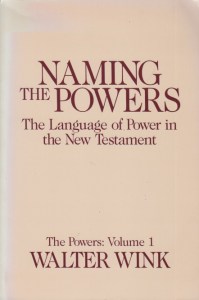
Those of us who became academically aware (in the biblical field) in the 1980s knew the name of Walter Wink.  Now, if you’ve ever become academically aware, you know that we all know some names vaguely, as if seen in a glass darkly, and some more intimately.  Wink fell into the former category for me.  He specialized in “the other testament,” and although I read Greek quite well, my academic track led me through Hebrew to Ugaritic and beyond, in the opposite direction.  I taught New Testament in my academic career, but never found the time to go back to Wink.  I knew he’d written about “the powers,” and the idea was interesting, but I had other research I was doing and I never got around to him.  Now I’ve finally finished the first volume of his famed trilogy on the powers (Naming the Powers).

“Powers” was a circumlocution for many things in antiquity.  It is a high abstraction.  Why do you do what you’re told?  The powers.  They can be human, such as bullies or governments (which are increasingly difficult to distinguish), or they can be supernatural.  Much of Wink’s book is technical—this isn’t easy going, even if it’s theology.  He looks closely at the terminology of power and exegetes it minutely.   The book comes alive, however, in part 3.  There were quite a few worthy insights here, but the one that struck me the hardest is how institutions generate a power that no one individual can control or contain, let alone comprehend.  As Wink points out, a school isn’t a building.  What goes on inside such a building takes on a power that reaches beyond any of the individuals involved in teaching or learning.  Think of Harvard.  What is it?  Who is it?  It bears power simply by the citation of its name.  No scientist can quantify it, but none will dispute it either.

Thinking about “the powers that be” in this way is transformative.  Wink draws this into the ancient perception that what is happening “down here” is merely a reflection of what is taking place on high.  Not unique to Christianity, or even monotheism, the idea that our lives reflect the reality of some higher power is pervasive in human thought.  And institutions.  Harvard, as most prestigious universities, essentially began as a place to train clergy.  Even at this stage it began to exert a power.  Today Harvard (and many other schools) still hosts a seminary and training ground for clergy.  They face a largely unbelieving society when they’re done.  And if they’re at all like me, it might take them decades to realize something may be missing.


New Religion

Republicanism, it seems to me, has become its own religion.  It started off when the GOP married evangelical Christianity, but the offspring of that unholy union has become a religion all on its own.  It certainly doesn’t adhere to classical Republican principles (tariffs?  Really?).  Nor does it adhere to Evangelical standards (turn the other cheek?  Love thy neighbor as thyself?).  Like most blendings, this new religion has some elements of each parent and it has no lack of fanatic supporters.  The traditional Evangelical, for example, considered the Devil “the father of lies”—one of his biblical titles.  The Republican, however, considers pathological lying to be signs of messiahood.  There’s a tiny disjunction here, but it proves that what we’ve got is the birth of a new religion.

Books and articles have begun to appear on how Evangelicalism has changed.  I don’t believe it’s so much a matter of Evangelicalism evolving as it is Republicanism fulfilling the need for intolerant religion.  In every culture there are those who want to go back to the day of Moses and golden calves and stoning those you hate.  It’s a little more difficult these days, what with secular laws that protect the rights of others, but the GOP has found a way.  My heart goes out to old fashioned Republicans, it really does.  Fiscal conservatives have found themselves in church with a bunch of people with whom they agree on very little.  They have no choice, for their political party has been sanctified.  And the only thing worse than an Evangelical is a bleeding-heart liberal.  Next thing you know the Democrats will start quoting the Bible at you.

The lying thing really takes some wrapping my head around, though.  I’ve always said nobody believes in a religion they know to be false.  This new development challenges that, if it doesn’t challenge the very idea of religion itself.  Republicanism is a religion based solidly on bearing false witness.  Self-aware of it, even.  You can’t tell me that these educated white men don’t know a criminal activity when they see one.  That they can’t read, and reason, and trust their intellect (although it takes the back seat to their overwrought emotions).  Sound like a religion to you?  It sure does to me.  It’s been coming a long time, but it took the last three years (the tradition length of Jesus’ ministry, it’s often said) for this to dawn on me.  The religion of the lying messiah.  I’ve got to wonder what kind of future it’s got.  I smell the fires rekindling in the burnt over district and wonder who’s for dinner.


To Be Continued

I’m about in the middle of Neal Stephenson’s Fall: Or Dodge in Hell.  I’ve also just about finished Walter Wink’s Naming the Powers.  At the same time I’m revising the draft of Nightmares with the Bible, which will become my fourth published book.  While doing all of this at the same time (and working about nine hours a day), it occurred to me that to really “get” an author you should theoretically read her or his oeuvre from start to finish.  Ideally, to trace the arc of thought, you shouldn’t leave anything out.  The reason that this is as important as it is futile is one of the nagging problems that came to me while working on my doctorate: how do you know what a source you’re citing is really saying?

Pardon my nihilism, but this is an important matter when it comes to academic practice.  Academics cite many sources, and often miscite them.  I’ve seen it regarding my own work.  One scholar argued the exact opposite of what I published in an article and even made the point that he was building on what I’d stated.  Clearly he was digging where I’d been building or vice versa.  We were going in opposite directions and what I’d written was to undermine what he was arguing.  The thought came to me now because both Stephenson and Wink are the writers of many volumes.  I need to cite my sources, but it’s clear that the books are merely slices of lifetimes of thought.  Academia wants you to show your work, but its dated even before you press the “send” button.

I’m not knocking scholarly process.  It’s the best system we’ve come up with for getting near to the truth.  Since no one person has the entire truth, however, we get closer still if we follow a writer from start to finish.  Those of use who use pseudonyms in order to keep our day jobs only complicate things.  Our works (which we hope will outlast us) are only fragments of a larger world of thought that goes on behind the writing of books.  And what about weblogs, or “blogs”?  The million-plus words on this one are a stream of consciousness that weave within, behind, and outside of the books, articles, and stories I write.  Some writers make bold as to attempt biographies of other writers.  Some try to read everything said writers wrote.  Even so they’re only getting part of the picture.  To understand where a writer’s coming from requires more commitment than we’re likely willing to spare.  Now, if you’ll excuse me, I’ve got some books to finish.


What Remains?

As our government continues to pretend it has an interest in anything but enriching the individuals in Washington, a rather constant refrain of “broken system” has emerged.  It heard that phrase repeatedly in conversations in San Diego, on a variety of topics.  Now, I’m no stranger to buzzwords, but this strikes me as particularly apt to describe what we’re seeing.  A democracy within a republic builds safeguards to prevent the abuse of power, but when abuse of power occurs and one political party insists on enabling such abuse, the system is indeed broken.  Not only that, but there’s no will evident to fix it.  The GOP glories in it, feeling like it’s somehow winning the game as families and individuals suffer as a result of it.  In the past, it seems to me, there was a desire to repair what was an obvious problem.

Self-delusion, it seems, has become very common.  That, and some older politicians may not be aware how frequently they’re shown in their foibles on the internet.  Information that used to take weeks or months to filter out is now known instantaneously, and everybody’s overloaded and confused.  Politicians, instead of trying to show us the way in such a landscape are rather acting like my late stepfather in saying “Do as I say, not as I do.”  A fine bit of hypocrisy, that.  At least he tried to mend his ways, even if not successful in his efforts.  He would’ve known, however, that he had no business being president.  I reflect on this broken system quite a lot and I wonder what is next for us.  When trust in government is completely eroded, where do we turn?

Many have celebrated the decline of religion.  Let’s be more precise here and say organized religion.  Survey after survey reveals that we aren’t necessarily becoming less religious, but we’ve been watching prominent religious leaders throw their unstinting support behind a broken system.    Many of them continue to ignore the truth to support an incumbent who’s demonstrated that he’d just as soon turn on them as help their cause.  And for what?  Simply to prop up a tottering system, to squeeze out the last drops of what can be used to make things better for themselves before it all falls down.  As I was flying essentially coast to coast, it was evident from the air just how diverse a nation we are.  For nearly 250 years we’ve been able to make it work.  Now that it’s clearly broken, it seems the will to make it better has vanished.  And only politics remain.


Honest Labor

When an artisan begins a new job, s/he must acquire the tools of the trade.  During a period of unemployment I seriously considered getting certified as a plumber.  I’d done some plumbing repair and, unlike many people, I wasn’t afraid of it.  (I am, however, terrified of electrical work.)  When I was looking into it, it became clear that there would be a significant outlay of tool purchasing up front.  While all of this may seem obvious, people are often surprised to learn that writing books also involves tools acquisition, although it generally pays far less than plumbing. The tools used to be made of paper, but they can wrench pipes apart and rebuild a bathroom from scratch.  I’m referring to books, of course.  In order to write books you have to read books.

Long ago I gave up on trying to read everything in an area before writing.  There’s just too much published these days.  When I was teaching and actually had a modest book allowance I would attend AAR/SBL only to come back with armloads of books that I needed for my research.   Of course I had the backing of the seminary library as well, so I could find things.  As an independent scholar doing the same work, however, you have to do a lot more tool acquiring since no library will back you up.  Nightmares with the Bible came back from peer review with a standard-issue academic who wanted me to “show my work.”  (I.e., document everything.)  Apart from slowing the book down (it is written), this also means acquiring tools.  AAR/SBL always reminds me of just how much is being published these days and that my toolbox, although already quite hefty, isn’t nearly big enough.

As I’m going through Nightmares rewriting and adding footnotes, I’m discovering more and more material that could be included.  As an editor myself I try hard to keep to assigned word counts, and the entire allotment could easily be taken up by bibliography alone.  I am very modest in my spending at conferences now—independent contractors have to be.  Nightmares will likely be my last academic book; I can’t afford to keep going like this.  I don’t plan to give up writing, of course, just academic publishing.  Both this book and Holy Horror were written for non-specialist readerships, to showcase my non-technical way of explaining things.  Both ended up with academic presses and are slated to be among those specialist tools that the beginning artisan covets but for which s/he has to budget.  And when this house is finished it will have an impressive, if most unusual, private library.


Faithful to Monsters

“Since childhood I’ve been faithful to monsters. I’ve been saved and absolved by them because monsters are the patron saints of our blissful imperfections.” Guillermo del Toro’s quote came to me via my colleague John W. Morehead’s wonderful Theofantastique (actually its Facebook page).  I get the sense that those of us in the field of teratology parallel play a lot.  At least I console myself that way because so few monster sites link to my blog.  Nevertheless, I have great respect for del Toro and his drive to bring monsters into the mainstream.  His quote, however, hits upon a central theme of what I try to do here and elsewhere—reflect on what monsters have to do with religion.

Notice the religious language (obviously intentional): faithful, saved, absolved, patron saints.  Monsters are indeed self-reflections, and they play on the same field as religion does.  Often at the same time.  Religion, even in the best of circumstances, entails fear.  If everything were fine all the time, what need would we have of it?  Instead, aspects of life we don’t cherish or anticipate come at us.  Winter comes far sooner than we expected.  Monsters lurk in that brief season between summer and winter, that autumn of the soul.  They know us quite well.  Our weaknesses are evident to them.  But as del Toro notes, they absolve.  And more readily than any Episcopalian.  The religion of monsters is fierce and forgiving.  When we watch them on the screen, we’re watching the drama of, in del Toro’s nomenclature, salvation.  If we didn’t require saving, again, why would we need religion (or monsters)?

Being faithful to monsters again bears comparison with the divine.  Should you become one of the lost while the 99 don’t require any assistance, your monsters will come find you.  In fact, that’s what they most specialize in.  What are dark nights of the soul without a little company?  It’s not sacrilegious to map the divine world with that of monsters, for any language regarding such high stakes beings must be metaphorical.  Our standard version of God is often a large human.  Generally he’s male, and he doesn’t always display compassion, although capable of doing so.  Monsters may be creatures of our own imaginations.  They are cast large on the screen since they too stand in for those to whom we owe some tribute for this is not a safe world in which to raise your kids.  Guillermo del Toro understands; we should listen.


Prophets and Precipitation

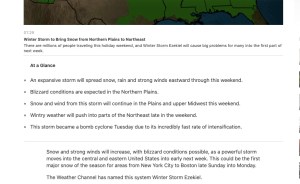
I have no idea how they name winter storms, or even if they should.  Weather-hype is yet another instance of click-bait, or watch-bait that requires constant upgrading to draw in increasingly jaded readers/watchers.  Winter storms are a fact of life, particularly in northern states.  If you name them, then you think you own them, as the saying goes.  In any case, beyond the fact that they go through the alphabet to draw their inspiration, I have no clue what criteria are used for giving names.  The storm that many of us were out in for much of the day yesterday was “Ezekiel.”  There are plenty of “E” names available, and I wondered at this biblical choice.  Ezekiel is often treated as a name for eccentrics, and I wondered if something about this storm was proto-apocalyptic or what.  Beyond the standard “snowpocalypse,” I mean.

The storm may have been considered of “biblical” proportions since it affected/is affecting much of the nation (as it is me, even as I write).  We tend to use the Bible for things that are of large scale, and, frequently, beyond our control.  Prophets often called for events on national level, and Ezekiel’s message had to do with a kind of ultimate redemption.  I suppose it’s the kind of message our nation could use right now, snow or not.  We could use good times sent from above, following the decidedly unbiblical evangelical administration we’ve put up with for three years now.  What would Ezekiel say?

Back in my teaching days, I had to cover Ezekiel in less time than the prophet deserved.  He pantomimed the coming destruction of Jerusalem, and, among the exiles, proclaimed their return to a better future.  Now I can’t say if winter storm Ezekiel will lead to a better future or not.  It will lead to some sidewalk shoveling, some travel headaches (as we experience firsthand yesterday), and the usual array of winter wonders.  I do know that claiming insanity to label a prophet is a cheap shot when it comes to explanations.  Ancient people recognized madness when they saw it, and prophecy, they knew deep down, was different.  None of this suggests this storm has been in any way predictable.  Yesterday with its accumulation of sleet and freezing rain, and today with its projected snow are all part of a typical December around these parts.  As people addicted to media stimulation, I guess we have to give it a name so that we can feel properly awed.


Back to Normal

The western philosophical tradition is built on the idea that permanence is reality.  From the Greek philosophers on, the idea has been to identify the basic, unchanging building blocks of reality to get at what’s really real.  The eastern philosophical system posits that change is reality.  Permanence is illusion, and that which we think of as unchanging is a deceptive projection of our own minds.  This dichotomy keeps coming back to me when things change and I keep waiting for them to go back to “the old way” or “the usual way.”  Most recently, for example, the shift to or from (I can never remember which) Daylight Saving Time.  This was followed closely by a mandated trip to San Diego, three time zones away, that lasted five days.  While there I met with potential authors later into the evening than I generally stay up on eastern time.  Now that I’m back home I keep waiting for things to go back to the way they were.

My response to all of this is to wonder if maybe I have the wrong philosophical disposition.  Problem is, the entire western world is built on the proposition that permanence is reality.  The things that worry us are, in eastern thinking, part of the constantly changing flux of reality.  While away from the usual constant connectivity of life at home, bills still come electronically.  Websites ask you for passwords that, like eastern thought, are constantly changing.  I play along, even to the point of “buying” property so that it will always be mine.  Right now lots of things are up in the air in the western world—the future of democracy itself is uncertain—and I keep waiting for things to get back to normal.

Part of the problem is that I keep too busy.  It is easier for me to maintain this illusion if I slow down and have time to think it through.  Things change too quickly for that, however.  Using time as a pole star to navigate this constantly heaving sea, I’ve become a little confused about my longitude.  I’m settling back into eastern time at the new hour they tell me that it is, but I feel as though I’ve left lots of things behind.  I’ve had a little time off work over the holiday and there’s a tremendous amount of change awaiting me once I fire the laptop up again.  I want to go back to where I was before I boarded that plane, back before I “gained” an hour.  Back before I had to learn everything you need to know to “buy” a house.  I look to the east and nod.