Prophet Margins

One of the most misunderstood of biblical phenomena is prophecy.  One of the reasons it’s so misunderstood is that other ancient peoples came to associate it with predicting the future.  Now, what prophets said often had implications for the future, but they were more forth-tellers, as they say in the biz, than fore-tellers.  Amos, for instance, was a prophet concerned with social justice.  We know little about his life, but we can discern that ancient prophets could be paid to become “yes men” (“yes persons” just doesn’t sound right, and most were male) for the establishment.  Kings then, as now, surrounded themselves with sycophants who would tell them their policies were approved, or even ordained by God.  Amos was not one of those.
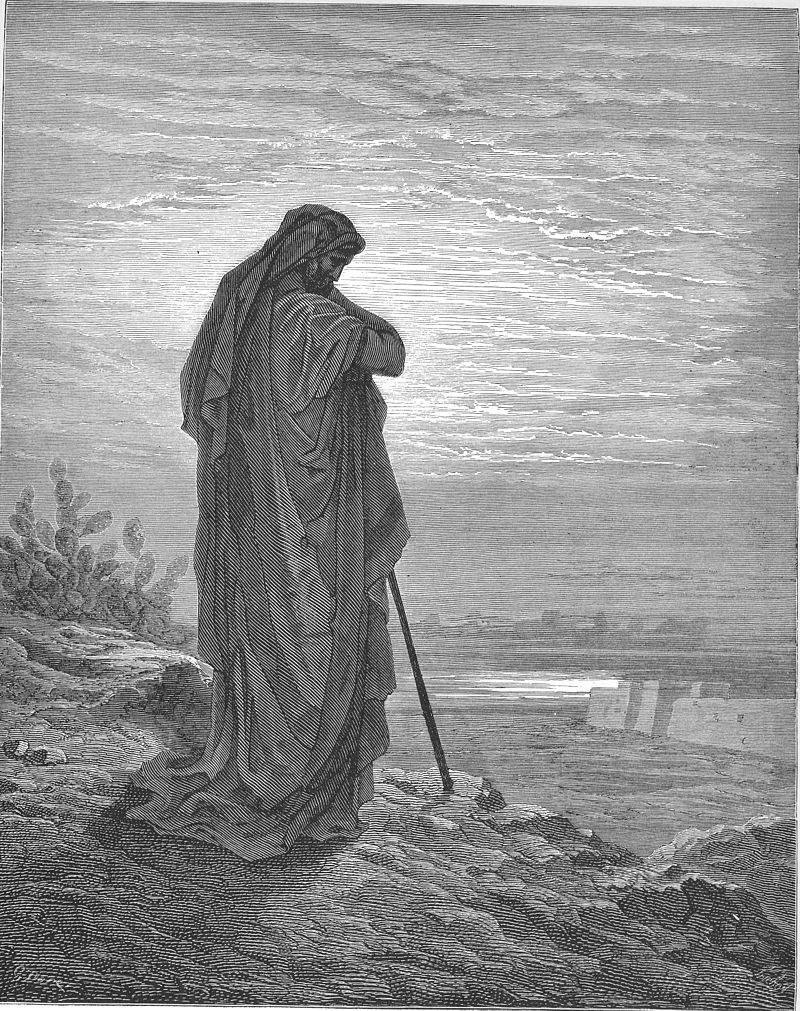
Amos points out in the book attributed to him that he was no paid prophet.  He was an honest worker with a great concern for social justice.  He lived in a prosperous time, but the wealth disparity between the rich and the poor troubled him.  (Amos has never been a favorite among prosperity gospelers, since his message has always been recognized as authentic among both Jews and Christians and he condemns the inequality rampant in society.)  Many in the eighth century BCE believed ceremonial actions—like, say, holding up a Bible in front of a church—pleased God.  Amos boldly declared such things sickened God as long as society favored the rich at the expense of the poor.  There’s a reason Evangelicals and Republicans tend to avoid Amos.  “But let judgment run down as waters, and righteousness as a mighty stream,” is not an easy thing to hear when you’re busy giving tax breaks to those who earn more than enough while refusing basic health care to the poor.

Prophets tend to speak of the future in conditional terms.  If your ways don’t change, then this will happen.  Some Christians, anxious to prove that Jesus was the messiah, came to see prophets as great predictors of the future.  Amos would likely have taken exception to them.  Even in his own day Amos made people uncomfortable.  His favorite image for God was that of a lion ready to attack.  His contemporaries told him to shut up.  Amos then made the famous statement that he was no professional prophet.  He would not adjust his message so that the comfortable could feel good about themselves.  If Amos were in America the last four years would’ve had his throat raw with pointing out to “Christians” how they’d come to misrepresent everything the prophets stood for.  We need more like him today.

Christian Fragility

Having read White Fragility, I was intrigued when a friend asked me if there might be such a thing as Christian fragility.  I think he was onto something.  To see how this might work, it needs to be understood that white fragility is the intense fear of having whiteness problematized.  We have been raised, conditioned, to think of it as the default form of humanity.  All others are “minorities”—aberrations, as it were.  Because of that “Caucasians” are reluctant to discuss race.  What my friend was suggesting, I think, is that there might be such a thing as Christian fragility as well.  Long considering itself the default true religion, Christianity has falsely convinced millions of Americans that this country was founded as an explicitly Christian one.  Many are surprised to learn Islam was here very early, largely because of African slaves.  And what of the indigenous religion of American Indians?

The idea of America as the ideal Christian nation is so deeply rooted that it’s something we bristle at talking about.  Think about it: educational institutions of the secular stripe don’t like to admit that many of them were founded as seminaries.  When I was growing up the two forbidden topics of conversation were politics and religion.  It seems that fragility may be a useful explanation.  Many academics refer to our culture as “post-Christian.”  They haven’t gotten out much.  Our culture is thoroughly suffused in Christianity.  It’s the air we breathe.  It’s the basis for many of our laws.  Much of science training (as I’ve argued before) is based on Christian assumptions.  Because Christianity shares so much background with Judaism clearly the picture is more complex than this, but the point I’m trying to make stands: we feel very uncomfortable when that implicit Christian identity is challenged, no matter how secular we are in reality.

Prior to Trump fear of “godless Russians” or “godless Communists” ran deep.  Ironically, evangelical Trump supporters now look to Putin’s Russia as a kind of model for political leadership.  We’re flailing about in Christian waters, baptizing the worst of human behaviors because we can’t bear to discuss whether something beyond Christianity might be worth considering.  I can’t claim to have absorbed the concept of white fragility fully, but I think the basic idea is sound.  American culture is extremely reticent to open discussions that suggest white, and Christian, aren’t defaults.  That people come in all kinds of shades of pink, tan, brown, red, yellow, and black are just as American.  That Islam, Buddhism, Hinduism, Jainism, and any number of other religions belong in a melting pot.  Christian fragility might well explain why this is so.


It Happened on Epiphany

Photo credit: Martin Falbisoner, via Wikimedia Commons

Can you spell treason?  It does begin with the letters “T-R-.”  The events of yesterday made it difficult to sleep securely in “the land of the free” as thugs took over the capitol building in Washington, and even after that Republicans still contested the electoral votes from Pennsylvania, preferring a treasonous president to a democratically elected Joe Biden.  As all of this was playing out, Georgia gave control of the senate to the Democratic Party.  Like many Americans born in a democracy, I stared at the news aghast yesterday as Republicans, fully in the public eye, tried to dismantle the very system by which they themselves were elected and even went so far as to claim they were patriots for doing so.  They draw the evil courage to do this from their “Christian” faith.

Yesterday was Epiphany, a Christian holiday.  To see Republicans—claiming the name Christian—attempting to overturn democracy on that very day was sickening.  To my mind it will live on like 9/11 as one of the most dangerous days in US history.  When asked to get the crowds that he personally incited to disperse, Trump released a video on Twitter telling his followers that the election was stolen and fraudulent but they should go home.  Pouring gasoline on a fire he himself lit, sending both houses of congress into hiding, his snakes-in-the-grass continued to support the myth that Trump hadn’t been defeated.  When the smoke clears this American thinks it’s time to dust off laws about treason and start applying them again.

Congressional leaders, and the president, swear to uphold the Constitution—hand on the Bible.  In the most closely watched election in history, with no evidence of fraud, when the loser wouldn’t concede his party backed him.  The Republican party has been infected with evil, I fear.  Even after seeing the turmoil that their posturing caused, they tried to discount the votes from my state just to keep a very dangerous man in power.  Our democracy didn’t die yesterday.  It died four years ago.  Claiming the name “Christian” without ever reading the Bible or attending church or caring about their fellow human beings, the Republican party has gone down in infamy on the feast of Epiphany.  The electoral vote count by congress is a mere formality, and I, a native and resident of Pennsylvania, am outraged that anyone claiming the power of a democratically elected office—disputing the very process that gave them any influence at all—questions my right to vote.  Why hasn’t treason been invoked?  Four years under the influence of the Evil One has shown its effects, and it happened on Epiphany.


Manifest Duty

As slaves to Mammon our celebrations are frequently curtailed.  In agricultural culture, winter was a time when fields couldn’t be cultivated (at least in northern climes) and thus the twelve days of Christmas could be relaxed without much consequence.  The history of this holiday complex is fascinating, and while many of us have been back to work for a few days already, today, Epiphany, is the “official” end of the season.  Twelfth Night, in some traditions yesterday and in others today, was a day of celebration, the twelfth day of Christmas.  Ancient pre-Christmas holidays such as Saturnalia lasted several days.  Today’s business world frequently gives a Scrooge-like single day off and many of us spend our hard-earned vacation days to fill out the week that is inevitably slow at work otherwise.

In Christianity, until recent times, Epiphany was a bigger holiday than Christmas.  Of the two it was the original day for gift-giving,  That makes sense in the commemoration of the visit of the magi that Epiphany represents.  They were the first givers of Christmas gifts.  Since Jesus was Jewish the idea of a manifestation, or epiphany, to the gentiles became an important marker.  Magi are styled as Zoroastrians from Persia.  The story occurs only in the gospel of Matthew and clearly wasn’t intended to coincide with the arrival of shepherds and angels.  As the Epiphany story grew to include Christmas it also encompassed many of the shadowy events of Jesus’ early years.  His questioning of the teachers in the temple was a kind of epiphany, as was his baptism.  All these things came together during a fallow time and were sufficient reason to take it easy for twelve days between the end of December and the beginning of January.

Some of our employers have expressed surprise that things continue to run fairly smoothly with workers reporting remotely.  These same people also seem surprised that people come back from several days off refreshed.  I suspect that they are also astonished at how well their computers work after being rebooted.  Time off is sacred time.  Whether we dress it up with elaborate stories of kings, wise men, sages, or magicians traveling great distances to see a baby in a foreign nation or whether we make it the day when one cousin baptized another, Epiphany grew into a major feast in medieval times.  Today it’s just another work day.  And with it the end of another holiday season will need to last us until near the end of yet another year.


Non-sacred Time

It’s difficult to say goodbye to the holiday season (although, according to its origins it’s not over yet!).  While the church still recognizes a couple more days until Epiphany—which until recent times was more important than Christmas—the secular “work world” is back to usual after New Year’s Day.  2021 started with a bonus, giving us a long weekend as well.  In any case, getting back to normal time is always a difficult transition.  For those of us who spent many years in academia, the holidays began about mid-December, and in my case, stretched fairly well into January.  Now, using a combination of vacation days and floating holidays, I’m able to set up a mini semester break of a couple of weeks.  Although I have trouble sleeping in, I was still able to spend the days with family and not worrying about business.

There is a difference in the quality of time off.  Some, I suspect, are eager to get back to work.  For me this first Monday back is difficult to face.  Some would argue that the difference in time quality is merely a subjective projection.  There is nothing scientifically changed from the last two weeks to the reality of the first Monday back.  This is one of those places where religion steps in as the more understanding boss (such instances are rare, so appreciate them while you can!).  Sacred time is taken very seriously by any number of religious traditions.  Even our beloved weekends have a basis in religious observance.  Holidays, even in a secular setting, are opportunities to recharge.  For me the spring semester was something I never dreaded.  We’ve allowed capitalism to take precedence over sacred time.

The problem with ordinary time is its mundanity.  Looking back, I’d been anticipating the holiday season with its time off for well over a month.  A full twelfth of the year.  To help with the transition, with my family I spent some weekend time cobbling together a personalized Modern Mrs. Darcy reading challenge.  Knowing I have good books in the future helps immensely, although I have much less time to read when work takes up much of my waking time.  Even that new start can’t be scientifically measured.  It’s something unique to human minds.  January begins with endings.  No matter how difficult 2020 may have been, at least it ended with a relaxing couple of weeks with family and no pressures to sit in front of a computer screen for over nine hours a day.  There will be more holidays ahead, and each one of them will be sacred time.


Seeking Renewal

Now that many are breathing a sigh of relief that 2020 is finally over, I stop to ponder time.  Measuring time, although most forms of life do it in some way, is a human organizing principle.  Calendars were originally religio-agricultural devices.  In order to keep the crops on their seasonal cycles, the gods were invoked—there was nothing secular about their world.  It’s not known who invented holidays or even the concept of a new year, but it is clear that it was a fairly early idea.  Different cultures today still celebrate New Year’s Day at differing times of the year.  Having it a week after Christmas helps to make this a holiday season, but it is no guarantee that a sharp break in continuity will come after a bad year.

Lots of bad stuff happened in 2020, but clearly the circumstance that made it a “bad year” was the Covid-19 pandemic.  Here in the United States it became a full-blown crisis because of the cause of four years of ethical famine, Donald Trump.  Those who can see beyond their religio-politics know that he is a man who spent his entire career looking out for nobody but himself.  Such people do not work as public servants and are downright terrible in a crisis.  The pandemic quickly grew into a crisis and we spent nearly ten full months out of twelve isolating ourselves.  The other crises of the year (generally pointing fingers at Washington), such as the important resurgence of Black Lives Matter and the California wildfires, were exacerbated by the pandemic about which our government did nothing.  Lack of interest has led to death numbers that have become a Stalinistic statistic.

As much as we like to think nature bends to human plans—our calendars—we have no idea what 2021 might hold.  We’re left with a country that has been neglected for four years.  Our Republican-controlled senate can’t even agree to provide any kind of relief to average people without adding riders and conditions to make our situation even worse.  Still, I’m optimistic.  New Year’s, whenever it is, marks change.  I’ve been noticing for over a week now that the sun is rising earlier than it had been as we descended into December.  The light is beginning to return.  While we can expect nothing good from the White House for twenty more days, we can look beyond that and know that change is on the way.  The division of time may be an artificial construct, but it can, if we allow it, become a sign of hope.


Yankee Doodle

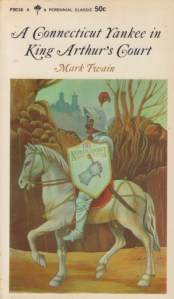
Some books stay with you in a way that hits very close to the nerve.  Since I read Mark Twain’s A Connecticut Yankee in King Arthur’s Court many years ago, memories of how it left me feeling prevented me from re-reading it.  That’s pretty unusual for Twain, in my experience.  I’ve read some of his other novels and there’s not a similar feeling toward them.  The racist elements are disturbing, but overall the stories manage to overcome some of the darkness with either levity or sarcasm.  The scenes that scared me off from re-reading Connecticut Yankee were the two episodes in which young women were murdered.  I realize Twain was simply being honest here regarding the cheapness of life in medieval times, but I found both these instances so saddening that I had a difficult time coming back to it.

Now, some two or three decades later the book speaks to me in a new way.  Something else I recently read reminded me of it, and I was struck at just how much Twain’s Arthurian peasants resemble the unthinking crowds of Americans who simply accept what people like Trump say.  One of Hank Morgan’s banes is how the uneducated refuse to question what they’re told.  In many ways this is humorously narrated but a dark undercurrent remains behind.  Twain had clearly supposed that nineteenth-century America had overcome this brainless gullibility.  A century and a half after Twain’s Connecticut Yankee we’ve clearly been involved in retrograde motion.  Twain levels much of the blame on the church.  His choice comments in this regard also still apply.

“I was afraid of a united Church; it makes a mighty power, the mightiest conceivable, and then when it by and by gets into selfish hands, as it is always bound to do, it means death to human liberty and paralysis to human thought.”  So Morgan states in chapter 10, and indeed, in the novel it is the church that largely leads to the downfall of the civilization Morgan had built.  Or again, in chapter 17: “I will say this much for the nobility:  that, tyrannical, murderous, rapacious, and morally rotten as they were, they were deeply and enthusiastically religious.  Nothing could divert them from the regular and faithful performance of the pieties enjoined by the Church.”  Twain couldn’t admit in public,  even in his own nineteenth-century life, what he really thought about organized religion.  It’s pretty plain in his fiction, but disguising fact as fantasy is a tried and true method of getting at the truth.  If I weren’t so sensitive to the human plight, I might read it more often.


Good Will

Social media can seem overwhelming.  There are so many sites and there’s so much to keep track of.  And that’s in addition to all these “super storms” we have dumping inordinate amounts of snow and rain on a house neglected by previous owners.  Given the circumstance, I joined Next Door.  I don’t have time to follow it, but each day I get notices of new posts.  On Christmas morning one from the previous day caught my eye.  A local mother could neither afford to decorate her tree nor buy her teenage sons presents.  She turned to Next Door and the comments and offers of help posted shortly thereafter revived my faith in the inherent goodness of people.  Holidays bring out the best in us, I believe.  We want others to be cared for.  It’s just too bad we have trouble enacting it in any political setting.

Next Door is about grassroots connections.  We are fairly new to our town.  Although it’s distinctly purple, the people are friendly to one another.  It saddens me that we’ve allowed the politics of hate to define us for four years.  Those unable to see through Trump’s self-serving tenure think it’s been business as usual as one man has torn the country apart to make himself feel good.  Out here among hoi polloi, people are reaching out to strangers, offering Christmas ornaments, gifts, and food.  I think that must be rain on my face.  Why else would my cheeks be damp?  Left to their own devices most people would behave well toward others.  Fear makes us act in destructive ways.  What if we all reached out helping hands when anyone was in need, and accepted handouts without shame when we needed them?

Christmas was rainy around here.  Just a week after receiving an early snow dump of over a foot, the rain gauge is overflowing.  Caring for our environment, it seems, would be the most obvious way of ensuring the greatest good for the greatest number.  I know that sounds utilitarian, but it certainly feels more moral than personal enrichment at the expense of others.  Too much water here while the west suffers drought and wildfires.  We know our actions contribute to the instability in our atmosphere.  No actual scientist denies it.  As these twelve days of Christmas play out, I see no sign of compassion from the swamp, yet there is a light shining through the gloom.  It’s a sign of human kindness.  And it is as close as next door.


Udolpho’s Mysteries

The carousels on Google can provide a great deal of information.  Looking at them, along with trusted lists of gothic novels, it became clear that one of the few classics I’d not read was Ann Radcliffe’s The Mysteries of Udolpho.  It’s been on my shelf for many years, it’s shear bulk staring me down each time I turned in its direction.  Long books are, of course, fine if they keep you going.  Knowing this was published in 1794 (in four volumes) cast some doubt on the narrative earning the sobriquet of “page turner,” and thus it proved not to be.  I’m afraid my disposition meant that the gothicness of the novel (and it’s certainly there) didn’t speak to me as I hoped it might.  There are creepy castles and rumors of hauntings.  Lots of stormy nights and damsels in distress.  Still, it comes across as the problems of the wealthy and that has to be handled well in order to not turn off this poor reader.

Still, a novel of such fame being written by a woman in the eighteenth century is worthy of note.  More than that, Radcliffe was the most successful (in financial terms) professional writer in the decade that produced The Mysteries of Udolpho.  Her literary influence is undisputed.  The novel is, however, excessively long.  Descriptive prose style was common at the time and may seem excessive to modern readers.  This is, however, impressive for an author who never traveled to the regions about which she wrote.

About 600 pages in, in the edition I read, something caught my eye.  Much of the novel consists of descriptions of mountain ranges in France and Italy.  As one party is on its way up one of the inclines, one of the gentlemen mansplains some of the geological features.  Noting that sea shells are found at such elevations, and so far from any body of water, it is noted that this is evidence of the deluge.  What’s so astonishing about this is that even in the twenty-first century that explanation still has currency among biblical literalists.  The novel appeared before Charles Lyell, who would explain the ancient ages of rocks, was even born.  We have centuries of knowledge at our disposal that we still have a tendency to dismiss.  Interestingly, Radcliffe was famous for reviving gothic literature partially by explaining away any supernatural elements.  Of course, accepting standard religious teaching of the day would pretty much have been expected.  And yet the mysteries continue even over two centuries later.


Religion Prof

Back in 2009, when Sects and Violence in the Ancient World started out, there was a fair bit of interest.  At one point I was listed among the top fifty “biblioblogs.”  Back in those days I got to know James McGrath, the curator of Religion Prof, a great blog now hosted on Patheos.  If you want a finger on the pulse of what’s happening in religious studies, you should read him.  With an energy I can’t conceive, he posts interesting stuff every day, even while being a professor.  And like me, he’s fascinated by religion and pop culture.  He also understands something—links and likes and shares are important.  People in my generation and beyond often don’t think that clicking that little thumbs up will do anything.  It does.  More so, that share button.

I was really pleased when James agreed to do a virtual interview with me about Holy Horror and Nightmares with the Bible.  You can find the interview here—and be sure to recommend and share it.  James has several interesting books of his own.  You should check them out.  The world of religious studies (and dare I claim it, biblical studies) is hardly moribund.  Underfunded, yes.  Socially devalued, certainly.  But alive nonetheless.  James’ blog is proof of that.  My regular readers will know my usual jeremiad about how higher education has been treating religious studies.  You see, I’m an historical thinker.  Where we come from is important.  Higher education began because of religion.  Its origins lie in monastic communities preserving learning—some of it secular—for the good of the world.  Now administrators looking for a department to cut know just where to turn. Shouldn’t we treat our ancestors with a little more respect?

I’m forcefully reminded of the many times analysts have declared that religion would fade away.  The claim has been made multiple times over the centuries.  At the same time scientists studying humankind conclude that religion is good for us, and that we’re naturally inclined to it.  Of course we should cease studying it!  Well, Sects and Violence in the Ancient World has also evolved over the years.  Not all of my posts are about religion anymore.  Most of them touch on it, however, because I’ve studied it my entire life.  Not only did religion make Homo sapiens what they are, it also formed some of us individually in ways so profound that we’ll never escape it.  Some of us even wear it proudly.  Great job with the blog, James, and thanks for the shout out!

Remember the early days?


Chick Tracks

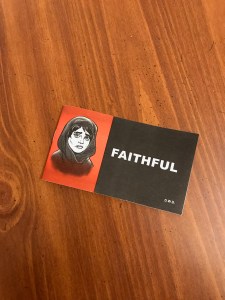
Goodreads isn’t the only booklover’s website, but it is one that publishers pay attention to.  Having a following on Goodreads helps for making marketing manageable.  Or so the thinking goes.  In any case, I recently had a message on Goodreads about Holy Horror.  It seems someone has, against all odds, found the book and is reading it.  This particular reader asked me in a comment about Chick tracts.  I’ve written about Jack Chick before.  He was a veritable one-man evangelical force of super-nature.  He is responsible for many of my personal nightmares with the Bible.  His cartoon tracts were designed to scare the Hell out of kids, literally.  I read them religiously.  My Goodreads reader pointed out that I could’ve made use of them in Holy Horror.

This made me ponder the reticence of academics to address religion as a cultural force.  Chick tracts are extremely common, even today.  As I posted last year, we were handed one while walking between venues at the first annual Easton Book Festival (an event forced virtual this year by, well, you know).  Not that Chick’s intellectual ability deserves study, but his influence is undeniable.  How many of us fundamentalist kids were set on our life trajectories by tracts that looked like mini-comic books but which had an unwavering, uninformed viewpoint held as gospel?  Chick tracts broached no dissent.  The Bible alone, and the Bible as interpreted by fundamentalists alone, was the only possible way of avoiding everlasting hellfire.  Nightmares indeed.

Chick died in 2016 after half-a-century of terror (his first tract was published in 1960).  Apparently Chick was a shy evangelical and his prolific cartooning was a way of assuaging his own fears of not evangelizing.  Ironically, in his tracts he offloaded that burden onto others—kids were made to feel inferior if they didn’t talk about Jesus to their friends, no matter how shy they might have been.  There’s not much information easily available on this influential man.  A motivated scholar, I’m sure, could dig up information—nearly any life can be illuminated to some degree—but I’m not sure the will is there.  If it ever happens, I suspect the study will be done by someone like me, raised on Chick and fed steady doses of childhood Bible reading.  My Goodreads interlocutor was perhaps onto something by suggesting my watching horror has something to do with Chick tracts.  Stranger things have, I’m sure, happened.


Turning Point

As the “Keep Christ in Christmas” crowd gears up for another Yuletide season, its capitalistic brother wonders about how good Christians will shop during a pandemic.  We’re not great materialists in my house, and our holiday spending tends to be modest.  Even so, the stocking stuffer is the kind of thing you find while browsing in stores.  I don’t feel comfortable indoors with strangers now.  Apart from groceries and hardware I haven’t been in any kind of store for at least a month now.  How to get ideas for those little, often inconsequential gifts that are demanded by homage to Saint Nicholas?  The holiday season is a wonderful amalgamation of differing traditions that should, in a perfect world, suggest openness to all and inclusivity.  At least this year we have that to look forward to.

Inclusivity is a gift worth giving.  Many of us are weary of the privileged “angry white man” who has held control of just about everything for the past several centuries but is still never satisfied.  The holidays around the winter solstice—itself the marker of days finally beginning to lengthen again—should be a symbol of the many traditions that make Christmas what it is.  There is no one “pure” idea of what this season represents (beyond shopping) because people all over have traditionally welcomed the return of light after many days of darkness.  Sometimes that darkness of exclusivity can last for years.  Now that we are beginning to spy a sliver a light on a distant horizon perhaps we can see enough to correct the error of our ways.  Perhaps.

That still doesn’t solve the dilemma of pestilence-filled stores where people want to huddle inside because it’s cold out there.  I can’t seem to recall where they hung the stockings in the manger, but surely they must’ve been there.  It’s how to fill them that’s the issue.  Our world has become so virtual.  How do you put streaming into a sock?  How do you stuff that cuddly subscription service into hosiery?  In a pandemic we’re reaping the fruits planted by a technologically-based society.  The art of browsing hasn’t been electronically replicated.  It’s the moment of inspiration in that curiosity shop that seems to be missing this year.  Most of us, I suppose, would be pleased to find a vaccine in our carefully hung stocking.  At least a government that takes the threat seriously will be something to anticipate.  Just a little longer, and the light will be coming.


Mere Christianities

While reading about the experience of an American Catholic who’d gone to Rome (check out this post), something in particular struck me.  Although the setting was in the 1960s, the author noted a truth that is still with us: Americans take religion much more seriously than do their parent bodies overseas.  This may be true elsewhere in the world as well, but those of us in this former frontier know that American isolation means religion developed here in a way different from much of the rest of the world.  To get a grip on that we need to realize that Christianities in America are largely of European origin.  That’s important because the roots of these traditions lie elsewhere and the question of how they measure up against the religion started by a Galilean peasant bears close scrutiny.

First of all, if we take what we can gather from the Gospels the things that Jesus might’ve actually said, we find contradictions.  This isn’t unusual.  Nobody was writing things down as he said them and Jesus probably taught off the cuff (not the maniple).  These traditions were recalled a couple decades after the crucifixion.  Try remembering exactly what you said just a year ago and you’ll get a sense of the difficulties.  Paul of Tarsus took this teaching in a new direction, both in doctrinal and physical senses.  Christianity became a European religion.  Fast forward by a few centuries and we find its much-changed Protestant forms inspiring people to go look for a place to practice it their own way.  Politics never follows far behind religion and so the American Indians became victims of those seeking religious freedom by fleeing from home.

Meanwhile, back in Europe, much of the fire that had led to sparks flying over here had been banked.  The Enlightenment and its application to these various traditions had shown that literal interpretations were historically unlikely.  Indeed, Americans trained on the frontiers by clergy with little education had taken Christianities in entirely new directions.  Literalism was often assumed, although its expressions varied wisely.  When you look closely at how religions develop you learn that the rank and file believer is out of touch with “official doctrine” and those who specialize in it find they can’t course correct without looking hypocritical.  The book I was reading had Vatican officials complaining Americans too Catholicism too literally.  It seems this is the fate of any faith that allows itself to become a mere religion.

Photo credit: Mapham J (Sgt), No 5 Army Film & Photographic Unit, via Wikimedia Commons


Bethlehem

Now that the holiday season is upon us, I guess it’s okay to post about the upcoming.  It’s actually pretty hard to avoid, living so near Bethlehem.  While Easton claims the first Christmas tree in America, Bethlehem was settled on Christmas Eve and named accordingly by the Moravians.  It’s a tourist destination for Christmas aficionados everywhere, and, as my wife quotes about 2020, “we could use a little Christmas.”  So we headed to the Christkindlmarkt over the weekend.  Apart from an abundance of consonants, Christkindlmarkt is a chance for vendors to bring their wares to where tightly shut pandemic wallets are willing to open up a bit.  This year, however, the “markt” was completely outdoors rather than under the usual four large tents with heaters running.

It was an enjoyable morning out, with temperatures near sixty—certainly not something you can count on for late November.  There were fewer vendors here for a variety of reasons.  You get a boost, for example, by getting people gathered together.  Our herd instincts kick in.  Seeing others spending, we decide to take our chances.  Outside the great rusting behemoth of Bethlehem Steel’s famed stacks stands sentinel.  This year, however, socially distanced tents and booths meant having to walk and stay back while others browsed, all while wearing masks so that smiles could not be seen.  Gathering without gathering.  With no interest in leading a charge against the disease on a national level, we’re all left to muddle through.

Several of the vendors had novelties portraying the year 2020 as the disaster that it’s been.  Instead of ending it with wishes for national peace, the incumbent is trying useless lawsuits to prevent the voices of voters from being heard.  Stirring up his followers to protest against frauds that never happened, while having hundreds of lawsuits awaiting outside his own door as his actual deeds have been examined seriously for the first time.  Bethlehem reminds us that peace and hope ought to be in the air at this time of year.  Thinking of others rather than ourselves.  Do we see that being modeled by 45 and his ilk?  Instead I’m standing here outside where there used to be a warm gathering tent.  A place where we each donate our body heat to help keep everyone warm.  Giving, even as the Republican-controlled senate withholds any stimulus package they think is too generous.  Yes, we could use a little Christmas right about now.


Money Days

Those of us who live in caves (figuratively) have trouble filling all this in.  Not a great fan of capitalism, I find “Black Friday” a troubling add-on to the holiday schedule.  Now I’ve lost track of all the expanding special days: Small Business Saturday, Cyber Monday, Giving Tuesday.  Must we celebrate capitalism so much?  I have no problem with non-Christian holidays, but when money becomes the sole basis for special days I have to wonder.  Mammon is a deity of which we’d been warned a couple of millennia ago.  The real irony is that it’s the very religion that posted that warning that now seems most closely related to the capitalistic system that perpetuates its worship.  It wouldn’t be such an issue except that the religion that has bought into the system so readily is the one that is putatively based on its condemnation.

Irony is something for which historians are always on the lookout.  Perhaps this is especially so among historians of religion.  Religion has come to denote a codification of our highest ideals and aspirations.  When did money attained such spiritual status?  It seems that Christianity was the vehicle.  Although it’s most obvious in American politics, the relationship goes back to the whole colonial enterprise.  Once Christianity became an imperial religion under Constantine, its focus began to shift.  Even those splinter groups that started off with higher ideals soon came under the overarching umbrella of the capitalistic system sprung from the teachings of a poor carpenter from Nazareth.  And so we find ourselves amid a creeping array of money-based holidays that provide the secular answer to Advent.

Of course, Advent itself became a season of anticipating the commercialized holiday of Christmas.  And here as the calendar year winds down the financial year hopes for a shot in the arm because economy is the doctrine of this new religious thinking.  And the irony is that the system is set up so those who already have too much get more while those who don’t have enough end up with even less.  Sounds biblical, no?  Ever since my ouster from academia, I’ve had to cash in vacation days to make myself a little semester break.  A body gets used to a certain schedule, and those rhythms are difficult to shake.  As we work our way through pandemic-laced spending holidays I’ve got my eyes on a bit of time off from my small part in supporting this all-consuming machine.