Post Facto

“Yea, though I walk through the valley of the shadow of death,” Psalm 23 asserts, “I will fear no evil.”  Nor should one fear evil when flying over Death Valley, as I did coming out of San Diego, but I did.  There are perhaps not too many national monuments that can be appreciated from 30,000 feet, but the only way I’ve seen both the Grand Canyon and Death Valley is by plane.  My flight home from AAR/SBL had me sitting over a wing, so a photograph of the famed graben would simply show mostly wing and a bit of Death beyond.  This valley holds the record for the hottest ambient temperature recorded on the surface of the earth (134 degrees) and is famed as one of the filming locations for Star Wars.  Still, from the air the juxtaposition of mountains and salty, flat dearth was impressive.  I had no one with whom to share my excitement; the kid next to me was watching a movie on his phone and I had no idea who he was or if he’d be interested.
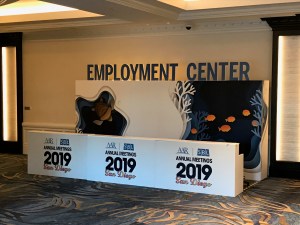
Disneyland, they say, is the “happiest place on earth.”  While I have my doubts about than endorphin-laced claim, I do know one of the opposite locales.  The hotel in which I stayed, the Grand Hyatt, San Diego, hosted the AAR/SBL Employment Center.  The hotel is not to be blamed for holding the most unhappy place on the planet, but as I looked at the booth I wondered if this was truth in advertising.  Should it not read “Unemployment Center”?  That two-letter prefix would make this at least honest, if not cheery.  I have spent some of the most miserable hours of my life in the employee hopefuls’ lounges at past conferences.  Hours and hours wasted, waiting to see if anyone, anyone at all was willing to grant you an interview.  I saw more than a few tears shed in that horrid place.  Some of them mine.

Now I’m high over Death Valley.  It feels far too sanitary to experience it in this way.  The professorate, which seeks to improve the world, is generally a powerless lot.  Signs scattered throughout the Convention Center and hotels asked such things as Does your school have over 50% contingency faculty?  And statements like Tenure track is not the norm.  The psalmist, it seems to me, got it right.  If you want to face the valley of the shadow of death and not fear, you have to walk through it.  The more people who do, the better the hope that we’ll land this plane with some kind of resolve to do be open to visions and to act upon them.

J L Seagull

Perhaps it has happened to you as well.  At some undisclosed period life became so busy that you felt as if—in a good southern California metaphor—you were riding on a huge wave and you couldn’t get off.  Back in my teaching days I had time to plan my trips to AAR/SBL and fit in some human activities as well as maybe even getting around to see the outside once in a while.  It’s great to run into so many people from every stage of my academic life—toddlerhood at Grove City College through my current doddering editorship—but I can’t help having the feeling that I’m popular now because I’m thought to have something others want.  The keys to the kingdom.  A possibility of getting published.

Those of you who read my daily reflections know that I’m glad to share publishing knowledge.  I encourage academic authors to learn a bit about the publishing industry.  It’s rapidly changing and when you have an inside track (here is the real added value) you need to look beyond your current book project to see what goes on behind the veil.  Widen the focus.  There’s a whole world out there!  My glimpses out the hotel window inform me that there’s an entire bay to be explored.  I watched seals or sea lions (it’s hard to tell from this distance) playing in the water as the sun rose.  Then a seagull flew up and landed inches from my face on the windowsill of my room.  It stayed for nearly a minute, looking me over as I looked it over.  Noticing the tiny white feathers that formed a W on the edges of its beak.  Its Silly Putty pink feet with small black nails.  The emerging red patch on the underside of its bill.  It took a step off the ledge, spread its wings and looked elsewhere for a snack.  I soon learned why.  A second later a larger gull landed in its place.  We too regarded one another curiously.  Had the glass not been there, we could’ve easily touched.  It also lept off to be replaced by an even larger, more mature gull.  None of the three were in any hurry to get away, but when they realized I couldn’t give them what they wanted, they left.

I’m a great fan of metaphor.  Academic writing, unfortunately, doesn’t encourage the craft of utilizing it (neither does it often encourage being coherent).  Later this morning—it will be early afternoon back home—I have to rush to the airport to catch a hopeful tailwind back east.  Someone else will check into my room.  If, perchance they sit by the window with the curtain drawn before dawn, the gulls will visit.  And maybe a lesson will be taken away.


Armed Forces

You ought to feel safe with the U.S. Navy so close by.  The naval base at San Diego is the second largest surface base in this particular branch of our sprawling military system.  From my hotel room I can watch the ships chugging through the harbor and from the Convention Center you can see quite a spread of naval real estate.  Still, all this hardware doesn’t make me feel safe.  Perhaps because I’m a child of the sixties, I can imagine a world at peace where military budgets don’t literally take food from the mouths of hungry citizens.  The last time I was in San Diego for AAR/SBL I toured the USS Midway aircraft carrier.  It’s clearly visible from my room.  I was amazed at both the technology and the obvious expenditure for such a craft.  It can’t be easy to set a city afloat.

Whenever I experience things like this I can’t help but wonder what we might accomplish if we loved each other as a species and put our heads together to try to solve our problems.  Lack of water—perhaps ironically in this naval city—is a serious global issue.  Poverty is the ghost of civilization.  The grasping of power by the driven but inept is clear worldwide.  We build great, complicated war machines.  The noise generated by the helicopters charging overhead bespeaks their weight and weaponry.  Down here in the southwest there are places civilians just can’t go because our military is busy keeping us too safe to allow us to wonder what they’re up to.  Black budgets must be nice.  I stand here among religion scholars and dream.

Ironically religion often leads to the fear that leads, in turn, to militarization.  We want to protect our “way of life.”  We’ll follow the prince of peace into war any day.  Just give the signal and release the missiles.  It doesn’t make me feel safe at all.  One time on a family visit, we drove through Norfolk, Virginia.  We stayed at a cheap hotel, because, well, we’re cheap.  The metal door was heavily reinforced with a stolid steel lock.  Navy men, we were informed, didn’t always behave well while ashore.  The locks were to keep us safe from those protecting us.  We stayed only one night and left early the next morning.  So I while the annual meeting away under the watchful eye of our largest line item on the budget.  They’re keeping our bodies safe, but who’s keeping track of our souls?


Focus on Religion

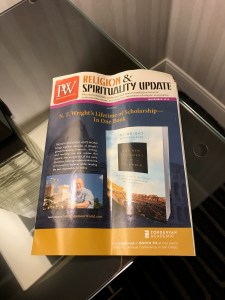
Publishers Weekly, or PW to those in the biz, is a great place to get information about, well, publishing.  I often spend AAR/SBL telling authors and prospective authors something that I wish I’d been told when teaching: time spent learning about publishing is never wasted.  PW every year has a “Religion and Spirituality Update” released in time for this meeting.  Despite the relatively small number of sales, religion is a discipline that loves its books.  I’ve only been quoted in PW’s special edition once, and it’s not been for a few years, nevertheless I always learn a thing or two from this free—yes, if you’re here in San Diego it’s free!—update.  It may seem odd to suggest that religion titles can be hot, but it is indeed possible.  Sexuality is hot.  I suppose that goes without saying.

A number of titles dealing with religion and sexuality appear every year.  What caught my attention, however was an observation from Jennifer Banks, from Yale University Press.  Noting the rancor that sexuality often introduces to discussions of religion, she observes that (and this is a quote from PW, not directly from Banks) “some Christians apparently need others to go to hell.”  (I can send the full citation, if you want to know.)  In an era when academics have been stressing inclusion, the retrenched religious world has been spinning in the opposite direction.  Instead of inviting everyone to Heaven, as might, say a Universalist, many conservative Christians consign fellow believes to Hell, and gleefully so.  It’s almost as if Christianity and capitalism have merged into a zero-sum game.  If some win, all the others have to lose.  They haven’t however, studied the history of Hell very well.

It’s kind of an insidious idea.  Given that we all want to justify ourselves, some go to the extremes of demonizing those who see things differently.  This form of religious thinking was original neither with Christianity nor the Judaism from which it grew.  There was no Hell in the Hebrew Bible.  The idea, when it did develop, wasn’t a place to torture your enemies, but rather a place demanded by justice.  Those who were utterly and unrepentantly wicked couldn’t hobnob in God’s country club with those who tried to be righteous.  In the modern evangelical narrative those who make certain medical decisions for basic human situations are among the utterly wicked.  Not surprisingly their sins are usually sexual.  If you want to see this in a wider context, pick up a PW when you pass by the stand.  “Anything free,” to quote another sage, “is worth saving up for.”  And who knows, it might keep you from Hell?


Wisdom of Trees

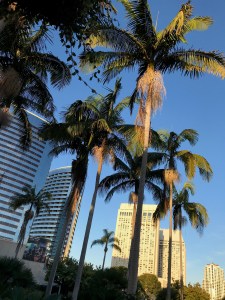
Stepping out of the airport the first thing I noticed was the palm trees.  I’ve traveled to this area enough times that I shouldn’t be surprised, but I always am.  And since we are creatures of the culture in which we’re raised, palm trees inevitably make me think of Gilligan’s Island.  We grasp for culture to help us make sense of this odd world of negotiating other people and, like many children born in the sixties, I was raised on television.  Gilligan’s Island (somehow appropriate training ground for attending AAR/SBL—it actually featured a professor) was as close to seeing a palm tree as I ever got, being raised in a very humble household.  To me, palm trees were as much creatures of fantasy as the monsters that populated the movies I watched on Saturday afternoon.

My first experience of a real palm tree was in Israel, 1987.  I’d signed on as a volunteer at Tel Dor, an archaeological dig near Haifa.  Then, as yesterday, I encountered palm trees—so alien and yet so natural—at the airport.  Welcome to Tel Aviv!  And so we think of palm trees as being part of paradise, a place where it’s always pleasantly warm and although well-watered it doesn’t rain too much.  Trees symbolize our culture.  Although back home in the northeast most of the leaves are down from the hardwoods, the region is also defined by its large plants.  Trees do that for us.  Spreading high over our heads, with dense cellular structure that makes them heavy, trees have always been attractive to our species.  And they can help us define, at a glance, where we are.  “Paradise” derives from a Persian word for “garden.”  Even in arid zones they value their trees.

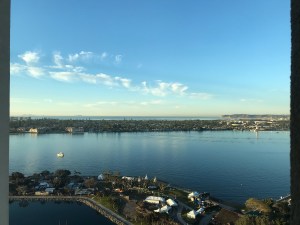
Looking out my hotel window I see the bay.  In the bay stands a marina.  Back home most boats are shrink-wrapped by now and I’ve already seen smaller bodies of water start to freeze over.  Paradise has no ice.  For the castaways, being on the island was always a challenge, but never a terribly serious one.  Thurston Howell III used his money (useless where there’s nothing to buy) to try to assert his influence.  Everyone treated him with respect, always calling him “Mr. Howell.”  In that paradise, however, one of the two characters (who had names) referred to always by title, the professor—the skipper, of course, was the other one—was the person looked to for guidance.  If anyone would figure out a way to be rescued, it would be the academic.  I’ll be spending the next few days on an island with mostly professors.  And when it gets too intense I’ll look at the palm trees and remind myself that this is paradise.


Daylight Saving Time Zone

One or two of you out there—you know who you are—put yourselves through reading my musings on a daily basis.  I haven’t missed a post in nearly a decade, but travel always complicates things.  Yes, it’s that time of year again—I’m on my way to AAR/SBL.  The American Academy of Religion and Society of Biblical Literature Annual Meeting is the trade show of the guild.  This year we’re meeting in San Diego, California.  The hope of many of us is that it’ll be sunny and warm.  Last year, of course, I missed the conference for the first time, exchanging the Denver Hilton for a night on the floor of Newark’s Liberty Airport.  This year I’m flying out of a different venue—one where egress is possible in the case of snow.

I always like to post a reminder to the faithful few that normal service on this blog may be interrupted.  One never knows what might happen when away from the regular routine.  And three time zones will surely wreak havoc with circadian rhythms that haven’t yet caught up with the end of Daylight Saving Time.  Or is it the beginning of Daylight Saving Time?  It makes no difference, because it lead to lack of normal sleep, no matter what we call it.  In any case, San Diego may make usual posting unusual.  At the very least it’ll be a few hours off.  I’ve become a creature of habit, posting my thoughts between six and seven on weekdays.  On weekends I’m up just as early, but I give the web a chance to sleep in.

These annual meetings are exhausting when you go on behalf of a publisher.  Unlike the leisurely experience of a paying customer, you don’t get to go back to your room for a nap, or even to sleep in.  Every year colleagues ask me to receptions but I decline because every day is a school day.  And I have appointments from 8:30 until 6:30 daily.  Sometimes even later.  You, my gentle reader, have been given advance notice.  I’ll try to continue my daily chronicle of life inside this particular head as thousands of scholars of religion mill about, wondering about the answers to the big questions.  Right now the big question is whether I’ve packed everything I’ll need.  I’ll gain three hours on the way out, but I have to leave them at the desk when I get back.  Along the way I’ll scatter posts like breadcrumbs to help me find my way home.


What I Meant to Say

So I try to illustrate each of my posts. I do this because in the days when the internet was young I often found blogs during image searches. I’ve grown more cautious over the years, regarding copyright. I try to stick to the “fair use doctrine”—and that’s what it’s called, a doctrine—or images I “own.” In the latter case it often means searching WordPress for a picture I’ve posted before. Since nobody has time to name all their photos, I use the assigned DSCN or IMG nomenclatures. There aren’t so many that a search won’t turn up an image in my library. Thing is, WordPress likes to anticipate what I’m looking for. What’s more, it “autocorrects” after I’ve begun scrolling through everything. DSCN becomes “disc” in its addled electronic brain, and IMG becomes “OMG.” Naturally, the image you’re seeking can’t be found until you manually correct autocorrect.

OMG has become very common shorthand these days. Growing up evangelical, there was a debate whether “o my God” was swearing or not. Those who like to hedge their eternal bets argued that this was taking the Lord’s name in vain, thereby breaking one of the big ten. This was to be avoided at all costs. Those with a little less fear (or perhaps a bit more courage) argued that “God” wasn’t “the Lord’s name.” God is a generic word and can refer to any deity, except, of course, for the fact that there is only one God. This led straight back to the conundrum. Exegetes tell us that technically this commandment isn’t about saying the deity’s name, but rather it’s a prohibition against using said name when you don’t intend to do what you say you’ll do. In other words, lying.

It’s truly one of the signs that evangelicalism has evolved that the world’s best known liar is unstintingly supported by this camp. When I was a kid, saying, well, OMG, could get your mouth washed out with soap. Lying could lead to other forms of corporal punishment, such as being, in the biblical parlance, smitten. Now it gets you elected to the highest office in the land and supported by all those very people who won’t spell out OMG, even when they’re busy cutting you off in traffic with their Jesus fishes flashing in the sun. When I was a kid presidents would step down rather than go through the humiliation of being shown a liar in the face of the world. Times have changed. And I have no idea how to illustrate such a post as this. What comes up when I search OMG?


Houses of Light

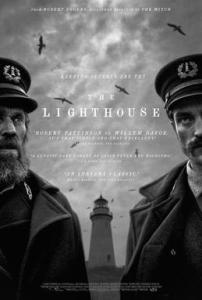
The Lighthouse is a movie we’ve been waiting a month to see.  Since its opening weekend my wife and I haven’t had two consecutive hours free during any weekend showtime.  Now that we finally managed it, I’ve been left in a reverie.  Robert Eggers, whose film The Witch opened to critical acclaim, has repeated the feat with this one.  His movies require a lot of historical homework and the end results have a verisimilitude that pays the viewer handsomely.  The details of the plot are ambiguous and the influence of King, Kubrick, Melville, Hitchcock, Poe, and Lovecraft are evident as two men in isolation grapple with insanity.  Also obvious is Greek mythology, with one reviewer suggesting Tom Wake is Proteus and Ephraim Winslow is Prometheus.  The end result is what happens when literate filmmakers take their talents behind a camera.

Naturally, the symbolism adds depth to the story.  The eponymous lighthouse is phallic enough, but the light itself—often a central metaphor of religions—is, like God, never explained.  Encountering the light changes a person, however, and the results can be dangerous, even as Rudolf Otto knew.  This light shines in the darkness so effectively that no ships approach the island.  The monkish existence of the keepers requires a certain comfort with the existential challenge of isolation, even if God is constantly watching.  The light never goes out, even when a reprieve would be appreciated.  Having reading Barbara Brown Taylor’s Learning to Walk in the Dark since the film opened, this makes some sense.  Horror movies lead the viewer into such territory when they’re thoughtfully made.

The concept of light is central to at least two similar forms of religion that have moved beyond doctrinal Christianity.  Both Quakerism and Unitarian Universalism emphasize the light as central to their outlooks.  Whether it be divine or symbolic, light is essential to spiritual growth.  In novels like Cormac McCarthy’s The Road the idea of an inner light keeps the father and son going.  In The Lighthouse the external light, when taken internally, leads to madness.  Since I watch horror with an eye toward religion—I do most things with an eye toward religion—I didn’t leave the theater disappointed.  I knew that, like The Witch, I would need to see it again but when it comes down to the price range of one ticket for repeated viewings.  Finding the time to get to the theater once was difficult enough, despite the payoff.  


The Happy Science

Many seem to be wondering, if the media are to be believed, why America, like REM, is losing its religion.  (And yes, I know that the expression for the latter means to lose one’s temper, not literally to lose one’s faith.)  Derek Thompson at the Atlantic recently wrote about how the more literal loss took place around 1990.  He posits that the rise of the Christian Right, the Cold War coming to an end, and 9/11 are behind the loss.  As an historian of religion, even with a more ancient focus, I have to wonder if his gaze goes back far enough.  Being born early in the sixties was an opportunity to have a front-row seat.  My family was very religious.  To us, the rest of the world may have been going to Hell, but locally we were trying to please God, as most everyone we knew was.

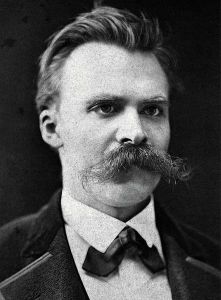
Theologians and sociologists thought God had died.  Nietzsche, always ahead of his time, had declared as much nearly a century before the sixties got underway.  The public face of religion, however, is never the same as what’s going on below.  The religious right was built on a deep-seated hypocrisy from the beginning.  Now hypocrisy is so very human it’d be easily forgiven were it not for the constant insistence on self-righteousness followed by the revelation of some base human vice.  Time and time again televangelists didn’t cover the tracks of their peccadillos well enough, and Catholic priest couldn’t fight that feeling.  They were doing what humans have probably always done, but while wearing the vestments of public respectability.  Like Cthulhu, it seemed like God was dead but dreaming under the sea.

Religion, as all scholars of the phenomenon know, changes only very slowly.  Church attendance began dropping in the seventies, but back then there was such a thing as the rule of law and a real concern that your neighbors didn’t think you a Commie.  Fast forward to the era of Trump when the rule of law broke down completely and religions rank right up there with Republicans as being the most dishonest elements of humankind.  We look back at when the slow trickle seemed to breech the dyke in the 1990s.  The real game changer (since 9/11 was still in the future) was the birth of the internet.  People began to talk freely about the two subjects—religion and politics—that those of us from the sixties were taught assiduously to avoid in polite company.  Nietzsche published Die fröhliche Wissenschaft in 1882.  It would take about a century to sink in, and human religious leaders would be the ones to prove his point.  At least in this world of choosing our confessions.


The New Light

Sometimes you meet kindred spirits in books.  Barbara Brown Taylor’s Learning to Walk in the Dark has been waiting patiently.  It’s one of those books that I suspected would meet me where I live, and regarding this I was correct.  Brown Taylor, a former Episcopal priest and professor of religion (both of which I attempted but failed to achieve), has the courage and insight to suggest that darkness might just be a friend.  The darker half of the year settled hard on me this year.  As its black wings gathered about me I reached for this book.  I’ve been struggling with a question I’m sometimes asked: why do I let my thoughts linger in what must be considered darker corners?  I watch horror and write books and stories about monsters.  What’s wrong with me anyway?

One accusation may be fairly leveled at much of American religion is that it is shallow.  Light is uncritically accepted as good and dark becomes somehow evil.  There are biblical prooftexts that can be used to “prove” this, but they change color when you wrestle with them.  Learning to Walk in the Dark contains many ways of reflecting on realities which are inevitable.  Brown Taylor visits museums that give the sighted the experience of being blind in a safe environment.  She spends time in caves.  She stretches out beneath the stars and contemplates the dark night of the soul as well as the cloud of unknowing.  These latter two are, of course, spiritual classics.  There’s quite a bit that can be learned from experiencing darkness and listening intently.

My own predilections toward subjects called “dark” are forms of therapy.  My religion simply can’t be shallow.  I need enough water to swim.  And yes, I’m afraid of deep water.  Darkness perhaps comes more naturally to those of us who are awake for every sunrise.  If I move far enough north that may cease to be the case, but for the last decade or so my internal alarm goes off a couple hours before the first sliver of light creeps over the eastern hills.  And I seem to have assimilated to it.  As I read Learning I could imagine the accusations flying from my former Nashotah House context.  Looking at that patriarchal theology of sin and misery, however, I think there’s no question whence true darkness comes.  Without the dark we could never tell that it was light.  Since we need both, it seems wise to follow the sage advice here offered and get to know the dusky side a bit more intimately.


Panic at the Bookstore

Usually it works like this.  I go into a used bookstore with a list of titles I’d like to find.  Yes, I know I can look them up on Amazon and pay some price gouger more than the book’s worth, but you sometimes find things forgotten on a shelf out of the reach of technology.  When I went into a used bookstore in the vicinity of Ithaca last month I didn’t have my list with me.  When I visit such a store, especially the first time, I don’t like to walk out empty-handed.  The word “Exorcism” on both the spine and cover of Ken Olson—excuse me, Dr. Ken Olson’s book on the subject, well, how could I not?  Exorcism: Fact or Fiction? is published by Thomas Nelson.  That immediately told me something of what the book would be like.  It wouldn’t be an academic treatment, and it would be somewhat evangelical.  Still, I didn’t have my list with me.

Olson hasn’t had an easy life.  His license to practice psychology was revoked after he performed an exorcism and my sympathies are always with those who have lost jobs.  Rejection is, after all, a form of violence.  The book, however, isn’t so much about exorcism as it is about evangelical views of it.  Written around the time of the satanic panic in the 1990s, the book takes seriously the claims of the alleged victims and also the physical existence of the non-corporeal Satan.  This actually leads to a few logical brick walls.  Referring to the body parts of non-physical beings can be an exercise in metaphor, but evangelicals tend to be literalists otherwise.  This discrepancy begs for discussion but receives none here.

The history of moral panics is interesting.  We live in the midst of them pretty much constantly now.  The internet doesn’t really help.  Moral panics are times when particular concerns spread rapidly (for which the web is ideal) without having any critical questions asked.  They often lead to a mob mentality that can victimize the innocent.  Although that’s clearly not his intent, Olson’s book tends to do this too.  If a victim is female, as is often the case, conservatives blame her for such things as abortions, forgetting, it seems, that a male was involved.  Since abortion scares are another example of a moral panic, it’s not surprising Olson treats them along with other forms of spiritual warfare.  Those who turn to the book looking for The Exorcist will be disappointed.  You might find a copy of that, however, at your local used bookstore.


Homemade Halloween

Halloween is a holiday that brings together many origins.  One of the more recent is the tradition of watching horror movies in October.  I don’t know if anyone has addressed when horror films became associated with the holiday, but Halloween hasn’t always been about startles and scares.  Histories usually trace it to the Celtic festival of Samhain.  Samhain was one of the four “cross-quarter days.”  Along with Beltane (May Day), its other post equinox cousin, it was considered a time of year when death and life could intermingle.  Spooky, yes.  Horror, not necessarily.  Many cultures have had a better relationship with their dead than we do.  We live in a death-denying culture and consequently lead lives of futile anxiety as if death can somehow be avoided.

As a holiday Halloween only became what it is now when it was transported from Celtic regions to North America.  Other seasonal traditions—some of English origin such as Beggars’ Night and Guy Fawkes Night—which fell around the same time added to the growth of trick-or-treating and wearing masks.  At its heart Halloween was the day before All Saints Day, which the Catholic Church transferred to November 1 in order to curb enthusiasm for Samhain.  As is usual in such circumstances, the holy days blended with the holidays and a hybrid—call it a monster—emerged.   When merchants learned that people would spend money to capture that spooky feeling, Halloween became a commercial enterprise.  Despite All Saints being a “day of obligation,” nobody gets off school just because it’s Halloween.

My October has been particularly busy this year.  One of the reasons is that Holy Horror, as a book dealing with scary movies, is seasonally themed.  As I was pondering this, weak and weary, upon the eve of a bleak November, I realized that home viewing of horror—which is now a big part of the holiday—is a fairly recent phenomenon.  Many of us still alive remember when VHS players became affordable and you could actually rent movies to watch whenever you wanted to!  Doesn’t that seem like ancient history now, like something maybe the Sumerians invented?  People watch movies on their wristwatches, for crying out loud.  I suspect that John Carpenter’s Halloween had a good deal to do with making the holiday and the horror franchise connection.  Horror films can be set in any season (Wicker Man, for instance, is about Beltane, and three guesses what season Midsommar references).  We’re so busy that we relegate them to this time of year, forgetting that we still have something of the wisdom of the Celts from which we might learn.


Read a Book

A huge shout-out to Andrew Laties for conceiving and organizing the Easton Book Festival!  Easton may not be the largest city in the state, but the Lehigh Valley is Pennsylvania’s fastest growing area.  As we discovered when we moved here almost a year-and-a-half ago, it is a region that supports bookstores.  Even before the Festival we’d explored some six or seven and after moving from central New Jersey—where keeping a small shop or two open was a struggle.  We’ve become spoiled for choice.  Writers may not be the easiest people to herd—many of us are quiet and tend to live in our own heads quite a bit—but the festival has brought some 200 of us together, and we write on all kinds of things.

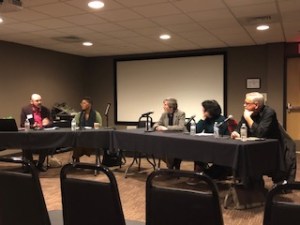
Although the panel on which I participated had religion as one of its themes, my wife and I noticed that at each session we attended religion was mentioned.  Either it was in an author’s background, or it figured into their writing, or most embarrassingly, it objected to and tried to silence them through censorship.  Although my book’s subtitled The Bible and Fear in Movies, it was evident that I wasn’t the only person who found the Bible’s effect on people scary.  And the theme continued into the evening as I attended the author’s banquet solo.  Many of the people I met had religion in their background or in their present motivations for writing, and not one of them was judgmental toward a guy like myself who’s trying to find his way.

The Easton Book Festival is in its first year.  Although by late afternoon the weather had deteriorated into the rain we can’t seem to shake around here, it was wonderful to see people walking around with festival booklets (there are enough events to warrant one) and not bothering to conceal and carry.  Books, that is.  For a moment, they were cool.  My second session is this afternoon.  As I learned both last weekend at my book signing and at sessions yesterday, a sell-out crowd is unlikely.  This is a free event and even authors who had more fingers than attendees were gracious and glad for the opportunity to explain what they were trying to do with their writing.  And they unstintingly shared what they’d learned with one another.  This was community, centered around books.  It was a small slice of what Heaven could be like, if we’d all just take an interest in each other.  Even if we’re shy and secretly would rather be home writing.


Influential Brethren

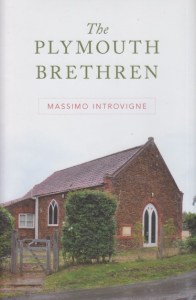
Outsized ideas from under-recognized sources always captivate me.  I have to admit that my own childhood fascination concerning, and fear of, “the rapture” still haunts me.  While our house isn’t large, the other day I couldn’t see or hear my wife anywhere when I knew she was home and my first thought was that she’d been raptured and I’d been left behind.  Please don’t try to console me with logic; I know very well the problems with this initial assessment and knowing the history of the idea of the rapture can’t stop the primal fear when it strikes.  So it is with religious ideas inculcated in the young.  That’s why I knew I had to read Massimo Introvigne’s The Plymouth Brethren as soon as I heard of it.  The Plymouth Brethren, and specifically one of their formative leaders, John Nelson Darby, were the inventors of the rapture.

Introvigne’s book doesn’t trace rapture history (other books do that), but he does narrate, in an admirably succinct treatment, whence the Brethren arose.  In the nineteenth century in the British Isles, some were very concerned that Christianity had gone off the rails.  Accommodating with secular society, it had become heavily doctrinal and, worse, political.  Breakaway groups were common, including those who went back to the “Bible alone” as the basis for assessing what being Christian truly was.  The Plymouth Brethren developed in this atmosphere and they still remain a relatively small Christian sect (I use that term completely neutrally).  Even though they themselves splintered over time, they were never a very large group.  They, however, invented the rapture.

John Nelson Darby, one of the founders of the movement, believed history was divided into dispensations, or periods, predetermined by God.  The dispensation in which we now live (and in which they lived two centuries ago) would include a dramatic rapture that would allow Darby’s understanding of eschatology to fall within the system he developed.  This idea was picked up by Cyrus Scofield and included in his enormously influential Scofield Reference Bible.  That Bible, although many evangelicals considered the Plymouth Brethren as a kind of “cult,” was used as the unquestioned roadmap for the end times.  It was picked up by such promoters as Hal Lindsey and Timothy LaHaye and made into a meme that just about any educated person recognizes.  We all know what “the rapture” is, although the Bible itself doesn’t spell it out at all.  Introvigne’s book is very informative on the Brethren but his chapter on their ten main divisions is, necessarily, a touch confusing.  Well balanced and fair, this is a great source for those who wonder who these people were that gave us such worries when our wives have “disappeared” into some other part of the house.


Spiritual Fear

There’s an old adage that if a headline asks a question the implied answer is “No.”  I’ve found that to be true, largely.  I hoped differently when I saw the article titled “Are Horror Films Secretly Spiritual?” by S. Rufus in Psychology Today.  Rufus, admittedly not a fan of horror, ponders whether it might not meet a spiritual need for some.  She would not count herself among that number, should the assertion prove to be the case.  Indeed, her post has more sentences ending in question marks regarding this assertion than it has straightforward declarative ones.  Rufus notes that ancient religions involved a kind of fear-based response appropriate to the lifestyle of those open to constant threat by the natural world.  She seems to believe that civilization has saved us from that.

Now one of the questions with which I constantly struggle is why I watch horror.  I do not like being afraid, and when people find out about my fascination with horror they tend to treat me as if there’s something wrong with me.  I guess maybe I think that civilization has not so much eliminated the sources of threat so much as changed them.  Those who grow up poor know fear.  Fear of want is extremely prevalent in our capitalist society.  I see the “street people” when I go into New York City.  They are not few.  Once you start to get away from affluent suburbs just about anywhere you start to see the run-down houses of those who can’t cope with the demands of a consumerist society.  Even those of us with an education are liable to joblessness and the very real terror that attends it.

Civilization, in other words, comes with its own costs.  Religions originally began—some of them at least—largely from the fear response.  Yes, people were afraid.  The gods, properly propitiated, stay the hand of disaster.  For now.  Some religions, such as those in the monotheistic family tree, tend to suggest higher principles like love can be the motivation.  These religions, however, quickly begin to make threats against those who are heterodox, and reintroduce fear into the formulation.  I suspect, from my own experience of all of this, that the answer to the question may actually be “yes”—horror films do offer something spiritual.  There is a catharsis, if I may borrow a term from psychology, in them.  The spiritual element may, however, run much deeper than that.  Until human society truly takes love and justice as its operating principles, we will have horror films to help us learn to cope.