Horizontal Thinking

“Theology” is a word that means very different things in different contexts.  I dislike labels in general and I seldom call myself a “theologian” since that implies a systematic or “dogmatic” theologian on this side of the Atlantic.  (And a better paying job.)  In the about to exit Britain “theologian” tends to mean someone who studies religion and can be used regardless of discipline.  In any case, I avoid the use of the title since my interests tend toward the history of religious ideas, not making them into a workable system.  I was a little surprised when I received an invitation from the journal Horizons in Biblical Theology to contribute a piece on horror and the Bible.  The issue in which the article was published (41) has just appeared.  Ironically, invitations to contribute seldom came when I was employed as an academic.  Of course, “independent scholar” is now a fairly common avocation.  Especially in theology.

Horizon

I won’t post any spoiler alerts for the contents of the article—I don’t want to quell the stampede of those eager to read it—but the basic idea is that biblical studies has embraced horror.  Like long-lost cousins, they have come together at last, realizing that they are both pariahs.  People generally don’t know how to carry on a discussion with a biblical scholar, as if those of us who spend time with the Good Book are constantly judging others.  I can’t say as I blame them since that image is reinforced fairly constantly.  Horror scholars, on the other hand, are thought to be weird examples of arrested development—stuck in the juvenile phase.  Social respectability isn’t their strong suit, although horror movies do well at the box office and one of the most successful writers ever is Stephen King.

Religion and horror share more than being associated with troglodytes, however.  Both address primal human fears.  Religion may not be “all about” fear, but a healthy dose of it is.  If life was peachy all the time, would we have any need of religion?  We need help coping with our fears, and religion has a long history of dispensing it.  Knowing we’re going to die, and in all likelihood will experience some suffering before that, whether physical or psychological, is a heavy burden to bear.  Religion has always been there to provide meaning and sometimes even solace.  Horror, or at least the best of it, does so too.  I’m not sure I would call it theological, but if you’re interested you know where to find my latest musings on it.
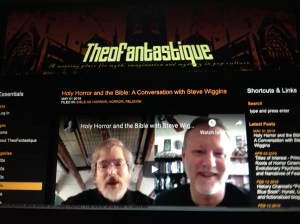

Theofantastique Interview

Two times.  In my “professional” life I’ve been interviewed only twice (not counting, of course, far too many job interviews).  The first time was as a talking head for Nashotah House.  This was in the days before the internet really caught on, so it was done in DVD format.  If you come over to visit I’ll dig it out and we can have a good laugh.  The second occasion was much more fun.  Although I write about horror a lot, I don’t mention Theofantastique nearly enough.  Back in the days when I started blogging, I discovered this site that featured all kinds of interesting stuff on religion and horror (and actually on all kinds of genre pop culture).  I always enjoyed the insights and got more than a few books for my own research and reading from tips I found there.

When I finally got brave enough to contact John W. Morehead, the curator of the blog, we both quickly realized we had some things in common.  John very kindly offered to post an interview with me on Theofantastique about Holy Horror.  It’s live now and it was really fun to talk to an actual person about my book.  You see, I work alone.  I knew that, leaving the classroom, I was departing my chosen career.  On those high school aptitude tests they told me that I should be an entertainer.  What professor isn’t?  I pity their students if they’re not.  I’ve been posting videos on YouTube for a few weeks now.  It’s immediately obvious how much having a live audience helps.

Unfortunately, Holy Horror isn’t exactly priced to move.  In fact, local bookstores have turned me down for free presentations based on the price alone.  It is, however, a fun book to read.  At least I intended it that way.  When life give you horror, make Bloody Marys, I guess.  By the way, John has been coming out with some interesting books also.  I posted on his The Paranormal and Popular Culture recently.  Theofantastique is often the place where I first learn of new horror films (I don’t get out much) and new books that I should read.  Of these two things there’s never a shortage—horror is a thriving genre—and talking about why you wrote a book helps to clarify things a bit.  Horror may seem a disreputable genre to many, but it has redeeming values.  To hear about them, please watch the interview.


Myth and Magic

Magic and religion are difficult to tell apart.  Scholars have known this for some time, but don’t often say anything about it for fear of offending.  A few days ago Religion News Service ran a story headlined “How the ‘Harry Potter’ books are replacing the Bible as millennials’ foundational text.”  While many reacted with shock, to me the fact that a foundational text can be identified at all is a relief.  You see, reading is good for you.  Really, really good for you.  One of the most hopeful things I observed as a parent was the increased quality and volume of young adult literature available.  Of course it’s produced to make a profit, but the fact is it showed that reading is alive and thriving.  If the young make a habit of it, well, let’s hope that habit’s hard to kick.

My own reading doesn’t always keep pace with my desire to do more of it.  I go for a couple of weeks sometimes without finishing a book.  I begin to feel depleted.  There’s something spiritual about reading, and fiction can reach parts of your soul that are on guard when non-fiction’s your subject.  And that’s like magic.  It took a couple years for me to catch on to the Harry Potter craze.  Eventually my wife and I broke down and bought book one and read it together.  As millions of readers can attest, that first book was a fishhook.  We all really hope the world does contain some magic.  Many people find that solace met with religion.  Either way, fiction can enhance the experience.  We read the original series, hanging tensely until the final volume came out.

Many of those who believe in a magical religion protested the sale of magical fiction.  We were still in Wisconsin at the time, but we saw the protestors outside a local bookstore the release day for one of the later volumes.  Like Death-Eaters the protestors opposed Harry Potter.  The root of the problem seems to have been unique truth claims.  Whenever a religion declares itself the sole harbinger of “the” truth, every other way of looking at things becomes evil.  Even if it expressly declares itself to be fantasy fiction for young adults.  Years have passed, and Harry Potter, like other forms of pop culture, has grown to the status of a religion.  Even Nones want to believe in something.  Magic and religion are, after all, very difficult to tell apart.


When Like Rome

Among the constant topics of discussion, both in the academy and in its publishing ancillaries, is the loss of interest in religion.  After a period of growth early in the new millennium, as measured by college majors, interest has dropped off and Nones are set to replace evangelical Christians as the largest religious group in America.  The corresponding lack of interest in religion is extremely dangerous.  I’ve often posted on the necessity of looking back to see where we might be going, and the further back we go the more we understand how essential religion is to the human psyche.  My own academic goals were to get back to the origins of religion itself—something I continue to try to do—and I discovered that they rest in the bosom of fear.  I’m not the first to notice that, nor have others been shy about using it to their advantage.

Lack of classical education, by which I mean reading the classics, has led us to an extremely tenuous place.  More interested in the Bible, I followed the track to another ancient system of thought, but as I find out more about the religion of classical Greece and Rome, the more I tremble.  You see, ancient Roman writers (especially) were extremely conscious of the fact that fear motivated people.  In order to construct a steady state, they infused it with a religion based on fear and supported by said state.  An overly simplified view would suggest that the Jews and Christians took their religion too seriously and refused to play the Roman game.  When they wouldn’t worship the emperor (who surely knew he wasn’t a god) they threatened the empire.  The response?  A good, old-fashioned dose of fear.  Crucifixion oughta cure ‘em.

See what I mean?

The thing is, our American form of government, buoyed up by an intentional courting of evangelical Christians as a voting bloc, manipulates that fear even more stealthily than the Romans did.  People ask me why I “like” horror.  I don’t so much like it as I see its role as a key.  It is a key to understanding religion and it has long turned the tumblers of the state.  Ancient societies kept religion under state control—something the Republican Party has been advocating as of late.  Why?  Religion, based on fear, ensures the continuance of power.  Those of us who watch horror are doing more than indulging in a lowbrow pastime.  We are probing the very origins of religion.  And we are bringing to light the machinations with deus.  Let those who read understand.


Self-Convinced

Like many people, I suppose that my own views are right.  All people think this, I suspect, otherwise they’d change their point of view.  Unless they’ve been brainwashed, of course.  Religion has a way of convincing people that they alone are right.  (And perhaps also those who believe just like them.)  I have plenty of experience with this.  Seemingly normal, friendly people suddenly turn on you when you’re not there to defend yourself.  All in the name of religion.  The place, unfortunately, that it’s most found is in “conservative” religions.  With preachers braying about righteousness and being washed in the blood of the lamb the human element is often sacrificed.  Anyone who dares to think differently is going to Hell, and, in most of these traditions, you wish them godspeed.  Then there are those who wish for true dialogue.

Dialogue means, however, that you have to admit you may be wrong.  That’s one of the features the self-convinced fear most.  Ironically, even those who think they’re right can admit that they could be wrong.  Otherwise what’s the point of discussing anything at all?  As Tom Nichols points out in The Death of Expertise, many are offended that someone has greater knowledge of any area than they.  Like it or not, some of us have studied religion, the Bible, and spirituality for our entire lives.  You might not agree with everything such a person says—we often disagree among ourselves—but at least one might admit that a mere Ph.D. counts for something.  Even if on the stock market it simply won’t trade.

Ironically, as a young man I too was self-convinced.  For some reason that I can’t fathom, I decided that if my beliefs were solid they would stand up to the challenge of higher education.  As an undergrad I majored in religion at a conservative college and graduated summa cum laude.  I chose a liberal seminary to challenge further what I believed and came away magna cum laude.  Then the doctorate.  (Edinburgh didn’t offer such trifles as honors; if you made it through the program you should be so thankful.)  Tolerance became a massive part of my outlook, even as I ended up on the faculty of a very conservative seminary.  I was willing to listen, but the same could not be said for those who saw things differently.  Many of whom were far less educated, I say with all due self-abasement, than yours truly, in such things.  As time goes on I can’t help but reflect on this.  Even as I do I know others are completely convinced I’m wrong.


Rise Again

Resurrection, as I argue elsewhere, is a scary thing.  Since today’s Easter, at least in the western Christian world, people are—or should be—thinking about resurrection.  In the case of Jesus, a young man who died “before his time,” resurrection seems only fair.  Indeed, in the earliest biblical hints of the concept it applied to people in precisely that category.  The story’s different for older folk who are beginning to wear out and are ready to go to a better place.  Christianity made the idea of resurrection more palatable by stating that you get a new and better body next time around.  The creeds say, after all, “the resurrection of the body.”  Heaven, it seems, is an embodied location.  Resurrection is necessary to get there.

Horror writers and film makers have used revenants to great effect.  When they do, pop culture latches on.  Think about the vampire craze of the early 2000s.  Or the ongoing fascination with zombies.  Even your basic garden-variety ghost.  They’re all revenants that attract and repel us.  We’re not quite sure what to make of life after death.  It’s okay if it’s played out beyond human senses, but as much as we want life to go on we don’t want to witness it here.  Horror films like to play on this ambiguity.  They’re closely related to religious ideas.  I’m occasionally asked why I watch horror; it’s essentially the same question as why I study religion.  Sometimes you just need to look closely enough to find the connection.  Resurrection, as I discuss in Holy Horror, is tied to some of humanity’s most basic fears.

Just two days prior to Easter, Good Friday in fact, Lorraine Warren passed away.  A fervent believer in resurrection, she was half of the dynamic paranormal investigating couple of Ed and Lorraine, about whom I’ve posted from time to time.  This coincidental occurrence illustrates once again the connection between resurrection and horror.  The Warrens were fond of declaring that haunting spirits of the human kind were those that had not passed over into the next world.  Revenants were confused spirits (not to be mistaken as demons, which were something completely different).  Resurrection, presumably, awaits just the other side of the veil.  Clearly religion shares this roadmap with horror.  Just as the Warrens will be resurrected as characters in this summer’s forthcoming Annabelle Comes Home, such returns to life may take many forms.  It’s Easter for some of us, and it can integrate horror and hope, if viewed a particular, perhaps peculiar, way.


Discriminating Tests

That explains it.  That glow coming through the window as I got out of bed this morning is the full moon.  Since this is the first full moon after the vernal equinox, that means Sunday’s Easter.  If Sunday’s Easter this is Good Friday.  That brought to mind an article my wife sent me from The Atlantic, “Most American Christians Believe They’re Victims of Discrimination.”  In this piece Emma Green explains that Christians of a certain stripe believe they’re under threat.  Most people express surprise at this outlook, but having grown up in a Fundamentalist tradition I can say that this is hardly new.  The narrative of persecution among conservative Christians has been around for a long time.  They have a mandate, you see.  A mandate to make the entire world like themselves.

Hearing the many cries of legitimate oppression doesn’t help, of course.  In this linked world of instant communication and news 24/7, we’ve become perhaps too aware of just how widespread oppression is.  Christians have felt persecuted from the very beginning, and they don’t like now being cast in the role of oppressor.  Forcing other people to conform is no longer considered right or desirable, but Christians have a mandate.  What strikes me as odd here is that we have a means of learning about this—of arming ourselves with knowledge—but we’d rather be surprised at the polls and pay for it with years of actual oppression.  What is this mysterious means of knowing?  The Bible.  If read, this viewpoint can be understood.  And if handled carefully, disarmed.

The Roman Empire, after which, tellingly, American politics is modeled, oppressed Christians.  At least for a while.  Then the faith became establishment.  And it began oppressing.  An ocean away, Christians fled here because they wanted freedom of religion.  They didn’t always want to share that freedom with other groups experiencing discrimination.  Especially, of course, if they could be compelled to do heavy labor without pay.  Now these groups feel they’re being judged for saying “Merry Christmas,” or for declaring loudly that Sunday’s Easter.  They can’t point to behaviors that in their understanding of the Bible are bad and tell people not to do them.  They don’t understand that Allah is the same deity they worship, only in monotheistic form.  And they get all this news while the moon is still in the sky.  I look at the puddle of light on my bedroom floor and head for my writing nook.  It may be Good Friday, but I’ve got to work today, getting Bibles ready to sell.


Mystic Connections

Those of us who find rationalism a bit too constricting sometimes find solace in mysticism.  My reading of late, which is mostly research for Nightmares with the Bible, frequently touches on mystics of the past.  This isn’t a new fascination.  All the way back in college, as a religion major, I mentioned to one of my professors that I found it appealing.  A frown settled across his academic face.  “Mysticism is dangerous,” he said.  He went on to explain that churches (he was Presbyterian, and I Methodist) had belief systems into which mystics—those who experience the divine directly—didn’t fit.  A direct experience of the divine could cast doubt on church doctrine and nothing, as you might guess, is more important to true believers than dogma.

That discussion at such an impressionable age set me aback.  Here as we enter (for the non-orthodox) the Triduum, or “Great Three Days” the faithful are hoping for some kind of divine experience, I expect.  Many of us will spend two-thirds of it working.  In any case, if nothing mystical happens why do we bother?  Mysticism is equally deplored by science since it suggests something that doesn’t fit into rationalism’s toy box.  A universe where the unexplained—and oh so subjective!—direct experience with naked reality threatens to undo all the neat columns and tidy formulas that describe the entirety of existence.  Conventional churches tend to agree because you never know what God might do if you open that box.

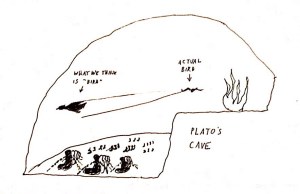
There are religions that welcome mysticism.  They recognize that human-built systems are only approximations—Platonic shadows, if you will, cast upon the cave wall.  Mystics are those who, temporarily unchained, dare to turn around and face the fire directly.  Who knows?  They might even catch a glimpse of the sun itself.  More conventional religions are run like businesses.  You come to a certain building at a certain time.  You perform prescribed actions on cue.  You place your money in this specific receptacle at this specific time.  Leave and forget it all until next week.  Our younger generations don’t find this engaging, just as they see through the lie of the inherent fairness of capitalism.  I can still see the frown of my theology professor.  The old systems are falling apart even as those not too weary after work will head to Maundy Thursday services for a slip of bread and a sip of wine.  The mystic, however, doesn’t know what might happen next.


Not-Quite-Normal Religion

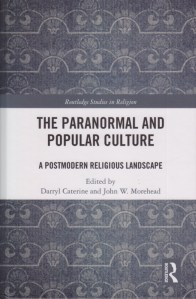
I’ve been thinking about categories quite a lot lately.  In a world connected by the internet, it seems that traditional categories don’t stretch far enough.  For example, I recently read The Paranormal and Popular Culture: A Postmodern Religious Landscape, edited by Darryl Caterine and John W. Morehead.  Published by Routledge, this is an academic study.  It contains some things, however, that many academics would find challenging.  I can’t summarize the entire book here since there are twenty very different essays included, but I can say this is a book that makes you think about categories.  Even the word “paranormal” means different things to different people.  To my way of thinking it has to tip the hat to Rod Serling and that place where fiction and fact begin to overlap.

That’s appropriate for this book: there are articles about what people perceive as factual encounters with all kinds of creatures and events, as well as studies of the decidedly fictional beings like Batman and zombies.  Our categories, in the modern world, tend to be inviolable.  Even scientists who handle Heisenberg know, however, that we are now in the postmodern world (as the subtitle indicates) and true objectivity is beyond the reach of all.  None of us stands outside the box looking in.  We’re all in the middle of it, and we look around ourselves trying to figure out what is real.  Another problematic category that, reality.  We don’t even understand what consciousness is yet, and how can we hope to know what is really real?  We all have dreams and some take them more seriously than others.

Reading books like this with an open mind is a truly po-mo experience.  After finishing more than one piece I found myself having to put the book down for a while at least so I’d have a hand free to scratch my head.  You see, we’ve been taught to laugh at those who believe in the paranormal.  It has been the only acceptable way that rationalists can deal with that which flies in the face of the system.  The internet, however, has put those isolated, ridiculed individuals into a community and the advent of reality TV (and what can be more real than what we see on the tube?) erodes the laughter factor little by little.  Plumbers can find ghosts but scientists can’t.  The average person relates more to the plumber, I think.  It all comes down to categories.  Making sense of them can, and will, impact our views of reality.


Label Maker

Did you ever have one of those label makers?  The kind with a rotating wheel that embossed a plastic ribbon with letters that you could stick to things?  Labeling is so easy!  I often feel constrained, however, by the chosen labels of extremist groups.  Not all evangelicals are power-hungry or enemies of human welfare.  This is perhaps one of the keys to the success of extremists.  Camouflage has long been recognized by evolution as a most effective tactic.  I have many evangelical friends who do not protest cartoons, or ride around in Trump-laden vehicles, polluting the environment like there’s no tomorrow.  The problem is what to call them since the more radical wing has usurped their nomenclature.  I often think of this because I eschew labels in general, but people in a collective can do quite a bit more damage than a single disgruntled individual.  Perhaps “disgruntled” should be part of their name?

Religions generally begin as efforts to help make the world a better place.  The historian of religions sees, however, that over time many believers begin seeing the peripherals as the central tenets of the faith.  Since I’m familiar with evangelicalism, let me use that as an example.  As a form of Christianity, evangelicalism began with the Reformation.  Pietist groups, freed from Catholicism’s idea of communal salvation, began to worry about their individual souls and how  they might be saved.  Their belief structure eventually came to include the necessity of converting others because, if you read the Bible a certain way, that’s a requirement.  Over time this outlook  evolved into the idea that only one group (one’s own) has truly understood the Christian message.  Once numbers grow numerous, it becomes like the medieval Catholic Church—large enough to take political power.  Somewhere along the line the central message of helping make the world a better place morphs into making the world evangelical only.  Or whatever label we feel constrained to use.

labels are problematic

I’m not picking on the evangelicals here—this could apply to any extremists.  And it certainly doesn’t apply to all evangelicals.  Religion has been part of human culture from the very beginning.  A good case can be made that it is one of the basic components of consciousness itself.  A person has to learn how to become unreligious.  We are also political animals.  Who doesn’t want things their own way?  We can’t all win, however, and some religions have difficulty separating, say, a savior willing to die for others and the insistence on one’s own way no matter what others want.  Like most aspects of life this is a balancing act.  I grew up evangelical.  I have friends who are evangelical.  I don’t want to insult anybody, but what can you do when you feel disgruntled by the degradation of religion into an excuse for hate?  I lost my label maker long ago and I no longer know what to call things anyway.


If Onlyists

A special brand of Fundamentalism called King James Onlyism is a particularly odd variety of faith simply because of its required backing and filling.  In brief, this particular evangelical position claims that the only inspired translation of the Bible is the King James Version.  It’s best not to look too closely at the KJV, however, or the problems start.  Primary among them is that the version most Onlyists cite is not the original King James.  Published in 1611, this translation is immediately evident by its use of “I” for “J” and for the long s (the one that looks like an f).  Perhaps more troubling for Onlyists, it also includes the Apocrypha.  There was still some debate at the time concerning the status of these deuterocanonical books, and they were part of the actual KJV.

The typical King James used by Onlyists is a revised KJV.  In England, where the translation was done, revisions were made from time to time, leading to an Oxford version (Blayney text of 1769) and a Cambridge version (Scrivener text of 1873).  On these shores further adjustments were made leading to the rather strange situation where there is no single King James Version of the Bible.  There are many King James Versions.  Attempts to control Scripture often end up like that.  The underlying problem is the belief that there is a single version of Holy Writ.  Inerrantists are pledging their faith to something that doesn’t exist.  Defending this approach many would claim that the revisions are minor, but small changes can make huge differences.

The belief in one single version relies on the belief that God inspired not only the original writers, but the translators as well.  It denies that the better manuscripts that have come to light since the early seventeenth century (including the Dead Sea Scrolls) contain any authentic information of what the Good Book says.  Textual criticism, in the absence of any original manuscripts, is the best way we have of discovering what the original likely said.  Onlyists argue that the manuscripts from which King James’ translators worked were the divinely selected ones and their work was inspired—a position against which no empirical proof can be offered.  This faith trades in certainties that only bringing in direct heavenly control can achieve.  And it means that Catholics are wrong, despite King James’ inspired error to include the Apocrypha.  That’s the thing about a trump card like inspiration—once it’s played there’s no way to overcome it.


What’s Wrong with Heroes?

There can be no doubt that under Trump conservative Christians have been flexing their muscles.  Few things corrupt so readily as political power, and evangelicalism—already an unrealistic way of looking at things—is itching to throw punches.  A story on For Reading Addicts that my wife sent to me bear the title “DC Comics cancel latest comic after backlash from conservative Christians.”  The piece by Rowan Jones notes that Second Coming was cancelled due to pressure from evangelicals with the cultural sensitivity of the Kouachi treatment of Charlie Hebdo.  Cartoons, it seems, are a real threat to true believers in a way that reason is not.  Jones notes that the comic was actually largely supportive of Christian values, but like an evangelical Brexit the reaction was taken without understanding the issue.

The anger of conservative religions—it hardly matters whether they are Christian, Muslim, or Aum Shinrikyo—often plays itself out in displays of violence.  I wonder if part of this insecurity comes from the fact that the expectations of their faith don’t work out they way they’ve been led to believe they will.  The myth of the blessed existence of the true believer is given the lie by life in a secular world.  While the evangelicals support Trump, 45’s tax plan takes money from their pockets and hand it to the ultra-wealthy.  This raises no objections, but a cartoon showing Jesus helping the poor?—now that’s offensive!  And still no second coming takes place.  It’s difficult to retain a fantasy view in the face of cold reality.

Who doesn’t like a hero?

Religious beliefs are a deeply personal matter.  It is a dicey business to try to get someone to change their outlook when they’ve been convinced that the consequences are eternal.  Although vaguely aware of other religions all along, Christianity in the “new world” was taken quite by storm at the 1893 World’s Parliament of Religions in Chicago.  Suddenly it was clear that other moral, decent religions had developed similar ethics to what had largely been supposed to have been Christian innovations.  It’s difficult to feel superior when others in the same room seem just as intent on improving the lot of humankind as you do.  Even when a particular religion holds all the political power of a nation it’s overly sensitive to cartoons.  This is a curious situation indeed.  I’m not a comic book reader—I don’t even have time for internet articles unless someone sends them to me with the suggestion that they’re worth my time.  And I, for one, think a little more humor might just make the world a better place.  Either that or we need a hero.


Which Shaman?

It’s a strange kind of vindication when you see someone argue your ideas independently.  Even if they understand those ideas in a different way.  I suppose it’s necessary to say that in academia those who have university posts are assumed to be more authoritative than those of us who don’t. That’s not sour grapes, it’s simply a fact.  Some years ago, after having first seen Christopher Nolan’s The Dark Knight, I wrote a post on this blog suggesting that the Joker functioned as a shaman in that movie.  Being a blog by a non-university academic, the post had a few readers, but it is not peer-reviewed and therefore, officially just a matter of opinion.  I have studied religion professionally for decades now, however, and I would still stand by my assessment.

Recently I came across an article that argued Batman was a shamanic figure in that same movie.  It was affirming that another academic had come to a similar conclusion, however, we differ in our interpretation of who bears shamanistic characteristics.  It doesn’t help, I suspect, that shamanism isn’t well understood, and even the name is a bit of a misnomer.  We don’t really have a word for non-major religious practitioners of indigenous populations who may have little in common, so we call them shamans.  Their religious systems are too specific—“granular” is the favored business word these days—to categorize them easily.  And the reason for this is that we think of religions in the light of the large, organized conglomerations that arose in western Asia a couple millennia ago.  It’s difficult to make room for smaller exemplars.

Something larger religions have done is distorted the idea of religion as a local phenomenon.  Communities used to reflect the religious experience those who lived in them knew.  Catholicism divided the world into parishes and even tolerated some differences between them.  Protestantism gave Europeans (and their New World descendants) a set of choices, and towns in America often sport many steeples not because religion draws a community together but rather because it generally tears it apart.  Hierarchical religions are about as opposite of shamanism as Batman is different from the Joker.  They may have similar ends in mind, but their methods are quite different.  The shaman is a figure that leads to spiritual wholeness for the community.  Their methods seem questionable to larger, highly structured religions.  And the unaffiliated trickster may accomplish more than an establishment figure in a local setting.


Chilly Fluids

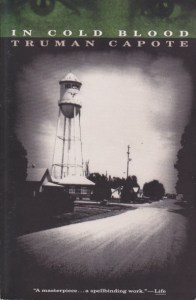
I’m not sure why I did it.  Read In Cold Blood.  I’d known of Truman Capote’s main claim to fame for years, but an accidental recent mention, a cheap copy in a used bookstore, and a week of grabbing time to read did it.  I’m not a fan of true crime, and despite my fixation on horror movies, I try to steer away from anything that doesn’t have a hint of the speculative about it.  There’s a difference between horror and terror.  I’d happily lived a half-century without ever hearing about the Clutter murders and kind of wish that were still the case.  Yes, there are doubts about the veracity of Capote’s account at points and novelists are often convincing liars, but still, at the heart of the matter more than just four people are senselessly murdered in the course of the tale.

A few elements stood out in the reading of the book.  One was that given the naiveté of the 1950s I wonder how anyone could ever really want to go back to that decade.  We’re run by a government full of doddering old men who seem to idealize the falsity and utter conformity of an age that was really a pressure cooker in which cases such as this would explode.  I was born in the much idealized 1960s but I don’t think we should go back to them.  We learn, we change, we grow.  Knowing what we now do, it was kind of painful reading how blissfully ignorant so many people were.  We may be more afraid these days, but at least we’re more realistic.

Another factor, very much at home in this world older but no wiser, is how the Bible is cited at the trial in support of capital punishment.  Although it may not have been intentional on Capote’s part, he demonstrates a deep truth about Scripture.  It can be read in more than one way.  In conservative Kansas in 1960 it could sway jurors to seek the death of other human beings.  The murders were indeed savage and pointless.  Capote’s account of them is difficult to read.  Perhaps more difficult is the way the Bible is used to unleash the basest instincts of people against other human beings.  Yes, parts of the Good Book require the bad thing, but if we’re over fifty years beyond Holcomb we’re over fifty score beyond a time when just one interpretation stands for all.  If it ever did.  There’s a difference between horror and terror, but the Bible can participate in both.  I prefer to stick to the former.


Patchwork

I don’t wear clothing with advertisements.  Perhaps it’s my Quaker-like sensibilities, or maybe it’s just that I hate being a shill.  What has any corporation done for me that I should give it free advertising?  Actually, not free—advertising that I have to pay to give?  I do have a few college sweatshirts, though.  Always a booster for education, I don’t mind wearing that brand.  Otherwise, I sit back and marvel how marketers get people to think it’s cool to strut their (the marketers’) stuff.  Brand names declare one’s tribe, one’s level of affluence.  I used to rip any exterior labels off my clothes but it became clear it was a losing battle, especially when brands are incorporated (note the word) into the very design.  And we play along.

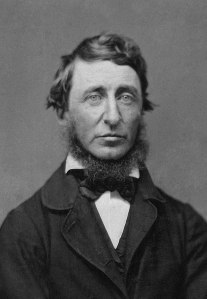
I shouldn’t be too harsh.  After all, corporations are people too.  At least in the cataract-infested eyes of the law.  They have rights just like, or even more than, individuals do.  We live this fiction and watch the wealthy grow loftier, and we wear their brands so that others will sense where we belong.  Long ago I began to object to this.  Maybe it was because I grew up poor and wearing cheap knock-offs of brand names was embarrassing.  The cut of your trousers said something about what your folks could afford.  I actually began buying all my own clothes at the age of fourteen and, consequently, habitually wear things until not even Goodwill will consider them appropriate for resale.  And I still tend to buy generic.  Thoreau, in a patched quote from Walden and Civil Disobedience can be made to say it well:

As for clothing, […] perhaps we are led oftener by the love of novelty, and a regard for the opinions of men, in procuring it, than by a true utility. […] No man ever stood the lower in my estimation for having a patch in his clothes; yet I am sure that there is greater anxiety, commonly, to have fashionable, or at least clean and unpatched clothes, than to have a sound conscience.

The fact is we despise the patch-wearer for not playing the capitalist game.  You’ve got to pay good money for jeans with tears already in them and the world of the facile has no room for posers who actually wear through the knees.  If we ever meet you’ll know me by the frayed edges of my sleeves and cuffs.  I’ll likely be the guy sitting on a bench without a Starbucks cup in my hand, cradling Henry David and nodding vigorously.