Naming Rainbows

Living in the area around Allentown-Bethlehem-Easton (ABE, in airport parlance), one can’t help but be aware that Crayola is based in the E sector.  We visited the Crayola Experience while still residents of New Jersey and if there’s any place that smells like childhood this was it.  One of the truly interesting aspect of Crayola is that it defined specific shades of color.  Or at least Crayola’s version of it.  Many of us have pretty clear ideas about the basic six colors: red, orange, yellow, green, blue, and purple.  Sure, they added “indigo” to make it into a pronounceable name, and changed purple to “violet” to give us the standard seven, but this illustrates the point that I’m making—colors are somewhat relative.  Try to get anyone to describe, famously, puce (which I’ve learned is French for “fleas”).

A friend has recently been sharing stories from a book on the origins of color names (Secret Lives of Colors by Kassia St Clair), from which I learned about puce.  Although I haven’t read the book myself, it has become clear that colors indicate different things to different people.  All of this reminded me of a crisis I faced in my youth.  One of my teachers in middle school, in physics class, mentioned that not all people perceived the same color in the same way.  Or at least there’s no way to know whether they do or not.  Perhaps, he suggested, everyone has the same favorite color, but what they call it is different.  While the latter point seems unlikely, I took to heart that not everyone sees things the same way.  The same dilemma came back to me as my friend showed me various colors and said that her idea of what that color name designated was something quite different.

As in much of what I write, there are metaphors and analogies active here.  A paradox of religions is the great variety among them combined with the certainty that one’s own alone is “the truth.”  And all religious believers tend to be certain that theirs is true.  Like the color names we learn as children, we seldom grow up to question what we were told in our youth.  Some religions appeal to adult converts, but most people stay close to the orthodoxies of their youth.  Religions, like colors names, are a matter of consensus, for there are any number of shades and hues, and what we decide to name them is not revealed from on high.  They do, however, give the world considerable color.


Waiting for a Miracle

A friend recently sent me a New York Times story about Marianne Williamson’s spiritual background.  Before I say anything more about this I have a confession to make.  I didn’t know who Marianne Williamson was and, consequently, I’ve never read any of her books.  I also didn’t know about her presidential bid, although she seems much more grounded than whatever it is that sits in the Oval Office these days.  In any case, it’s the spiritual background part on which I’d like to focus.  Williamson is apparently a devotee of A Course in Miracles, a book written by Helen Schucman in the 1970s.  According to the NYT article, Schucman penned the book by the dictation of a divine voice.  This aspect seems worthy of further exploration, regardless of politics.

You see, sacred books have a long history of divine dictation.  The Bible makes such claims only obliquely, but clearly there were some who believed that Moses was the recipient of narration from on high.  Mohammed heard a voice saying “Write.”  Centuries later the Book of Mormon was written out at the dictation of Joseph Smith.  The point is that such texts are often believed to have had sacred origins.  I find Schucman’s reluctance to put herself down as the author of A Course in Miracles instructive.  She didn’t believe she wrote it.  Not to devalue any of these sacred texts mentioned, I would nevertheless note that authors often feel that their words come to them.  Maybe academic books don’t count, but when I’m writing fiction, it’s like somebody’s hands are on the wheel, but I’m not sure I’m the one driving (with apologies to Jeff Daniels).

A Course in Miracles has been translated into double-digits languages, something quite rare even among many bestsellers.  What this says to me is that people still crave answers from an authoritative text.  The written word has a power that electronic publication lacks.  Who wants to point to a screen and say, “this is divinely revealed truth”?  Hefting a heavy book, printed on actual paper, has a symbolic power that outweighs that of ebooks.  Probably it’s because the Bible paved the way.  We’re already primed for a sacred text, in physical form.  The longer I study holy books the clearer it becomes that they will unlikely ever cease to be written.  Helen Schucman didn’t have the last word.  As long as people write it’s doubtful anyone ever will.


Dark Theology

I’ve been struggling for several years, I expect it’s no secret, with how horror and religion relate to one another.  Many think the task itself pointless, as if pop culture can simply be brushed off like an annoying bug.  But flies keep coming back.  They won’t be ignored.  Almost a decade ago I discovered Douglas E. Cowan was also walking this spooky path past the cemetery.  I also know that as an academic he must demonstrate his chops in technical projects.  America’s Dark Theologian: The Religious Imagination of Stephen King was extremely welcomed by me.  Like many people I’ve read some Stephen King.  Like Cowan, I’ve noticed how often and how deeply religion is entangled in his story-worlds.  Before King is simply dismissed, we must reckon with the fact that movies based on his novels and stories have a long  pedigree and almost canonical status.

This is not the place to analyze America’s Dark Theologian in depth, but it is a place that would highly recommend the book.  Cowan takes several aspects of King’s works and shows how they tie explicitly to traditional religious thinking and longing.  I haven’t read nearly all the books Cowan cites here, nevertheless, the analysis he offers is compelling.  Scholars of disciplines outside religious studies have tended to dismiss it as being moribund.  Cowan shows that those who make a living in pop culture disagree.  King makes no bones about the fact that he sees the application not only of religion, but also theology, as one of the driving forces for his fiction.  We dismiss such observations at our peril.  Think of you favorite King novel and ponder; is there religion there?

Clearly religion’s not always the cause, but Cowan gives a careful consideration to much of King’s oeuvre, and there’s no denying he’s onto something.  As he points out, King is far more interested in the questions than in the answers.  Those who know religious studies—theology, if you must—know that the same is true there.  I’ve studied religion my entire intellectual life.  One of the reasons students evaluated my teaching so positively, at least I hope, is that because I encouraged the questions and did not privilege the answers.  In this field, answers are merely speculations.  We only really fall into serious danger when we cease asking questions.  Cowan does an excellent job of parsing out some various pieces that will make some kind of basis for a systematic theology of Stephen King’s thought-worlds.  We would be wise, I believe, to pay attention.


Utterly Indifferent

One of the main purposes of this blog, apart from being a kind of daily tablet for my thoughts, is to demonstrate that religion continues into the age of secularity.  It would be an uncomfortable stretch of the imagination to suggest Kurt Vonnegut was a religious writer, but it would also be a disservice to him to ignore just how much religion shows up in his novels.  Often the remarks are subtle and perhaps easily missed, but one of his early works, The Sirens of Titan, treads pretty solidly in that territory.  From the fact that monument to the twelve great religions was made by artisans who don’t know what those religions are to the founding of a new religion to unify humankind, this story never strays far from it.  It’s also, in my experience, the most science-fictiony of Vonnegut’s books.

The Church of God the Utterly Indifferent is the goal of Winston Niles Rumfoord’s doomed Martian attack on earth.  Because the Martians are actually brainwashed earthlings, they are sacrifices to the grand vision of all people sharing a single religion that recognizes God does nothing to help humans and humans, therefore, should not worry about serving God.  Clearly a religion that functions the opposite way of most actual religions—which try to keep God happy, often by harming other humans—Rumfoord’s vision is a united Earth.  One of the pawns in his scheme is his unhappy wife, and another is the biblically named Malachi Constant.  Constant built a ship to take humans to Mars.  Christening it The Whale, Constant took the pseudonym Jonah, which is something readers are increasingly ill-equipped to understand, but which demonstrates Vonnegut knew his Bible.

Religion plays throughout Sirens of Titan in ways that both poke fun at the seriousness with which religion is treated and with a certain respect for its power.  Vonnegut’s famous nihilistic leanings pervade the novel with an almost Job-like portrayal of Rumfoord, and several ethical questions lie beneath the apparent space-travel story.  Genre fiction, as I’ve intimated before, is intended to be slotted easily into recognized categories.  Critics reserve the sobriquet of “literary fiction” for those pieces that don’t really fit other patterns—not all fiction obeys the rules—and that’s where I’d put Sirens.  Yes, people zoom around in flying saucers and invasions from space are standard sci-fi tropes.  Engagement with religion, even if it is to question it, tends to move fiction into more serious categorizations, excluding, of course, novels written to promote a particular religion.  None of them would suggest a Church of God the Utterly Indifferent.  Unless, of course, they came from Kurt Vonnegut.


Weathering the Sun

I may have given up on Weathering the Psalms a bit prematurely.  Those who know me know that the weather impacts my mood.  Now that I have a yard to mow that feeling has grown exponentially since perpetually wet grass is happy grass and is impossible to cut with a reel mower.  Today, while those of pagan inclinations celebrate the sun, there’s more rain in the forecast.  As there has been since Sunday.  If Yahweh’s the God of the sun, then Baal’s had the upper hand for some time now.  As an article on Gizmodo has pointed out, this has been the rainiest twelve months on record for the United States.  And we’re largely to blame.  We’ve known we’ve been warming the globe since the 1980s, at least.  Yet we do nothing about it.  You can’t stop the rain. 

Our species occupies that odd role of predator and prey.  Most predators, actually, are prey to somebody else.  Not being nocturnal by nature, we fear the dark when we feel more like prey.  Since we’re visually oriented, we crave the light.  Today, when the conditions are right, we have it abundantly.  Ironically, of the seasonal celebrations, the summer solstice is the only one with no notable holidays.  Easter and a host of May Day-like holidays welcome spring and Halloween and Thanksgiving settle us into fall.  December holidays around the other solstice are the most intense, but summer, with its abundant light and warmth, is perhaps celebration enough.  Or maybe we know that marking the longest day is a transition point, since now we’ve reached a natural turning point.

So, it’s the solstice.  From here on out the days start getting shorter and we slowly move toward the time of year when horror becomes fashionable again.  The light that we crave now ebbs slowly to the dark we fear.  There should be a holiday around here somewhere, for those of us outside academia continuing working right on through.  The problem is western religions, especially Christianity, place no especially memorable events here.  Resurrection’s a hard act to follow.  Calendars, apart from telling us when to plant and harvest, are primarily religious tools in origin.  When things are their darkest, six months from now, the church moved the likely spring birthday of Jesus to counteract pagan festivals encouraging the return of the light.  I, for one, would like to see a day to commemorate it, even if it’s raining again.


Built To Last

Those pyramids sure are sturdy.  The other day I was reading something from a biblical literalist that was discussing the pyramids.  The great pyramid of Khufu and its companions in Giza were built between about 2590 and 2505 BCE.  They’ve been around a long time.  Somewhat later this author casually mentioned Noah’s flood.  It had never occurred to me before, but since Archbishop Ussher dated the creation of the world at 4004 (and so it appears in the Scofield Reference Bible), the flood took place in 2348 BCE.  Now this flood was so catastrophic that it carved out the Grand Canyon and buried all those dinosaur bones that would eventually become fossils.  It was more than a little inconvenient, and terribly disruptive.  Except the pyramids had been around for well over a hundred years by that point.  It’s a wonder they weren’t harmed.

Such inconsistencies populate much of literalist literature.  When the Bible is the full measure of science and history and all human knowledge, there’s bound to be some issues, given that it was written at a specific time and place.  You see, the pyramids aren’t even held together with mortar.  These are loose stones we’re talking about, under great pressure.  The “Bent Pyramid,” at Dahshur, changed its angle at half-way up.  A physicist calculated that if they’d continued at the original angle, the weight of all that stone would’ve caused it to act like liquid, flowing like water.  Best repent and rethink your plan.  But these monuments were built to withstand world-wide floods!  And the mummies weren’t even mildewed.  If only Jericho’s walls had been so well built.

From WikiCommons

Maybe that’s why so many modern myths about the pyramids developed.  This sacred shape somewhere between a square and a triangle is said to have unusual properties.  I’ve read that if you put a dull razor (whatever that is) underneath a pyramid shape when you go to bed at night you’ll awaken to find it sharpened.  Made of wire, that shape on your head will not only prevent aliens from reading your thoughts, but will boost the power of your psyche as well.  The funny thing about the Bible is that it never mentions the pyramids at all.  Joseph spent a bit of time there and his descendants stayed for centuries.  Nobody bothered to note those wonders of the ancient world.  Since we’re literalists, though, that gives us a way out.  If the Bible doesn’t mention the pyramids they might not exist at all.  Problem solved.


Identified or Not

Okay, so this will require some explanation.  It came about like this: I was in a used bookstore.  (This in itself requires no explanation, of course.)  I noticed a slim book, cover out, called A Pocket Guide to UFO’s and ETs: A biblical and cultural exploration of aliens.  Biblical?  I picked it up only to discover it was from Answers in Genesis.  Please note: I do not buy books or paraphernalia of Fundamentalist groups unless I can get it used.  I don’t want to support this particular weirdness in any way.  Well, the money for this used book was going to support a used bookstore and not a religious aberration, so I figured it would be good to see what the Fundies have to say about a topic that seems to have started to engage public interest again.

The book begins by helpfully pointing out that if there’s life on other planets the Bible doesn’t mention it.  And since the only way it could’ve got there is by evolution—for surely the Almighty would’ve said something about it in his book, if he’d invented it—the whole idea is a non-starter.  Evolution, as everyone knows, is a satanic idea meant primarily to challenge the Bible and secondarily explain the diversity of life forms on earth.  And since earth is the only planet the Bible recognizes, it is the only one with life.  So, UFOs, it stands to reason don’t exist.  Well, that’s not quite fair.  They do exist but most can be explained away and those that can’t may well be demonic.  Since there can be no aliens, and since some sightings can’t be otherwise explained, then demons—which the Bible does mention—must be responsible.  They (demons) can also explain why other world religions exist.

There’s plenty in here to offend just about everyone apart from the Answers in Genesis crowd.  The screed spends quite a bit of time knocking down ancient astronaut ideas, and taking Erich von Däniken to task.  Science is useful in explaining how pyramids were built, but not in how the rock used to build them was formed (it takes far too long to make limestone the old fashioned way; God simply used a variety of different rock types to make the one inhabited planet more interesting geologically).  And those UFO religions?  Inspired by demons, no doubt.  In fact, even reading a little book like this could lead you to become interested in the subject, so be careful!  In fact, the safest thing of all (and I’ve only got your well-being in mind) is to leave it on the shelf.


Leggo My Lego

Given my proclivity to seek the profound in what is often considered the banal, I have been mulling over The Lego Movie.  Before you cast the first brick, yes, I know this movie is five years old and I know that it has sophisticated intertextuality with other movies and sly humor.  I use banal in the sense that Legos are, quite literally, plastic and they don’t work well in conveying the human form.  Our overactive psyches help here, and we give the characters their necessary humanity, but this is a movie for kids, even with its Trump-like President Business forecast some two years before the last election.  With all of that being said, and the word “forecast” already being used, my “Bible radar” zeroed in on the prophet in the movie, Vitruvius.

Vitruvius is based on a combination of Tiresias, the blind prophet, and any number of biblical characters who forecast the future.  Dressed like Moses, but named after a Roman author and architect, Vitruvius utters the prophecy at the beginning of the film and returns as a character that combines Obi-Wan Kenobi and the prophet Samuel.  (I said there was sophisticated intertextuality.)  Whether any of this is intentional is difficult to say—well the Obi-Wan part is pretty obvious—but it plays into the common view of prophets.  One of the points I make in Holy Horror (which deals with a different genre of movie) is that people understand biblical ideas through the lens of pop culture.  Prophets, through that lens, tell the future.  In the Bible itself they don’t do that very much, but since the New Testament reads itself into the Hebrew Bible (more intertextuality) the idea became pretty fixed that prophets told the future all day long.

Ironically, Vitruvius—a name that sounds like “virtue”—was famous for describing perfect proportions.  Indeed, Leonardo da Vinci’s “Vitruvian Man” sketch is based on this idea.  As ideas go, this is a false one against which many of us struggle our entire lives.  There is no perfect, Platonic human body.  Yes, certain people are attractive, but genetics and circumstances make us who we are.  And some of us grew up without Legos, but despite that deficiency we came to know the product.  The Lego characters aren’t in any sense of Vitruvian proportions.  Witty and intertextual, they’re made of plastic and they encourage us to buy for our children.  And one wonders whether Vitruvius is a prophet or a hidden symbol of that word’s homonym.  Let the building begin.


Refuge in Diversity

The Easton Saturday morning farmer’s market is a happening place.  Daring to spend a non-raining Saturday away from mowing, my wife and I decided to check it out.  If you’re not familiar with Easton, Pennsylvania, it has more than the Crayola factory that smells like childhood itself.  The downtown is marked by a traffic circle with an island in the middle large enough to fit, well, a thriving farmer’s market.  As usual, large gatherings attract those selling spiritual rather than material goods.  A very well dressed gentleman handed me a flier and when I got home I had to look up Refuge Church of Christ to find out what it it’s all about.  A New York City-based denomination of predominantly African-American membership, the church has over 500,000 members.  That I hadn’t heard of it before is no surprise.  There are well over 40,000 denominations of Christianity alone and it’s difficult to keep track of them all.

There comes a time in the life of anyone who takes religion seriously enough to study it professionally when s/he’s inclined to ask which is the original.  Think about it: you’re bartering with your eternal soul on the barrelhead here and don’t want to make the wrong choice.  When someone invites me to convert (I don’t know the secret handshake to show I’m already a member) I’m curious about them.  The unfortunate thing about all of this is that each tradition believes it has the truth and most, if not all, others have got it wrong.  Few are the faiths that declare, “Believe whatever, just believe.”

I once tried to make a denominational genealogy chart.  Part of the problem is that tracing things back to Catholicism isn’t quite right.  The Roman Catholic Church as it exists today is quite different than anything Paul, or Peter, or James would’ve recognized.  To say nothing of Jesus.  And that’s inevitable.  Religions don’t stay the same.  They evolve as soon as they pass from person to person.  Those who belong to denominations often do not know what the official teachings of the body are, and getting back to the original they’d find that their denomination started out believing things quite different than its own current theology.  If you’ve got only one soul with which to make that eternal decision and literally thousands of choices, well, let’s just say that you don’t want to think about it too much.  Besides, we’re here for fresh fruits and vegetables.  And it’s a rare gift of a Saturday without rain, no matter who’s responsible.


Idol Thoughts

The Enlightenment led, in some respects, to a condescending view of the past.  Historians know, for example, that the basics of science and engineering predate the Middle Ages.  Just consider the pyramids.  The people of antiquity were anything but naive.  We tend to think in Whiggish ways, despite our awareness of past achievement.  Perhaps it’s because we misunderstand past religious thought.  After all, the Enlightenment is generally understood as freeing the human race from “superstition” and leading to empiricism.  Empirical thinking had been there all along, of course, only it hadn’t been the sole way of making sense of the world.  Consider, for example, the “idol.”  In the biblical world food was left for statues of the gods, but it seems to me that people were smart enough to figure out that images didn’t actually eat it.

Elaborate rituals, of course, attended the making of gods.  These symbolic actions were said to make this object more than just a piece of wood, stone, or metal.  Assuming it required food, however, strains credulity.  The symbolic nature of the offering, however, was accepted.  The same is likely true of the offering of food to the deceased.  Even in ancient Israel the time-honored practice of leaving sustenance for the dead was carried out.  Was this symbolic rather than naive?  I tend to think so.  Reason told the ancients that the dead ceased to move, and therefore to eat and drink.  It was nevertheless a sign of respect to leave food, which, in a world of frequent malnutrition, could have been put to better use.  It was a symbolic sacrifice.

Surely they didn’t understand the fine interactions of nature that require microscopes and telescopes to see, but their knowledge relied on the divine world to address what remained mysterious.  We still, for example, have difficulty predicting weather.  We understand that the atmosphere is subject to fluid dynamics and countless minuscule factors that contribute to it.  We’re also aware that global warming is a reality.  Like the ancients we can choose to ignore, or pretend that the obvious doesn’t exist.  Like them, we do so for a reason.  Our political leaders are unwilling to stand in the way of the wealthy.  Reelection and all its perquisites—including personal enrichment—are simply too enticing.  Empirical evidence is worth ignoring for such emoluments.  When we feel tempted to assert our superiority over those of past ages, we might pause to consider that we still offer food to idols.  And get just as much in return.


Fear of Religions

There’s a narrative of fear in Christianity that seems to have been absent at the beginning.  This is evident when driving the highways of America where you’ll see billboards (which are meant for selling things) advertising the truth of a kind of biblical Fundamentalism.  On my recent trip across Pennsylvania this fear stood out in some rather obvious ways.  And it doesn’t reflect the Christianity reflected in the Good Book.  Stop and think about it: although the persecution of early believers was probably never as widespread as the usual narrative says it was, the writings we have describe facing persecution with joy.  Believing that they would be delivered, the oppressed welcomed the opportunity to prove their faith.  The Chick tracts I read as a child, however, focused intently on how scary the future persecution would be.  Fear, not joy, was the motivation for belief.

As we stopped in a turnpike rest area, we noticed a kiosk of Christian books amid snacks both salty and sweet.  The only other reading material available had to do with tourist attractions and finding directions.  It was, upon retrospect, odd.  Pondering this I recalled the narrative I heard repeatedly in my youth—a time was coming when it would be illegal to be Christian.  There would be persecution and the only proper response was a faith borne of fear.  This was not a religion of love thy neighbor.  No, this was a religion of armed survival based not on turning the other cheek, but on asserting itself with a show of firepower.  This kind of weaponized evangelicalism has taken over the narrative of Christianity.  Paul of Tarsus, knowing he would likely be executed, wrote of his joy from prison.  In the land of plenty we tremble.

The more cynical side of my experience suggests that politicians—who have learned that fear gets them elected—found in this form of Christianity a convenient set of sheep without a shepherd.  There’s fear in these billboards.  Fear that another religion may take over.  Or that secularism may make cherished beliefs illegal.  This isn’t cause for celebration, as the sermon on the mount proclaims it should be, but rather a call to arms.  In this country we have more than enough.  Among those left out, however, this fear grows just as rapidly as among those who fear they may lose the abundance they have.  They try to convert the weary traveler whose eye is drawn to the billboard.  And even those who stop for a drink of cold water which, the Bible suggests, should be freely given.


Night of the Living

The New Yorker view of the world, so the joke goes, sees the five boroughs in great details, then a very thin New Jersey across the Hudson with a vague California somewhere out west.  Having worked in New York City for nearly a decade now, I know that such a view is exaggerated, but has a small glimmer of the truth.  We can only pay attention to so much and things are constantly coming at you in Gotham.  I sometimes forget, now that I’m in Pennsylvania again, just how diverse my home state is.  I’m not from old Pennsylvania stock—neither of my parents were born here and neither of my mother’s parents were born in the same state she was.  Still, when you’re born in a place it’s natural to feel that’s where you belong.  You inherit the outlook.  I inherited Pennsylvania.

Pennsylvania is a bit unusual in being a commonwealth divided in two by a mountain range.  Laid out with an horizontal orientation, it’s about 280 miles across, and once you’re over the Appalachians, you’re into a different subculture.  On our way into Pittsburgh, signs for Evans City reminded me that among its many contributions to American culture, the Steel City also gave us zombies.  Now from a history of religions point of view, zombies came from Caribbean religions that fused indigenous African beliefs with Catholicism.  A religion that arose among people commodified as slaves.  A zombie was a body with no will.  It took George Romero, living in Pittsburgh, to give us the movie zombie with The Night of the Living Dead.  Pittsburgh, among some, is glad to claim the title of zombie capital of the world.  Its zombie walk is a thing of legend.

Ironically, the western end of the state, beyond the mountains, tends to be more conservative than the side closer to the seaboard.  (Pennsylvania is the only of the original thirteen colonies not to have direct Atlantic Ocean water frontage.)  Yet it has adopted the most egalitarian of monsters—the living dead.  Romero tapped into the universal fear of unsettled death to make what were later to appear as “zombies” the unnamed monsters of his most famous film.  Everyone has to die, and no matter our religious outlook (or lack thereof) the question of what comes after is asked on both sides of the Appalachians.  And even by those across the Hudson in New York City.  There may be even something between the two.


Thunder Towers

It sounded like brontide.  The Martin Tower, the tallest in the Lehigh Valley and once corporate center for Bethlehem Steel came down yesterday morning.  Completed only in 1972, the following decade saw the collapse of the steel industry, and the building has sat vacant a dozen years.  Now it’s gone.  The reasons the building could no longer stand are many and I won’t try to explain them as if I understood.  The fall of the tower, however, put me in mind of human folly and the belief that corporate profits will only ever grow.  Capitalism is built on a set of myths that the wealthy truly believe—I suspect many others do too, otherwise the system couldn’t possibly last.  Adam Smith may have been right academically, but in reality humans are greedy, venal, and shortsighted.   At least those who “rise to the top” are.

We didn’t move to the Valley for the steel.  Having settled in New Jersey just about when the Martin Tower was abandoned, like many other displaced academics I was looking for a job.  There were cities in the Midwest—we weren’t far from Milwaukee or Madison—but there was no work.  If you’re “overeducated” your best bet is to settle near a huge metropolitan area, as closely as you can afford to.  Then hang out your shingle.  Capitalism, however, has made New Jersey affordable only for the excessively wealthy.  Besides, I was born within the imaginary lines that we call the Commonwealth of Pennsylvania.  In fact, when I got my license transferred last year the computer asked me if I still lived in Venango County, where I was born.

I didn’t see the tower come down.  It’s not visible from my house, but it was always right there when I drove to Lowes to pick up some necessary hardware to survive in this area.  (Weed-whacker and lawnmower—reel variety.)  My mythology of towers always takes me back to Babel.  In the biblical worldview towers were a sign of arrogance.  God seemed to think they were trying to invade divine turf, and so he made it so we could no longer understand one another.  There hasn’t been a moment’s peace since.  We build towers tall to show what we can do.  We don’t really need an angry deity to come down and confuse our language any more.  We’ve got capitalists and their excess money to lead the way.  The sound of thunder roared and I divined just where such leadership will guide us.


Revisiting Mesopotamia

As a refresher on my own ancient history, I picked up Tammi J. Schneider’s An Introduction to Ancient Mesopotamian Religion.  This was one of those books that spawned several internal conversations simultaneously as I realized just how much modern lenses color our perceptions of past societies.  Before commenting on that, however, a few necessary points must be made.  Our knowledge of Mesopotamia is in its infancy.  There are only a handful of universities around the world that have the resources to prepare young Assyriologists adequately.  Once prepared, those young folk will be introduced to the job market of those with far lesser education because there are practically no jobs in the field.  Seems a poor way to treat the civilization that invented wheels, arches, and beer.  Or so I’ve read.  In any case, many tablets in ancient languages have never been translated because there simply aren’t enough people to do it.  Any conclusions, therefore, must remain tentative.

Ancient religion in western Asia was extremely political.  From our perspective, this seems odd—although it’s happening again in real time.  Ancient societies relied on the cooperation of religious and political leaders and each institution helped the other.  They didn’t have the added complication of monotheism to deal with.  In trying to keep all the gods happy, they simply reasoned that if things fell apart, another god had grown to a superior position.  Certainly they believed the gods were there—we do too.  We call them cash, the stock exchange, and commodities, but we still worship and adore.  And they keep the government going.  (I kind of liked it better when they were old-fashioned gods; at least they had sympathy for the human condition.)

After getting to know the gods, Mesopotamians recognized that humans were to do the work for them.  Gods, after all, owned the land and priests and kings were powerful individuals.  You didn’t want to cross them.  Rituals were developed to ensure the smooth continuation of seasons and agriculture.  As Schneider points out, we don’t have enough information to understand all of this.  Our information comes from across millennia and from locations sometimes hundreds of miles apart.  If this is a puzzle well over half the pieces are missing.  We glimpse people like us, trying to survive.  Gods are unpredictable, but you can try to read a liver or two to find out what’s on their minds.  And some of the kings thought they were gods.  The more things change, the more, it seems, they stay the same.


Mother of Stone

One thing we all have in common is mothers.  Whether it’s the mysteries of biology or something more spiritual than that, the connection lasts forever.  The thought occurred to me yesterday as we visited Columcille, one of those places that reflects a vision for a piece of land that transforms the ordinary into sacred.  Columcille Megalith Park is inspired by the standing stones of Celtic lands.  Open to the public for a suggested donation, the park consists of a stone circle and several menhirs (megaliths) arranged along paths through the woods.  Recognized by the Nature Conservancy as a sacred space and outdoor sanctuary, it draws thousands of visitors of all faiths with both recreational and religious rationales.  Throughout the park we found evidence of spiritual interaction with nature left on or near the stones.  But what has this to do with mothers?

One of the areas in the park is the Sacred Women’s Site.  As we lingered there yesterday, I reflected on the sacred nature of all women, and mothers.  That’s not to suggest that motherhood is for all women, but rather that our society has been slow to catch up with the idea that women show us the way.  Men have “had charge” for millennia now and look at where we are; cooperative ventures and peacekeeping efforts crumble as world leaders encourage the resurgence of exceptionalism.  We’d rather have an inveterate liar lead the nation than a politically able woman.  Britain wants to pick up its marbles and let the European Union disintegrate.  We seem to have forgotten that just a century ago a world war ended.  We need sacred spaces like Columcille.  We need to remember the sacred women.

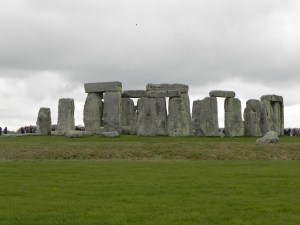
One takeaway from our brief visit was that although there was also a grove for sacred men, that of the women was more peaceful.  The idea of standing stones making a site sacred goes back at least to the Bible.  Stone circles are found from ancient Israel to the far-flung Orkney Islands of Scotland.  Standing among them, whether modern like Columcille or ancient like the Ring of Brodgar, or yes, the more famous Stonehenge, there is a sense of sacred purpose.  Miles from Stonehenge stands Avebury, a town built around another stone circle.  There the megaliths were divided between female and male stones, with both required to make the ring complete.  Such places require a tremendous amount of work.  When they’re constructed, however, they give us places to think of mothers and the mystery of life.