Opposites Distract

In the current political climate—and not just in the United States, as Brexit reminds us—opposites seem to be the order of the day. The middle ground seems to have fallen out as those frantic for turning back the clock to a day that never really ever existed make their voices louder and more strident. After seven millennia of progress, the apogee of mankind—and let’s be explicit that we mean rule by white men—was reached in “the greatest generation” and the happy days that followed in the 1950s. Those of us born to protest for an even greater idealism have, by our very nature, disrupted the smooth calm that fictitiously prevailed through the first half of the last century. In a new millennium the ghosts of the last century dictate policy. Would I have felt safer then?

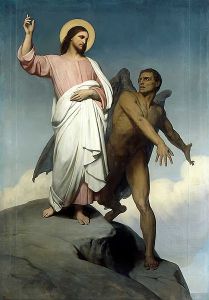
The more I ponder this stark dualism, the more it seems that the origin is religious. In its most recent iteration that religion is branded as Christianity, but in actual fact the dualism goes much deeper than that. The adjective “Manichaean” has become popular with writers who discern a certain black and whiteness to our outlook. Mani wasn’t the first dualist in history. In fact, he was somewhat late to the game. We don’t know much about Zarathustra, or Zoroaster as the Greeks called him, but we do know that he set out to devise a new religion. His outlook was one that saw the world as opposites. For every good god there had to be a bad god. There was a struggle that would result in either going to a heaven or a hell. Just about every religion that has developed ever since has shared his conflicted outlook.

DSCN2077

As political pundits bellow more like hippopotami than elephants, trumpeting that those who are different are not to be trusted, we’ve come once again into a dualistic world. Pluralism and globalization are not without their critics. Technology, however, has ensured that they will continue apace. Some governments have tried to “switch off” the internet. Those on the other side of the Berlin Wall didn’t want the truth of what was happening on the other side to be known. They had invented a dualism that was protected with rifles and threats. The problem is things aren’t as simple as the Manichaeans would have us believe. Ours is a world of beautiful, glorious complexity. It takes religion, it seems, to make such a wonderful chaos into something far too simple to match reality.

Literally Smitten

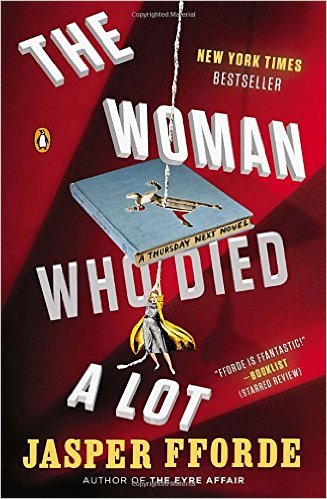
FfordeWomanDiedJasper Fforde is one of those writers who blends nonsense, deep thought, constant plot twists, and polished writing into compelling novels. His labors are always fun to read and often leave me with something profound to ponder. I haven’t followed his Thursday Next stories in any kind of strict sequence, but I figure that I can sacrifice a few of his abundant references to previous events to read through the latest installment I can get my hands on. The Woman Who Died a Lot was the most recent of these books for me. Thursday Next is a literary detective and her exploits often lead, certainly intentionally, to a feeling that in Fforde’s world libraries and reading are even more than fundamental. Everyone wants to be prided on literary achievement. His universe wouldn’t exist without books and those who love them.

In The Woman Who Died a Lot (and since I haven’t read all the books in the series I have to confess that this theme might’ve been developed earlier) in Fforde’s Swindon, religions have been united into the Church of the Global Standard Deity (GSD) and this GSD drives much of the plot. As Thursday races to solve the latest literary crime, the GSD has decided to smite Swindon. A number of global smitings have already taken place and everyone knows what to expect. A plasma-like discharge, of precise dimensions, wiping out a specified sinful part of the city. The sin here is greed and such smitings have lead to new kind of tourism where the morbidly curious gather outside the boundaries to watch the show, much like Jonah outside Nineveh. As in most Fforde novels there is both a touch of ridiculousness and social critique combined here. I can’t tell you how the smiting ends or you might not read the novel yourself.

The story is populated with peculiar religious orders that always evoke a laugh, and even a Ministry of Theistic Defense charged with finding a way around the smiting of a God willed into existence by the very people the GSD will destroy. I sometimes wonder if Fforde was ever a seminarian. We fabricate our own doom in this literary universe. It’s all in good fun and is reverently irreverent. Virtue is rewarded and in many respects the religion is conventional. The deity can be bargained with, but the law, once laid down, is inviolable. Casuistry is, of course, always an option. It’s a story told with tongue solidly in cheek, but also with brain fully engaged. Fforde is an author not afraid of religion. Indeed, he knows it can lead to a remarkable plot with consequences that will leave a reader scratching one’s saintly head.


Nazi Religion

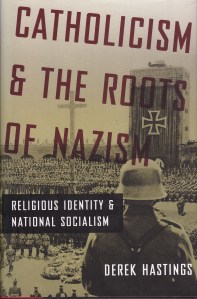
CatholicismRootsAs a lifelong pacifist, I’ve never been a fan of war books. Indeed, war seems to be to an utterly useless waste of life and a source of herculean suffering. The fact that wars happen, and books about them depress me, causes me to avoid them. Still, Derek Hastings’ Catholicism and the Roots of Nazism is less about war and more about, as the subtitle phrases it, Religious Identity and National Socialism. As I read through this history of the early Nazi movement, it occurred to me that this was probably the first actual book I’ve ever read about it. My knowledge of the Nazis had previously come from articles, movies, and documentaries. And Hogan’s Heroes. Being largely of germanic pedigree, I suppose I bear some residual guilt. I have to remind myself that my ancestors had left Europe before Germany had even existed as a unified state. I like to think they would’ve left during the rise of the Nazis, if they hadn’t already left generations before.

In any case, I had no idea of how the Third Reich dealt with organized religion. I have heard anecdotal opinions from time to time that the Catholic Church should have been stronger in its condemnation of the atrocities that wartime Germany perpetrated, but I had no sense of their official outlook toward each other. Hastings makes clear that although Catholicism and Nazism came to distrust each other implicitly, at the beginning of the Nazi movement they were considerably more chummy. In fact, anti-Semitism was something they had in common. Many of the early member of the party were Catholics—some of them priests—who felt an accord with the developing ideology. As Hitler’s rise to power increased, his personal antipathy to Christianity widened the growing gap between his own outlook and that of the early Catholic Nazis.

The book has no schadenfreude for the church, however. This is academic history. As Hastings notes, few studies have focused on the early developments of Nazism. In today’s political climate, that struck a chord with me. It seems vitally important to be aware of how such movements start so that we can recognize them as they attempt to rise again. I have little confidence, reading the news, that we are any better in the 2010s than people were in the 1920s when political instability, economic distress, and hatred of those who were different led to a reactionary, fascist regime. Could it happen again? I look around at a culture in love with guns and endless, selfish gain, and distrust of those of different ethnic origins and I wonder. The early stages are, I think, the most crucial to recognize. Surely no German Catholics could’ve anticipated just what Nazism would become.


Holy Girdles

Religions, it seems, come in belts. Or at least elements of religions do. Although we may not all agree on what constitutes the “Bible Belt” we all have a pretty good idea that it includes several southern states, and parts of the Midwest. It doesn’t really resemble a belt that I can tell, but its convenience and assonance keep the phrase alive. Over this past weekend I was in the “Borscht Belt.” I’d heard the term before, but had no idea where this supposed belt was, or, indeed, why it was called this. Historically, three counties in the southern Catskills, so I learned, were attractive locations for summer homes for Jewish families from New York City. All within a easy day’s drive of Gotham, they provided the low mountain, resort feel of much of New York State and Pennsylvania. According to Wikipedia (surprisingly, I had no books on the Borscht Belt in my library) this designation is less descriptive now than it had been, back in the day.

BorschtBelt2

One of the immediately obvious features of the region, at least as recently as last weekend, were the number of orthodox Jews walking beside the roadways throughout these counties. I’m using “orthodox” here not as a technical term since I have difficulty identifying the different brands of conservative Jewish belief (there I go again!). Another obvious indicator was the number of billboards written in Hebrew. Just a hundred miles down the road west and these markers tend to disappear. By the time you reach the central part of “the southern tier” you come back to what was once called “the Burnt Over District” from the “Second Great Awakening.” Distinctively Christian in orientation. Religion is endemic in these hills.

The internet tells me that the Borscht Belt began to unbuckle with the relative ease of air travel. I have many Jewish colleagues who pop over to Israel on a fairly frequent basis. I suppose the Catskills just don’t compare with the Holy Land. Further south, along this same rocky spine, you come to the Poconos. I grew up hearing about this vacation paradise in my own state, but, like the Catskills, the region has been largely abandoned for higher mountains, bigger thrills. Having grown up in the foothills to the Appalachians, I learned in school that these are ancient mountains. Old ways are naturally preserved here. The religion I grew up in was old-time, for sure. There’s an agelessness to these weathered hills that seems to invite those with old religions to form enclaves and imagine that little has changed, despite what Wikipedia might say. And maybe it’s time to get a bigger belt, since conservative religion seems to be growing rather than shrinking.


Stations, Everyone

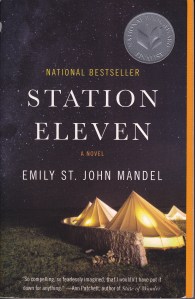
Station11There has been a movement, of late, among some sci-fi authors, to envision a more optimistic future. I have always been a fan of dystopias, myself. Perhaps it’s the working-class mentality backed up by being raised in poverty speaking, but sometimes I feel that collapse is more fair than progress. What passes for progress, anyway. Maybe I’m thinking this way because I just finished Emily St. John Mandel’s Station Eleven. This book has been on my radar for some time since it is one of the more hopeful dystopias out there. The story of a group among the very few who survive banding into a traveling troop of musicians and thespians is about the most hopeful outcome I can imagine. Not a day passes when I don’t feel the effacement of humanity that has been slowly taking place since I first became aware of the world. Sure, I do appreciate the strides made in medicine. Of this internet, which is the only place anyone ever really sees me, I’m less sanguine. It has its benefits, but even Mandel mentions the cell-phone zombies that are all too real and as omnipresent as an omnipotent deity used to be.

Station Eleven has, as many dystopias do, a religious sect that emerges after society collapses. This element of bleak futures is actually very accurate, I anticipate. We’re constantly being told by the “intellectuals” of the public variety that religion is for weak-minded dreamers with milquetoast aspirations for fantasy. The fact is the vast majority of people in the world are religious. The numbers are nowhere even near close. If a pandemic were to wipe out all but one percent (and hopefully it wouldn’t be the one percenters that survive) those who remain would, without doubt, turn to religion. People are easily led in this area of life. Mandel gives us The Prophet. His vision of the world is not helpful, but he has no trouble gathering a following. He’s also somewhat messianic: child of a single parent, raised in Israel, he comes to bring a sword to a nation already prostrate in the dust. This is powerful stuff.

Societies that try to rebuild themselves after traumas quite often rely on religion. This is hardly surprising as civilization itself began as religions coalesced into temples and their priesthoods. What is surprising is that so many intelligent people today can’t see just how important religion is to our species. As I suggested before, part of this is that religion defies simple definition. It’s easy to belittle “magical” thinking when it’s assumed religion has to do only with the supernatural. Religion, however, reaches into whatever we believe. Some ideas in modern cosmology, derived from physicists and their mathematics, can look sort of religious when viewed from a certain angle. As those who write dystopias know, religion is complex. It may lead to massive destruction. Chances are, however, that if there are any human beings left to crawl out of whatever pit we dig, they will do so with religious ideas in their heads. As usual, the writers have foreseen it.


Commander in Heaven

I pity the nation that doesn’t have divine founders. Origin myths help to orient our thoughts about where we belong in the order of things. Given enough time, any national founder will become a god. When a friend recently shared a blog post about Gogmagog, I had to dust a few cobwebs from my memory to place the mythic founding of Britain. During our years in Scotland my wife and I read about the heritage of the British Isles, according to bards before the Bard. Bede, Geoffrey, and the anonymous author(s) of the Mabinogion. Long before the Romans arrived on those islands, there had been gods, demons, and giants. The Medieval writers, of course, were drawing from the Bible. Gog and Magog are figures from Ezekiel, borrowed by Revelation. Sacred writ says enough about them only to make them mysterious. Their combined role in British myth makes one think they might be giants.

The founding of Israel, of course, is treated as history by many. I don’t mean the recent founding of the political state, but rather the biblical version of things. Moses leading the Israelites out of an oppressive Egypt, miraculously through divided waters. Foundation myths are that way. We can watch the process unfolding, even after just a few centuries. George Washington’s literal apotheosis is virtually certain. Even Alexander Hamilton experienced an unlikely resurrection when he was in danger of being removed from the ten-dollar bill. For nations to thrive this kind of transformation must take place.

6082318543_90e9752777_o

This is perhaps easier on states whose origins are lost in antiquity. There was nobody there to see the general fall off his horse or the commander in chief inhale. This was what folklorists call illud tempus, the time of events unlike those of today. Quotidian time has become profane—just look at the headlines if you don’t believe me. Those who are gods today are only those who make themselves so. We can see it happening all the time, if we pay attention. The implications should give us pause, when we consider those we think of as heroes or giants. Time makes gods. And it is just possible that we might be better off without a pantheon so terribly large.


Holy Castle

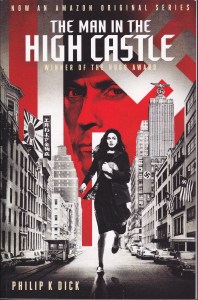
ManHighCastleReading about Philip K. Dick prompted me to read one of his novels. But which one? Some Amazon pick-up lockers on the way to work are painted with a mural of The Man in the High Castle. I haven’t seen the series, but there was the paperback, facing out, at the local independent. It’s been a while since I’ve read Dick, so I have to find my legs for his style. I’m surprised at just how much religious language he uses. Our cultural biases tend to insist that intelligent people aren’t hoodwinked by religion, but it does, nevertheless, appear. The premise of Dick’s novel is based largely on I Ching, the “Book of Changes.” Indeed, the conclusion of the novel relies heavily upon it. Along the way, however, Dick shows his sacred mettle when it comes to Judaism and Christianity as well. His prose is sprinkled with biblical quotes.

More than just a surface awareness, The Man in the High Castle offers some deep reflection for the reader. Mr. Baynes, seated on the rocket to San Francisco, ponders the Nazis who’ve won the Second World War. Reflecting on their hubris he considers how they’ve come to think of themselves as divine. “Man has not eaten God; God has eaten man.” This gave me cause for pause. Apart from Dick’s narrative, the idea of divine anthropophagy is in keeping with much human experience. We often consider ourselves masters of our own fates. Many, however, find themselves dangling like a spider from a web over the fire. Not that of Edwards’ Hell, but simply that of human circumstance. The Nazis didn’t win the battle, but listening to today’s political rhetoric, they may have won the war.

Nobusuke Tagomi explains to Baynes how I Ching, a 5000-year-old book, is alive. “As is the Christian Bible; many books are actually alive.” Far from poking fun, Dick suggests there may be something to all this mumbo-jumbo after all. We are conditioned to mock, dismiss, and ignore religion in this world where rationality leads to presidential races such as this one we’re currently suffering. Follow the trail back, I suggest. Look for clues. Philip K. Dick isn’t the only secular writer who knew more than the average person about what fascism looks like, and about the role of religion in its downfall. The novel may not be easy to read. It demands much of those who approach it. Nevertheless, it preserves the truth that many books, indeed, are alive.


The Survey Said…

Survey

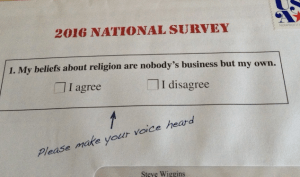
There may come a time, perhaps “when the trumpet of the Lord shall sound,” that junk mail will be no more, a mere historical curiosity. For now, in these days of declining postage prices, we’ll continue to put up with it. I suspect much of it targets my generation and those older—people who are modest about the time they spend on the internet, and who long to look out the windows when they’re at work. (The non-virtual windows, I mean.) Although I lament the waste of paper, and the cost to our literal dendritic friends, sometimes free amusement comes in my mailbox along with the occasional profundity. I received a survey the other day that had decorative check-boxes on the envelope for agreeing or disagreeing. “My beliefs about religion are nobody’s business but my own” the question read. My knee-jerk reaction, itself a religious term, was to think “Of course! Nobody can tell me what to believe.” An occupational hazard of being a religionist, however, is that the ready application of exegesis always stands to hand.

Are my religious beliefs nobody’s business? I suspect since the sender was looking for money that some manner of business was indeed involved, but beyond that are my beliefs nobody’s concern? Freedom of religion allows us to believe what we will, and since beliefs are very, very difficult to change, this is a central tenet of any form of democracy. You can’t have a free people without letting them believe what they can’t help but think to be true. It may, however, sometimes be somebody else’s business what I believe. If my religion is dangerous—and what religion isn’t, to some degree?—don’t hoi polloi have a right to know? Ah, but then aren’t we in danger of registering, profiling the believer? This is a violation of rights as well.

My pen hovers uncertainly over the paper. My views are something that I keep to myself. Few people know what I actually believe. On the other hand, day after day I post thoughts that in some way can be tied to religion. Is this a trick question? A junk mail survey shouldn’t be so hard. When did studying before checking the mailbox become a requirement? In my teaching days I had students who claimed they had a right to know what I believed. I had a right to keep my views private. Who’s right? Whose right indeed? Belief doesn’t come easy. It’s not as cheap as the media makes it out to be. Unless, of course, it arrives unbidden among the junk mail that makes up so much of our lives. And even then it might be something to take seriously, at least for a little while.


Forgive Us Our Tabs

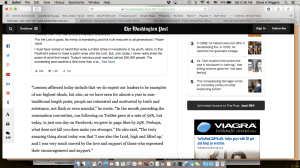
Forgiveness is somewhat of a specialization among the crowd courted by the new GOP. Although it is forgiveness that goes only one way, at least it’s a start. Think back to Bill Clinton making his non-inhalation declaration followed by W who could not hide from his drug-fueled Yale days. Televangelists who admit, in tears, that they had an affair stand a fair prognosis for at least a limited recovery. The religious right loves a repentant sinner. I suspect it will be the trump card in the deck, come this fall. A host of sins can be banished under this incredibly effective rubric. This past week Mike Webb, Republican hopeful for Virginia’s Congress, having lost his party’s bid decided to run as an independent. No forgiveness required. What’s right is right. During his announcement of his decision, however, he posted a screenshot on Facebook without checking his tabs. As the Washington Post article by Justin Wm. Moyer reveals, some of those tabs included porn sites. In a move no Democrat could’ve made, the conservative candidate thanked God for his mistake and his likes increased by 25 percent.

Technology is a kind of big brother. By their tabs you will know them. Our browser histories reveal who we really are. Browser histories, however, may be cleared. And those who know how to manipulate the forgiveness card can make no mistakes. After all the Gospels declare that you must forgive the repentant 490 times (taken literally), which leaves a comfortable margin to get elected. A little bit of time with the Good Book can do wonders for your campaign. The problem is, it only works with the GOP. If he admitted to inhaling, you can be sure that the War on Drugs would’ve crashed down on the White House. Dems have to keep squeaky-clean records because forgiveness doesn’t apply to that crowd.

Screen Shot 2016-05-21 at 5.38.11 AM

One of the ironies, apart from the Viagra ad on the page telling this story, is that such incidents reveal a basic misunderstanding on the part of the electorate. No tenet is more easily finessed than forgiveness. Who’d hit a dog who’s rolled over on his back, exposing his vulnerability, admitting that he’s just eaten what you left on the counter for your dinner? Apologies can be accepted for some of the most outlandish sins. They’re cheap to make but reap rich rewards. As a former evangelical I know this may sound terribly cynical. All I can say is I’m sorry, please forgive me. And don’t look too closely at my tabs.


Beg to Differ

Screen Shot 2016-05-09 at 4.15.19 AM

“What do you burn apart from witches?” “More witches!” Earning a doctorate is kind of like learning how to get lost. It certainly doesn’t make you either cool or employable, but it allows you a few years to accumulate enough debt to keep you out of trouble for awhile. One of the things I learned along the way is that you should always follow the crowd. I look at the schools that only hire Harvard grads and there can be no doubt. I look at all the Trump supporters and I know there can be no question. Yes, the ayes have it. So, I never learned to tell which bands were truly worth listening to until I learned to follow the critics. I never studied music. Like most people, I know what I like but I can’t say why. I only discovered Radiohead in the last few months. Some of my critics claim my complaint of lack of time is only an excuse, but I don’t listen to music unless I can really listen to music. It can’t be pure filler. Put on Beethoven’s seventh and you’ll see what I mean.

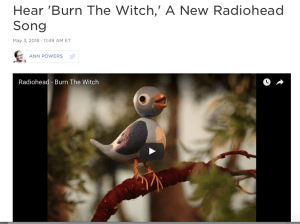
In any case, my wife alerted me to the new Radiohead song “Burn the Witch.” And you can’t listen to a new song without watching it as well. This time it’s worth it. The claymation video accompanying the song (conveniently found here on NPR) is a reprisal of “The Wicker Man,” one of the truly intellectual movies in the horror genre. Of course, that’s something I picked up from the crowd. We’re told by the most powerful and charismatic bigots of our age that life is all about acquiring stuff. Were I to argue with that, well, I guess I’d be the witch to be burnt. Before listening to/watching the Radiohead song, do yourself a favor and watch “The Wicker Man” (the original, please, accept no substitutes). Go on, everybody’s doing it.

The most dangerous thing in the world is an independent thinker. No, I didn’t learn that at Harvard. On my first walking tour through Edinburgh with one of my doctoral advisors he pointed out the part of town where they used to kill witches. He was truly an original thinker (still is) and taught me to be one too. Problem is, I should’ve been following the crowd all along. You want people to pay attention to you? Go to Harvard! Want people to vote for you? Clearly show you’ve got what it takes (money). Give a man a little cash and anything will do for brains, to paraphrase one of the smartest movies of all time. The only way forward is to do what everyone else is doing. And pick up some kindling along the way—you’re going to need it.


The Devil, You Know

I’m the first to admit that I’m behind the times. Too much of my free time is spent reading weird news or going to used book sales to keep abreast of what’s happening in the adult world. If it weren’t for my wife sending me news stories via the internet, I would still be wondering why Gorbachev isn’t helping to hunt down Osama Bin Laden. Since I’m captive to a religious worldview, I was interrupted in my calculations by the news that Ted Cruz is, allegedly, Lucifer. My research had me on the trail of Santa, since the simple transposition of two letters would give us the title of the Zoroastrian prosecuting attorney. And, I figured, it was fairly safe to out St. Nick when Christmas is still eight months away. Hopefully I’ll still find something in my stocking come December. I kind of figured that when we found the real devil he would be a Republican in any case. Even as I write this, Cruz is out of the race. I thought the Devil never gave up.

I wonder where else in the civilized world would politics be such a joke. Can you trust the opinion of a man named Boehner? It’s easy to change your name—just ask anyone who came through Ellis Island. They’re laughing at us, folks. Seriously, they are. I don’t get much email, but I’ve had two international missives asking me what’s going on over here. It’s a good thing I don’t know, otherwise I’d have to try to explain. You see, the Bible doesn’t say much about Satan at all. In the Hebrew Bible there is no devil. By scraping together the few references to “the Satan” and morning star, some have said the alleged Ted Cruz of ancient times was clearly in the Bible. Somewhere between the Testaments he showed up. By the time Jesus was old enough to climb temple towers, he was there. In the meantime the Zoroastrians had come down from the North Pole…

Then there’s the fact that when he’s not wearing a conservative suit and announcing a female running mate, the Devil is described as looking like Pan. Goat horns, goat feet, but always the torso of a man. And he’s red, just like the Coca-Cola red of Santa’s suit, and states like Texas. It’s a good thing I don’t read any more conspiracy theories than I already do. You’d probably find me tootling away on my pan-pipes waiting for a bus in the Port Authority. No, there’s a reason I stay away from the real news. It might interrupt my fantasy world. And, I’m afraid, it might actually be more entertaining. And don’t worry about my Christmas—I plan to have an eleventh-hour conversion, just in time to have a chimney installed in my apartment. If I can only be sure I get it done before February.

There's something political going on here...

There’s something political going on here…


States Slights

States, at least the united kind, can have personalities. Some of us move after the diminishing herd of jobs and so end up in places we hadn’t really planned to live. In each state where I’ve made by domicile (six, as of the present), I’ve met people born and bred, down home and with no intention of ever leaving their native land. To such people, I imagine, state symbols may be important. I always felt unjustly proud of Pennsylvania’s Keystone status. I was born there, but neither of my parents and none of my grandparents were. I don’t live there any more myself. I was pleased and just a little surprised to learn that New Jersey has a state dinosaur (the hadrosaurus), discovered right here in the Garden State. This past week, according to an NPR story my wife sent me, Tennessee is trying to garner its own state dinosaur, in the form of the Bible as the State Book. I think it would be a great idea for each state to have an official book, but I would think that it might be a book written by someone from that state.

IMG_1363

Senator Steve Southerland, according to the story, put forward the legislation due to the Bible’s importance in the Volunteer State. The problem is, of course, the Bible is a religious book and that by choosing a religious book you’re getting dangerously close to choosing a state religion. “There used to be a wall here,” you can almost hear the constitutionally minded saying. The Bible is important. Whether we want to acknowledge it or not, no well-informed individual can deny that the United States has had a long and complicated love affair with the Good Book. As I try to show in many of my posts, the Bible still permeates our society in unexpected ways. Nobody’s trying to erase that history, but really, which state is going to select the Rigveda for its own book? Or the Qur’an? The Analects?

States are justly proud of their contributions to the whole. We have state flowers, mammals, trees, and birds. Tennessee’s is the Mockingbird. We have state slogans and mottos. But can any single state claim the Bible more than any other? I have to be just a little suspicious about claims that there’s no religious jingoism at play in suggesting it should be any state’s book. Yes, many Bibles are printed in Tennessee. Many writers have called the state home as well. Wouldn’t the more distinctive contribution come from a book that Tennessee actually had a hand in producing? Bibles, like it or not, can be claimed by all. I can see a tug-o-war coming with Texas, should this state symbol be canonized.


Rainbow Nation

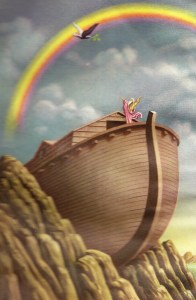
By now I suppose it’s old news that North Carolina has joined the wall of ignominy as the latest state to try to discriminate against gays. It seems our aging leadership just doesn’t get it that a large majority of people in the younger generation just don’t have a problem with accepting homosexuals for who they are. Laws are generally still made by old white men, though. One might be tempted to say “good ole boys.” They may make the claim that this is political, but as one astute editorial in the New Jersey Star-Ledger pointed out, this is about religion. The editorial, which ran on Saturday, notes that studies have shown that when people learn a law sequestered under “religious freedom” is actually discriminatory, the law loses support. The government by the people thing seems to be working backwards. What will it take for elected officials to realize that we are a rainbow nation? And rainbows, according to the Bible, are good.

MyFavoriteNoah

I’m always amazed at these attempts to turn the clock back. It is the season of “spring forward” is it not? Religions that have a problem with homosexuality also have an unscientific understanding of human sexuality as well. Not one person in the Bible had a clear idea of how conception worked. If they didn’t understand the facts of life, how can we expect to learn the life of facts from them? What amazes me most is that such views don’t take the whole picture into account. Intersex individuals—of whom there are many—demonstrate that easy definitions of gender are sure to be wrong. Even tying the concept of gender to sex seems to be misguided. And yet we pass laws the favor a first-century understanding of what it means to be human.

In the end what will change the minds of the corporations will not be their heads or their hearts. The decision will be made by their backsides where their wallets will be growing a bit lighter as corporations decide to take their facilities elsewhere. It’s a sad commentary on our society when justice isn’t enough to strike down a prejudicial law. It takes money to do that. It is a strange world indeed where it take lucre to lead to light.


Cthulhu’s Tea Party

It was in the eldritch-sounding Oshkosh that I first came across H. P. Lovecraft. The web was still somewhat of a novelty then, and I’d run across a Dagon symbol that I couldn’t identify. My researches led me to the old gods of Lovecraft’s atheistic imagination. Even non-believers are haunted, it seems, by deities. Dagon, about whom I’d published an academic paper, always seemed to be a divinity to whom very few paid attention. Little did I know that in popular culture this god, along with others made up by Lovecraft, were slowly gathering an immense following. Now, about a decade later, Cthulhu is everywhere. I was reminded of this when I came across a website advertising Cthulhu tea cups. As you drink your tea, Cthulhu emerges. These novelty items, along with many, many others, are easily found. Cthulhu is running for president. The creature that Lovecraft described with such terror is now available in a cute, stuffed plush. Board and card games come in Cthulhu varieties.

IMG_1551

What I find so interesting about this is that the following of Cthulhu has taken on religious dimensions. Not that writers haven’t invented religions before—L. Ron Hubbard came up with Scientology after a career of science fiction writing, and Jediism is considered a religion by some—but Cthulhu represents the darker aspects of religious thought. As Lovecraft described him, he is a horror. Not the kind of thing you’d want to discover peering out of your teacup. I wonder if this is precisely why the fictional god has become so incredibly popular. In a time when some real presidential candidates are really scary, suggesting that an evil deity take on the job may only be natural. Cthulhu is, after all, really more an alien than a god, but to puny humans the point is moot.

Mainstream religion is not about to disappear any time soon. There is, believe it or not, a strong resistance to the materialistic reductionism that presses in on us from all sides. People are not becoming less religious—they’re becoming differently religious. The old sacred texts are being replaced by the fictional Necronomicon. Ethereal beings that have always been there are bowing before ancient aliens who aren’t really eternal or omnipotent, but who feel more real in our culture of might makes right. Whether a religion is factual or fictional has come to matter less than the feeling that there is something, anything, larger than humanity that demonstrates the vanity of our striving after material gain. That actually sounds quite biblical. Anything believed with adequate passion stands a chance, it seems, of becoming a religion.


Unlearning Prejudice

With the terrorist attacks in Belgium on our minds, people are asking once again, “What’s up with Fundamentalists?” My jeremiad that the only solution to religious violence is to study religion reaches few eyes, I realize, but the internet has the capability of spreading memes far and fast. It is merely the hope of a closet optimist. One thing that Fundamentalists believe—I know from personal experience—is that the stakes are based in eternity. In Christian fundamentalism, for example, Hell or Heaven will be forever and any parent would be depraved indeed not to teach their children this belief from their earliest days. That parent-child bond is strong to the point of being unbreakable. That’s why what children learn about religion tends to stay with them all of their life.

IMG_0922A story on the Freedom from Religion Foundation website describes how it is fighting the distribution of Gideon Bibles in public schools in Delta County, Colorado. I was under the impression that Gideons contented themselves with hotel rooms and county fairs. I had no idea that they were active in public schools. In response, the Freedom from Religion Foundation has provided counterbalances to be available to students, including materials calling the Bible into question, and, somewhat more surprising, atheist and Satanist literature. It is clearly a political move to prevent the district from allowing Gideons to distribute Bibles, but it feels an awful lot like a battleground to me. We want the best for our children, but is it best to put our adult biases out where they can be so plainly seen? In a pluralistic society, religion will always raise extreme responses where children are concerned.

The question here is not whether children should receive religious teaching or not, but where such teaching should occur. We are a nation founded on the principles of religious freedom, and although the concepts have changed since the founding days, the ideal is still valid. No matter how one wants to argue the point, people will be religious beings. They may express it in enormously different ways, but express it they will. Children trust us to act like adults. We want what’s best for them but the risk is very high. What should be done? Educate adults. But then, that’s a screed you’ve heard from me before.