Fictional Fact

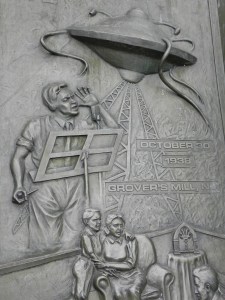
Do you remember that tragic sinking of a Staten Island ferry when a giant octopus pulled it under? Sounds vaguely familiar, but I wasn’t living near New York at the time. A story in The Guardian tells how Joseph Reginella, a sculptor, made his commemorative piece of art for Battery Park for a fictional incident. Like the memorial for War of the Worlds in Grover’s Mill, New Jersey, this is something we remember that never really transpired. We remember what never happened. It’s easy to forget that memory evolved for specific purposes. Mainly we remember for survival. Our brains evolved to keep us alive. If we don’t recall where we found water, or where that hidden cliff edge is, we don’t last for long. But we remember other things as well. The time that Oog borrowed your stone axe and didn’t give it back. Our social memory made us human, so we’re told.
dscn4239

No doubt it is possible to develop a keen memory. Precise recollection of events just as they happened, in sequence. It’s also possible, even collectively, to misremember things. We tell stories. We make myths. There was no giant octopus incident. Maybe we saw such a thing in a movie one time. That movie, paired with the plausible evidence of a public monument commemorating the event becomes a modified reality. I’m just sure I can remember it happening, can’t you?

Studies of such phenomena tell us that memories aren’t what they seem to be. To make distant recollections Holy Writ, for example, we have to rely on divine inspiration. Without it we might just be remembering a story somebody told once upon a time. And where did I put the car keys? Yes, our memories are open to manipulation. Things that never happened become real this way. George Washington did not chop down a cherry tree and confess to his father because he could not lie. And yet we believe. We make myths because they give our lives meaning. Face it, evolution is a pretty boring explanation for why we’re here. Natural selection has no goals in mind. Things that work best tend to survive in the gene pool. And in some people’s memory there may be a giant octopus in that pool as well. Did the the Cornelius G. Kolff get pulled under or not? Would a ship with such a name ever be made up? Myths are still born every day, even as the octopuses cower in their caves, awaiting the next naive ferry to transcend reality.
Reflecting Ourselves

There once was an old man from New Hampshire. No, this isn’t a limerick. He was famous enough to get his face on the state quarter, back when they were doing that state quarter thing. Then he fell. The Old Man of the Mountain was no more. We like to see ourselves in stone. On a trip with my wife and a couple of friends in my post-grad days in Edinburgh, we were driving around the Isle of Skye. The largest of the Inner Hebrides, the island has a mysterious natural beauty. One of the most famous monuments on Skye is the Old Man of Storr. Postcards always show it to be a rock pillar jutting up by itself at the base of a mountain. As we approached the old man from the north, I got the joke. My friends still dispute it, but if you look at the mountain crest above the pillar, it forms a perfect profile of an old man’s face. Then what is the rock pillar? It’s just the right distance from the old man’s face to be, well, you get the picture. I’m convinced that those from Skye laugh at all the tourists taking a picture of the old man’s naughty parts.

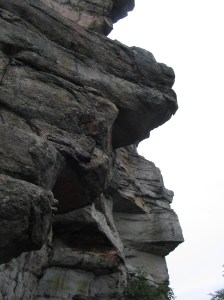
The technical term, as I’ve discussed before, for seeing that which isn’t really there is pareidolia. Some people call it matrixing. Our brains, wired to see other people, often see them where they don’t exist. The Old Man of the Mountain formed a passable human face before the rock face collapsed in 2003. This past week I read an article in the Washington Post of the collapse of Duckbill, a rock formation in Oregon’s Cape Kiwanda State Natural Area. Like many cases of pareidolia, this rock pillar was only seen as a duck by those whose brains make the connection. People like to go see that sort of thing. It makes us feel less alone.

Do you see it?

Do you see it?

The article by Cleve R. Wootson Jr., however, points out that Duckbill didn’t jump. He was pushed. A group of eight guys, caught on video, rocked the pillar until it toppled. This is why we can’t have nice things. The deliberate destruction of monuments is a crime, and the culprits are being sought. Make Way for Ducklings, the Robert McCloskey children’s classic, was cast in bronze in Boston’s Public Garden. In 2009 vandals stole one of the ducklings, which was quickly replaced. It’s difficult to understand the mentality of those who wish to destroy our duckbilled friends. Yes, Duckbill was only rock. No, I never had the chance to see it. As long as the Old Man of Storr lies recumbent in the Scottish highlands, however, we will have grounds to wonder.


Intelligent Life

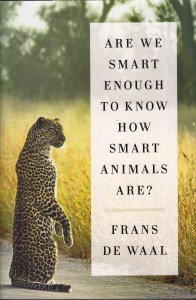
arewesmartPerhaps the most pervasive trait of religion is its ability to construct worldviews. Even when the religion is eventually abandoned, the worldview remains. Most scientists would deny that religion lies behind their perspectives, but in the case of human exceptionalism it remains the most logical cause. I always eagerly await new books by Frans de Waal. Ever since I read his book on empathy and apes, I couldn’t wait for the next one. His latest book, Are We Smart Enough to Know How Smart Animals Are?, although the title is a mouthful, does not disappoint. As I’ve noted before about his works, de Waal is perhaps the most sensible person writing in science today. He considers the evidence and takes his own biases into account. In a competitive world where science money is often doled out to those who can exclude others, de Waal is willing to leave the door open when the evidence demands it.

What is really ironic is that evolution has become the line in the sand between biblical literalists and science. As de Waal points out, the idea that people are different from the animals from which they evolved—in some qualitative way—is an idea based on religion. Many scientists still hold to it in a way that can only be described as, well, religious. This is very strange when evolution works by gradual changes over long periods of time. When did humans gain whatever trait that separates them from “the animals”? When I was a child it was tool use. When that was disproved, it became language. When that was disproved it became consciousness. The latter is the safest since nobody really knows what it is. As de Waal amply demonstrates the Behaviorist school was clearly wrong about animals (including humans). What no Behaviorist wants to admit is that the idea that we alone are conscious comes from the cultural interpretation of the Bible.

Are We Smart Enough to Know How Smart Animals Are? is, like many of de Waal’s books, full of wonderful observations of the ways animals actually behave. They solve problems. They learn from experience. They anticipate the future. In some cases they have been shown to outperform humans on cognitive tasks. And yet we still insist that people are somehow different. Better. Interestingly this is one area where religions and science tend to agree. People are just more important than animals. I wonder if one of the underlying reasons—not addressed by de Waal—is that we have come to depend on a lifestyle that unfairly exploits animals. After all, we eat them, use them for work, and even experiment on them. If we admit that they are intelligent we would need to, yes, rethink all of this. Given what’s happening in the world today, it is perhaps time to admit what we don’t really know.


Evolving in Place

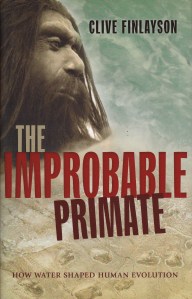
ImprobablePrimateEnvy is not a word I would use to describe how I feel about those trying to piece together the earliest stages of humanity. Evolution, naturally, is a given. Once beyond that, however, the landscape gets dicey. Clive Finlayson is an author I don’t envy. I just finished his The Improbable Primate: How Water Shaped Human Evolution, and it felt like he had to put this immense puzzle together while missing about nine-tenths of the pieces. Early human fossils are rare and it doesn’t take much to throw a laboriously constructed scenario into yesterday’s mistaken hypothesis bin. The central premise of the book, as stated already in the subtitle—human evolution followed water—seems about as firm as any idea. We need water daily and our bodies evolved to help find it efficiently. It’s a fascinating story. Along the way I learned that much of what I’d previously learned about ancient human development was probably wrong. I’m only a casual evolutionist.

Finlayson suggests—and not all biologists would agree with him—that all humans living on earth at any one time (with one possible exception) were of the same species. That is to say, the model I grew up with of separate species (Neanderthal and Cro-Magnon were the usual suspects) duking it out over scarce resources doesn’t match growing evidence very well. We Homo sapiens seem to share some Neanderthal DNA and that paints a somewhat more romantic encounter between the species than the violent one I learned. The same goes for other human ancestors, according to this little book. Our first instinct may not be to kill the stranger. We may have lived apart for a few thousand years, but when populations come back together they “share genes,” if you get my drift. This still happens, of course. The difference is today we’ve become politicized and entitled. We don’t want people not from around here to share our stuff.

Part of that is natural, I suppose. Finlayson points out that the feeling of belonging in natal territory is something we share with other primates. We feel that we belong where we’re born. That seems to me a difficult thing to quantify, but I feel it nevertheless every time I venture back to my hometown. It just feels right. Not that we can’t adjust to elsewhere, but our nature rewards us, in some measure, when we come home. This is a wide-ranging study for such a small book. I don’t envy all the meticulous jigsaw staring without a box-top that students of human origins must do, but the results are still quite interesting. Even if the picture, when enough pieces are finally found, ends up being something different than we thought it was.


Simply Beautiful

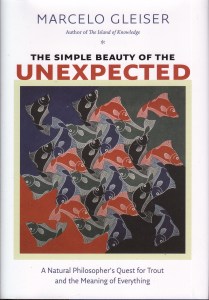
Simple BeautyThe scientific method has been a boon to humanity. Knowing how to sharpen the rational faculties has demonstrated its benefits time and time again. Sometimes, however, overemphasis on rationality contains hidden costs. Humans are not always rational, and sometimes this is a very good thing. Culturally we’re told that reason trumps emotion and that evolution has somehow led us to this. That’s only part of the story. Marcelo Gleiser’s excellent The Simple Beauty of the Unexpected serves as a wonderful corrective to this one-sided view. Although I’ve been trained in rationalistic thinking, my humanities background lacks the credibility of similar training in the sciences. Gleiser, as a physicist, demands respect. As he notes throughout this book, physics asks the hard questions. The only proper response, he rightly declares, is humility. Arrogance in any human endeavor may make for a good story, but it is bad citizenship on this planet.

I have to confess to being one of those poor souls who really doesn’t care about fishing that Gleiser mentions early on in his book. That doesn’t mean that I don’t agree with his outlook and mature thoughts on the subject. Using fly-fishing as a kind of bait, he draws the reader in to consider some deep and meaningful questions about life. Although he describes fishing literally, he clearly has a metaphorical usage in mind as well. Rare is the scientist who will admit that science can’t answer all questions, and moreover, wouldn’t want it to. Showing the limits of rational thought can feel like taking one’s clothes off in front of a crowd for those wedded to empirical evidence. Applied science clearly works very successfully. That’s not the same as having all the answers. Gleiser beautifully illustrates this, acknowledging that the spiritual has a role to play even among the rigorously trained and actually employed of the intelligentsia. This is a very important book.

Admitting that some things happen for which there is no rational explanation, Gleiser advocates for appreciating the wonder rather than trying to force science into situations where its explanatory power fails. This doesn’t happen often—indeed, rarity is what makes the unexpected so wondrous—but when it does happen we need to, like a fisher, accept it as part of the way the art unfolds. In Gleiser’s terms, not every fishing trip is successful. If you always had success, what would be the point in trying? He ventures into the murky waters of religion a time or two, but this is catch-and-release, not for the kill. The Simple Beauty of the Unexpected is an example that includes itself. Those who read it will learn what this means.


Things Unseen

The reductionistic mind doesn’t care for mystery. Unlike a lover, the unknown is a problem to be solved so that the march of nice, neat solutions may continue to march on, unabated. Fear of fuzzy thinking leads to a coldness that those of us experiencing life find not a little unsettling. Take the cougar, for example. Right now I’m in one of the few habitats of the grizzly bear in the lower 48. It is also home to mountain lions (pumas, panthers, ghosts of the Rockies). Just a week before I came here a local website posted a rare photo of a cougar caught unawares. These creatures are seldom seen, and are officially extinct for most of the country east of the Mississippi. That doesn’t stop them from existing, however. Reports from my native Pennsylvania continue to be filed. I saw tracks when I was a child, but never saw an actual cat. A friend in West Virginia had seen one shortly before we visited that state some years back. Even New Jersey still gets the occasional sighting. Officially these are misidentifications.

I recently read a couple of books that addressed the beast of Dartmoor, in the United Kingdom. Dartmoor is a wild and remote area and for many years an uncomfortable story has circulated about an unknown creature that haunts the moors. The story is older than Sherlock Holmes as Sir Arthur Conan Doyle had the detective face the hound of the Baskervilles in that region. Those unhappy with the unknown have sought a rational explanation and now some are claiming that escaped cougars are the basis for the tale. A zoo owner even declares that some of his escaped in the 1980s, causing the stories to arise. The fact that the beast had been part of folklore for over a century already at that point suggests that this may be a little too little a little too late. It’s better than mystery anyway.

DSCN0740

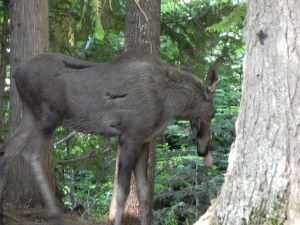
My minimal experience on Dartmoor didn’t lend itself to seeing folkloristic beasts. Even my somewhat extended time in this wilderness hasn’t led to a cougar or grizzly sighting. The mysterious gains its reputation by rarity. The thrill of seeing a relatively common moose is akin to theophanic. I know it’s just a big deer. It’s more than just a big deer. Wonder is an essential part of the human condition. Without it we become as soulless as the mechanistic universe some so desperately want to explain neatly, according to the rules. Cougars escape. Cougars escape detection. What else might we be missing in a universe we’ve only just begun to explore.


The Canine Mystique

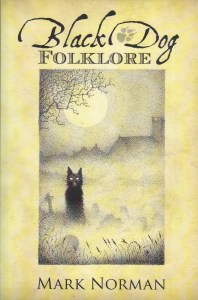
BlackDogAnyone who spends long enough in the United Kingdom will hear about them. Not everyone believes in them, but reports of their presence are pervasive. Some call them ghosts while others call them protective spirits. They are the black dogs. As Mark Norman points out in his new book Black Dog Folklore, the tales of these spectral canines go back centuries and they also appear in other parts of the world. The majority of the lore comes from the British Isles and even there they are concentrated into certain parts of the country. Norman isn’t setting out to prove that they exist, though. This book is an exploration of folklore and the question of the reality of the phenomenon isn’t the point. The fact is people have reported encountering similar kinds of black dogs that vanish in similar ways frequently enough that secondary characteristics can be described and the accounts can be treated as lore.

Dogs were the earliest domesticated animals. Long before cattle and sheep could be tamed, humans and dogs had learned the mutual benefits of each other’s company. This very long association between species has, however, not always been smooth. Dogs retain something of the ancestral wolf in their nature, even as we harbor our inner ape. Some people fear dogs, and indeed, dogs are still used for security and can be trained to attack, or even kill, people. Their millennia-long association with humans, however, has assured them a place in our mythologies. Ancient cultures frequently mythologize dogs, making them prime candidates for an afterlife in folklore.

Traditionally, dogs are chthonian creatures. That word tripped me up the first time I encountered it. “Chthonian” is literally something like “of the earth,” but in mythology it is used to designate that they are associated with the underworld. As in life, dogs may act as guides in mythology, and one of their regular associations is with the realm of the dead. It’s no wonder, then, that dogs came to be associated with ghosts. As Norman demonstrates, the lore was pervasive enough to engage Sherlock Holmes in The Hound of the Baskervilles, and perhaps even Bram Stoker used the image in Dracula. Winston Churchill referred to his depression as a black dog. Norman’s book won’t convince the reader that such things actually exist, but what it does do is draw the tales together to determine what there is to analyze. Since dogs have been our companions for so long, they have become part of our narrative tradition, participating in what it means to be human. As with all good folklore, there are those today who still swear these spectral dogs still haunt those who are willing to believe.


Monkey Puzzle

One of the unexpected consequences of Christian theology is the ongoing insistence in science that human beings are qualitatively different from other animals. Actually, it goes back to the Hebrew Bible and the concept of “the image of God.” As the absolute line between human and beast continues to blur (intelligence, tool use, language use—you name it) mainstream teaching has trouble admitting that our special differences aren’t that different. A Washington Post story by Darryl Fears describes how capuchin monkeys have been using tools to extract cashews from their toxic husks for at least 700 years. These monkeys use a two-rock system to get at cashews, which, in their natural state, are inedible. The surprise here is that this makes these monkeys denizens of the Stone Age and capable of teaching complex behavior to their offspring.

Animals watch parents to learn to eat—it might seem to be a simple idea. In reality it’s more complicated than that. As I watched a doe and fawn foraging the other day, it occurred to me that what we call “instinct” is a way of getting around admitting animal intelligence. Why would a newborn (“unconscious”) animal seek to feed, or flee from predators? We call it instinct, but what we really mean is a form of will, a desire to survive. This “will” pervades nature well below the human-animal divide. Plants strive to thrive, and exhibit a “will” to live. By just taking all this for granted and calling it “instinct” we’ve further cut ourselves off from the organic world of which we’re all a part.

Christian culture gave rise to scientific method. No doubt this is an embarrassing scenario for those who believe science should reduce all the wonder of being alive to mathematical equations. Can’t we just pretend that rationality was creeping in from the beginning? Aristotle was going that way wasn’t he? But his work was “lost,” only to be recovered by Muslims who saw the value of such logical thinking and Christians—in an over-simplified history—wanted to catch up. Meanwhile, in the Dark Ages monkeys were using an intricate system to extract tasty nuts from toxic casings without the benefit of any religion at all. The Stone Age, we easily forget, was the first recognizable step on the road to the technological world we inhabit today. And we continue to use an outmoded paradigm to understand our place in that world.

391px-Organ_grinder_with_monkey


Consciousness Times Eight

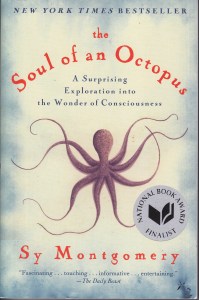
SoulOctopusPerhaps the characteristic that marks our species most distinctly is its arrogance. Conscious of who we are (we think) we stake the claim for minds for ourselves alone while all the evidence points away from that very conclusion. Naturalists are castigated for “anthropomorphizing” animals by stating that they have consciousness too, or—oh the heresy!—personality. Any of us who’ve spent time with two or more of the same non-human species, however, know that personality is a given. Animals think and feel and, yes, act on their own view of the world. I have to admit I fell in love with Sy Montgomery’s The Soul of an Octopus. I’ve read animal books from my youngest days, but finding an author so forthright about the feeling of getting to know another species is rare. And I learned tentacles full of information about octopuses. I had already known that octopuses are intelligent—I hadn’t realized just how smart—but since my interactions have only been with sleeping cephalopods on the opposite sides of aquaria glass, I had little to go by.

Throughout her charming book, even if the evidence is anecdotal, Montgomery reveals the personalities of the octopuses she got to know at the New England Aquarium. The reader can be left with no doubt that these are animals with personality, different from one another and strikingly conscious. We can’t define what consciousness is, but I tend to agree with Montgomery that it is what many people call “soul.” She admits that her religious tradition would likely frown upon her willingness to share such a valued commodity with an animal—an invertebrate, no less—but surely she is right. Many, if not all, animals have a form of consciousness. Heaven will be a much more interesting place for it.

Please don’t confuse my enthusiasm with sentimentalism. Those of you who regularly read this blog will know that books on animal intelligence by a variety of scientists make up a steady part of my literary diet. Biology, however, often has a difficult time in a world where physics and chemistry are treated with reductionistic glee. I was strangely satisfied when Montgomery mentioned that Stephen Hawking signed the Cambridge Declaration on Consciousness which proclaims humans alone are not the guardians of this phenomenon we don’t even understand. The Soul of an Octopus was one of those books that I couldn’t wait to keep reading, even if it meant being on my long commute each day. And I can’t help but think of how much intelligence we squander by claiming that only our own kind possesses it.


For the Dogs

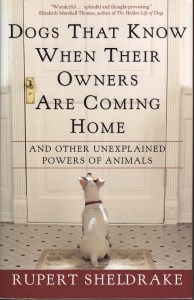
DogsThatKnowYou know that feeling of being dropped into a very strange place?  Sure, it’s disorienting for a while, but once you get used to it, you start to enjoy your surroundings.  Now ask yourself: what if my entire way of looking at life is based on a faulty paradigm?  Many, I suspect, will drop out at that point.  There’s strange, and then there’s going too far.  For those wedded to the idea of finding the truth, however, weirdness is part of the journey.  I just finished reading Rupert Sheldrake’s Dogs That Know When Their Owners Are Coming Home.  Yes, it felt like the room was spinning (actually, I read it on the bus, so that might’ve been true a time or two), but it confirmed something I’ve suspected for many years.  The reigning, mechanistic universe paradigm is wrong.  Please don’t take this as an anti-science statement.  Sheldrake is a bona fide scientist, and I’m an avid reader of science books.  It’s not so much that science is wrong as it is that science doesn’t go far enough.  Ever since the Industrial Revolution—not coincidentally—we’ve been informed that the universe is really a giant machine.  We can figure out how it works using this squishy stuff in our heads that insists we can find Pokemon everywhere we look when it’s not busy solving the riddles of the mulitverse.

Sheldrake, who is given a wide berth by many scientists, states what any of us who grew up with pets knows: they know more than they’re saying.  Admitting up front that much of the evidence is anecdotal, Sheldrake provides empirical studies to demonstrate what folk say.  Dogs do know when their owners are coming home, before they are within sight, hearing, or smelling range.  His study, however, isn’t limited to dogs or to knowing when someone’s coming.  Animals, by virtue of their own minds, have abilities that we do not.  Since they don’t speak our language, we assume they are dumb.  In fact, as this book shows, a great many animals know a great deal more than we do.  The question is, if this is the truth why don’t we hear more about it?

We prefer, it seems, our truth to be qualified.  There’s a lot at stake here.  The reigning paradigm keeps us plugged into this corporate machine we’ve devised.  Our lifestyle cannot subsist without the subordination of animals.  We can’t give them abilities we lack, apart from tastiness.  If the universe isn’t a machine, it might open the door for a broader view of reality.  Maybe it is better to be post-Christian, but religion has proven benefits to humans (and perhaps animals).  Why does religion remain in a mechanistic universe?  Perhaps what we call “souls” are the same as “minds” and perhaps they aren’t the same as brains.  If we really do have minds, it is in our best interest to care for them, develop them, and improve them.  It may seem like a strange world indeed where your dog informs your view of reality.  Read Dogs That Know When Their Owners Are Coming Home, however, and see if you don’t find yourself wagging your tale, just a bit.


Dinosaurs, Old and New

T._rex_old_posture

Tyrannosaurus rex, aside from being a photogenic movie star, was one of the top predators of its day. Ironically, in the Jurassic Park original trilogy (which would have been, more appropriately Triassic Park) tyrannosaurus rex becomes the ultimate protagonist, while unfeelingly killing to meet its own instincts. Since saying “tyrannosaurus rex” wears you out, we’ve become accustomed to calling the great carnivore t-rex. Everyone knows t-rex when they see it. Its a sign of danger, aggression, and unthinking acquisition. In one of nature’s great ironies, however, t-rex had tiny arms, nearly vestigial. What it wanted it had to get with its mouth. To live like that you have to grow pretty big, so big that nobody else can really challenge you. Punching is out of the question.

I’m often struck as how appropriate dinosaur evolution is to the human situation. Dinos (because “dinosaurs” is also too long) grew to be the top life-forms of their day. (We like to think of being the top. The perspective from down here in mammal land, in those days, was pretty different.) If you’re big enough, who’s going to stop you from taking what you want? Endless rows of teeth and a constant hunger can do wonders for evolutionary development. But then, extinction. Recent analyses have shown that it wasn’t as simple as an asteroid strike. It seems that many features of nature conspired against the dinosaurs, including the tyrant lizard king. T-rex had evolved into the monster featured in many pre-teen nightmares, only to be replaced by birds and mammals. Maybe it grew too big to be supported by the planet that allowed it to crawl out of the slime eons before.

In a recent photo of a Trump rally, one of the signs of a supporter had flopped over leaving just the word “rump” visible. I had to ponder this. T-rump. “Dinosaur” is a word used today to mean something that has outlived its time. Ideas, as well as such practices as, say, claiming that one race is superior to others, have rightfully gone extinct. There are those who say that t-rex was less a fierce carnivore than a scavenger. A vulture rather than an eagle. They claim that such a large snout and such small arms better suit one who picks at that which is already dead instead of working hard to bring down the more challenging beasts, often with horns. I’ve always thought dinosaurs were very appropriate metaphors for the human situation. Even Jurassic Park was superseded by Jurassic World, after all.


Man’s Best Fiend

While reading the Hull Daily Mail (don’t ask), I came across an article entitled “Rock legend Alice Cooper ask questions about the Beast of Barmston Drain.” Apart from that lovable Britishism of making groups into grammatical plurals, this brief article gave me much to wonder about. After all, Paul Simon’s most recent album features a song entitled “The Werewolf,” (about which I recently wrote) and here is another rock performer from my youth raising the question about a similar beastie. According to the piece by Amy Nicholson, the Beast of Barmston Drain is a new urban legend about a creature half-man and half-dog. No doubt, werewolf reported sightings have been in the ascendent over the past few years, but how such an insignificant beast drew the attention of Alice remains unknown.

800px-Lycaon_Transformed_into_a_Wolf_LACMA_M.71.76.9

Many who know me—and those are few—are shocked to learn that I grew up listening to Alice Cooper. A fundie kid listening religiously to the father of shock rock? Songs about monsters, spiders, female maturation, and necrophilia? Perhaps it was because Welcome to My Nightmare just summed my childhood up rather nicely. Whatever the reason, to this day Alice Cooper is the only big name rock act I’ve even seen in concert. And that was only about six years ago, when I was still teaching at Rutgers. I had trouble hearing student’s questions in class on the next Monday night. Alice and werewolves in the same headline feels so much like yesteryear that it makes me want to believe in shapeshifters all over again. No wonder Hull is set to be the City of Culture. (Hey, Glasgow had it’s turn, so fair’s fair.)

To me, werewolves reveal much about a culture that strives to be far too civilized. We suppress our inner animal to become tie-wearing, wine-swilling sophisticates only to wonder where the wonder’s gone. And we start seeing werewolves lurking in culverts and drainage ditches. At least people are getting out at night. I’ve followed American tales of the dogman for years now, reading all of Linda Godfrey’s books on the subject. Even if it doesn’t exist, we stand to learn much of the creature that just won’t go away. Of all the transformations people talk about, that to the wolf is the most compelling, and among the most ancient. It may only be a dogman that people are seeing at the moment, but given some time it will evolve back into the wolf from which the story had its very beginnings. The answers, as always, probably lie in our childhood.


Nature’s Voice

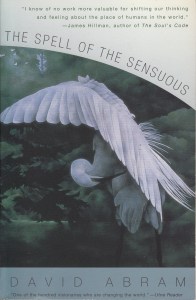
SpellSensuousCivilization isn’t all it’s cracked up to be. Sure, it’s got its moments—modern medicine, indoor plumbing, Honey Boo Boo—but often it’s artificial. It’s like somebody made up a set of silly rules and those who dare violate them are treasonous barbarians. Over the past few years I’ve been reading books that consider our biological development and what nature seems to indicate about how people might exist more holistically in the world. I don’t mean New Age outlooks, although, surprisingly, such treatments often aren’t far off base. I’d never heard of David Abram or his book The Spell of the Sensuous. (For those who think sensuous means only one thing, the subtitle is Perception and Language in a More-Then-Human World.) Although somewhat dated, this is an insightful book. The basic premise is that we are, by nature, part of a much larger world but we have, like spoiled children, decided to take it all for ourselves and isolate our species from all others, claiming a superiority that none dare challenge. In the process we’ve lost much of what it benefits us being animals, and have separated ourselves from the wonders of the world all around us. Working in Manhattan, I have to agree.

Basing his observations on having lived among aboriginal peoples, Abram notes that although anthropologists have denied the tenets of Christian missionaries on the religious front, they have continued in that teaching concerning biases against nature-based belief systems. Peoples who live close to the land observe things which seem superstitious to the “civilized,” but which are, in reality, simply astute realizations based on watching how the world works. Like Thomas Nagel, he notes that consciousness pervades the natural world. Animals, plants, even the earth itself displays forms of awareness that we ignore in our rush to exploit and gain “wealth.” In reality, we suffer for having made ourselves something we’re not.

There’s a lot in this book, far more than a single blog post can say. I don’t agree with all the points Abram makes—that writing may be responsible for our dilemma is a bit of a stretch—but there is great wisdom in this tome. At several points I had to stop and ponder the implications of what he was saying. Yes, nature speaks. Creating a world where “success” is measured in removing yourself as far from nature as possible requires elaborate rules. As far as I can tell, obeying the rules means that if you’re one percent of the one percent you’ll have nothing to complain about. If you have enough money—itself an artificial construct—you can run for president with no other qualifications. Meanwhile, nature suffers at our hands and may only recover once the world is forced from our hands and the sensuous once again takes over, doing what it has always done.


The Found World

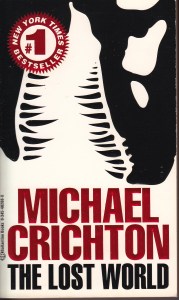
LostWorldChallenges will make you do funny things. One enjoyable dare has been Modern Mrs. Darcy’s Reading Challenge. With a modest twelve books in twelve months goal, the specific target is to read the types of books laid out. Into one of those categories, for me, fell Michael Crichton’s The Lost World. It’s sad that I feel I need so many disclaimers—I never really outgrew my love of dinosaurs—such escapist literature is indeed a guilty pleasure. Crichton could write a quick read, not bothering to pause for literary hindrances, and this novel fits the bill. It always surprises me when at the end of a traumatic story where friends die (this time ripped apart by reptilian carnivores) that the protagonists escape and never mention the dead. They joke, explain holes in the story, and generally look forward to a better, raptor-free future. There is, however, some food for thought here, among the lucre-grubbing sequel to Jurassic Park.

The first religious element that caught my attention was resurrection. Ian Malcolm rather convincingly died in Jurassic Park (and even an unconvincing death works for most people). In The Lost World he’s suddenly back again, with a barely disguised deus ex machina, and is as diffident as ever. The other former protagonists know better than to return to an island full of dinosaurs. Resurrection is a time-honored literary trope. So much so that it’s sometimes difficult to believe that death is in any way permanent. Well, come to think about it, the dinosaurs too are resurrected. Do reptiles have souls? Crichton’s dinosaurs seem to.

Then, just over halfway through the story, I was stunned. The chapter, or section, called “Gambler’s Ruin” explains how science and religion (or the humanities in general) are really the same. I couldn’t believe that a bestselling novel actually took the point of view that scientific objectivity is just as fraught as post-modern literary theory. There is no way to observe without influencing. When a conscious presence enters the equation, the facts have to counterbalance in return. Many, of course, would disagree in principle. Still, this unexpected bit of profundity stopped me in mid-chomp. Materialism, beguiling as it may be, doesn’t explain Heisenberg or Schrödinger. It takes a resurrected mathematician to do it. No wonder chaos abounds in this world where dinosaurs still rule the earth.


Fossilized Views

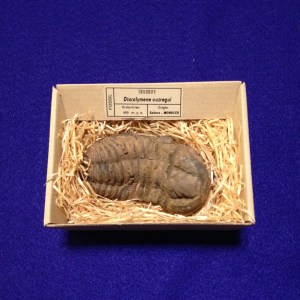
Not all Fundamentalists are the same. I grew up believing the Bible was literally true, but in my family we recognized that fossils indicated the earth was older than just a few thousand years. Keep in mind that I never tested this with any preachers—we didn’t need to. We knew that evolution was wrong, but that didn’t mean there had never been dinosaurs. Kids are as sure of dinosaurs as they are of angels. Besides, we lived beside a tributary to the Allegheny River that was rich in fossils. We’d spend summer days wading in the water looking for rocks with impressions of various bivalve shells in them. They weren’t hard to find. And being collectors of just about anything inexpensive (or free, as in the case of fossils) we brought them home. We really didn’t see any great disconnect between the black book on the table and the rocks in our hands. There was room for both.

It must’ve been a slow news day at Huffington Post recently when a story titled “This Guy Is Pretty Sure He Found Fossils From Noah’s Flood” ran. The guy in question is from Texas, and, finding fossils probably not unlike those we used to, supposed that they were laid down during Noah’s flood. This was an idea that I only encountered after I’d left home. We couldn’t afford many books when I was growing up, but we did have conventional dinosaur material. Nothing strange enough to suggest that the flood created all the landforms and fossils on the planet. That would’ve sounded just a bit strange. Today, however, it is common to suppose all Fundamentalists are naive and enemies of science. Not all are. Some, I hope, are like I was, trying to find a way to fit their faith into a world that science has come to help define a bit more clearly. Positions have, however, polarized a bit since my tender years. We now fight over things we used to wonder about.

IMG_2734

The fossils I found as a kid found their way back into nature before I grew up. If I ever have the time when visiting home these days, I still try to get an hour or two to spend down by the river to look for the rocks that filled me with such awe as a child. That was a world where belief was fairly easy. I loved science. I loved my religion. I loved the fossils that told me the story was a complicated one. Only I wouldn’t have believed that decades later I’d still be trying to suggest to others that the world is big enough for both facts and faith. I haven’t been a Fundamentalist for decades, and given a few million years, who knows how even the nature of the debate might evolve.