Eating Earth

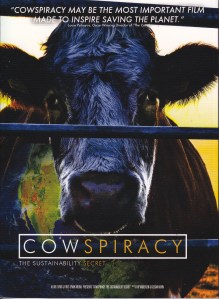
Some things are hidden in plain sight. That doesn’t make them any the less insidious. One such hidden truth is that the earth is of a finite size. Another is that, consequently, its resources are limited. Our species is easily led, as are most herd animals. Standing out can be embarrassing. Painful even. This is the recipe, along with a generous dash of greed, that has put us on the brink of worldwide catastrophe. We live in an unsustainable system, and some of the largest culprits are our appetites. As a fan of horror movies, I can honestly say Cowspiracy is the scariest movie I’ve seen in a long time. It’s a documentary, not genre fiction. Scientists had generally already thrown up their hands because we’ve passed the tipping point for global warming, and then we elected ourselves the stunning leadership of Donald Trump.

No one can predict exactly what form the collapse will take, but we’ve set the key factors in place. We’ve been warned for years. Cowspiracy demonstrates something we don’t want to admit—the agricultural lobby is extremely powerful and the least sustainable aspect of life on this planet is animal husbandry. In early civilization, where technology did not exist to support large-scale farming, meat was not a staple of the human diet. Families that could afford animals gained more value from their beasts alive than on the plate. And they had only a few. As mechanization increased in the last century, we made livestock valuable commodities. When I was a kid word on the street was you were even poorer than we were if you couldn’t eat meat every day. Humans were the absolute, if blind, masters of their own domain. Now agriculture is the single largest force of degradation of the environment on the planet. And nobody wants to listen.

Cowspiracy is not an easy movie to watch, even for a vegetarian of many years’ standing. So why watch it? Because our reliance on animal-based food is destroying our planet. Not slowly either. If this is true, why haven’t we heard of it? Kip Andersen and Keegan Kuhn spend an hour-and-a-half exploring that in this important film. While it can’t be fully summarized here, in a word it can be said: money. There’s huge money to be made in a business rightly called animal husbandry. Wedded to profits at the expense of the very soil that gives us life, we eat our way to the grave. And we do it even when technology has already offered viable alternatives. They are also hidden in plain sight.


Self-Conscious

Cassini is no more. The Saturn-bound satellite was launched in 1997 when the earth was a very different place. As it’s four-year sell-by date passed, the little robot who could kept on snapping photos around the ringed giant and its moons. Remote controlled from three planets and an asteroid belt away, it was decided that the explorer had to be destroyed in Saturn’s thick atmosphere rather than contaminate one of the moons where life might someday be found. Yesterday the probe burned up on its way through Saturn’s perpetual cloud bank. This has led to many emotional tributes, even among scientists who believe Cassini was just a machine. It also shows us how little we really know about consciousness.

During the two decades that Cassini was in space, we’ve learned quite a bit about animal consciousness here on our own planet. Many are now finally becoming convinced that we share this strange quality we can’t even define with other biological entities. Well, at least the “higher” kind. And we can’t help but think that maybe our more intelligent machines possess it too. We treat them as if they’re alive and willful. That could be a case of our own consciousness projecting itself onto inanimate matter—that’s something consciousness is pretty good at too—but since we lack the ability to measure consciousness, we can’t know if it’s there or not. To hear the astronomers talk, we’re going to miss Cassini, a machine that outperformed expectations. Ironically, once we get machines off the earth they tend to do that, even without oil changes every 5000 miles.

Down here on earth we complicate consciousness with cash. Devising an elaborate economic system to demonstrate who can buy power in the White House and who can’t, we want to know who is more important than whom. It’s a simple metric. Bank accounts tell the truth, no matter what the level of consciousness—or even of sentience—that the account holder may have. And then we wonder why a nation that can send a satellite three planets away can’t even figure out that all races should be treated equally and fairly. Cassini was a collaborative effort. Different races, genders, and economic classes contributed to its remarkable voyage. Eyes around the country were moistened when its last image was projected to earth. We wisely decided to immolate our satellite before we could contaminate another world. Meanwhile on our own planet we’re barely conscious of what we continue to do.


Fall of the Titanosaurs

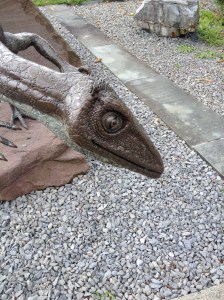
If I had it all to do over again, I might well have gone into paleontology. Like most kids, I grew up fascinated with dinosaurs. Then “real life” got in the way and you need to get a job since you can’t spend your time playing with your cheap plastic toys and dreaming Triassic dreams. There’s no future in the past. So I decided to study dead languages instead. Still, the recent discovery of Patagotitan mayorum is exciting. Titanosaurs—the really big dinosaurs—were not even known when I was a child. What we used to call “brontosaurus” was about as big as they got, but we did know that diplodocus was out there somewhere, even a bit longer. We didn’t have to worry about ark space in those days because we knew that extinction happens.

The current evangelical flavor of the day takes a hard line on evolution. Since it absolutely can’t happen and since there’s no denying dinosaurs, they must’ve crowded onto old Noah’s floating hotel along with everybody else. The problem is we keep discovering more and more large dinosaurs. Patagotitan was 122 feet long, without skin. It weighed more than ten elephants, making me wonder about water displacement ratios. Depending on your definition of that fuzzy measure of the cubit, the ark was only 450 feet long. And Patagotitan is only one of the titanosaurs that dwarf the already huge apatosaurus (the correct form of brontosaurus) and brachiosaurus. Even if they hibernated the sheer mass of reptilian tonnage wouldn’t leave much room for the latter ascendant mammals. That is, if mammals had come later and ascended.

Noah, despite being a traveler, never made it to Patagonia. In fact, the ark pretty much stayed still during the flood, coming to rest in Turkey after having been constructed somewhere just east of Eden. And since the Bible doesn’t mention continental drift we can’t even rely on Pangea to have gotten all the beasties to ark central on time. I’m guessing that Patagotitan was probably a slow walker. Since the continents were just like they are today, it must’ve been a fair swimmer as well. And it didn’t mind quarters just a touch claustrophobic for such a massive monster. What with all the home improvement shows these days, Noah might have considered an addition to the ark. But the Bible says God gave him the plan and one thing we know about the Almighty is that what he says he means literally. Dinosaurs or no.


The Rights and Privileges

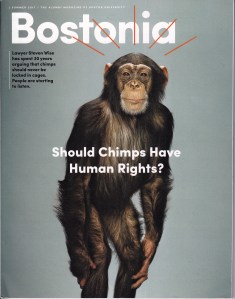
Bostonia is but one of several alumni magazines that makes its way to our humble apartment. Between my wife and I we have many colleges and universities begging us for money while offering us no jobs. Despite being a denied professor I have little time for magazines. I’ve always been a book man. If I’m going to put time into something I want an ISBN to claim at the end of the day. Still, the cover of the Bostonia asks a relevant question: “Should Chimps Have Human Rights?” I have long argued, based on books I’ve read and on personal experience, that animals are conscious beings, like we are. If consciousness evolved, it has to have its roots in other animals, otherwise scientists are positing “special creation,” call it what you will. If animals share consciousness, they should share rights.

People have used animals for as long as they could figure out how to do so. It may have been a two-way street at first, since we’re pretty good at protecting critters we find valuable and who doesn’t like a free lunch? They stick around us. The earliest domesticated animal seems to have been the wolf, which we made into a dog. Other common mammals joined the mule train after that. Humans: they treat you rough, but they’ll make getting food a snap. There’s a kind of consciousness involved already, don’t you think? If they can’t figure out that we’re not going to harm them (at least not yet) then they’re smart enough to keep their distance. Not all wolves became dogs.

Primates, however, are a special case. They sort of look like us. Chimpanzees, especially, act like us. They don’t get human rights because those are reserved for others of our own species. I mean, consider those in charge of the free world! They believe in the right to acquire as much of the world’s resources as they can for themselves. They guard the use of those resources so they can live in unutterable luxury and make everyone else pay through the nose for the very necessities of keeping alive. The masses pay taxes while those who have more than enough do not. We are a domesticated species, it seems to me. Don’t get me wrong—I do believe chimps should have human rights. Other animals too. We’re all connected. But the real question I have, looking at the headlines from Washington, DC, is turned the other way around: should humans have the rights of chimps? Don’t ask me; universities won’t hire my likes when others will bring them greater glory. They’ll gladly accept my money, however. It’s their right.


Water Bears

Since we should all be busy planning on alternatives to planet earth, my mind has turned to tardigrades. Known as “water bears” these very simple animals are amazingly complex. Don’t go looking for them in your drinking water, however. They’re microscopic. So why am I thinking about tardigrades at a time like this? Because they’re one of the few organisms that scientists believe could actually survive the destruction of the planet. Who knows? They might even be able to survive in Washington, DC. Maybe that’s why they’re in The Washington Post.

You have to look closely to see one.

Able to cling to life at the cusp of absolute zero, in conditions with no oxygen, and at doses of radiation that would leave the human race—among most other species—fried, these micro-organisms are truly remarkable. No wonder scientists are playing with thought-experiments as to how to wipe them out. Hey, scientists are only human after all. Don’t worry—nobody’s really trying to kill these little guys off. The question behind Ben Guarino’s story seems to be what makes these tiny creatures so amazingly resilient. It raises an issue that I often ponder. The will to survive. Evolution is, according to standard theory, without purpose. Natural selection works in a “logical” way: the most successful organism survives long enough to breed and its traits become standard options in the next generation. Nobody needs to want anything (except to mate) and chance takes care of the rest. But that doesn’t explain the will to survive. The “eye of the tiger,” if you will. I’m sure this wasn’t what the Washington Post was intending to trigger, but doesn’t it seem strange that even “non-conscious” micro-organisms “want” to survive?

The desire to exist is dangerous territory. It has a whiff of the divine about it. One of the characteristics of life, if my high school biology isn’t completely outdated, is the ability to reproduce. What it didn’t address, for fear of teenage snickers, I’m sure, is the desire to reproduce. Why does life insist on its own continuation? Is it truly just an eons’ long succession of one-night stands that results in creatures capable of even asking that question? Or is there something more to it? Tardigrades have segmented bodies, legs, and claws. All at less than 40,000 cells per individual. They lack a neocortex (which doesn’t necessarily disqualify an individual from being president). They can’t answer the questions we put to them. As individuals they are remarkably easy to kill. As a species, however, their resilience carries the answers to some very deep questions. If only we had the will to ask them.


Fishy Business

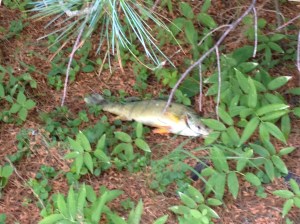
There’s bound to be a logical explanation for how it got there. After all, this is private property and people have been here all day long. Somebody would have noticed if fishermen had stomped up this boardwalk, dropping their catch along the way. There’s no place to dock a boat. And yet here it is in all its Fortean glory. A fish out of water. Literally. It’s a perch, I think. About eight inches long. Forty yards from the nearest water. Other than the flies all over it, it looks in good shape. As if it were out for a swim in the dry air and lost its way back to the nearby lake. I’m sure there’s a logical explanation, but I can’t help but think of Charles Fort and his witty takedown of conventional reasoning.

In addition to fish, this lake also hosts ospreys and bald eagles. Just yesterday morning I saw one flapping above the water looking for breakfast. And one of my relatives saw an eagle struggling with a fish the other day—an issue of maintaining air-speed velocity when fully laden, I think—only to have to catch and release. Could that have happened twice? Raptor drops the slippery, heavy fish and can’t fit under the pine trees with that wingspan to pick the thing up. Possibly. It’s not the most fun explanation, but it will do when logic’s non-negotiable.

Charles Fort, the great anomalist, is perhaps most famous for his irrepressible insistence that rains of fish had a more exotic explanation than a tornado sucking them up only to drop them far from water. In his puckish way, he wrote how such “damned facts” were explained away by convention. Fort liked to hold the door open for the wider possibilities. Meanwhile we’re stuck here with the unarguable reality that there’s a dead fish by the boardwalk, far from water and a logic that makes me ask, if it fell from a bird’s talons why does it look so perfect? No twigs or pine needles picked up from its heavenly plummet. No obvious injuries to its piscine flesh. Even had some disgruntled fisherman rowed up unobserved and flung a perch as far as he could, the thing would’ve had to’ve had quite a spiral on it to’ve made it this far from the lakeshore. Science works by sweeping the facts outside the norm off the table. I’m not saying there’s anything paranormal about this fish, I’m just wondering what Fort would’ve made of it, beyond a free lunch.


Nature Watching

Whenever I travel in the northwest, I keep an eye open for what one colleague calls “charismatic megafauna.” You know, the big animals that are so rare to see that they develop a charming, if imaginary, persona. Not that I’ve ever seen much of it here. It’s rarity is part of the charm. My usual hope is to see a moose—something that happens every three or four years. Black bears are even rarer. Grizzly bears, which still inhabit this area, and mountain lions I’ve never seen. I know they’re there, but their agenda is not to be seen. My first full day here I was sitting outside working on an academic paper. My time off work is rare, and when I get a moment, even in the wilderness, I try hard not to waste it. I had the feeling of being watched. Not the creepy kind of feeling, but the kind where you think an animal might be keeping a wary eye on you.

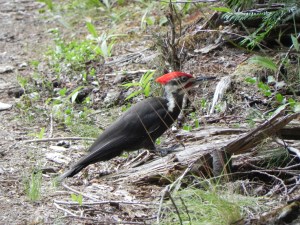
I looked over the top of my book. Several yards distant I could see a head bobbing up and down. Then I noticed a black patch on a nearby lodgepole pine. It took a few seconds for the red head to register. A mated pair of pileated woodpeckers. Not exactly huge, but they are large birds. And since they are the personality behind Woody Woodpecker, well, I guess you can call that charismatic. Charismatic enough for me to put down my Ugaritic mythology and go inside to fetch a camera. Of course they were gone by the time I’d returned. I decided to take a walk down the track in a vain hope of finding them again. Once in a while charismatic megafauna cooperate. There they were, one going after ants on the ground, the other perched above pecking wood.

Most of our large fauna we’ve driven to near extinction. Humans can’t stand not to be the biggest thing around. The megafauna remain, however, hidden though they may be. An online site for this area posted a photo of a cougar snapped last summer. I’m not sure when the last time a grizzly might’ve wandered down from Canada, but since last November I’m not sure why they’d even bother. Even the moose seem coy. Animals don’t do what we want them to do. Those that we can’t domesticate follow their own agendas and calendars we can’t hope to comprehend. As they flap away I can swear these woodpeckers are laughing at me.


Devonian Dreams

Toothbrush and dental pick in hand, I go at it. Not that I’m a professional, mind you, but curiosity drives me to this. You see, this crinoid before me is at least 358 million years old and anything that can make me feel young deserves all the attention I can give it. Crinoids are also know as “sea lilies,” but they aren’t plants. They’re actually echinoderms, and the fossils I’ve found in the past have only been cross-sections of their “stems,” a stone circle, as it were. This one has tendrils visible, and I can’t believe that it was a chance find on one of my recent walks through Ithaca’s gorges. I’m dreaming Devonian dreams, and I want to brush away the plaque of the eons and see what I’ve actually found.

Fossils are a kind of eternal life. The creature that died to leave this impression lives on as a monument in stone. It reminds me of my unfortunately brief stint as an archaeological volunteer. Scraping away dirt to reveal a piece of pottery that hadn’t been touched by human hands for 3,000 years. Of course, that’s merely a second ago when you’re talking about something pre-Carboniferous. The dinosaurs won’t even show up for another 100-million years. And I think I have to wait too long for the bus. Time, as they say, is relative. Did this medusaized creature before me realize just how terribly long it would take for enlightenment to arrive? And how so very swiftly it could fall one foolish November night? Careful, this fossil’s fragile.

I grew up among the Devonian substrate in western Pennsylvania. The Bible on my shelf told me to disregard the evidence before my eyes. Some clever true believer had declared Noah’s flood the culprit, never bothering to explain how freshwater fish showed up after the deluge. Those we tried to keep in our aquarium never seemed to handle the slightest disturbance of their salinity. The ages of the literalist are by definition short-sighted. 6,000 years seems hardly enough time to account for any sedimentary stone, let alone that riddled with fossils. I’m hunched over my bit of slate, dental pick hovering nervously over what will never come again. The Bible behind me says it’s an illusion. You may be right, Mr. Scofield. You may never have evolved. But as my fingers glance a creature dead before even the crocodile’s grin I have to declare that I have.


Big Shoes

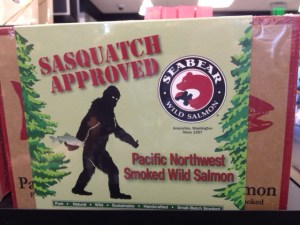
Belief in the supernatural seems to be alive here in the northwest. At least if the culture at Sea-Tac Airport is anything to go by. I’d noticed, last year, that a sasquatch graces a restaurant in the N terminal, where jets from Newark tend to land. This year we had a bit of a layover, so we strolled through the C concourse. There I found sasquatch approved salmon in the somewhat anomalous Hudson News. Then, as I sat in one of the stylish, Seattle seats, a young woman came up next to us and sat down wearing a Sasquatch Volleyball shirt. I’m past the age when I can get away with innocently asking young ladies if I can take a photo of their shirts, so you’ll just have to use your imagination for the latter. The point is, bigfoot has been mainstreamed.

When I was growing up you got pretty mercilessly teased if you expressed any interest in such things. Now that I’ve got a respectable career others can get away with what captured my imagination as a young man. I’ve never thought of myself as being ahead of the curve. Or really ahead of anything, for that matter. Still, I trust my instincts. Maybe religion will come back into vogue some day. Or maybe it will simply be called something else. A tainted name is difficult to live down. The supernatural—or paranormal—often shares conceptual territory with religion, and although the pews aren’t getting any fuller, the number of those looking for some kind of meaning in the unusual seems to be holding steady. Physics can take us only so far in understanding what it is to be human.

Times change. Yesterday’s jokes are today’s orthodoxies. Those who spend a great deal of time peering back into history won’t be surprised by this. What is true today is true for today. New facts will be discovered and if we lived long enough we’d find that the future world will believe quite differently than we do. Not that the truth is relative. It is, however, temporary. Massive religious wars have been fought over trying to keep truths timeless. The sad irony is that the truths had already changed by the time such wars had been waged. The more rational we become, it seems, the more we open the door for the supernatural. I won’t presume to be one declaring such truth. That would take more weight than I have to offer. And anyone making such a claim would have some awfully big shoes to fill.


Clean Sweep

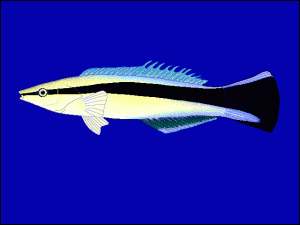
The other day I was reading about cleaner wrasses. These are the fish, usually in coral reef community, that establish a place of business, and other fishes who want to be rid of parasites come onto location to be cleaned. They allow the wrasses to nip them all over to get the pests taken care of, even allowing the smaller fish to swim into their mouths to work their specialization there. Kind of a mix between a visit to the dentist and the car wash. Documentary makers have filmed the process multiple times, and, being humans, we project onto the piscine scene a kind of business template—an exchange of goods for services. Then we turn back to our own lives and forget the underwater world.

Image credit: Robbie N. Cada, courtesy FishBase, courtesy Wikimedia Commons

Still, I have to wonder about what’s going on here in the realm of consciousness. We do not yet know what consciousness is, but we all recognize it in ourselves. We know we’re alive and conscious—except when we’re dreaming when we don’t seem to realize what’s going on in our brains isn’t really happening. Most of the time, however, we set our goals, have our intentions, and go about our business accordingly. What is the motive force that drives a fish to the cleaner wrasse’s studio? Isn’t there a level of consciousness involved to know that this fish’s house is where you need to be for this kind of treatment? Don’t the larger, predator fish know that if they eat the wrasse in their mouth they’ll have to find a new service provider? Are they aware of this or are they, as some scientists like to tell us, simply biological machines following their programming?

I’m not a scientist, but I see consciousness all around me. I watch the interactions of land animals—I generally don’t take trips under the sea, no matter what Sebastian says—and they are anything but simple. The birds on the wire and in the chokecherry trees have complex interactions. All you have to do is watch a single individual for a few minutes. They make decisions—the sky is a vast, open template with no obstacles, surely they have to decide why they want to go this direction and not that! And bowerbirds build nests as elaborate as Victorian mansions. Not that there are bowerbirds at my bus stop, or even in New Jersey. There are limits to how far even nature will go. As I stand here, waiting for my bus, I can’t help but think how like a cleaner wrasse I am. And I’m sure they must be conscious of what they’re doing since life’s all about the exchanges of goods and services.


Serpent Number One

I haven’t read The Essex Serpent by Sarah Perry. Yet. My reading list is frighteningly enormous and constantly growing. I just can’t seem to get on top of it. In any case, my wife sent me an NPR interview with Perry that set me to thinking about monsters. (It really doesn’t take much.) One of Perry’s answers in the piece by Ari Shapiro stopped me in my tracks. Perry admits that recent political events have made her question her belief in benevolent humanism. I’d never thought of our current crisis in that way before. This is one example of what happens when it’s—pardon the expression—every man for himself. We’ve stepped away from religion as any kind of public conscience. The religious right doesn’t fit any classification of religion that I know of, so I’m discounting it as a legitimate form of belief. When we look out for number one, a self-appointed number one takes over.

With an insidiousness that can only be called evil, our elected “representatives” tried to sequester away the facts of their healthcare bill that they wanted to ram through in order to give the wealthy serpents tax breaks. The thing about looking out for number one is that you’re only number one to yourself. There can only be one one. Lining one’s pockets with the tax money of others is a trick as old as civilization itself. In ancient times, however, they at least called themselves kings and emperors and made no excuses for what they were doing. We said we were advanced enough to do without the religion that supported these outdated views. We’re back to the days of kings and emperors. Anyone who believes differently is fooling him or herself. There have been snakes in the garden from the beginning. Getting rid of religion won’t clear them from the grounds.

There are many benevolent humanists. There are many more who are suffering under the weight of current political systems. Unhappy people elect dictators. It has happened before—in the current lifetime of many, no less. The warning signs are all there to be ignored. The fruit sure looks nice, hisses our constant companion. Looking out for number two is the first step. Then number three, and twenty, and eight-billion. That’s benevolent humanism. Anything less is, well, a walk down the garden path. We’ve been down that path before. Those who trust serpents must learn to count. To do anything less is less than human.


Fishers of Cars

The car was drunkenly weaving across lanes in substantial traffic along Interstate 80. Erratic driving that, although not breathalyzer confirmed, suggested impaired operating. It’s something you never like to see. We stayed behind the vehicle, knowing that it was safer to keep such a car in view rather than attempting to overtake it when the driver veered into the left lane. Since the same muted colors recur on vehicles these days, we needed a quick way to identify this driver at a glance. The Jesus fish on the rear served the purpose well. This situation struck me as a kind of parable, although it really did happen. One of my brothers is a driver by profession. He often tells me that if someone cuts him off in heavy New Jersey traffic, more often than not the car bears a Jesus fish. WWFD?

The ostensible purpose of the Jesus fish is to witness to the world “here is what a true Christian does.” While the New Testament, if I recall, indicates that the true believer puts others before him or herself, the rule of the road is somewhat less spiritual than that. None of us are saints when we get behind the wheel. We’ve got places to go and the drive isn’t really much fun with thousands of other cars bunging things up constantly. Still, if you take the extra effort to put that Jesus fish on your car, aren’t you signaling that this driver holds her or himself to a higher standard? Or maybe the fish is a talisman, like “Baby on Board,” that will somehow protect from the careless, aggressive driver thinking only of self.

The irony here is not that the driver is making poor, or aggressive decisions behind the wheel—let the one without sin cast the first stone—but rather that s/he implicates Jesus in the act. There’s a ready, steady market in evangelical paraphernalia. The WWJD bracelet keeps the question within sight much of the time—but keep your eyes on the road! One of the main problems with the Ichthys symbol is that it is generally on the rump of your car. Out of sight, out of mind. As you finish that last drink before climbing in behind the wheel, the fact that your personal Lord and Savior is being announced to the world may just slip your sodden mind momentarily. The real question is whether a car is the best place to announce your religious commitments. It was the the man in front of the fish, after all, who said “do unto others as you would have others do unto you.” Except in heavy traffic, of course.


Scaping By

Failure is a part of life. We don’t like stories about failure, however, unless the protagonist goes out with a memorable bang. So it is that when we fail we start looking for a scapegoat. Now it’s a little too early to tell if Ken Ham’s Ark Encounter can be considered a failure. According to a story on Friendly Atheist, “Ken Ham is Now Blaming Atheists for the Economic Failures of Ark Encounter,” the ark may be loaded with dinosaurs, but not money. People need their myths, yes, but myths that take themselves too seriously often fail to convince. Atheists, even the friendly variety, have always been convenient scapegoats. I wonder how many scapegoat species are in the Ark Encounter.

I don’t know about you, but I’m curious about the Ark Encounter. I don’t want to go because I don’t want them to have any of my money. As I’ve told academic friends who visit—I just can’t see contributing to their cause. Although the Right seems to implode when it reaches power (there are far too many selfish people in the Party, and selfishness leads to easy splintering) one thing that it has is money. Think about it, the extremely wealthy are on their side. If I was given a free pass I might find it worth my while to wend my way back down to Kentucky. Who doesn’t like a spectacle? And I would like to see how they represent scapegoats in their dioramas. Besides, with sea levels rising from “fictional” global warming it might not be a bad idea to get a few tips on how to build an ark, no matter what you believe.

You only fail when you fail to try. That was a phrase a friend used to repeat to me before disappearing from my life. A friend from college once told me that I had to stop admitting my failures if I wanted to move ahead in life. There is a danger in easy appearances of success, however. Failure can be a very noble teacher. There are mornings when I’m walking across Manhattan, passing the homeless in their blankets on the street, and I realize that I would not be where I am were it not for failures. I could hide them, but if I haven’t learned from them they’ll only burst out of the closet again when it gets too full. Is Ken Ham’s Ark Encounter a failure? It’s far too early to tell. One thing we know for sure, however, is that scapegoats will never be an endangered species even if there’s a world-wide flood.

James Tissot,Agnus-Dei: The Scapegoat (Brooklyn Museum via Wikimedia Commons)


The Birds

While waiting for the bus, now that it’s light out that early, I like watching the birds. They have complex interactions and so many different styles of flying. They have ways that are a closed book to our species. From human eyes they seem so playful that it’s difficult to believe they participate in a struggle for survival. Evolution tells a different story, of course. Living not far from the great human nest of Newark’s Liberty Airport, it’s not unusual to see an engineered flying machine soaring high over their avian heads. Which, I wonder, are the better fliers? Birds, after all, evolved. Flying wasn’t planned, as far as we can tell. Although not so much around here, some birds don’t even fly.

I once read—many years ago and I can’t recall where—that if a person were to fly they would need an enormous chest to beat the very large wings they’d need for lift-off. Birds, apart from being naturally aerodynamic, have hollow bones which make them a touch fragile, but less tied to gravity. Our planes and jets, unlike the escape vehicle in Chicken Run, don’t flap. Bernoulli’s law keeps them aloft, along with some meticulous engineering and heavy fuel consumption. Humans may imitate nature, but they supersede it when they can. Still, I have to wonder why, if birds were a special creation as our literalist friends claim, God didn’t make them more like a plane.

Holding your wings out stiff all day, I’ll allow, would get pretty tiresome. Still, if you’re designing a critter to fly you might as well go with the best parts available, right? If not, I’m going to have a talk with my mechanic and ask for some of my money back. Birds, for all their charm, are very good illustrations of evolution at work. Dinosaurs taking to the air is so poetic that it has an organic feel. Flying is a great way to escape your land-bound predators. That step from long leaping to flying may be a doozie, but it seems to explain the shape of birds better than any intelligent design. Among bipeds, though, only one claims the place of being god-like in shape. Having said that, there are some flaws that a good biomechanical engineer might address. But then, who said God majored in engineering? When I went to college I was firmly under the impression that he’d majored in religion. And that, as many engineers might suppose, is for the birds.


Keeping Pace

I had no idea my life was in danger. I was out for a weekend walk with my wife, when suddenly, there they were. Snails. In case you think I’m over-reacting, take a look at Christopher Jobson’s piece on Colossal titled “Why Knights Fought Snails in the Margins of Medieval Books.” One of the main points is that the snails were symbols. We tend to forget the power of symbols today. Even modern vampires no longer react to crucifixes—what are we supposed to do? For those who are willing to linger a moment instead of rushing on immediately to the next thing, snails give us quite a bit to contemplate. In a world that hates slow-pokes, “consider,” as my friend Ecclesiastes might’ve said, “the snail.”

As highly evolved cousins of the snail, we suppose we were cut out for greater things. We build towers. We make new nations. We watch them both crumble. On the ruins of those walls we find snails. They have very little to do and expend no worries about getting there on time. Nobody emulates them, although some masticate them. They tend to disappear when the sun is hot. They don’t like the limelight. Yet snails contribute to our world in ways we simply don’t take the time to contemplate. Our time has been commodified. We’re told when to sleep and when to wake for our jobs. Then we’re told none of it matters anymore since 45 has decided to change the rules with his latest tweet. And still the snails crawl.

Before I learned to fear them, I remember happy childhood moments finding snails. This was generally not at home since we rented even then, and landlords have a weird compulsion about landscaping. When wandering far enough from home I’d find snails crawling on stalks of damp grasses early in the morning. They fascinated me. If I plucked them off, they’d pull in their eye-stalks and retreat into their shells. So secure. So symbolic. Eventually I learned that I was obligated to move fast. Keep pace. Be measured by my productivity. Pharaoh’s watching, after all, and that quantity of bricks required isn’t getting any smaller. Not many, I would learn, share my appreciation of snails. It takes a great deal of confidence to go slowly. Those who routinely ignore speed limits won’t understand my symbolism here, I know. Still, I can’t help but think we have a great deal to learn from our cousins who remind us that time isn’t everything after all.