Monster Mash

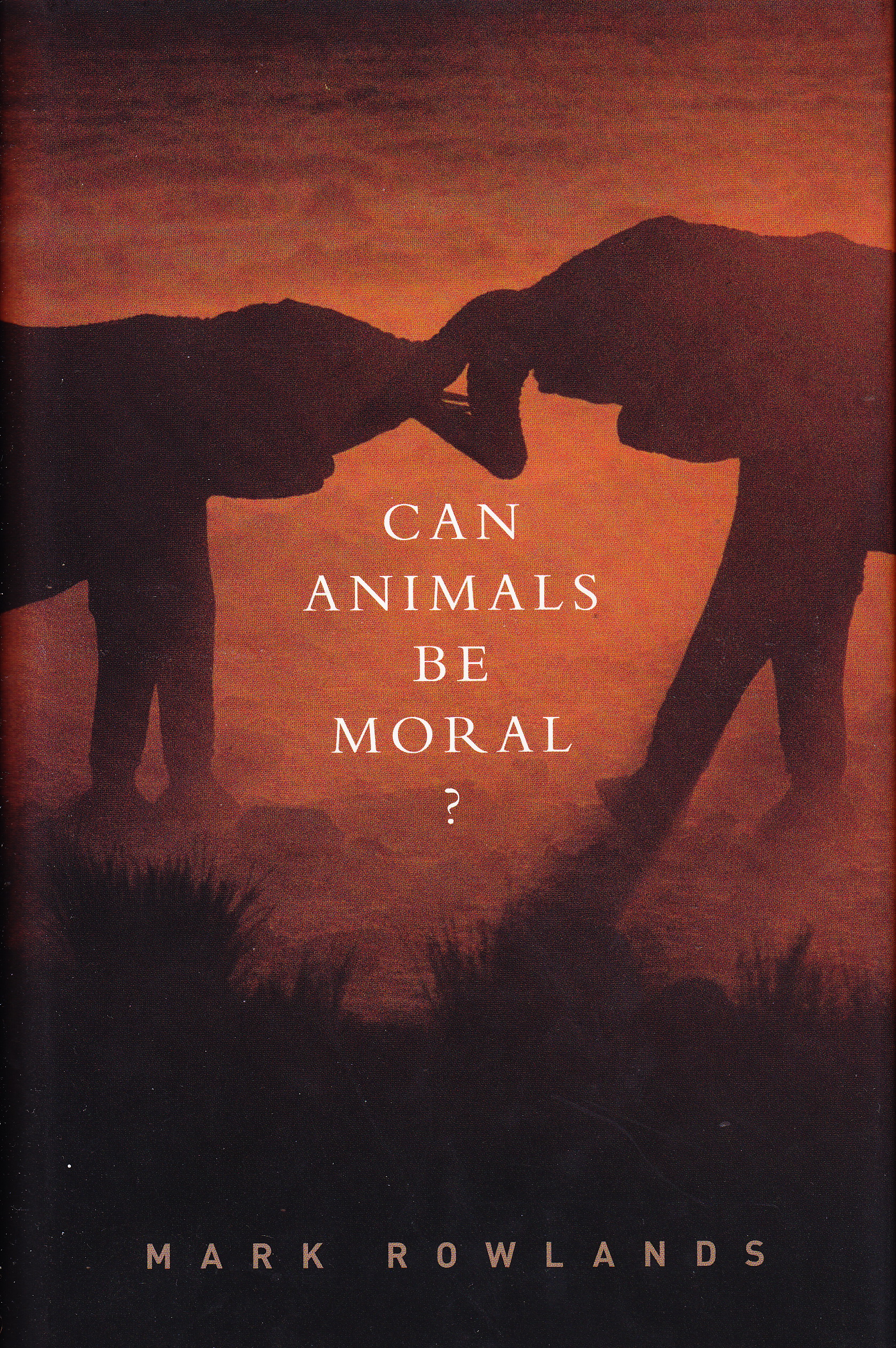
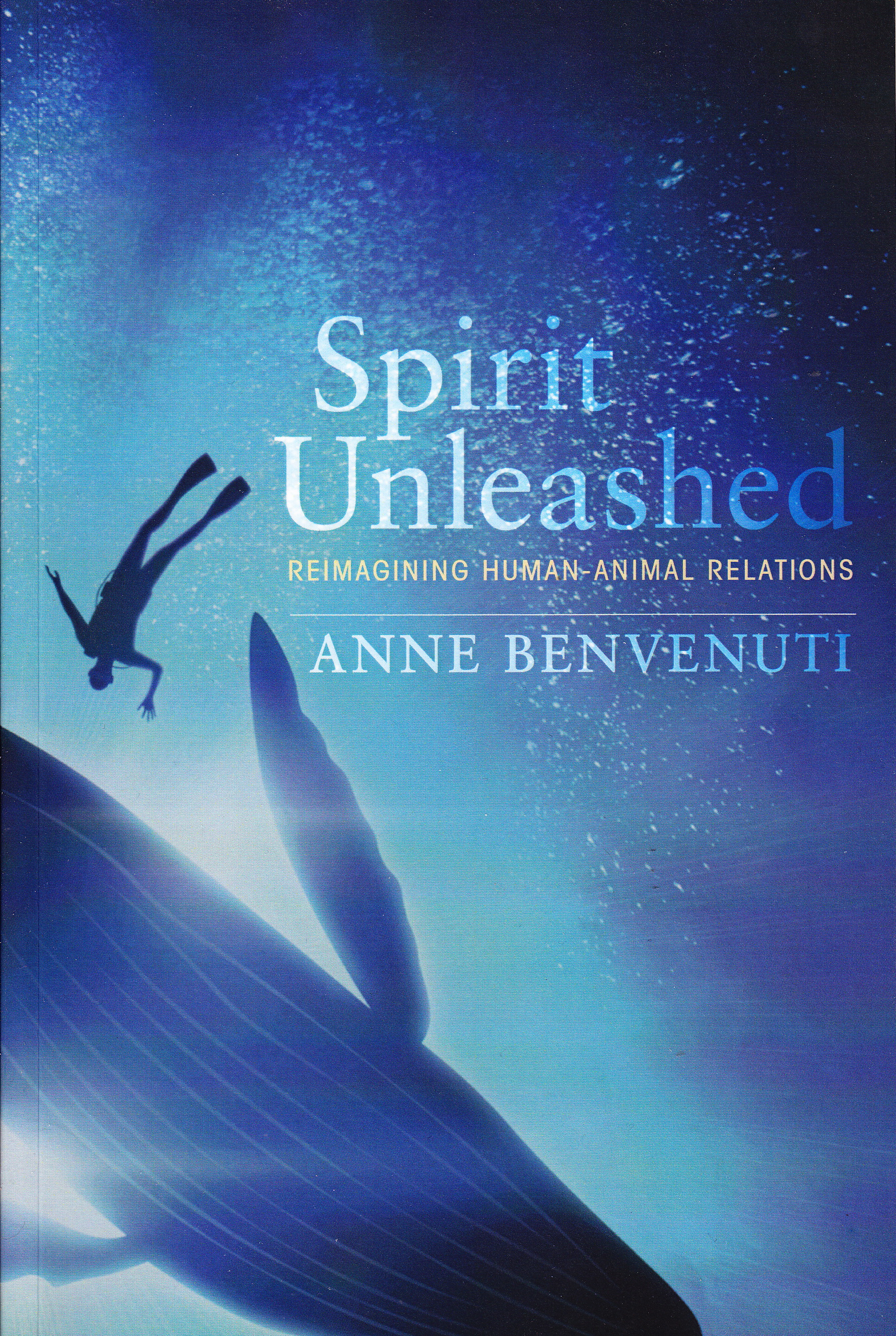
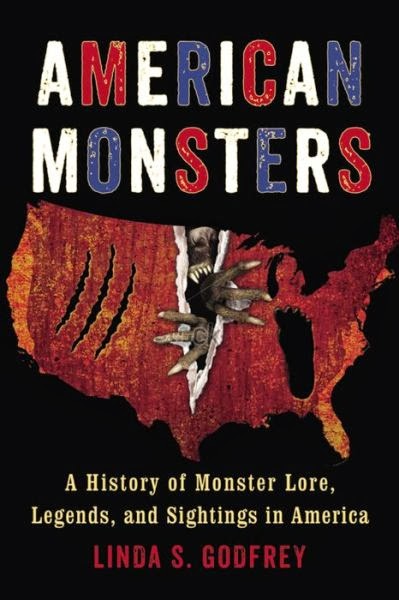
American MonstersIn one of those ironies of personal history, I never met Linda Godfrey although we lived not far from one another and shared a great many common interests. I’m not sure she would return the sentiment, but while I lived at Nashotah House many odd things happened. Academics can be pretty deep in denial about what they experience, and although I never saw any man-wolves, as I stood outside one night to photograph a comet I felt terribly exposed and in not a little danger. This was on a rural seminary campus. Nashotah was still wooded then, before evangelical shaving of the landscape, and certainly among the most gothic of seminaries I’ve ever seen. Meanwhile Linda Godfrey was researching, just a few miles down the road, weird animal sightings on Bray Road. I began a correspondence with her after we left Wisconsin and I have read all of her books. Local history has always fascinated me, and although I was an accidental Wisconsonite, I nevertheless enjoyed learning about the strangeness of the state I formerly called home.

Godfrey’s latest book, American Monsters: A History of Monster Lore, Legends, and Sightings in America, throws a wider net. We are all in here with the monsters. Blending, as the subtitle suggests, lore and legends with eyewitness accounts, American Monsters can leave the reader a little disoriented, in a good way. We’ve been taught to discount anything that doesn’t match the everyday—what boss wants a worker with a higher vision?—and pretend that such things don’t exist. Weird creatures don’t donate their bodies to science readily, and we are left wondering if something is really peering at us from these October woods. Inside you’ll find stories of flying, swimming, and running monsters. We are safe nowhere. Either from the scientifically undocumented or from those that are purely imaginary. I stand outside in the dark in a smallish town waiting for a bus. What was that sound behind me?

Monsters are only now beginning to gain academic respectability. When I was in graduate school the topic felt so puerile that no respectable Ph.D. candidate would dare suggest such a dissertation to a button-down committee. Now they are beginning to roll off the presses. As part of the religious imagination, monsters are not so easily dismissed. We can assign them to the dark caverns of fantasy and under-stimulated imagination, but they will burst out in their own time and, like gods, demand our devotion. I have no idea whether these cryptids creep, flap, or swish around in our world. People see them all the same. And believing may be seeing. I’m glad for Godfrey’s success at pointing out that our rational world is full of monsters. Hers is a perfect book for days of effacing light and lengthening shadows, all across the country.


See Serpent

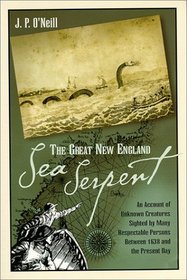
GreatNewEnglandSeaSerpentSeeing, it is said, is believing. I have a feeling that this truism may have become effaced somewhat in this age of deft photo manipulation and apps that are marketed to insert ghosts and UFOs into any picture. Nevertheless, anyone who has seen anything genuinely puzzling knows that it creates a lasting impression. A world without mystery, although a capitalist’s dream, is a nightmare for everyone else. So it was, now that October is here, I settled down with J. P. O’Neill’s The Great New England Sea Serpent. I found O’Neill’s book in a used bookstore a few weekends ago (appropriately water-damaged), and since I have a fascination with the ocean and monsters, this seemed like it would appeal to both of my avocations. It did indeed. O’Neill isn’t a sensationalist writer, but rather she is a normal person with normal jobs who has an interest in strange animals. Beginning in 1751 and up to three-quarters through the twentieth century, people had been spotting a classical sea serpent along the New England coast, and occasionally on ocean voyages across the Atlantic. Of course, we’re told, sea serpents don’t exist.

The Great New England Sea Serpent is a compendium of sightings from many reliable witnesses over the centuries. Of course, to many it is impossible. To me this appears to be the same kind of arrogance we apply to the universe—if we haven’t catalogued it by now, it doesn’t exist—to suggest there are no monsters of the deep. As any oceanographer will tell you, we know more about the surface of the moon than we do about our own oceans. If you turn your globe (or app) just right, there are views of our planet where virtually no land is visible. We are a watery planet. Even with current technology, the deep ocean is difficult, and very expensive, to explore. Who knows what might be lurking there right off the bow? O’Neill’s account is full of old salts and snarky journalists, but at the core of it all is a humility in the face of the largeness of the sea. What do we really know?

Of course, there is a fear of literalism. The Bible (and other ancient texts) take sea monsters for granted. Leviathan is a dangerous beast and, no matter what the pundits say, is no crocodile. And yet, for the past several decades the reports of the New England beast have dried up. Where has our beloved sea serpent gone? I have to wonder with both our polluting our oceans and our increasingly efficient (and massive) ships, if we haven’t simply forgotten that ancient maps used to leave space for dragons. Our great ships, guided by GPS, and our oceans running a temperature, are sure signs that greed has surpassed wonder. Have we, in our self-centeredness, slain the last of our dragons? O’Neill, please understand, does not call them dragons. Hers is a sober and straightforward account. But when October comes I just can’t help but hope there are still some monsters out there, deep under the waves.


Disco Duck

From the Roman Empire, Holy or otherwise, to the British Empire upon which the sun once never set, human endeavors are inevitably temporary. We like to think we’re making lasting contributions. Not so long ago Phil Robertson could make claims on vast amounts of media attention for his homiletical, gun-toting brand of family values. Despite not being a television watcher, even I was drawn into the drama as Happy! Happy! Happy! became a bestseller. Perhaps because my pursuit of religion has never earned me three such exclamation points, I read the book to find the secret of success. It is a combination of unquestioning belief and a willingness to blow the heads off of ducks in flight. Not that I would know about such things. The Dynasty made its way into Time magazine and other media outlets as the most interesting thing reality television, which is anything but, could throw at us.

Then Phil made a statement that set many viewers off. Mistaking intolerance for true religion—rather a constant in the algebra of faith—Robertson expressed his views on homosexuality and the ratings began to slip. Last year as I walked into a department store, I found Duck Dynasty bobble-head dolls and even fake Dynasty beards for those with no gumption to grow their own. Golf balls and beer glasses and all sorts of merchandise. Yes, you could partake of the good life without even cocking or pumping your shotgun. Other members of the family wrote books. (I have friends who produce quality literature who can’t find publishers.) We love the self-made genius of a simple guy and his make-believe world. Happy. Happy. Happy.

IMG_1503

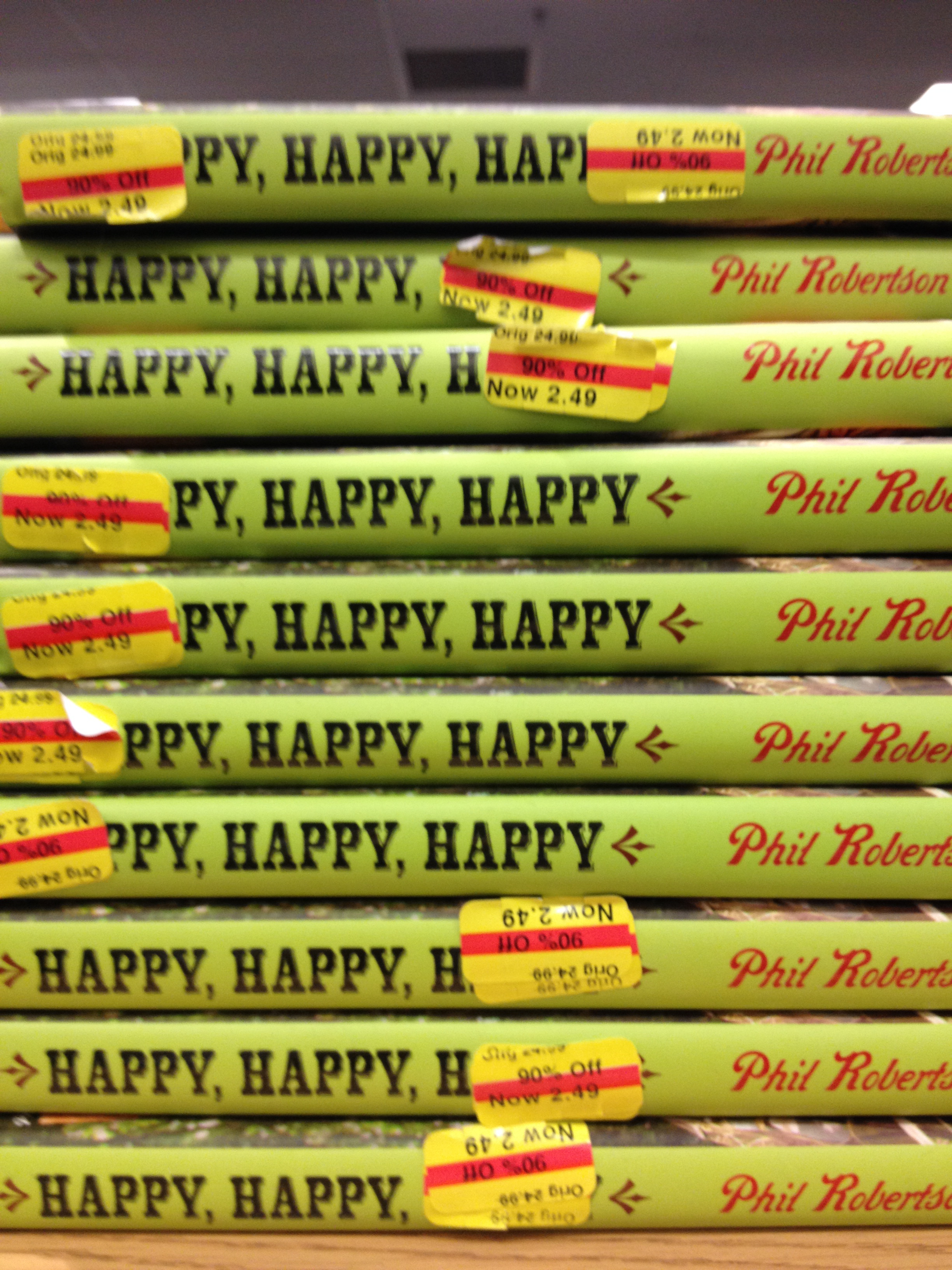
It has been some time since I’ve seen Duck Dynasty mentioned in the media. I wandered into the same department store this year to find stacks of Dynasty merchandise drastically reduced. You could buy Phil Robertson’s memoirs for even less than Amazon prices. In bulk, if you desired. My historically inclined mind turned to the great empires of antiquity. Did Alexander, I wonder, really know what he wanted? What about when you finally reach the ocean? What is off on the other side? Once you’re out of sight of land, you’ve lost your control back home. Next thing you know, Diadochi have fractured everything. The gods of empire, it seems, don’t have it all together after all. Happy? Happy? Happy?


Our Pigeons, Ourselves

You don’t have to be in New York City long to begin to see yourself as an expert on pigeons. The ubiquitous avians are ruthlessly castigated as “flying rats” and “filthy birds,” primarily because they like people food and poop everywhere. I have it on the authority of Gomi and Stinchecum that everybody poops. From what I’ve seen walking through the city early on the morning after a holiday, not everyone is discriminate about where—and I’m not talking only about the pigeons. Still, I can’t help thinking that pigeons are unfairly maligned. They are pretty birds, when examined individually. They have iridescent throat feathers and a pleasing, portly gait—almost jaunty. They manage well, despite hardships. Often I see one hobbling about missing a foot or otherwise physically challenged, and yet ebullient in their pullastrine way.

IMG_1287

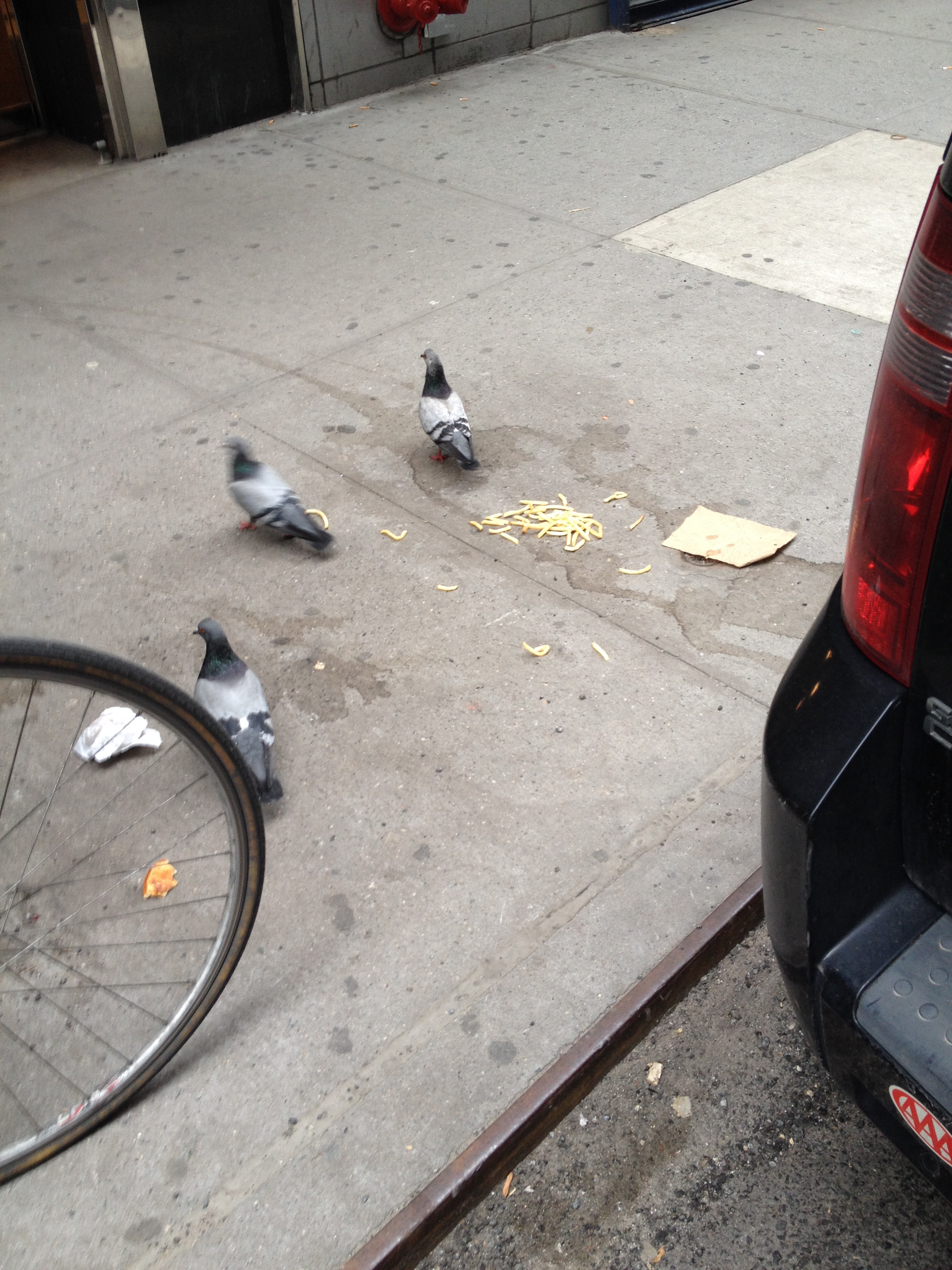
Yesterday as the NJ Transit behemoth in which I was riding rounded the helix into the Port Authority Bus Terminal, I saw two depressed pigeons. Unlike the jolly bobbing and pecking they usually seem to enjoy, this pair was simply standing. On the ground before them was a dead pigeon. Now I don’t know the backstory here, but the two standing around didn’t look like murderers to me. It seemed that they’d come upon a fallen comrade and were, in their own way, offering respects. In the ongoing debate separating ourselves from other animals, I often wonder if we have by-passed many of the basics. I do know that many animals find dead of their own species distressing. This is well documented. Why not pigeons?

Pigeons—related to doves, which, according to some religious traditions have sacred qualities, eh, Mary?—are seldom classed as the brightest of birds. I’ve written about the intelligence of corvids before, but pigeons have uniquely adapted themselves to our polluting ways. I grew up in a small town where pigeons weren’t especially abundant. They gather in large numbers where many people congregate and drop their litter. And, based on my recent experience, contemplate the mysteries of death. Peregrine falcons lurk overhead, doling out death at over 200 miles an hour. All the pigeons want to do, it seems to me, is to get a free lunch in an uncertain world where those whose presence has conjured them despise them. Unlike their sacred cousins, they are, like us, utterly pedestrian. Maybe they too appreciate the simple value of life.


Once and Future Ape

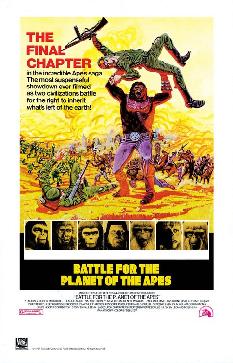
Battle_for_the_planet_of_the_apesThe original pentalogy of the Planet of the Apes franchise began a slow decline with Beneath the Planet of the Apes. Producing a movie per year from 1970 to 1973, the series died with Battle for the Planet of the Apes. Given that Dawn of the Planet of the Apes has been compared with this original final installment, it seemed time to reacquaint myself with it. The early seventies, as I recall them, were tense times. Social unrest both at home and abroad, coupled with a maddeningly increasing nuclear arsenal, seemed a recipe for disaster. Indeed, the world does end with the second installment of the pentalogy, a scenario set up in the final episode as the Alpha-Omega bomb, guarded by mutants, is declared worthy of reverence. Only through the magic of time travel do Cornelius and Zera travel back to the paranoid 1970s to start the whole series over again. The Battle for the Planet of the Apes, apart from its preachiness, does overflow with religious language and rhetoric. Indeed, it begins with a reading of Scripture from the Lawgiver. Pentalogy or Pentateuch?

Caesar is said to be the savior of apes and, like in the current Dawn, the sympathies of the viewer are with the apes. Gorillas, the frat boys of the ape universe, do indeed cause troubles, with Aldo becoming a kind of Cain who slays a fellow ape, Cornelius. (They even got the initials correct, if reversed.) Religion, and prejudice, it seems, have brought this fictional world to a crux, caught in an endless loop of new futures. As Virgil says, there are an infinite number of lanes on this highway. Presumably, traveling back in time opens up all kinds of possibilities.

Despite the number of reused shots in the film—the first ten minutes or so are simply a recapping of the previous two films—and the unfortunate pacing (how could a climax of two angry apes climbing a tree have possibly dragged on for so long?), the movie does have a message. Race tensions, high at the time, are overtly and covertly addressed. Disarmament is praised. The only future that seems not to exist is for one more movie. Interest moved on to science fiction’s apotheosis in Star Wars just four years later. Once again we would find ourselves in a world of black and white, with simple choices. There was no ambiguity among the Jedi. Still, for all that preaching, equality never did reach its goal. So even with its faults (didn’t we see that same tree-house bombed four times?) it is worth dusting off the Battle for the Planet of the Apes once in a while and pondering better possible futures.


Secular Sacred

IMG_1472On a family walk in the woods, along came a spider. Actually, the spider had already been there quite a while, given the amount of work that its web represented. Few sing the virtues of spider brains, but there is a captivating symmetry here, an aesthetic that nature endows on the work of one of its most feared yet skillful creatures. As I ponder this web, I can’t help but to consider the word sacred. Oh, I don’t suppose the spider is worshipping an eight-legged, arachnid deity, but there is something more than simply utilitarian about its creation. And I wonder why the sacred is so often shuffled off to the realm only of the religious. Increasingly scientists and philosophers are using the word sacred for a trope when superlatives fail. They don’t mean a guy with a beard on a throne in the sky, but rather those things that give us pause in a busy life to stop and think that something more is going on than just the electro-chemical storm in our heads.

At the risk of offending some, the sacred need not be tied to the gods at all. It is, rather, a sense of reverence toward the amazing world in which we find ourselves. Yes, this web can be measured with precision. Its arachnid host captured and studied. We can count the number of insects it catches as a measure of its efficiency. All this and we still won’t have encapsulated the web in its entirety. The sacred is like that. I don’t know why it is that I find some places special. Why it is I linger outside where my childhood homes once stood, or on the hill where stood the hospital in which I entered the world. Although I’m not divine, these places are sacred. So I pull the car to the side of the road and stare at that lot where our house once stood. It was a web. Fragile and necessary. And it was on the edge of the woods.

A walk in the woods is a form of rebirth. Some of my earliest memories are wandering among the trees. I was, like many children, terrified of spiders. No doubt there were thousands of them here. And yet I cannot keep away. Perhaps it is because nearly every day of the week I trundle to Manhattan and there is nothing around me that doesn’t bear the scars of artificiality. I don’t recall the last time I saw a spider in New York City, apart from a man in a blue-and-red costume pretending to be one. I’m sure they’re here. I’m sure they spin their webs and there are those who marvel at how complex and beautiful they are. The unexpected spider will always frighten me, I suppose. That doesn’t mean, however, when I come upon a web, that I haven’t met the secular sacred once more. Especially if it’s on a stroll in the woods.


Fish Fridays

There’s an old myth among Protestants that on Fridays Catholics eat fish because fish are sinless animals. As far as I’ve been able to determine, this is pure fabrication on the part of curious outsiders. Still, it has grown a mythology of its own. Some say that the non-pecuniary piscines are that way because they, naturally, survived the flood. I’ve often wondered how that impacted the fresh-water varieties of fish, or if they evolved after the fact. In any case, the story, it seems, has grown with the telling. Fish on Fridays has nothing to do with the fish and everything to do with the people. And so does standing in line.

DSCN4792The New England Aquarium is, ironically, one of the big draws on a rainy day in Boston. I’ve stood in longer lines before, but after a late night of truncated fireworks and waiting an hour for a T train home after being thoroughly soaked, it is a test of endurance to stand for over an hour-and-a-half in rain encouraged by Hurricane Arthur. To see fish. To find sinlessness. The ocean, it always seems to me, is one of the places where human greed has not yet been fully realized (not that we haven’t tried) but in which we’ve dipped our polluting fingers time and again. Still, fish are fascinating. Watching them make lazy circles around the 200,000-gallon giant ocean tank, the many ways that creatures have evolved to swim enchants me like a kid. Of course, the real draw, for many, is the penguins. Psychologists have explored the human fascination with anthropomorphized animals. Penguins in their “formal attire,” clumsily totter about on two legs and occasionally display very human behavior. At feeding time some are polite, waiting their turn, while others are aggressive and pushy. If someone is too greedy, the bird next in line will push him or her off the rock into the water, where the offender has to come back to the group, having lost his or her place. Where does sin enter this picture?

Seeing fish on Friday has me wondering why we declare some animal behavior sinful and other animal behavior saintly. Wandering the four stories of this aquarium crowded with others seeking to avoid the rain is often like looking into a mirror. Do these animals realize they are trapped? Although the sea lions and seals seem happy and enthusiastic, and the penguins just bored, it is difficult to read the face of a fish. So after a long day standing, my family heads back into the rain, hoping to make it to some restaurant before this rain beats our weary umbrellas into utter submission. There’s almost no traffic today, but one driver speeds through the puddles down the great coastal highway 1, completely soaking those waiting to cross to drier climes. The wall of water coming at us would’ve made Cecil B. DeMille envious. It’s a holiday and I can’t figure what the hurry is as my second and last pair of shoes grows waterlogged from this selfish gesture only to get through the light. I’m pretty certain I’ve discovered where sin is, however, and it is definitely just outside the aquarium.


June Bugs

On my way to work yesterday, I came upon an overturned June bug clawing at the air, trying to regain its feet.  I’m always in a hurry getting to or from work, but I decided to stop, offering the insect a leaf to grip, and turning it back over.  I knew, as I spied birds flying overhead, that its chances weren’t good.  In the course of nature, insects are radically overproduced because so many get eaten.  In my apartment they can even be a source of sudden terror when they find their way inside.  I knew the June bug was probably nearing the end of its short time on the earth, but as I held out that leaf to it, I knew that in the act of struggling we were one.  That sounds terribly Buddhist of me, I know.  Insects and humans share, on the most basic level, the desire to survive.  Who likes to feel vulnerable—soft, unprotected underbelly exposed to the air?  Defenseless and helpless?  Certainly not this poor beetle.

Photo credit: Patrick Coin, Wikimedia Commons

Photo credit: Patrick Coin, Wikimedia Commons

Stepping off the bus in New York City, I began my daily power walk to work.  The bus had arrived a few minutes late, and my anxiety level about clocking in works as if it’s on steroids.  I have to buzz past the interesting things happening in the city, the people who merit a second look, the architecture that has an unexpected amount of detail, only to be lost in the overwhelming number of buildings.  Big buildings as numerous as bugs on a summer morning.  Then I saw a box pulled up on a low sill outside some swank bank.  I often need boxes at work, and I can’t help stopping to appreciate how this unbroken expanse of paperboard would be useful.  Then I noticed the feet sticking out the end.  There was life in this box, not so different from the beetle I’d stopped to help an hour and a half ago, in its exoskeleton, grasping for some kind of salvation.

I arrived at work agitated. I had been able to help the beetle, but what could I do for the sleeping human being in his box? I had no money in my pocket, and even a twenty would stay the exposed, raw human on the city street for no more than a few hours. To care for a person takes commitment, long-term willingness to make sure that those who fall on their backs are set again on their feet, given the resources, the opportunities they need to get along in a world where those circling above are far more dangerous than the birds in my neighborhood. I looked at my calendar. June is nearly over. The June bugs will soon disappear. And yet I couldn’t erase the image from my mind. How much relief seemed to show on that inexpressive June bug face when it could finally crawl away from the center of the sidewalk. Something was terribly wrong here. And a man was sleeping in a box just two blocks away. In the act of struggling we are one.


Jonahado

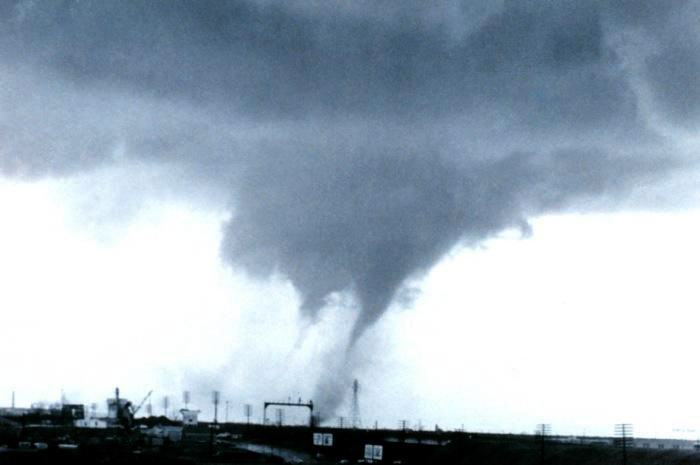
SharknadoSome movies are so bad that they become classics. Some are just plain bad. The jury in my head is still out on Sharknado. The story, obviously tongue-in-cheek, is so far-fetched as to be pretentious, and anyone who knows something about either sharks or tornadoes, or both, will likely find credibility waning from the first scene. For those sensible among my readers, who’ve not seen the movie, the title gives it all away. A global-warming-induced hurricane hurries toward Santa Monica with its forever young sun-worshippers. The hurricane floods the California coast, bringing sharks to the city streets. As our protagonists drive around somewhat pointlessly, the sharks attack their car, eventually eating everyone who’s not family. At one point the family tries to buy rations at a liquor store, only to have the news announce that this is the apocalypse. The store owner scowls that it’s the government, not God, that’s bringing this upon them. Then the waterspouts appear, morphing into tornadoes carrying sharks, still hungrily chomping at everything as they fly through the air.

Ironically a biblical theme comes about with the swallowing of Nova. As she falls from a helicopter (don’t ask), a great white shark snaps her up in mid-air, and since she’s about the only character you can care about, the movie seems to have reached its nadir. As the tornadoes dissipate and the sharks coming raining down, the eponymously named Fin is swallowed whole by a huge great white, while still holding his chainsaw. We already know that this latter-day Jonah will make his way back out, and we are supposed to be surprised that this is the very same shark that holds the reborn Nova, who admits her real name is Jenny Lynn. Like Neo in The Matrix, she is the convert to a new faith, this time in the family of Fin, whose only fault, it seems, is that he cares too much for others.

While a made-for-television B movie (although C or D might be more appropriate), Sharknado demonstrates the popular conception of the apocalypse. Not that it will involve flying sharks and destructive wind-storms, but that the end of the world is somehow inevitable. We have convinced ourselves that its a matter of when, not if, the world will meet its demise. Global warming, clearly our fault, is blamed by the movie (as is the government), but the story is that the flimsy culture we’ve constructed is subject to utter ruin by a hurricane and maritime predators. Or I could be reading far too much into this. Religious tropes may be picked and chosen at will. And when things really go wrong, like accidentally switching on Sharknado, we have a ready arsenal of religious ideas at hand to blame. And the apocalypse may be the least of our worries.


The One That Got Away

While looking for reviewers for a book proposal on Jonah, I had a strange realization. Few mainstream biblical scholars are interested in the book. Or at least in publishing on it. The same goes for the Bible’s other great watery adventure, Noah’s story. Ironically, these are the stories we, as children, are weaned on. Kids love animals, right? And both Noah’s ark and Jonah’s great fish mastication involve animals, as well as lots of water. Both stories have more than a whiff of the fantastic about them—the kind of thing children can relate to. And yet, biblical scholars, collectively, wonder why few people are interested in their work as they take on the more heady work of unraveling Isaiah or Romans.

Sistine_jonah

Jonah used to be a test case for the Fundamentalist crowd. You were a “Bible believer” if you could, with steely gaze, claim that Jonah was swallowed by a fish—the Bible doesn’t say “whale”—and survived three days only to be vomited up on the Levantine shore to make his soggy way back to Assyria. Three days swimming in the gastric juices of just about any animal doesn’t do a great deal for a prophet’s credibility. Or physique. And since the story is fantastic, and populist, scholars avoid it like a giant fish. Meanwhile, John and Susie Q. Public want to know about this story—what does it mean? Did it really happen? Why is it in the Bible at all?

My generalization above is somewhat faulty. (What generalization isn’t?) Evangelical scholars still take an active interest in Jonah. Jonah is the stomach-acid test of faith. Since I never really outgrew my love of monster movies and outlandish plot lines (my brothers recently convinced me that I should see Sharknado) I’m fascinated by the tale of Jonah. It is one of the most carefully constructed stories in the Bible, and it clearly has a very counterintuitive message about who is acceptable in God’s eyes—here’s a hint: they live in Nineveh and even dress their animals in sackcloth when they realize they’ve been naughty. The book of Jonah, however, has been condemned for being a puerile tale of a guy who can hold his breath three days, amid chemicals that can dissolve most organic substances, and utter Psalm-like prayers all the while. Fish stories, after all, are something that many folks intuitively know how to interpret.


Saints and Serpents

Santa Barbara feels like paradise.  To a guy who grew up under the gray clouds and sometimes cruel winters of the northeast, the sun-washed placidity of the California coast feels almost surreal.  I’d never witnessed a flight of pelicans before, or visited a university campus that felt more like a spa.  Nothing introduces trouble into paradise like guns.  As we are beginning to try to make sense of yet another mass shooting involving college-aged kids, the somber-faced newscasters talk about how difficult it is to handle mental illness as they fret over seven more coffins that should never have been necessary.  It’s the right of Americans to own guns.  It’s the heritage of many to experience mental illness.  Elliot Rodger only had three guns and over 400 rounds of ammunition in his car.  Where’s Charlton Heston when we need a little comfort now?


America’s love affair with firearms is too protracted and entrenched simply to turn back the clock.  Guns are functional devices, but their deterrent force seems effectively only on those who don’t own them.  We’ve opened Pandora’s box and shook the last bit of hope out of it.  College is the stage of growing up where we learn about what life has to offer.  Choosing majors, meeting potential mates, gaining a measure of freedom.  Freedom.  Those who own guns don’t seem to appreciate how unbalanced this makes the rest of us feel.  When I walk behind someone smoking on the city streets, I can’t help but think that I’m doing nothing to foul the smoker’s air.  If only I had a gun.


One of the most poignant scenes in the Ellis Island museum is where the potential immigrants are being tested for mental illness.  As a hopeful paradise, we seemed to say, we don’t want to invite any problems ashore.  Mental illness is not the fault of the sufferer.  Making guns available to those who suffer depression and rage is madness.  And despite the rhetoric, the only one with gun in hand who ever seems to stop the rampage is the killer himself, by turning his own on the victim and perpetrator.


IMG_0149

Standing on a beach in Santa Barbara, you are looking out over five thousand miles of placid, unbroken, blue water.  The sky and the ocean seem to blend together.  A scoop of pelicans flies overhead, becoming lost in the sun.  And there is a serpent wrapped around a tree somewhere nearby.  There always is.


The Cow Jumped

While digging through the attic for some reference material for a colleague this weekend, I came upon a box of Bibles. I actually have many Bibles around the place—often within an arm’s reach—despite the ease of internet biblical access. One thing of which I own few are leather-bound Bibles. Trying to be as vegetarian as I can, I have avoided leather in my apparel as much as possible (sometimes the alternatives are even more expensive), and apart from a rare, old book, I prefer cloth to leather, and, generally, paperback to cloth. Still, working in the Bible industry, I know that among the best selling Bibles are the leather variety—those that involve the ultimate sacrifice, although not of the human kind. Leather as a book-binding material is an early development. Leather is durable, and strong, even if a little kinky. Before synthetics, it was used to protect tomes that had been written by hand, representing hundreds, or thousands, of human-hours of work. You wanted it to last. So kill the fatted calf.

I was amazed, therefore, to discover that most leather Bibles are bound with pigskin. That’s right, the material tossed around the grid-iron Sunday afternoons from September through February is kin to the very binding on your standard Bible. Pig leather (never called that) is cheap and durable and is the routine binding for leather Bibles. You want a kosher holy book, you’ll need to buy calf-skin (one thinks of a savior dying at only 33), and it will cost you. Pigs, generally eaten by Christians, are unclean to Jews and Muslims, and books bound in pig cannot be touched by the most religious of the monotheistic sibling faiths. To me, I just see dead animals all around in any case, and wish we might find some way to protect our pages with something else.

Photo credit: Ben Salter, Wikimedia Commons

Photo credit: Ben Salter, Wikimedia Commons

A larger issue (isn’t there always a larger issue?) is a porcine one. Pigs, we are told, are very similar to humans. We use their organs to transplant for our own, and some scientists think they may have played a role in human evolution (although this is not the conventional view). Although I can’t claim Babe led me to vegetarianism, it certainly didn’t hurt. For that matter, neither did Charlotte’s Web. Still, the idea of swearing atop a deceased pig to tell the truth, or watching a televangelist beat a dead pig, definitely has some theological implications. So as I sit here staring into a Hammermill box full of Bibles, I wonder about the hidden costs. Not just to calves and pigs, but to the species who claim that this box of books contains a truth deeper than the many other tomes all around me. And I wonder just how naive I may have been on the finer points of the religion based on these books as well.


To Thine Own Self

sexatdawnAmong the books that I would rate very important, Christopher Ryan and Cacilda Jethá’s Sex at Dawn would need to be on top, or nearly so. As I’ve often stated on this blog, religion and sex are very closely related. Every religion, in some way or another, intimates itself into sexuality. Like religious belief, however, it is something about which we blush, look at our feet, and politely change the subject. Perhaps it would be helpful to shift focus, then, to the subtitle: How We Mate, Why We Stray, and What It Means for Modern Relationships. Well, not even that reaches the depths to which this book plumbs. Ryan and Jethá actually peer back deep into prehistory and look at the changes that agricultural life brought onto humanity. Comparing that information to conclusions drawn from evolutionary theory and serious biological study, they derive a picture of a much more equitable culture for which humans clearly evolved. Agriculture, and just plain culture, changed all that.

With culture, you see, comes the materialist idea of possession. Hunter-gatherers, even today, are the best sharers in the world. Their generosity isn’t noble, as Ryan and Jethá point out, but entirely practical. In addition, their lives are longer, healthier, and happier than those of the modern, stressed-out, perpetually frustrated, “cultured” individual. We are constantly trying to get ahead, and own more. Of course, we don’t want to mention or think about the fact that when we die, all that ownership will mean nothing. We invent complex laws that so only our biological (we think) offspring will carry on that legacy until the last bit is parceled out so fine that all that remains is a name that few will remember millennia down the road. For that we suffer nearly constant frustration. I’ve not read a book in decades that made me want to throw all of this off and head out to the woods, sharpened stick in hand. (Problematic, since I’m pretty solidly vegetarian.)

Some of the larger implications, however, that Sex at Dawn doesn’t address, are the roles that religion plays in problematizing what we’ve evolved to be. Of course, sex scandals in churches are referenced, since they are such crucial evidence. What is overlooked, for the purposes of the book, is that religions have always tried to define and control sexuality, at least since the dawn of agriculture. We don’t often consider that agriculture, in addition to making us fat, and lazy, also gave us organized religion. It may be that religion came first, but it only grew into a coercive social force with the temple culture of ancient Sumer, and it has been with us ever since, dictating who may love whom, when, and for what purpose. Sex at Dawn is not for those who are set in their ways, nor for those who take a one-size-fits-all attitude toward life. For the rest of humanity, however, there is hope that perhaps we can learn to be a little more true to what nature intended us to be, and to understand that nature may be many things, but it is seldom evil.


Take a PAAS

Like so much of life, PAAS Easter Egg coloring kits were the result of an accident. To be more specific, a chemical accident in New Jersey, something which is far from rare. This particular accident, however, had a fortuitous side-effect: the brightly colored (but not radioactive) Easter Egg dye that many of us associate with childhood. Around 1880 Newark druggist William Townley spilled colored dye onto his suit, leading him to individually package holiday colors, according to a story in the New Jersey Star-Ledger. That individual packaging allowed for a full set of egg colors to be sold together and the PAAS brand was soon launched.

The idea of coloring Easter Eggs, like so many Christian traditions, likely has pagan roots. Eggs were a sign of new life with the coming of spring in many cultures (although boiling the poor things rather defeats the purpose). Christians adopted the egg as a resurrection symbol—the chick pecking out of its shell was like the resurrected Jesus bursting from the tomb, albeit somewhat less dramatically. Watching a newborn chick hatch is an emotional experience. At the 4-H Fair, standing around the incubator in the chicken tent, you can see wobbly, uncertain, tiny birds tentatively trying to assess this strange new world that is colder and somehow more compelling than life in the shell had ever been. The mighty son of God they’re not, but they are much more like us, looking for answers and taking small steps until they’re more certain of what they face.

DSCN4483

The coloring of eggs has origins lost in antiquity. Nobody’s quite sure why it was done beyond the fact that they look nice. Romans ate eggs as part of their spring celebrations, and Christians came up with a story to explain colored eggs. The legend claims that Mary Magdalene, in trying to convince the emperor of the truth of the resurrection, turned eggs from white (or brown, as they likely were in those days) to red in her open hands. This proof, however, failed to convince the Caesar. What seems certain is that pagans liked coloring eggs so this provided a new source of evangelism to the Christians who assimilated the practice. Like Christmas, the Easter Egg has become a thoroughly cultural symbol—since Easter comes on a Sunday employers aren’t obligated to give the day off, so everyone can celebrate. Children hunt eggs on the White House lawn and we can still expect everyone to be in the office on Monday morning. Resurrection, after all, can only reach so far.


Floaters and Swimmers

Noah seems to have found a renewed audience these days. Nothing like a major motion picture to make even one of the most famous biblical characters even more notable. And the spin-off stories are now considered news as well. One of the many impossible stories of the Bible, the ark, as scholars have long known, would not have been a physical possibility. Quite apart from the building in days before metal smelting was invented, there was the problem of volume. Since evolution is ruled out de rigueur, each separate species had to have been represented, since no changes are allowed from that time to this. The sheer number of them, especially since new ones are being discovered even now, was deemed impossible to fit on an ark of even biblical dimensions. Add in the food necessary for 150 days, especially considering the carnivores, and the human-power required to care for all those beasts (only eight are permitted by Genesis, and Noah was 600 years old at the time) and you get the picture. Then Mesopotamian flood stories even older were discovered. It was quickly recognized that this was a myth with a larger message to tell.

Now, according to geobeats, and to the relief, I’m sure, of Russell Crowe, physics students at the University of Leicester have calculated that the ark could have floated. The story, in a one-minute sound bite, is a little shy on details. The students used the biblical cubit, and figured there were 35,000 distinct species at the time. I’m not sure where that number originates, but it doesn’t take into account how Noah got the koala’s to swim from Australia. According to present evidence, the earth is home to about eight-million-seven-hundred-thousand different species. And since they can’t evolve, that’s an awful lot of swimmers.

According to the university website, this was not intended as an exercise in biblical literalism. “The aim of the module is for the students to learn about peer review and scientific publishing. The students are encouraged to be imaginative with their topics, and find ways to apply basic physics to the weird, the wonderful and the everyday,” according to Dr. Mervyn Roy, the instructor. The students, working the math angle, didn’t expect the results to work. That they did surprised everyone. Except Noah, one presumes. The story makes clear that the number of animals was used to calculate mass, not dimensions, so squeezing all the beasts in might have been quite another chore altogether. Miraculous, one might say. As for me, I am waiting to see that pair of koalas swim from Darwin to the Persian Gulf, and then back again once the waters finally recede.

Don't forget to see the movie!

Don’t forget to see the movie!