Monstrous Intentions

Atlas Obscura is one of those websites where you could spend all day and feel like you’ve just traveled the world. Featuring less know locations, and strange spots that you might like to visit, sometimes it also has stories about monsters. Well, at least one story about monsters. A friend of mine recently shared Cara Giaimo’s story about thirteen lesser-known monsters from history. While none of these are likely to keep you up at night, they do demonstrate the endless imagination people devote to the unknown. Monsters, like religion, defy easy categorization. Is something that’s “too big” or “too small” for its type a monster? Is it a monster if it is a mix of things that don’t normally come together? Or is it merely a matter of baleful intention? What doth a monster make?

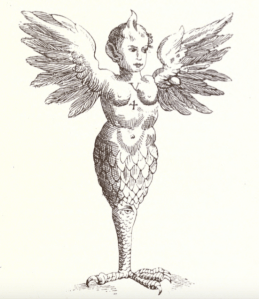
Taking a page (almost literally) from John Ashton’s Curious Creatures in Zoology, the Atlas Obscura page runs down some monsters once believed to have existed. Some of them, despite our flattened world seen only through the eyes of rationality, were actually reported to have existed. The “monster” of Ravenna, for example, was apparently a sad case of a medieval/early modern birth defect that, in the popular imagination took on monstrosity. We now know that birth defects may contain throwbacks to earlier stages of evolution, or that genetic coding may contain mutations. None of this suggests any evil intention on the part of anybody. Accidents of nature may be the saddest kind of monster of all.

Screen Shot 2016-01-27 at 5.42.32 AM

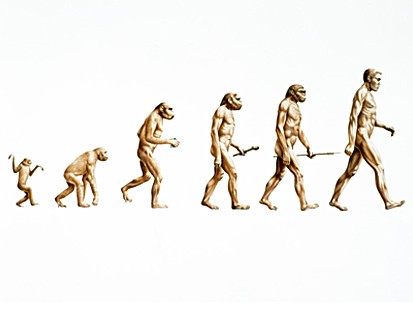
A surprising number of the monsters from Ashton’s sampler here are mixes between human and animal. Indeed, that mix is still a potent force, theologically. One of the loudest voices speaking out against evolution is the one that says people are “not animals.” Having grown up with that belief, it took a couple years of college to convince me that we fit into the greater biological scheme of things. We fear that which resembles us, but is not quite us. Perhaps part of the mystique is that we haven’t quite yet learned to be humane to one another. Being a monster may just have more to do with what one does with prejudices than it does with physical features of their bodies.


Thinking about Thought

The history of thought can be compared to a slow-moving pendulum. At other times it can be more like a ping-pong game. Acceptability for ideas can take time, but sometimes the perceptions change rapidly. Having been raised in a small town in a Fundamentalist setting, it is difficult to assess where exactly the “status quo” was when I was growing up, but by the time I had reached college it was pretty clear that the challenge science posed to my particular brand of religion was pretty firmly entrenched. Materialism—in the philosophical sense—had obviously gained several champions. B. F. Skinner and his followers applied this template to human beings, and it became fairly common to hear that we were basically automatons. (Ironically, double predestination in the Calvinism I was learning about taught pretty much the same thing.) Today there are even more vocal heralds proclaiming that all that is, is material. If it can’t be measured empirically, it can’t exist. The pendulum, or ping-pong ball, has come to one side of the table, or arc, awaiting rebuttal.

An article in Scientific American from two years ago (my personal pendulum sometimes moves slowly as well) asks the question “Is Consciousness Universal?” The article by Christof Koch describes panpsychism, the theory that anything beyond a certain level of organization is conscious. Koch begins by discussing dogs. Those of us who’ve spent time with dogs know that they are clearly conscious, although a materialist would say they are just as much dumb matter as we are. But panpsychism goes beyond dogs and horses and other “higher” mammals. Anyone who has taken the time to study any animal in depth, particularly those that are obviously mobile and can seek what they wish to find, knows that animals have will, and intension. The loss of meaning only comes with materialism.

Integrated information is the term Koch uses to describe the baseline of consciousness. Of course, this would need to account for more than the merely biological. Computers may be sufficiently complex, but the information they “possess” is not integrated, thus keeping them from being truly conscious. I’m not enough of a scientist to understand all the technicalities, but I do know that something as simple as common sense suggests that consciousness is part of all animals’ experience of life. As some scientists have long realized, feeling, or emotion, is integral to the thought process. Only when we realize that we share this world with a great variety of conscious creatures will we begin to make any progress toward understanding the difference between mind and mindfulness.

DSCN5295


Top Predator

Jurassic_Park_III_poster

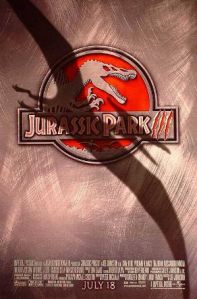
The reboot of Jurassic Park, Jurassic World, has been on my mind. Back in the early days of this century I hadn’t bothered to see either Jurassic Park II or III. The original, despite its faults, was like a childhood dream come true. I’ve always felt that dinosaurs (along with vampires and pirates) made for the best movies, although space has to be right up there in the top since 2001 (not the year, the movie). Since the summer I’ve made a point to carve out time to finish out the holy trilogy of dinosaur flicks. I liked the character Dr. Malcolm in the original, but he should’ve never been the main character of the sequel. The Lost World almost lost my resolve to see the series through. The story was unvarying: humans meet dinosaurs, dinosaurs chase humans. New and innovative means of trying to contain or exploit them try to demonstrate the evils of hubris and greed, but dinosaurs always prevail. Jurassic Park III was a bit better, going back to the original formula but adding something bigger than Tyrannosaurus Rex—the Spinosaurus. It was unbelievable, however, that a paleontology doctoral student couldn’t recognize it, thinking it a mere Suchomimus. At the turn of the century, new dinosaur finds had suggested that Spinosaurus was larger than T-Rex, and the movie reflected the new top predator of the time.

It is the little boy in me that keeps me coming back for dinosaurs. Some of my favorite toys were cheap, molded plastic dinos, and when my daughter was young we bought her all the more realistic (and pricey) Safari versions. When I get to the store, I still stop and look at the species we never acquired and make a wish. I think it’s because dinosaurs represent something we can never have. Species that grew to enormous size and had armor-like skin, and even, if some paleontologists are to be believed, considerable intelligence. Of course, that may just be the movie talking. In a world where all things are equal, we’d never stand a chance against dinosaurs. They are like reptilian deities.

When Amanda Kirby (ironically, the only adult to be addressed by first name in the movie by new acquaintances; the males are called by their titles even after they’ve been through several dinosaur attacks together) sees the incubators at the compound, she says, “So this is how you make dinosaurs.” Dr. Grant (let’s give him his title) responds, “No, this is how you play God.” Playing God is a trope as old as science itself. Planting crops to grow where you want them to grow is playing God in its own way. Creating uncontrollable forces that can destroy you seems to be a uniquely human trait. And so my imagination is drawn back to dinosaur days. Those who make the movies tug on wishes that any mere creature would have: to create its own gods and somehow manage to survive them. Hubris, it seems, is just as human as dreaming of dinosaurs.


Monster Smash

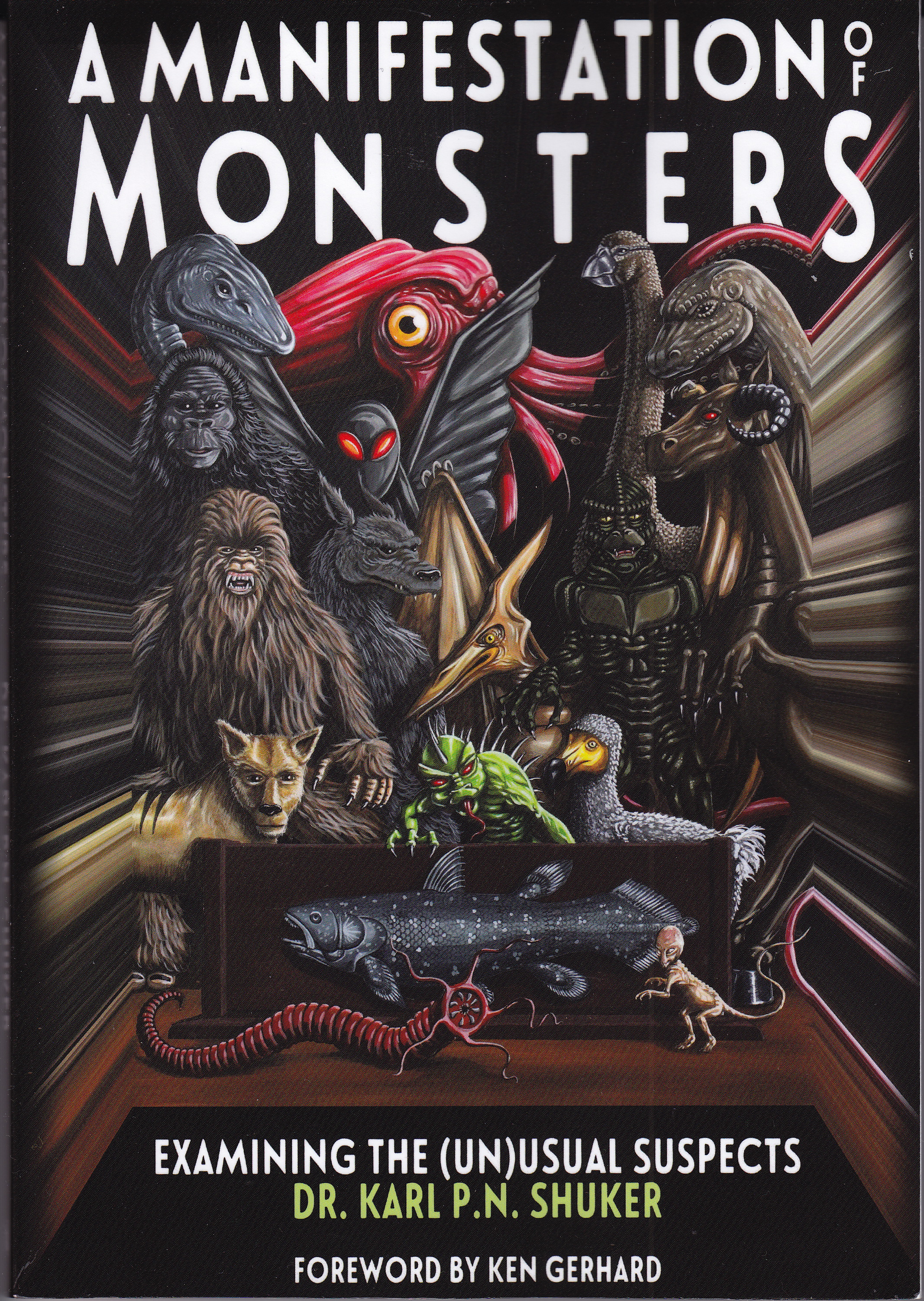
MnfsttnMnstrsIt’s the time of year when young men’s minds turn to monsters. Well, at least this middle-aged man’s does. Seeing a book by Karl P. N. Shuker entitled A Manifestation of Monsters, I was intrigued. I had some Amazon points burning a hole in my internet, so I took a chance on it. The fact is good books on monsters are hard to find and Shuker is listed as “Doctor” and that sometimes stands for something. Subtitled Examining the (Un)usual Suspects, the book is a curious Mischwesen of folklore, actual animals, and cryptozoology. The latter should be no surprise as Shuker is a noted cryptozoologist. Compiled from many of his previously published articles, the book contains some fascinating accounts of extinct creatures and some improbable accounts of modern monsters.

Since Banned Book Week is a time to explore challenged ideas, why not read about some cryptids? They are anti-establishment monsters. Banned creatures. As is usual with monsters, there’s little rhyme or reason to the arrangement. Unlike many in the field of cryptozoology, Shuker is skeptical of outlandish claims, and has actual training as a zoologist. What stood out to me as I read accounts of unusual creatures is that some people report seeing the oddest things, and that other people are driven to hoax all kinds of monsters. It is clear that the human mind is programmed to believe in the possibility of the improbable. Critical thinking, as anyone with advanced training knows, is hard work. Belief can be a far simpler matter. We crave a world with the exotic, and potentially dangerous. Shuker’s piece on the mythical chupacabra demonstrates that nicely.

While I’m pondering things that are banned, I consider how some who use critical faculties well like to disparage others. This, of course, is not in the best interest of science. We haven’t discovered everything yet. We think that because of the internet we’ve gone about as far as we can go in hive-mind mentality. Never mind that bees and ants beat us to it. People, many of them very intelligent, continue to see things they can’t explain. Others say that any living creature larger than a breadbox has already been discovered. I tend to think the world is a pretty big place and that people prefer to huddle together in cities for a reason. The mountain gorilla, for example, was discovered just in 1902. Now that the season for monsters is upon us, I like to imagine what else might be wandering around unseen by human eyes. And I hope banned ideas may continue to thrive in the forests of our minds.


Doubting Dawkins

A recent Guardian introspective on Richard Dawkins reminded me of the dangers of idolatry. Dawkins, an internationally known intellectual pugilist, the article by Carole Cadwalladr intimates, is as human as the next guy when you can catch him off the stage. Ironically, it is evolved primate behavior to adore the alpha male, but, at the same time, to prevent abuse of power and to get away with what you can behind said alpha male’s back. We are worshipping creatures, at least when it suits our best interests. Anyone who’s been intellectually slapped down (something yours truly has experienced multiple times) knows that it is an unpleasant experience that one doesn’t willfully seek out. We try to keep out of the way of those who assert themselves, preferring the safer route of just doing what we’re told and apologizing for something we know isn’t really our fault. It’s only human.

Evolution

The media have provided us with ever more expansive ways to build our “experts” into gods. Dawkins, a biologist, has become one of the go-to experts on religion. The media don’t seem to realize that hundreds of us have the same level of qualifications as Dr. Dawkins, but in the subject of religion. Many of us are not biased. And yet, when a “rational” response to religion is required, a biologist is our man of the hour. Granted, few academics enter the field in search of fame. Most of us are simply curious and have the necessary patience and drive to conduct careful research to try to get to the bottom of things. We may not like what we discover along the way, but that is the price one pays for becoming an expert. Those who are lucky end up in teaching positions where they can bend the minds of future generations. Those who are outspoken get to become academic idols.

I have no animosity toward Richard Dawkins or his work. I’ve read a few of his books and I find myself agreeing with much of what he says. Still, a trained academic should know better than to “follow the leader” all the time. (Some schools, note, are better at teaching independent thought than are others!) The academic life is one of doubt and constant testing. Once you’ve learned to think in this critical way, you can’t turn back the clock. One of the things that those of us who’ve studied religion know well is that all deities must be examined with suspicion. Especially those who are undoubtedly human and who only came to where they are by the accidents of evolution. I’m no biologist, but I inherently challenge any academic idol. I’m only human, after all.


Interstices

College move-in weekend can be a stressful time. In our particular case it means crossing a couple of state lines and staying in a hotel. Well, I suppose we technically might manage to load, drive, unload, and drive in a day but that seems awfully abrupt. You need time to shop for those supplies that might have run out, wait for roommates to arrive, and spend the last quality time together before facing an empty nest for four months. So we find ourselves in a hotel. It’s the one closest to the university, but it is also the host to some kind of event that draws a lot of people but fails to make internet event calendars. We usually stay at this hotel, and they even emailed us at the start of summer to make reservations early. The clientele this weekend is a cross-section of town and gown. It’s a mixed group. In the hall I see other students about, but there are those here who’ve come for non-academic entertainment, whatever that might be.

The barking started about 6 p.m. I grew up with dogs and most members of my family still have dogs. In fact, evidence points to the dog—the wolf at the time—being the first of the domesticated animals. Before agriculturalists rounded up sheep and goats and cattle, the dog accompanied the hunter-gatherer and both engaged in a win-win scenario. The successful hunt of a large animal left food for both humans and their best friend. Ironically for dog-owning anti-evolutionists, dogs are among the most selectively bred of animals. Looking at a pug, or a maltingese, it’s difficult to conjure up images of the wolf pack. The dog next door, obviously lonely and abandoned, was the small, yippy sort with a high-pitched, insistent bark. It was clear there was more than one in there. And, of course, hotel doors are about the least soundproofed surfaces on the planet. It was like Fifi and company was in the room with us. When I turned in about 10, the barking was still going on, and the front desk said they were trying to locate the guests registered for that room.

What's that shining?

What’s that shining?

I grew up with dogs, and I understand the attachment. I do, however, sometimes wonder about the courtesy of others. Some actions impact other people in direct ways, and sometimes we just don’t think of the consequences. I don’t just mean dogs. Lying awake, listening to distraught pets, I thought of the point of higher education. It is an “industry” in which I have a strong investment. The point of it all is to make our life together on this planet better for everyone. There will always be those who can’t travel without their dogs. There will always be those who have to venture far from home to get the education they want. Can’t there be affordable hotels with doors to dampen the noise just a little bit? Or maybe some of us a just over-sensitive at times like this. Maybe it’s time for me to go back to school to try to figure it all out.


Being Sheepish

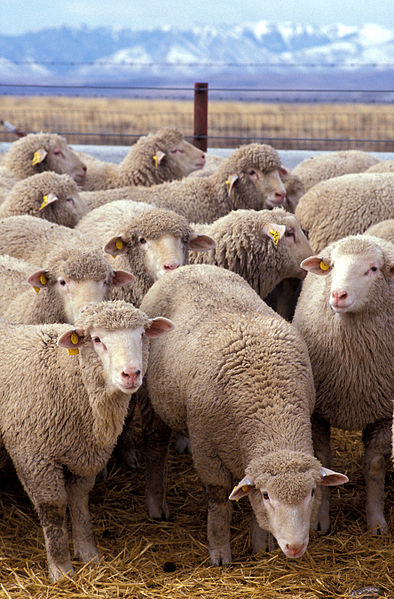
Being among the animals at the fair, you begin to notice things that are foreign to those of us with exposure only to the house-pet variety of fellow creatures. Up close, for example, sheep are bigger than you might think they are. Since they’re domesticated and wooly, I tend to think of them as little—maybe knee-high—and in need of constant attention. The truth gives the lie to such false constructs. It was in the course of seeing sheep that I found out about Shrek. Shrek the sheep, now unfortunately deceased, has his own Wikipedia page. This was a single-minded ungulate who decided that the ’70’s lifestyle wasn’t truly over. The New Zealander took off from his heard, to avoid shearing, so the story goes, and hid in a cave for six years. With echoes of Odysseus, the ruminant survived just fine without human help and grew a serious coat of wool. When finally discovered and, of course, sheared, he gave enough wool to make suits for twenty men. Shrek had to be euthanized four years ago.

The story might have ended there. Shrek, however, fueled the imagination of several Christian writers who saw all kinds of parables in the lifestyle of this prodigal sheep. After all, in the pastoral culture of first-century Palestine, sheep suggested themselves as the fodder for the original set of Christian parables. Sheep wander, get lost, and get saved. They need someone to look after them. A good shepherd, preferably. In fact, sheep tales go further back in time, even to the Hebrew Bible. Perceptive prophets noticed how similar we are to our distant, quadruped cousins. It would be very odd, in hindsight, if nobody had picked up on the story. The mental picture is simply too appropriate.

394px-Flock_of_sheep

Metaphors, some have argued, are what make us human. We can see ourselves projected into just about any part of nature, and looking at nature, we can spy ourselves. Parables, by their definition, are never literal. We have to peer into them and find truths that gainsay the obvious. If we’re honest, we’d have to admit to being very much like Shrek. Who doesn’t want to run away and hide from what “the man” instructs us to do, against our own will? Yes, sheep have wills. Like any sentient creature, they have a sense of what they want and the best way to survive. With our fancy neocortex, we’ve domesticated sheep and bred many of their natural tendencies out of them forever. Still, I’m heartened to learn of Shrek the sheep. The lesson I draw from his story may not be the same as many Christian websites, but it will be no less true, I should think, for being such.


All’s Fair

The county fair is an institution that tastes like a real slice of Americana. My family’s been involved with our 4-H Fair for several years now. Long days sitting under tents in the August heat, showcasing to young people that a good time can be had without the usual kinds of diversions that lead to regrets and tattered dreams. For many kids the fair will be as close as they ever get to a cow, goat, or chicken. For the less rurally inclined, there are pets like cats, dogs, and small animals. For others there are model trains, rockets, and airplanes. Increasingly robots and more current forms of art such as steampunk and film-making are appearing. In short, there’s pretty much something for everybody there. I know that my entire family has benefited from the experience. I didn’t know about 4-H as a child, so this has been a pleasant awakening for me.

IMG_2408 copy

As I wondered the fairgrounds, something that I suppose I’ve noticed before hit me with a new clarity. The Arts and Sciences tents are right next to one another, and these represent the classic forms of liberal arts education. Yes, the Gideons and Right-to-Lifers are here, but they’re over in the commercial tent. They’re selling something. Education—true education—is free. Those who grow up on farms can learn an awful lot about science by watching animals. The more formal schooling, however, asks for deeper engagement. Creative writing helps to explore ideas that simply don’t flow in conversation. Photography forces you to look at something from someone else’s point of view. Science teaches close observation and practical extrapolation. This is like a little university set up in a grassy field with a very affordable tuition.

The old hiker’s mantra goes “take nothing but pictures, leave nothing but footprints.” This year there was a real emphasis on footprints. The kinds of footprints that many clubs chose, however, were carbon. Many adults have grown up in a culture of consumption and disposal. Our young are now trying to demonstrate for us the errors of our ways. Sure, there are resources to last for centuries yet, but they will not last forever. Who are we to suppose it is our right to take what we please and leave the mess for our young to clean up? A day at the fair always renews my sense of hope. These are all volunteers here, giving up the latter part of their summer to try to make the world a better place. Perhaps the ethics should come up from the young, rather than descending from generations that have put their own wants ahead of those who might truly make a difference.


Permian Record

GorgonIt looked like an arm bone to me.  Then again, I have no formal training in either anatomy or geology.  The strata of Pennsylvania shale was littered with shell fossils from before the dinosaur era.  Had I found a rare early animal?  You see, I love fossils.  In fact, I was so disappointed the first time I walked into a Fossil store that I’ve never had the heart to go back.  Something about finding the remains of creatures millions of years old is inherently fascinating, and I was fortunate enough to grow up by a river that had plenty of fossils for the taking (a great pass-time for children of humble means).  When I saw Peter D. Ward’s Gorgon at a local book sale, I had to get it.  In addition to my love of fossils, I also have a special interest in Medusa, and the title grabbed two aspects of my attention at once.
 
The gorgon of the title is explained by the subtitle: The Monsters That Ruled the Planet Before Dinosaurs and How They Died in the Greatest Catastrophe in Earth’s History.  As Ward explains, many in the media express surprise that there was anything before the dinosaurs.  Perhaps I grew up with too much Genesis on the mind, but I knew about the Permian Extinction—the most deadly episode in Earth’s biological history.  Over 90 percent of life forms died out, including some of  the cooler species of mammal-like reptiles like the dimetrodon.  I have to confess, however, that I don’t recall ever hearing about gorgons before.  They are a South African species.  Well, they were, long before apartheid and other ridiculous human foibles.  Indeed, one of the charms of Ward’s account is that he doesn’t separate the human element from the paleontological.  His visits to South Africa often demonstrated how the current dominant species of the planet participates in its own extinction.  Valuing personal gain over social justice cannot have long-term payoffs.
 
This is a compelling story of people committed to finding answers in a barren land.  To an inveterate fossil-hunter like me, it was a dreamy sort of read.  I had my fossil “arm bone” assessed by a geologist.  It was actually a trilobite trail.  A trace fossil.  Sometimes things aren’t what they seem.  The answer of why of the Permian Extinction transpired turned out to be the most distressing aspect of the tale.  Climate change, Ward demonstrates, can easily lead to mass extinction through the very act of breathing.  Our evolution has favored the current atmospheric makeup of our planet.  Dinosaurs, who appeared after the Permian Extinction, had evolved lungs for processing air with less oxygen than we’re used to.  Greenhouse gases can shift subtle, invisible balances that are necessary for taking a breath.  And I could extrapolate to a future where technology will again come to the rescue, but only of those who can afford it.  And I wonder what far distant evolved intelligent species will make of a civilization where financial gain was considered the greater good than survival of an entire species?  Humanity itself will have become a fossil by then. But a well-dressed one.


Drumheller Drama

Those who’ve participated in the great drive out west—if you’ve done it you know what I mean—have passed through the range of dinosaurs. Actually, dinosaurs can be found here in the east; New Jersey once had a reputation of the home of the hadrosaurus, before an even larger beast took over the state. In my native Pennsylvania the occasional dinosaur footprint would be found. But to really see the dinosaurs, the west is best. In Makoshika State Park you can find triceratops skulls right out on the ground. You can find plenty of Christians as well. Ironically, we’ve advertised to the world that Christians and dinosaurs don’t mix, but, in fact, they can get along just fine. In a BBC story my wife sent me, one of Canada’s great western dinosaur reserves, Drumheller, Alberta, has a potential clash between sauropods and savior. Seen from one angle, at least. The story by Tom Holland points out conflicting wills for an entrepreneur who wants to build a dinosaur display and a long-established passion play that occupies the space he wants.

Dinos

News doesn’t get read without some measure of drama, so Holland pits the dinosaurs against the Christians. What seems to me, however, as the real issue is entrepreneurial expansion versus what seems like an arcane melodrama, the reenactment of Jesus’ death. Ironically, the greater part of North America was colonized by Christians of various descriptions. Many of them established their culture in various ways across the landscape. As a culture, it wasn’t always belligerent, and sometimes even beneficial. Passion plays, once upon a time, were considered the mark of culture. Jesus, I’m sure, knew nothing of dinosaurs but would have had no problem with them, I contend, if he had.

The issue here is less about science versus religion as it is about cash versus culture. Even Ahab turned his face to the wall when he couldn’t have the land that he wanted. If someone else got there first and made a recurring shrine, does capitalism have the right to slough it out of the way? I love dinosaurs. I’ve driven many miles out the way to see dinosaur trackways far beyond the trodden path. These are but shadows of footprints cast millions of years ago. Both dinosaurs and Jesus have their place in our hallowed past. While pictures of Jesus riding dinosaurs may well be over the top, the message perhaps rings true: there’s no inherent conflict here. When someone wants to make quick cash, however, there will always be sacrificial victims involved.


Google Me This

Technology frequently flummoxes me. Although I use it daily, it changes more swiftly than I can hope to. Working for a British company, for example, my computer seems to be a loyalist. It supposes that it is in the United Kingdom even as it sits on my desk in New York. I’m told this has something to do with a mystical key called an “IP address.” When I search Amazon, prices come up in pounds. When I google something, I’m told that European laws restrict certain searches. And, interestingly, I discover that Google’s icons of the day have a British theme.

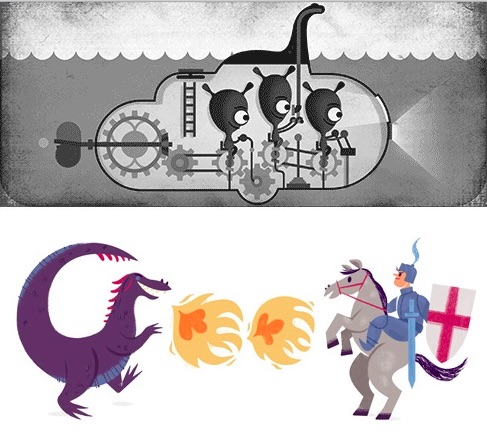
GoogleI’m assured Google is a fun place to work. One of those enlightened companies that believes reducing stress and increasing enjoyment of employees leads to good results. Were that all companies so enlightened. In any case, the famous Google logo is often decorated with a commemoration of the day. This past week, two such icons appeared on my UK searches. The first commemorated Nessie with something like the 81st year of her appearance. The icon puckishly showed Nessie to be a fake, a submarine actually piloted by aliens. Later that same week, on St. George’s Day, a dragon appeared on the icon. I began to wonder about this reptilian connection. If lake monsters are real, many make the claim that they must be plesiosaurs, their dinosaur cousins that most resemble them. St. George, clearly a character cut from the same cloth as Hadad, slays a dragon—an equally mysterious reptile.

We tend to associate dragons with evil, although in world mythology they appear equally as often as harbingers of good. Human interaction with reptiles has always been fraught. Somewhere along our evolutionary track we must’ve shared a common ancestor with them. Even today some responses, such as fight or flight, are referred to as those occurring in the “reptilian brain.” In Genesis 3 the serpent slithers in. According to Revelation, at the other end of the canon, the snake is still there at the end. It was only happenstance that Nessie and George’s unnamed monster appeared in the same week, I suppose. Nevertheless, there is a deep connection between them and us. We can’t seem to get away from them, even should we flee across the ocean.


Animal Form

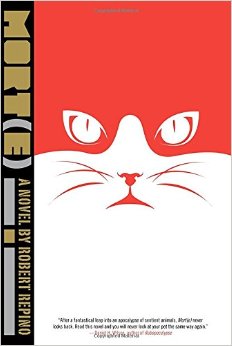
Mort(e)The fear of insects is fairly common among people. It is difficult, however, not to appreciate the “hive mind” and how insects in colonies work for the betterment of all, often at the expense of the individual. Now imagine that the hive mind resents what humans have done to insects over the millennia. And suppose that their massive mind allows them to develop a hormone that transforms animals into partial humans with consciousness and, for the most part, workable hands. Then you’ve got the premise of Mort(e) by Robert Repino. A debut novel about a cat (Mort(e)) and his desire to find a friend in the fog of war that follows the transformation of animals into people, the story is as compelling as it is creative. Add in a strong dose of religious concepts (Mort(e) is considered a messiah among the battered human population, and he has a prophet) and you’ve got a captivating story perfect for comment on this blog.

While not all novels I read have a religious element, a surprising number do. And this isn’t because I pick stories with religious themes. It is because religion pervades the human outlook on life. Repino’s novel, however, does go beyond a casual mention of religion. It turns out to be central to the plot in a way that, were I to describe it here, would constitute a spoiler, and since I want to encourage reading of Mort(e), I don’t want to reveal too much. Suffice it to say, without religion a large part of the story would be missing. No matter whether you believe religion is good or bad, you’ll find plenty to think about here.

These days I read novels liberally mixed in with non-fiction reading. Sometimes I’m disappointed after I spent a few hours on a book and find it to lack substance. (Sure, I do read as a guilty pleasure from time to time, but here I mean the kinds of books you invest in.) Mort(e) is a substantial story. The world in which the protagonist operates can be described as apocalyptic, and end-of-the-world scenarios have a way of raising questions about what we believe. The time spent reading Mort(e) is a good return on investment. And once it has been out there long enough, I’ll want to return to that plot spoiler to investigate it further. It’s that kind of book.


A Night at Culture

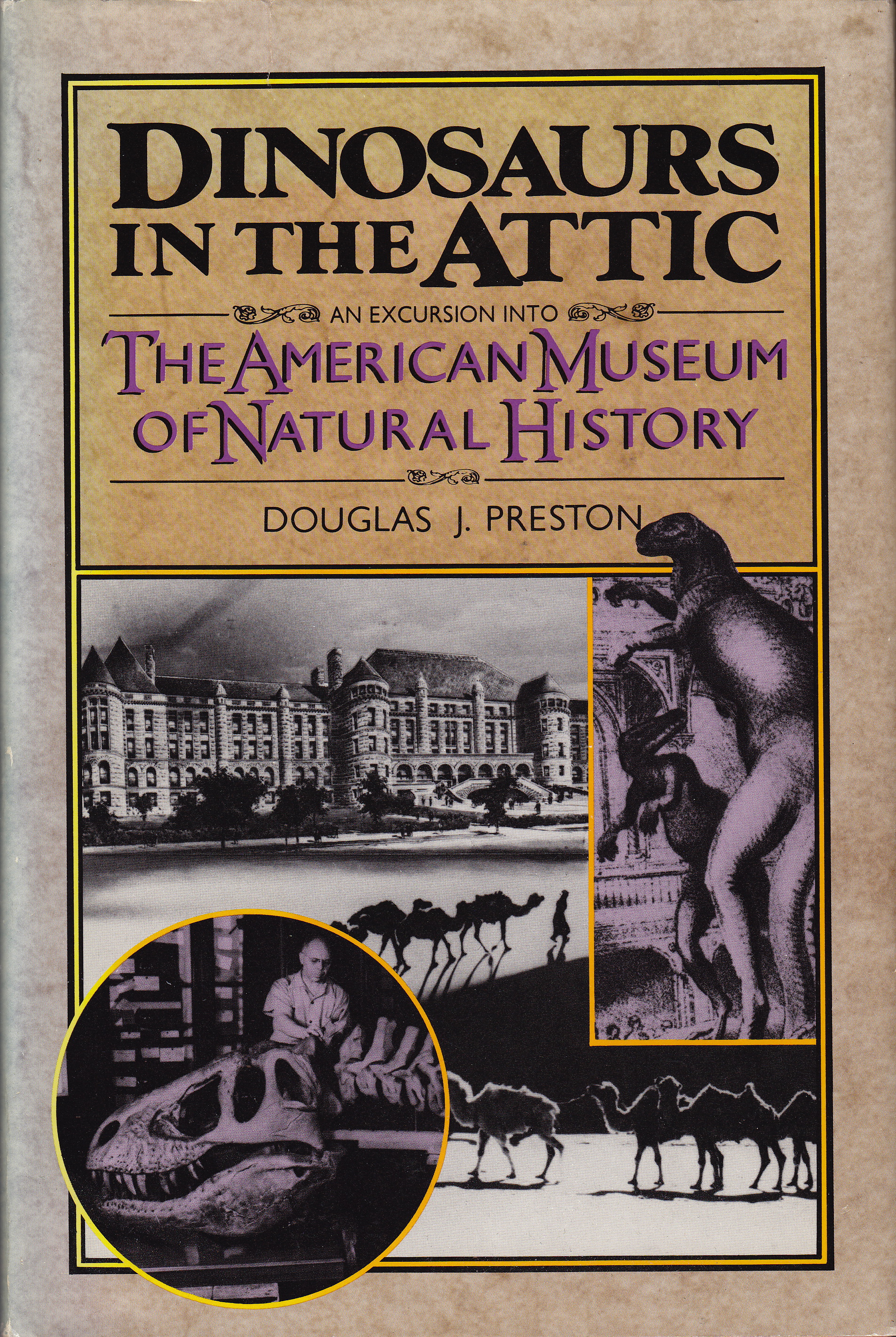
AmericanMuseumOne of the undisputed benefits of living in the greater New York City metropolitan area is the potential for culture. I know that culture exists everywhere, and that is precisely one of the points behind Douglas J. Preston’s Dinosaurs in the Attic. I picked this up at a used book sale because of my love of dinosaurs, but the subtitle provides more of a description: An Excursion into the American Museum of Natural History. Just when the first Night at the Museum movie came out, the American Museum of Natural History offered a program of nights to sleep in the museum, geared toward children. A generous family member bought us tickets and we got to sleep in the oceanarium under the giant whale dangling from the ceiling. We were allowed to explore galleries by flashlight, including the most famous collection of dinosaurs in the world. Who wouldn’t want to read about the backstory of such a museum after such an event?

As might be expected, with roots in the late nineteenth century, it was a different world in which this museum was conceived and built. Rare animals were shot to be part of exhibits, artifacts were acquired and shipped across national borders, and even world-class bird collections were bought to help an indiscrete baron avoid the humiliation of having an affair revealed by a blackmailer. Still, the religious element was clear. One of the founders for the museum, Albert Bickmore, went off in search of artifacts with his Bible tucked under his arm. Exotic places and peoples were still allowed to be called exotic, and the museum eventually became famous enough to star in a movie.

What struck me the most about this fascinating story, however, is when Preston points out that the most fragile, and valuable possession of the museum are the myths. Early ethnographers visited peoples that, even then it was already too clear would become extinct (culturally), and recorded their religious stories. This, and not the thundering Tyrannosaurus Rex, was the true purpose of the museum. Museums are about people. What we discover, what we make, and how we impact our planet. Myths, religious stories, are some of the most unique and delicate pieces of information that we can leave behind. Even materialists have beliefs. We all believe in something. Although nobody goes to a Night at the Museum to read dusty old stories, it is a source of comfort that they are there. Many of the cultures have indeed died out. Were it not for the foresight of those who could see where globalization would eventually lead, they would have been forever lost. And a world without myth is not a world worth living in.


Love the Sinner

Nashotah House, in the many years I taught there, was very saintocentric. Our daily lives revolved around Saints’ Days, many of whom I’d never heard. Not having grown up Episcopalian, I wasn’t accustomed to all the obscure people recognized as worthy of having their own day. I was, however, surprised to learn that the church did not venerate the two most well-known secular saints: Patrick and Valentine. Perhaps having its origins as an all-male institution, St. Valentine’s Day was considered a dangerous concept to commemorate? But no, he wasn’t even on the calendar of saints in the Book of Common Prayer. While the rest of the world was celebrating love, we were generally getting ready for Lent.

The truest holidays mark the observations of subtle shifts in nature. With our indoor, virtual lives, we’ve lost track of the fascinating rhythms of the natural world. The birds begin to pair off and mate, so the etiology goes, around this time of year. So to baptize that pagan erotic longing, St. Valentine was brought into the picture. So the story claims. Religions have always found love somewhat of a stumbling block. On the one hand, it is the highest ethical good—the greatest moral regard you can have for another person is love. (We try not to tell them that, because it might betray too much, however.) On the other hand, love can lead to physical intimacy and there things get a little dicey. Religions of all descriptions attempt to regulate sexuality. It may be a fearful thing, so perhaps we should put a saint’s face on it. Could act like cold water on the natural fires of biological creatures in February.

St-Valentine-Kneeling-In-Supplication

So instead, Valentine’s Day has become a secular holiday. Kids send one another cheap cards indicating their enforced regard for one another. Guys carry flowers awkwardly through the streets of Manhattan. The clerk at the chocolate shop, even several days in advance, sends you out the door by saying “Happy Valentine’s Day.” It’s the secret we all know. Ironically, the church has backed away from Valentine. Perhaps, if our religious institutions took seriously what it means to be human, and promoted love as the highest good rather than political conformity, we would truly have cause to celebrate. But don’t mind me—more likely as not, I’m just gazing out the window, watching for birds and the hope of spring.


Seeing I

One of my few Twitter followers (stawiggins) suggested that I watch Dr. Ken Hayworth on YouTube. Specifically, Part 3: If we can build a brain, what is the future of I?, hosted by Galactic Public Archives. It is well worth 9 minutes of your time. Trying to figure out consciousness has been a major preoccupation of mine for some years. I don’t have the tools of neuroscience, but I do have over half a century of coming to know this “I” that constantly seems to wake up in this same body and experience all its woes and occasional joys. Hayworth suggests that the self is a model projected by our brains to help us make decisions and to plan for the future. In a fascinating thought experiment, he notes that if a duplicate self were made, we (or I) should not object to being executed since there is an exact copy now. Hayworth notes, however, that any individual will object because we are “designed” to think this way about ourselves. Designed, I wonder, by whom? I suspect Hayworth means evolution designed us that way, but evolution is non-teleological, and, I suspect, not really reificatory. Evolution is merely a process.

Perhaps the horns here are only those of a semantic dilemma, but I feel not. Hayworth goes on to discuss how instinct works to continue this illusion of self. I’ve never found instinct a very believable concept. We use it when we want to deny consciousness to animals and very young children. Since they can’t have a concept of “I” they have to have “instinct” to preserve themselves. Logically, to me, this seems to be fudging. What is instinct? Is it really any different than admitting at some micro-level, animals have consciousness? To me it seems that consciousness is one of those “turtles all the way down” kinds of propositions. To be alive is to be conscious at some level. Be careful how far down you dig here.

DSCN2021

Hayworth then goes on to what sounds like an almost biblical conclusion. Ethics insists that humans are part of a whole. (A very diseased whole, as the imbalance in society forces us to conclude, but a whole nevertheless.) To kill one is to violate the consciousness of the whole. This concept seems sound, and I would suggest that it might benefit from expansion. Why stop at the human level? We are animals. Animals are conscious. Here we are back at the turtles again. Perhaps we have expended too much energy trying to parse self from soul from mind from consciousness. Perhaps we are all part of a large collective consciousness. If so, we got some very sick units near the top. Any organic being that insists only one percent needs to be kept in perpetual plutocratic indigence while billions of others wonder how long they will survive at this payscale in this economy, or, more realistically, act as slaves to that one percent, is a sick beast indeed. If consciousness is collective, we could all use a massive shrink.