Father Abraham’s Faith

Okay, so this is the scene: Abraham is old and he has just one son to whom a promise has been made (this is the biblical version, by the way). God had promised him that he’d have as many descendants as the stars in the sky, so it seem that Isaac has a long way to go. And the boy’s not married yet. Abraham calls in his trusted servant and gives lengthy, detailed instructions on how to go back to ancestral Iraq and find a wife for Isaac. Just to make sure the servant understands just how serious this is, Abraham says, “Put, I pray thee, thy hand under my thigh,” (I can’t help thinking he added a big wink) and instructs him to swear to obey the instructions precisely. Readers of the Bible since at least the Middle Ages have recognized that “thigh” here really means genitals. The more we’ve learned of the ancient world the more we’ve discovered that men touching each other’s privates was a sign of a most serious oath—it’s a touch that can’t be taken back, and any promises made in this way must be kept.

I’ve been reading about monkeys. More precisely, about evolution. When reading about how baboons show intent to form an alliance, I was surprised to learn that males utilize scrotum-grasping. Since all’s fair in love and war, when baboons fight ripping off another guy’s jewels is considered perfectly acceptable. That means that allowing another male to fondle your testicles is a sign of ultimate trust. Baboons, it seems, have been doing it long since before Abraham showed up on the scene. I wonder if this then is a case of convergent evolution of whether Abraham’s oath goes back to nature in its most basic form. Once castrated, especially in antiquity, a man had no choice about going back. To invite another man to put his hands “down there” was a serious matter indeed.

The only requirement really given to Abraham by God was circumcision. Again, from what we know of ancient times this was not unique to Israel, but the theological freight associated with it was. For a man who’s been promised as many descendants as the sand on the sea shore, allowing another man to cut away part of your reproductive organs is a sign of ultimate trust. This is a behavior that seems not to go back to nature, however. Not even chimpanzees have quite figured out how to make knives or use them to carve up sensitive areas. This has none of the marking of evolution. An act like that seems to have come directly from the gods. Abraham, in a way most modern believers would find incomprehensible, was the paragon of faith.

Contemplating the ineffable


Another Dark Knight

Batman was dreamed up in the late 1930s as an ambiguous character that fought crime and protected innocent civilians. The backstory emerged that he had witnessed his parents being shot down as a child, and eventually adopted the identity of a bat to frighten the perps. Batman never, in principle, used guns. Of course, the DC Comics character eventually scored a wonderfully campy television series that entertained many of us as children. It even spawned a movie. Then, fifty years after the original, Tim Burton gave us a darker, more serious Batman. The series of promising movies degenerated into the unforgivable Batman and Robin, and many assumed the flash in the pan was over. We didn’t need any super heroes. Christopher Nolan resurrected this bat in Batman Begins, and when I first saw The Dark Knight I was stunned. Good and evil danced a waltz so delicate that you were never sure who was leading. The frisson was palpable.

Thursday night the Nolan series’ final episode was released. I’ve not seen it yet, but from the moment I step out of the Port Authority Bus Terminal in Times Square until I arrive at work, I will have seen several multi-story Batmen looking down on the real life Gotham, explosions erupting and everyone wondering if Batman will survive this film. Yesterday morning the news opened with a horrifying story from real life in Aurora, Colorado. A gunman opened fire on a crowd of opening night movie viewers, killing at least twelve. Several children were shot. The gunman, like a real-life character from Arkham, was apprehended and claimed to have explosives in his house. I stared at the story and wondered what has become of humanity.

Facebook has turned into a venue for flying political banners. I’m always surprised to see how conservative people I knew in school have become—in those days no one had me beat for non-progressive thought. I’m truly amazed, at times, by the glorification of America’s gun culture that accompanies conservative causes. People want to shoot and want to glorify their right to shoot. I have, on rare occasions, shot rifles for sport—only at targets and only when others have asked me to. There is no denying the rush of power one feels, knowing that, like God, you can destroy the thing far distant from you with just a squeeze of the finger. I’m not sure I’m happy in a universe populated by such gods. I grew up a conservative, but also a pacifist. I grew up watching Batman defeat evil so clearly defined that no room remained for ambiguity. Yes, I grew up a conservative, but then I just grew up. I will watch The Dark Knight Rises and will not know what to expect.

Neither good nor bad.


Leggo My Congo

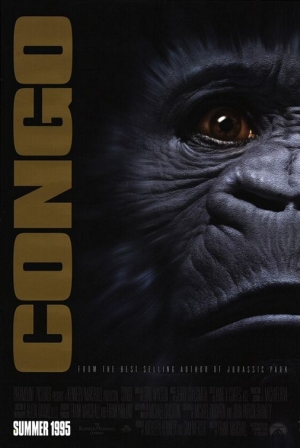
When I first saw the trailer for Congo, back in 1995, I was a new father and my interest in talking apes understandably took a back seat. While the movie sat back there like a quiet child, it was slowly forgotten. Something prompted my memory over the weekend, so I finally watched it. Now, I had plenty of time to read the negative reviews, but I have a soft spot for both talking apes and bad movies. The really fascinating aspect of Congo, however, was the fantastic liberties it takes with the ancient world, particularly the kingdom of Solomon. Solomon has been under investigation over the past few decades. Archaeologists have not found evidence of the biblical opulence concerning both his wealth and fame. It seems likely that he was an actual king, but the king of a small nation that did not have quite the pull that later tradition granted to it. Still, Solomon has become a cultural trope for great wealth and splendor, and if a movie-maker wants an easy frame of reference, well, some people will recognize old Sol. Those who do recognize Solomon probably won’t have a ready inventory of his assets to interrupt their enjoyment (that presumes a lot) of the movie.

The motive factor that brings our unlikely traveling companions together in Congo, are the fabricatedly mythical diamond mines of King Solomon, located in the Congo. A self-styled archaeologist and professional con-man from Romania assists to finance a flight to Africa to help return a homesick gorilla (Amy) who also, by the way, talks. The only realistic aspect of the heroes is that the university professors are the ones who are completely broke and have to rely on corporate funding to get their monkey off their back (well, actually she’s an ape). And then there is the huge communications giant (TraviCom) that needs the diamonds for their communications equipment. And a bunch of Africans who just want to stay alive (most don’t succeed). Solomon was never really associated with diamonds in the Bible. His wealth is described in terms of gold, silver, bronze, peacocks, and suprizingly, apes. Why and how he would have managed a mine in central Africa when even the Egyptians didn’t travel there is never explained.

Well, I shouldn’t be so hasty about the Egyptians. Our Romanian con-man is also able to translate Egyptian heiroglyphics, liberally scribbled on the walls of the fortress surrounding Solomon’s mine. These preserve the story of the “myth of the killing apes” that generated an honest-to-god guffaw from my cynical self. New mythology and corny characters aside, the movie didn’t fail to reach me. I’m always a sucker for talking apes and under-funded education, both of which represent a kind of extinction. If Solomon really had a reach all the way to the Congo, and if he extracted the huge diamonds the movie showed scattered around on the surface of the ground and if universities could actually get media attention for causes other than the shortcomings of their football programs, there could be cause for hope. In what is a bit of probably unintended social commentary, after the mine is destroyed in a volcanic eruption, only one diamond remains. And that diamond benefits neither the single surviving African nor the underfunded university professor. It becomes a weapon in the hands of a large, private corporation.


Scotland’s Cryptic Evangelist

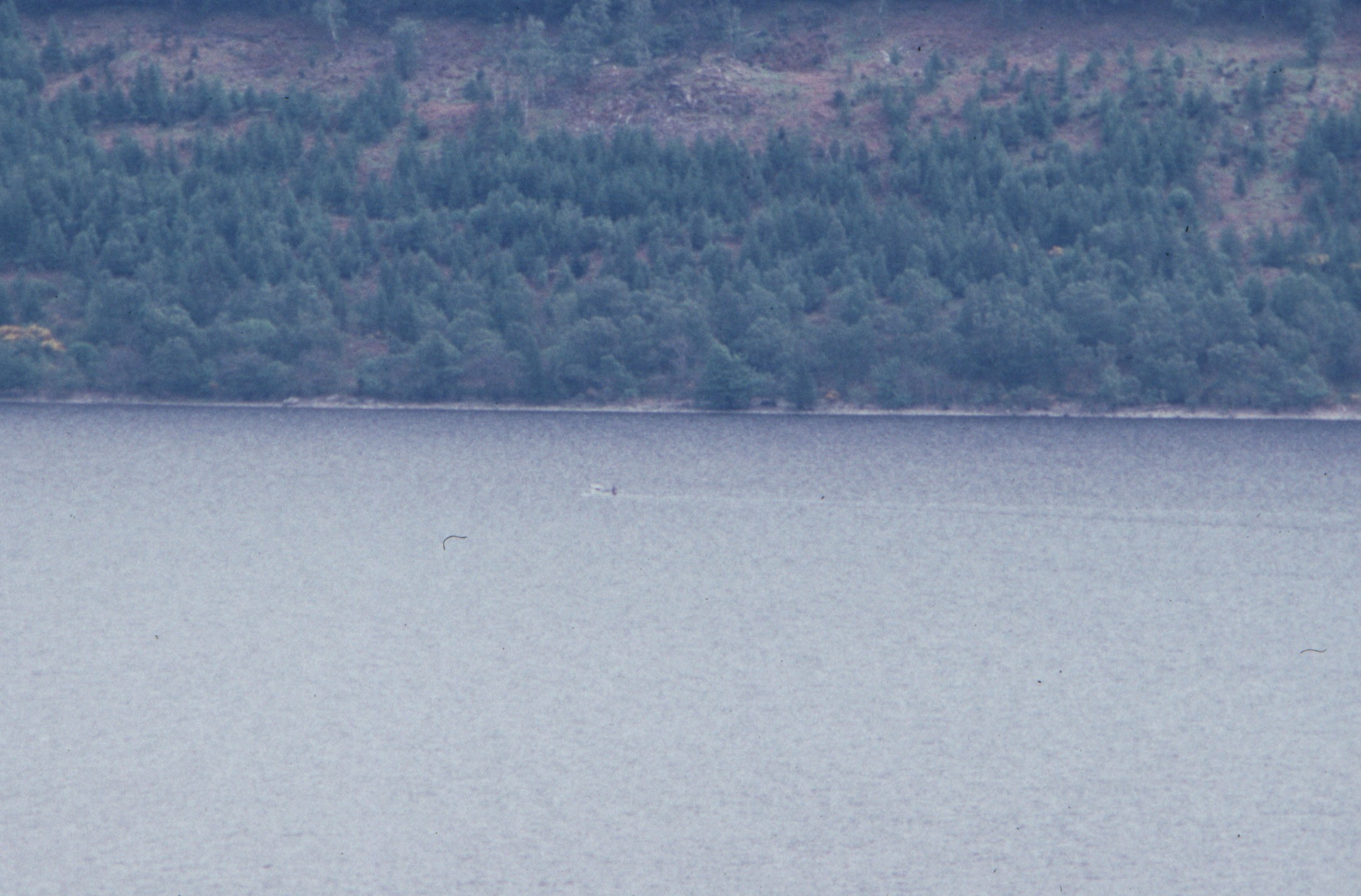
Many years ago it was now, on a Victoria Day bank holiday weekend, my wife and I were on a camping trip with friends in the Scottish highlands. Pitching our tents on the banks of Loch Ness, we joked about the potential danger—after all, Nessie had reputedly attached St. Columba, therefore even the pious had no refuge. Early the next morning, our party still intact, we drove to Urquhart Castle, arriving before it opened. Out on the loch we saw something moving through the water, leaving a wake. It was breaking the surface but was too small to be a boat and it was not a bird. It moved at constant speed until it was out of sight. This was in the days of actual film, and slide processing was “dear” as the Scots say, but I snapped off a photo anyway. The slide is too indistinct to make a diagnosis, but our friends, who had a better camera, came to the conclusion that it was a small boat. After looking at their enlargement, I still have my doubts. I’ve always sat on the fence for the Loch Ness monster. Certainly it seems improbable, but we have only a cursory knowledge of sea creatures and Loch Ness is deep and long and isolated. Is there a Loch Ness monster? Maybe yes and maybe no.

Of course, Nessie has been in the news, as my wife pointed out, backed by the considerable creativity of the creationist camp. Seizing a living dinosaur as the death knell of evolution, Fundamentalist schools in several states are using textbooks that argue Nessie’s existence proves that dinosaurs didn’t evolve and that they still walk (or at least swim) among us. An excellent corrective to this “either evolution or special creation” is Victor Stenger’s book God: The Failed Hypothesis, that I reported on a few weeks back. With apologies to the late Stephen Jay Gould, this tactic puts an entirely new spin on the concept of the hopeful monster theory.

Religion and monsters are thoroughly intermeshed. Often this intermingling comes as the result of revulsion against the unclean or impure aspects of life that monstrosity represents. Numerous analysts have shown that monsters tend to be unholy mixes of elements that religions prefer to keep widely separated—animals that would never have made it onto the ark, yet somehow have arisen since the deluge. Human fear at contamination has an excellent basis in evolution; those who never developed the sense to stay away from the sources of contamination grew sick and died off. Monsters, in this sense, serve as useful reminders for avoiding the “strange fire” that so displeases the Lord. Reading how good Christians are now reaching out the right hand of fellowship to their monstrous brethren, I wonder if a long-held belief is being imperiled. Those who would swim with monsters must be very cautious indeed, for above all things, monsters are notoriously unpredictable.


Flea the Obvious

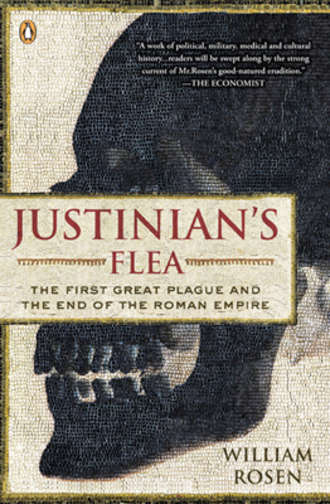
In one of my personal ironies of history, the period of ancient times that I find least interesting is the one I’ve been reading most about. Part of that is based on my lack of coherence when it comes to selecting reading material. I take recommendations seriously, so when a friend suggested Justinian’s Flea by William Rosen, I figured I’d better read it. I had fairly recently read Philip Jenkins’ Jesus Wars, about the nearly unbelievable shenanigans of post-apostolic Christendom, and so I felt up to taking on the Plague. Justinian’s Flea is about the fall of the Roman Empire. At Gorgias Press, where Justinian’s former prostitute wife Theodora was subjected to revisionist history that made her a lifelong saint, I learned to discount most of what went on during this time period. I was, it seems, a bit too hasty. Justinian and Theodora’s reign is quite interesting, and it is, as intimated, largely because of ecclesiastical politics.

Rosen begins his study by laying out the background to Justinian’s imperial days in Constantinople. In describing the disputes between what specialists now call various Christianities (formerly true believers versus heretics), Rosen notes that Christians had particular disdain for Gnostics, largely based on interpretations of what Jesus’ death might mean. At one point he writes, “Monotheistic religions are famously intolerant of apostasy, even when they disagree about what constitutes it.” Here he hit the flea on the head. “I doesn’t know what it be, but I’m ag’in it.” This attitude of religions has long been the motivation behind massive campaigns of bloodshed and intolerance. Often in the name of religions that claim peace and tolerance as the highest goods. So it was in the early church; heretics were routinely martyred for their “wrong” belief.

Not to throw in a spoiler, but the first great wave of the Plague does nearly draw an end to the ailing Roman Empire. Justinian’s expansions were mere band-aids trying to hold together a Frankenstein’s monster of many nationalities. So riding home on the bus I was surprised first of all that the driver engaged a passenger in conversation (generally frowned upon) and second of all, that he ranted for many miles about politics. It isn’t very comforting in the stressful traffic around New York City to hear your bus driver cry out, “the Roman Empire collapsed—maybe it’s time America did as well!” The prospects of getting home seldom looked dimmer. And I had just been reading about that very empire’s last days. I try to stay away from predictions because I dislike being proven wrong—the end of the story hasn’t been written yet. Rosen, however, has given us a great cautionary tale; if the humble flea can help bring down the world’s mightiest empire—one ruled by a leader overwhelmingly concerned with religion—maybe it’s time to canvass what the infidels like to take in their coffee.


Same Sex Sanity

When the people speak, sometimes it’s just nonsense. So the people of North Carolina believe in the exclusive rights of dysfunctional heterosexuals over committed homosexuals. And President Obama makes a powerful statement. As Americans we are reared to respect personal freedom. And what freedom could be more personal than the open expression of love? The reasons given for exclusivity of heterosexual marriage are spurious—certainly the Bible considers marriage in purely pragmatic, not sacred, terms. As citizens of their own time they were as much programmed by their environment as are people today. Marriages were arranged and the concept of sexual orientation simply did not exist. It is not that I castigate marriage—having been married nearly a quarter of a century myself I would be a fool to do so—but I in no way feel threatened by anybody falling in love with anybody else. Nor is it the right of any loving Christian to stand in anyone else’s way.

A God who created gender-changing fish to fry in Hell (particularly on Fridays) seems unnecessarily cruel. (Yes, such fish do exist.) A God who created other animals that exhibit homosexual behavior (bonobos, penguins, elephants, lizards—at least 450 animal species have been caught in the act) and then condemns it is surely working at cross-purposes with the nature he (always he) created. It has become quite clear from nature that sexuality is far more than procreational activity. If your kit is for kid making only, why do so many good, Christian couples have trouble conceiving? And don’t say “God only knows” because Fundies have no monopoly on questions that demand a verdict. What is God playing at here?

Intelligence and sexual behavior seldom go together. Religions, however, have a hard time keeping themselves out of the bedroom. Loving, committed relationships hurt no one. For a religion claiming to be based on love, declaring various expressions of love wrong is diminishing the good in the world. The Bible has very little to say about homosexuality. Good, Bible-believing Christians often turn blind eyes to the many more stringent passages about divorce and remarriage, but single out the very few that mention specific same-sex acts. Do they not see how such cherry-picking makes a mockery of calling anything holy? With all the excised bits, it might be more appropriately called the Holey Bible. For me, it seems they might find it more instructive to observe the moray eels rather than trying to cover their wrasses.


Supernatural or Supernormal?

For anyone who’s honest, a person has to confess to doing weird things every now and again. Often we don’t even know why we do them. Those who write about our animal cousins after observing them closely offer a storehouse of explanations. Much of our behavior derives from our evolutionary heritage. In Supernormal Stimuli: How Primal Urges Overran Their Evolutionary Purpose Deirdre Barrett presents a most cogent case for why humans take things to the extreme. Everything from sex to overeating to television to our attraction to the young to why we kill each other in conflicts may be explained by the incredible attraction of supernormal stimuli. Beginning with the bird and bee studies of Niko Tinbergen, Barrett explains how we are often simply acting out eons’ old patterns that sometime prove to be destructive when left unchecked. The way to escape from them, she notes, is to become aware of them.

A bird will often favor an exaggeratedly large and crudely patterned egg over her own. Leopards will sometimes attempt to raise baby monkeys after eating their parents, because the babies are so cute. Thousands of citizens will prefer to watch athletes on television while eating unhealthy food rather than exercising themselves. Why? Supernormal stimuli have an immeasurable biological draw, and humans are in no way exempt. Tinbergen, the eventual teacher of Richard Dawkins, saw this as one of the dangers of Christianity. By separating humans radically from animals, religion presents us with false reasoning as to why we act the way we do. Science explains, religion makes up excuses.

The most poignant aspect of Barrett’s fascinating study has to do with war. Territorial animals make frequent displays of force that, in humans, translates to war. There does seem to be a biological basis for the male predilection for aggression. As Barrett notes, “Women throughout history have said—as do contemporary ones in Israel and Palestine—that a group of mothers could sit down and hash out in one afternoon an agreement that has eluded male rulers for years.” If men could lay down their posturing and be willing to let others have a fair share of the goods, life might be more amenable to all. It’s not all bad news, however. Nature endows us with endless curiosity as well. Is that not what brought you to this blog? I hope that curiosity extends to Deirdre Barrett’s Supernormal Stimuli and we will all learn to overcome the baser parts of natural selection.


Planet of the Monkeys

“If salvation is available only to Christians, then the Gospel isn’t good news at all. For most of the human race, it is terrible news.” That may not be Rachel Held Evans’s choice for the final word on the subject, but it is the privilege of all writers to be misinterpreted. I read Evolving in Monkey Town because of an odd confluence. Evolution always tastes like forbidden fruit to me, although there can be no real doubt concerning its factuality. Also, the spiritual journeys of women continue to fascinate me. Even if the women are young enough to be my daughter. I first learned about the Scopes Monkey Trial in Mr. Pierce’s tenth grade history class. In eleventh grade I argued the Fundamentalist side of an epic, three-day debate on evolution in current issues class. I set a reputation that I’m still attempting to live down. (Studying religion for the next ten years probably did me no favors here.) The end result is that I feel a personal connection to what happened in Dayton, Tennessee, although I’ve never been there.

Evolving in Monkey Town is a memoir of a struggling, skeptical fundamentalist. Reading it at times made me squirm a bit, seeing childhood worries and frustrations coming back to me through someone else’s experience. Some of Evans’s remarks could have come from me, had I the courage to write up my past so that others might view it. At the end of the book it was obvious that I could not agree with many of the author’s personal convictions, but she earned my respect. Under the constant pressures of pleasing a deity that can’t be seen, or empirically verified, Evans sees clearly the disconnect between the teachings of Jesus and Fundamentalist Christianity. She has a wonderful knack for clear sight and forthright comment. Like me, she has become aware that a Fundamentalist upbringing is something no one ever truly escapes.

The crisis that seems to have sparked Evans’s angst was the recognition that no matter how you arrange it, an exclusive religion cannot coexist with a just deity. The world is just too big for that. Any scenario in which God sets the rules and makes it impossible for the vast majority of humanity to attain those rules does reflect rather poorly on this pater familias. We are all reduced to a diabolical game of charades as we march merrily toward perdition. Theodicy is an insurmountable problem in this live-a-day world we inhabit. Reading about the altruistic traits of the primates most closely related to us reveals something about being a monkey’s uncle. When we look at the shenanigans religions enforce on people to make them more worthy of heaven, I think we would all have to admit to living in Monkey Town.


Two Sparrows

Once I found a baby bird blown from its nest. Many future priests had walked by already that morning, not even noticing. At first I thought it was dead, but then it lifted its head weakly and opened its beak in a soundless cry for its mother. Afraid to touch it, I pulled on some gloves, took it home and called the local animal rescue center. With my daughter keeping the chick warm in the backseat, we drove down the country roads hoping the little thing would survive at least long enough to get professional help. When the trees leafed out and the air warmed up that summer, I received a call from Animals in Need. The bird had survived and was ready for release—would I like to let it go near where I found it? They had worked hard to prevent habituation, and I brought the bird home in a paper grocery bag that it occasionally tested to see if it could find its way out. With my daughter, I opened the bag in the woods and the bird was gone in a flash. We barely saw it as it flew to freedom.

If I were a rich man, well, I guess I would run for president. Perhaps it was being overseas for a week, but the presidential race seemed to fall from the news with Santorum’s demise (if ever I believed in divine intervention, it was on the day he dropped out of the race). Of course, those in Britain who knew me wondered about the carnival characters running for the “most powerful man” job. So we’re now left with a very wealthy man who’s just like the rest of us. Ironically, I’ve been thinking about the Bible—an occupational hazard—and wondering when the ideal of Jesus’ teaching was forgotten in the haste to become the richest Christian on the block (or empire, as the case may be). The disconnect couldn’t be sharper between the man who said that if you wanted to please God you had to give all your material goods away and a man running for public servant has more money than the last eight presidents combined. And Reagan was no slouch on the financial end. Where your treasure is, there will be your heart also.

I can’t remember the last time I felt valued by a politician. At least the Democratic candidates attempt the lessen the suffering of the poor a little bit, but I still see people sleeping in the streets. The roller coaster that is the economy demonstrates its unfeeling course as some get rich then plunge to the depths only to soar out of them again into sunny spaces. According to the Gospels, Jesus said not a sparrow falls to the ground without God knowing it. Apparently that little bird I was privileged to rescue was part of the divine plan. That guy sleeping on the subway grate over there trying to keep warm? Well, the politicians apparently can’t see him, and I wonder if the God who watches the sparrows has noticed either.

Not a sparrow (golden pheasant)


Strixology

One of the fascinations of parenthood is learning to see things through the eyes of a young person again. When my daughter was fascinated with dinosaurs, I found myself learning such tongue-twisters as micropachycephalosaurus (I spelled that without looking it up just now) and struthiomimus just to remain conversant with her. (That, and I never really grew up.) When she took a childhood interest in insects, I found myself picking up bugs that would have sent me running just a few short years before, in my bare hands, to take them home to show her. All of this is by way of introducing my current continuing interest in witch trials. My wife (and consequently our daughter) is a direct descendent of the Towne family that included three innocent women accused as witches in the 1690s—Rebecca Nurse, Mary Easty, and Sarah Cloyce. When my daughter found out, the next long weekend from school we drove to Salem. I’ve been reading about witches ever since. I recently finished Brian A. Pavlac’s excellent Witch Hunts in the Western World. Well, as excellent as any book about such a gruesome topic can be. In the course of reading it, an unexpected connection dawned on me.

Many of those accused of witchcraft in the early modern period in Europe were accused of killing babies. The vast majority of them were women, often midwives. Those so accused had their bodies stripped and examined in public venues, generally only to have confessions tortured out of them later, under the eyes of male magistrates. The church had given credence to the superstition that witches actually existed and were in league with the Devil. Suddenly as I read, I heard the echo of a familiar refrain that comes from modern witch hunters. Those who, like the magistrates of old, are men; men telling women what they may or may not do with their bodies. Who draw their self-righteousness from their religion and who claim that birth control is of the Devil. Who accuse women of killing babies. Texas begins to sound like the rebirth of the Holy Roman Empire. In all of Europe that was where the most women were slaughtered, in thousands, by men who burned with the zealotry of a religion that had lost touch with reality.

Time spent on history is never wasted. At times we seem to have come so far, but then I look back over my shoulder and see the suchomimus of unbridled male fantasy closing fast. We have worked hard to bring equality to all people, but at the start of yet another millennium, we are still measuring the worth of humans by the gonads they carry. Based on outdated views from a book that was once meant to be inspirational. Sadly, the legacy often left by religion is only a residue of superstition. The reasoning behind the witch hunts of yesteryear and those of today is the same—the desire to control the behavior of others. It is the cocktail of religion and politics that inebriates those who crave power. What was true then remains true today. In the words of Pavlac, “A history of the Middle Ages shows the intensifying entanglement of magical thinking with political power, which produced the European witch hunts.” Substitute “Modern Day” for “Middle Ages” and “Planned Parenthood” for “European” and see if you can’t find a pattern.


A Tiger’s Tale

When my wife finished Yann Martel’s Life of Pi she said, “You’ve got to read this book!” Philosophical novels don’t often capture the interest of publishers or agents, but when they manage to slip through the fine-mesh mail-armor of the guild, they sometimes become best-sellers. Publishers often underestimate the intelligence and the hunger of the average reader. I was glad to have something so provocative to read on my long daily commute. Since the book was published in 2001 I won’t worry too much about spoiler alerts. It should come as no surprise that the biblical flood theme comes through a book where a zookeeper’s son is stranded on a lifeboat with various forms of wildlife. The most unexpected and endearing member of this menagerie, the tiger Richard Parker, is also the most deadly. How easy it would be to spin off in a Melvillesque direction of the beast as a representation of an uncomfortable God! Indeed, when Richard Parker scampers away when the boat runs aground, Pi laments how it was like losing God.

Setting the stage for this development is the tale of three religions. As a boy raised in India Piscine (Pi) is surrounded by traditional Hindu culture. On a family vacation he notices that atop the three hills are three houses of worship: Hindu, Christian, and Muslim. Curiosity draws the young boy in, and by the end of part one he is happily and concurrently Muslim, Hindu, and Christian, to the deep chagrin of the various religious leaders. They, coincidentally, all meet Pi with his parents one day in the park and each insists that although they encourage the boy’s continued membership in their tradition, he must drop the other two. Like any sensible person, Pi has chosen the safe road when it comes to conflicting religions: accept them all. It is only religion itself that deconstructs his triune belief system.

After his eventual rescue, Pi is questioned by insurance agents concerning the fate of the ship. They cannot believe his incredible tale, because they can only believe what they have seen for themselves. Pi asks, “What do you do when you’re in the dark?” An appropriate question for us all. This story is a parable about perceiving more than what can be seen. Tigers are hidden all around. Sometimes we call them Hobbes. Sometimes Richard Parker. They are protectors and they are dangerous. Some people call them God. In the end our protagonist is left without the divine presence that had kept him alive all the way across the Pacific Ocean. When the book is over, I think we would all admit, it is the tiger that we miss most of all.


Sh*t Apes Say

Knowing from experience that when I stay alone in a hotel, despite my best intentions, I will get bored and end up watching Mudcats or Dual Survival until my brain feels like a boiled egg, I anticipated my trip to California. I packed Planet of the Apes, the original and best of the lot, hoping for some intellectual stimulation. Having grown up in an anti-evolution household, we were curiously allowed to watch Planet of the Apes, a kind of forbidden zone of the mind. It remains one of my favorite movies of all time. It is also a manifesto of science besieged by religion. Note what Dr. Zaius says, “There is no contradiction between faith and science… true science!” And he is the Minister of Science, and Chief Defender of the Faith. The trial of George Taylor, a thinly disguised parody of the Scopes Trial, has Honorious (read William Jennings Bryan) stating, “It is based on our first article of faith: that the almighty created the ape in his image, that he gave him a soul and a mind, the he set him apart from the beasts of the jungle and made him lord of the planet,” and turning on his fellow apes Zira and Cornelius, he accuses them of being “perverted scientists who advance an insidious theory called evolution!”

Dr. Zira, as one of these “perverted scientists,” asks Cornelius (incidentally, the name of the first non-Jewish Christian, according to Acts), “How can scientific truth be heresy?” This is echoed by Dr. Zaius in the trial where he states, “It is scientific heresy that is being tried here.” Indeed, the entire simian culture is based on the blurring and blending of science and religion. Throughout the film various characters make barbed statements about the human propensity to ignore the obvious. Landon, challenging Taylor about the time change they experienced in space, says—in a line that could come straight from Answers in Genesis—“Prove it! It’s still just a theory.” The exact rhetoric currently used by creationists in school board meetings around the country. To which the most apt reply seems to come from Dr. Zaius, speaking of humanity: “his wisdom must walk hand-in-hand with his idiocy.”

Occasionally even the gun-toting humans get the picture clear. In his opening monologue George Taylor wonders about the world seven hundred years from now, “Space is boundless. It squashes a man’s ego. I feel lonely. That’s about it. Tell me, though. Does man, that marvel of the universe, that glorious paradox who sent me to the stars, still make war against his brother? Keep his neighbor’s children starving?” This seems to be the true measure of heresy—a religion that puts fellow humans on the same level as animals (and even animals deserve far more credit than we are willing to give). Among my favorite lines is Cornelius’ response to Taylor shaving his beard; “Somehow it makes you look less intelligent,” he opines. Endlessly remade, Planet of the Apes is a movie that still answers some of the issues that plague our society nearly half a century later. Perhaps the last line should go to the apes, adjusted of course, for gender sensitivity, “[hu]man[ity] has no understanding.” Well said, Dr. Zaius, well said.

A piece of childhood


Real Hope

I’m doing something I seldom undertake: posting a second blog entry on a single day. Well, I’m in California and my time scale is all out of whack anyway; who’s to say what time it really is? Last night (or was it afternoon?) I checked into my hotel to find a message from Una McGurk, the colleague of Trina Paulus and coordinator of the Hope for the Flowers Kickstarter campaign. I mentioned Trina Paulus’ Hope for the Flowers in a recent post, as a way of summing up some thoughts on resurrection and societal change. I am a die-hard idealist, often to my own detriment, and I didn’t really elaborate on just how important a book Hope for the Flowers is. In all seriousness, it is a transformative book for those receptive enough to read it with an open mind. Sometimes we’re inclined to think that books that look as if written for children can’t have anything adult to say. We are so wrong.

In keeping with the spirit of the book, Trina Paulus and Una McGurk are attempting to raise funding to produce an independent animated version of the story. Since movies and books dominate my post topics, this is a cause I find worthy of support. A bit of a spoiler alert here—if you haven’t read the book, or if you simply need to be reminded, Stripe and Yellow are caterpillars in love. Stripe, however, is drawn to the world of what all other caterpillars do—climb. Forsaking his love, he climbs to the top of one of the countless caterpillar pillars in the world only to find that those at the top get there by throwing others off. The top of the pillar is empty. Nothing is there except the hollow feeling of having beat others to the pinnacle. Still, above the pillar, butterflies soar.

It is a simple story, but the message is profound. And necessary. Looking at the progress of corporate greed and heartless acts of personal promotion, it is difficult not to call Trina Paulus a prophet. In a day when Christianity is identified primarily with draconian restrictions on what “true believers” cannot do, I think we could all use a few more butterflies. Chances are, if you are reading this blog, you have some sympathy for the human race. If you do, visit the Hope for the Flowers website and consider pledging a donation, no matter how small, to spread this message further afield. Not only the flowers, but also the very survival of humanity could well depend on it.

A California caterpillar says yes!


Hope for the Flowers

Resurrection can become a tired trope, but it is the stuff of both religion and science. Last week it was reported that Russian scientists revivified a plant frozen on the tundra 30,000 years ago. Quite apart from proving that Siberia was already in place 24,000 years before God got around to creating the planet, this amazing feat teaches us lessons about life and its resilience, and also of the possibilities beyond the great pale. The scientists regrew the plant without the benefit of using seeds, making this a kind of virgin birth of the florid kind. Using plant versions of stem cells (the kind of science forbidden in the USA: “won’t somebody think of the seedlings!”), the dead plant was rejuvenated and is alive and healthy in a world vastly different than the mammoth-infested, frosty plains of northern Russia where it first saw daylight. Still, that environment was less hostile to science than the Religious Right. This resurrection shows that we don’t need miracles to bring inert matter back from the dead. No doubt there are covert Creationists trying to sneak into Russia with travel-sized bottles of Roundup in their carry-on bags.

Science has brought us to incredible places by its continued, self-critical process. Religion, preferring no critique, has given us characters like Rush Limbaugh, Glenn Beck, and Rick Santorum. And a really big book. Looking at the religious scene today it is difficult to believe that religions began as exercises in optimism—the world could be better if only we’d progress. Regress now characterizes the religion in the public eye—men (occasionally women) claiming that things were better when we were tilting with mammoths than they are now with people advocating equality for people of other genders, races, and sexual orientations. Science represents our progress, and the vocal theocrats claim we should be going backward. Back to when men were measured by the size of their spears.

Back when I was a teenager I discovered the book Hope for the Flowers, by Trina Paulus. Not really a graphic novel, and not really a children’s book, it tells the story of two caterpillars with the courage to reject the constant, heartless climbing so often required by the world. In the end, of course, they become butterflies. The story has a religious subtext, naturally, but it was for a religion that believed butterflies should be valued rather than smashed between the pages of a heavy Bible. Butterflies bring the pollen that allows flowers to thrive. We live in a world where butterflies have become soft and defenseless while religion is aggressive and offensive. Science has shown us the way to bring flowers back from the grave, but old-time religion is waiting in the shadows with its rusty scythe.


Nevermore

Once in a while an uncanny clarity penetrates this fog of an asphyxiating miasma that passes for a life in higher education. It was a rainy, gray day in February when I stood outside 13 West Range at the University of Virginia, looking into Edgar Allan Poe’s restored room. Poe, who is right up there with Melville and Moses among the greatest writers of all time, lived a life that was short, sad, and silenced. Or so it seemed. Dead by 40, with a career that never really got a foothold, Poe would seem to be the ideal model of a failure. His currency, however, has preserved the voice of unrest that pulses like the very life-blood through American culture. Even as a teenager, I identified with Poe. Knowing that I could never attain his level of polish and perfection, even listening to the cadences of “The Raven” can still reduce me to tears. So, standing outside his room in the gloomy rain was a private epiphany.

13 West Range

Undefined was the sense of loose ends and hopelessly tangled threads of a life I tried to weave without the blessing of Athena. I ended up at a small seminary where my influence was limited to the few students with open minds. It was truly a gothic experience, living at Nashotah House with its medieval mindset and matching physical setting. Daily watching my learning being shredded by the staunch dictates of undying dogma, I never forgot Poe. When my own career was jettisoned by a bloated theology that had no room for questions, I spent many months in a depression so deep that life had almost lost that spark of hope that makes it worth continuing. Again and again the waves crashed over me—this was the doing of the church. Those who putatively followed the teaching of a man who said, “Do unto others—” Fill in the blank.

Poe was forced out of school by an unloving foster parent who valued money more than his adoptive son. Traveling up and down the east coast looking for a place to fit his writings into a slot for a little money, he died from causes that will never be identified. Today we know he was a meteor—a brief, brilliant light in a darkened sky. He is the patron saint of all those whose voices have been silenced by an unfeeling establishment. Even in my wildest dreams, I never hope to approach the depth and grandeur of his pen, but I can stand here in the rain and commune with him. The emblem of the Raven Society stands perched in that room, and its single word is the dying word of hope in the face of an uncaring world. And that one word will be the epitaph of society that refuses, even now, to listen.