I Think, Therefore I Believe

This week in Time, an article by Jeffrey Kluger explores the intelligence of animals. Quite apart from many examples of how bonobos can string together relatively complex concepts using symbol cards (thus evidencing more intelligence than New Jersey’s current governor), the article demonstrates that many animal species display what we would recognize in other humans as intelligence. The article then develops the corollary that if animals think then perhaps they sense emotion as well. Having raised my daughter on Kratt’s Creatures and Zoboomafoo, none of this was new to me. I may be no scientist, but watching closely how animals behave, it has always been obvious to me that we are more like points on a continuum rather than a “special creation.”

Not to put too fine a point on it, this is what lies behind the human obsession with its non-animal status. As Kluger states, “For many people, the Bible offers the most powerful argument of all. Human being were granted ‘dominion over the beasts of the field,’ and there the discussion can more or less stop.” Unfortunately for our animal companions, the use of the Bible to repress others does not stop at human beings who don’t share your religious views. Many use the Bible as an excuse to do as they please to creatures who demonstrate similar emotional responses to people in similar situations and who, increasingly we realize, also think. Kluger’s article opens with an interview with Kanzi, a bonobo. One of the inevitable conclusions is that this great ape is able to think ahead and make plans. Evolution on this point has apparently skipped many Neo-Cons.

For years I have been telling my students that animals display behaviors that we label as “religious” in humans. The difference is that we are able to ask other humans what they are thinking and thereby gain somewhat direct access to their thought process (if they are telling the truth). Because we fail to share language with animals, we assume we are superior thinkers. To me this does not stand to reason. Animals are as fully members of this planet as humans are. Our desire to exploit them is more a reflection of human dominionist tendencies than a reflection of their lack of intelligence. We may even have animals to thank for the basic tenets of religious thought since religions are better described as evolved than revealed.

Maybe not the best sign of animal intelligence, but consider the Neo-Cons...


My Animal, It’s a God!

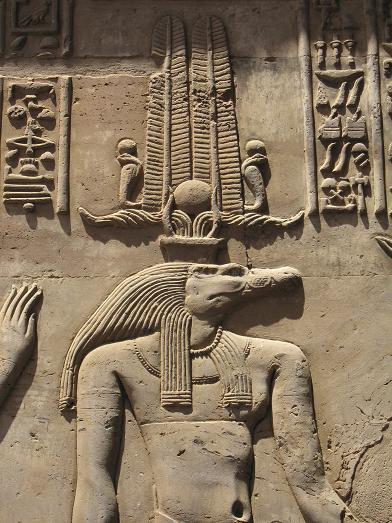
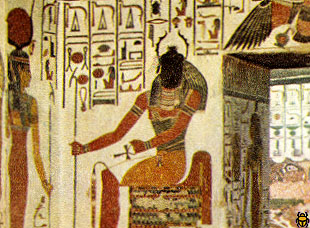
Preparing to enter the Egyptian segment of Ancient Near Eastern Religions, I always have to shift gears to their unique portrayal of the gods. Unlike the Sumerians, who preferred an anthropomorphic divine world, the Egyptians reveled in theriomorphic and Mischwesen deities. Almost earning the title of ancient hippies, the Egyptians felt a deep connection between the world and their gods – as well as living by the mantra “life, health, peace.” Their connection to the earth resulted in gods in animal form or human bodies with animal heads. Having read several attempted explanations, it still comes down to the fact that we don’t know why Egyptians mixed the divine and the animalistic.

Egypt was a culture that bloomed in harsh surroundings. Whether they fully realized it or not, their civilization was survival on the very brink of inhabitable space. Surrounded by desert, much of ancient Egypt was just that thin stretch of land within the fertilizing reach of the Nile’s flood zone. Beyond that, in the “red land,” few survived. Yet the desert is not completely barren. Animals better adapted to heat and aridity survive there. The Egyptians had an appreciation for the divine attributes of animals that are in some way more clever than humans. It is the nature of divinity to be more than human.

The Egyptian ideal of life in harmony with a fragile environment is one that the world could stand to relearn. Instead of proclaiming superiority over mere animals, they recognized that animals know some things that people have not yet learned. How better to display the mysterious power of the gods than to utilize the mystique of the animal world? Sure, a human with a beetle for a head may seem more like a horror-film gone awry than religion, but when the superiority of the scarab is realized, religion will naturally follow.


Paranormal Prophets

At the suggestion of a friend, I watched The Mothman Prophecies last night. Very loosely an updated version of the collapse of the Silver Bridge in Point Pleasant, West Virginia, the movie both satisfied my monster movie habit and my interest in things biblical. As a monster flick, it was satisfying in maintaining tension, never clearly showing the creature. As a representation of prophecy, it falls into the camp of Nostradamus.

Reports of the “mothman” began in 1966 and continued over the next year. It was reputedly seen near the Silver Bridge, the artery that connects Point Pleasant with Gallipolis, Ohio. After the tragic collapse of the bridge, resulting in nearly 50 deaths, the paranormal prophet was never seen in the area again. While in West Virginia last year, a friend introduced me to a couple from Point Pleasant who stopped into her store. They looked a little embarrassed when the mothman came up in conversation.

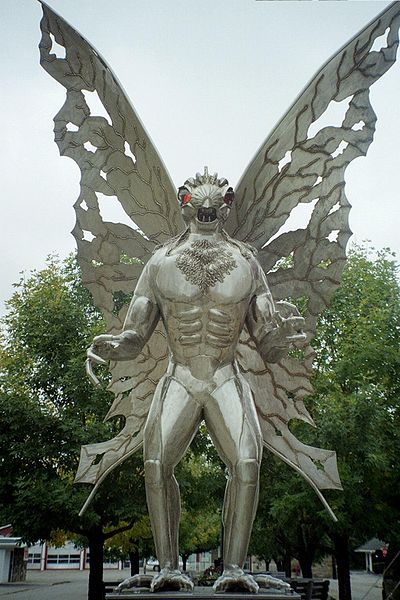
Point Pleasant's mothman statue from WikiCommons

Prophecy, in the vernacular, refers to predicting the future. Although some biblical prophets correctly intimate future happenings, mostly the image of prophets in the Bible is that of effective speakers. Prophets are individuals who participate in the reality of the world by adding their powerful words to the mix. If their words regard a future event – fairly rare in the Bible – they affect the outcome because their words have influence in the world. It is a supernatural view of the spoken (or written) word, to be sure, but it is a long cry from predictive ability. It is a matter of perspective.

Interestingly in the movie, Alexander Leek, the specialist on mothmen (apparently there are many), suggests that they see farther because they are higher in the sky than humans. In other words, it is indeed a matter of perspective. Certainly the mothman must go down as one of the oddest cryptids sighted. I give them no credence as prophets, but I will think twice before driving over bridges from now on.


Mythology Gone to the Dogs

Today’s New Jersey Star-Ledger reports an inter-species religious scandal that highlights the vast difference between god and dog. Last month a Canadian Anglican priest fed a dog a communion wafer. The gesture, a spur-of-the-moment reaction to a visitor who brought his dog to church (somewhat of a rarity in itself) was likely just a reflex to seeing that inevitable lolling tongue at the communion rail. Priests see lots of lolling tongues, mostly human.

In my long years at Nashotah House, where daily communion was a requirement of all faculty and students, I’m sure I consumed several pounds of communion wafer. I also received many stern warnings that this particular food item – if communion wafers can really be considered food – was unlike any other and must be treated with the utmost sanctity. Ironically, more than once I was handed a wafer by a priest with an out-of-control head-cold who’d clearly just contaminated an entire paten full of the sacrament with an eager virus. Within a week most of the student body would be hacking up an holy phlegm, not dissuaded from sharing the common cup. Despite the obvious fact that the ritual had become a disease vector, the mythology of its sanctity lived on.

The history of Christian ritual is a specialized field with experts who know the minutiae of each subtle gesture and the history of each preposition in the Anaphora. The ritual itself has become an object of worship. For some the fate of the wafer has become the fate of the world. This is mythology in action. Nevertheless, I have often received unbelievable hostility from those crowned with righteousness. As long as the right words are pronounced in the right order with the appropriate gestures, it is perfectly acceptable to stab another human being in the back.

I grew up with dogs. With the rare exception of the occasional biter, canines have treated me very well. Some on the verge of worship. If it comes down to choices, I’ll take my chances with the dog with a lolling tongue rather than with the priest with the magical bread.

Belief in dog is not a bad thing


Sharks and Apostles

There are sharks in the water. For the third day in a week, some New Jersey beaches have restricted access to the ocean because of sharks. As a particularly hot July trundles along, this is not really welcome news. Also yesterday, the Vatican codified revisions to its clergy sexual abuse crisis. According to an Associated Press article in the New Jersey Star-Ledger, women’s ordination groups are angry because sexual abuse and the ordination of women are classed together as crimes against the church.

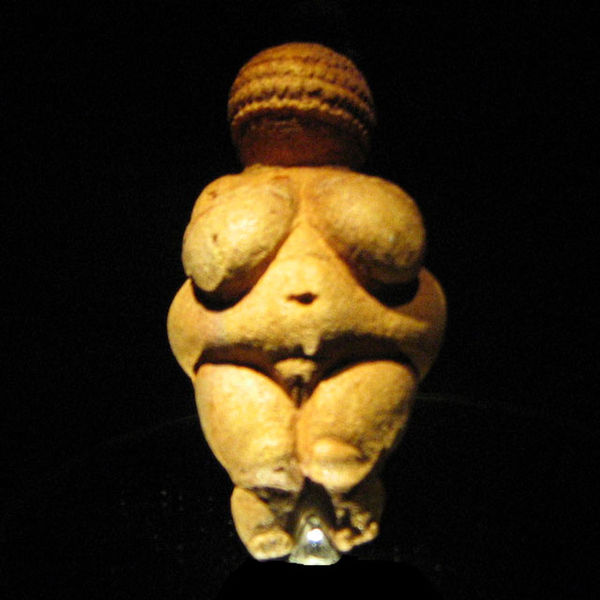
Venus of Willendorf

Even before civilization began, it seems, religion and sexual dimorphism were tied together. Beginning back 35,000 years ago Paleolithic humans carved female figurines. In a hunter-gatherer society where struggle for survival was the best paying job available, the execution of such objets d’art in a brutish, hostile environment reveals religious sensitivities. Stone Age humans knew something that organized Christianity forgot within its first century: sexuality is never far from religion. The Bible itself, particularly the Christian Scriptures, emphasize that celibacy is a putative gift, not something that can be learned or forced on someone. In typical Roman fashion, however, the church quickly mandated celibacy as the norm and ruled that women were the source of evil.

Nothing could be further from the indications of both Paleolithic remains and scientific thinking. Women, long the source of spirituality, were now cast aside in an arrogant aberration of earlier practice. Largely based on the angry writings of one man, the church decided that men alone should determine the eternal fates of others. Masculine men who knew self-control and who could turn off millennia of evolutionary pressures by a sheer act of will. Centuries later, and the Vatican with its own Pontifical Academy of Sciences, the church still can’t get beyond basic reproduction and sexuality issues. I would go to the beach to try to think this one out, but there are sharks in the water.


When Dinosaurs Will Rule

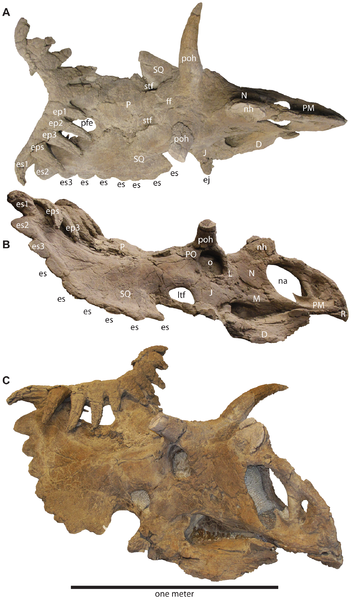
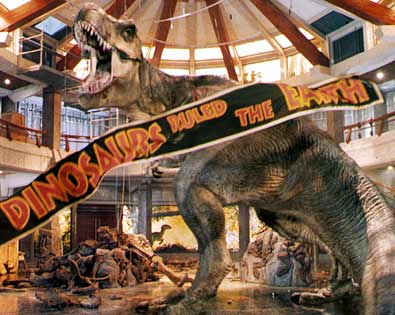
Just about all of us begin life as budding paleontologists. What kid doesn’t adore dinosaurs and their paradigmatic story of planetary rule followed by inexplicable decline? The mystery and drama only add to the fantastical nature of the beasts themselves – creatures towering over houses and trees, predators the size of school buses. When my daughter hit dinosaur age, my latent paleontologist experienced a profound resurrection. Sure that she’d become the next great dinosaur hunter, I relearned all the old species names and added dozen more from creatures discovered since my interest went underground. While my career was spiraling downward at Nashotah House, I contacted the paleontology program at the University of Wisconsin to see about retraining. I even started to teach myself calculus.

Life delights in playing funny tricks on people. Once again my career in religious studies spirals downward and the specter of the dinosaurs rises. Literally. A former student of mine pointed out an article on Helium.com that spells out some possible implications of the Deepwater Horizon fiasco. The first sentence reads: “Ominous reports are leaking past the BP Gulf salvage operation news blackout that the disaster unfolding in the Gulf of Mexico may be about to reach biblical proportions.” The Bible is our standard measure for disaster; no crisis can not be made worse by throwing in the adjective “biblical.” If Terrence Aym is correct, however, even the Bible won’t save us now.

Apocalypse now?

Basing his analysis on Gregory Ryskin’s thesis that immense methane bubbles from under the ocean led to several past mass extinctions on our planet, Aym suggests that all the signs are present that a true doomsday scenario is unfolding in the Gulf of Mexico. I have seldom been impacted by doomsday predictions, but Aym’s article is perhaps the scariest thing I’ve read in years. I’m not enough of a scientist to assess the danger, and the media blockade only makes the speculation worse. Could it be that the decay from all those dead dinosaurs, their cohorts and predecessors, their flora – the very source of fossil fuels – is rising to deal yet another mass extinction on our planet? The reader will need to decide. For me, I regret that I didn’t stay with the dinosaurs, for they still rule the planet.


Jurassic Playground

Over the weekend I watched Jurassic Park for the first time in many months, perhaps even years. Despite the caricatures that substitute for believable characters, the dinosaurs are mostly believable and the warning tone appropriate. Throughout Dr. Malcolm cautions against “playing God” – an interesting perspective for a character who ascribes so fully to chaos theory. So when the television was off and the dinosaurs once again safely extinct, I continued to ponder this notion of “playing God.”

Quite often the phrase occurs in two main contexts: those of science and ethics. When humans have discovered the naturalistic explanation for a phenomenon and devise a human means of altering it, we are then in the realm of “playing God.” It seems to me that this is only a difference of degree from what people, and other creatures, have always done. Does not every action we take have endless ramifications? In our own little chaotic system, our decisions and activities impact others just as surely as a T-rex stomping through the park. It is only a matter of degree.

As human beings we may be the only animals that consciously “play God,” but the truth of the matter is that we are all pieces in an intricately interconnected system. Animals, even plants (behold the kudzu!), influence the activities of others, changing courses of rivers, degrading the environment, blocking the paths of ants, ant-eaters, or ant-eater eaters. What could be more natural than “playing God?” This, of course, doesn’t change the ethical angle, but throws it open much wider. Should we clone dinosaurs? Should we clone people? Don’t ask me – I’m too busy playing God in my own little corner of the world.

T-rex plays God


Cryptid Be Thy Name

While poking around the internet last night to take my mind off the heat and humidity surrounding me, I stumbled across an article entitled “The Religious Struggle over Cryptozoology” on a site called Science and Religion Today. The piece was written by Joe Laycock, a doctoral candidate at one of my alma maters, Boston University. Having just finished Bruce Hood’s Supersense, there was a pleasing euphony in the coincidence. Cryptozoology is the study of unknown animals, and is not necessarily based on the supernatural (although it may fall within Hood’s definition of it). Laycock notes that two religious elements in society have latched onto this study: New Agers and Creationists. Creationists, it seems, see in certain cryptids, such as the Loch Ness Monster, hold-overs from the Mesolithic Era that prove the Mesolithic Era never existed. God can still make dinosaurs today, therefore the Bible (which doesn’t mention dinosaurs at all) must be true.

The draw of the unknown

One of the most welcome parts of Hood’s thesis was its consonance with Stephen Asma’s On Monsters, a book I’ve posted on before. Both authors explore how the human psyche reacts against what it perceives to be “strange mixes,” beings that cross-over between readily defined categories. Hood addresses this by tackling the concept of “essence” while Asma notes a dread accompanied by a sense of wonder. Hood demonstrates that from a scientific point of view, there is no such thing as the “essence” of a person, object, or living thing. Such ideas are the cling-ons from the era of souls and radically distinct species and genders. Closer observation has taught us that many such things are more of a continuum than a series of sharply defined types. Religions prefer to have fixed categories. Religious ethics often depend on them.

Laycock suggests that both New Ageism and Creationism “can be read as a religious response to the cultural authority of science.” Religions fear that which can be empirically demonstrated since it throws the god-of-the-gaps into the dryer and he comes out smaller each time. This is so, despite the fact that Creationists crave scientific respectability. While teaching my course on Myth and Mystery at the University of Wisconsin Oshkosh, I dwelt on cryptids for a few sessions. They are indeed often surrounded with a religious mystique. I wouldn’t necessarily dismiss the possibility of undiscovered species, many new ones are described by science every year. Nor would I say that they are supernatural. Nature has ways of surprising us still, and as Asma clearly demonstrates, we still have a need for monsters.


Go Fish

You are what you eat. That trite truism has been kicking around for a few decades now, and although it has been an aphorism to encourage healthy eating it does convey a deeper truth. Scientists working in Africa have determined that the hominid diet of roughly two million years ago led to rapid brain expansion (rapid on an evolutionary scale, of course), according the New Jersey Star-Ledger. Remains found in Kenya, featuring a Rutgers University archaeologist, have indicated a widely varied diet of fish, turtles, and crocodiles among ancient hominids. Apparently these animals provide valuable nutrients for brain development, a somewhat disturbing piece of information for us vegetarians.

The more I have pondered this information, the more it has become evident that the concept of God has undergone considerable evolution. As I have noted several times in the past, religious behavior emerges at the very least in the Paleolithic Era of human development. What those non-literate ancestors thought or believed about “God” is long lost, but it seems to have persisted into modern conceptions of divinity. Belief in supernatural beings is attested world-wide, and therefore is a true human universal. (There are, of course, non-theistic religions and individuals, but all cultures show some measure of belief in the supernatural.)

In those moments when I am free to ponder what this might mean, I wonder about the earliest conceptions of the divine. It seems likely that this being was like a hominid, able to respond in kind to placating gestures on the part of early humans. An abstraction simply doesn’t fit easily into minds focused on the practical aspects of survival without the guidance of professional theologians. That early God was able to, but not obligated to assist our fearful ancestors with the struggles of daily life. That aspect of the divine being has not changed in many millennia. Even today many religious individuals still consume fish, a food approved even for meat-free days, by God himself.

Early images of God?


Mystical Aquariums

This is the dawning of the age of aquariums. With the Gulf oil spill still gushing out of control, there is a current awareness of the plight of the seas due to unnatural (i.e. human) interference. Perhaps that is why so many people flocked to the Mystic Aquarium yesterday. That, and the fact that it was a beautiful day on the northeast coast. Having grown up in land-locked western Pennsylvania, I have always appreciated the oceans and their microcosms, designed for human visitation. My first actual aquarium experience was the New England Aquarium in Boston, a facility that sets a very high standard for all others. Trips to the Seattle Aquarium, the Norwalk Aquarium, the Camden Aquarium, and a variety of smaller facilities (I unfortunately missed out when my family visited the San Francisco and Shedd (Chicago) Aquariums) always leave me with a sense of connectedness to our planet. Life emerged from the seas, and, as Rachel Carson observed, we always long to go back to our ancestral home.

It is easy to spend an entire day at the Mystic Aquarium. Beluga whales are impressive close-up, and the sea lions show more intelligence that your average Republican. Jellyfish, with no brain at all, are capable of doing tricks humans can’t – a tank of bioluminescent jellies was captivating. The penguins had a fascination all their own. It had been a few years since I’d been able to pet a shark or ray. In a separate exhibit on Deep Sea exploration, largely featuring Robert Ballard, the man who discovered the Titanic, the aquarium houses several robots used for entering regions uninhabitable by humans. Since my intense association with FIRST Robotics is never far from mind this was an unexpected bonus. The biblical aspect of the journey, however, came at the end.

Exhausted from a day of wandering, hot and lethargic, we came across the final exhibit: Noah’s Ark! I had begun to wonder if I’d managed to spend a day in an entirely secular venue when the Bible showed up. The display was about the Black Sea. William Ryan and Walter Pittman’s theory of the origin of Noah’s flood in the Black Sea deluge was showcased, along with a video of Ballard, Ryan and Pittman discussing their ideas. As I tell my students, I don’t find this theory particularly convincing – the flood story first emerged, it seems, in southern Mesopotamia – but it is an excellent example of the hold the Bible has on the western imagination. The Black Sea did flood, shifting from fresh to salt water; that discovery is fascinating in itself. In the western world, however, it somehow just feels incomplete without giving old Noah his own Nantucket sleigh ride. To find the origin of the story of Noah, a trip to any vantage-point along the ocean where the power of the sea is evident is all that is required.


Voices from the Third Estate

Discussions over the past week in that great wasteland we call state government have included talk of actually having millionaires taxed to shoulder a little of the state’s fiscal burden. Naturally there has been a strong backlash in this nation of deeply embedded plutocracy. Those who have their millions certainly feel little social responsibility, since the prosperity Gospel (or its analogs) comforts them with whispers that wealth is a sign of blessing. One of the most evil ironies of all is that many such folk have the chutzpah to cite the Bible as their backer. God loves the beautiful people.

Such virulent misreading of religion shrugs off millions of gallons of crude oil gushing into the Gulf. Petroleum companies breed some of the wealthiest individuals around, and if we wipe out the marine life of the southern coast, well, that’s a small price to pay for individual privilege. Somewhere along the line an unholy matrimony between religion and greed produced the great plague that will lead to the fall of western civilization. This may be seen clearly among the apes.

Frans de Waal, an author whom I’ve quoted before, notes that in ape society when an individual (or individuals) takes advantage of the system, the group eventually brings an end to his (or rarely her) reign. Primate society can only tolerate abuses that damage a community for so long before a collapse is immanent. Consider Rome, “the eternal empire.” Every day politicians posture in the media about how they have the best interests of society at heart. As members of the privileged classes, they have lost sight of what it feels like to live in the constant umbra of the supercilious wealthy while millions have no jobs, no health care, no future. Millionaires owe nothing to the society that allowed them to become rich, for the Bible tells them so. Nature, however, begs to differ.


Giving Lilith Her Due

Lilith Fair has announced its 2010 tour dates and excited fans are already purchasing tickets. Lilith Fair is a collection of women artists who share a stage to showcase the female contribution to contemporary music and donate a considerable share to charity. The event name, of course, is taken from the mythological character of Lilith. Popularized as a rare example of “Hebrew myth,” Lilith is a character who likely derives from ancient Mesopotamia, although her origins are obscure. Best known as “Adam’s first wife,” her somewhat sexy story in Judaic tradition evolved into Lilith being the original woman. Unlike Eve she was created simultaneously with Adam. Things were fine until she wanted to be on top during intercourse – males were not made to be dominated, according to patriarchal old Adam, and Lilith ships out to shack up with Satan. She is demonized (literally and figuratively) and becomes the “night hag” that snatches babies and claims the first right of intercourse with every male (an etiology for nocturnal emissions). She becomes the mother of demons.

This story shows all the traits of a late development, but the idea of a strong female figure in Eden is an appealing one. Lilith has come to represent the empowered female, and the modern trend towards accepting her as an icon of feminine independence is apt. Long ago I was intrigued by the female side of the story. Perhaps because I was raised primarily in a single-parent family for my formative years, I have always wondered about the disparity in our “advanced” culture that still considers the male as the “default” model with the female as kind of an adjunct after-thought. This fascination led me to the study of goddesses in the first place, culminating in a doctorate on Asherah. In the Bible men have Adam, Noah, Moses, David, and countless other role-models – even God himself according to standard interpretation. Why not admit the goddess?

It is telling that when Lilith becomes too powerful she is presented as evil. Anthropological explanations have little to offer by way of adequate explanations for such a development. Not to blame biology (or to lay claim to an excuse), but Frans de Waal’s Inner Ape demonstrates that males are hopelessly paranoid about showing weakness. Female primates tend to express their power by group cohesiveness while males try to blunder their way to the top with brute individualism. Adam had nothing to fear from Lilith. To those who perform in Lilith Fair, I only have to say, “Rock on!”


LOL Cat Bible Commentary, Part 1

It was bound to happen. Here is the first installment of the LOL Cat Bible Commentary.

Genesis 1.1 Oh hai! In teh beginning Ceiling Cat maded teh skys an teh Urfs, but he no eated them.

In teh beginnin
In teh beginnin ub teh dai — Ceiling Cat nawt wurk at nite, cuz datz wen
Basement Cat come owt to do ebil stuffz.
Ceiling Cat
Ceiling Cat writed da Bible. He’z the mos smartess an strongess kitteh ever. An him reely good — he no eat other kittehs fud, an he nebber jumpz on another kitteh in da middul ub teh nite (but for hoomuns dis ok).
maded teh skys
But first him taked a nap. Den Ceiling Cat maded teh skiez so him had place to liv. An den him putted a hole in da ceilin so him kood peep down on teh Urfs. Wait, him nawt maek teh Urfs yet! Ai sowwy, plz to furgive? Kthx.
an teh Urfs
K, nao Ceiling Cat maek teh Urfs. Urfs is where the hoomuns howse iz.
Ceiling Cat no maek teh udder Urfs, jus da wun wif da howse.
but he no eated them
Ceiling Cat can has a hunger after awl taht wurk, Aifinkso! But him no eated teh skiez, cuz den him fall owt, an den dere no moar kittehz to wurk on da Urfs. An him no eated teh Urfs howse, either. Him wanted to maek teh birdiez an teh moal an teh fishiez. An him also want to maek teh hoomuns for to maek his fud.

1.2 Teh Urfs has no shayps an has darwk fase, an Ceiling Cat roed invisible bike ovah teh wawters

Teh Urfs has no shayps
Cuz Ceiling Cat nawt evur maded a Urfs befoar. Him not no wut Urfs shayp iz!
an has darwk fase
Ceiling Cat can to seez in teh darwk, but dere nawt eny shayps to seez. The Urfs has dawrk fase liek teh howse wif no elec…elek…elekt…wif no lytes.
roed invisible bike
Liek him wuz dreemin. Invisible bike is hawrd to be finded in teh dawrk, but Ceiling Cat maded it an him finded it.
ovah teh wawters
Ceiling Cat nawt liek to get him feetz wet, so him no rided teh bike thru taht wawter. Wawters has see monsturs an stuffs.

1.3 At furst, has no lyte. An Ceiling Cat sez, “I can has lite?” An lite was.

At furst, has no lyte
Ceiling Cat nawt need lyte, but him noes taht hoomuns will to need lyte for to maek noms.
An Ceiling Cat sez
Ceiling Cat has to tawk to himself cuz of monokittehism. No udder kittehs arownd yet, not ebben Basement Cat.
I can has lite?
Ceiling Cat reely wanted a cheezburger. But him needed a hoomun for to maek cheezburger. So him has to maek teh lyte for to get noms.
An lite was.
Nao him can to see howse an da Urfs he maded. Den him maded lolz an udder stuffz, but first him taek moar napz.

(Translated into LOL Speek by the world’s greatest CATS! Fan Kthx)


Thoughts Off de Waal

Although Frans de Waal’s Our Inner Ape was published half a decade ago, the monograph remains terribly relevant. I gave some primary impressions of the book last week, but one section has remained firmly in my head and has mingled with all the harsh rhetoric in the news about health care reform in the United States. Asking the question of whether Homo sapiens are still evolving biologically, de Waal withholds his final opinion on the matter, but he points out that statistics indicate Americans are falling behind much of the rest of the developed world in terms of general health. This he ascribes to the competition inherent in a free market economy that favors the best health care only to the wealthy while the average citizen is offered substandard options. The numbers bear him out on this – he notes that on the standards utilized to measure general health, the United States is not even in the top 25 industrial nations.

With the conviction of a true prophet, de Waal notes that privatization of health care has led to a precarious imbalance in medical care in the United States, where the top 1 percent of citizens has more income to spend than the bottom 40 percent combined. This, he believes, is because we have lost sight of the altruism inherent in apedom. Although the great apes are endangered (ironically, by their overly greedy genetic cousins) their societies show no such disparity. An ape family will assist a weakened or feeble member and give it extra care to ensure that it is offered a life as comfortable as possible. They do not discard the fragile and “expendable” members. Republicans, however, wave placards trying to shout down basic health coverage for the poor.

Does biological evolution continue among the human species? Have we stopped natural selection’s eternally ticking clock? Only time will tell. It does seem, however, that the very Bible pounded by the Religious Right (health care reform’s greatest opponent) would argue that the apes got it right. We should care for the poor, disadvantaged, and underrepresented. While the Tea Party belles are busy trying to rewrite history with America founded as a Christian nation they daintily wipe their mouths on the pages of the very book they treasure so deeply and claim as their authentic heritage.


Hate, in the Name of Love

I knew I was in trouble when I looked up the concept “codependency” on Wikipedia this morning and read, “This article has multiple issues.”

I was reminded of an article my wife pointed out to me on MSNBC earlier this week concerning Fred Phelps and his Westboro Baptist Church. My thoughts about religious freedom clash with my outrage over what may be legally classified as a religion. I’ve mentioned Phelps before, but the deeper issue here is whether freedom of religion can truly be free. Westboro is being sued (rightfully, imho) in a case that is going to the Supreme Court. His codependent hatred is causing excessive grief to the father of a soldier killed in Iraq. Phelps claims it is God’s will that he spread his Gospel of Hate.

Reading Frans de Waal’s Our Inner Ape, it quickly becomes apparent that empathy is what makes human society possible. Without our ability to feel for another, nature would lead us on a selfish rampage that would not be satiated until everyone but the alpha male was ruthlessly butchered. This seems to be Phelps’ idea of Heaven. It should be a stark warning sign when apes have better bred manners than a pastor.

Hatred and religion may form a codependent bond. Each feeds off the fear and distrust of the other, striking blindly at anything that is different, challenging, or unclear. Religion does have its noble children – those who in the name of their faith try to make life better for others. If the world were run according to Phelps’ religion, however, I would opt for life on the planet of the apes.