Mystical Aquariums

This is the dawning of the age of aquariums. With the Gulf oil spill still gushing out of control, there is a current awareness of the plight of the seas due to unnatural (i.e. human) interference. Perhaps that is why so many people flocked to the Mystic Aquarium yesterday. That, and the fact that it was a beautiful day on the northeast coast. Having grown up in land-locked western Pennsylvania, I have always appreciated the oceans and their microcosms, designed for human visitation. My first actual aquarium experience was the New England Aquarium in Boston, a facility that sets a very high standard for all others. Trips to the Seattle Aquarium, the Norwalk Aquarium, the Camden Aquarium, and a variety of smaller facilities (I unfortunately missed out when my family visited the San Francisco and Shedd (Chicago) Aquariums) always leave me with a sense of connectedness to our planet. Life emerged from the seas, and, as Rachel Carson observed, we always long to go back to our ancestral home.

It is easy to spend an entire day at the Mystic Aquarium. Beluga whales are impressive close-up, and the sea lions show more intelligence that your average Republican. Jellyfish, with no brain at all, are capable of doing tricks humans can’t – a tank of bioluminescent jellies was captivating. The penguins had a fascination all their own. It had been a few years since I’d been able to pet a shark or ray. In a separate exhibit on Deep Sea exploration, largely featuring Robert Ballard, the man who discovered the Titanic, the aquarium houses several robots used for entering regions uninhabitable by humans. Since my intense association with FIRST Robotics is never far from mind this was an unexpected bonus. The biblical aspect of the journey, however, came at the end.

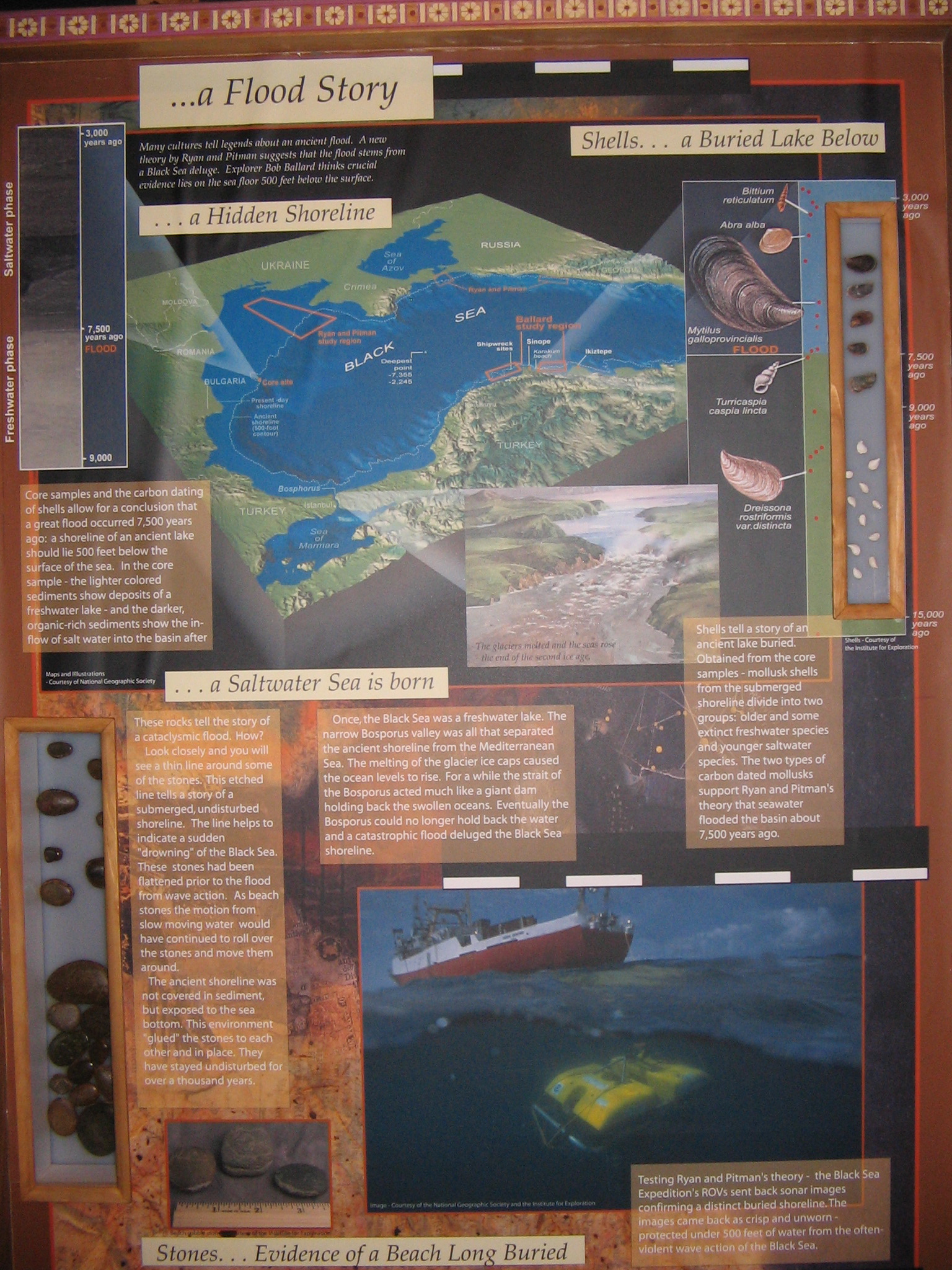
Exhausted from a day of wandering, hot and lethargic, we came across the final exhibit: Noah’s Ark! I had begun to wonder if I’d managed to spend a day in an entirely secular venue when the Bible showed up. The display was about the Black Sea. William Ryan and Walter Pittman’s theory of the origin of Noah’s flood in the Black Sea deluge was showcased, along with a video of Ballard, Ryan and Pittman discussing their ideas. As I tell my students, I don’t find this theory particularly convincing – the flood story first emerged, it seems, in southern Mesopotamia – but it is an excellent example of the hold the Bible has on the western imagination. The Black Sea did flood, shifting from fresh to salt water; that discovery is fascinating in itself. In the western world, however, it somehow just feels incomplete without giving old Noah his own Nantucket sleigh ride. To find the origin of the story of Noah, a trip to any vantage-point along the ocean where the power of the sea is evident is all that is required.


Voices from the Third Estate

Discussions over the past week in that great wasteland we call state government have included talk of actually having millionaires taxed to shoulder a little of the state’s fiscal burden. Naturally there has been a strong backlash in this nation of deeply embedded plutocracy. Those who have their millions certainly feel little social responsibility, since the prosperity Gospel (or its analogs) comforts them with whispers that wealth is a sign of blessing. One of the most evil ironies of all is that many such folk have the chutzpah to cite the Bible as their backer. God loves the beautiful people.

Such virulent misreading of religion shrugs off millions of gallons of crude oil gushing into the Gulf. Petroleum companies breed some of the wealthiest individuals around, and if we wipe out the marine life of the southern coast, well, that’s a small price to pay for individual privilege. Somewhere along the line an unholy matrimony between religion and greed produced the great plague that will lead to the fall of western civilization. This may be seen clearly among the apes.

Frans de Waal, an author whom I’ve quoted before, notes that in ape society when an individual (or individuals) takes advantage of the system, the group eventually brings an end to his (or rarely her) reign. Primate society can only tolerate abuses that damage a community for so long before a collapse is immanent. Consider Rome, “the eternal empire.” Every day politicians posture in the media about how they have the best interests of society at heart. As members of the privileged classes, they have lost sight of what it feels like to live in the constant umbra of the supercilious wealthy while millions have no jobs, no health care, no future. Millionaires owe nothing to the society that allowed them to become rich, for the Bible tells them so. Nature, however, begs to differ.


Giving Lilith Her Due

Lilith Fair has announced its 2010 tour dates and excited fans are already purchasing tickets. Lilith Fair is a collection of women artists who share a stage to showcase the female contribution to contemporary music and donate a considerable share to charity. The event name, of course, is taken from the mythological character of Lilith. Popularized as a rare example of “Hebrew myth,” Lilith is a character who likely derives from ancient Mesopotamia, although her origins are obscure. Best known as “Adam’s first wife,” her somewhat sexy story in Judaic tradition evolved into Lilith being the original woman. Unlike Eve she was created simultaneously with Adam. Things were fine until she wanted to be on top during intercourse – males were not made to be dominated, according to patriarchal old Adam, and Lilith ships out to shack up with Satan. She is demonized (literally and figuratively) and becomes the “night hag” that snatches babies and claims the first right of intercourse with every male (an etiology for nocturnal emissions). She becomes the mother of demons.

This story shows all the traits of a late development, but the idea of a strong female figure in Eden is an appealing one. Lilith has come to represent the empowered female, and the modern trend towards accepting her as an icon of feminine independence is apt. Long ago I was intrigued by the female side of the story. Perhaps because I was raised primarily in a single-parent family for my formative years, I have always wondered about the disparity in our “advanced” culture that still considers the male as the “default” model with the female as kind of an adjunct after-thought. This fascination led me to the study of goddesses in the first place, culminating in a doctorate on Asherah. In the Bible men have Adam, Noah, Moses, David, and countless other role-models – even God himself according to standard interpretation. Why not admit the goddess?

It is telling that when Lilith becomes too powerful she is presented as evil. Anthropological explanations have little to offer by way of adequate explanations for such a development. Not to blame biology (or to lay claim to an excuse), but Frans de Waal’s Inner Ape demonstrates that males are hopelessly paranoid about showing weakness. Female primates tend to express their power by group cohesiveness while males try to blunder their way to the top with brute individualism. Adam had nothing to fear from Lilith. To those who perform in Lilith Fair, I only have to say, “Rock on!”


LOL Cat Bible Commentary, Part 1

It was bound to happen. Here is the first installment of the LOL Cat Bible Commentary.

Genesis 1.1 Oh hai! In teh beginning Ceiling Cat maded teh skys an teh Urfs, but he no eated them.

In teh beginnin
In teh beginnin ub teh dai — Ceiling Cat nawt wurk at nite, cuz datz wen
Basement Cat come owt to do ebil stuffz.
Ceiling Cat
Ceiling Cat writed da Bible. He’z the mos smartess an strongess kitteh ever. An him reely good — he no eat other kittehs fud, an he nebber jumpz on another kitteh in da middul ub teh nite (but for hoomuns dis ok).
maded teh skys
But first him taked a nap. Den Ceiling Cat maded teh skiez so him had place to liv. An den him putted a hole in da ceilin so him kood peep down on teh Urfs. Wait, him nawt maek teh Urfs yet! Ai sowwy, plz to furgive? Kthx.
an teh Urfs
K, nao Ceiling Cat maek teh Urfs. Urfs is where the hoomuns howse iz.
Ceiling Cat no maek teh udder Urfs, jus da wun wif da howse.
but he no eated them
Ceiling Cat can has a hunger after awl taht wurk, Aifinkso! But him no eated teh skiez, cuz den him fall owt, an den dere no moar kittehz to wurk on da Urfs. An him no eated teh Urfs howse, either. Him wanted to maek teh birdiez an teh moal an teh fishiez. An him also want to maek teh hoomuns for to maek his fud.

1.2 Teh Urfs has no shayps an has darwk fase, an Ceiling Cat roed invisible bike ovah teh wawters

Teh Urfs has no shayps
Cuz Ceiling Cat nawt evur maded a Urfs befoar. Him not no wut Urfs shayp iz!
an has darwk fase
Ceiling Cat can to seez in teh darwk, but dere nawt eny shayps to seez. The Urfs has dawrk fase liek teh howse wif no elec…elek…elekt…wif no lytes.
roed invisible bike
Liek him wuz dreemin. Invisible bike is hawrd to be finded in teh dawrk, but Ceiling Cat maded it an him finded it.
ovah teh wawters
Ceiling Cat nawt liek to get him feetz wet, so him no rided teh bike thru taht wawter. Wawters has see monsturs an stuffs.

1.3 At furst, has no lyte. An Ceiling Cat sez, “I can has lite?” An lite was.

At furst, has no lyte
Ceiling Cat nawt need lyte, but him noes taht hoomuns will to need lyte for to maek noms.
An Ceiling Cat sez
Ceiling Cat has to tawk to himself cuz of monokittehism. No udder kittehs arownd yet, not ebben Basement Cat.
I can has lite?
Ceiling Cat reely wanted a cheezburger. But him needed a hoomun for to maek cheezburger. So him has to maek teh lyte for to get noms.
An lite was.
Nao him can to see howse an da Urfs he maded. Den him maded lolz an udder stuffz, but first him taek moar napz.

(Translated into LOL Speek by the world’s greatest CATS! Fan Kthx)


Thoughts Off de Waal

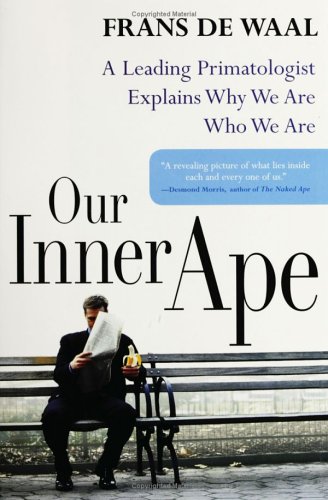
Although Frans de Waal’s Our Inner Ape was published half a decade ago, the monograph remains terribly relevant. I gave some primary impressions of the book last week, but one section has remained firmly in my head and has mingled with all the harsh rhetoric in the news about health care reform in the United States. Asking the question of whether Homo sapiens are still evolving biologically, de Waal withholds his final opinion on the matter, but he points out that statistics indicate Americans are falling behind much of the rest of the developed world in terms of general health. This he ascribes to the competition inherent in a free market economy that favors the best health care only to the wealthy while the average citizen is offered substandard options. The numbers bear him out on this – he notes that on the standards utilized to measure general health, the United States is not even in the top 25 industrial nations.

With the conviction of a true prophet, de Waal notes that privatization of health care has led to a precarious imbalance in medical care in the United States, where the top 1 percent of citizens has more income to spend than the bottom 40 percent combined. This, he believes, is because we have lost sight of the altruism inherent in apedom. Although the great apes are endangered (ironically, by their overly greedy genetic cousins) their societies show no such disparity. An ape family will assist a weakened or feeble member and give it extra care to ensure that it is offered a life as comfortable as possible. They do not discard the fragile and “expendable” members. Republicans, however, wave placards trying to shout down basic health coverage for the poor.

Does biological evolution continue among the human species? Have we stopped natural selection’s eternally ticking clock? Only time will tell. It does seem, however, that the very Bible pounded by the Religious Right (health care reform’s greatest opponent) would argue that the apes got it right. We should care for the poor, disadvantaged, and underrepresented. While the Tea Party belles are busy trying to rewrite history with America founded as a Christian nation they daintily wipe their mouths on the pages of the very book they treasure so deeply and claim as their authentic heritage.


Hate, in the Name of Love

I knew I was in trouble when I looked up the concept “codependency” on Wikipedia this morning and read, “This article has multiple issues.”

I was reminded of an article my wife pointed out to me on MSNBC earlier this week concerning Fred Phelps and his Westboro Baptist Church. My thoughts about religious freedom clash with my outrage over what may be legally classified as a religion. I’ve mentioned Phelps before, but the deeper issue here is whether freedom of religion can truly be free. Westboro is being sued (rightfully, imho) in a case that is going to the Supreme Court. His codependent hatred is causing excessive grief to the father of a soldier killed in Iraq. Phelps claims it is God’s will that he spread his Gospel of Hate.

Reading Frans de Waal’s Our Inner Ape, it quickly becomes apparent that empathy is what makes human society possible. Without our ability to feel for another, nature would lead us on a selfish rampage that would not be satiated until everyone but the alpha male was ruthlessly butchered. This seems to be Phelps’ idea of Heaven. It should be a stark warning sign when apes have better bred manners than a pastor.

Hatred and religion may form a codependent bond. Each feeds off the fear and distrust of the other, striking blindly at anything that is different, challenging, or unclear. Religion does have its noble children – those who in the name of their faith try to make life better for others. If the world were run according to Phelps’ religion, however, I would opt for life on the planet of the apes.


Ape Versus Primate


I have just finished reading one of the most important books I’ve found in quite some time: Frans de Waal’s Our Inner Ape. My attention was first drawn to the author when Rutgers University sponsored a talk he gave in the fall that I was unfortunately unable to attend. Simultaneously I saw his book footnoted in a text I was reading and decided to follow up on it. In addition to containing fascinating, documented anecdotes concerning ape behavior (he tells of a bonobo that attempted to help an injured bird fly!) de Waal holds a mirror up to the great apes and sees humanity reflected back. His discussion of the origins of morality makes far more sense to me than any theory I’ve seen a professional ethicist concoct. Our sense of empathy, de Waal notes with considerable evidence, derives from our common ancestor with the apes.

After discussing the understudied trait of kindness in the apes, de Waal writes: “With morality firmly rooted in sentiment it’s easy to agree with Darwin and Westermarck on its evolution and to disagree with those who think culture and religion contain the answer. Modern religions are only a few thousand years old. It’s hard to imagine that human psychology was radically different before religions arose. It’s not that religion and culture don’t have a role to play, but the building blocks of morality clearly predate humanity. We recognize them in our primate relatives, with empathy being most conspicuous in the bonobo and reciprocity in the chimpanzee. Moral rules tell us when and how to apply these tendencies, but the tendencies themselves have been in the works since time immemorial” (225).

These might just be platitudes if ample evidence did not demonstrate their veracity. Apes plan ahead, recognize fairness, and can even see issues from the point of view of others (something Gorgias Press might benefit from learning). They are clearly inheritors of the moral sense that evolution has crafted among all cooperative animals over the eons. Religions like to lay claim to the origins of morality: we behave this way because our god told us to. In a sense that may be true, but only if the “god” is nature itself and the instruction it gives is the way for a species to thrive. Caring for one another, all religions aside, is the formula that evolution presents as the most successful choice of natural selection.


Dinosaur Ark

Over the weekend I had a detailed comment left on my post about the discovery of Aardonyx celestae, found here. Since the comment is a lengthy rebuttal, my answer begged to become a post of its own, so I present it here. The first remark I have to make is that my commenter wrongly suggested two problematic assumptions: I “don’t care” about correctly representing Creationist viewpoints and that I “ridicule Christians.” For those many students who have taken my classes over the past 17 years, it is always clear that I respect all religious viewpoints; in fact, empathy is generally cited as one of my main characteristics. I vehemently defend the rights of individuals to believe the religion they believe to be right – e.g., I do care. As for the ridiculing Christians concern, I ridicule no person. I will, however, point out viewpoints that are ridiculous, “Creation Science” being one of the most obvious. As is clear to anyone who takes the time to survey Christianity, the large majority of Christians in the world have no problems with evolution. A small but vocal sub-sect of the religion, mainly based in America, is the main Christian group that supports Creationism.

My theological assailant tells me that the Hebrew word for “kind” in the Noachian account is “min” (the root, marked as “dubious” in the standard lexicon, is myn) and that it is “much broader” than the word translated “species.” The problem here is that the ancient Semitic viewpoint has been left unaddressed. For the ancient Israelite dog was dog and wolf was wolf, and ne’er would the twain meet. Arguing that a limited evolution has taken place in order to make room on the ark is a fatal flaw to the position. Once it has been admitted that the Noah story is not literally each and every species known, it is the equivalent to the ark springing a leak mid-deluge. The commenter’s examples of animals breeding only “within their kinds” is also problematic. Such “kinds” are not recognized by “nature” and numerous examples of viable offspring crossing species have been recorded. Nature simply doesn’t abide by the neat and tidy categories that the ancient Israelites recognized. Suggesting that two sauropods were all that was needed on the ark to produce everything from Titanosaurus to Anchisaurus is a stretch for even “day-age” theorists since the genetic differences between them are as immense as their body size differentials. This slippery use of the word “kind” has all the imprecision of a god-of-the-gaps.

Did God say to take seven pair of each clean animal? My Bible reads “two of each kind” in Genesis 6.19. But wait, the story changes in Genesis 7.3. Could it be that we have two separate sources (or “kinds”) here? My commenter does not inform me where the fresh-water fish came from; after God blew the water out of the cosmic dome (Genesis 8.1) they must have had time to evolve while the salt leeched out of the low-lying basins left behind by the flood and its marvelous geography-forming power. Good thing Noah had plenty of fresh water on the ark!

“Take time to consider what scientists have already said on the issue,” my debate partner adjures me. That’s just the problem, however. I do read what the scientists say. And all of them who write without a Genesis bias tell me that the ark story is not scientifically feasible. More than that, being a life-long Bible reader, I came to that conclusion as well, based on the genre of the story (myth). I never claim to be the first to find contradictions that prove problematic for the Bible – I simply try to make my readers consider the implications of the fact that such contradictions indeed exist.

What I find so interesting about such criticism is that the author of the comment has not tested his/her hypothesis about what I actually believe. On principle I do not share my personal religious beliefs on my blog, just as I do not share them in the classroom. What I believe is immaterial to the issue of Creationism; in this issue the facts speak for themselves. The fact is “Creation Science” is science fiction.


Sects in the City

Newsweek ran a story a few days back asking an obvious question: with all the scandal surrounding an exclusively male Catholic priesthood, why not invite women into the leadership mix? The story, by Lisa Miller, makes the point that sexual scandals have continued to deepen and widen only to be treated lightly by a hierarchy that insists sex is only for procreation. Sex between men and women, that is. If an exchange is made between males, particularly if one is under-aged, well, no souls are going to be derived from that! Although Miller’s plea easily wins on the basis of reason, when power is so deeply entrenched reason is likely to be tied to the stake and set ablaze. No, the church has made up its mind, and well, darn the torpedoes!

The church seldom embraces scientific advance without an approval period. The sexual scandal is no different. Everything that has been learned about sexuality over the last couple of centuries suggests that it’s not just for reproduction any more. Nor has it ever been. At least not in primates (both religious and mammalian). Religious organizations often test their strength by seeing just how far into the lives of subscribers they can reach. What they can control they will. The problem with sex is that it is very hard to control. It can be hidden, castigated, descried, and shamed, but it will not go away. Sexuality is hardwired into all creatures that reproduce that way. No, this is actually about power and privilege. Unchecked power and privilege inexorably lead to abuse. We expect that for the corporate world, excuse it even. Yet we hold the church to a higher standard.

Thine is the power and the glory

It is difficult for an institution raised from infancy with the assurance that God loves it best to outgrow this fantasy. Most people never examine their religion too closely — the edifice is built upon the premise that the leaders know more than the laity. Simply believe what you are told to believe. Yet no religion can lay claim to authenticity without subjecting itself to critical examination. This is the nightmare the Catholic Church now faces: two millennia of posturing and assuring believers that everything is fine are coming unraveled. And ironically the instigator is sex; that common denominator for any species with a backbone, and even some without.


Evil Echinoderms

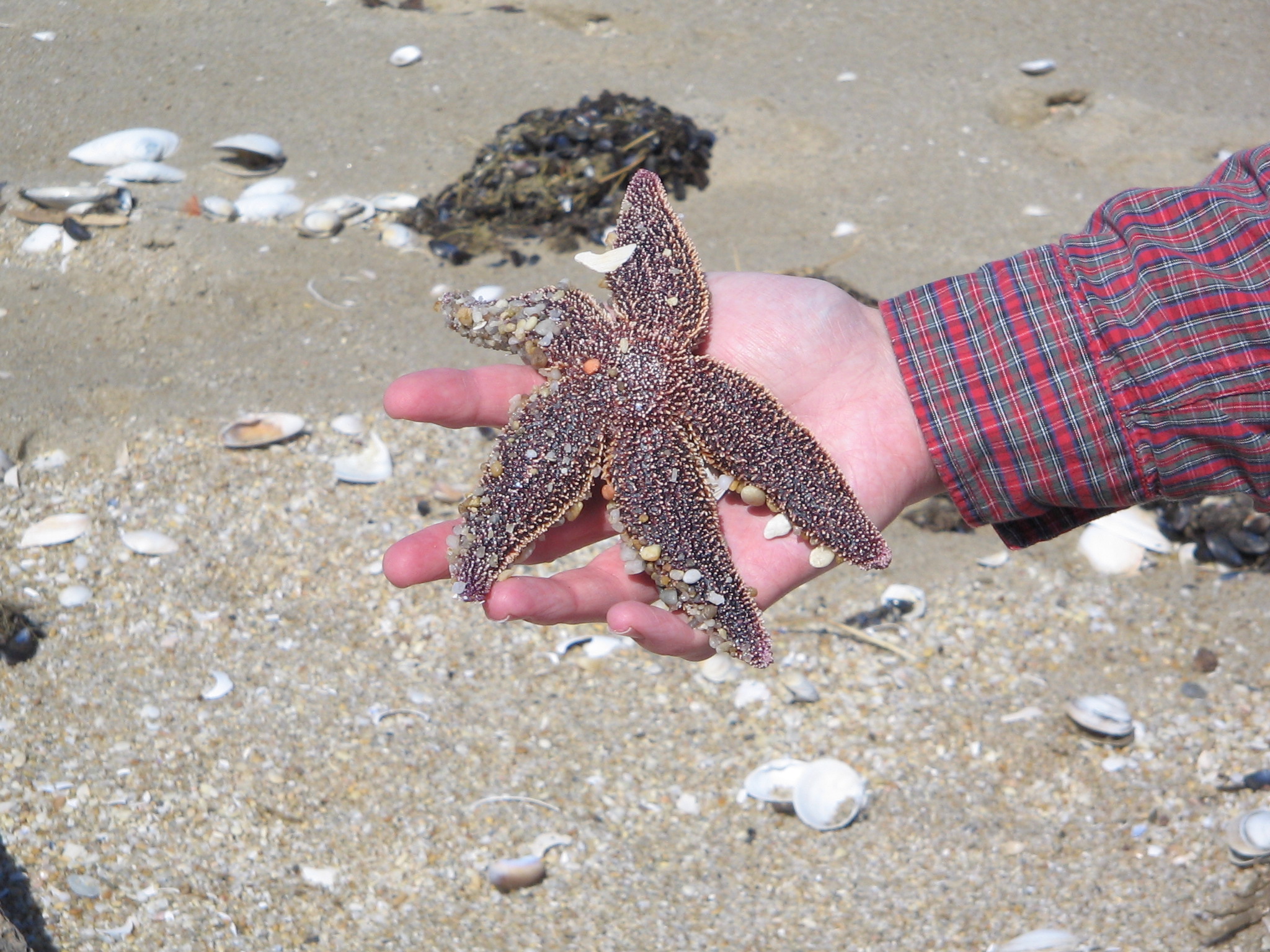
Ever since I can remember, I have longed for the ocean. Not a good swimmer, and not one to eat the myriad creatures that fill its immense waters, I find myself nonetheless drawn to its endless pounding surf and salt spray. Even before I’d read Rachel Carson’s The Sea Around Us, discovered the eternal fascination of Herman Melville’s Moby Dick, or had even heard of H. P. Lovecraft, I knew that I belonged to the ocean. It need not compete for my affection. It had already won. With family visiting this weekend and with an unseasonably warm March weather-system, we went down to the Jersey Shore yesterday to visit my old friend. Sandy Hook is a peninsula that juts up from New Jersey toward New York City, a sandbar of undeveloped free ocean access administered by the National Park Service. During the summer it can be intensely lined with fishermen and sun-worshipers, but in March it was a reasonable place to be. Sea creatures are abundant when left alone, and we saw our first harbor seal of the season, along with a galaxy of sea stars. These echinoderms had eluded me thus far; we’ve been to the shore several times during our Jersey days and had never discovered any. One large sea star had been stranded in an evaporated tide pool. Compassion overcame me and I carried it down to the surf to offer it a chance for continued survival.

Miserable sinner?

Recently I reread Jonathan Edwards’ horrific yet classic sermonic masterpiece, “Sinners in the Hands of an Angry God.” Vividly depicting a furious deity barely capable of restraining his repressed wrath directed toward wicked human beings, but for an uncommon dose of misplaced compassion, Edwards suggests we all deserve ghastly destruction. Edwards underscores one of my recurrent observations about religion – it is a means of control. The great Puritan divinity only accepts penitent Puritans, all others go directly to Hell, not passing Go, not collecting their two-hundred dollars.

As I held that helpless sea star, destined for the cruel, drying rays of an unclouded sun, I did not think of its multiple transgressions. Murderous predators, sea stars consume other sea creatures, including their own kind, in the constant struggle for survival. This one had obviously had a successful run and had grown to an impressive size. I felt no rage, no desire to destroy this killer. Instead, I saw a radiant example of a being evolved to live in an environment that I can not even comprehend, just doing what it needs to get along in its undersea world. And I recognized the wrath of God for what it really is – one man’s unfulfilled plan to decide the destiny of his fellow creatures.


In the Heart or in the Head?

I don’t have cable television. I don’t even have one of those digital conversion boxes. I’m afraid the costs and technology have gone beyond a guy who grew up with a black-and-white television with the screen the size of an old Mac Classic. I still try to keep a wary finger on the pulse of popular culture, and fortunately the internet provides just about everything in a condensed version. When I want to see a television show I generally do so through DVDs. Again, expense is prohibitive to the underemployed, but kindly family members often help out with occasional contributions. My brother surprised me this Christmas with the first season of the History Channel’s Monster Quest series (brothers sometimes see what you try to hide from the wider world). After a long weekend of class prep, I sat down to watch an episode last night that introduced me for the first time to the work of Dr. Robert J. White, a retired professor from Case Western Reserve University.

I have always been intrigued by the unlimited possibilities, no matter how remote, that science fiction can conjure. This episode, however, was factual and showed footage of Dr. White’s successful head transplant operations on monkeys in the 1970s. I had no idea that such work had ever really been conducted, let alone successfully. Visions from X-Files: I Want to Believe flashed across my cerebrum while I watched the footage. Not to mention the ubiquitous heads-in-jars of many a science-fiction movie! A plaguing religious question was also stirred back into life after having settled at the bottom of the tank for many years – where does the essence of a person reside? Organ transplants are everyday occurrences, and many lives are prolonged by the sharing of body parts no longer used by their original owners. And transplants do not stop below the neck – cornea transplants bring us very close to the brain, the presumed seat of our personality, consciousness, or, if you will, soul.

when a head meets a body

Dr. White’s monkeys that survived seemed to have retained the personality of the original monkey head on its new body, but I wonder if that was just an illusion. In our world where each individual is treated as a discreet unit, the essence of a person is thought to reside in the brain. Our brains, however, recognize our bodies and sometimes bodies reject the very organs intended to save them. Is there really any possibility of preserving the essence in one’s head alone? Or are we, like ants and bees and Portuguese Men o’ War, really all part of a collective organism? Maybe there is a good reason I don’t have cable or a digital conversion box.


Out of Reach

Last weekend I had hoped to see the movie Creation: The True Story of Charles Darwin. This is a movie that has had trouble in the United States since distribution companies felt it would be too controversial for American audiences. Believing that evolution is still a taboo topic in the most “advanced” nation on the planet is a peculiar conundrum. Why are we so sensitive concerning our natural pedigree?

Primatologists are constantly discovering new and unexpected connections between the great apes and homo sapiens. We share biological, and as we are increasingly aware, cerebral traits. Empathy and xenophobia, two features once believed unique to humans, are in evidence among our great ape cousins. We are on a continuum rather than a segmented train.

Bearing these provocative thoughts in mind, I was ready to head out to the theater, even if I had to go alone, to see the story of Darwin. I’ve read enough biographies to know there are some heart-rending moments in the story, situations that I would not be able to face – but it is a story of truth. It is ironic that we sometimes fear the truth, since religion is our effort to find exactly that. So, resolve firmly in hand, I searched for New Jersey theaters showing the film. None. The nearest show was in Midtown Manhattan. Add a twenty-dollar train ticket to the cost of admission, and to an underemployed academic the price was out of reach. Perhaps some day the movie will become available for general public consumption. Until it does, however, I’ll just have to lament my frustration to a local empathetic ape.

A scene from the movie, so I'm told


Inter-species Prognostication

Groundhog Day is a holiday easily forgotten by all but Bill Murray fans and residents of Punxsutawney, Pennsylvania. The day, however, has a role deep in European folk religion that was reflected in the “cross-quarter days.” From ancient times, the four days of the year that fall precisely between the solstices and equinoxes were known as cross-quarter days, based on the day of the month that rent was due in England (“quarter days”). The Celts recognized this cross-quarter day in early February as Imbolc (later Christianized as Candlemas). Part of the folk religion held that animals had special powers on cross-quarter days, and that fair weather on Imbolc meant that more wintry weather was on the way.

In America, where Groundhog Day has its original burrow, the tradition began among German immigrants. The first historical reference to Groundhog Day was made in 1841 in Morgantown, Pennsylvania. By 1886 Punxsutawney had its groundhog Phil and the tradition has continued ever since.

Although it is a lighthearted holiday, I always tell my Hebrew Prophets class (which begins near Groundhog Day) that this is a form of socially accepted prognostication. Few believe that a marmot can predict the weather, but we like to believe that winter is on its way out when the cold starts to feel old and stubborn and we are ready for a few sunny days. The old tradition states that if Phil doesn’t see his shadow he won’t dash fearfully into his den and spring is on its way. Fact is, spring falls six weeks from Groundhog Day, so no matter what the rodent says, spring is on its way. Ancient religions always stress the hope that nature will continue as it has in the past and that spring will follow winter as it should. It is nevertheless a fun day to watch the largest member of the squirrel family amble out of his heated burrow, no doubt confused by all the furless bipeds standing around with cameras, and play the prophet for his fifteen minutes of national fame.

The world's hairiest prophet?


Missing Links

Dinosaurs hold a fascination like few other creatures. Perhaps it is because of their exotic and tragic rise to dominance and their meteoric plummet to obscurity. Maybe it is because of their impossibly creative adaptations to their environment leading to frills, fans, and pointy bits in unexpected places. It might even be that they reveal our own future to us. Whatever the reason, dinosaurs still rule.

In the news yesterday, a man was arrested for stealing a dinosaur. Not a Jurassic Park living model, but a fossil excavated from private land in Montana. A few years back I took my family on a dinosaur-based trip to the west. Trundling across the endlessly flat eastern half of Wyoming, I insisted that we turn down a rutted and washed out dirt road to an obscure site where dinosaur footprints had recently been discovered. Rolling into Red Gulch (seriously!), we were, surprisingly, not the only people there. Staring down at my feet next to the fossilized prints of some ancient carnivore was like feeling the very pulse of evolution. There was no fear of divine retribution here, just a sense of tangible continuity with a long and very distant relative on the tree of life. Creationists insist that dinosaurs and other creatures were each separately created, fearing, I suppose, an interspecies miscegenation, in keeping with their overall fear of sexuality. I was envisioning myself shaking claws with cousin dilophosaurus.

There be monsters here

Over the years we’ve made many dinosaur trips, stopping at dinosaur museums in North and South Dakota, Montana, and Colorado. Once, at Makoshika State Park in Montana, where you can walk along and see dinosaur fossils in situ, we heard a couple exclaim to the flustered park ranger, “but how can that be when the world is only 6000 years old?” Dinosaurs are symbols. They represent the ultimate in stature and environmental dominance, while at the same time hosting brains that struggled to rival a humble grapefruit. As I read the other, more serious, headlines I realize how much we are like our very distant cousins.


Moby Dickens

One of the perks, or perhaps afflictions, of not having cable is missing the constant stream of current culture daily rushing by. When I hear others discussing the latest chic program I feel helplessly Bronze Age in the cell phone generation. Occasionally, when visiting family members who can afford to be fully wired, I catch glimpses of what the thousands of networks have on offer. During a visit to my mother’s house last year I caught an episode of Whale Wars. This reality program follows the exploits of the Sea Shepherd Conservation Society as crews attempt to foil whalers going about their daily slaughter. The truly disturbing part of the episode I watched was the enmity of the whalers towards these cetacean saviors — let alone their utter disregard for the intelligent creatures in our seas who have the misfortune of not having evolved opposable thumbs. Armed with weapons for disabling, and potentially killing, their species-conscious fellow homo sapiens, the whalers defiantly claim it is their right to destroy these gentle giants.

I confess to having been an advocate of our animal companions since I was a child. I used to contribute regularly to Greenpeace until the non-negotiable bills of adult life routinely began to outstrip my extremely modest income. These great creatures, the largest our planet has ever yielded, are seriously endangered because of the machinations of their only predators — us. Despite the fact that most whale products are not really necessary for economically deprived families, the gruesome harvest continues. Today’s newspaper carried the story of how the Sea Shepherd’s new ship, Ady Gil, was rammed and sheered in two by an angry Japanese whaling crew’s vessel.

In the light of all this, it may seem hypocritical to admit that my favorite novel of all time is Herman Melville’s Moby Dick. I cringe every time I read his descriptions of nineteenth century whaling, but I draw my comfort from knowing that Ahab’s nemesis is not a physical whale but an invisible, silent, immortal deity. As the tortured captain hurls harpoon after harpoon at the implacable god who caused him so much personal harm, no barb can ever kill Moby Dick. The echoes of Melville’s own subterranean cries against cosmic injustice reverberate so clearly through his prose that I simply can not put the book down once I start to read it over again. My heart goes out to the physical whales, however. They are the innocents being hunted by a predator they can’t stop as they are forced by nature to surface for air. In the cetacean version of Moby Dick, which surely must exist in some form of whale consciousness, they too are being relentlessly pursued by unfeeling gods.