Joyous Beltane

Every year around Beltane, I think of The Wicker Man.  Of course, the holiday itself, aka May Day, is no cause for alarm.  What makes the movie so effective—and I mean the original film, of course—is the fear of others’ religions.  My last two books have explored the nexus of horror and religion and The Wicker Man always stands out as an example of how naturally the two go together.  May Day, or Beltane, represents one of the cross-quarter days.  It falls roughly halfway between the vernal equinox and the summer solstice.  Days are noticeable longer now than they were back before the equinox, and Beltane, like many cross-quarter days, uses the symbolism of light to remind us of the seasonality of life.  While the light is here we should make use of it.

Photo by Ameen Fahmy on Unsplash

Agricultural festivals—and many ancient holidays began as such—acknowledge the importance of the lives of animals pastoralists depended upon.  Imbolc, the start of spring, was marked by sheep beginning their lambing.  Beltane was the point at which cattle could be driven to pasture.  It stands opposite Samhain, the origin of our Halloween, with Lughnasadh falling between.  These holidays were often celebrated with bonfires (thus The Wicker Man), but fire was understood as protective rather than destructive.  Although the Celts seem to have originated in east-central Europe, they were pushed to the northern fringes of the British Isles by other invading peoples.  Their location in chillier climes suggests that fire may have also held a practical purpose.

May Day is celebrated throughout much of Europe as a day associated with fertility.  This, it seems, was a major cause of concern among Christian missionaries.  Fertility is, of course, a natural hope.  Agrarian peoples rely on it to survive.  Fire served to bless the animals and to keep away the mischief of the little people, or nature spirits.  Much of what we know of Beltane, as with other Celtic holidays, has to be reconstructed since the Celts didn’t leave a scholarly archive that could be farmed for information.  Indeed, prior to widespread literacy what would’ve been the point of writing down what the folk already knew?  It was obvious that summer was on the way.  Even in years when the temperatures struggle to warm consistently, there are hints that “the light-soaked days are coming.”  The bonfires of Beltane represent the warmth and light that are on their way.  And what religion could object to that?


Leap Night

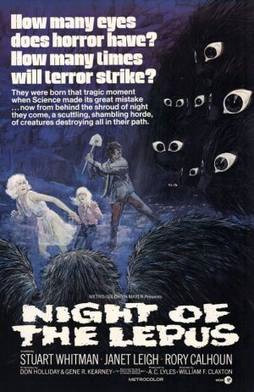
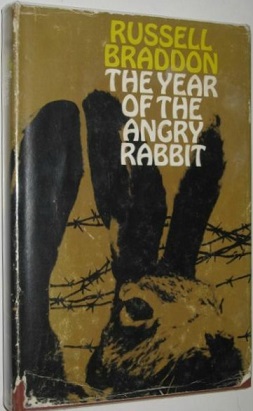
I was quite young when I saw Night of the Lepus for the first time.  Well, I had to have been at least ten, but when I recently sat down to watch it only one or two scenes looked familiar.  Like most poorly done horror films, Night of the Lepus has gained a cult following.  The story is loosely based on Russell Braddon’s comedic novel Year of the Angry Rabbit.  Without the comedy.  Or at least without intentionally being funny.  In an effort to control rabbit overpopulation in Arizona, a new virus is released into the population.  Instead of killing off the bunnies, it makes them grow as large as wolves and become carnivorous.  They go around attacking people with big, nasty, pointy teeth (to be fair, Monty Python and the Holy Grail wouldn’t be out for three more years).

Night of the Lepus was criticized for not being scary at all—a cardinal sin for a horror film.  I was kind of embarrassed when my wife walked in and found me watching it.  Nostalgia can do funny things to a person.  It is almost painful to watch the public officials make such obvious missteps each time they start to get an idea of what’s happening.  They’re almost as imbecilic as the Trump administration was.  Meanwhile rabbits are hard to make scary.  Perhaps William Claxton should’ve read Watership Down.  Ah, but Richard Adams’ classic was only published in 1972, the year the movie was released.  What was it about the mid-seventies and rabbits?  

Part of the problem is that Night of the Lepus takes itself seriously without the gravitas required to do so.  Who can believe actual rabbits are vicious when, to make them monstrous, the movie simply shows rabbits against miniature scenery?  Their human handlers occasionally smear their mouths with red, but a rabbit doesn’t appear cunning and vicious.  And to get them to attack people they had to use human actors in rabbit suits.  I’m a fan of nature going rampant as a vehicle for horror.  Hitchcock’s The Birds did it effectively.  So, I’m told, did Willard (which is remarkably difficult to access with HBO never having released it onto DVD).  The seventies were when ecology began to be recognized as perhaps the most important of global issues.  Half a century later we’re still struggling to reconcile ourselves with it.  Meanwhile the rabbits have begun to appear in our back yard.  They may nibble our perennials, but I’m not afraid.  At least as long as they don’t watch Night of the Lepus and start to get some ideas.


Rabbit Years

A childhood horror movie that I only recall in the most wispy of fringe memories is Night of the Lepus.  It’s one of those monster movies that involves mutated animals, in this case the unexpected rabbit.  I’m not sure why it’s been on my mind lately, but a little research indicated that it was based on the Russell Braddon novel, The Year of the Angry Rabbit.  This book is out of print and still under copyright, so finding a copy wasn’t easy.  Apart from vague images of giant rabbits, I had no idea what to expect.  The book turned out to be a comedy horror, in that order.  Remembering that the movie wasn’t funny (although it is consistently considered one of the worst cinematic efforts of the time), I wasn’t prepared for this.

You see, I don’t like to read about books before I read them.  I don’t read cover copy.  (I tend not to watch movie trailers either, unless it can’t be helped, like when you’re in a theater.)  I suppose knowing a genre of a book helps, but I just wanted the experience of reading the story behind a movie that won’t completely vacate my memory cells.  The Year of the Angry Rabbit is a satire on government, war, and capitalism.  If you’re not expecting a serious horror story it’s quite funny.  Russell Braddon never became a household name—he was from Australia and a person’s cultural impact tends to be greatest on their own continent—but if you knew this was a satire from the start you’d probably enjoy it as such.  Although written in the sixties, it’s climax takes place at the millennium, now two decades past.  It’s always interesting to see what people thought we might be up to by now.

Although there are elements of humor to our politics, Orwell seems to have been more on the money than Braddon.  Nevertheless it’s important to keep the old stories alive.  There are still people like me who will seek out rather obscure novels from many decades ago.  They might have to have sat on library shelves for years without having been checked out—this used to be the glory of the library, before “evidence-based usage” studies ruined them.  I search for things I want to read in my local small town library and find that my tastes are too obscure.  Besides, old stuff has to be cleared out to make room for the more recent books hoi polloi wish to consume.  I’m glad they’re still reading.  For me, however, I’ll need to stretch back to a time before I was old enough to read to satisfy an unrelenting memory. It was rabbit years ago.


Whale Tales

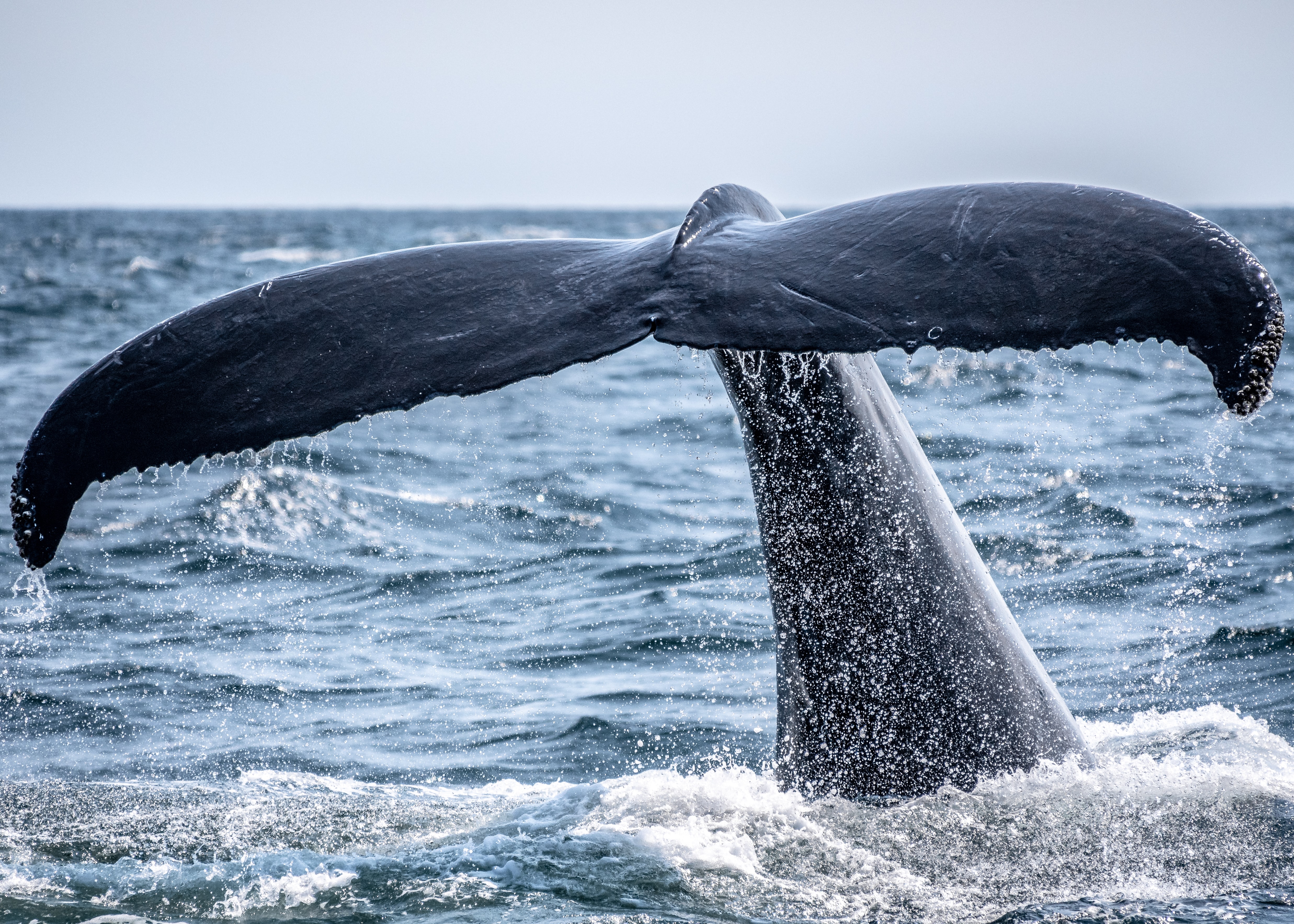
Photo by Richard Sagredo on Unsplash

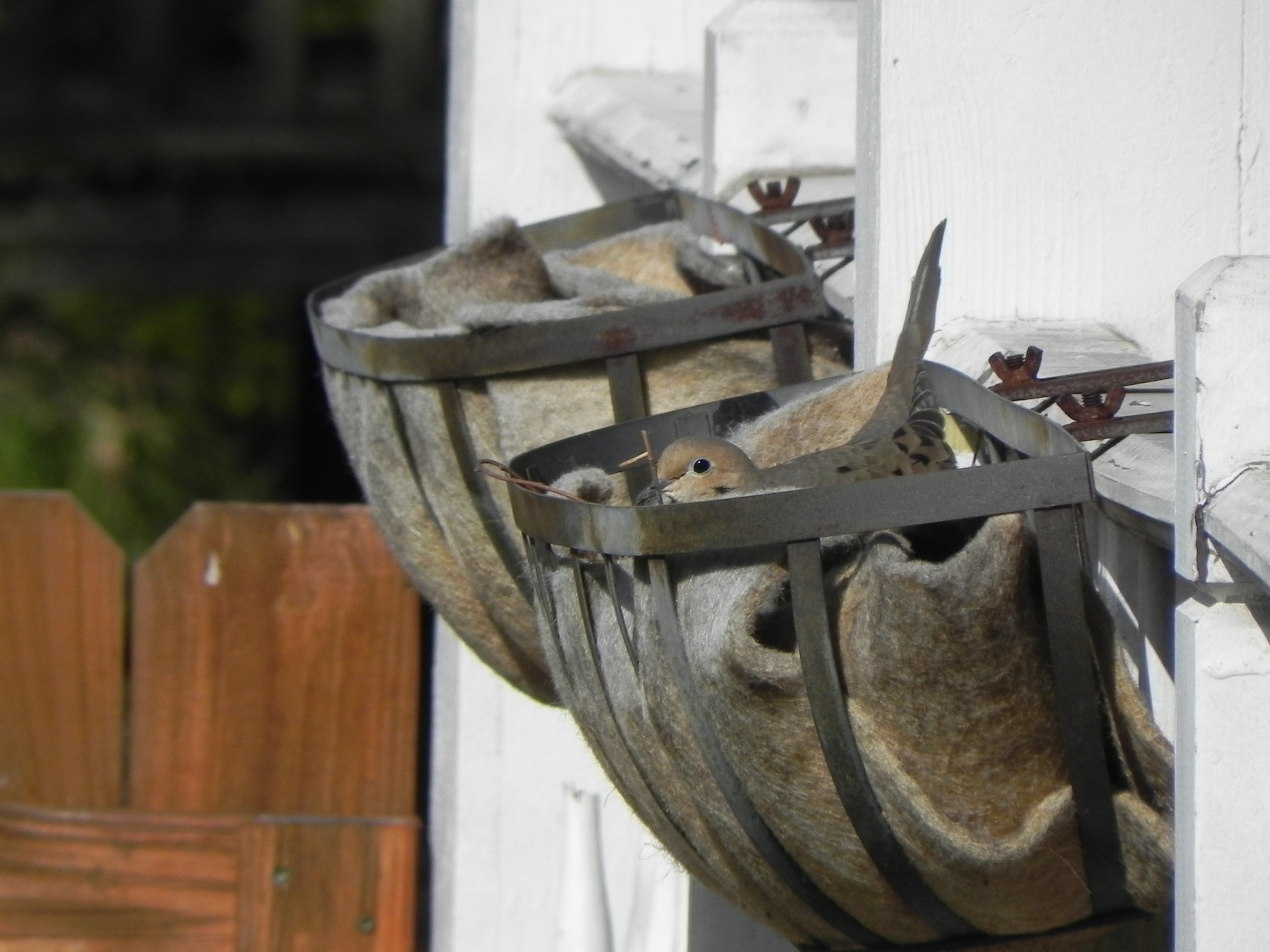
Always I’m surprised when other people seem surprised, specifically about animal intelligence.  Then I have to remind myself that our culture has absorbed the biblical view that people are different so thoroughly that even scientists believe it.  I watch the birds out my window quite a lot.  What they do is intentional and often quite intelligent.  True, not all animals are college material, but they are far brighter than the “automaton” paradigm with which I grew up.  So when I saw a piece in The Guardian titled “Sperm whales in 19th century shared ship attack information” I kept the tab open until I could read it.  Then I woke up this morning wondering why one of my many open tabs had the header “Sperm” on it, only to remember that I was going to read about whales.

I’ve written about Moby-Dick many times on this blog.  Although Melville didn’t experience financial success with it, he managed to pen one of the most profound and memorable novels ever.  One of the things he stressed was the intelligence of the whaler’s prey.  The Guardian article describes how, due to the magic of digitized log books, researchers can now compare captains’ notes about whaling.  What this comparison makes clear is that whales shared the information about attacks and avoided the areas where they occurred.  Despite the massive size of their brains, researchers had supposed whales to be rather stupid—or automatons—simply waiting to get slaughtered.  Animal intelligence is visible anywhere as long as we’re not afraid of that bogeyman, “anthropomorphism.”

We’ve been taught that human beings are so special that we think other animals act like us only because we’re projecting onto them.  Since the Bible informs us that we’re special and they’re further down the food chain, we must assume that creatures who destroy their own planet believing that they’re serving the will of God are somehow smarter than animals living in harmony with their environment.  We’re so smart that we had to add an extra sapiens to Homo sapiens to show just how special we are.  I’ve long suspected that animals are far more intelligent than we allow them to be.  Philip Hoare’s article offers us yet more evidence that we’ve underestimated our non-sapiens companions time and again.  Ironically we can accept that evolution explains how life forms change over time, but we somehow can’t let go of the story that says we’re somehow different.  I think we need to get out more and simply watch how animals behave.


Old Wolves

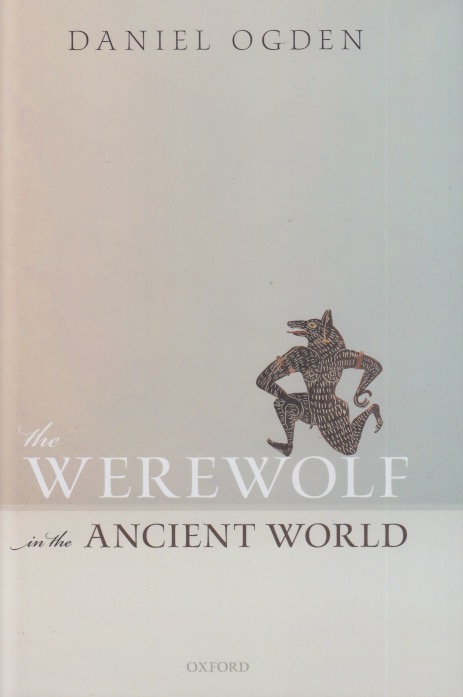
Among the classic monsters, the werewolf seems to suffer from lack of a foundational novel.  Yes, vampires are older than Bram Stoker’s Dracula, and antecedents can be suggested for Mary Shelley’s Frankenstein, but there isn’t a werewolf novel of similar stature.  Daniel Ogden, however, does us a service by providing an extended discussion of, as his title states, The Werewolf in the Ancient World.  His survey is intriguing and informative, and also insightful.  The werewolf is not always what it might seem.  Ogden is an able guide through sources from antiquity through some medieval tales, focusing mainly on the ancient ones.  He extensively explores their associations—witches, sorcerers, ghosts, and the like.  And related tales of human transformation.  He even suggests what some of those transformations may have been seeking.

The werewolf is perhaps the most obvious monster that expresses repressed desire for transformation—a kind of salvation.  Civilization comes with a cost and the werewolf is symbolic of the individual driven by animal desire, unrestrained by human convention.  It’s also an idea of great antiquity.  Although Ogden doesn’t go into it, stories of humans turned into wolves goes back at least to the Epic of Gilgamesh, one of the earliest pieces of literature we have in fairly complete form.  The idea is attested in writers such as Plato and Augustine, if only to refute it.  In other words, it is clearly something people have thought possible from very early times.  Our long association with the wolf, and its domesticated version—the dog—certainly plays a psychological role in such tales.

As Ogden points out, Guy Endore’s novel The Werewolf of Paris, published in 1933, is perhaps as close as we come to a foundational novel.  In the Universal monsters series that developed a canon for monster boomers, The Wolf Man was a somewhat late entry, appearing in 1941—a decade later than Dracula and Frankenstein.  Despite these tardy cultural appearances, the werewolf has been part of our collective psyche far longer.  Ogden shows that clearly.  When you stop to rethink stories like Little Red Riding Hood, the talking, humanized wolf appears so naturally that we don’t often stop to consider the implications.  I certainly hadn’t made the connection explicitly until reading it here.  Ogden’s work is readable but academic, so be prepared for citations and some technical talk.  Nevertheless, this is the clearest guide to lycanthropy and the magical ideas behind it from ancient times to have appeared in recent years.  


Many Moons

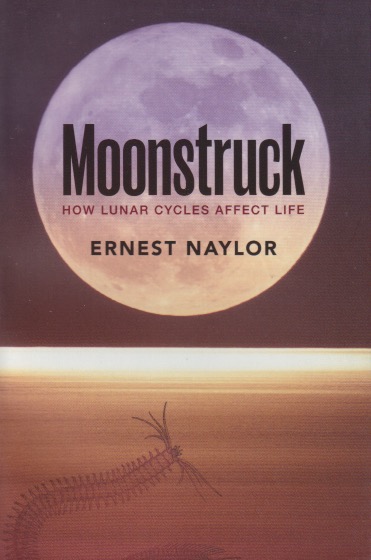
Scientists, often with their base matrix bound up with the local religion, are frequently interested in  myth.  And sometimes religion too.  This is no surprise.  Many of us go into religious studies because of its influence on our lives and scientists, who measure and analyze material realities, must be curious when their results challenge some religious or mythic assumptions.  So it is that Ernest Naylor addresses mythic beliefs about the moon’s influence on animals and what scientific findings on the same show.  Although this book wasn’t exactly what I thought it would be, Moonstruck: How Lunar Cycles Affect Life does address the subtitle assertion quite directly.  Naylor, a marine zoologist, knows about tides—caused by the moon—and their effects on marine organisms.  That connection is the main focus of the book, with occasional forays onto dry land.

What caught my attention right away was that when discussing myth and religious ideas, Naylor describes two stories as biblical: the woodcutter banished for gathering on the Sabbath and Judas’ banishment.  Both of these, he seems to believe, have the Bible banishing the criminals to the moon.  That was news to me.  There may well be folklore with such associations, but a simple opening of the covers of the Good Book would dispel this particular “myth.”  Neither the sabbath wood-gatherer nor Judas were banished to the moon after their deaths.  The former presumably went to Sheol and the latter presumably to Hell.  For me this illustrates yet again how many ideas professional people outside the guild suppose to be “biblical.”  The Bible says very little about the moon.  One New Testament demoniac is described as “moonstruck,” but beyond that the occasional references are mainly just to the moon qua moon.

The Bible’s a big book.  Everyone in western society knows it’s an important book but few read it.  Even fewer deeply engage with it to understand its original context and message.  We hear stuff and we’re told it’s in there, and we believe it.  I first noticed this in high school.  Classmates would tell me “the Bible says…” (you can fill in the blank with just about anything, this isn’t a quiz).  Almost always they were wrong.  By that point I’d read the Good Book many times cover-to-cover.  I owned concordances and knew when foreign matter was introduced.  The thing about the Bible is that it’s fairly simple to look it up.  Moonstruck focuses on marine animals and tells interesting connections to the moon.  It has a chapter on humans and the moon, finding little direct biological influence.  It’s an informative book, just don’t use it to verify what’s in the Bible.


Animal Spirituality

I had little scientific basis for my claims.  It wasn’t that I didn’t have evidence, but it was more one of those “if you see something say something” kinds of scenarios.  I have been claiming for many years that animals experience some kind of spirituality.  My evidence was drawn from disparate scientific materials I’d read, along with ancient religions.  Egyptians believed baboons worshiped the sun.  Chimpanzees make threatening gestures toward the sky during thunderstorms.  Penguins grieve.  Human spirituality, it seems to me, is part of our kinship with other living creatures.  Then I found an article by none other than Marc Bekoff titled “We’re Not the Only Animals Who Feel Grief and Spirituality,” in no less a prestigious place than Psychology Today.  Bekoff, some of whose books I’ve reported on here, has studied animal emotions professionally.

Our ideas of human exceptionality, it seems to me, often get us into trouble.  Arrogance is perhaps the most dangerous of psychological states.  When we see ourselves as part of a continuum, and realize that it can go on beyond us—yes, there are likely greater intelligences—humility should be an expected response.  Those who are arrogant frequently experience their comeuppance, even if they have to get elected to high office for it to happen.  We share emotions with our fellow creatures, and, now according to at least one expert, we share spirituality.  What is spirituality?  It seems to be an awareness that the body isn’t everything.  In my lexicon it’s listed there right with consciousness, mind, and soul.  We know it because we feel it.

The interconnectedness of the world, and beyond, is something many want to take exception from.  Looking around, such folks say, “Hey, we’re different than all of this.”  Yes and no.  We’re different, but that makes us no less a part of it.  Nature is our matrix.  We build fancy houses, but so do bower birds, and they do it without benefit of opposable thumbs, or even hands.  Of late we seem reluctant to admit that even human beings have spirituality.  That doesn’t stop us from feeling it, however.  I’m glad that others see it in the animal realm also.  Anyone who’s “owned” a dog knows what it’s like to receive worship.  We’ve selectively bred these wolves to adore us.  Is it so much of a stretch, then, to suppose that other animals also feel a sense of admiration for what’s beyond themselves?  Only the most arrogant wouldn’t pause to consider it.


Wild Oats

The day after Thanksgiving, although it’s too late for millions of industrially slaughtered animals, is a good time to think about plant-based diets.  I’ve been a vegan for three years now, and it has led me to some interesting places.  One of them is oat milk.  Like most Americans, I eat cereal for breakfast most days.  (When I volunteered for the dig at Tel Dor in 1987, however, olives, Nutella, and bagels made quite a passable morning meal.)  Apart from cereal breakfasts being a religiously motivated practice, they’re easy to prepare but difficult to do without milk.  You can (and many sometimes do) eat dry cereal, but we’ve been conditioned to pour milk on it to make a kind of soupy, grainy start to our day.  It feels familiar.

We started out, after much research, using soy milk.  It has to be a particular brand, though, because it can have an oily taste.  We eventually switched to oat milk.  Unlike soy, I can actually drink it like regular milk.  We’ve been buying Planet Oat, but recently we tried Oatly.  Now, I’m one for a working breakfast.  Time is precious and work begins uncompromisingly early.  That means I don’t read cereal boxes or milk cartons any more.  That changed with Oatly.  I found an entertaining and eloquently stated kind of creed on the back of the carton.  When’s the last time someone brought spirituality to the breakfast table (apart from introducing the eating breakfast cereal craze)?  It makes me feel more grounded.

The intricately interconnected web of life makes me think that we should be cognizant of our food.  What we eat should be approached reflectively.  If we had government subsidies for fields of oats rather than industrial farms for the inhumane treatment of “food animals” it seems to me the world would be in a better place, spiritually.  There’s been some comeback of wildlife since Covid-19 forced us all indoors.  I am glad to see it.  These creatures are our siblings.  Even if that seems to be going too far, it’s becoming increasingly difficult to deny that animals have emotions and minds, particularly those that humans eat.  Given the foodieness of contemporary society (everyone’s talking about food rather worshipfully these days) it would seem that pondering at least how we treat animals before we eat them should be a matter of common courtesy.  Being so far removed from our sources of sustenance has done something to us, I fear.  There are great alternatives out there, and some even make you smile while munching your cereal.


Predatory Birds

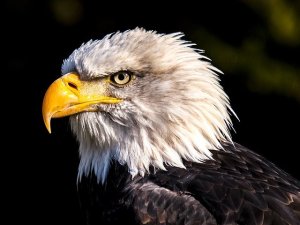
Maybe it’s a pandemic thing, what with humans huddling away more, but the big birds have come back.  Turkey buzzards and Canada geese are pretty common most of the time, it seems, but other large birds have been putting in an appearance around here lately.  Perhaps the most spectacular are the bald eagles.  My wife and I saw a couple on election day.  (I’ve been a lifelong believer in signs, as much as I try to deny it.)  We were out on a rare errand when one of them flew right over our car.  A couple days later I saw one out the window while I was at work.  My home office has a window that looks out over a small local park.  There are trees and a creek runs through it.  The eagle was likely keeping a look out for fish.

Image by Kathy Büscher from Pixabay.

This past week, however, the activity stepped up.  On a bleary-eyed Monday I sat in my office chair thinking that there were five whole days until I could relax again.  Mondays are hard.  I glanced out my west window and a bald eagle was heading straight toward our house.  I got a good look, but didn’t have time to grab my phone for a photo.  Two days latter, as I was getting through my email, a flash of wings caught my attention.  A great horned owl swooped up into a tree across the street.  Since the leaves are down, I had a chance to grab some binoculars and get a good look.  It was far enough away that a photo would’ve shown only a blur.  I should’ve been working, but sometimes you simply have to stop and look.

On Thursday, again in the morning, a broad winged hawk came and landed on the large electric wire that runs down my street.  The electric (I presume) cable is quite thick and sturdy.  With the binoculars I could see the bird’s claws gripping the twisted contours of the cable.  We regarded one another for some time.  We’ve only lived here for just over two years but I sit in that office nearly every day and I’d not seen such a slow riot of predatory birds.  As I said, I tend to take things as symbols.  I don’t always interpret them correctly, of course.  One thing that makes me glad is that seeing a bald eagle around here, at least for the time being, isn’t such a rare sight.  And I think I know what it means.


What Smells

One of the stories I recently read had a character commenting on the smell of a place.  Although humans can’t rival many other mammals and some birds for sense of scent, smell is a keen reminder of location.  It is also one of the more personal aspects of the senses.  We get nervous when people start talking about smells.  We all know, however, that places have their own fragrances.  Home smells a certain way.  You always notice it going home from college, where the dorms have their own smell.  When I was visiting campuses as part of my editorial expectations, I returned to Boston University School of Theology.  Apart from the main corridor of 745 Commonwealth avenue appearing smaller than I remembered, the smell was so familiar as to be overpowering.  I hadn’t been there for at least a couple of decades, but my brain remembered it well.

I trust science.  I also think science can’t explain everything, particularly in the life of emotions.  One of the natural limitations of science is the data with which we have to work.  We have limited input.  I remember in chemistry class in high school we worked with chemicals that replicated scents.  The particular ethyls used to reproduce fruit scents were similar only by suggestion.  I remember thinking the banana combination only smelled like bananas because it was suggested to me that it did.  Smell is a complex world, and we know many animals do it better than we do.  Dogs, bears, even mice, know more of the world through their noses.  I suspect Fido knows home primarily by its smellscape.  We, the “masters” tend to miss a lot.  And that makes me wonder what science might be missing by our limited sense of smell.

If there is a supernatural world, I wonder what it might smell like.  We’ve all known someone whose dog wouldn’t go into a certain room, or who reacted to something we couldn’t see.  Perhaps Fido couldn’t see anything that we couldn’t but could smell it.  I often think that when dogs are tested humans try to understand their visual acuity because that’s how we experience our world.  Dogs, however, experience their world through scent.  We could stand to learn quite a lot about this planet we inhabit if we could somehow access the smells that we simply lack the capacity to reach and analyze.  We are only beginning to scratch the surface.


Scared Space

It was dark.  I often work in dim light since the computer screen backlights everything.  I’d strained my back the day before, and getting into a standing position took some time, with the first steps being necessarily ginger.  Out of the corner of my eye, I saw it in the shadows.  A wolf spider was on the arm of my chair, just inches away.  I could move neither fast nor fast enough.  By the time I’d hobbled to an empty peanut butter jar (we keep them for this purpose), it was gone.  But the fright remained.  It was several hours until I could think of sitting in that chair again, although the spider was last seen fleeing the site of the attack.  That got me to thinking about how spaces maintain the events that transpire in them.  It’s the early stage of haunting, I suppose.

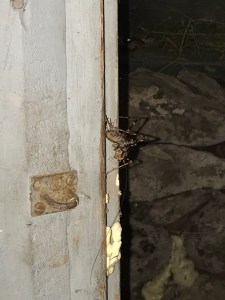
Spiders were a childhood terror.  Just a week before the current spider incident, I was in the basement doing some repairs when a spricket jumped on my arm.  Sprickets, also known as camel crickets or cave crickets, live in damp places and they actually jump at their perceived enemies to frighten them away.  It works.  I was absolutely terrified by the thing.  It was large, and although it was on my arm only a second or two, I wanted to run screaming from the cellar and strip off my shirt and throw it in the washer.  I couldn’t go back into the basement the entire day.  It was the site of the fright, you see.  Spricket and spider were long gone, but their threat remained in the place I’d encountered them.

I often write about sacred space.  There is also such a thing as scared space.  I can see how this would’ve evolved from our primate ancestors.  Chimpanzees, for example, are frightened of large spiders.  They can climb trees right after you and they are impossibly fast.  I suspect in our encounter the spider was more frightened of me than I was of it.  I’m a giant in its multiple eyes and, were I not a believer in catch-and-release, could easily have killed it.  (Messy for the chair, but conceivable.)  Our ancient ancestors would likely remember—this is the place the spider bit Oog.  Must avoid.  So the idea remains, scarring the spaces we habitually sit.  Spiders outdoors, as long as I see them before they see me, are not such a source of fear.  But right now I think I’ll pick a new favorite chair, until my favorite becomes sacred again.


Horse Senses

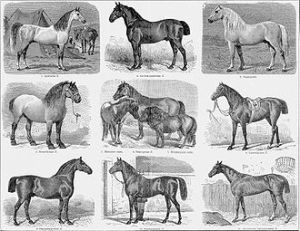
Chief was a smart horse.  The horse camp instructor told us that horses sometimes distended their midsections when a rider was strapping on the billet because they knew the strap would be tight.  The billet goes underneath the horse and is essentially what holds the saddle on.  The instructor told us to be firm about this—we weren’t going to hurt the horse by tightening the strap as much as possible.  Now, this was United Methodist Church camp, and I am someone who tries hard not to hurt anyone.  Besides, I’m not one of the larger specimens of the species and Chief was quite a large horse.  I can swear he had a knowing, laughing look in his eye that day as I pulled the billet tight.  Or so I thought.

As a camp counselor in the Western Pennsylvania Conference, you were assigned to a set of camps with no say in the matter, and I had been assigned four weeks of horse camp.  I wasn’t a kid who grew up wanting to ride or own a pony.  I was just doing my job.  Sitting atop a horse, I felt like some combination of John Wesley and Edgar Allan Poe heading for the house of Usher.  It was the first day of the first week of camp and my first time riding.  It was going fine until the instructor told us to canter, the speed between a trot and a gallop.  It was then that I felt the saddle starting to slip and I knew that Chief had used the old horse trick of distending his middle while I’d tightened the strap.  I felt the saddle begin to slip to the right (the wrong side for mounting or dismounting).  So I fell off a cantering horse.

Although the instructor yelled at me for not putting the reins over the pommel before I hit the ground, what stayed with me was how smart that horse was.  Chief, knowing the disparity of our relative sizes and weights, once stepped on my foot.  He was an intimidating horse with an attitude.  After the end of four weeks I’d gone on to the point where we spent an overnight in tents with our horses curried and tethered outside for the night.  What those days taught me was just how intelligent animals are.  I was reassigned from Chief to a more gentle horse for the remaining three weeks when the instructor realized she was stuck with me for a while.  But the horses, they knew me even better.


Believing and Seeing

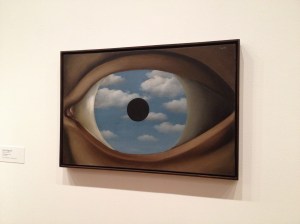
Our eyes locked for a moment.  He wasn’t ten feet away.  Of course, like all famous people he knew that his fans thought they knew him and hoped that he would know her or him.  This isn’t a particularly rare thing to happen in New York City, but the instance in my mind happened in Atlantic City after an Alice Cooper concert that I attended with my brother.  As kids we’d listened to Cooper with some avidity,  and even the concert itself was a somewhat intimate affair (we were both adults at the time).  An audience of hundreds instead of thousands, and many of the attendees about our age—that is to say, not young.  That meeting of the eyes, however, reinforced something I already knew.  Looking is more that your eyes receiving light particle-waves.  It is a connection.

Try this with your bestie—it can be your spouse, lover, or friend.  It especially works if you’ve known her or him for many years.  See how long you can go staring into each other’s eyes.  It’s not easy.  You start to feel that they can see your secrets: your fears and vulnerabilities.  You glance away.  Materialists claim that seeing is a simple matter of light entering our eyes and our brains interpreting it.  We all know, however, what it’s like to be stared at.  How uncomfortable it makes us feel.  We can often tell when someone’s staring at our backs.  I wonder if there’s more to seeing than appears?  Performers often crave the energy of being before thousands of eyes.  They know how it’s just not the same when you have to pretend.  I knew that well as a teacher.

Could seeing really go both ways?  Even animals don’t like to be stared at.  It’s an informal experiment I’ve tried while jogging.  If you break eye contact with a deer, cat, or rabbit, you can get fairly close.  If you stare, however, they dash away.  It doesn’t matter if you turn your head—it’s the eye contact.  I ponder how this relates to narcissists in power.  They crave the eyes on them.  The way to de-power them is to stop looking.  Alice Cooper, I’m certain, has no idea who I am.  He wouldn’t remember me if we ever met.  That night he was standing outside the door of the afterparty where those who’d paid extra could get to meet him.  We didn’t exchange a word, but we made a connection.  There’s more to seeing than meets the eye.


Kind Animals

How many people could it be?  That’s the question a pandemic naturally raises.  Last weekend my wife and I ventured to a Vegan Festival in Easton.  Since we vegans are a rare bunch anyway, and since we tend to be socially conscious, there wasn’t likely to be any dangerous behavior.  That, and how many people would actually show up for what is often considered a somewhat wobbly crowd who don’t like to “rise, kill, and eat.”  It felt like a safe place to be with socially distanced kindred spirits.  Everyone was wearing masks and there was no Trump bravado going on.  For a moment it reminded me of the kind of accepting country the United States used to be.

Veganism, you see, isn’t just about not eating and not exploiting animals.  It’s about honoring the wonder of life in all creatures.  I realize some of the issues—believe me, I try to think things through thoroughly.  It’s all about consciousness.  We’re still a considerable distance from being able to define it, and some people, like philosopher Thomas Nagel, believe it might go all the way down and through the plant kingdom as well.  Consciousness is one of the great mysteries of science.  We hardly know what it is, and how are we to know where it stops?  If we assume other people are conscious (with a few notable exceptions) based on their words and actions, might we not suppose at least some of the “higher” animals are as well?  Or are you just being a fool when you talk to your dog?

You see how this naturally suggests consciousness may lessen by matters of degree, but then we learn that even some insects know how to count and can understand a concept of zero (beyond most Republicans).  We like to put insects down at the bottom because we’re bigger and therefore more important.  Veganism suggests that we stop and think about these things.  We don’t necessarily take everything for granted.  It is clear that the largest polluter and environmental problem is industrial animal farming.  Rainforests are cleared for grazing land.  Profits from big agra are staggering.  Wandering through the stalls, keeping our distance from others who perhaps think too much, we partook of the counterculture in our own quiet way.  The street festival was small this year, but I do have hopes that it might grow, along with some serious thinking about the consequences of our actions.  


The Parable of the Dates

Speaking of resurrection, a news story I saw on Agade, apparently originating in the New York Times, tells of dates.  The kind you eat.  These dates were newsworthy because they were grown from seeds two millennia old, found in an archaeological dig in Israel.  The story shows just how tenacious life can be.  Seeds dead for centuries came back to life and bore fruit.  Things like this fill me with an optimism about this thing we call life.  Two thousand years is a long time to be buried.  These seeds nevertheless came back when the conditions were right.  There’s a parable here.  The parable of the dates.

Tardigrades are remarkable.  Sometimes known as “water bears” or “moss piglets,” they are actually microscopic animals.  Google them and take a look.  The amazing thing about tardigrades is their ability to survive.  Although they are animals, they can go three decades without food or water.  (Not quite the same as two millennia, but trees have their own remarkable abilities.)  Tardigrades can survive temperatures as low as absolute zero and higher than boiling.  Scientists study what makes these little critters so sturdy, but the takeaway for me is that life is remarkably resilient.  Given that Republicans and their ilk seem set on destroying the planet, it is comforting to know that life will continue, even if without our particular species to appreciate it.

The idea has been expressed in many ways over the years.  Doctor Malcolm in Jurassic Park says “Life will find a way.”  Stephen Jay Gould wrote in Bully for Brontosaurus that when we talk of the destruction of the earth what we really mean is the end of our own survival.  The planet—life—can and will persist.  The funny thing is that we don’t really have an accurate understanding of what life is.  If a tardigrade can be revived after thirty years without water, isn’t this an exuberant expression of what life can do?  And what about the Galapagos Tortoise, surviving a century-and-a-half?  If we leave them alone, sea creatures can live even longer.  Bowhead whales last two hundred years while at least one Greenland shark doubled that.  And the news story about dates raised from two-thousand-year-old seeds indicates something wondrous about life.  It persists.  These dates are from the time of Jesus and the Roman Empire.  Some trees, such as the bristlecone pine, have been continuously alive for double that span.  We should be in awe of life.  And we should act like it, for it will outlive us by a long stretch.