Thunder Towers

It sounded like brontide.  The Martin Tower, the tallest in the Lehigh Valley and once corporate center for Bethlehem Steel came down yesterday morning.  Completed only in 1972, the following decade saw the collapse of the steel industry, and the building has sat vacant a dozen years.  Now it’s gone.  The reasons the building could no longer stand are many and I won’t try to explain them as if I understood.  The fall of the tower, however, put me in mind of human folly and the belief that corporate profits will only ever grow.  Capitalism is built on a set of myths that the wealthy truly believe—I suspect many others do too, otherwise the system couldn’t possibly last.  Adam Smith may have been right academically, but in reality humans are greedy, venal, and shortsighted.   At least those who “rise to the top” are.

We didn’t move to the Valley for the steel.  Having settled in New Jersey just about when the Martin Tower was abandoned, like many other displaced academics I was looking for a job.  There were cities in the Midwest—we weren’t far from Milwaukee or Madison—but there was no work.  If you’re “overeducated” your best bet is to settle near a huge metropolitan area, as closely as you can afford to.  Then hang out your shingle.  Capitalism, however, has made New Jersey affordable only for the excessively wealthy.  Besides, I was born within the imaginary lines that we call the Commonwealth of Pennsylvania.  In fact, when I got my license transferred last year the computer asked me if I still lived in Venango County, where I was born.

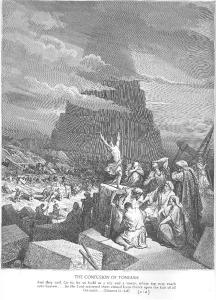
I didn’t see the tower come down.  It’s not visible from my house, but it was always right there when I drove to Lowes to pick up some necessary hardware to survive in this area.  (Weed-whacker and lawnmower—reel variety.)  My mythology of towers always takes me back to Babel.  In the biblical worldview towers were a sign of arrogance.  God seemed to think they were trying to invade divine turf, and so he made it so we could no longer understand one another.  There hasn’t been a moment’s peace since.  We build towers tall to show what we can do.  We don’t really need an angry deity to come down and confuse our language any more.  We’ve got capitalists and their excess money to lead the way.  The sound of thunder roared and I divined just where such leadership will guide us.

A Nightmare or Two

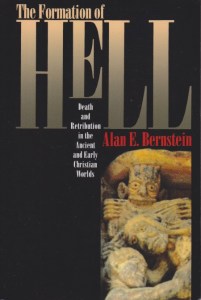
Some books are complex enough to require a slow reading.  Alan E. Bernstein’s The Formation of Hell: Death and Retribution in the Ancient and Early Christian Worlds is such a book.  For those of us raised in a faith primarily geared toward avoiding Hell, the concept becomes a lifelong nightmare.  It doesn’t help that, depending on your clergy you’re taught different, sure-fire ways of achieving that avoidance.  Often it hinges on “believing” the “right” thing.  Fundamentalists tend not to call it “doctrine” since that sounds rather Catholic, but the idea’s the same; it’s a tenet of faith.  As Bernstein shows, however, Hell is an idea that developed over a very long time with several different views of what happens after death.  There’s no single, linear progression, but rather a conglomeration of ideas from a variety of sources.

No single volume can cover all the background to Hell.  Bernstein focuses on Egypt for the early material, as well as Babylonia.  These early civilizations demonstrate that people have always wondered what comes next, and what happens to those who oppress others—the bullies of this life who don’t deserve the same eternal rest as the rest.  Usually some form of punishment awaits, but not always.  In the Hebrew Bible one of the great issues was the fact that everyone goes to Sheol, good and bad alike.  As in classical Greece and Rome (on which Bernstein spends a great number of pages) the concept of the netherworld is gloomy, but not torture.  Except in exceptional cases, of course.  The Greeks had Tartarus as a place for those who dissed the divine.

Even early Christianity didn’t have a uniform view of it.  The New Testament is decidedly divided on the topic.  Revelation seems to be the last word, but it’s not.  Later thinkers such as Origen and Augustine (who came to different conclusions) weighed in.  Catholic Christianity lavished great love on the latter and Augustinian views became disproportionately influential.  Reading his lack of compassion can cause nightmares, although he justifies it theologically.  The one thing I missed in Bernstein’s lengthy treatment was the Zoroastrians.  This religion of ancient Persia introduced a distinct dualism into the biblical world; it perhaps represents the first relatively developed concepts of Hell and Heaven.  Zoroastrianism suffers from lack of documentation, however, and it is difficult to parse it as meticulously as Bernstein does the other cultures covered.  This book requires much pondering as it’s read, and if you were raised believing this kind of thing it’s sure to bring back a nightmare or two.


Horizontal Thinking

“Theology” is a word that means very different things in different contexts.  I dislike labels in general and I seldom call myself a “theologian” since that implies a systematic or “dogmatic” theologian on this side of the Atlantic.  (And a better paying job.)  In the about to exit Britain “theologian” tends to mean someone who studies religion and can be used regardless of discipline.  In any case, I avoid the use of the title since my interests tend toward the history of religious ideas, not making them into a workable system.  I was a little surprised when I received an invitation from the journal Horizons in Biblical Theology to contribute a piece on horror and the Bible.  The issue in which the article was published (41) has just appeared.  Ironically, invitations to contribute seldom came when I was employed as an academic.  Of course, “independent scholar” is now a fairly common avocation.  Especially in theology.

Horizon

I won’t post any spoiler alerts for the contents of the article—I don’t want to quell the stampede of those eager to read it—but the basic idea is that biblical studies has embraced horror.  Like long-lost cousins, they have come together at last, realizing that they are both pariahs.  People generally don’t know how to carry on a discussion with a biblical scholar, as if those of us who spend time with the Good Book are constantly judging others.  I can’t say as I blame them since that image is reinforced fairly constantly.  Horror scholars, on the other hand, are thought to be weird examples of arrested development—stuck in the juvenile phase.  Social respectability isn’t their strong suit, although horror movies do well at the box office and one of the most successful writers ever is Stephen King.

Religion and horror share more than being associated with troglodytes, however.  Both address primal human fears.  Religion may not be “all about” fear, but a healthy dose of it is.  If life was peachy all the time, would we have any need of religion?  We need help coping with our fears, and religion has a long history of dispensing it.  Knowing we’re going to die, and in all likelihood will experience some suffering before that, whether physical or psychological, is a heavy burden to bear.  Religion has always been there to provide meaning and sometimes even solace.  Horror, or at least the best of it, does so too.  I’m not sure I would call it theological, but if you’re interested you know where to find my latest musings on it.


If Onlyists

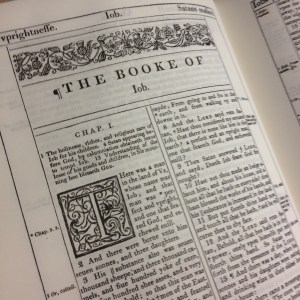
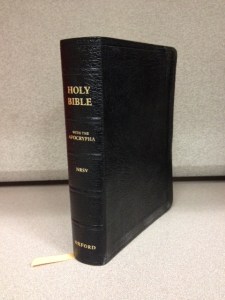
A special brand of Fundamentalism called King James Onlyism is a particularly odd variety of faith simply because of its required backing and filling.  In brief, this particular evangelical position claims that the only inspired translation of the Bible is the King James Version.  It’s best not to look too closely at the KJV, however, or the problems start.  Primary among them is that the version most Onlyists cite is not the original King James.  Published in 1611, this translation is immediately evident by its use of “I” for “J” and for the long s (the one that looks like an f).  Perhaps more troubling for Onlyists, it also includes the Apocrypha.  There was still some debate at the time concerning the status of these deuterocanonical books, and they were part of the actual KJV.

The typical King James used by Onlyists is a revised KJV.  In England, where the translation was done, revisions were made from time to time, leading to an Oxford version (Blayney text of 1769) and a Cambridge version (Scrivener text of 1873).  On these shores further adjustments were made leading to the rather strange situation where there is no single King James Version of the Bible.  There are many King James Versions.  Attempts to control Scripture often end up like that.  The underlying problem is the belief that there is a single version of Holy Writ.  Inerrantists are pledging their faith to something that doesn’t exist.  Defending this approach many would claim that the revisions are minor, but small changes can make huge differences.

The belief in one single version relies on the belief that God inspired not only the original writers, but the translators as well.  It denies that the better manuscripts that have come to light since the early seventeenth century (including the Dead Sea Scrolls) contain any authentic information of what the Good Book says.  Textual criticism, in the absence of any original manuscripts, is the best way we have of discovering what the original likely said.  Onlyists argue that the manuscripts from which King James’ translators worked were the divinely selected ones and their work was inspired—a position against which no empirical proof can be offered.  This faith trades in certainties that only bringing in direct heavenly control can achieve.  And it means that Catholics are wrong, despite King James’ inspired error to include the Apocrypha.  That’s the thing about a trump card like inspiration—once it’s played there’s no way to overcome it.


Chilly Fluids

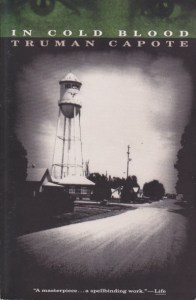
I’m not sure why I did it.  Read In Cold Blood.  I’d known of Truman Capote’s main claim to fame for years, but an accidental recent mention, a cheap copy in a used bookstore, and a week of grabbing time to read did it.  I’m not a fan of true crime, and despite my fixation on horror movies, I try to steer away from anything that doesn’t have a hint of the speculative about it.  There’s a difference between horror and terror.  I’d happily lived a half-century without ever hearing about the Clutter murders and kind of wish that were still the case.  Yes, there are doubts about the veracity of Capote’s account at points and novelists are often convincing liars, but still, at the heart of the matter more than just four people are senselessly murdered in the course of the tale.

A few elements stood out in the reading of the book.  One was that given the naiveté of the 1950s I wonder how anyone could ever really want to go back to that decade.  We’re run by a government full of doddering old men who seem to idealize the falsity and utter conformity of an age that was really a pressure cooker in which cases such as this would explode.  I was born in the much idealized 1960s but I don’t think we should go back to them.  We learn, we change, we grow.  Knowing what we now do, it was kind of painful reading how blissfully ignorant so many people were.  We may be more afraid these days, but at least we’re more realistic.

Another factor, very much at home in this world older but no wiser, is how the Bible is cited at the trial in support of capital punishment.  Although it may not have been intentional on Capote’s part, he demonstrates a deep truth about Scripture.  It can be read in more than one way.  In conservative Kansas in 1960 it could sway jurors to seek the death of other human beings.  The murders were indeed savage and pointless.  Capote’s account of them is difficult to read.  Perhaps more difficult is the way the Bible is used to unleash the basest instincts of people against other human beings.  Yes, parts of the Good Book require the bad thing, but if we’re over fifty years beyond Holcomb we’re over fifty score beyond a time when just one interpretation stands for all.  If it ever did.  There’s a difference between horror and terror, but the Bible can participate in both.  I prefer to stick to the former.


The Root of All

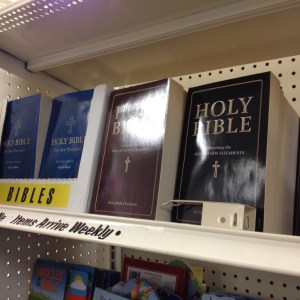
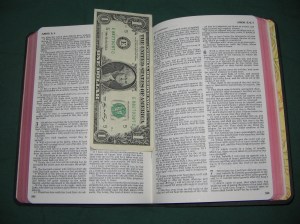
The other day I was in one of those stores where everything is sold really cheaply.  I figure it helps balance out all those times when I’ve been overcharged for things at other stores because I was pressed for time and needed something quickly.  In any case, these dollar store establishments have a constantly rotating stock, it seems (things move at a buck!), and so you might or might not find exactly what you’re looking for.  While just looking around, acquainting myself with the content, I came upon a shelf of Bibles.  God’s word for a dollar a pop.  This isn’t a place I’d normally come looking for books.  Then it occurred to me: many of those who shop in such stores are committed to a faith that keeps them in their economic bracket.

That suspicion was confirmed by other items at the store.  Many of them were Christian-themed.  This seemed like the opposite of the prosperity gospel.  People trying to scrape by, to shave enough off the budget to make it to another paycheck.  Many Americans live like this.  Many of them support Trump.  Selling the Bible to them cheaply definitely involves a mixed message.  There’s indeed a message, as I’ve learned in the publishing, in the way books are priced.  Getting a thousand-pager printed where the unit cost is below a dollar requires a massive print run.  Someone knows that Bibles sell.  You won’t find such cheap divine revelation at Barnes and Noble.  The same content, maybe, but not at the same price point.

The economics of cheap Bibles contains a message.  Those who can’t afford much can be guided toward spending some of it on the Good Book.  While just reading the Bible may indeed bring comfort to those who know where to look, as a whole this book requires major interpretative work.  As I’ve been indicating over the last several days, Holy Writ is not nearly as straightforward a reading experience as many suppose it to be.  Trying to figure out what Nehemiah’s differences with Sanballat the Horonite have to do with the rest of us isn’t an easy task.  To find out, if the internet doesn’t give us quite all the knowledge we want or need, can require some intensive study, up to and including seminary.  Even then you might not get it.  Studying the Bible requires further commitment than simply picking one up for a Washington might imply.  But then, it costs less than a lottery ticket.  And you can get it while saving money on other things you need.


Eastern Canon

It’s complicated.  The Bible, that is.  Tracing its origins as a book can easily occupy a lifetime, but the issue that keeps coming up with Scripture is how, definitively, to close the canon.  If we should.  My research on demons lately has led me once again to the books of Jubilees and 1 Enoch.  The latter has long been popular with the paranormal crowd because it has some weird stuff in it.  Thing is, as I mentioned back in November, these two books are part of the biblical canon of the Ethiopian Orthodox Tewahedo Church.  And the Eritrean Orthodox Tewahedo Church.  That makes these two books by definition “biblical.”  You won’t find them in nearly any printed Bible in the western world, although you can locate them in collections of the Apocrypha and Pseudepigrapha.

This privileging of the western canon has implications.  How do we know what really belongs in the Bible?  Judaism never officially closed its canon, but by consensus the same books contained in the Protestant Hebrew Bible (aka Old Testament) are those recognized.  Early Christian writers had different Bibles.  It took almost four centuries for them to agree  generally on what should be included.  In Europe, that is.  Not all branches of the church were represented in the Council of Rome.  Instead of waiting for the consensus of all—there was an urgency to stomping out heresy—the decision was made.  For some.  Meanwhile other Christian groups continued to use certain books that “the official” closing of the canon left out in the rain.  Or the desert.  Whichever.

The question of just what’s in the Bible goes a bit deeper than that.  The Tewahedo Churches of eastern Africa also recognize the books of 1 and 2 Maccabees.  “So?” did I hear you say, “Catholics recognize them too—what’s the big deal?”  These books, however, in the Ethiopian and Eritrean canons are not the same as western 1 and 2 Maccabees.  The books of the Mäqabeyan contain different content while maintaining the same basic name.  This means that we’re gonna need a bigger canon.  What’s more, these books have been pretty much ignored by biblical scholars.  One of the reasons, no doubt, is that they are written in Geez, a language not on the menu of too many seminaries.  Simply to dismiss them, however, is to ignore the belief system of over 50 million Christians.  It seems that the version of the Good Book tucked under the arm of many an evangelist is the condensed version.  Putting together a canon, it appears, is more complicated than it looks.

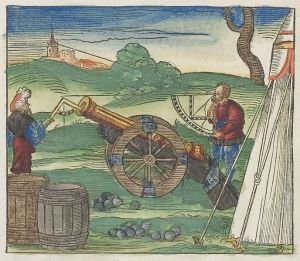
Not that kind of cannon! (Photo credit: Walther Hermann Ryff, via Wikimedia Commons)


Chapter and Verse

Maybe like me you’ve read some arguments based on chapter and verse.  I should mention that I mean chapter and verse in the Bible.  The typical scenario will go like this: Genesis (say) uses this word three times in chapter 38.  The case then often slips to making a point on the number of instances a word or phrase occurs within a circumscribed set of verses.  (The actual word doesn’t matter—this is a thought experiment.)  When I ran into an example of this a few days ago a thought occurred to me: chapters and verses are later additions to the biblical text.  They were never part of the original and were only added because Bible readers got tired of saying “That part in Genesis where…”  In other words, chapter and verse are artificial means of interpreting the Bible.  They’re very useful for taking quotes out of context.

I used to tell my students that you have to think carefully about what is the Bible and what isn’t.  As a culture where the book has instant recognition, we tend to think of that discrete unit of pages and cover as coming from one person—the author.  In reality most books (I can’t speak for the self-published) are the work of several people.  Just like it takes a community to raise a child, it also takes one to assemble a book.  That includes the Good Book.  Not everything between the covers is sacred text.  I’m pretty sure about that since as I was glancing through the latest edition of the New Oxford Annotated Bible I found my own name in the Preface.  As much as I’d like to claim otherwise I’m not exactly biblical. 

Modern ways of looking at ancient texts require a degree of facility in understanding how God’s scribes of yesteryear went about their work.  While early experiments in binding books may go back close to the time when the latter parts of the Bible were being written, the scroll—without chapter and verse—contained only the words of the text.  Most ancient manuscripts in Greek, anyway, didn’t even bother to put spaces between the words.  That leaves some room for ambiguity in among all those letters.  The Bible is a complex book with a complex history.  We do it a disservice as modern readers treating it as a modern book.  If you read Scripture online, or via electronic media, an even further layer of interpretation has been added.  That’s why we still need Bible scholars tangled somewhere in this world-wide web.


Spoken Against

“Antilegomena” is a word that appears more often in New Testament studies than it does in those of the Hebrew Bible.  Still, it’s an important part of the discussion of “the Bible,” especially since Heaven stands at the end.  Antilegomena is the Greek word for “disputed texts.”  You see, when the Bible was being compiled, there were many books from which to choose.  The twenty-seven books generally recognized as the New Testament included several that were disputed.  The Antilegomena included these books: the Gospel of the Hebrews, the Apocalypse of Peter, the Acts of Paul, the Shepherd of Hermas, the Epistle of Barnabas, and the Didache, all fine and good.  But the list continues: James, Jude, Hebrews, 2 and 3 John, and Revelation.  This final half-dozen made the cut, although Revelation is still disputed in some quarters.  All of these books were, however, in some early Christians’ Bibles.  The exact date that the New Testament canon was fixed isn’t certain, but it wasn’t widely recognized until the fourth century C.E., that is, over 300 years after Jesus.

The first time I learned about canonization in college I was shocked.  Like most people raised on the Bible, I believed that it had come, fully written, from the hand of God.  Maybe there was even an autographed copy somewhere.  Grove City College, at the time, disputed the Documentary Hypothesis of J, E, D, and P, but to the credit of the religion department they did tell us about it.  Moses, of course, we were taught, did the actual writing.  But then there was the problem of the New Testament.  There were other gospels, some as old as those that made it into the Bible.  The realization dawned that “the Bible” was much more complicated than I had been led to believe.  And what was up with the Apocrypha?

One of my professors said that the problem with inerrancy is that it proposed a Bible more perfect than God.  I’m not sure that I follow the logic there, but I take his point (they were all “he”s, whoever he was).  The Bible may not be a perfect book  There are parts missing and repeated bits.  It is nevertheless one of many sacred books from around the world, and it is the holy book of much of Christianity.  From the very beginning some of the contents were disputed.  Even as an undergraduate I had some inklings that a journey that involved taking the Bible seriously was going to lead to some strange places.  That single book that had always been presented to me with a definite article—“the” Bible—was actually a book that the earliest followers of Jesus didn’t know.  And they seem to have got along fine, as far as getting to Heaven goes.


You Call That Working?

A recent post of mine on the United Methodist Church got a lot of response (for me, anyway) on other social media.  As I pondered this—I’ve written about the topic many times before—it occurred to me that most people probably have no idea what biblical scholars do all day.  (That is, besides write books that only other biblical scholars read, and teach their classes, or, very occasionally, edit books.)  Biblical studies is arguably one of the oldest academic pursuits in the world and what it boils down to in a word is “contexts.”  We try to understand the multiple contexts of the biblical texts.  Think about this a second: when you pick up a book, newspaper, magazine, or their electronic equivalents, what is the first, if often unconscious, thought you have?  Isn’t it something like “what kind of book, newspaper, etc., is this?”  Is it fiction or non?  Is it reputable or not?  Who wrote it and when?  These are all contexts.

The Bible was written about two millennia ago.  Very little of that original context still remains.  In fact, none of the original manuscripts even still exist.  It was a book written in Hebrew, Aramaic, and Greek.  The vast majority of people in the western world do not read these languages, and so the Bible comes to us in mediated form—translation.  Translation, as any writer knows, is a form of interpretation.  It is not, and can never be, the original.  To figure out what the Bible “means” it has to be interpreted—even just reading it is a form of interpretation.  Biblical scholars want to be able to interpret it in informed ways.  We learn about its various contexts and use them to help us understand.

What did people think like thousands of years ago?  Can you even remember what it was like to look up a distant location without the internet?  Writing letters or dialing a rotary phone to get information on it?  Going to triple A to get maps?  And all of that was only two decades ago.  Life in biblical times was very different than life today.  The people then didn’t understand science the way that we do.  The writers of the Good Book didn’t have any idea that what they were scribbling would one day be considered holy scripture.  They had completely different contexts.  Whether the contexts are historical, literary, or social scientific (we still haven’t figured out an elegant way of saying the latter) biblical scholars use a variety of methods to get to those contexts.  We can’t go in with the answers already in our heads—if we did we’d only find what we were looking for.  At the end we have an answer, not “the” answer.  And so biblical studies continues.


Common Tyrants

“Common tyrants, and public oppressors, are not intitled to obedience from their subjects.”  The words aren’t mine, nor are they from this century.  That, however, makes them no less true.  Jonathan Mayhew was an eighteenth-century clergyman arguing that Bible’s admonition to obey government officials did not apply to those who abused power.  In reading these words I felt a sense of loss in a very basic way.  No, I’m not a fan of turning back the clock—it can’t really be done anyway—but when the word of a single book was not disputed those tempted to follow tyrants could be made to justify it with a Good Book that could also be used to refute it.  We no longer have a common frame of reference, but tyrants still exist.

Shouting matches have been substituted for discussions because those who support tyrants can’t see how they are also being oppressed.  It’s one of the ironies of history.  This internet age has only found a way of magnifying people’s differences on the political scale, even as it has brought us to the common marketplace of culture.  Who doesn’t use Amazon?  Tyranny, by definition, is the arbitrary use of power.  One might think of, oh, declaring a national emergency when none exists just to get what one wants.  One might think of surrounding oneself with criminals against the nation just to get what one wants.  One might think of business practices meant to ruin others just to get what one wants.  There seems to be a common theme here and it’s one on which the Bible has a great deal to say.  The only Scripture that gets quoted is that which supports tyranny, eh, Mayhew?

When the debate was about the Good Book we were largely all on the same page.  Not all colonials wanted to break with King George III.  Some profited from the connection.  Others thought Holy Writ prevented revolutions rather than inspiring them.  Tyrants have always been with us.  You’d think that with all the media we have these days that we’d be able to spot one fairly easily.  The camera, however, has a way of giving the lie to the Good Book.  Anyone can say they read it.  Or claim they obey it.  Its own test seems to be “by their fruits you will know them.”  The words aren’t mine.  They’re from a distant century past.  But it seems the fruit is dying on the tree, even as spring begins.


Quoth Hardy

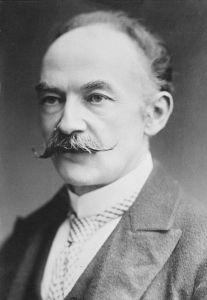
There are days when the quote from an author is the best thing to happen to me.  You probably know those kinds of days—days when there’s nothing really to stay up for so you go to bed early.  Lengthy days when your Muse wins easily any game of hide-and-seek.  You see, I save most of my fiction reading for bedtime.  If I turn in soon enough I can read quite a bit before falling asleep.  Not to sell you a false bill of goods, but that’s not the source of the quote.  It actually came to me from an unrelated email about the Bible.  The quote, while lengthy, comes from Thomas Hardy:

By the will of God some men are born poetical. Of these some make themselves practical poets, other are made poets by lapse of time who were hardly recognized as such. Particularly has this been the case with the translators of the Bible. They translated into the language of their age; then the years began to corrupt that language as spoken, and to add grey lichen to the translation; until the moderns who use the corrupted tongue marvel at the poetry of the old words. When new they were not more than half so poetical. So that Coverdale, Tyndale, and the rest of them are as ghosts what they never were in the flesh.

This comes from a letter to Professor D. A. Robertson of the University of Chicago, dated to February 1918.  Hardy was a known critic of religion, but like most writers of his day he knew the Bible.  Now, I’d never generally put myself on the same page with Hardy, but something similar to this thought had occurred to me long before I saw this quote.  We treasure ancient writing simply because it has survived.  This should be a sobering thought to any of us who try to forge our thoughts into words.  We have no way of knowing if, at the time, an author was considered great.  Merely the passage of time can make writing unfashionable in its age appear brilliant.  Like rocks tumbling over each other at the base of a cataract, they find polish over time.

My particular context for receiving this emailed quote was the King James Version of the Bible.  Often considered sacred in that translation, it was not uniformly well received when first published.  There had been English Bibles before, and since the Good Book is the foundation of western literature, a new translation commanded attention.  It had its critics, but over the centuries the translation itself became holy, whether it deserved it or not.  Similarly, Martin Luther’s translation of the Bible helped to codify the German language.  We shouldn’t be too quick to dismiss Scripture, not for its theology, but for its immense influence on western thought.  As Hardy noted, it may be the passage of time that makes writing great.  Even so we might be wise to pay attention.


Not Your Parents’ Bible

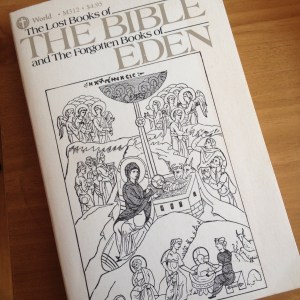
As someone always interested in origins, I reflect on how I’ve ended up the way I have.  I mean, who plans to end up a Bibles editor?  In the grand scheme of a universe with a sense of humor, it’s an odd job.  I grew up reading the Bible, but lots of people do.  Most of them end up with ordinary people jobs.  Obviously, working on a doctorate in the field is admittedly strange, but then, my interests have always been to get to the truth.  The other day I spotted a book on my shelf—the book that arguably started it all.  The Lost Books of the Bible and The Forgotten Books of Eden.  These days I would recognize this for what it is, a cheap reprint of a book published quite some time ago (1926 and 1927).  No “value added content.”  Just a reprint.  But why did this book have such influence?

It was the first time I’d realized—and growing up in poverty with parents lacking college educations you have to teach yourself a lot—that there were other books about as old as the Bible.  The idea fascinated me.  Somehow my fundamentalist upbringing had convinced me the Bible was the first book ever written—after all, its author was God and how much more primordial can you get?  Now this particular book (Lost Books of the Bible etc.) contains some apocryphal Gospels.  Not having a strong grasp on the concept of canon, I wondered why these books had been excluded, or, to use the title conceit, “lost” and “forgotten.”  In college I would learn about the canonical process.  I’d hear more about it in seminary.  There I would learn that even older sources existed.  In the pre-internet days, in a rural town without so much as a public library, how would you find out about such things?

Helmer Ringgren’s Israelite Religion captured my imagination in seminary.  Even there, however, nobody on the faculty seemed to know much about what had come before the Bible.  Harrell Beck told us of ancient Egypt in our classes, but clearly there were further depths to plumb.  I learned about James Pritchard’s Ancient Near Eastern Texts, which I bought at the Harvard Divinity School bookstore.  Other texts went back beyond Holy Writ.  Just how far would have to wait until the University of Edinburgh.  I sometimes wonder if I might’ve taken a different turn here or there had anyone been able to answer my young, unformulated questions about the origins of the Bible and other ancient books.  Now we just have to ask the internet.


Lingua Franca

The history of Israel and its neighbors has been appropriated deeply in the mindset of western cultures.  Both the British and Americans, for example, have thought themselves the “new Israel,” for once a people is chosen so all people wish to be.  I’ve been thinking about this in linguistic terms of late.  To get to the main point, we need to read a little history—it’ll be painless, I assure you.  Israel was a nation frequently conquered.  The imperial powers to the east, beginning with Assyria and continuing through Babylonia and Persia, overran the land.  This hostile takeover involved not only Israel, but its neighboring nations as well.  These early, violent attempts at globalization worked themselves out linguistically, in part, by the necessity to communicate in a common language.

In the broad sweep of world history, the conquering nation tends to impose its language on the conquered.  Think of Alexander of Macedon and the adoption of Greek as the “lingua franca”—the official language of empire.  Ironically—and this is what captures my attention—when Assyria overran Israel, it also conquered “Aram.”  (Aram was the area north of Israel, roughly what we think of as Syria today.  Their language was Aramaic, which is closely related to Hebrew.)  Instead of the Assyrian language being imposed on the defeated peoples, the invaders adopted Aramaic as the official imperial language.  Some of this may have to do with the fact that Aramaic, being alphabetic, was much easier to learn to write than syllabic Assyrian (known generically as Akkadian, along with Babylonian and its dialects).  It may have been the last time a conquering nation admitted at least some of the culture of the defeated was superior.  (Ironically, the Romans felt that way about the Greeks.  Those who have ears…)

Aramaic continued in favor even as the conquered adopted Alexander’s Indo-European Greek centuries later.  Lingering into Roman times many of the people of what was left of Israel were bilingual, knowing Greek and Aramaic.  The latter was the language of Jesus.  Aramaic later survived in the form of Syriac, but the area was overrun by Arab invaders and Arabic became the lingua franca.  Still, nestled in the middle of this linguistic history is that episode of the ascension of Aramaic to imperial levels.  That’s the thing about globalization—it’s an exercise in compromise.  Many distrust and hate it, and even today some sub-cultures fear they’re being wiped out by granting too much to those who “don’t belong.”  In some ways it’s an understandable fear.  Learning new languages is hard, especially for adults.  There is perhaps a lesson in the survival of Aramaic, though, that might still come in handy when cultures collide.


Frankly

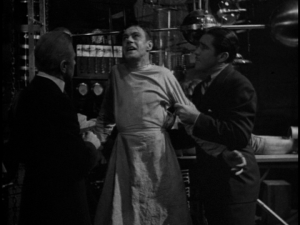
Even in the 1960s, if I recall, Dracula and Frankenstein really weren’t that scary.  I mean this in the sense of the 1931 Universal movies that began the entire trend of “horror” films.  They were, nevertheless, monarchs among those of us who claim the sobriquet “monster boomers.”  (I’ve never considered myself as part of any generation, but there’s so many people that you’ve got to sort us somehow.)  Recently I talked my wife into watching/re-watching these two films with me.   The pacing makes it seem like everything in the 1930s was stuck in slow motion.  The frights are difficult to feel, given what we’ve seen in movies since then.  And they are both, it occurs upon reflection, movies in which religion is the norm against which we measure monsters.  God is assumed.

Dracula, of course, fears the crucifix.  His chosen home in England is a ruined abbey.  Although the source of his monstrosity is never discussed, he is intended to be an embodiment of evil, draining the life of innocents.  Renfield craves flies and spiders in order to ingest their life.  Christianity can’t tolerate such evil and Dracula must be staked (off screen).  Frankenstein’s monster is much more obviously theological.  Opening with a warning to the audience that the film may shock due not only to its frights, but also because of Henry’s desire to create life, the film has philosophical discussions between Henry and his associates, and ends with the moral dilemma of what to do with an evil created by human hands, yet clearly alive like other people.

Metaphorically speaking, these first two horror films set the stage for later developments in the genre.  It isn’t so much fear and startles that define the genre as it is a deep dread of offending the powers that be.  Childhood was so long ago that I can no longer recall just which movies I saw on Saturday afternoons, but these two were among them.  Even as I was beginning the spiritual journey that would assure my job was never far from the Bible, I recalled with fondness the frissons of watching Dracula and Frankenstein—and then the host of other Universal monsters such as The Wolf-Man, The Invisible Man, and The Creature from the Black Lagoon (the last being scary in the classical sense).  The world in which they operated was deeply religious, for even the gill-man was an implicit condemnation of evolution.  These monsters were informing a religious outlook that would last a lifetime.  Going back to Dracula and Frankenstein is like turning back to the first page of Genesis and beginning again.