Christmas Lights

How many people read a blog on a major holiday?  The process of writing takes no vacations, however, and I often think of holidays as a time to write.  It doesn’t really matter if anyone reads it; writing is our witness to the cosmos that “Kilroy was here.”  Even if most of us have no idea who Kilroy was.  So I find myself awake earlier than most children on Christmas morning.  My long habit of rising early to catch the bus hasn’t been easy to break.   I creep down the stairs and water the tree before turning on its colorful lights.  I make a cup of coffee and wash the dishes left in the sink after a festive Christmas Eve.  And I think.  There’s always the thinking.

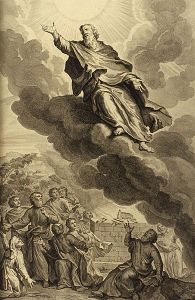
The meaning of Christmas, as the holiday classic tells us, eludes Charlie Brown.  Linus van Pelt gives one rendition—that of the Gospel of Luke—as the canonical meaning, but in my experience it shifts during a lifetime.  Christmas, after all, is one of a host of solstice celebrations.  My thinking these days is that it’s all about light.  Shimmering angels, glowing stars, light coming into the darkness.  These ideas seem to have, for the most part, Zoroastrian origins, but they’ve been thoroughly appropriated and, in true American style, commercialized.  The news headlines read how disappointed retailers always are.  The take could’ve been bigger.  Capitalism relies on Christmas to make the third quarter.  Light in the darkness, in its own distorted way.

As I sit for these quiet moments in the glow of only a tree, I think of those for whom the holiday has become a kind of disappointment.  Not a cheery Christmas thought, I know, but an honest one.  As families grow and diversify the childhood Christmas of excited children scrambling under the tree to excavate the next gift for me starts to fade.  Our economic system separates, and the dearth of days off around the holidays makes travel back to childhood homes difficult.  We do the best we can, but the fact is the sixties (speaking for me) are over.  Our reality is colder and darker than it used to be.  I part the curtains and look for any sign of dawn.  It will be a few hours yet before the sun brightens this winter sky, but then, that’s what the holiday has come to mean for me.  At least this year, it is the hope of light returning.  And that, alone, makes it a holiday.

Epistle Writer

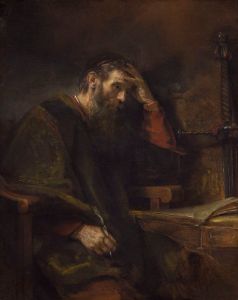
I’ve been reading about Paul.  You know, that Paul.  What has struck me from this reading is that if he weren’t in the Bible rational people would likely think Paul was writing nonsense.  Getting into the Good Book is a big score, for sure, but a close look at what this particular apostle wrote does raise eyebrows, as well as questions.  Over my editing years I’ve discovered quite a few methods of dealing with the saint from Tarsus, but what they really point to is the elephant in the room—we don’t really know what Paul was on about.  A few basic facts stand out: the Paul of Acts doesn’t match the Paul of the authentic letters, and although Paul never met Jesus he became the architect of much of Christianity.

There’s a reason that I focused my doctoral work on the Hebrew Bible rather than the New Testament.  Still, it remains fascinating to look closely at Paul’s claims.  At some points he sounds downright modern.  Like a Republican he declares that he can be tried by no human power.  Specially selected by God himself, he can’t be judged by the standards of normal people.  This is dangerous territory even for those who eventually end up in the Good Book, especially since it wasn’t written as an abstraction, but to a specific readership in a specific place dealing with specific issues.  Galatia wasn’t the same as Corinth.  The issues at Philippi weren’t the same as those in Rome.  Yet, being in Scripture makes all his musings equally inspired.

The more we learn about Scripture the more difficult it becomes.  Perceptions evolve over time, and we know nothing about how various books were selected.  There are no committee minutes.  We don’t even know the committee’s name or if it was ad hoc or standing.  With repeated and long-term use these books became Bible.  Take Paul’s letters—it’s virtually certain that we don’t have them all.  He makes reference to letters that we don’t have.  What might he have written therein?  Is part of divine revelation missing?  The discovery of other gospels and many contemporary religious texts to those that made the Bible cut raises questions that can only be resolved with the category “inspiration.”  Christianity isn’t unified enough to add any more books, although some sects do nevertheless.  Paul is very much like that—an example of not being subject to human trial.  For a founder of a major religion we know surprisingly little about him.


Evangelical Angels

Angels are everywhere at this time of year.  The Christmas stories of the gospels of Matthew and Luke have made them an indelible part of the tradition.  It’s not unusual for entirely secular individuals to be decorating with them and they are generally without controversy in public displays of holiday spirit.   A colleague once asked me why Americans were so credulous when it comes to a belief in angels—the numbers of believers are quite high, statistically.  I wonder if it’s because we need them.  Considering that the Republican Party is the Evangelical’s party, it’s no small wonder that even atheists embrace angels.  We all could use a little help from on high.  This time of year, such hope can be disguised behind tinsel and bows.

America must seem a strange country to those who immigrate (or had immigrated, when that was possible).  We wear our religiosity—and this is not the same thing as true religion—not only on our Christmas trees, but even on billboards by decidedly secular highways.  It’s as if even all the things America stands for, such as love of money, guns, and automobiles, only hold together with the saccharine glue of a sickly sweet religion.  A Bible-believing nation that has no idea what the Bible actually says and lauds a president who breaks at least a commandment a day and gains no reprimands.  We have shown our red neck to the rest of the world and yee-haw we are proud of it.  And we got the Good Book to prove it.

After all this shakes out we’ll be needing some angels, I suspect.  My colleague felt that sophisticates, big city skeptics, ought to be more willing to dismiss unenlightened beliefs such as those in spiritual beings.  The thing is, spiritual beings serve a very useful purpose.  They keep us honest—and I don’t mean in an Evangelical way; I’ve seen Evangelical honesty and it’s as corrupt as the Devil.  No, I mean that angels are important to show that we have hope.  Maybe they are secular angels—even the Bible doesn’t give any description of them at all, so how can you tell a secular from a religious angel?  That lack of pedigree doesn’t mean we don’t want them watching over us.  Belief is an important part of being human, secular or not.  The billboard space tends to go to those who want your money, and that applies to the ones that appear to be religious as well.  If this is the way the religious behave, we’d better hope there are angels everywhere.


Christmas at the Bus Stop

I had to make one of my periodic treks into New York City this week.  Unlike most years when a warm spell comes after the onset of winter, we’ve kind of fallen straight to the heart of the season this year and those of us standing in line for the bus were experiencing it via wind chill.  The cold got some regulars to talking about Christmas.  Although I’m not the oldest one who makes this long trip, the majority of the commuters this far out have yet to attain my years.  Those chatting at the stop had kids at home that still believe in Santa Claus.  It made me recall how we trick our kids with all kinds of quasi-religious folkloric figures, but also how seriously some adults participate in the mythology as well.

Among those chatting, the leaving out of cookies and carrots was almost canonical.  The cookies are for Santa, of course, and the carrots for the reindeer.  The more I pondered this, the more it became clear that this is a form of thank offering.  The story of Bel and the Dragon, in the Apocrypha additions to Daniel, tell of how priests leave out food for an idol.  The offering is gone in the morning and the credulous worshippers assume the statue has eaten it.  Religious offerings, except those entirely burnt up, were often used to support priesthoods.  Santa has his elfly acolytes, of course, but the priesthood for his cult is that of parents eager to make Christmas a special time for their children.  Capitalism’s big pay-off.

Then one of the commuters mentioned how she had her husband leave a footprint in the fireplace ash to add verisimilitude to the ruse.  We never had a fireplace when I was growing up, and I often wondered how Santa got in when we had no chimney to come down.  In any case, my hazy morning mind thought once again of Daniel and Bel.  The way that wily Daniel exposed the fraudulent priests was by sprinkling—you guessed it—a fine layer of ash around the offering after the priests had “left” for the night.  In the morning he showed the people the footprints of the deceptive heathens to the people.  The statue hadn’t eaten the food after all!  Serious consequences followed.  Christmas, despite its commercialization, brings fond childhood memories to many of us, and we’re reluctant to let that go.  The one man in on the discussion (it wasn’t me) said that when he was growing up they had a somewhat different offering.  “My dad,” he said, “told us to leave Santa a beer and a sandwich.”  This guy’s name might’ve been Daniel.


Mythic Truth

“Myth embodies the nearest approach to absolute truth that can be stated in words.”  I recently came across this quote from Ananda K. Coomaraswamy.  Coomaraswamy was a philosopher and metapmhysist from Ceylon, and like many eastern thinkers had a more holistic view of the world than western rationalism.  We’re taught from a young age that myth is something false, not true.  This colloquial use of the word is so common that those of us who’ve specialized in myth slip into it during everyday conversation.  Words, however, have uses rather than meanings.  Coomaraswamy was engaging this reality in the quote above.  Words can take us only so far in exploring reality when we have to break into either formulas or poetry.  Although they are under-appreciated poets are the purveyors of truth.

Having studied ancient mythology in some detail, it became clear to me as a student that these tales weren’t meant to be taken literally.  Instead, they were known to be true.  It takes a supple mind to parse being true from “really happened,” as we are taught in the western world that on what “really happened” is true.  In other words, historicism is our myth.  Meaning may not inhere in words, but when we use words to explore it we run up against lexical limits.  Is it any wonder that lovers resort to poetry?  On those occasions when I’ve been brave enough to venture to write some, I walk away feeling as if I’ve been the receiver of some cosmic radio signal.  We have been taught to trust the reality of what our senses perceive.  Myth, and poetry, remind us that there’s much more.

The Fundamentalist myth is that the Bible is literally true.  If they’d stop and think about it, they’d realize the mockery such thinking makes of Holy Writ.  The Good Book doesn’t look at itself that way.  In fact, it doesn’t even look at itself as a book—an idea that developed in later times.  The time and the cultures that produced the Bible were cool with myth.  They may not have called it that but the signs are unmistakable.  Ananda Coomaraswamy knew whereof he wrote.  The closest to absolute truth we can come takes us to the end of declarative, factual writing.  Scientists writing about the Big Bang devolve into complex mathematical formulas to explain what mere words can.  Myth is much more eloquent, even if we as a society, dismiss it along with other non-factual truth.


Where Was I?

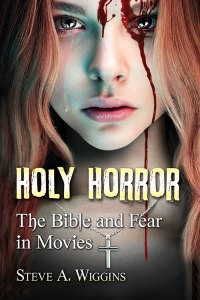
Finally!  I have sent my proofs and the index for Holy Horror back to McFarland and I find myself in that state following intensive concentration on one thing.  Well, as much as work will allow such concentration.  Those who write books know how difficult it is to switch gears from fifth back to first while driving at highway speeds.  As soon as the email arrived stating that the proofs were ready, I dropped everything to get them read, outside work hours, of course.  With mind focused on a single goal—get the job done—I’ve managed to forget where I was before being interrupted by my own work.  I recall it had something to do with demons, though.

Perhaps the most taxing part of trying to write while employed full time is keeping track of where you are.  The luxury of spending hours outside of class doing the index, for example, is compressed into the little free time I have between writing for this blog and work—between a blog and a hard place, as it were.  Indexing, which can be quite pricey when a professional does it, is  much easier with a searchable PDF than it ever was going through a printout page-by-page to find obscure references you forgot you ever wrote.  It reminded me of the time I had Owen Chadwick over for dinner at Nashotah House.  I recalled someone asking him about something he’d once written and he looked puzzled for a moment and then replied, “One writes so many things.”  Indeed.  Millions and million of words in electrons, if not on paper, mark the status of a life.  And indexing will prove it to you somehow.

This morning I awoke with the proofs and index safely emailed back to the publisher.  What was I doing before that?  I know that work is looming just a short hour or two ahead, and I need to accomplish part of my life’s work before going to work.  I can’t afford to waste this time.  Nightmares with the Bible is coming along nicely.  A very drafty draft of the book exists.  I have some more research to do, however, and the annotated bibliography—ah, that’s where I left off!—is still a shambles.  Not only that, but I’ve got a stack of reading on the topic next to my chair.  Time to put on a pot of coffee and warm up those typing fingers.  I’ve got real work to do.


Righteous City

I’m a stomach sleeper, if that’s not TMI.  This began many years ago when I realized that upon awaking from nightmares I was always on my back.  I started doing what I knew was dangerous to infants, safe since I haven’t been part of that demographic for decades.  Terrazzo isn’t one of my favorite sleeping surfaces, however, and on my back on the floor of Newark’s Liberty Airport I realized I couldn’t roll over, for many reasons.  My glasses, for one thing, were in the internal pocket of my Harris Tweed.  For another, on one’s stomach one’s wallet is exposed in a way that’s maybe too inviting.  Before suggesting I could’ve placed my wallet and glasses elsewhere, let me write in my own defense that rationality isn’t my strong suit after midnight.

The night before

I found a spot next to a set of escalators where the constant thrumming alternately kept me awake and soothed me to nod.  I heard many languages spoken as I drifted in and out of consciousness for the few hours I had to wait for dawn.  And nobody disturbed me.  This is rather remarkable—a person asleep is a vulnerable being.  Doing it out in public with no private walls was a new experience for me.  I don’t sleep on planes, buses, or trains.  Or, until two days ago, airports.  It brought to mind the biblical world.  A town was considered a righteous place if a stranger could sleep unmolested in a public place.  The traveller—please take note, United—was in need of special consideration.  My situation revealed something unexpected about Newark Airport.

The morning after

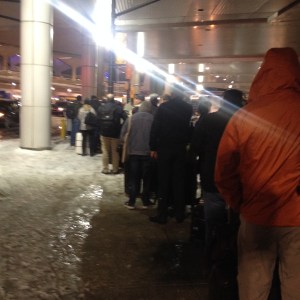
It was full of angry, frustrated people.  I opened my eyes at five a.m. to find a very long line snaking down the corridor behind me—a queue that had been there when I first drifted off.  These were people trying to reschedule flights since United couldn’t bump that day’s passengers because they’d decided not to fly out the night before.  Despite the weariness and intensity of emotions, there was very little bad behavior.  We were biblical strangers, mostly in the same circumstances.  No creature comforts, no privacy.  An east Asian woman said the next morning that in her country the airline would’ve brought food, and blankets at least.  In the United States fiscal concerns reign supreme, however; do you know how much it would cost to care for all these stranded people?  When I opened my eyes the situation was about the same as when I closed them.  I couldn’t help noticing I awoke on my back.


Eternal Return

For those of you who don’t live, eat, and breathe academic religious studies, it’s my duty to point out that the American Academy of Religion and Society of Biblical Literature (AAR/SBL) annual meeting begins this week.  For those of us in the biz it’s like the sun holding still at Makkedah as we try to prepare for our various roles.  This year the conference is in warm and sunny Denver, so be sure to dress in layers.  The meeting was held in Denver many years ago now, and I remember very little of it other than it being the year my final published paper from my Nashotah House days was read.  Or started to be.

I don’t know whether it was the altitude or the time of year, but I wasn’t feeling well the last time we met in Denver.  Although it may not show on this blog, I’m really into geology and the city has a great mineral collection in the Denver Museum of Nature and Science.  I went out to look at the collection the morning of my paper and had the great embarrassment of being sick while in the museum.  I went back to my hotel for a nap and when it was time to read my paper I had to excuse myself because running my eyes across the lines of text made me nauseous.  Concerned-looking philologists didn’t know what to do as I sat through the session with my head between my knees.  That’s how I remember Denver.

Perhaps this year will offer redemption.  You see, it’s very different attending the conference as the representative of a press instead of an institution.  Your time is completely booked.  People want to discuss their book ideas with you.  For a few short days of the year you’re one of the popular guys.  But for me, there are colleagues from every stage of my career on hand.  Not too many people from Nashotah House come, although there are more now than there were when I was about the only faculty member who went.  I see those I knew from Oshkosh and Rutgers, Gorgias and Routledge.  Those I knew as friends before we became professional colleagues.  They’re not after me to publish their books, and sometimes that’s all it takes to make three days of popularity really count.  Later today I’m off to Denver and I won’t have time to see the sparkling minerals this time around, but hopefully I’ll remember it more fondly when its over.


Knowing How To Know

Some questions are deceptively simple.  For example: how do you know?  The fancy philosophical word for this is “epistemology,” although that often takes it a step further to ask how do you know you know.  Given that many powerful individuals are motivated by a Fundamentalist faith the question of how we know is more important than it might seem.  Back in the days when faith commitments meant thinking such things through, theologians in the western world came up with three bases of knowledge: scripture, tradition, and reason.  Anglicans, especially, favored this “three-legged stool.”  If you removed any one of the three, the stool became unstable, topsy-turvy.  The analogy worked well.  It assumed that all three factors would be weighed against each other.

Image credit: Blackash at en.wikipedia

As time went on two developments occurred—the wider belief in science, and the work of John Wesley, a priest in the Church of England and founder of the Methodists.  Science argued that reason alone led to knowledge, whereas Wesley’s thought suggested a fourth leg for the stool—experience.  This latter configuration eventually became known as the Wesleyan quadrilateral, sometimes one leg was bigger (usually Scripture), but the other three could not be dismissed.  Science, however, rested on a one-legged stool, reason alone.  Fundamentalism, which is a fairly new form of religion, chooses Scripture as its one leg for a wobbly stool.  It may sometimes claim “tradition,” but since it only dates to the nineteenth century its tradition can’t hold a candle to that of, say, Roman Catholicism.

Amid all the drama we see developing in the halls of government where, increasingly, the power to declare truth resides, it’s important to understand how we know.  For a large and growing segment of society Scripture has been removed as a leg of the stool.  For others it is the only leg.  Having attended a United Methodist seminary, I admit the Wesleyan quadrilateral made great sense as soon as I heard of it.  At the time I didn’t think of this, but if you remove Scripture, the stool still has three legs, and could stand for even a secular person.  Scientists, if they examine their own precepts closely, could see that their stool has those three legs: tradition, reason, and experience.  The largest, of course, is reason.  Still, science builds on the work of earlier thinkers (tradition) and the observation of results (experience).   Knowing how we know the truth has become a question that theologians would’ve never anticipated.  The self-assured assertions of a self-convinced egoist don’t have a single leg to sit on.


Chris 73 / Wikimedia Commons


Residual Thoughts

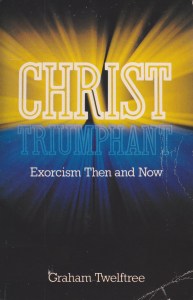
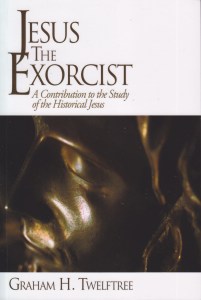
I feel compelled to say that this book was not among the overwritten tomes I mentioned in yesterday’s post.  Indeed, although the title reflects the outlook of the author, you need to get to the subtitle to find out what the book’s about.  Although I work at an academic press, I disagree with academic book pricing models.  Graham Twelftree’s previous book, Jesus the Exorcist, had to be picked up in a paperback reprint edition before it could be affordable to the likes of mere mortals.  After reading it I learned that Twelftree had written a more popular book on the topic—Christ Triumphant: Exorcism Then and Now.  Putting much of the material from the previous book in less technical terms, this version goes on to ask questions that can’t be put into a standard dissertation, such as “should exorcisms still be done?”

The academic is necessarily a skeptic.  One of the biggest problems our society faces is the open credulity of those who haven’t been taught to think critically.  Twelftree is a rare academic who keeps an open mind while approaching the material with a healthy skepticism.  Often it’s too easy to suggest that disregarding that which doesn’t fit a theory is the only way forward for an academic.  Sweeping off the table that which we don’t like.  The word Twelftree uses is “residue”—that which remains after the majority of possession cases have been explained medically.  The usual response is to disregard this small fraction of anomalous material and claim “case closed.”  In this book Twelftree dares to go further.

The supernatural has become an embarrassment for many, even in believing communities.  An interventionist god, or demons, would set off chain reactions that would distort the known laws of physics, so such things simply can’t exist.  Things which we can’t explain only exist because we haven’t got all the variables yet.  I recall how cold that made me feel when I first encountered the idea in physics class.  “Scientific determinism” it is sometimes called.  This little book rehearses the New Testament material covered in Twelftree’s dissertation, but goes on to raise the implications from that study and apply them to modern times.  It’s a brave thing to do in an academic world where brushes and brooms are very common.  Where residue is wiped up and tossed away without a second thought.  Those who stop to think through the implications are rare, which makes them so much the more interesting reading.  And not being from an academic press, such books are often  affordable.


Universal Books

I’m reading an overwritten book right now.  In fact, I just finished an overwritten book.  Such works, I suppose, are the results of being taught how to write.  It’s not that people can’t be taught to compose, but for various reasons some authors, either through the privilege of having high-powered publishers, or their own conviction that they don’t require correction, overwrite.  I suppose overwriting is, like beauty, in the eye of the beholder.  Several years back I recall a critic stating Lemony Snicket’s A Series of Unfortunate Events was overwritten.  I thought it was fun.  Yes, deliberately exaggerated, but nevertheless well-composed.  Those books were enjoyable to read because, I think, they refused to take themselves seriously.  Writers can be temperamental people.

As an editor something I need to repeat—for academics are consummate overwriters—is to keep your intended readership in mind.  No book is written for everyone.  In fact, many people can’t make it through books like the Bible because they’re hard to read.  Religious books often are.  There’s no such thing as a universal book, but some believers in some religions make the claim for their sacred texts.  Like many curious people I find it rewarding to read the scriptures of other traditions.  It’s not always easy—in fact, it seldom is.  It’s frequently disorienting and I look for an edition with an introduction.  The reason is when it comes to books, even sacred ones, it’s not one size fits all.  Many religious conflicts in the world could be resolved if we’d just realize this.

Someone who reads a lot is bound to be disappointed from time to time.  We turn to books either looking for a certain mood or specific pieces of information.  Authors often take things in their own directions.  Our minds don’t all work in the same way.  That’s why, in my opinion, reading is so important.  I prefer “long form” writing—I always have.  Sometimes an idea can be well expressed in an article, but taking the time to develop ideas requires a nuance not all publishers appreciate.  (Yes, I realize that by expressing this sentiment in a brief essay like this I leave myself open to deconstruction—one of the overwritten books I just read was written by a deconstructionist.)  Still, I have trouble abandoning books that take ideas in a way I wouldn’t go.  Usually when I start reading, I’m committed to finish.  Some would say that’s foolish.  I take it as a learning opportunity.


Whose Canon Is This?

Being a Bibles editor, I suppose, is a rare kind of job these days.  The book that defined our culture now rests in the back seat under discarded fast food bags and covenants of a more modern kind.  Often it surprises me how little we really know about the Good Book.  When I was a teenager I discovered that Catholic Bibles had more books than the Protestant versions with which I’d grown up.  Had I been more attuned to historical issues at that point this surely would’ve raised a crisis.  Had we left out some sacred books?  That would seem to be a grave mistake.  As I was making my way through all the translations of the Bible you could find in a rural area in pre-internet days, I began to read the Apocrypha.

The title “Apocrypha” translates to “hidden” or “obscure.”  Martin Luther’s argument was that these books were never in the Bible recognized by the Jews (therefore, by extension, Jesus), and therefore should be left out.  My question upon reading them, as it was regarding just about any book, was “did this really happen?”  That was the acid test for a Fundamentalist youth.  If something really happened it was, by definition, true.  The implications of this for the books of the Protestant Bible only became clear later.  Scripture is more subtle than that.  So it is that I’ve been thinking about how we in Bible-land privilege the western canon.  Not only are the Deuterocanonical books called “Apocrypha,” we leave out the books of the Ethiopian Orthodox Tewahedo Church, despite its 45 million members.

The books of 1 Enoch and Jubilees are included in the Ethiopian canon, but they can be tricky to find even now in the wide world webbed together.  Western biblical scholars have begun to take strong interest in these books, but the days are long passed when scholars could determine the content of the Bible.  The Good Book has taken on a life of its own that no amount of scholarship can challenge.  Minds have already been made up and tightly closed, even as we continue to gain information on ancient contexts and the massive collection of writings that never made it into anyone’s Bible.  Fundamentalism, so very certain of itself, has defined a circumscribed Bible to which nothing may be added or taken away.  Even as John of Patmos wrote that admonition, however, the Bible recognized by early Christians was growing.  And, ironically, some even left out his book.  Such matter remain hidden indeed.


November Novina

One of my New Testament professors was fond of saying early Christianity was exclusive so that people would want to join.  “If everybody could be a Christian,” he suggested, “why would anyone want to be?”  There is a snob appeal to such a country-club approach to religiosity (although I believe it to be false) that has somehow come to be attached to All Saints Day.  As the holiday that spawned Halloween (or so some say), All Saints seems to hold us the exclusive members of a sect that began with radical equality.  The slight was addressed in All Souls Day (tomorrow), when the rest of us might have a chance of being remembered.

There was a death in my extended family yesterday, of someone not much older than me.  I won’t reveal the personal details here, but I do ponder the coincidence of his passing so close to All Saints.  When we’re gone, we hope, people will remember our good, opposite to what Shakespeare suggested might be the case with Julius Caesar.  There are those who touch our lives for good, be it loudly or softly, and we tend to think of that good as who they were.  But sainthood?  Isn’t that a bar too high for anyone to achieve?  And if we think we’ve made it, even that very thought is enough to disqualify us.  Some sects of Christianity treat any member as a saint, but that leaves little to which to aspire.

Carlos Schwabe, Death of the Undertaker; Wikimedia Commons

For the rest of the world this marks the beginning of November—that month when cold settles in along with longer nights, but no reduced working hours.  We are approaching the holiday season, for we need some help to make it through times when loss can feel so close at hand.  The veil separating worlds—something science has tried hard to dismiss—was believed to be more permeable at this time of year.  All Saints was a bright day of upbeat music and glory, while All Souls followed in black and more somber tones.  That’s kind of like November.  I grew up, as did my departed kin, without the awareness of these holidays of transition.  Protestants sometimes miss the complexity traditional Catholicism had carefully grown.  At Nashotah House this was a day of obligation (although they all were, really), and we’d be invited to add names to be recited in mass.  I have a name or two to add this year, and I like to think anyone should be free to join.


Changing Times

Demons are an embarrassment.  The typical scholar of the historical Jesus can’t avoid the fact that one of Jesus’ main activities is exorcism.  You can go the whole way through seminary not hearing about that aspect even as you become very well acquainted with the two-source hypothesis.  That’s why I found Graham H. Twelftree’s Jesus the Exorcist: A Contribution to the Study of the Historical Jesus so refreshing.  Here is someone willing to address the topic generally swept off the table.  If the gospels are to be believed, then Jesus was an exorcist.  And if he was an exorcist, that must imply a thing or two about demons, no matter how embarrassing.  There’s a lot to this question, of course, and things are never as simple as they seem.

Many of those who look for the Jesus of history suggest that the Galilean sage simply accepted the framework of his era in which various diseases such as epilepsy were considered demonic.  As he healed such people—also somewhat of an embarrassment since it implies the supernatural—he understood their maladies in the same way his contemporaries did.  That tidy package, however, doesn’t sit well with narratives that assume a world full of demons.  Things have changed since the first century, of course.  After the Middle Ages demons fell out of favor.  And yet, the gospels remain pretty much unchanged, trying to fit into a new worldview.  This is the uncomfortable place in which those who seek the historical Jesus find themselves.

Twelftree approaches and analyses the text at its word.  The casting out of demons was an eschatological (end-times) act.  It was the beginning of the end for the evil spirits that torment this world.  Of course, two thousand years have come and gone and, according to some, demons are still with us.  The number of requested exorcisms has been on the rise.  The end times have lasted a lot longer than anyone anticipated.  It’s beginning to look like politicians can do what God seems reluctant to affect.  Bringing about the end of the world is no matter of clearing the house of demons, but rather letting evil take the helm.  If that’s a mixed metaphor, let’s just say demons are masters of confusion.  Since medical science has given us a great deal of comfort and relief from suffering, we’re glad to let demons go as the explanation of diseases.  But that doesn’t make things any easier for those looking at the first century when, as Twelfree demonstrates, Jesus was an exorcist.


Not so New

I remember it clearly.  The ubiquity of technology robs me of the memory of how I knew about it, but there was plenty of pre-internet buzz.  A new Bible translation was being published and people were very excited.  Including me.  By the time the New International Version (NIV) was set to appear, I had read every translation of the Good Book I knew, cover-to-cover.  Being a good evangelical, I started with the King James.  I’d read it a time or two, then moved on to the Revised Standard Version.  As you might guess, with my interests I didn’t have a lot of friends, but I do recall people complaining that it wasn’t literal enough.  I’d read the Living Bible, and the Good News Bible.  My favorite was probably the New American Standard Bible, though, because it was as close to languages I then didn’t know as I could get.

We didn’t have much money in my family, and since my summer jobs covered the cost of my school clothes, disposable income was fairly rare.  But then a miracle.  Christmas morning I opened my “big gift”—a brand new NIV.  In a way that is somehow difficult to recapture these days, I was absurdly happy getting a new Bible.  I started reading it right away.  Little did I know it would become the best-selling modern English translation of all time.  And that’s saying something—Bibles are big business.  The reason for the NIV’s appeal was that it was Evangelical-friendly.  No awkward issues like inclusive language, and, to be honest, a nicely rendered English.

Being in the Bibles business I decided to read about who was behind the NIV and found an unexpected connection with Rutgers University, where I used to teach.  The owner of the NIV translation is Biblica.  Biblica is the name of the International Bible Society, initially founded in 1809 as the New York Bible Society.  In a way that’s hard to imagine in today’s New York City, that’s where the group formed.  One of its founders?  Henry Rutgers.  Eventually the New York Bible Society became international, and like many good evangelicals, moved to Colorado Springs.  The money from continuing sales of the NIV must contribute to their somewhat posh-looking campus.  Meanwhile, Rutgers University has moved in quite a different direction.

Connections like this have always fascinated me.  Although much detritus has flowed under the bridge with all that water, I can still feel that brief, sharp release of endorphins when I pick up my well-used NIV.  I think of days of naive faith and all that has come after.  Yes, Bibles are big business, and yet somehow so very small.