Driving Truth

One of the problems with driving is that you can’t get pictures of billboards. Well, given the way people drive around here, I suspect that may not always be true. Nevertheless, I always think of billboards as trying to sell something. There’s sometimes fairly easy to shut out, but in long stretches of otherwise uninteresting road you fall into their trap. Now having grown up in western Pennsylvania, we always thought the people out east—Philadelphia was the largest city in the state, after all—were more sophisticated. It is around here, however, that I often see billboards selling evangelical Christianity. If you put out your wares, you’ve got something to sell. Money to make.

As I was traveling that stretch of somewhat plain highway 33 between Stroudsburg and Easton I noticed a billboard reading “In the beginning God created the heavens and the earth.” To shore up its academic credentials the billboard footnoted Genesis 1:1. An inspirational sunrise, if I recall, shown over the Bible. Of to the left—of course to the left!—was a small “no circle” and inside the famous skeletal progression from ape to human. The message was “no evolution.” The more I pondered this, the more strange it became. Most Americans are well aware that billboards aren’t exactly the locus of truth. They are gimmicks to try to get you into the store. Like the one a few miles down that advertises the world’s largest humidor; even those with no interest in tobacco might feel just a touch curious what such a place might look like. Why would you take your most intimate personal beliefs and put them on a billboard? Does that make evolution any less likely?

A strange perception has lately taken over this country. The idea that an individual’s wants equate with the truth. Shout it loud enough and it has to be true. Billboards would never stretch the truth, would they? Is that image enlarged to show texture or what? And wouldn’t a better choice of anti-evolution rhetoric have been Genesis 2? That’s where God makes Adam from lowly dirt. Yes, Genesis 1 gives us the dramatic six-day creation, but Genesis 2 manages to say it all happened in one day—isn’t that more in keeping with capitalistic ideals? Greater efficiency leads to greater profits, after all. And profits, we all know, are the real purpose behind billboards for any product under the sun.


Biblical Popes

It was the end of the world. The year was 1979, if I recall. One of those occasional manias that sweep the nation weighed heavily upon my high school. My English teacher—for her class was at the very hour of the appointed end—sensibly scrapped her lesson plan for the day and had us each write an essay. Would the world end or not, during this very class period? We then shared what we wrote. I recall one answer—not my own—quite clearly. “The Bible says when the reign of Pope is short after the long reign of the previous Pope, the world will end.” (This was just after the death of Pope John Paul I.) A moment’s thought revealed that there are no Popes in the Bible. How could anybody think there were?

Of course, we were at the end of a decade whose bestselling book was Hal Lindsey’s The Late, Great Planet Earth. It was part of what analysts call John Todd Phase of the world’s end scenarios. Or was it the Pat Robertson Phase? In any case, all kinds of obscure signs floated in the air. But Popes in the Bible? Had any of my classmates even read the Good Book? This may have been the only occasion when it was beneficial to have been raised a fundamentalist. I’d already read the Bible many times through and it said nothing about Popes. Not even the Catholic translations.

The iconic role of Holy Writ in secular society is greater than many people suppose. “The Bible says” is practically gospel because few people will check it out. I knew from my conversations with clergy, even as a teen, that few ministers had actually read their own foundation document the whole way through. That leaves them vulnerable to the “cloud of unknowing” whether something is biblical or not. The only way to find out is to sit down with the tome and start reading. Although today such sites as BibleGateway make reading the Good Book online remarkably easy, it’s still a commitment of many hours immersed in an arcane world and mind-numbing lists of who begat whom once upon a time. Examined closely, the Bible is an odd book as far as Holy Writ goes. The same applies to the scriptures of many world religions. Somewhere along the line someone decides that this book, or collection of palm leaves, or set of scrolls, has divine origins. And since world scripture is vast, there’s got to be something about Popes in there somewhere, for when the next end of the world scare comes along.


Holy or Not?

The ancient divine world was a slippery place. When you stop to think about it, this makes sense. The deities and demons of antiquity were invisible. Different opinions existed as to what they were. The idea of “the Bible” that contains infallible information didn’t exist. Apart from the books now accepted by Protestants, the “Apocrypha” and even more fun Pseudepigrapha contained many more traditions than the average reader might guess. I’ve been a student of that ancient divine world for decades now, and I learned quite a bit from The Watchers in Jewish and Christian Traditions, edited by Angela Kim Harkins, Kelley Coblentz Bautch, and John C. Endres, S.J. Appropriately divided into three parts (origins of fallen angels, Second Temple developments, and Jewish and Christian reception) these collected essays explore different dimensions of these mysterious beings.

Watchers are seldom mentioned in the Bible, in just a few verses of Daniel. In some traditions they are high angels—think the hymn that includes the word “ye Watchers and ye holy ones”—but mostly they are fallen angels. If you limit yourself to the Good Book you really get only four verses of Genesis 6 to explain them. Other ancient writers, some of whom likely influenced the New Testament, took up the subject. The book of 1 Enoch contains a section called The Book of the Watchers. Here the Watchers come down to earth with a couple of purposes—to share forbidden secrets with humanity, and to mate with human women. The offspring of these matings are giants, Nephilim, or demons. Perhaps all three. These events are retold in Jubilees and are taken up by early Christian writers especially.

Although this book isn’t a monograph with conclusions based on all the information it contains, it nevertheless gives a very good sense of the various traditions that developed around these Watchers. Even when reading through the Bible as a child, the Genesis 6 episode caught me off guard. The story isn’t highlighted in children’s Bibles, and the way it’s told in Hebrew leaves a lot of ambiguities in the adult reader’s mind. It’s almost as if this brief account is bing kept deliberately obscure. The Good Book drops this bomb then blithely goes on its way without mentioning it again. This episode reminds us just how little the Bible clarifies. It wasn’t written to be the “inerrant word of God,” and those heady days just after Eden were full of stories that it never bothered to tell. The Watchers, meanwhile, made their way into popular culture because the silence of Scripture allows readers to fill in the blanks with either angels or demons.


Which Bible Again?

Which Bible? That’s a fair enough question. No matter how much you want to deny it, western culture always has been and always will have been biblically based. That being the case, it’s best to know which Bible we’re talking about. The Protestant Bible is America’s Good Book. Although there were Catholics before Protestants were a gleam in Luther’s eye, the latter laid early claim to the Bible. When a Bible appears in a social or civil religion context, it’s most likely Protestant. The Catholic Bible contains extra material—that which Protestants call The Apocrypha. Satisfied that Luther was right to leave the Deuterocanonical books out, their role as fake good news has never been questioned. If the King James was good enough for Jesus and Paul, they say, only half in jest.

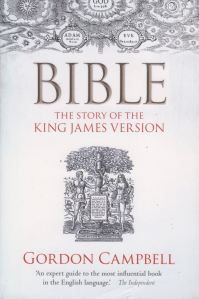
Some Evangelicals belong to the King James only movement. They come up with alternative facts when faced with the reality that the King James translation includes the Apocrypha. Yes, it’s right there in black and white. The Authorized Version of the Bible included the “Catholic books.” I was reminded of this the other day when I was searching for a simple factoid—how many words are in the King James Bible? The vast majority of websites give the unquestioning answer of 783,137. They may then break it down into “Old Testament” and New. Almost always they leave out the Apocrypha. The word count there is 152,185, and if my math serves, that brings the total to 935,322—not quite a million words. The Good Book is a big book.

The King James Onlyists (yes, that’s a thing) have bigger problems than the Apocrypha. What King James is the onlyist? The KJV you buy in your Christian bookstore is one of the many 18th century revisions of the 1611 King James. You see, translations are hardly stable. They change over time. Even the Revised Standard Version isn’t completely standard. I noticed while reading it as a kid that words had been changed over time. If our beloved Onlyist friends want to be purists and go back to the 1611 then they’ll have the problem of the Apocrypha to deal with. So which Bible? It’s a fair question. Catholic Bibles are bigger. Some Orthodox traditions also include such exotic books as Jubilees and 1 Enoch. And, from this we should take a lesson. Where there’s 1 Enoch, there’s always another not far away.


Ask an Evangelical

News stories this year have plowed up a frequently repeated question: what’s an Evangelical? This was the subtext to a Washington Post story that declared “Half of evangelicals support Israel because they believe it is important for fulfilling end-times prophecy,” as if it’s news. The media’s a little shy, I get it. Those of us who grew up Evangelical could have told them that at least 40 years ago. As a child I knew that Israel had to be fully restored for Jesus to return. Politics, we thought, were holding God hostage. You see, if the Bible says something, and it’s infallible, then even the Almighty has to obey it. And some parts seem to indicate that Israel has to be restored—interpreted a certain way—before Jesus gets his invitation back.

This Evangelical support isn’t because they love the Jews. No, no. Let’s not get personal about this. It’s because the second coming isn’t coming until the pieces are laid out in order. The Bible’s like a crystal ball, only it’s holy. It can predict the future with great precision. You can be sure someone like Trump is in there someplace, maybe in the passage where an ass speaks. In the 1970s it was Nixon. The wonderful thing about prophecy is that it’s made with interchangeable parts. As Millenniarians know, if you get your year wrong never apologize. Simply recalculate and keep preaching as if nothing happened. The Almighty is a forgiving God. At least to those He likes.

Intellectuals seem to think Evangelicalism is contagious. Well, to be fair, historically it has been. That was the whole point of camp meetings. Most Evangelicals aren’t too shy to tell you what they believe. In fact, their reading of the Bible sort of insists that they do. If you’re too bashful, many of those in the academy (or even formerly so) started out in their ranks. Rare is the biblical scholar who decided on that field of study purely based on intellectual curiosity. There was likely a method to their madness. Yes, of course Evangelicals support any politician who moves the embassy to Jerusalem. Tis a consummation devoutly to be wished. The divine heels have been dragging for a couple of millennia now, so it’s time to get this show on the road. All you have to do is ask an Evangelical. They’re not hard to find; in fact, they seem to be everywhere these days.


Taming Shakespeare

It hardly seemed credible, from what I heard in high school, that anyone would read Shakespeare if it weren’t required. I’m not completely naive, but I do wonder if we insist on introducing kids to the Bard before they’re ready for him. The real stumbling block is the unfamiliar words from the Elizabethan period. With enough regular reading they’re less of an obstacle to adults. Or should be. Or not to be. In any case, one of this year’s reading challenge books required that I read The Taming of the Shrew. I’d never read it before and kind of shied away from it because of the chauvinistic theme—Katherine has to be “tamed” by Petruchio so that her poor, sweet sister Bianca can be married. The overall theme is biblical—Rachel can’t be wed before Leah, so Laban declares. The play’s a comedy at the expense of women.

Those who know Shakespeare better than I question whether the playwright’s motives were as undeveloped as all that, but it is in keeping with the time. That’s not to excuse such patriarchal thinking, but we can’t rightfully blame people for thinking in the terms of their time. Yes, we now realize (except on Pennsylvania Avenue) that women and men deserve equal treatment. We are all human beings and should be treated as such, not as if one gender were somehow more important or better than another. In the Tudor Era, however, that idea had not yet caught on. The Taming of the Shrew contains clues as to why.

Perhaps the most reviled part of the play is Katherine’s closing speech as to why women should be subjected to men. Her reasoning is distinctly biblical. Indeed, the edition of the play I was reading took pains to point out the biblical allusions in the speech—primarily to letters of the New Testament. The fear, unaccountably real after all these centuries, is that we might go back to such thinking. The Bible, after all, doesn’t change much. The most conservative of society still read it in the King James, although the Bible Shakespeare’s contemporaries knew best was the Geneva translation. And, like the schoolchild reading Shakespeare, such conservatives need a little help with the language since words have changed their usages over time. They also may need some assistance realizing that not only words evolve, but so does our understanding of what it means to human. It’s not women who need to be tamed, Mr. Shakespeare. No, it’s quite the opposite.


In God’s Name

If anyone ever bothers to go through my personal zibaldones (if the word’s unfamiliar, please use the search box for my post on it) they’ll find my personal shorthand. It’s not extensive since I’m a firm believer in explaining things and if I don’t write things out I often can’t decipher what I meant. One of the shorthand marks that I do use is the Greek letter theta. Those who know me will have no trouble guessing that it stands for “God.” Or more appropriately, “theos” the Greek word for God. This particular Indo-European lexeme has a venerable history and appears in such forms as deus, Zeus, and deity. Although in a case such as Zeus it can be used as a personal name, it is, in fact, a title. Somewhat like “president” used to be. And it can be used for any number of divinities.

In the Bible there exists a well-placed concern not to dis the Almighty. God—to use his title—had a temper and was known for not being afraid to show it. Among the Ten Commandments is one not to take God’s name in vain. Scholars argue over what exactly that means, but Judaism, on the ground, had to make decisions about it in a practical way. The best way to avoid divine wrath was never to say the divine name at all. God’s name isn’t “God.” That’s a universal word, applicable to any garden variety divinity. God’s personal name, we think, was Yahweh. To ensure the keeping of the commandment whenever this noun was encountered in the Good Book, the word “Lord” was used. That’s the convention behind Lord in small caps in some Bible translations. If you don’t say the name you can’t break the commandment.

In more recent days, in print culture, a further caution has been introduced. In academic writing it’s common to see “G-d.” I can guess the origins of this convention, but I have to admit that concern can lead to obfuscation. Nowhere does Scripture proclaim that you can’t use the title of the ineffable one. I can’t help but think this is following the conservative tendency to see the use of “God” in exasperation as swearing. The fact that another common swear abbreviates itself as “G. d.” might caution against using this particular combination in an effort to preserve the sanctity of the title. No one ever doubted that Baal was a god—but note the carefully lower case “g”—or for that matter, Mars or Zeus. Or, just to be safe, B-l, M-rs, and Z-s. May I suggest, based on personal experience, that theta might be used instead? But only if referring to the true G-d.


Good Book Gone Bad

The Bible is a book of horror. This isn’t the main point in Holy Horror, but the fact is terror is never far from the surface in the Good Book. My days as a young scholar of the Bible were defined by the works of feminist scholars. One of the influential books of that generation was Texts of Terror by Phyllis Trible. Not hiding behind a masculine orthodoxy, she looked at how various biblical stories appeared from the eyes of female readers. There is indeed terror everywhere. The evils of slavery condemn that hideous loss of agency when one human being becomes considered the property of another. Women, before the feminist movement began, were taught that the Good Book demands this perverted social structure. They are indeed, in the eyes of its patriarchal world, property.

Important as this realization is, the terrors of Scripture go deeper. Even overlooking the genocides—the numbers make it difficult to take in the horrors of the individuals classed as faceless victims—there are multiple accounts of gruesome murders and violence in the Bible. Wars were an annual expectation. Diplomacy was often considered religious compromise. “Us verses them” mentality led to constant conflict. When it came to executing one another, the denizens of the Good Book could be quite inventive. No doubt women and foreigners were poorly treated on a daily basis, but when left to their own devices with divine voices in their heads, the men of Holy Writ knew how to terrorize one another quite effectively.

Even after the message of Jesus of Nazareth, which included love and care and compassion, the Bible goes on to close with the violent visions of Revelation. Perhaps it’s not appreciated so much in the present day, but the Apocalypse had a difficult time making it into the Good Book. Unfortunately the reasons weren’t that it was a book of horror, but the very fact that its status was debated should give us pause when hiding behind the rhetoric of a canon with its door slammed shut. The Bible contains some high, soaring words of noble thoughts and divine consolation. God can be an empathetic lover. With its status, in toto, as a book of divine revelation we have to pay serious attention to the fact of its participation in the genre of horror. Much of this is in the backstory of the films I discuss in Holy Horror. Others may have already explored this dynamic of Scripture, but it’s often a Good Book gone bad.


Kakistocracy

While in seminary I had the interesting job of teaching a visually impaired student Greek. This wasn’t an arbitrary choice on the part of my professors since, as an undergraduate I had exhausted the Greek curriculum at Grove City College and my fourth year the professor suggested I teach the course to the second years. This was, however, strictly koiné—I’ve always been from the lower class echelons. Trying to figure out how to explain a dead language to a student who couldn’t see required some creativity. At that point in my life ministry loomed as a career and it was still fairly easy to learn new languages. I was studying Hebrew at the time with the inimitable William Holladay at Andover Newton Theological Seminary, both of which are now gone.

I recently ran across a story in the Washington Post that utilized an unfamiliar word based on Greek: kakistocracy. It seems that the present administration has officials scrambling for new words to describe the depths to which our government is willing to sink. There’s an old saying: “the Greeks have a word for it”—I suspect the ancients would be shocked to see this particular word emerging again after centuries of progress. The translation of kakistocracy is quite logical for those with some Hellenistic training; it means “rule by the worst.” The sad thing is that democracy has come to this. Anyone with a fragment of a brain stem could see that 45 didn’t win the election in any sense but an electoral college one—giving us a new direction to sling the related word “kaka” around. It was the fact that those privileged to vote simply didn’t get around to it. As it was, the “incumbent” lost by three million votes. Nobody, however, is willing to do anything about it. It’s kaka.

If the swamp has been drained, it’s been to become a cesspool. With complete disregard for decency, decorum, and democracy, the directives issuing from the potty mouth on Pennsylvania Avenue demonstrate just how diabolical government can become. The sad thing is, the Greeks already had a word for it. One thing we know about our species is that we like to repeat our worst moments over and over again. Even worse, we seem to be proud of it. So as the kakistocracy grows to include porn stars, genital grabbing, and treasonous relations with foreign nations, the world looks in wonder and concludes people like George Washington and Thomas Jefferson had gotten it wrong after all. At least the student I was tutoring, although she couldn’t see, wanted to learn to read. And that made all the difference.


Exorcising Theology

Among those curious about exorcism, the name Fr. Gabriele Amorth requires no introduction. As “the Vatican’s chief exorcist” (a claim the book makes), Fr. Amorth was known for conducting many deliverances and for teaching a new generation of exorcists. Looking for an entryway into his perspective, I read An Exorcist Explains the Demonic: The Antics of Satan and His Army of Fallen Angels. That a priest in Rome should be conservative was no surprise. What was truly astounding about this account was how unquestioningly the exorcist accepted nearly everything to do with Roman Catholicism. His reading of the Bible is quite literal. His understanding of the Virgin Mary as the Mother of God offers no nuance. Demons are fallen angels and, somewhat surprisingly, he uses “Devil” and “demon” interchangeably. For a hierarchy so thoroughly parsed, this was a bit unexpected. Encountering these explanations, much of what I’d recently read in Matt Baglio’s The Rite made sense. Baglio’s protagonist studied in Rome when Fr. Amorth was still active.

Much of the book felt like a lecture from the 1950s. Sex, drugs, and rock-n-roll can all lead to demonic possession. And it turns out to be quite pervasive. Many people, saints and sinners alike, are possessed and don’t even know it. This is truly, according to the priest, a “world with devils filled.” The book begins with a Catholic, if literal, interpretation of Jesus’ role in the salvation of humankind (although the masculine pronoun is preferred throughout). Not only that, there’s no question that women can or should be exorcists. This is something that priests alone can handle. And he even goes far as to point to Eve (who literally existed, one gets the impression) as an example of how women are more easily tempted than men. Reading this brief tractate was like stepping back into a world that even antedates that of the Republican Party. Not decrying science, however, Fr. Amorth suggests medical explanations can account for some of what sufferers deem as possession. Those who think they are in trouble with demons should first go to a psychiatrist. If the problem can’t be solved, it’s time to call in the men in black.

Another area of concern is his outlook on other religions. African and East and South Asian belief systems are coded as possibly satanic. This universe is a strictly Catholic one. Having noted that, a strong undercurrent of love pervades the book. It’s clear that Fr. Amorth was a priest motivated by care for others. His theology may have been hopelessly medieval, but his heart was in the right place. And, if the accounts are to be believed, he was quite good at expelling literal demons. Some of the metaphorical ones, however, seem to have remained firmly in place.


Mediated Reality

According to the Good Book, Methuselah lived nearly a millennium. For all that, the information on him in Genesis occurs in a mere five verses, in a span of seven. We learn when he married, whom he sired, and how long he lived. Not much information of the last antediluvian, especially considering how much time he had. When I searched for him on the web the other day, the information box that showed up on Google had, at the very top, a picture of Anthony Hopkins. I immediately recognized his makeup from Noah, a movie that I just can’t make myself love. The fault for having no other image may be the failure of human imagination—where do we find an image of a thousand-year old?

The internet mediates our reality. One of the points of both my books now in the works is that modern understanding of the Bible is largely media based. Few people have the time or inclination to read such a big book. (Given the continued evangelical support of Trump, it’s pretty clear that most of them haven’t read it either.) We want other people to do the heavy lifting and give us a summary in neat little boxes at the top of the screen. There’s far too many things to do in this tangled web to be spending months reading a ponderous, outdated tome, even if it does have plenty of sex and violence. Even if it influences the lives of each and every person living in America every single day. We’d rather have someone else—preferably not some egghead with a Ph.D.—give us the executive summary.

Once I did the math. If you add up the dates in what I used to call “Genesis years,” the year Methuselah died was the year of the flood. The Bible doesn’t say that old Methuselah drowned when the windows of heaven were opened, but it’s a reasonable conjecture. Nature abhors, it seems, a human being living so long. Our bodies just aren’t built for it. Some trees, on the other hand, have been alive for thousands of years. Botanists call them “Methuselah trees” (I told you the Good Book influences everything!). The pity is we know so very little about this ancient human being from days of yore. Was he a good man? He seems to have been washed out in the sluice gates of what became one great universal sewer at the time. Although we know little, his life would make quite an epic movie, I think. We already have an actor lined up, for Google tells me so.


Updates

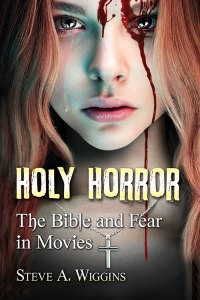
So, I’m getting ready to update this website. I’ll give you a warning before things change. Another update, however, is in order. I’ve been promising that I’d let you know when my forthcoming book with McFarland received its final title. Well, drum roll please! The final title is actually the first title I proposed—Holy Horror: The Bible and Fear in Movies. And it has an ISBN: 978-1-4766-7466-7. And a cover design too, but I can’t share that just yet. It is appropriately lurid, matching the subject. But in all seriousness, the book makes a case for the fact that many people understand their religion via popular media. Being a bad boy, I look at it through horror movies.

The title Holy Horror was a play on Douglas Cowan’s excellent book, Sacred Terror. I recall reading that book, starting the night I bought it as SBL, curled up in the swank conference hotel bed, turning pages until I couldn’t hold my eyes open any longer. It had honestly never occurred to me that religion scholars could get away with writing about horror movies. Cowan had the natural advantage of being a Canadian, something I’ve always longed to be. He also has a secure university post. I was, at the time, just a guy trying to feel secure in what seemed like (and turned out in reality to be) a threatening seminary position that was shortly to end.

It may be difficult to understand how horror can be consoling. It can. I’m a squeamish guy. I don’t like blood and gore. I hate being startled. Nevertheless, I took comfort in this genre as my career was falling apart. Holy Horror was a cathartic book for me to write. There’s more than a little metaphor in it. One thing that will become clear to readers is that the Bible is no stranger to horror movies. Ironically, many of them are strangely conservative—Carol J. Clover’s classic Men, Women, and Chainsaws (which I’ve reviewed on this blog) made that point clearly. Horror often has the same message as your typical Disney film, although it’s presently slightly differently. How so? Well, I can’t say very much here or you’ll have no reason to read my book. McFarland does a great job with publishing this kind of title. You won’t find it in Barnes and Noble, and not likely in your local indie either, but it’ll be available on Amazon and these days that’s enough. And before long these pages will change to reflect its coming.


Re-reading the Rite

I’ve written on The Rite before. My current book project, however, led me to reread this account after watching the movie based on it a couple of times. The film dramatizes, of course, the somewhat understated demonic activity in the book. The protagonist loses about 30 years in age and isn’t yet a priest. As is usual, the book is better than the movie. Matt Baglio’s story follows Fr. Gary Thomas from parish ministry in California to his discovery of possession and appointment as an exorcist. As part of the Vatican initiative to have an exorcist appointed in every diocese, Fr. Thomas was sent to Rome to take a course on exorcism. His experience was all academic until he began to attend actual exorcisms with an unconventional Capuchin monk. Very little described in the book is difficult to believe.

This time around the curses nabbed my attention. Among exorcists of the Roman Catholic stripe, there is a strong belief in the reality of curses. Not only the reality of curses, but the belief that curses can lead to demonic possession. Knowing that Catholicism has struggled with accusations of being unsophisticated and behind the times, the fact that this isn’t more widely known is pretty self-explanatory. Growing up Protestant, I was always taught that curses are make-believe. They don’t really have any influence on a person’s life. The world of demons, however, is a supernatural one and the concept of curses still holds sway in this universe, as the book shows.

Another arcane aspect that resurfaced when I reread this book is just how elaborate the Catholic backstory is. Many Catholics, it’s clear, distance themselves from such topics as the Devil and demons, but there’s no escaping the Virgin Mary and the drama of Jesus versus the powers of evil, as well as the intercession of saints. The problem is that many of the players are personified in the Bible. It’s pretty hard to say the Good Book got it wrong. That worldview lends itself to belief in supernatural impingement on this sphere. Not that that’s a bad thing. Many people, however, would rather believe in a materialist world with physical cause and effect being the main operating paradigm. Demons complicate all that. But then, so does the idea of Mary being a perpetual virgin, and even the patrilineal heritage of Jesus himself. The Rite brings to the light something many would perhaps prefer to be kept under a bushel. Strange things do happen in this world, and they do tend to respond to the backstory that’s been told. That makes such books difficult to classify, even with the backstory.


Personifying Evil

Biographies seldom cover millennia. Even if one were to try to uncover all the scant facts on old Methuselah at 969 years, it would still fall short of four digits. So Peter Stanford’s The Devil: A Biography takes the long view. Even with that lengthy perspective, there’s little that might be known about the prince of darkness. Even with a role in the Good Book his appearances are few and details are lacking. What Stanford does, of course, is outline, more or less, the history of Satan. This is no easy task since few ancient sources focus on trying to provide explanations for exactly who this might be.

As with most books by non-academics (and I don’t mean to sound snobbish here) there are some overstatements. Some of the details aren’t so finely parsed. It’s the big picture the author’s after and he does quite well when it comes to the modern era. Not only is there enormously more material from which to choose, there is also a great deal of literature and even headlines available to harvest. All writers that I’ve encountered on the subject make the point of demonstrating that news of what’s happening in the modern world suggests either the Devil exists or that something (or things) is doing a great job parodying such a character. When seeing evil in the highest reaches of the government it’s not so hard to believe.

The thing about the Devil is that he almost died out. In the nineteenth century when the explanatory value of science was firmly kicking in, and industrialization was making our live both easier and harder, the dark lord went underground. Humans seemed capable of making and claiming their own evil, and even the professionals—the clergy and formal religionists—had admitted Satan was most likely a metaphor gone wild. The birth of Fundamentalism, a movement that became prominent only in the 1920s, necessarily resurrected the Devil. The Bible does mention Lucifer, so he had to be real. Since that day he’s learned a lot. Protean to the extreme, he bears many guises. No longer beholden to a demonic tail, cloven hooves, or a pointy beard, he most often appears clean shaven and wearing expensive business suits. Borrowing a phrase from the Good Book, it’s by his fruits that we know him. Stanford’s biography shows its age a little, but when you’re covering a couple thousand years of speculation, being outdated is only a venial sin.


Refillable Ideas

Maybe I’m too slow of thumb, but this ought to be simple. For many years I kept a small slip of paper in my pocket, along with a pen. Eventually I upgraded the paper slips to Moleskine notebooks since they’re harder to lose and the covers mostly prevent the smudging of my ideas. When something strikes me I don’t reach for my phone—by the time I enter the passcode, select the app, and try to type with fat thumbs, the idea’s gone. Instead I pull out my Moleskine, battered and frayed by the final pages, and my pen. The problem is I’m still enough of a working-class guy to lose pens. If a cord comes disconnected beneath my desk, I’m down there on my back fixing it rather than calling IT. Pens fall out of my shirt pocket on planes, trains, and automobiles.

A lost pen shouldn’t be a problem, but finding a pen that writes right away is. Like most people I have scores of throw-away plastic pens handed out by vendors with their company name on them. I prefer a good quality pen—the kind a family member gives you for your birthday—but they hurt when you lose them. I finally settled on a happy medium. One of my kin gave me a heavy-weight, refillable pen that has a robust clasp so it doesn’t slip out of my pocket, down between the seats of public transit vehicles. Refills, however, are another story. Who would’ve thought that I’d spend my time reading reviews on Amazon just to find pen refills that write the moment inspiration strikes? Well, I do.

Unlike those who whip out their phones to write things down, I still pull out my notebook. Nothing is more frustrating that feeling an idea evaporate while waiting for the ink to flow. My most recent refill is on strike most of the time, while that cheap pen from the health fair at work never seems to have a problem until it runs out of ink and has to be tossed into the landfill. I wonder if the Bible would’ve ever been written had Moses to rely on the poor quality of pen refills available before the common era. Maybe he had less commuting time, although I’d say 40 years in the wilderness qualifies. His stone tablets may have been heavier than my Moleskine, but his chisel was sure and his words still adorn courthouse lawns everywhere. Perhaps I’m too modern after all.