Kings and Fiends

Martin Luther King Jr. was, and is, a symbol of hope. This day, as we’re encouraged to think of progress, we’re mired under leadership that less than a week ago used derogatory language to describe people that aren’t white enough for his liking. Those who, like King, have a dream, are under attack by a government that has pledged its allegiance to the dollar. The dollar in the hand of the white man. From the days of the prophets on the dream of a just and fair society has been the ideal. Instead we find ourselves under the ultimate party of privilege that likes to quote the Bible but which admires Pharaoh far more than Moses. They claim to see the promised land, and that land belongs only to them.

I was too young, as a seminary student, to appreciate I was walking the same halls as Dr. Martin Luther King. Sitting in the same classrooms. It had all been before my time. Because of the Bible I first took an interest in history—eager to learn how we’d come to this place. Ronald Reagan—who now amazingly seems rather benign—was making it difficult for the poor by promoting “trickle down economics.” We all saw how that worked. The modern-day Pharaohs may not wear the impressive headdress of antiquity, but they’re no less fond of owning slaves. King understood that non-violence comes with a cost. It takes time. Unlike the present administration, he understood the difference between right and wrong.

The Pharaoh in the White House makes it difficult to appreciate any progress at all. We have come to see what it means to be a nation that solely, utterly worships Mammon. The voice of the Bible is weak and shouted down by those who see no gain in it for themselves. There were surely those in Egypt who were poor but who appreciated the Pharaoh. At least he was enslaving those from somewhere else, according to Exodus. According to the Good Book it was God himself who opposed this system, but now, according to the evangelicals, God has blessed it. It is the will of God to rob the poor of their health care so that the rich can add even more to their too much. On this Martin Luther King day we struggle to find hope in such a world. The hope is there, but we have to be willing to dare to dream.

Jedi Bible

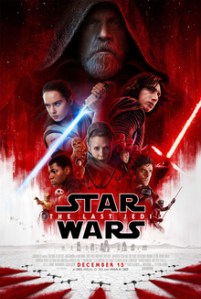
A long time ago in a galaxy far away there was no paper. This is something I didn’t realize until I read a book of essays by Ryan Britt a couple years back. George Lucas, although a limited visionary, saw a Star Wars universe without paper. When I thought back over the original trilogy, and the harsh prequel trilogy, that seemed to be true. Nobody picks up a piece of paper to read anything. Like many people I went to the theater to see The Force Awakens and left stunned. After being battered by episodes I through III, it was good to see the old form return. It was as if the force really had awakened. Then I went to see The Last Jedi.

Overly long and often plodding, I wondered, after it was over, what was so different this time. Not only was Luke Skywalker annoyingly noncommittal to the force, but backstory and counter-backstory made the truth hard to discern. There was a lot more talk of the Jedi religion as a religion. From my perspective, of course, this isn’t a bad thing. I would like to know more about this. There’s a secret tree on Luke’s island wherein are the sacred Jedi scriptures. Yoda shows up and calls down lightning like a little green Elijah and burns the Jedi library and its Keebler home. Then it hit me: not only is there paper in this universe, there are actual books. Scriptures.

We’re never shown the inside of any of the books, but if the fact that fans tend to fill in the blanks holds true we may well see future publications of the Jedi Bible. H. P. Lovecraft’s Necronomicon, a fictitious tome, now exists because his devotees couldn’t live in a world without it. And paper scriptures add an entirely new dynamic to any religion. Most world religions (at least on this planet) have some form of text. Books tell us what to believe and how to live our lives. Given enough time people will realize that they were written by other people and need to be interpreted by people. After all, if God could write the Bible, what would prevent him from writing the Qur’an, or the Book of Mormon? So stuck here in the middle of a trilogy the rules have changed. First paper has appeared in Star Wars. And although it’s a little too early to be sure, it looks like Jediism will never be the same.


Middle Age Demons

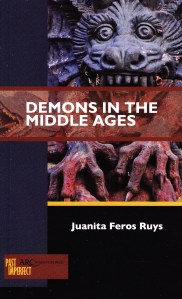
One of the consequences of watching horror movies is the interest in the origins of various monsters. Since many such films feature demons, their backgrounds and origin stories have always been a point of curiosity. Time is always an issue and Juanita Feros Ruys obliges that hurried sense by packing a lot of information into her short book Demons in the Middle Ages. Covering the basics in the introduction, she moves on to discuss demons in the desert—the bane of the early monastic, and demons in the monasteries of populous Europe. A chapter on the Scholastics describes how early science was applied to incorporeal beings, and a final chapter on learned magic, i.e., raising demons via magic books, finishes off this brief study.

What is particularly striking here is that the Bible says surprisingly little on the topic. It says, however, just enough to kickstart the Late Antique and Medieval interest in the subject. Vast amounts of speculation were raised in the Middle Ages concerning what exactly demons were and what they were made of and what they could or couldn’t do. Ruys points out the trajectory of the male necromancer giving way to the female witch just as early modernity was getting started. The results, we all know, were horrific. Throughout it is remarkably clear that belief in demons was strong. People took them very seriously—the Bible says they’re there, so there. Belief, as always, has consequences. Beginning with the Scholastics, however, a reasoned understanding of the spiritual world was deeply desired.

Reason and faith aren’t really the strangers they’re often portrayed to be. Medieval monks could be quite clever and scientific in their outlook. Human mental faculties, created, as they believed, by God, were necessarily good. Something I’d never considered, but which Ruys explores, is the belief that God cannot experience emotions. Being an “unmoved mover” meant not experiencing emotion (which, she points out, includes a noun of movement). This also meant that demons, according to some, had no feelings. This is a very cold spiritual world, particularly when it’s put into conflict with the human one. Spiritual, rational beings subjected to emotions, we’re the ones at the mercy of supernatural beings more powerful than us, yet incapable of the warmth we crave. About a millennium and a half of shifting beliefs in demons crowd this tiny book. Although not intended to be especially profound, it gives the reader plenty to ponder. Including why some of us watch horror movies at all when religion can do the trick all by itself.


Let the Memory

One of the rare and long-anticipated treats of being near New York City is the prospect of a live show. For practical reasons we don’t go to shows very often—years separate the occurrences—but once in a great while we manage to afford such a boon. Yesterday we attended the penultimate performance of the Cats revival on Broadway. The experience was transcendent. I’ve seen the movie version a number of times, and over the years I’ve caught a few live performances here and there. For whatever reason, this musical speaks to me. Although it doesn’t really have much of a plot—it’s more a series of vignettes—it is about redemption and being comfortable in one’s own skin. T. S. Eliot was a poet who knew spirituality intimately. Andrew Lloyd Webber, no one needs me to say, writes stirring music.

Cats, unlike many shows I’ve seen, requires athleticism as well as vocal ability. The performers are in nearly constant motion as they play out their roles, often with acrobatic flourishes. Most of the parts are for the young, while those dwelling on the experience of older characters—Gus, Grizabella, and Old Deuteronomy—tend to be recollections of youth as a commodity that slips away leaving as residue the wisdom that comes with age. It’s quite biblical in that respect. Even the old can appreciate back flips and double cartwheels and the grace of ballet. For this particular production the lighting stood out as an integral part of the story. Illumination, I might add, is a powerful metaphor.

In our family discussions afterwards, comparison with other versions dominated. Although my wife and I saw a community theater production long ago (placing us, I reluctantly suppose, in the ranks of the older characters), our main introduction was through the filmed adaptation. Again, like the Bible, we tend to think of canonical versions. This is how it should go. Because of both its running time and its demands on the players, not all vignettes are included in each production. The character who narrates the story may change. Choreography is adjusted. Each show, as is the case with live theater, is a little different. Standing in the snow on a cold, New York City December afternoon awaiting the opening of the doors, we wondered what would be changed. The original Broadway run had ended while we lived in the Midwest, so this was both our first exposure but also our fourth rendition over the decades. None, it turns out, could be called canonical. That, however, took nothing away from the inspiration of the event unfolding before our very eyes.


Ancient Perspectives

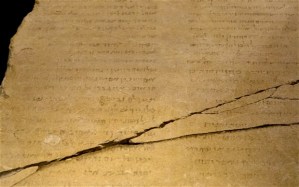
Around the holiday season, on social media, stories relating to the Bible tend to pop up. When my wife mentioned a New York Times story about “Gabriel’s Revelation” on the second day of Christmas, I was suspicious. The story, which was nearly a decade old—the internet keeps things in circulation far longer than those old library tomes consisting of physical newspapers bound together—describes the unprovenanced inscription as predicting a messiah will rise after being dead for three days. I assumed this meant evangelicals would be overjoyed, but it turns out that the artifact, if authentic, predates the New Testament. That means that it can’t be traditionally ascribed as a prophecy, since it’s not in the Bible, and therefore it becomes a threat because it suggests Jesus’ story isn’t unique.

Image credit: The Telegraph, from Wikimedia Commons

This is an interesting dynamic. A potentially important ancient artifact can only have value if it’s in the Bible or proves the Bible “true.” When that happens the faithful crow about how the evangelical position was right all along. If such a document implies that the gospels were borrowing from widespread cultural assumptions, however, it becomes just another unimportant bit of junk from days gone by. Confirmation bias, of course, is something in which we all indulge. Nobody likes being wrong. The difference is that the scholar is obliged to admit when the evidence overthrows his or her position. New options have to be considered.

Since I was between jobs in 2008 when the inscription was announced, it escaped my notice. Now that nine years have settled the dust a bit, there seems to be no sustained case for declaring Gabriel’s Revelation a forgery. Neither does it appear to have changed Christianity at all. The period known as that of Second Temple Judaism has shown itself to have been rich in messianic expectations. We know little, historically speaking, of Jesus of Nazareth. We know from the Dead Sea Scrolls that some were expecting a messiah along the lines of what Jesus was said to have been. But those documents aren’t part of the magical book that contains the truth, the whole truth, and nothing but the truth. In as far as they back the Bible up, they are celebrated. When they call the Good Book into question, they are rejected. I have no idea whether Gabriel’s Revelation is authentic or not. It seems pretty clear, however, that a faith that’s based on one unquestioned source might be more fragile than even other artifacts that have managed to survive, somehow, from ancient times.


Nothing Better

While it may seem that the largest challenge on a blog like this is writing all these words every day, that’s often not the case. Early on in my blogging life, I learned that images draw readers in. That may no longer be the case, but I do try to ensure that my posts have apt illustrations. Due to the fact that I can’t keep up with technology, I no longer know where these images are even stored, so when I was seeking a picture—amid thousands—that I had saved on my backup drive, I came across a series of photos taken in central Pennsylvania. These showed some road-cuts with obvious and impressive folding of geological layers characteristic of orogenous zones. Geologists only discovered the earth was ancient in the nineteenth century, and evangelicals have been disputing it ever since.

Genesis, so the spotless thinking goes, says the world was created in six days. So, by God, in six days it was created! When Darwin simply put the pieces of the puzzle together, evangelicals objected loudly. They started electing US presidents in the next century—a blink of the eye in geologic terms. They don’t dispute non-biblical dinosaurs, however. Their kids would object. The impressive sedimentary layers (or for that matter, igneous or metamorphic) were, they claim, made by God to look old. To fool us. That’s the kind of deity he is. So I got to thinking of a “to do list” for a God with nothing better to do than to oversee intricate and complicated layers of rock that make sense in geological time, but which, apparently, are only planted here to test the faith of brand-spanking new Homo sapiens.

One thing such a deity might do is take care of social injustice. Since he is a father, I suspect we ought to listen to his son, my evangelical friends. Jesus of Nazareth seemed pretty set on helping other people and everyone loving one another. This was, of course, between stints of helping make the planet look older than it actually is so that sinful scientists could trick their compatriots into going to Hell by believing false evidence. There are so many things you could do if you had the time to make such intricate traps. Why not write another book, for example? The Bible could use a good sequel. But no, it is far better to spend divine time making a world look older than it is. And if I had been able to save the time looking for that image that took over half an hour to find, a post such as this would’ve never been created at all.


Wise Women

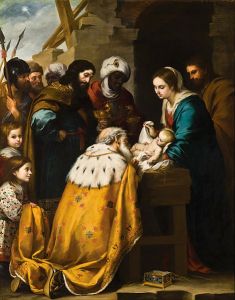
At a neighborhood holiday gathering the topic of a local living nativity came up. This year they need some wise men (don’t we all!) and some of the women mentioned that wise men should have beards. As the wearer of an old growth facial forest, I became the subject of a couple of queries—could you be a wise man? I replied that I wasn’t smart enough, but in the back of my mind I was attending the last church nativity play I’d been in. It was at the Church of the Advent, Boston’s high Episcopal establishment. I was cast as a centurion and was directed to deliver my lines woodenly. Being who I am, I did as I was told. I was invited to the cast party on Beacon Hill anyway. It was one of my few brushes with society folk in Boston.

Like many boys raised in church, I’d been cast in such plays before. One of three boys each born just one year apart, I was assigned the role of wise man along with my brothers. Far too young to grow a beard, I wore a costume made by my mother and carried a jar from a science experiment as a gift for baby Jesus. Being poor, we had no gold—or even frankincense or myrrh—lying around. In school we’d done this science project where a solution grew crystals up the inside of an ordinary coffee jar and out over the top. Stain it with food coloring and you have a gift fit for a king. So the illusion went.

The Christmas we celebrate today isn’t based too much on fact, but it is a prime occasion for plays. It’s a dramatic story, although the New Testament has to be bent and twisted to make it all fit into the comprehensive narrative of proselytizing playwrights. The king nobody recognizes being born in a barn. The creator of the universe being rejected by the very world for which he (the baby was always a boy) was responsible. The story is as timeless as Dickens’ Christmas Carol, and it’s enacted thousands of times each year in churches large and small across the country. Is there any reason that, as long as we’re straying into realms of imagination, the wise visitors shouldn’t be female? The ability to grow facial hair has little to do with any kind of intelligence. In fact, we’d be much better off right now with a woman in charge.


Old Salt

Time has been at a premium lately, but when I have a few spare moments I like to read the Oxford Dictionaries blog. Those of us who make a living with words often find them utterly fascinating. Simon Thomas’ post, “Worth their salt: words and phrases with roots in ‘salt’” brings a number of interesting facts to light. Salt, now on the list of public enemies, is essential to our well-being in small doses. His clever post includes “salt of the earth,” a phrase biblical through-and-through. It reminded me of the fact that the Bible’s become so porous that few people can say what’s actually in it. It’s kind of a big book, and who has the kind of time needed to read it all, let alone remember what it did or didn’t say? Many phrases are attributed to Holy Writ that don’t appear within its covers, while others that do come thence are thought to originate elsewhere. Strange but true.

We may never come to an agreement on what Jesus actually said, but “salt of the earth” is a phrase attributed to him. Indeed, he may have coined the term “saltness,” but I haven’t researched that thoroughly. The idea of essences, I’m told, is outmoded. But the idea is fascinating—what is salt that has no taste? Would it work to clear our roadways in winter time? There’s a layer of salt on my car already, and it only just snowed for the first time this year. We all know what salt is, what it tastes like—but what is its essence? (If such things exist?)

Thomas notes that Roman soldiers were paid it salt. I wonder if this was behind a phrase my step-father used to use about work. Although he and I did not get along, now that he’s gone I come back to the hidden bits of wisdom he sometimes shared. He worked very long hours, and seemed happiest when he was doing so. Early in the morning he’d limp through the house and say, “Time to get back to the salt mine.” He wasn’t a literal miner, although we lived in coal country. Salt could mean food, and the salt mine was where you worked to provide food for your family. I may not have gotten along with my step-father, but he worked hard to support a family with three kids not his own. He may have been bitter about that, but today anyone who stays with a family in hard times is considered salt of the earth. And that’s biblical.


Ravages and Kings

I was recently thinking about King Saul. If it’s been a while for you, Saul was the “first king” of Israel, according to the books of Samuel. Saul had a problem. That problem’s name was David. David was younger, more popular, a gifted musician and lady’s man. In sudden fits of rage Saul tried to kill David, more than once. An unstable man was in charge, but claiming God’s sanction he was safe from any kind of impeachment. In the words of Mel Brooks, “It’s good to be king.” So Israel limped along under weak leadership until Saul got himself killed in battle. I couldn’t help think that this story shows just how relevant the Bible remains today. Mad kings are difficult to displace. They have their fans and, to quote Alfred, “some men just want to watch the world burn.”

David’s reign was no picnic either. He had his Bathsheba affair, and was constantly making war as well as love. He pretended to be insane to save himself from Saul, but he was loved by Yahweh and thrived. Oh, and he wrote the book of Psalms. It’s a bit of a shock when this much feted king gives Solomon, his son, his last words. Instead of some pious sentiments or perhaps a last-minute poem, his final instructions are a hit list. “I promised not to kill Shimei, but you made no such promise.” Wink, nod. And Solomon reigned, bragging of groping a thousand women. One of the one percent, he was fabulously wealthy and ultimately couldn’t hold his kingdom together. And none of this is even prophecy!

Why do we put up with mad kings? The world is full of good, and able people. They have a very difficult time getting elected in a democracy. They had trouble even when it was a monarchy. Yes, power corrupts. We know that. Those who are truly mad, however, learn to live by gaming the system. Lies are alternative facts and truth is fake news. Other elected officials, apparently incapable of reading the newspapers, follow the leader. Like lemmings, they ignore the cliff just ahead. Ironically the Bible has a role to play in all this madness. In fact, many people seem to think Israel had a cozy little history. They’re the ones who’ve never read the Good Book. Even during the golden reign of David there were schisms and political murders. All you need to do, however, is say God told you to, and even a madman can become a saint.


Not So Gnostic

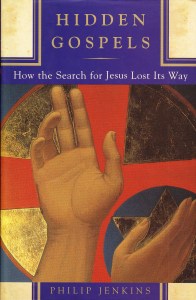
A certain, amorphous indignation comes over those of us trained in history when we encounter abuses of the same. In my case, some thought me conservative when I argued in my first book that Asherah as Yahweh’s wife wasn’t nearly the slam dunk some scholars were making it out to be. Don’t get me wrong, I wanted to see Yahweh as happily married as the next deity, but it was a matter of the evidence being weak and not thoughtfully examined. That is to say, I sympathize—maybe even empathize—with Philip Jenkins. His book, Hidden Gospels: How the Search for Jesus Lost Its Way, is an historical dressing down of many in the New Testament scholarly community who’ve perhaps let a bit of historical rigor slip in order to understand the world of early Christianity.

You see, once upon a time, scholars took the Gospels as, well, the gospel truth. Contradictions were simply harmonized or glossed over. When newer ancient material began to be discovered, however, adjustments had to be made. Perhaps the “orthodox” story of Christian origins wasn’t the only option available. In the twentieth century some spectacular manuscript finds were made, including the “library” of Nag Hammadi—largely Gnostic—and the Dead Sea Scrolls. New understandings of early Christianity were possible when these texts were considered. Some scholars engineered sweeping theories about revolutionary ideas concerning Jesus and his buds. Jenkins laments the lack of historical precision that many of these reconstructions demonstrate, and he comes across as somewhat annoyed.

Sensationalism, as we all know, sells publications and gets presidents elected. We all like a good story. In the case of Jesus, this means that the reconstructions of scholars often challenge traditional views, and popular publications love it. Jenkins finds it distasteful. Although this book is well written, as all of Jenkins’ material tends to be, it probably doesn’t do his arguments any favor to have retained the tired trope of heresy. Heresy means nothing without a supernatural bias, something that historians must avoid. Heresy, after all, assumes that one and only one version is correct (orthodox) and the four Gospels demonstrate that such a simple dichotomy is more difficult to sustain than it might appear to be. Yes, the Gnostic texts may not be as early as the traditional Gospels, but the ideas may have been circulating from near the beginning. We know surprisingly little about Jesus, so it’s not unexpected that rumors would’ve flown, even in antiquity. A solid source of information on some of the early “other gospels,” Jenkins’ book serves as a useful reminder that history is almost never as simple as it seems it should be.


Museum Piece

So the Museum of the Bible is now open in Washington, DC. It actually opened while a quorum or more of biblical scholars were busy making their way to Boston for the annual meeting of the Society of Biblical Literature. Many of the guild realize that the museum’s a conservative, evangelical venture, but it brings some attention to the beleaguered field and so it’s strangely welcome. This shows itself in the rather surprising names on museum publications. Renowned scholars don’t seem to think through the implications of supporting such places with the star appeal of their names. Indeed, many in the professorate are starved for attention—I’m not judging; I implicate myself even by making such a suggestion. When such an institution opens, it validates those it implicitly condemns.

A Bible museum?

Scholars can be woefully naive. Visiting places such as the Museum of the Bible, or the Creation Museum, or the Ark Encounter, pumps money into the already very well-funded Christian right. Such believers are extremely political and seek to get candidates like Trump elected. By slaking our puerile curiosity, we’re funding those who’d have us stripped of our very freedom to believe as we do. The paper trail’s there for any who wish to follow it. Supporting such ventures in any way will lead to headaches in the future. Sure, I’d love to see dioramas of dinosaurs on the ark so that I could feel superior for a little while. There’s a price for such vanity, however, and that price is the loss of freedom itself. We see it at work in our government at this very moment.

Museums are places for artifacts that are outdated. This is an ironic statement to make concerning the Bible. Especially by those who believe it is the final word. Why put that word into a museum? The irony’s worth it if enough paying customers arrive. Scholars meanwhile try to find ways to analyze this. Articles and books are appearing, stating what we already essentially know. The Green family, motivated to repressive political action because of their Bible belief, have spent money to build an elaborate museum, money that could’ve been used to help the poor. The book that appears in that museum suggests that the poor should be our concern. And although it actually does say that idols shouldn’t be worshiped, it has the great potential to become one itself. All you have to do is pay the admission price to find out.


The Pace of Progress

Scientists tell us the earth is slowing down. It’s only by a fraction of a fraction of a second, but like a top set spinning these endless revolutions can’t go on forever. Although the evidence all points in this direction, it feels like it’s speeding up. How else can I account for the apparent loss of time I’ve been sensing? Let me contextualize that. I’ve been attending the Society of Biblical Literature and American Academy of Religion annual meeting since 1991. That first meeting in Kansas City’s acid-etched in my friable consciousness with the long hours waiting for interviews that never came and no mentors to show me what to do. Those three-and-a-half days stretched on into an endless Tom Sawyer summer. I was anxious to get back to my wife in Edinburgh to and finish my dissertation. Fast forward a quarter of a century.

My days are now filled with back-to-back meetings. Normally by now I’d have had a leisurely perambulation among the bookstalls (where I spend all day) taking in the volumes the competitors publish, noting what I need to read. Instead, the time has been shortened. I have to keep a constant watch on my watch for the next appointment. Hearing about new books being born rather than tending the infants that surround me. We are a thriving population of readers here. Although it looks like a large crowd, I know that in reality we don’t make much of a dent. Boston’s big enough to absorb us and all our feverish ideas. When wakefulness arrives at my usual New York commuting time, even the nights seem to be shorter. Where has the time gone?

Most of those I meet have no idea I write books of my own. It was a process started long before the conferral of a diploma from a university far away. The earth is spinning in that direction, I’m told, so I should be in the tailwind of Edinburgh all the time. I’ve grown old with some of these colleagues. Those I’ve known since I was a young man, thinking he knew something about life, learning how little he really knew in this very city. I’m pretty sure I know even less now. The world, for example, seems to be speeding up to me. In fact I know it’s slowing down. Days are growing longer, but there is ever more yet to do. And all I want to accomplish right now is to walk around a bit and browse the books that others have written. I’m absolutely sure the earth is indeed speeding up.


Some Bible Lovers

I’m on a train heading to Boston. If you notice a dearth of religion scholars in your neighborhood this weekend, it’s because it’s time for the American Academy of Religion and Society of Biblical Literature annual meeting. If a religious emergency comes up, take two of your favorite scripture and call the office next week. Viewed from the outside, this must be one of the stranger scholarly gatherings. A few thousand people get together in posh hotels and convention centers to exchange ideas about which the larger world cares very little. Ironically, the vast majority of people in the world are religious, but as a society if we know enough about the Bible to get us through the most recent indiscretion, so we’re good. Let the scholars have their fun.

This year there’ll be a session on monsters and monster theory that I helped to organize. That doesn’t mean I’ll get to attend it—the conference is a very different beast for those on the exhibit hall floor—but I’ll have the satisfaction of knowing that it’s happening. Years ago I discovered that many of my colleagues who are teaching shared an interest in monsters. Many of us weren’t aware of the others because this isn’t the kind of thing you talk about in polite company. One thing an editor may be is a vector. We hear what widely separated people are working on. Every great once in a while we’re able to put the pieces together. So it was with monsters. There seemed to be a critical mass, and two or three colleagues took the idea and ran with it. Or ran from it, whichever you do with monsters.

For me Boston will be a series of meetings that will blend into one another until I’ll have to consult my notes to remember anything at all. If I could feel this wanted outside the conference I’d never have to dream of being a rock star. You see, editors are the gatekeepers of academic publication. For those lucky enough to have teaching jobs, it’s publish or perish, so the editor is a vital link. The rest of the year we fall into the background. Emails go ignored. Reminders are forgotten. Requests unanswered. But here, out on that carpeted concrete, we’re the ones they’ve come to see. What we do in the conference matters very little to the world at large. But we do it anyway. We gather together just before Thanksgiving, thankful to be reminded that there are others like us.


Persecution Myth

The myth of persecution is a great cover. Christians, we are accustomed to think, are timid and loving individuals eager to turn the other cheek. In this sophisticated world of science and technology, they might appear a little naive, but they’re not really out to hurt anyone. Or at least some of them aren’t. I grew up among what would now be called Fundamentalists. Harsh to their own sins, they’d not imagine harming others. The story went that in the Roman Empire days it was open season on Christians and the oppressors liked nothing better than killing off a dozen before breakfast. That myth has largely been debunked by historians. Yes, there were some brief periods of intensive persecution, but for the most part the early Christians were left alone.

Many of the more zealous among the literalist sects today feel the loss of that mythology keenly. What can you do when you learn that your primitive ancestry wasn’t as heroic as you thought it was? For some, that myth must be kept alive today. When it is acknowledged that our world has become a smaller place because of technology, we get exposed to those who give the lie to our prejudices. Moral Muslims (despite the media portrayals), Hindus, Buddhists, and even secular humanists, abound. News, however, thrives on negativity. After all, it too is a capitalistic enterprise. We see the violence, the hatred, the bigotry. The myth lives on. Christian Dominionists have simply given up on the rest of the race. The Bible, after all, says few will be saved. And they have thrived for decades based on the simple fact that nobody takes them seriously.

I have seen the lack of compassion in evangelical eyes firsthand. A coldness that declares education to be evil since the only truth was revealed long ago in unchanging form. The word of God stands forever. It says so itself. And among the most despised of all human beings are those who study that word instead of “just reading” it. Those outside this camp know there is no such thing as “just reading.” They also know that we have no original biblical manuscripts at all and that translations are merely approximations. It’s difficult to build absolute laws on approximations. Among themselves these groups claim that legislation to treat others equally is a direct affront and insult to them. In fact, they claim they are persecuted because of the fair treatment of others. The thing about democracy is that any system can be gamed. Even Putin can be your friend, for this is the world of myth.


Bible Practice

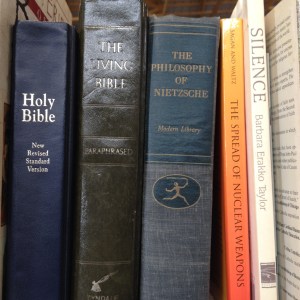
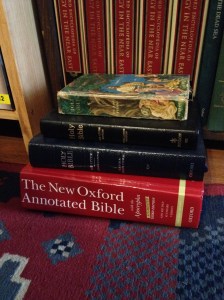
In a strange kind of oneupmanship, the horrendous murders in Sutherland Springs overshadowed the story of Scott Ostrem’s multiple shooting at a Walmart in Colorado. Ostrem apparently shot at random and killed three people. No motive is known, but when his apartment was searched a stack of Bibles was found. Plenty of people have Bible stacks in their houses—I know I do—but the odd element here is guns. The “reasoning” behind the NRA’s convoluted logic is that guns are for self defense. Everyone ought to have them, along with their Bible stacks. When those voices in your head begin to speak, which you grab—gun or Bible—may make all the difference. Fact is, you don’t have to be mentally stable to buy guns. And no matter how much the NRA says you should shoot back, guns in the hands of madmen obey no rules.

Trump promised to make America great again. One of the statistics at which we excel—indeed we’re a world leader—is gun deaths. We also do pretty well at opioid overdosing. Politicians can’t seem to figure out that the underlying causes here are related to the society they’ve built where you can’t ever get ahead and no matter what you do the 1 percenters will get richer while you spend your days struggling to get to the point when you can climb back into bed and sleep it off until it all starts over again. Watch them in congress. See them trying to thrust more money upon the wealthy. See them pocket the funds the NRA so generously offers. And then read the statistics. Some inexplicable disconnect exists that no amount of drugs will bridge. We are a hurting nation. And stacks of Bibles aren’t the answer.

A Bible stack in its natural habitat

In antiquity there was an ideal. Not that it ever existed in practice, but at least they had the idea. The ideal was that there was nothing wrong with wealth as long as the wealthy first ensured that everyone had enough. Then they could go on an accumulate as much as they wanted. The problem of course is that nobody knows what enough is. When do you know that you have enough? Today there’s no ceiling cap. Take your pick: money, guns, drugs, Bibles. You can have as much or as many as you wish. In just about any combination. Any combination that doesn’t involve money. Only the 1 percenters should be entitled to that. And the rest of us here below and fight it out over the remaining three.