Narrative Ark

Complete with an artificial giraffe perched on its prow—or aft, I can never tell the difference—a modern-day Noah’s ark is about to set sail. Or set float. The Bible doesn’t describe any kind of steering or propulsion for the ark since its main job was not to sink. According to a story on Huffington Post by Nina Golgowski, the life-size “replica” of Noah’s ark from the Netherlands (that I’ve posted about before) is about to go to sea. Spreading the good news as it goes, it is headed for South America, according to the story. Then the itinerary heads north, where the most rapid true believers can be found. Perhaps intentionally the ark is headed toward the godless left coast rather than hitting the Bible Belt. The fact that an imaginative reconstruction of a mythical ship can float may save many from Hell. A few questions, however, remain.

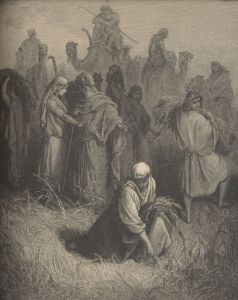
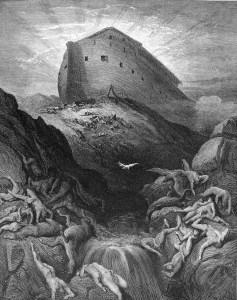
I’m a visual guy. I study pictures rather than just look at them. As a kid I was amazed at the sheer variety of arks that claimed to follow Noah’s blueprint. Reading the account in Genesis, it is clear that all that’s given are measurements—in cubits, no less—and instructions to make three decks and a window. The Dutch ark follows the design made popular by the 1977 Sun Pictures’ In Search of Noah’s Ark movie. The design, I recall thinking as a teen, looked slick and scientific. Engineered to withstand a fake storm in a bathtub, this has to prove something. When rock outcroppings on Mount Ararat were photographed from satellites and military jets, they suggested this was, in fact, correct, some of the time. Close-up photos were inevitably lost as sherpa after sherpa fell into hidden crevasses with the camera still in hand. Now they won’t let you climb the mountain, just in case.

The drawing that launched a thousand, or at least one, ark(s).

The drawing that launched a thousand, or at least one, ark(s).

Apart from the ark design is the more important question—the question about leg room. With all our technology, and a world that has been pretty thoroughly, if disappointingly, explored, we still haven’t catalogued all the species on the planet. The ark had to hold all the species since evolution is a diabolical lie. Pugs had to be there as well as their non-ancestral wolves. Both African and Indian elephants. Black and white rhinos. Hippopotami, pygmy and economy-sized. It had to have been pretty crowded, and Answers in Genesis claims there had to be room for dinosaurs too. For me the question has always been those left off the ark—the fish. If the oceans are salt water and the whole world was flooded, whence the fresh-water fish? They couldn’t have evolved, since nobody does. That’s a head-scratcher. Good thing too, because there had to have been more than just two fleas on that ark.


The Devil, You Know

I’m the first to admit that I’m behind the times. Too much of my free time is spent reading weird news or going to used book sales to keep abreast of what’s happening in the adult world. If it weren’t for my wife sending me news stories via the internet, I would still be wondering why Gorbachev isn’t helping to hunt down Osama Bin Laden. Since I’m captive to a religious worldview, I was interrupted in my calculations by the news that Ted Cruz is, allegedly, Lucifer. My research had me on the trail of Santa, since the simple transposition of two letters would give us the title of the Zoroastrian prosecuting attorney. And, I figured, it was fairly safe to out St. Nick when Christmas is still eight months away. Hopefully I’ll still find something in my stocking come December. I kind of figured that when we found the real devil he would be a Republican in any case. Even as I write this, Cruz is out of the race. I thought the Devil never gave up.

I wonder where else in the civilized world would politics be such a joke. Can you trust the opinion of a man named Boehner? It’s easy to change your name—just ask anyone who came through Ellis Island. They’re laughing at us, folks. Seriously, they are. I don’t get much email, but I’ve had two international missives asking me what’s going on over here. It’s a good thing I don’t know, otherwise I’d have to try to explain. You see, the Bible doesn’t say much about Satan at all. In the Hebrew Bible there is no devil. By scraping together the few references to “the Satan” and morning star, some have said the alleged Ted Cruz of ancient times was clearly in the Bible. Somewhere between the Testaments he showed up. By the time Jesus was old enough to climb temple towers, he was there. In the meantime the Zoroastrians had come down from the North Pole…

Then there’s the fact that when he’s not wearing a conservative suit and announcing a female running mate, the Devil is described as looking like Pan. Goat horns, goat feet, but always the torso of a man. And he’s red, just like the Coca-Cola red of Santa’s suit, and states like Texas. It’s a good thing I don’t read any more conspiracy theories than I already do. You’d probably find me tootling away on my pan-pipes waiting for a bus in the Port Authority. No, there’s a reason I stay away from the real news. It might interrupt my fantasy world. And, I’m afraid, it might actually be more entertaining. And don’t worry about my Christmas—I plan to have an eleventh-hour conversion, just in time to have a chimney installed in my apartment. If I can only be sure I get it done before February.

There's something political going on here...

There’s something political going on here…


Lily White

The funny thing about being “white” (I’m more of an anemic pink myself) is that my race seems to think all the gods share our ethnic traits. I’ve seen Thor, so I know. The Daily Kos ran an article recently about Crystal Valentine, a black poet, and how she responded to Megyn Kelly’s 2013 statement that Jesus is a white man. I won’t say what Valentine’s apt response is, but I will say I feel a lot better knowing that I’m not the only one who’s a couple years behind the news. I remember 2013 well. It was a year of transition, some would say enforced exile. If you could pull that trick off 2500 years ago, you’d have no end of books written about you. Just check out the offerings on The Exile and you’ll see what I mean. But I digress. Is Jesus white?

Historically all we can say is that Jesus was Jewish. We don’t have any Jewish men from two millennia ago to ask about their skin tone. One of the problems of having an only child, especially for a deity, is that you have to decide on the race (and gender; perhaps twins would be better?). Other religions sometimes make similar claims, but the problem persists. Especially when one race claiming God’s ethnicity develops an industrialized military economy. Who’s going to argue with that? So if Jesus is white, it stands to reason that his dad is too, right? If you listen to the sidewalks of Manhattan you’ll have your answer. Or the question.

IMG_1558

All of this makes me wonder about the image of God. Theologians like to make it sound academic by calling it imago dei. If you can read Latin then you obviously know the truth. With monotheism and imago dei, you’re gonna run into problems. Nobody likes to be told they’re adopted. Since this theological construct has caused no end of pain and misery, I have to wonder if we’re better off thinking that we’ve not had a case of mistaken identity after all. We all evolved out of Africa. We should, it seems to me, treat our parents with more respect. And that, dear reader, is straight from the Bible.


Come Sail Oy Vey

Nothing says unorthodox like a headline that reads “Smart Jews? Thank the Extraterrestrials.” Breaking Israel News ran the story recently and, being constitutionally unable to pass up anything so strange, I had to take a look. The article, by Adam Eliyahu Berkowitz, is really just a half-century retrospective of Erich von Däniken’s Chariots of the Gods?. I remember fifty years ago—not well, mind you, I was only three—but even when I was a teenager and the book had its second (of many ordinal) gasp(s), and a movie came out. People, even those not traditionally labeled as “crazy,” flocked to theaters to see it. The book went through multiple printings. The era of “ancient astronauts” was born. Von Däniken, it seems, is alive and if not exactly kicking, still making people uncomfortable.

IMG_0038

In this news story von Däniken suggests that Jews are more intelligent because of their alien DNA. Don’t quote me on this, but I’m pretty sure that was the plot line of the X-Files season 10. Isn’t Fox Mulder Jewish? Maybe I’m getting myself mixed up in some kind of plot here. I have to admit, however, to having a touch of nostalgia for Chariots of the Gods?. There was a kind of innocence to it. Nobody seemed to be inseminating anyone else, or stealing babies. It was good, clean fun.

Something bothers me, however, about the assertion that aliens are, indirectly perhaps, responsible for holy writ. I remember thinking through the implications of this idea (already floated four decades ago) that God might be more Captain Kirk than Jesus Christ. It is inherently disturbing. Especially when von Däniken says in the interview that the Jews are the chosen people, but they just got the chooser wrong. ET instead of I AM. The really interesting part is that ancient astronauts have become a somewhat accepted cultural trope. I don’t know whether they were there or not (I wasn’t around at the time), but they sure do make Saturday afternoons much more interesting. One wish I hold is that people writing about this old idea might find a new opening bit. Ezekiel seeing the wheel has been done to death. Surely a bit of creative thought might suggest a new, undiscovered ancient truth.


What’s the Message?

I said I’d come back to Bono. A story in the New Boston Post heralds a new documentary on Bono and Eugene Peterson. Both are famous in their own way, but no doubt Bono has the bigger name. Peterson, a pastor, is noted for his book The Message, a contemporary translation of the Bible. The documentary, “Bono and Eugene Peterson: The Psalms,” focuses on the book that brought rock star and scholar together, according to the story. The Psalms have a way of surprising people. In a day when the Bible is treated with considerable suspicion (how Bible scholars must feel, learning now that they are really rouges!) it’s sometimes easy to forget just how readable many of the Psalms are. The collection is, of course, uneven. Some are wonderful. Others are frightening and express immoral, if very human, sentiments. It is difficult to treat the Psalms as a whole.

437px-The_Sunday_at_Home_1880_-_Psalm_23

Having researched the Psalms in some depth, I found them to be one of the most challenging books to teach. We tend to have preconceived notions about the Psalter. That they are poems written by either David or God (neither of whom signed them). That they are comforting. That they are appropriate for any occasion. The reality is that Psalms is a most difficult book. Some of the poetry is sublime. Even up to the lifetime of yours truly, it could be assumed that many in secular society could recite Psalm 23 from memory. Not all of them are, however, quite so nice. Those that advocate murdering the babies of your enemies as less easy to consider holy writ.

The Psalms are generally a collection of human poetry. As I used to tell my students, whereas laws, and even narratives, are often top-down, the Psalms are one of the few places in the Bible where people are allowed to speak. There is joy in the Psalter, but there is also bitter frustration. Not all of the poems have happy endings. We seem to think that once a document becomes sacred it can no longer retain human fingerprints. The lie is given to this position in the Psalms. They are a most human book. Maybe the documentary will say why Bono finds this particular collection of poetry so inspirational. His is, after all, a human voice. There may be a message here since the Psalms are so fallibly human. And if nothing else, humans are experts at seeing the same thing in different ways.


Fast One Flood

I’m not sure what to believe anymore. This crisis of faith revolves not around religion, but around media. Pundits have been saying for some time that the internet has meant the slow death of journalism, and there are so many websites that redistribute news that its like the whole world is involved in a constant, perpetual game of “telephone.” All of this is preface to a story a friend sent me that appeared on the website God. I’m not sure I trust God. The story is too good to be true. At least in a schadenfreude sort of way. God is hosted on thegoodlordabove.com, and, well, we all know about dot coms. The article concerns the destruction of Answers in Genesis’ Noah’s Ark theme park by a flood. That is believable. Floods do occur, as Noah knew. What becomes unbelievable is that the National Weather Service forecaster stated that there were no storm clouds in the area at the time. That qualifies as a miracle.

Martin,_John_-_The_Deluge_-_1834

Did this really happen? I don’t know. I wasn’t there. Plenty of times when I was there (wherever there happened to be at the time) I wasn’t even sure what happened. Can I find the truth? One of the police sites for internet rumors is Snopes (also a dot com). I remember when Snopes began as a place to quell fears of urban legends. Back when the worldwide web was young, there was a verisimilitude to stories gleaned from the net. Living in the sparsely populated Midwest, it was easy to believe that some of these things could happen to you. At times I held onto Snopes like a crucifix, especially if I had to go out alone at night. Snopes tells me that thegoodlordabove is not to be trusted. The story is false, like others that have originated on the site. Answers in Genesis, unfortunately, is still going strong with its theme park.

Authoritative texts aren’t what they used to be. There was a day when all you had to do was pull a black leather book off the shelf to find the definitive answers. In Genesis or any other of the books. Now we rely on the worldwide consensus of the web. You can’t trust God on a website. Snopes, however, is pretty reliable. It’s the Scully to our natural Mulder. That’s why the web will never have the same impact as print media. Even the website for your bank or government can be cleverly faked. I might’ve looked no further had the purported flood not fallen from a cloudless sky. I guess I’d better be a wary believer. For the internet tells me so.


Biblical Stories

The Bible had quite a week last week. It went from being vetoed as the “state book” of Tennessee to making it onto the list of the ten most challenged and banned books of the year for the first time. Did you ever get that feeling that you should’ve thought a bit more closely about career options? I mean, the Bible’s not half bad. Yes, it has some naughty bits, a few instances of cursing, and adult situations. There are homicides, suicides, and genocides. It endorses slavery and advocates religious intolerance. It’s not all bad news, however.

IMG_2634

We find it easy to make summary judgments based on our own tendency to elevate human products to divine status. That which is most holy, after all, becomes the most profane when it’s defiled. The Bible itself can be like any other book. Printed on paper, bound between two covers, it contains ideas that must be interpreted. There’s no such thing as “just reading.” Even that road sign that says “slow children” is open to hermeneutics. What is objectionable is the use to which the Bible is put. And that use is objectionable due to the claims made about it. Saying that God rolled up his immaterial sleeve and took a transcendent pen into his incorporeal hand and began to scrawl is a bit naive. We know that people wrote the Bible—and much of it is sublime—and other people compiled it into a book that eventually acquired sacred status. It wasn’t born holy, it had to grow into it.

Once the Bible became objectified it turned into what people eventually use all objects for: a weapon. We can take sticks and stones and break your bones (no, that’s not in the Bible), and we can take paper and ink and hang you as a witch. Or pillory you as a liberal. Or say that it forbids the love you feel in your God-given heart. Something strange has happened here. The Bible’s not a bad book. It’s a bit on the long and repetitious side, but it has many, many memorable sayings and noble sentiments. Entire civilizations have been based on it. Or readings of it. They’ll ask you to put your hand on it and swear in court, and then they’ll ban it so your kids can’t read it. It’s been a tough week for the Good Book. Somehow, however, I don’t think we’ve heard the last of it because people love a conflicted story.


Le sacrifice humain

The thought of lying tied to an altar while you know someone is about to murder you is a terrifying one. For several reasons. Clearly, you don’t want to die. A more potent fear, however, may be that a darkly savage deity lies behind the dead. An angry, demanding god who desires nothing less than your annihilation. A story in the Washington Post by Sarah Kaplan suggests new findings by anthropologists now suggest a much more frightening rationale behind the world-wide phenomenon of human sacrifice. Kaplan reports that the article in Nature suggests human sacrifice was a means of social stratification. Maintaining control. Surely it must be obvious that those sacrificed are never the powerful and elite, unless, in a reversal of power structures, they suddenly find themselves on the wrong side of the might that makes right. Think of England’s King Charles I, for example. The societies scrutinized in this study, however, are less “civilized” and human sacrifice is a means to remind people who’s in charge.

404px-Ofiara_Abrahama1

What I find interesting about this is how easily the discussion slips into religion being part of the mix. Those of us who’ve spent our professional youths earning advanced degrees in the field have long realized that there is a political element to religion. Temples, yes, were built to the glory of their gods. They were also built to help finance the monarchies in power. Even the temple in Jerusalem was only erected after the monarchy was finally entrenched. Priests supported kings and kings supported priests. They were the elites of society. As Nathan so aptly pointed out, you don’t sacrifice your own lamb when you’re rich. You take someone else’s. Thus it has always been with the exercise of power.

The Nature study examines stratified and egalitarian societies. Human sacrifice is most pronounced in the most stratified. Those where—let’s not be too blunt here—the top one percent want to demonstrate their obvious control over the rest, human sacrifice is most common. Is it really religious? I think the answer is obvious. The gods people worship are those that are most like themselves. The difference is largely one of power. Might, despite all protestations to the contrary, does make right. Or at least right-wing. Human sacrifice still occurs. If the new study is right (and who can argue with science?) there is only one way to avoid being at the wrong end of the sacrificial knife. Or stone. Or torch. And it is to sacrifice the potential to become rich in order to ensure true equality.


States Slights

States, at least the united kind, can have personalities. Some of us move after the diminishing herd of jobs and so end up in places we hadn’t really planned to live. In each state where I’ve made by domicile (six, as of the present), I’ve met people born and bred, down home and with no intention of ever leaving their native land. To such people, I imagine, state symbols may be important. I always felt unjustly proud of Pennsylvania’s Keystone status. I was born there, but neither of my parents and none of my grandparents were. I don’t live there any more myself. I was pleased and just a little surprised to learn that New Jersey has a state dinosaur (the hadrosaurus), discovered right here in the Garden State. This past week, according to an NPR story my wife sent me, Tennessee is trying to garner its own state dinosaur, in the form of the Bible as the State Book. I think it would be a great idea for each state to have an official book, but I would think that it might be a book written by someone from that state.

IMG_1363

Senator Steve Southerland, according to the story, put forward the legislation due to the Bible’s importance in the Volunteer State. The problem is, of course, the Bible is a religious book and that by choosing a religious book you’re getting dangerously close to choosing a state religion. “There used to be a wall here,” you can almost hear the constitutionally minded saying. The Bible is important. Whether we want to acknowledge it or not, no well-informed individual can deny that the United States has had a long and complicated love affair with the Good Book. As I try to show in many of my posts, the Bible still permeates our society in unexpected ways. Nobody’s trying to erase that history, but really, which state is going to select the Rigveda for its own book? Or the Qur’an? The Analects?

States are justly proud of their contributions to the whole. We have state flowers, mammals, trees, and birds. Tennessee’s is the Mockingbird. We have state slogans and mottos. But can any single state claim the Bible more than any other? I have to be just a little suspicious about claims that there’s no religious jingoism at play in suggesting it should be any state’s book. Yes, many Bibles are printed in Tennessee. Many writers have called the state home as well. Wouldn’t the more distinctive contribution come from a book that Tennessee actually had a hand in producing? Bibles, like it or not, can be claimed by all. I can see a tug-o-war coming with Texas, should this state symbol be canonized.


Or Just Sleeping?

442px-Nietzsche187aYesterday was the anniversary of the death of God. The Time magazine cover, the first to be text only, asking “Is God Dead?” was one of the iconic images of the 1960s. Fifty years ago yesterday, the media ventured out onto a limb that hasn’t snapped but hasn’t exactly bloomed either. Maybe it’s because the idea wasn’t original. Philosopher Friedrich Nietzsche had suggested that God is dead in 1882, nearly a century before Time. A friend in seminary reported seeing graffiti that read “‘God is dead’—Nietzsche; ‘Nietzsche is dead’—God.” Although we laughed over it, this waggish statement contained a profound truth. The concept of God has proven remarkably resilient. Indeed, it may be part of what makes us human.

The media, nothing if not endlessly self-referential, responded. In fact, an article by Lily Rothman on time.com, is a Time story about a Time story. An endless regression of unbelief. Roth mentions theologians in her column— theologians still, and perhaps always have, debate the question of God’s existence. The ultimate untestable hypothesis, God, in that sense, is an easy target. The media reach readerships of which the rest of us only dream. I didn’t see the Time cover as a child (we did not subscribe), but it made its way into Rosemary’s Baby as a statement of the Zeitgeist more effective that a declarative sentence. It is a question that haunts. Miracles, according to the Bible, used to be large and spectacular. Today they don’t happen at all. What went wrong?

Rothman’s story begins with a seminary professor being fired. William Hamilton, at the then Colgate Rochester Divinity School, was dismissed over the question of God’s existence. Seminaries have been particularly sensitive to questions of God’s continuing presence. We sometimes forget, however, that magazines exist to make money. The same is true of some theologians. If you wanted to get noticed when the Vietnam War claimed so many headlines, you needed to say something striking. As the article points out, the question of God’s death seems a lot less radical today. Living through this campaigning season running up to the Republican National Convention it might be less difficult to disbelieve. I wonder what Nietzsche would’ve said.


Ivory Towers

IMG_0481

I sometimes confuse “ivory tower” and “ivy tower.” It’s only a matter of or. In my mind the halls of academe are frequently covered with ivy, but the usual term for a rarified higher education is actually “ivory tower.” A pristine, white edifice unstained by the concerns of day-to-day life. It never occurred to me that the phrase might be biblical. According to tradition, King Solomon quoth, “Thy neck is as a tower of ivory” to his beloved (Song of Songs 7.4a). How the term moved from an obscure reference in a love poem to higher education involves the nature of the latter. Higher education was an enterprise of the church. These days we tend to think of religion as opposed to learning, but in fact, universities were natural outgrowths of cathedral schools where future clergy were trained. There was also a guild-consciousness about the Middle Ages that also played into this, but primarily what we think of as universities today were developed to educate clergy. Many of the Ivy League (again with the ivy!) had their origins as seminaries.

Ivory towers, however, are still remote from this. Eventually, probably due to the difficulty of interpreting the Song of Songs, ivory tower came to be an epithet of the Virgin Mary. Indeed, some interpreted Song as the love between Mary and the church. Rather than the erotic intent of Song, which quickly became an embarrassment to the chaste church, the ivory tower came to symbolize the purity of the Virgin. Untouchable, sparkling white. From the pre-Reformation church, universities sprang. Devotion to Mary ran high.

Although the origin of ivory towers as a metonym for universities is uncertain, it appears in literature by the nineteenth century. Possibly it reflects nothing more than the dignified life of the mind as opposed to the sullying of hands. Or perhaps it reflects a deeply buried knowledge that the university, as secular as it has grown, is a scion of the church with its devotion to a virgin who somehow commandeered the language of a love poem from antiquity. Today ivy is less common on campuses than it used to be. Our higher education is much too modern and chaste for that. The towers of ivory, however, remain. Now they refer almost exclusively to dreamers who’ve lost touch with the everyday world. And, as often as not, with the Bible that gave them their start.


Ark Apocalypse

I get lost in the web. Although my work requires that I remain plugged in to the internet all day long, I confess to feeling lost on the weekend. I don’t know what to browse or where to look for titillating new information. A friend then asked me what I thought of Gabriel’s Ark being sent to Antarctica. I had no idea what Gabriel’s Ark might be and I had to hunt through the corridors of rumor and conspiracy that make up much of the worldwide web to find it. Once I did the story grew incredible and also impossible to verify. Maybe this is why I avoid the web on weekends.

337px-Folio_29r_-_The_Ark_of_God_Carried_into_the_Temple

So the story goes like this: Gabriel, the archangel, gave Mohammed a secret weapon called an ark that would herald the last days. This ark was buried in Mecca. So the story goes, it was unearthed in September and it was the power of that ark that led to the tragic crane collapse that killed over a hundred pilgrims in Mecca last year. Days later the weapon went off again, leading to the death that the media blamed on a human stampede. Wanting to rid themselves of the ultimate weapon, the Saudi officials handed it to Russia. A research ship headed for Antarctica took on the mysterious cargo in Arabia before chugging south. Patriarch Kirill of the Russian Orthodox Church met with Pope Francis, so the story goes, to receive an ancient document to control the ark. The Patriarch then showed up in Antartica to enact a strange liturgy before the trail goes cold on the story.

No major, respected news media carried the story. That only confirms that it is a cover-up in the eyes of many. What is so fascinating about all of this is that those who continue to keep the story alive clearly believe that the end of days is being unleashed not via the Christian apocalypse, but a supposed Muslim one. It’s as if Revelation didn’t deliver, so now we need to turn to some other ancient, obscure document to document the apocalypse. Meanwhile, those who’ve spent their lives learning to read ancient texts by accredited universities scrounge for whatever work they can find. Odd people aspire to very powerful political positions. Money is the only thing that matters. Maybe it is the end of days after all.


Foundational Books

Over the weekend I visited one of my favorite used book stores, The Old Book Shop in Morristown. It’s neither huge nor fancy, but it has the feel that is so important to the restless mind. The feel of not knowing what you may find. The mystery of discovery. As I browsed, it occurred to me that although books of all varieties lodge here, the predominance of the old books tends toward the religious. The books associated with the church have survived for their centuries, closely followed by the classics—what was once considered the purview of the educated. I suppose one might argue that the breviaries, hymnals, and Bibles indicate overprinting on the part of overzealous presses, but I know that’s not the whole story. In fact, until quite recently the educated were expected to be religious as well. There was a kind of humility at work here. Even scientists respected the God who’d put all of this into place. This was not so much overprinting as it was meeting a prevalent need.

In early America, for example, if a household owned a book, it was more than likely a Bible. Bibles existed in profusion due to—putting it most crassly—demand and supply. People wanted to have a Bible. Particularly Protestants who’d been taught that it alone held the key to their salvation. There are some things you just don’t leave to chance. As that era continues to fade and people unload the books they no longer need or want, the Bibles and hymnals and prayer books make their way to antiquaries and I spend my weekends browsing among them and pondering how we came to be in this place.

Education—books—is/are foundational to our society. Books may be messy and lend to clutter, I’m told. In our apartment they climb in stacks alongside overfull bookshelves like ivy up the side of a tower, and yet I find them difficult to release. There’s knowledge here for the taking. The visit to the used bookstore inevitably leads to finds I hadn’t expected. There were no Bibles in my hand as I checked out, but no matter. I’ve got many Bibles at home. I’m aware that building requires foundations. Architecture may change over the centuries, but old foundations remain for millennia. To be educated is to be aware of them and appreciate them for what they are.

IMG_2732


Unlearning Prejudice

With the terrorist attacks in Belgium on our minds, people are asking once again, “What’s up with Fundamentalists?” My jeremiad that the only solution to religious violence is to study religion reaches few eyes, I realize, but the internet has the capability of spreading memes far and fast. It is merely the hope of a closet optimist. One thing that Fundamentalists believe—I know from personal experience—is that the stakes are based in eternity. In Christian fundamentalism, for example, Hell or Heaven will be forever and any parent would be depraved indeed not to teach their children this belief from their earliest days. That parent-child bond is strong to the point of being unbreakable. That’s why what children learn about religion tends to stay with them all of their life.

IMG_0922A story on the Freedom from Religion Foundation website describes how it is fighting the distribution of Gideon Bibles in public schools in Delta County, Colorado. I was under the impression that Gideons contented themselves with hotel rooms and county fairs. I had no idea that they were active in public schools. In response, the Freedom from Religion Foundation has provided counterbalances to be available to students, including materials calling the Bible into question, and, somewhat more surprising, atheist and Satanist literature. It is clearly a political move to prevent the district from allowing Gideons to distribute Bibles, but it feels an awful lot like a battleground to me. We want the best for our children, but is it best to put our adult biases out where they can be so plainly seen? In a pluralistic society, religion will always raise extreme responses where children are concerned.

The question here is not whether children should receive religious teaching or not, but where such teaching should occur. We are a nation founded on the principles of religious freedom, and although the concepts have changed since the founding days, the ideal is still valid. No matter how one wants to argue the point, people will be religious beings. They may express it in enormously different ways, but express it they will. Children trust us to act like adults. We want what’s best for them but the risk is very high. What should be done? Educate adults. But then, that’s a screed you’ve heard from me before.


Underground Easter

SleepyHollow

Recently I had the opportunity to write a post for the OUP Blog on the topic of Sleepy Hollow. I’m not exactly obsessed with the program, but it fascinates me that a television show that is so religiously based was such a hit for a couple of seasons. Religiously based, that is, in a thoroughly secular way. That may sound like a contradiction, but that is precisely part of the charm. We are constantly being informed that religion is on its way out, but we keep coming back to it in other guises. Sometimes disguises. Since today is recognized as Easter among many western Christian groups, I thought it’d be appropriate to consider resurrection. We know that resurrection is an idea that pre-dates Christianity and that it is one of the most basic religious hopes people share, in some form or other. It is also one of the central themes of Sleepy Hollow.

The premise of the series is that Ichabod Crane has been resurrected two centuries after his death. Alive in Sleepy Hollow, he and Abbie Mills fight off a variety of weekly frightening monsters, the primary one being the Headless Horseman. But the Headless Horseman is also a resurrected character. Ironically, he is Death, and even Death comes back from beyond. As particularly the first season goes on, we find other characters dead and risen. George Washington comes back from the dead to give instructions for coming out of Purgatory. The second horseman of the apocalypse, War, is a character brought back from the dead. In the second season, Thomas Jefferson, in a kind of futuristic sense, is brought back from the dead as a kind of living hologram. Where, o Death, is thy sting?

Sleepy Hollow is a secular program. There is no overt religious message. To tell a compelling story, however, the writers keep coming back to the Bible and other sacred texts, and supernatural themes. In researching the program I learned that other networks (who has time to keep track of them all?) also have supernatural features and that competition is fierce. Meanwhile we’re being told that religion is all but stomped out under the weight of rationalism. My observation is that it may be dressed up as something different. It may even be in disguise. Religion, however, is experiencing its own resurrection in popular culture and the idea of Easter has yet to be considered obsolete.