Determinism to Succeed

I’ve been watching some episodes of Morgan Freeman’s Through the Wormhole, the recent Science Channel sop to the masses to explain what scientists are thinking. I always appreciate when scientists (and other specialists) are willing to abandon argot and talk to the rest of us in plainspeak. Even if the implications are a little scary. The episodes I watched this weekend shared a near determinism. The physicists interviewed stopped shy of saying that all is ordained by the rules of science, but the implications still rang loudly in my ears. This concept is at home in the church.

Back as a college student attending a Presbyterian school (I have never ascribed to this particular flavor of Christian thought), I first chanced upon predestination. In fact, the subject was well nigh unavoidable. Students of all majors and backgrounds ended up discussing it around dinner tables as well as in the classroom. The instigator, instead of physics, was John Calvin. His theology suggested that mere mortals had no say in their destinies; God created some to be saved, the rest to be damned, fairness be confounded. I sat through many classes where the professors would argue with erudite words that all this had been foreordained. Some, “double predestinarians,” went as far as to argue that every firing of every synapse, every motion of every muscle, had been predetermined by God before the creation of the world. When I asked “why?” I was told that God has his (always “his”) reasons, and that I, a non-Presbyterian, should simply accept my fate.

Four years of wrangling and no one managed to convince the opposite party. One of my more intelligent professors once told me after class, “you free-willers always win on philosophical grounds, but we predestinarians always win on scriptural grounds.” He seemed to think that solved it. Perhaps he was predestined to conclude that. I disagreed. No greater monster could exist than a deity who predestined the horror we’ve created in our world. To see all this human suffering, much of it pointless, and simply shrug and say “God has his reasons,” is to implicate the creator in a cosmic Nuremberg. For me, I’d feel safer with the physicists saying it is all a matter of unfeeling cosmic laws. Perhaps I’m predestined to write this, but I still think they’re all wrong.

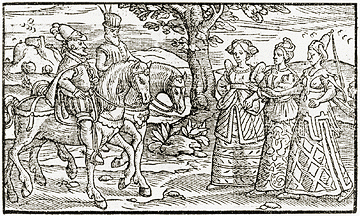
Was Calvin predestined to wear that hat?


Dating Daniel

Last semester one of my students had an encounter with a literalist. This is not uncommon, but the issue raised ran counter to what we were covering in class, namely, the book of Daniel. Apocalyptically minded literalists use Daniel and Revelation as a two-tiered roadmap to the future, supposing that these books are predictions of the end of time. Scholars who’ve studied apocalyptic literature, however, know that such interpretations misrepresent a fascinating genre of ancient writing that says more about its own time than some unforeseen future (our time). Nevertheless, the myth of Daniel’s foresight persists.

Long ago biblical scholars noted that although set in the period of the Babylonian Empire, the book of Daniel makes several basic errors about that time period. On the other hand, Daniel knows the period of the Seleucid Empire (when it was actually written) in relatively precise detail. We think nothing of it when an author today sets a story in the past, but somehow this is dirty pool in the composition of an evangelical Bible. Apocalyptic was intended to provide encouragement to those under persecution, not to give them a Google-mapped future. It is in the nature of apocalyptic to present the author as a seer, but the future age is a Zoroastrian contribution that gives books like Daniel and Revelation their edge.

Misunderstanding genre is a large concern among literary scholars. A document like the Bible, which contains several distinct genres, must be handled carefully if it isn’t to be misrepresented. I used to point out that if the passages intended to be read ironically were understood literally many Bible-quoters would be in trouble. After all, doesn’t Amos declare, “Go to Bethel and sin; go to Gilgal and sin yet more” (4.4)? Learning to place biblical genres within their proper context makes a world of difference. Instead of Daniel telling us to hold tight because the end is near, he is found to be encouraging those who were suffering in his own day. We have no biblical roadmaps for the end times because the end of the story has not yet been written.

Daniel tells the lions a story about the future


Build-A-Bible

Winter Term is underway, and one of the first aspects of the Bible I discuss with students is the fact that the Bible was a book that was compiled instead of written. In our society we are used to the concept of the Bible as a document that is unified by divine authorship, often forgetting (or ignoring) that none of the authors was intending to write a book with the tremendous authority the Bible now enjoys. Students ask how the Bible came to be; it was a process of gathering material widely utilized in Judaism. No one knows the actual composition history of the Torah, but after the Pentateuch got the process rolling, scrolls were gathered in collections and added to the Bible en masse. By the end of the first century of the Common Era, we had a Hebrew Bible.

Sometimes this historical reconstruction is a hard-sell to members of a society where a divinely written book is accepted alongside sub-atomic particles and super novas. Despite the technological sophistication that accompanies growing up in our engineered world, students are often ill-equipped to accept the Bible as a product of human exploration. The writers, whoever they were, traveled this same path of discovery that we continue to tread. They wrote down their hypotheses, based on their experience, just like modern people continue to do. The difference is they did this a very long time ago.

Those books that were selected for inclusion in the Bible became the defining documents of western civilization. Even though there is now an international space station orbiting out of sight above our heads, and even though quarks, leptons, and bosons fly out of cyclotrons large enough to encircle most small towns, God still holds a quill pen. The fixation just after the age of cuneiform is a curious one. If only God had held out for the invention of the Internet, the compilation of the Bible would have taken a very different course, I suspect. Instead of beginning its title with the word “Holy” it would more likely have commenced with “Wiki.”


Battling Billboards

CNN’s Belief Blog carries the beleaguered story of the Lincoln Tunnel billboard battles. Last month a billboard proclaiming that the Christmas story is a myth had been sponsored by American Atheists to try to raise awareness that not all commuters are Christian. In response, the billboard has now been rented by the Times Square Church and newly proclaims “God is” with a number of devotional qualifiers. ‘Tis the season of wearing one’s passions on one’s red sleeves with white trim. Since this is America, it must be writ large.

The recriminations fly like childhood accusations: “but s/he started it!” Can’t mature adults agree to disagree? In a world constantly filled with inequality and strife, religion is used as a cudgel to enforce uniformity. The holiday season is much more than various religions marking their territories. The symbolism of the return of light after a long descent into darkness is archetypical, no matter whether it is the finding of oil to light lamps, the birth of Jesus, or the triumph of Sol Invictus or any of a plethora of other celebrations. It should be something that all people are able to share.

It is the “other” that is feared: the groups who do not share our religious outlooks. “He who is not for us is against us.” It is much safer to slap the other with a billboard barrage than to have to look into the eyes of another human being and say, “I respectfully differ.” Instead of welcoming in the light, we dig further into darkness. The Manichean sensibilities are undiminished after all these centuries. Some would argue that all must be brought into conformity for peace to prevail. To them I say, “I respectfully differ.”


Multiverse of Angles

Alternate realities. The concept fits well with astrophysical views of the multiverse that posit undiscovered dimensions and all their implications. Last night my family finished its group reading of Philip Pullman’s The Subtle Knife, as alternate a reality as might be imagined. Plucking Lyra from the uncertain ending of The Golden Compass, Pullman draws his readers into alternate worlds where everything is tied together by the consequences of “the fall” in Eden and where a new battle against the divine is about to take place. In an ambitious attempt to shift perspectives, we are told that the forces against God are, in fact, good. The magisterium, as its uncompromising strength in Lyra’s world demonstrates, will always seek to rule the world. It is an unsettling picture that Pullman paints, a reality where what we thought was Ormazd turns out to be Ahriman.

At the same time, I have caved in and begun reading The Watchmen. Not a great fan of graphic novels, I have been faced with a mounting curiosity after watching the movie a few times. In this alternate reality, God is simply irrelevant. Doctor Manhattan elaborates on the nature of a universe without a deity more fully in the novel than audience forbearance would allow on the big screen. This is a world perpetually on the brink of self-destruction, where God is absent and human ambition becomes the driving force behind a petty, short-sighted reality. Despite the comic-book feel, the story is profound and the concepts disturbing. Alan Moore’s dark vision of other worlds allows unrestrained human desire free reign with no divine restraints.

Such alternate realities underscore just how much of our reality is structured by religious beliefs. They resemble our world in significant ways, but their lack of divinity forces a nascent nobility from human characters who are only too aware of their own weaknesses. Flawed people try to create a better world. Some theoretical physicists suggest that all imaginable realities likely exist in the infinitude of universes that crowd in on our limited view of the way the world actually is. The ideas are mind-bending since even the worlds imagined on our own limited universe have both created and destroyed concepts of God. What might God’s role be, should the multiverse (or even a Stephensonian metaverse) turn out to be the true reality?


Astronomical Chances

I am sure that I am not alone in the sense of relief that the solstice has finally arrived. Light will gradually begin to increase as the northern hemisphere slowly wobbles back toward the sun. And if I didn’t have another final exam to administer a little later this morning I would’ve stayed up to see the total lunar eclipse last night. Conditions were perfect, if cold, for viewing the event in New Jersey. NASA states that the last time a full lunar eclipse occurred on the winter solstice was in 1638. Those of us who survived to see last night’s events, whether with our eyes on the skies or on the Internet, have witnessed a rare astronomical coincidence. So rare, I’m sure, that some people have taken it as a sign.

This is the season for signs in the sky. The Gospel of Matthew narrates how Zoroastrian astrologers followed a star to Bethlehem. Over the years many astronomers have puzzled over what this anomaly might have been. (They might benefit from reading a little mythology now and again.) While still in Wisconsin my family went to see a University of Wisconsin planetarium show on the subject, and these family-fun science-and-religion public-relations events are anything but rare. It is in the spirit of the season.

Ancient civilizations bestowed upon us the gift of looking for signs in the sky. In antiquity’s three-tiered universe, the gods literally lived “up there,” so portentous occurrences above our heads were a bellwether of divine intention. Religious specialists had to be able to interpret the omens in the air. That fascination has remained with humanity ever since, no matter how rational we’ve become. While driving home in the relatively developed region of New Brunswick a few weeks ago, I saw a meteor. This was remarkable because the light pollution of multiple streetlights along with the volume of raging traffic headlights was intense. My eyes were glued to the taillights before me when it fell. It felt like an epiphany – it was the brightest meteor I’d ever seen, and over the years I suppose I’ve seen my fair share. It left me with the feeling that something momentous had occurred, an emotion that persisted for a few days. No wonder ancient astronomers found the night sky so impressive. The only negative aspect of the lengthening of the days is the corresponding shortening of the nights.


Whence Moses?

Podcast 21 follows on from podcast 19 concerning Moses. Specifically, the question addressed in this podcast is the origin of Moses. While not historically attested, Moses is nonetheless an important figure in both Judaism and Christianity. How do we explain Moses if he is not historical? This podcast attempts to suggest one plausible origin for Moses while admitting that we simply do not know where he really emerges in the religious imagination of antiquity.


Watchmen Tell Us

When the local Blockbuster went belly-up a few months back, I was one of the vultures picking the bones. With new DVDs continually creeping up in cost, I look for bargains wherever they might exist. Occasionally I find something for just a couple of dollars that really makes me think. Although I don’t go to theaters often, a couple of years back the previews all featured The Watchmen. I’m not a graphic novel reader either, so it was doubly doubtful that I would ever gravitate to this film. But here it was on sale. Very cheap. The previews had shown Dark Knight-like action and despite my own declarations, I had to admit that I was curious. So I’ve watched it a couple of times and have been intrigued by what an (absentee) role God plays in the movie.

I won’t go into much detail since the story is complex and, to my surprise, sophisticated. Nevertheless, the Watchmen – retired crime-fighters both good and bad – forced out of practice by the government, fear the approach of nuclear war and try to fight back. At several junctures characters declare that there is no God or that they believe there is no God. The setting is an alternate reality in the 1980s, but the crossover between that world and this is evident. Godless heroes may save the day, but with a tremendous human sacrifice required. At first viewing, I was stunned. The message was so bleak and hopeful. The movie could have been made with no mention of God, yet, briefly, his absence was underscored. Strangely, the Bible features in a bedroom scene where a future hero is spending the night with his girlfriend. Why the Bible? Why here?

I would be the first to admit that I do not have the proper background to comprehend the plot. Generally I like to read the book before I see the movie. One of the recurring motifs in the movie version is the doomsday clock that moves dangerously close to atomic war. On top of the Bible is the hero’s watch, ticking inexorably down to midnight. Even I can figure out that the countdown to doomsday is based on the Bible. What the import of this is, however, I can only guess. What kind of world has no God but still has Bibles? A world where Watchmen aren’t wanted and yet are sorely needed. Who will save us now?


Peace on Earth

One of the most ironic of Christmas messages is “peace on earth.” The irony comes in the means of declaring that peace. Apparently first-century angels were declaring peace to the entire world, according to Luke. The peace that we see proffered, however, often extends only to those like us. What is the harm in extending Christmas joy to all? Must one be a Christian of a particular stripe before the joy of giving can be bestowed? Over the last several years various Christian groups have sought to reclaim ownership of the holiday they borrowed from the pagan Romans, Celts, and Anglo-Saxons. Make it exclusively ours. Peace to us, and let others find their own way home.

In a season of charitable giving, understanding seems to have fallen off the list of Saint Nicholas. In his guise as Santa Claus he makes the rounds of the entire world, according to the mythology that children are told. Do we ever really picture Santa delivering gifts to those who live in Iran, North Korea, or Afghanistan? Does peace on earth apply to them? The thing about peace is, unless everybody has it nobody has it.

Can we learn to share Christmas? Those who fret over Xmas forget that first-century Christians abbreviated Christ with an X (chi in Greek), just as they represented him by a highly stylized fish. Today an empty fish on your bumper declares what an X cannot, apparently. The message is that Christmas belongs to us, not secular pretenders who just want an excuse to make their kids happy. For most of the history of Christianity, Christmas had been a low-key event, barely noticed by most of the faithful. When the possibility of material gain was added in, however, the holiday became especially holy. Should we share the doctrine but not the gain, or should we make Christmas a gift to all the world – a season when all might reasonably hope for peace?


Aye, Aye, Robot

As students gave their final presentations, the very last group discussed the End of the World. This is a topic upon which the Hebrew Bible is generally silent, despite the rants of many who misunderstand the Zoroastrian influence upon the apocalyptic book of Daniel. No, the Hebrew Bible’s apocalyptic material looks forward to a change of ages, a radical new beginning, but not an end of the world. Well, maybe the end of the world as R.E.M. knows it, but not the cessation of everything. In an interesting twist, this group moved from the Hebrew Bible to scientific scenarios of the end of it all. What became obvious is that undergrads these days are faced with multiple doomsday scenarios, most of which are of human origin.

Last month I was inexplicably elected as the president of the adult chapter of my daughter’s high school robotics team. An unemployed religion professor hardly seems the logical choice for leading the way into a technological future. I even declined the nomination but was persuaded to give it a try. Robots have improved the quality of our lives to a degree that most people do not even recognize. So I listened in amazement as the students last night presented the doomsday scenario entitled “iRobot.” Clearly this is a Transformer-like blend of iMac/iPod/iPhone and Isaac Asimov’s sci-fi classic I, Robot. (Is it mere coincidence that his name can be written iAsimov?) Their description was terse and scary: nanobots and more boxy industrial models will commandeer the Internet and take over. We will be Matrix-like slaves. And I am the president of a robotic club booster association. I felt like Judas, with a MacBook.

Robots, we are told, lack empathy. Experience teaches me the same about Republicans. This weird hybrid of religio-politics is not unlike our hypothesized robotic nemeses. Religion has given us a rope to hang Judas that can double as whip against the backs of the underprivileged. Where are Asimov’s Laws of Robotics when you need them? “A robot may not injure a human being or, through inaction, allow a human being to come to harm.” Yes, the old ways are breaking down indeed. I think I’ll take my chances with the robots. At least when a robot is cutting off your life support systems it is not doing so in the name of Jesus.


The Bible Tells Me So

As part of my regular Hebrew Bible class, students prepare classroom presentations for the end of the semester. This gives them a break from constant lecturing and also serves the function of initiating discussion. I assign social issues for them to discuss vis-à-vis the Bible; they can discuss these with each other in group-sessions throughout the semester. Since no one knows “the answer” when it comes to the Bible, I figure we can all learn from each other. I’ve been using this exercise for four years now, and at a school the size of Rutgers, you’d expect a wide variety of perspectives. This occurs, to be sure, as does more predictable stances. After fourteen weeks of instruction, most of them can only find the Bible a trove of prooftexts.

Learning to integrate biblical study into a rational worldview is difficult in our cultural climate. From nearly every medium from which religion wafts – Internet, television, newspaper, personal sermonizing – it comes out literal. The Bible/Quran says… (fill in the blank). What occurred to me during the student presentations is that scriptures of all descriptions become dangerous when their context is lost. Politicians, often among the arguably least educated members of society, argue about what the Bible says. Problem is, the Bible was written from a pre-Enlightenment viewpoint, a perspective that is out of reach to all but the most utterly naïve. Even to understand worldviews from the pre-Enlightenment you need to spend years of serious historical study.

So here’s our dilemma: we live in a society enamored of a book it doesn’t understand. Bible verses are used like Band-aids, pasted over every perceived rupture of continuity, but never quite reaching to the ends of the wound. Even after a semester of bald instruction – in the case of Nashotah House three semesters – students generally revert to what they know. To learn what the Bible instructs, take a pair of mental scissors, snip around the pericope, and tape the verse over the issue. There is, however, always a backside to the page. And most students never learn even to turn the page over to see if both sides agree. They could be ready for a life of politics.


I Can’t Ear You

I bought a box of Q-tips in the store the other day. I noticed that the package shows humans using the cotton swabs in a variety of ways: around the eyes, nose, eyebrows, even on a computer keyboard. Everywhere but an ear. The suggestive shape of the Q-tip, as well as the received wisdom of everything from the South African name “ear buds” to Mad magazine, indicates that they were invented for ears. We all share that somewhat unsavory habit of forming earwax, and doctors warn that using cotton swabs may impact the matter and lead to complications of hearing. Q-tips (originally “Baby Gays” – check out the Q-tips website) are no longer for ears. In the back of my mind I supposed that it was because of lawyers. All it takes is one litigious sophomore and companies run to their attorneys to show that the faulty application wasn’t their suggestion.

Laws run our lives. One of the most famous, but by no means the first, law-givers was Moses. I’m pretty sure Moses didn’t say anything about what to stick in your ears, but he did lay down the laws that Neo-Cons still argue should govern our lives just like the Quran governs the laws of Iran. The laws of the Torah, however, were only meant for the Israelites. Nevertheless, laws have become means of growing wealthy. If we can prove on a technicality that my dumb mistake was somebody else’s fault, why not have that person (or better yet, company) sued to within a millimeter of their lives claiming “damages”? The law has become a means to protect the special interests of those in power. As someone who has tried scrupulously to keep the law my entire life, I sometimes find that old Moses seems to have turned against me.

Laws are meant to protect the rights of people. When did laws shift to becoming instruments of entrapment and means of income? Just before leaving Wisconsin I was driving my family home from a movie. We were talking and laughing when I came to a speed-trap area of my local town where the speed limit drops from 45 to 25 m.p.h. within a matter of inches. Religiously I always complied. Today, in the spirit of the moment, I neglected my usual caution and was pulled over. A policeman young enough to be my son lectured me on unsafe driving (I began driving when he was still wearing diapers, and I had never been given a ticket before because I am not a speeder) before issuing me a citation. My wife couldn’t believe it – she knows that I never speed. One of my last memories of Wisconsin is being unfairly targeted by a law devised to bring money to the local police force. It has nothing to do with safety, since there were no houses or buildings for several hundred yards yet after the slow-down zone. Has the law come to free us or oppress us? Lawyers watch our backs, and law-makers watch their wallets. I want to ask Moses, but I’m afraid I won’t hear him. I seem to have a cotton swab stuck in my ear.

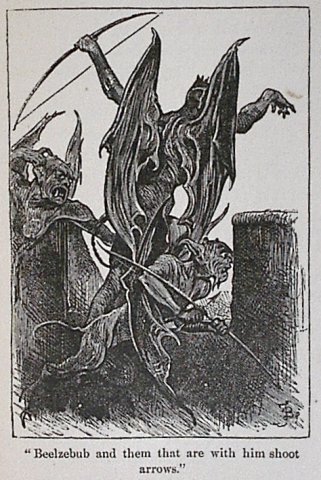
Lead us not into temptation...


Mercer Metaphor

Not being a follower of the rich and famous, I had never heard of Henry Chapman Mercer before visiting his house. Mr. Mercer has long departed, but he was a tile-maker with a very rich auntie back at the turn of the penultimate century. Being from Doylestown, Pennsylvania, Mercer poured his money (literally) into a castle made of concrete. This sturdy, labyrinthine structure, called Fonthill, is a five-story museum that is an hommage to ceramics and the art of tile making. The friends who introduced us the museum enticed me with the information that Mercer had embedded Sumerian tablets in the wall of his concrete mansion. Indeed he had. Standing in the house that Charles Dickens once visited, I realized that the literary connections stretched beyond Sumer to the lifetime of Mercer himself. And right in the middle was the Bible.

Who might that giant be?

There is so much to see in every room of Fonthill that I could not hope to take it all in. No photographs are allowed inside, so I was desperately trying to remember every square centimeter that I was lucky enough to examine. The Bible, however, came in the form of clay. Mercer designed tiles. A tile factory still sits on the grounds of the house. Many of these tiles depict biblical scenes. Perhaps sharing a shudder with most of the wealthy, Mercer had concerns for the afterlife. The Bible is the balm in Gilead. Although I couldn’t take photos in the house, pieces made from the same molds adorned the nearby Mercer Museum that we visited later that day. Both buildings lack adequate heating but abound in human-made stone. I snapped a couple of biblically themed tiles before eagerly heading to the warmth of the car.

Elijah reaches for a handout

Meanwhile the news declares that unemployment benefits are being shortened by a bloated government. Those who’ve been forced out of work by a capitalism out of control will now have to make their own jobs, it seems. Bush-era tax breaks are being desperately defended by congressmen who look surprisingly well fed. The rich have never had it so bad. Henry Mercer did not have to work for his money, yet the Bible adorns his monument in stone. Fonthill is definitely worth the trip to Doylestown. While you’re there, look for the ubiquitous Bible. The Bible, although possibly the most misunderstood book in human history, lends its gravitas even to the vaunted towers of Babel.


Impossible Kingdom

Over Thanksgiving we visited friends in Newtown, Pennsylvania. Newtown was the home of the Quaker painter Edward Hicks, famous for his many renditions of The Peaceable Kingdom. On a chilly Black Friday we walked to his former home, visited his Meeting House, and stopped by his grave. The Quakers, whose presence is much more palpable in the eastern part of the state, were the original Pennsylvanians. Their pacifism defined them, and the peaceable kingdom was their ideal world. A world without strife, without greed, without televangelists and politicians. It is a compelling vision.

A peaceable kingdom

The Society of Friends recognized no human leader to their movement that sought direct experience of the divine. In the Bible such a vision pervades early Israel where the rule of God was expected to be enough; no king was needed for this kingdom. The ideal world, however, was plagued by human ambition and selfishness. Before the first judge hung up his hat they knew that they’d need a king. A monarchy, as they were warned, that would bring about its own set of intractable problems. Leadership inherently creates inequalities. Just ask any accountant who keeps track of a governor’s expenses. Kinglets are just as bad as godlets.

We read about the excesses and abuses our leaders stockpile in the name of public servanthood. Yet, for all that, the world is not at peace. An increasing number of nations are joining the nuclear club, poising their missiles over populations of innumerable people in need. The peaceable kingdom has no king, and the visions of the prophets are cloudy and uncertain. Visiting the quaint, affluent hamlet of Newtown, it is possible to believe in the vision of one of their defining personalities. Just don’t open the newspaper or turn on the television. Because, like the Israelites, we have many eager kings lined up outside the door.

Is the peaceable kingdom dead?


Condom Not?

Newspapers and the Internet have been abuzz with Pope Benedict XVI’s leaked proclamation that condoms may be useful for male prostitutes in preventing the spread of AIDS. Many are astonished, and not a few heads have been scratched at the declaration from the stalwart bastion of “sex is only for procreation” Christianity. The announcement, while humanitarian, is deeply troubling. From ancient times it was recognized that human sexual behavior had more than procreational importance. The matter has been investigated by psychologists since the nineteenth century and the same conclusion was drawn: people engage in sexual practices for a variety of reasons. Meanwhile, the church has been holding out with a Hebrew Bible viewpoint enhanced by the personal outlook of Paul.

In the ancient world, the microscopic world of reproduction was unknown. What was actually happening in conception was misunderstood. Judeo-Christian sexual mores were based on faulty information, from a biological point of view. In such a view, the all-potent male gamete (inappropriately called “seed,” as if a womb were just a place for pre-formed humans to grow) was capable of producing life on its own. Reading a handful of Greek myths will demonstrate this principle nicely (since the Bible has a more demure and blushing way of discussing the idea). The concomitant concept that seed should not be wasted led to the faulty idea that, in the unforgettable words of Monty Python, “every sperm is sacred.” That mental construct has been used by the church to make women subservient to their biology in a way that never applied to males. The Pope’s declaration underscores this double standard.

If male prostitutes may use condoms with the church’s blessing to prevent the spread of AIDS, the only motivation left for heterosexual birth control is female control. The “lost cause” of male reproductive potential in male prostitutes does not apply in heterosexual unions? God holds married couples to a different standard than male prostitutes – why? Is the sperm in these two cases unequal? The Pope is undoubtedly on the right track by endorsing the use of condoms, but the church still has a profound distance to go before it can look women in the eye and say, “we believe you are truly equal with men.” Oh yes, and not blink while saying it.

Remember, these guys lost to the Greeks...