Everything’s Better at Harvard (Except Religion)

My wife pointed me to an important article in Newsweek on the plight of religious studies at Harvard. Now, I have to admit to a couple of bunches of sour grapes right up front. I was accepted at Harvard but elected not to go. Only after I had completed my doctorate at Edinburgh University after a lifetime of the study of religion and found that no jobs were available did I realize my mistake. I met colleagues who had jobs while attending academic conferences. All of those well settled in respectable positions had graduated from Harvard. A similar phenomenon exists in Great Britain. Those who actually find satisfactory positions hold doctorates from Oxford. Problem is, neither Harvard nor Oxford corner the market on good education (oh, the heresy!). People, however, are simplistically impressed by lineage.

In any case, this article by Lisa Miller points out the high drama of academic discord at the Shangri-La of American institutions. The famous linguist, Steven Pinker, who personally believes religion to be a severely faulty means of seeking enlightenment, has worked to prevent a required course in religion at the famed secular university on the grounds that faith and reason do not share the same status. Miller goes on to express how small colleges and state universities are picking up on the slack. My limited experience at Rutgers bears out her observations. In this large, rambling, decidedly secular school, my classes in the religion department are always full and I have to turn students away. Yet the university refuses to allow for a full-time hire. Secular America is deep in a state of denial. Because many academics reject religion personally, they simply can’t see how vital it is to understand it. I personally believe no one should be allowed to hold public office without having completed a course in Bible and its political abuse.

Meanwhile, Harvard still holds back. Its reticence will not prevent misinformed people from using their religion as a means of power and destruction. Pretending that since religion is not personally important it is not important at all has deadly consequences. To me it seems obvious that it is not the school you attend that is important, but what you learn while you are there.


How Flat is Your World?

I talk so much about lenses in class that some of my students must think I’m a closet optometrist. The lenses I refer to, however, are those that we all wear as part of our culture. We can’t help it – being born into a worldview is part of the human experience. From my youngest days I recall learning that the earth is twirling around at a dizzying rate and we are hurtling through space around the sun so fast that my thoughts can’t even keep up. These are lenses. Then we turn to the Bible (or other ancient texts for that matter) and read about the creation of their world. To understand their worldview we need to take our lenses off.

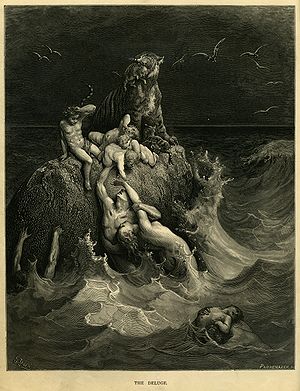
Last night I could see the understanding dawning on some faces in the classroom as I described ancient Israel’s worldview. They were flat-earthers, each and every one. The world that is described in Genesis 1 is flat with an invisible dome over it, a dome that holds back the cosmic waters and provides a living space for the sun, moon, and stars. The flat earth is upheld by pillars that erupt through the surface in the form of mountains, and there is water around all. Genesis 1 does not describe the creation of water; it is already there. You can tell there is water above the dome because it falls on us whenever it rains. Oh yes, and dead people are in Sheol, somewhere under our feet. This is the world that God creates in six days. It is not our world. It was their world.

One possible rendition of an extinct worldview

It is not that the physical world has changed, but perceptions of it have. When I stand outside (this was especially noticeable when I lived in central Illinois), I see the world is flat. I feel no motion – I get sick as a dog swinging my head around too fast, so I would know! The difference is that I understand apparent reality is not the same as physical reality. The writers of Genesis 1 did not anticipate our world, nor did they describe how it came to be. They described the world they knew, a world that does not actually exist. Fundamentalists today claim that the Bible is factual in its description of the creation, and that may be the case. But only if you take your lenses off and admit that the world God created is flat and is covered by a dome. And by the way, it looks like the windows of the sky were left open because it is beginning to snow again.


View from the Snowpocalypse

With all of the hype and anxiety of the current Nor’easter dumping snow on the East Coast, a guy from northwestern Pennsylvania can’t help but shrug his shoulders. What’s all the fuss about? Growing up in the snow belt of Lake Erie, I was accustomed to forgetting the color of the ground between December and April. School seldom closed with under a foot of snow. And I had to walk a literal mile to catch the bus, but it was uphill only one way.

The truly fascinating aspect of this storm is the creation of biblically charged words to describe it, as if the American vocabulary has run out of appropriate adjectives. “Snowpocalypse” and “snowmageddon” both appeared in this morning’s paper. The late biblical concepts of apocalypse and Armageddon indicate a devastating turn of the era when a new world is ushered in. All I saw out my front door was a bunch of snow. Peaceful, white, and pretty.

Snowmaggedon? Hardly.

I lament the farming of the otherwise underused Bible for images that cheapen the visceral fear and dread that accompanied ancient outlooks. Once while at Nashotah House in Wisconsin, when the temperature plunged to 38 degrees below zero (air temperature, not wind-chill) and the tired snow was being blown about by unforgiving winds, we were required to make the trek to Milwaukee for a day long spiritual retreat. Just about all human institution had shut down, with the sole remaining exception of a church eager to revitalize its aging congregation. As the ice on the window of the bus refroze immediately after being scraped off, I came close to thinking apocalyptic thoughts I admit. The weather, I guess, has always had a divine connection in our primitive minds after all.


Paul Does the Classics

I first became aware of Greek mythology in fifth grade. My teacher in an industrial, rough and yet rural school, believed in the benefits of teaching aspiring drug addicts and laborers the stories of gods and heroes. I immediately adored the stories we heard and read. Raised in a religious household, however, I feared enjoying the tales of what were admittedly pagan gods after all, too much. In the educational topography of my youth, we were on the brink of this brave new electronic world we’ve entered, and mythology was not considered a terribly useful part of the curriculum after that. I left the gods behind. In a class on the Christian Scriptures in college, however, my instructor suggested we all go see Clash of the Titans (the 1981 version) for its appreciative (if a little hokey) presentation of the Greek world. I enjoyed the movie and even took a class in the literature department on mythology.

Over the years I have touched and gone on Greco-Roman mythology while specializing in the mythology of Ugarit. Now that I’m teaching a course on mythology, I’m going back to my classical roots and rereading the stories of times not quite so ancient as the fertile crescent civilizations’, but older than what is considered practical nowadays. While rereading Euripides’ play The Bacchae, the concentration of images, concepts, and actions that recur in the Bible stood out in chiaroscuro. Especially noticeable were references to Paul in the book of Acts.

Like Paul, Dionysus comes to be imprisoned. Not recognized as a divine figure, King Pentheus of Thebes locked him in chains until he could demonstrate that Dionysus is just the wild imaginary figure of repressed women. An earthquake, however, soon rattles the city and Dionysus emerges, chains shed, to the astonishment of Pentheus. The scene reads like Paul and Silas’ escape from jail in Philippi (Acts 16). Admittedly this could be coincidence. A few lines later, however, Dionysus, free from prison, tells Pentheus, “Don’t kick against the goad – a man against a god,” (Act 3, Paul Roche’s translation). Even so, Paul on his way to Damascus sees a vision of a god and is asked, “Why are you persecuting me? It is hard for you to kick against the goads” (Acts 26.14). Perhaps Luke had read his Euripides?

Now I’m no scholar of the Christian Scriptures (although I have taught courses on them a time or two), but when obvious parallels exist it is incumbent upon modern readers to pay attention. The parallels of Dionysus and Jesus were evident to early Christians, so what I noticed was nothing new. When the followers of Dionysus, however, strike a rock with their sticks and water flows out, I wondered if Euripides had read his Torah!

Paul's bedtime reading


Book of Eli

Feeling that it is incumbent on a teacher of Bible to stay current with media presentations of my subject, I went to see Book of Eli yesterday. Not really a fan of violent movies, I was a bit concerned about being subjected to gratuitous carnage, but beyond the expected post-apocalyptic context and its attendant, constant menace, there was not too much to worry about on this score. For several years I have been researching the presentation of the Bible in movies. It is my hope to write this research up into a book one day if I ever land a job that allows such a luxury. Book of Eli will deserve a chapter of its own.

Apart from fundie self-praise fests, few movies present the Bible in such a heroic role as it plays in Book of Eli. Eli, like Jake and Elwood, is on a mission from God: to deliver a Bible to the last repository of education in the United States, namely a famous correctional institution. Along the way Road Warrior-style bandits harass him and Carnegie (a kind of deranged librarian with lofty political aspirations) covets Eli’s Bible, the last in existence. Carnegie wants the Bible because, “it is a weapon” of social control. (All quotes are approximate since I couldn’t take effective notes in the dark.) Eli must keep it because of his mission. Along the way Eli explains why the Bible is important to Solara, a young woman who is drawn to his sense of mission and devotion to the book. Explaining that since the last war, all Bibles have been routinely destroyed and that, “some say it [the Bible] is what caused the war,” Eli lovingly wraps the book in a cloth before secreting it in his ubiquitous backpack next to his machete. At this point I could feel the social commentary pressing hard upon me. The Religious Right would love nothing more than to force Armageddon on the planet so that they might go to their wonderful fantasy-land in the sky. Their misreading of the Bible has caused wars in the past and will likely cause them in the future.

As Eli loses the Bible to Carnegie and continues his mission empty-handed he explains to Solara, “I’ve been protecting it [the Bible] so long that I forgot to do what it says.” Again the social commentary was evident as news headlines continue to push hot-button conservative political issues where the heart has been cancerously eaten from the Religious Right and the Bible as idol becomes more important than what it actually says. When Eli brings his mission to its conclusion, however, the viewer is presented with an entirely positive view of the Bible. It is the symbol of civilization in a world of anarchy and Solara marches off as its acolyte into a hostile world as the sun sets in the west.

What is truly remarkable about this film is that it presents the Bible in a way that would make its study cool again (if it ever was). For those of us who’ve spent a lifetime shying away from telling others that we have spent our lives learning about the Bible, we might now walk into the glaring sunshine and have others step back in reverence for our selfless efforts to benefit the human race. Well, at least once the apocalypse is over.


Proselytizing Phylacteries

Two related stories appeared in today’s newspaper, both of which concern the Bible in public life. A commercial airliner was forced to undertake an emergency landing in Philadelphia while en route from New York to Louisville, Kentucky yesterday because of terrorist concerns. The cause for alarm? A Jewish teenager’s use of his tefillin in public. Often translated as “phylacteries,” tefillin are prayer boxes worn on the arm or forehead during prayer in some sects of Judaism. This idea is not really obscure if someone has basic religious training. People on the US Air flight, afraid that the scripture-bearing artifact might be a bomb, had their lives disrupted while the boy calmly explained what he was doing. After landing, TSA officials came aboard, just to make sure. That’s a comfort! TSA officials seem unable to spot a real bomb but take a more than academic interest in a boy saying his prayers. Perhaps reading a Chaim Potok novel should be required training for TSA service? As my wife observed: what if someone took out a rosary or a crucifix? Would the flight be diverted to van Helsing’s residence? The level of this religious ignorance belies the grumbling in my post yesterday. Religious study is vitally important in an increasingly global society.

Is this phylactery da bomb or what?

The second story, again courtesy of my wife, was first run on MSNBC earlier this week and reprised in the paper today. Trijicon, a major defense contractor for the U.S. military, has for years been stamping Bible verse references on its rifle scopes. Concerned citizens, perhaps after watching sniper Private Jackson quoting the Bible in Saving Private Ryan, have raised concerns that Bible verses on rifle scopes constitute proselytizing. In Muslim countries, after all, those who have been shredded by a bullet before they ever saw their assaultant might be tempted to convert if they ever glimpsed the rifle scope and saw the Bible emblazoned on it.

Today’s story indicates that Trijicon has agreed to provide “Bible verse removal kits” to the military so that the verse references might be easily erased. What is so sad about this situation is that no one seems concerned that the maker of lethal weapons adds Bible citations to their products. The purpose of these devices is the killing of other people. The Bible seems an odd choice of supporting literature for this cause. Well, maybe not. The Bible knows how to call down the wrath of the Almighty on enemies as well. And the Bible gives instructions on how to pray with a phylactery. These stories demonstrate as clearly as possible how selective reading of the Bible leads to hypocritically varying results in an overly religious, but religiously uninformed, society.


Portrait of Poe as a Young Man

An obscure portrait of Edgar Allan Poe has come to light and is scheduled to be auctioned off. Reports indicate that the watercolor painting reveals a young man without the world-weariness of the more familiar images of Poe. He may even be smiling.

Poe has long been one of my personal muses. His writing captivated my imagination as a young man, and his sense of tragedy encased a golden nobility. Although many consider his works to be juvenile, like the slightly later stories of Sherlock Holmes by Arthur Conan Doyle, Poe grew to a mature sensibility concerning life that rivals that of Job. Intrigued, years ago I wrote a high school term paper about the writer and discovered a spiritual compatriot who couldn’t outstrip the “unmerciful Disaster [that] Followed fast and followed faster.” Now on the side of years beyond the lifespan of my muse, I begin to understand how a happy young man becomes a Qohelet in his time. In his personal difficulties, Poe was able to speak for many of us.

To me this young portrait is cast in the tint of Dorian Gray. The real image of Poe is that of a man given few breaks in life. A man of keen sight and keener insight. There have been thinkers like Poe from ancient times, but they are generally resigned to the depths rather than to be found basking in sublime sunlight. When Ludlul bel Nemeqi or Khun-Anup pour out their souls to an unhearing sky, they create a fellowship for latter day Poes and Melvilles and Lovecrafts. I hope the portrait of a young Poe finds a good home and the message of its subject rings as loudly as the bells.

Poe-ever Young


Who Owns History?

Jordan has been asking for the Dead Sea Scrolls to be given back by Israel. During the Six-Day War of 1967 some of the ancient documents were absconded by Israel, according to the Jordanian point-of-view. (Nothing in the Middle East is every truly neutral or non-biased.) According to the newspaper, now Jordan wants them back.

This controversy is part of a larger trend for nations to demand “their” antiquities from foreign powers who have claimed and displayed them (in many cases) for large numbers of people to see. They are part of the world’s heritage and the modern day countries from which they emerged want them back. Why? To bolster national pride? Because of their inherent cultural value? To draw in tourist crowds who are interested in antiquities? The ownership of history is a touchy question. History itself belongs to the entire human race while individual artifacts may be stolen, purchased, or destroyed. Some are in the hands of major museums, minor museums, or in the houses of private collectors. Nations struggling for international respectability often want their heirlooms back, and this is only natural. At the same time, these nations may not have the infrastructure to preserve the artifacts securely. Think of the Baghdad Museum. When any government becomes unstable national treasures are at risk.

The Dead Sea Scrolls owe much of their public appeal to scandal. The story of their discovery and sale, rich with intrigue and skullduggery, is widely known. They capture headlines like 2000-year-old sex symbols; their chic name and aura of mystery assure public interest. As a scholar of the Hebrew Bible, however, I have always found the Ugaritic texts to be of far greater importance. Nevertheless, while living in Wisconsin some years back, and teaching at Nashotah House, I arranged a field trip to the Field Museum in Chicago where a roving Dead Sea Scroll exhibit was settled for a limited time engagement. The seminarians were excited, and we decided to make a family trip of it. My daughter was a pre-schooler at the time, and we towed her along to be acculturated. In a dimly lit room, the feeling of an authentic Middle East chaos attended the display, people wandering blindly around, not quite sure of what they were looking at (this based on overheard conversations). People wanted to be near history, even if they didn’t know why. I had seen the famous scrolls in the Shrine of the Book some years before, but it was easy to feed off the excitement. When we got home we asked our daughter what she enjoyed the most from the bus ride and day out. “Seeing the Dead Sea Squirrels,” she replied.

History involves seeing what we want to see. Nobody owns it. Everybody owns it. Who should keep the artifacts? I don’t know. It seems that history is larger than petty desires for cultural fame. But then, that is what history records — our desires to stand out from the crowd.


Theodicy Versus Idiocy

Among the leading reasons generally given for atheism in developed countries is the problem of theodicy. Theodicy is the act of justifying God, as implied by the roots of the word itself. In a world where many innocent suffer, as well as many guilty, the question of how a loving God and divine fairness fit into such a warped and corrupted system presents questions often left unanswerable. My class tonight will be reviewing Job, a book steeped in the issue of misfortune. The best that the narrator can offer is that Yahweh made a bet with the Satan and Job came out on the losing end. Not much hope for justice there.

This week’s horrific earthquake in Haiti has elicited high levels of sympathy and support as this poorest of western hemisphere nations struggles to find some kind of balance in a reeling world. The question of where God is amid all this tragedy, perhaps 100,000 dead, pensively teeters in minds sensitive to the human condition. Other minds, however, blare idiotic platitudes that only drive mourning theists closer to the other side. Pat Robertson, a major political player who has been a card-holding member of the Religious Right from its unholy inception, has declared that Haitians are paying the price for an ancient deal they made with the devil. In a theology that makes a mockery of even the Charlie Daniels band, Robertson stated, according to MCT News, that Haiti had made “a pact with the devil.” He said, “Something happened a long time ago in Haiti, and people might not want to talk about it… They were under the heel of the French… and they got together and swore a pact to the devil. They said, ‘We will serve you if you’ll get us free from the French.’ True story.”

This drivel, based on hearsay history and implicit racism, does not justify a loving, or even neutral, God. Instead, the Conservative deity is shown in his true colors: racist, supersessionist, arrogant, and uncaring. This is the deity behind the Religious Right. Some people castigate Pat Robertson for being outspoken and perhaps senile. I applaud him. He shows clearly what intellectual rubbish the Religious Right promotes. He simply has fewer inhibitions to admitting it.

In Job, there was a deal made with the Satan. The perpetrator of that deal was Yahweh. No answer is given as to why the innocent suffer. Job is a most profound book, wrapped in a childlike story of two supernatural beings trying to show each other up. If we look hard enough we can find the Religious Right in the book as well. Their voices are those of the “friends” that Yahweh ultimately condemns when he finally speaks from the whirlwind.


Prophets in Disguise

Yesterday I decided to take a break from austerity and take my family to see Avatar. Not just on the big screen (a rare enough treat), but in 3-D Imax format. In my zeal I had forgotten about my debilitating congenital problem with motion sickness. I have had trouble since I was a child sitting in the backseat, or riding backward on a train, or even turning my head around too fast. Once I was talked into riding a county fair ride by some high school friends and found myself still getting nauseous two weeks later. I have learned to live with this embarrassing problem, but sometimes I forget that the mere suggestion of motion will send me over the edge. I managed the first twenty minutes of the movie before having to close my eyes and bow my head for the rest of it. It is an interesting experience to listen to a movie. Following the basic plot wasn’t too hard, at least when I wasn’t thinking about all the talk of great special effects and the money I’d spent to see them.

Like most science-fiction movies, Avatar makes substantial use of biblical and mythological themes. The planet is named Pandora, after the “Greek Eve,” and I could hear traces of the hero quest throughout. When the indigenous people were introduced, however, my ears pricked up (as I understand those of the characters do). The Na’vi, it turns out, share the name of the prophets of the Bible. The Hebrew title for prophet is nb’, pronounced the same as the movie characters. I thought about this as I wondered what was going on during the action sequences that I could not see. Those who guard the traditional ways are the prophets, silenced by the grinding machinery of modernization.

Even avatars have their origins in religion. The first I had heard of avatars in science fiction was in Neal Stephenson’s Snow Crash. The idea felt so fresh then that I had to remind myself that Hinduism had given the world avatars as earthly manifestations of deities centuries ago. Placing oneself in another form ultimately stimulates the question of which is the true self, the ultimate reality. It is an inherently religious question.

The morning after, the room is still swaying about me, I can’t scroll down on the computer screen, and I am asking the questions of reality again. It cheers me that Avatar is doing so well at the box office. Any movie, even if unseen, that causes the viewer to question a frequently painful reality is worth the price of admission.

Another blue avatar


Prosperity Fail

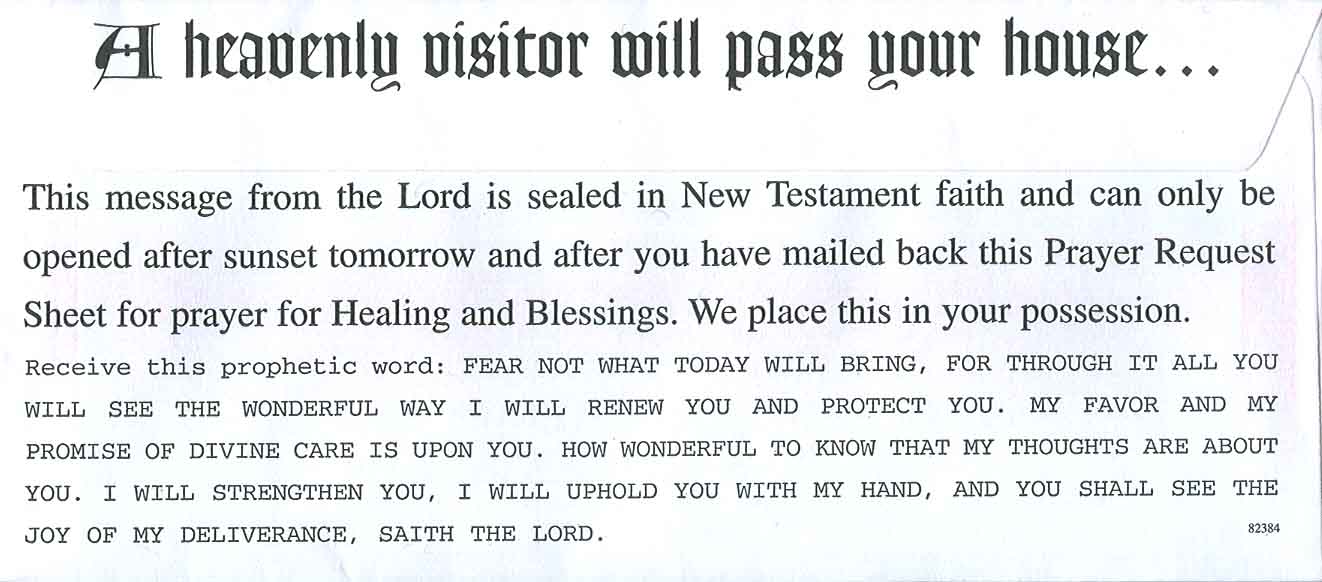
Every so often I receive unsolicited mailings from impersonal churches intimately addressed to “Resident.” Invariably these churches tell me that God wants me to prosper (although he has a funny way of showing it sometimes), offer to send me some totem to make it possible, and assure me of their general goodwill. Yesterday’s mail brought me a packet from Saint Matthew’s Churches offering to help me become wealthy by receiving a free golden cross just for responding — post paid! — to their offer. Clearly such mailings are intended to target readers down on their luck. Since I’ve been without a full-time job since July, I meet their demographic rather well. My response, however, may not be what they hoped for: I plan to send no money.

I wonder how deeply these prosperity clergy consider the impact of an unemployed individual receiving their vain promises. Sometimes when the under-employed receive such hollow promises it feels like a god-slap. Oh! If only I had been wearing this free cross I wouldn’t have had to suffer such bouts of depression and self-doubt! It was just that simple! And the Holy Bible says so too!

Those of us who’ve tried to make a living of studying the Bible don’t just read the cheery bits. The Bible is full of suffering, despair, and difficulty endured by those who tried to do the right thing. So, in fairness to the spirit of empirical inquiry, I’ve decided to respond to this offer. The control will be the last seventeen years of my professional life, during which prosperity has eluded me. It may take another seventeen years, but if I carry my free cross around, things are sure to turn my way. The accompanying literature says so. I’ll set myself a task in Outlook for 2026 to see if, A. the world hasn’t ended in 2012, and B. the magic golden cross really works.


Nag Hammadi

Want to create some excitement in the middle of a gaggle of scholars of ancient history? Just throw some newly discovered ancient text in their midst and sit back to watch the fun. This scenario has been (metaphorically) repeated many times in the last century and a half. New texts come to light and revolutionize what we know of ancient religions. The Nag Hammadi library represents one such flair up of excitement and intrigue. Discovered in 1945, this cache of mostly Gnostic texts has forced a new paradigm upon early Christianity. It has become clear that several flavors of early Christianity existed side-by-side until one group, claiming divine support, became the “true Christianity” (orthodox) while the others were just plain wrong. The Gnostic field of study received a shot in the arm with the publicity fair surrounding the Gospel of Judas, a Gnostic text not found at Nag Hammadi, early in the new millennium.

Good News, Gnostic Style

Discovery can be a dangerous luxury. When new evidence surfaces it can’t be ignored. When the religions of the ancient world reached their imperial stages it had already become too late to admit that mistakes may have had been made way back in ancient times. You can’t conquer a country and then just take it back. We now know that it is far more appropriate to refer to Early Christianities and Early Judaisms than to utilize their singular (if more prevalent) forms.

Nag Hammadi, a mid-size town in Egypt, has been back in the news since Coptic Christmas (just a couple of days ago) saw the death of six Copts when a Muslim extremist gunned them down on their way out of church. In turn, the Coptic community has been running riot in the town, destroying ambulances and shattering shop windows and driving Muslims off the streets. Those who hold their religions to be unchanging have the most to lose when new discoveries surface. It seems unlikely that exploration will cease; more ancient interpretations will emerge. When they do it also seems unlikely that they will find parent religions mature enough to accept their long-lost children. We could still use a little bit of secret knowledge, it seems, even today.


Bible Lite

Over the holiday weekend I listened to an amusing recording my wife gave me as a holiday gift. A comedy troupe known as the Reduced Shakespeare Company produced a recording of their sketches entitled The Bible: The Complete Word of God, abridged. As might be expected from a comedic treatment of sacred writ, there were a few moments that were calculated to make those who take their religion very seriously tremble a bit, but overall the recording was quite funny. While listening to it, however, I became aware of just how much time the Company was spending on Genesis.

Not a sophisticated, exegetical approach to the Bible, a comedy album is not the place to assess the status of serious biblical study. Nevertheless, a deep truth emerges from this lighthearted treatment of the Bible — people today tend to focus too much on the beginning. Every semester I ask my students, “What is Genesis about?” and inevitably the answers begin with, “the creation of the world.” Genesis is not about the creation of the world, despite its unfortunate title. Genesis provides two of the many biblical creation accounts, but its primary purpose is to introduce the Israelites and the special relationship Yahweh has with them. Nearly four-fifths of Genesis deals with Abraham and the next two generations of proto-Israelites. Once Exodus is reached, we are fully within the realm of Israel’s story.

This misunderstanding of how to read the Bible has led to countless uninformed attempts to make the Bible into a narrative of the science of cosmology. Nobody was present for the creation of the cosmos, and the point of Genesis is not to state what actually happened. In borrowing mythic themes from Mesopotamia and Egypt, at the very least, the biblical writers start their account of Israel’s origins with a “a long ago in a land far away”-style introduction. Modern-day readers are trained to latch onto first sentences for vital clues as to what happens further along in the story. The Bible was never intended to be read this way. When we mix ancient ideas of setting the scene with modern attempts to understand our world, it might be better to listen to the Reduced Shakespeare Company than to pundits who claim that earth’s light was created before the sun.

In the beginning was a laugh


Happy Circumcision Style New Year!

2009 ended with a blue moon. Last night’s lunar display (for those who could see the satellite) was the second full moon in December, one of the accepted definitions of a blue moon being the second full moon in any one month. Apart from its cool beauty of mythological fame, the moon is a timepiece to rival any Rolex or even Timex. Many ancient peoples lived by lunar calendars since the 28-day units of lunar time were regular and much more obvious to the layperson than solstices or equinoxes. A full moon is hard to miss.

Last night's blue moon from Wikipedia Commons

The marking of time is a religious activity. The date of Easter is still set according to the full moon; Easter falls on the first Sunday after the first full moon after the vernal equinox. Since Passover is a moveable feast and since we don’t know the year of Jesus’ death, Easter is a mathematical shot in the dark. It is regular because of the steady cycles of the moon. Time is a non-renewable resource, and since religions are generally concerned with what happens after death, time gains a sacred blush. Few holidays are truly secular in origin.

New Year’s is one of the most important holidays in the ancient world. There, the proper observance of seasons meant correct planting and harvesting times, and the possibility of survival. Living very close to the land, people required the assurance of the gods that their meager returns for labor led to enough food to survive. Keeping the gods happy as the new year began was essential. In the United States, New Year’s Day was observed on March 25 until 1752. It was observed on the supposed date of Gabriel’s annunciation to Mary that Jesus would be born. If you want to understand the title of today’s post, you’ll need to take a look at the Full Essays page and read the New Year’s Day section from my as-yet unpublished book for teens on the holidays. It does have a religious basis, as does circumcision itself.