Decade Fail

In a recent newspaper report on the state of the nation, local journalist Tom Moran cites a Pew survey in which most Americans surveyed rated the current and swiftly ending decade as the worst one of their lives. As a professional academic who was ousted from a highly rated, long-term teaching post this decade after a Fundamentalist takeover of the school where I taught, I am inclined to agree. Five years later I am still searching for any kind of meaningful full-time work, while yesterday I spied an ad for a “Ghost Twitterer” (as if someone is so important that they can’t write their own 140 daily words) and bowed my head in sorrow. Maybe we really have sunk to a new low.

What really caught my eye, however, was the statement of a fellow professor at Rutgers (where I have been an adjunct for nearly three years). Ross Baker noted that “It has always taken calamities of almost Biblical proportions to shake this country out of its smugness and complacency.” While I agree with his assessment, the use of the phrase “biblical proportions” demonstrated once again that my chosen field of specialization has a solid place in the popular imagination. Generally “biblical proportions” is a phrase used to refer to disasters, something along the magnitude of a world-wide flood, the destruction of Sodom and Gomorrah, or the plagues of Egypt. These mythological episodes have left a deep impression on our culture that the message of the Bible is a fitting one for the first decade of the twenty-first century.

Perhaps we are really in trouble if this facile view of the Bible is wedded to a facile misuse of the same book for constructing prejudicial public policies and ill-conceived conservative “reforms.” If the past decade has been a wash in this country, I would attribute it to a conservative evangelical political machine that churned out a president who literally would have been pleased to bring on the mythical Armageddon. During this bushesque reign of biblical proportions, I lost a secure job teaching Bible and haven’t been able to find any other full-time work. I would continue my rant but I have to polish up my résumé, and hone my succinctness skills, and try for a Ghost Twitterer position.


Is the Truth Under There?

Each semester I introduce my Hebrew Bible students to the dangers of “biblical archaeology.” Not that there is any wrong-headedness in excavating sites of importance to ancient Israel, but I warn them of requiring proof for religious beliefs. Early archaeologists digging in the lands of the Bible were open about their agendas — “proving” the Bible to be “true.” The problem is proof is certain only in mathematics, not in matters of faith. Truth cannot be known, but must be believed. When archaeologists excavate the unknown, they cannot know in advance what they might find.

As a young academic wannabe, I volunteered at Tel Dor in the summer of 1987. Before the introductory orientation sessions Dor was only a shadow of a reference to one of King Solomon’s administrative cities mentioned in 1 Kings; I knew nothing of its location or importance. I’d had enough of seminary to be skeptical of many truth claims even then, and the irreverent outlook of many of my fellow diggers underscored the secular nature of the venture. We were digging for the truth, but we might not recognize it when we found it. Apart from the scorpions and tarantulas, we unearthed many mute trinkets from Israelites silenced by time. My square team was assigned to the city gate; we were seeking the coveted fourth chamber to place the city in a Solomonic context.

To the best of my knowledge, our humble efforts did not prove the Bible was true. After manually hauling out tons of dirt, we found what appeared to be a gate chamber and perhaps even a rubbish heap. Of these two features the rubbish heap was the more interesting to me. Here it was that the cast-offs of ancient life had been consigned to oblivion only to be rescued by bewildered strangers far in the future. Truth is often in what we hide. It may not be glamorous or worthy of biblical paeans, but it is that part of our lives that we discard. Finding “Solomon’s” gate proved nothing, but what “his” people threw away contained nuggets of the truth.

Is the Truth Under There? Tel Dor 1987


Blessed Bovines

In perhaps one of the greatest ironies of history, throughout the Ancient Near East, cattle were currency. The entire system of fair exchange is based on what humans deem to be valuable — gold is not inherently of more worth than iron. We choose to agree on such value systems and the chosen material becomes a means of trade. In the Bible, before coinage evolved, wealth was measured in animal possession. The rancher with the largest herd was the richest person around. This should be familiar to readers of the Bible, and it is attested in the surrounding cultures of the Near East as well. Even in Egypt, which has the reputation of looking down on cow-pokes (see Genesis 46), bovines were sacred. The apis bull and the usual representation of the goddess Hathor attest to that.

Wikipedia's prized gnu cow

In reading the Iliad over the last few days, the value of cattle among the ancient Europeans also stands out. War prizes from Troy and other conquests are often valued in terms of how many cattle they are worth. Even captured human prizes are symbolically weighed against their worth in moo. The sacrifice that gods appreciate most is that of the beefy variety, although the small-scale farmer may only be able to spare a caprid; when the gods are showing temper, throw another steak on the divine grill and all will be well. It would be difficult to find a stronger religious continuum in antiquity than the pacifying value of bovine sacrifice.

Bovine worship gone crazy

One of the lesser recognized features of our ancient ancestors’ bovine-fixation is found in our own alphabet. Writing began with pictographic symbols representing their referents. Since cattle were so important, their characteristic visage made up a frequently utilized symbol. As cuneiform developed, drawing was replaced by wedge-shaped writing on clay, and the bovine head was represented as a series of wedges and lines. When the inhabitants of ancient Aram (very roughly our Syria) devised their non-cuneiform alphabet, the very first letter was an ox head. The Greeks turned our abstract cow onto its horns and gave the world its alpha, a form that survives in Western scripts today as a Latin capital A. In this industrialized age when, unless they go to the 4-H fair, many people never even see a real cow, every time we tap out messages on our keyboards, we still acknowledge the sacred bovine.


Turn a Priestly Eye

In the local newspaper today there are two stories involving priests and money. One focuses on a British priest, the other on an American priest. The story on page 6 states that a priest in England is receiving harsh criticism for having stated in sermon that the desperately poor are morally justified in shoplifting to survive. He added that this should only apply to large chain stores and not small, family-run businesses. On page 11 is the story of an American priest who won $100,000 in a televised poker tournament. Since the money is being given to the parish it is a light-hearted human-interest story.

What I find disturbing in all of this is the larger message. Yes, priests need to be involved in the financial affairs of the world — we’ve created a culture so focused on money that it is impossible to avoid it. Yet the distinct tone of the news stories is telling. The priest advocating shoplifting to save the poor is suspect since he challenges modern mores of property ownership. The Bible advocates landowners leaving some of their hard-earned crops for the destitute to glean. The priest who won an enormous pot playing a game is simply a creative individual raising church funds in new ways. The Bible states nothing about gambling for money. Somehow I can’t reconcile the two stories.

Everyone feels the economic pinch in hard times, but few in our society really know what it means to experience true deprivation. Would it not be better if the church could devise a system that ensured fair allocations of resources without having to advise petty theft or playing one’s cards close to the clerical collar?


Death’s Door

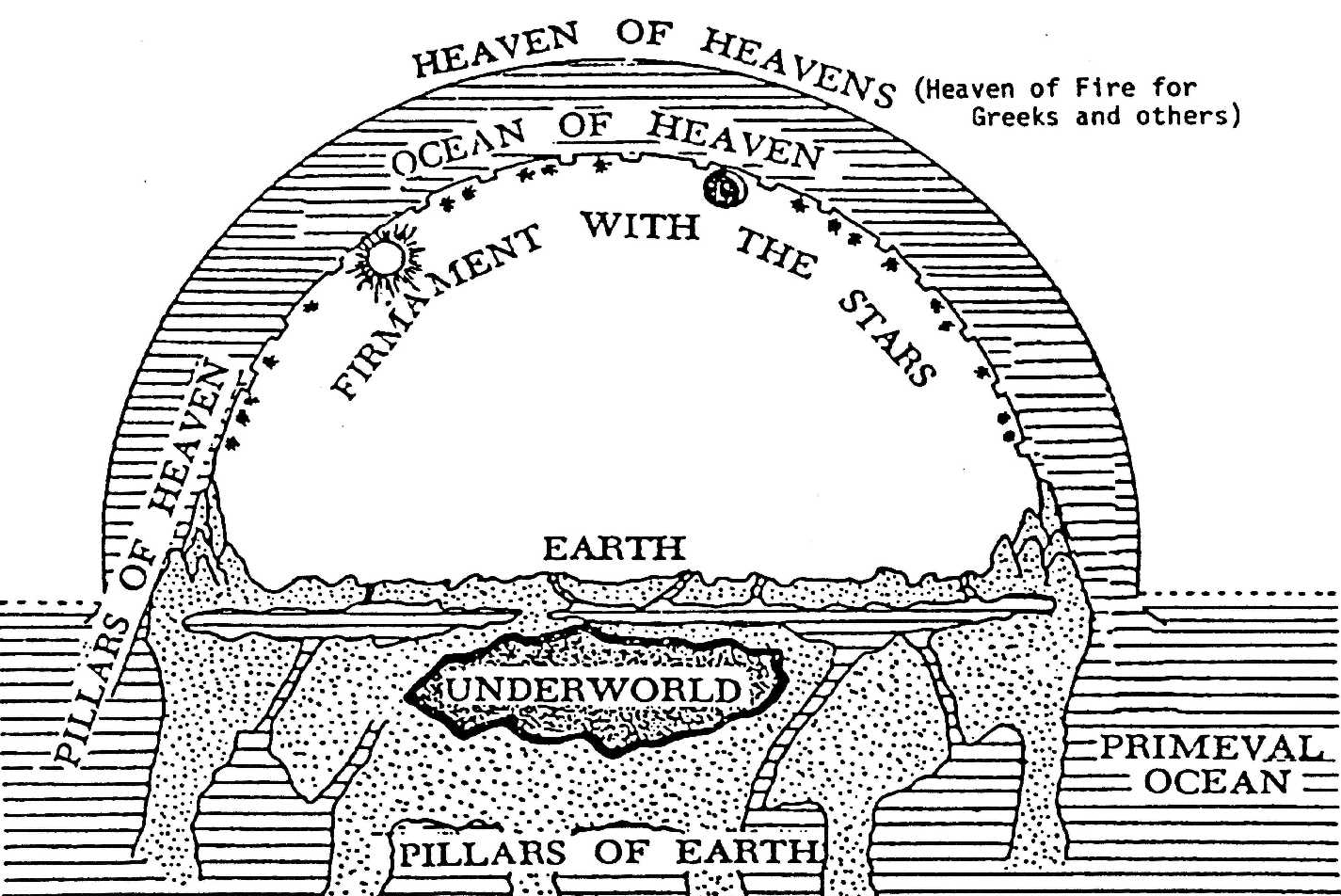
Podcast 18 considers the perceptions of the world of the dead, according to Ancient Near Eastern sources. Specifically the question addressed is can the dead return from the underworld, based initially on the story of Samuel’s return from the dead in the Bible — this leads to a description of the underworld based on ancient sources. The Zoroastrian connection is encountered in the development of the realms of heaven and hell.


Im in ur blogz

Translation. The Bible as we know it would not exist without translation. Ours is a culture of convenience — Americans want divine revelation dished out in easy-to-swallow portions in their own tongue. Going through the rigors of learning new alphabets and grammatical systems, not to mention the eerie specter of textual apparatus, are enough to frighten off all but the most stalwart of truth-seekers. This is a good thing. We would never advance as a culture if we all had to spend our time learning actually to read our religious texts as they were written, only to find out that we have no original texts at all. So we trust our translators.

A few weeks back I posted an entry on Andrew Schlafly’s misguided (imho) Conservative Bible, devoid of liberal bias. Since then Stephen Colbert’s interview with Schlafly has been making its rounds on the internet and thousands of people are now aware of the project and its biases. I stand by my original objection that biased translations are unfair representations of the actual ancient texts. But it looks now like I’ll have to be eating crow. A new translation is scheduled to arrive in stores next month, and it looks like it may have a bias. Still, it is a translation that no internet-savvy reader can afford to ignore. Yes, the Lolcat Bible is nearly ready to pounce from the press.

The culmination of the Lolcat Bible Translation Project, over two years in the making, a Bible in Lolspeak will soon be available. Comparing what I’ve seen of the two projects, I think there is more truth in the Lolcat Bible than in the Conservative Bible. I’ve studied more ancient languages than any sane person rightfully should, but I do rely on my able research assistant (aka daughter) to help read Lolspeak. She suggested the title for this post, but the full text reads, “Im in ur blogz, postin mah wurdz of wizdum.” That’s straight from the mouth of Ceiling Cat!


A Walk Around the Watchtower

The Jehovah’s Witnesses stopped by yesterday. I never pretend not to be home, and when I’m less stressed out I like to engage them in terms of biblical exegesis — religion is all about conflict. Yesterday I was still recovering from the disappointment of not getting a job I really wanted, so I simply answered their questions and accepted their Watchtower magazine. Thumbing through it, I ran into some hermeneutical obstacles — an occupational hazard for those of us who’ve spent a little too much time with the Bible, I suppose. A story about Joshua informed me that “Jehovah wants you to succeed.” It tasted a little too much like prosperity gospel and not much like life in the present. So I flipped a few more pages.

An article on Lunar New Year (Chinese New Year, as it is traditionally called), warned against Christians celebrating it, in part because of ancestor veneration. The Watchtower declares, “the Bible show that the ‘ghosts’ and deceased ‘spirits’ are really wicked spirit creatures pretending to be the deceased. For what purpose? To mislead people and bring them under their evil control!” Now, I admit to being drawn into the Ghost Hunter fan-base, but I do recall the story of Saul summoning Samuel from the dead. The Bible doesn’t indicate that he’s evil; in fact, it is Samuel himself! If ghosts want to deceive then they need to show up a little more clearly and give more direct messages.

I then learned about King David’s remarkable musical prowess in the story about music in the Bible. It is truly amazing what can be extrapolated from a literal reading of the Psalms. The magazine informs us that King Sennacherib, emperor of Assyria, demanded male and female musicians from Hezekiah. “It seems that they were first-class performers.” This seemed a little too much like the stereotype of Jewish entertainers, and since it was extra-biblical I couldn’t accept it. The story concludes by indicating that music is not a human invention. “The Bible describes music and singing in the heavens themselves, where spirit creatures play figurative harps and sing praises around Jehovah’s throne.” As I pondered what a figurative harp would sound like, I could swear I heard the sound of one hand clapping.

Being that time of year, the issue has an Epiphany story. Well, most Christians associate the wise men with Christmas, so I’ll call it a Christmas story. Eager to be honest, the author notes that the wise men were really foreign astrologers. And although they were into witchcraft, the angel announced Jesus’ birth to them to lead them away from this abhorrent practice. Then a divine revelation came to them in a dream in order that they could avoid Herod and his wicked plan. So the astrology that led them to Jesus was bad, but the end result was good.

When the Jehovah’s Witnesses ask me if I know about the Bible, I look at my feet and kick at an invisible speck of mud on the floor as I admit that I have taught Bible for nearly twenty years. But when they ask what I believe about the Bible I tell them the same thing I tell my students — what I believe is personal and I choose not to share it. I don’t begrudge any person of their religion. I even share the Jehovah Witnesses’ hope that the future may be brighter than the present. If you want to convert a religion professor, even an adjunct one, however, it will take more than a Watchtower to do it.


Moses and the Calf

It seems that Moses just can’t get away from that calf. Last week in a manger in rural Connecticut a calf was born. The calf is brown rather than golden, but it bears a distinctly cross-shaped white marking on its forehead. The owner suspects it might be a divine message, but he’s not sure what the message is. The children of the area named the calf Moses.

Does this all fall into the category of coincidence? Or is it indeed a long-awaited sign from on high? It does fall a bit on the C.E. side of the long-expected red heifer, but it looks like it just gamboled out of a bovine White Ash Wednesday service. And it was born in December! In a manger! (Or at least the present-day equivalent of one.) He bears the name of the arch-nemesis of venerated calves — Moses, the solemn monotheist. Even the chair of the Dairy Sciences Department at the University of Wisconsin-Madison declares the Catholic birthmark to be unique.

All in all, I think the farmer got it right. If divine messages come in the form of calves, we’ve got a serious mixed-signal problem down here. The greatest crime, according the book of Kings, that the Northern Kingdom of Israel perpetrated was the erecting of a set of golden calves. And the sign we get is a denominationally confused calf? Perhaps the appropriate question at this juncture would be, “how now, brown cow?”

Photo credit: Aaron Flaum, Associated Press


Be Kind to Your Canaanites

You can never find a Canaanite when you need one. This has been the bane of scholars of the Ancient Near East for many years. While teaching my class on Ancient Near Eastern Religions the question frequently arises: who are the Canaanites? Problem is, nobody really knows.

The Canaanites have prominence in the ancient world due to the Bible. The people already occupying the land that would one day become Israel are called Canaanites. They appear to have been culturally contiguous with Aramaeans in what is now Syria, the Phoenicians in what is now Lebanon, and even with the Israelites. While there are references to the Canaanites in antiquity, we have yet to discover a people who call themselves Canaanites (unless the Phoenician inscription from Brazil is legitimate!). Canaanite, at this point in time, is only attested as a name used for somebody else. “They are Canaanites,” not “we are Canaanites.”

An Egyptian version of a Canaanite

In this we have a useful paradigm. Today religions continue the “us versus them” mentality. In the Hebrew Bible it is often open season on Canaanites since they worship other gods. Today this fear and distrust continues with members of some religions declaring war on those in other traditions. Sometimes it is even within a single religion: Catholic versus Protestant, Baptist versus Catholic, or everyone versus Unitarians.

Religion is, however, always taken on faith. No technique exists to determine, empirically, which is the “true religion” or whether they are all paths up the same mountain. Religions are not fact, they are belief. And religions evolve. It would be the greatest evolutionary leap forward for religions to accept each other, to do away with the ersatz Canaanites. Not that Canaanites should be decimated or eradicated, but they should be accepted for who they are. Who are the Canaanites? They are anyone who practices a religion different from your own.


Billion Dollar Babies

Yesterday I attended a holiday-themed concert. It was an unusual mix of the archaic and post-modern in that although many traditional holiday pieces were sung, the readings were from an assortment of writers, some still living. The theme, not surprisingly, was the wonder of birth. One of the readings was from D. H. Lawrence, a writer more often associated on the making of babies end of the equation. Nevertheless, as the soporific music flowed I found myself once again thinking of special babies.

The concept of a special child marked at birth has an ancient pedigree. Long before Samuel, Samson, and Moses there were ancient heroes known from their unusual births. The theme is at least as old as Sargon of Akkad, and probably even older. Those who grow to achieve great things in life must, by back-formation, have had a wonderful birth. Of course, when they were born nobody knew they were special yet, and so our mythopoeia demands we devise incredible births for them. Anyone who is a parent knows that time stops and the entire world stands in rapt silence as your own child is born. All babies are billion-dollar babies.

The subtext to all of this is that without even looking for a special child we should realize that all people have inherent value. If religions truly taught that message there would be a lot less religious violence in the world and the dreams of many more infant dreamers might be attained. Perhaps all religions should take the stories of their own origins more to heart and hear them more often than once a year.


Algernon Sydney v. Estelle Walker

A headline in yesterday’s paper read “Mom expected God to provide food, daughter testifies,” regarding a New Jersey court case on child endangerment. Back in 2006 an unemployed mother decided, based on what her religion dictated, that God would sustain her family. Her children nearly starved to death after eleven days without food. In a society where those who take their religion literally like to wear it on their sleeves, and politicians receive excessive adulation for their piety, this case is a splash of ice-water honesty. Reality is, people starve to death. Many of them children, many of them religious.

The non-biblical adage “God helps those who help themselves” can properly be traced to Algernon Sydney, a seventeenth-century British philosopher. Quite apart from this noteworthy comment, Sydney was also aware that taking the verses of the Bible out of context you could prove just about anything. He famously wrote, “If you take the scripture to pieces you will make all the penmen of the scripture blasphemous; you may accuse David of saying there is no God and of the Apostles that they were drunk.” Found guilty of treason for his own words taken out of context, Sydney was sentenced to death. Today many people believe his words are biblical.

God help the man who speaks the truth

Perhaps the reality is that people do not want to own up to responsible religion. Believing that God dabbles almighty fingers into the realms of physics, biology, and chemistry every day, violating the laws of nature, they suppose that our little planet is the focal point of a grand cosmic scheme. Meanwhile, a glance at the paper reveals evil perpetrated in the name of God, and a glance at history reveals sensible thinkers facing the gallows.


Live and Let Love

The vote on homosexual marriage comes up in New Jersey today, and headlines are tense with anticipation. The New Jersey Star-Ledger’s assonant alliteration announces “Same-sex showdown” on page one. Protesters for and against are both shown in photo-ops as the sides line up for this epic battle of morality. Or is it?

“Same-sex” is a phrase I find offensive. One of the uncontested realities of life is that gender is much more complex than is usually supposed. Intersexual individuals (sometimes still called hermaphrodites) make up a larger part of the population than most citizens are consciously aware; studies suggest that in the United States the number may range from 50,000 to 5,000,000. Worldwide the number is likely higher. If the big guy in the sky wants to make gender straight and clear, we are receiving mixed messages.

If we are honest about this, we need to admit that what is on the docket is not morality but power. Apart from a few purists who have no choice on what to say in the matter, people are now widely aware that sex is not just for procreation. Studies of animal populations demonstrate this, and any number of people who use birth control, for whatever reason, also know it. Once sex is released from its procreation-only bounds, then where is the moral qualm within committed, loving relationships? The Bible says much, much more about adultery than it does about homosexuality (but don’t tell that to televangelists or Republican elected officials). Both are eligible for the death penalty.

One of the groups shown protesting in the paper is Torah Jews for Morality. They hold a sign reading, “Gay Union A Rebellion Against the Almighty.” One wonders what they are afraid of. The Torah is only binding on those who adhere to Judaism, no matter what Christian groups say. This is one point on which Paul and Jesus actually agree.

If we follow logic rather than emotion on this issue it is clear that all that is preserved by refusing marriage to homosexual couples is the privileged status of heterosexual couples, whether they engage in adultery or not. Society turns a blind eye to infidelity while going ballistic over committed homosexual union. So pick that gnat out of your teeth and get ready for swallowing a camel.


Towers of Babel

Yesterday I ran across a graphic on the Awilum blog that juxtaposed the tower of Babel with the Burj Dubai, the world’s tallest structure, to be completed next month. Perhaps it is a “guy thing,” but I can’t stop being fascinated by very tall buildings. An inveterate acrophobe, I avoided New York City until I was in my twenties and I was gritting my teeth the entire visit the first time I went to the top of the Empire State Building. Although they frighten me, I can not keep away from them. Driving through Chicago while living in the Midwest, I always kept a wary eye on the Sears Tower, lest it should fall my way. When the Society of Biblical Literature met in Toronto, I braved the CN Tower and even stood on one of the thick glass plates that give a bird’s eye view of the ground far, far below. Now there is an even taller building that fully deserves the name “sky-scraper.” At 818 meters, the Burj Dubai in the United Arab Emirates soars far beyond other efforts at the ultimate masculinity. It will be nearly twice as high as the Empire State Building when it is completed.

Gnu view from Wikipedia

Joseph Campbell, the late mythographer from Sarah Lawrence College, has had an enormous impact on the study of myth. As a specialist in Ugaritic mythology I find many points of disagreement with his assessment of mythic symbiosis, yet he once said something that has stayed with me ever since. In his Power of Myth video, he states that societies show their values by their tallest buildings. This statement is perfectly justifiable — the amount of resources required to erect enormous buildings does show a dedication to a quasi-divine purpose on the part of a society. Campbell’s example was the medieval cathedrals, and for anyone who has visited a medieval town this is easily affirmed. (St. Vitas Cathedral in Prague and St. Andrews Cathedral in Scotland confirmed this for me.)

The Hebrew Bible, however, casts another view on tall structures. Buildings such as the Tower of Babel are the ultimate in a Judaic assessment of hubris. Genesis 11 makes short work of Babel, stating that God has to stoop down to see this great effort, yet he feels threatened by it nevertheless. Our towers today demonstrate our conspicuous consumption, yet I can’t help but be impressed. Where some see only shifting sand atop endless pools of petroleum, other visionaries see the tallest structure on the planet. Just thinking about it, I find myself clenching again. I don’t plan a visit there anytime soon, but it is in the neighborhood of Babel, for those who speak the language.


Highway Homiletics

“Over the river and through the woods to grandmother’s house we go,” is an assertion to be taken literally in my case. Crossing the Delaware River and trekking through the forests of Pennsylvania are the only means to reach my childhood home from New Jersey. Each time I make the trip I am amazed at how strident the highway preaching along the way has become. Signs on both the interstates and the backroads announce the truths of a certain vociferous brand of Christianity that maintains that everyone must think that way or spend an eternity in hell. Having experienced this kind of fear-driven faith firsthand, I can’t protest too much without being labeled a hypocrite, but some of what I observed over the river and through the woods leapt out at me anew this Thanksgiving.

Firstly it seems that Jesus saves big rocks. Several large, obtrusive boulders worthy of the land time forgot bear the message that Jesus Saves. Locally this form of homiletics can be as persistent as the Trust Jesus notes spray-painted on just about every interstate overpass between here and Illinois. A religiously aware lumber company in rural Pennsylvania hosts a sign declaring, “Read, Heed, Live & Obey the Bible!” When I think of lumber, I think of 2-by-4s and of their standard use of knocking sense into others who look at things differently. This sign said more than its owner might have intended. A few miles down the road I read, “Why not try Jesus? If you don’t like Him the Devil will always take you back.” The assumption, naturally, is that anyone reading the sign is already devil’s food.

One of the great things about freedom of religion and freedom of expression is that such messages declare their writers’ fervent beliefs, but they hold no force beyond the rhetorical. Having met many sincere believers in other faiths over the years, I do wonder what kind of good news such non-negotiable advertisements really send. Some of the writers, I believe, are railing against the godless world they see around them (although the number of churches along these backroads would seem to testify to religion a-plenty) while others can’t accept any form of any religion that differs from their own, even if it be a different flavor of Christianity. Perhaps it is time I put up a sign advocating a vegetarian version of Thanksgiving — no turkey need die for anyone’s sins. In some religions such a message is considered trustworthy indeed.


On Faithful Monsters

From the moment I saw Stephen Asma’s On Monsters summarized in the Chronicle of Higher Education, I knew I had to read it. Having been fascinated by monsters as a child, and then having grown out of that fascination, this book is a respectable way to indulge my juvenile interests while learning something. The book’s subtitle, An Unnatural History of Our Worst Fears, reveals perhaps why I was so compelled by this particular volume. Those of you who follow this blog know that I contend that religion and fear are very closely related, well nigh inseparable even. As Asma delves into the origins of our monsters, he pauses for a while on the Bible.

The Bible hosts its share of monsters. From lengthy descriptions of Leviathan and Behemoth to tantalizingly creepy references to Azazel and the night hag, the writers of holy writ were as aware of monsters as we are. Asma focuses on the fantastic beasts described in the apocalyptic material, Daniel and Revelation. Obviously not intended to be taken literally, the descriptions of these fantastical beasts represent various ancient empires that threatened the early Jews and Christians respectively. Their monstrosity rests in their intent to destroy, not their hideous physical form. To quote from our host, “monsters are not creatures of natural history but symbolic warnings of a horrifying life without the Abrahamic God (or, in the case of Christians, without his son).”

The ancient fascination with monsters very likely has religious roots. These beings appear to stand outside the rationally created order and lurk in places where the divine is not. The fear they engender leads to the very religion that shuns them. Vampires fear a crucifix, demons are banished at the name of Jesus, and even the headless horseman shuns a church. People run to their faith to protect them from monsters, and monsters, in their turn, provided early believers with a rationale for their faith.