Yankee Doodle

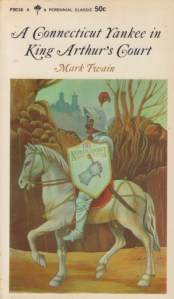
Some books stay with you in a way that hits very close to the nerve.  Since I read Mark Twain’s A Connecticut Yankee in King Arthur’s Court many years ago, memories of how it left me feeling prevented me from re-reading it.  That’s pretty unusual for Twain, in my experience.  I’ve read some of his other novels and there’s not a similar feeling toward them.  The racist elements are disturbing, but overall the stories manage to overcome some of the darkness with either levity or sarcasm.  The scenes that scared me off from re-reading Connecticut Yankee were the two episodes in which young women were murdered.  I realize Twain was simply being honest here regarding the cheapness of life in medieval times, but I found both these instances so saddening that I had a difficult time coming back to it.

Now, some two or three decades later the book speaks to me in a new way.  Something else I recently read reminded me of it, and I was struck at just how much Twain’s Arthurian peasants resemble the unthinking crowds of Americans who simply accept what people like Trump say.  One of Hank Morgan’s banes is how the uneducated refuse to question what they’re told.  In many ways this is humorously narrated but a dark undercurrent remains behind.  Twain had clearly supposed that nineteenth-century America had overcome this brainless gullibility.  A century and a half after Twain’s Connecticut Yankee we’ve clearly been involved in retrograde motion.  Twain levels much of the blame on the church.  His choice comments in this regard also still apply.

“I was afraid of a united Church; it makes a mighty power, the mightiest conceivable, and then when it by and by gets into selfish hands, as it is always bound to do, it means death to human liberty and paralysis to human thought.”  So Morgan states in chapter 10, and indeed, in the novel it is the church that largely leads to the downfall of the civilization Morgan had built.  Or again, in chapter 17: “I will say this much for the nobility:  that, tyrannical, murderous, rapacious, and morally rotten as they were, they were deeply and enthusiastically religious.  Nothing could divert them from the regular and faithful performance of the pieties enjoined by the Church.”  Twain couldn’t admit in public,  even in his own nineteenth-century life, what he really thought about organized religion.  It’s pretty plain in his fiction, but disguising fact as fantasy is a tried and true method of getting at the truth.  If I weren’t so sensitive to the human plight, I might read it more often.


Udolpho’s Mysteries

The carousels on Google can provide a great deal of information.  Looking at them, along with trusted lists of gothic novels, it became clear that one of the few classics I’d not read was Ann Radcliffe’s The Mysteries of Udolpho.  It’s been on my shelf for many years, it’s shear bulk staring me down each time I turned in its direction.  Long books are, of course, fine if they keep you going.  Knowing this was published in 1794 (in four volumes) cast some doubt on the narrative earning the sobriquet of “page turner,” and thus it proved not to be.  I’m afraid my disposition meant that the gothicness of the novel (and it’s certainly there) didn’t speak to me as I hoped it might.  There are creepy castles and rumors of hauntings.  Lots of stormy nights and damsels in distress.  Still, it comes across as the problems of the wealthy and that has to be handled well in order to not turn off this poor reader.

Still, a novel of such fame being written by a woman in the eighteenth century is worthy of note.  More than that, Radcliffe was the most successful (in financial terms) professional writer in the decade that produced The Mysteries of Udolpho.  Her literary influence is undisputed.  The novel is, however, excessively long.  Descriptive prose style was common at the time and may seem excessive to modern readers.  This is, however, impressive for an author who never traveled to the regions about which she wrote.

About 600 pages in, in the edition I read, something caught my eye.  Much of the novel consists of descriptions of mountain ranges in France and Italy.  As one party is on its way up one of the inclines, one of the gentlemen mansplains some of the geological features.  Noting that sea shells are found at such elevations, and so far from any body of water, it is noted that this is evidence of the deluge.  What’s so astonishing about this is that even in the twenty-first century that explanation still has currency among biblical literalists.  The novel appeared before Charles Lyell, who would explain the ancient ages of rocks, was even born.  We have centuries of knowledge at our disposal that we still have a tendency to dismiss.  Interestingly, Radcliffe was famous for reviving gothic literature partially by explaining away any supernatural elements.  Of course, accepting standard religious teaching of the day would pretty much have been expected.  And yet the mysteries continue even over two centuries later.


Wooden Translation?

The summer got away from me, as it always seems to, leaving several boxes of things yet to be sorted.  Since these boxes are in the garage where there’s no heat, doing it during winter isn’t really feasible.  Still, I found myself in the garage storage area the other day and quickly tipped open a box or two to remind myself of what might be inside.  One of the treasures I found is actually from my wife’s family memorabilia.  Not exactly a family Bible, it’s a New Testament one of her grandfathers gave one of her grandmothers as a gift.  It’s a red-letter edition, but what makes it unusual is the binding.  It has olive wood covers from Jerusalem.  The front cover is embossed with a Jerusalem cross.

Bookbinding has long been an area of personal fascination.  Growing up when and how I did, most of my books are paperbacks.  The paperback was initially one of the responses to shortages introduced by wars.  Since they were cheaper to produce they could be priced down.  I have a few academic paperbacks from the twenties (I can’t make myself acknowledge that 1920 was a century ago) whose paper bindings are literally paper.  I fear to take them off the shelf, given the fragile nature of their bindings.  Prior to that books tended to be “hardbacks.”  A piece of cloth-covered cardboard was the preferred means of protecting the vulnerable leaves inside.  Before that leather was routinely used.  Those were the days when books were properly thought of as an investment.

I often think of how little I will leave behind, at least in terms of items of monetary value.  Books seldom maintain their cover price for long.  As someone who lurks on used book websites, however, I do know that the choice tome of either quirky fiction or nonfiction under-appreciated at the time can easily jump market values with predatory sellers.  Even for a paperback.  I am loath to confess how much I’ve paid for a book I really needed for research that mere public libraries simply can’t access.  (The university library is a place of wonder, and one of the resources I most often miss in having become secular.)  Just this past week I saw a sci-fi book from the sixties I wanted to read priced at over $500 on Amazon (used).  When I went to check on it this morning all copies were gone.  And to think the world considers books a poor investment.  The real key is to be obscure, no matter your binding material.


Religion Prof

Back in 2009, when Sects and Violence in the Ancient World started out, there was a fair bit of interest.  At one point I was listed among the top fifty “biblioblogs.”  Back in those days I got to know James McGrath, the curator of Religion Prof, a great blog now hosted on Patheos.  If you want a finger on the pulse of what’s happening in religious studies, you should read him.  With an energy I can’t conceive, he posts interesting stuff every day, even while being a professor.  And like me, he’s fascinated by religion and pop culture.  He also understands something—links and likes and shares are important.  People in my generation and beyond often don’t think that clicking that little thumbs up will do anything.  It does.  More so, that share button.

I was really pleased when James agreed to do a virtual interview with me about Holy Horror and Nightmares with the Bible.  You can find the interview here—and be sure to recommend and share it.  James has several interesting books of his own.  You should check them out.  The world of religious studies (and dare I claim it, biblical studies) is hardly moribund.  Underfunded, yes.  Socially devalued, certainly.  But alive nonetheless.  James’ blog is proof of that.  My regular readers will know my usual jeremiad about how higher education has been treating religious studies.  You see, I’m an historical thinker.  Where we come from is important.  Higher education began because of religion.  Its origins lie in monastic communities preserving learning—some of it secular—for the good of the world.  Now administrators looking for a department to cut know just where to turn. Shouldn’t we treat our ancestors with a little more respect?

I’m forcefully reminded of the many times analysts have declared that religion would fade away.  The claim has been made multiple times over the centuries.  At the same time scientists studying humankind conclude that religion is good for us, and that we’re naturally inclined to it.  Of course we should cease studying it!  Well, Sects and Violence in the Ancient World has also evolved over the years.  Not all of my posts are about religion anymore.  Most of them touch on it, however, because I’ve studied it my entire life.  Not only did religion make Homo sapiens what they are, it also formed some of us individually in ways so profound that we’ll never escape it.  Some of us even wear it proudly.  Great job with the blog, James, and thanks for the shout out!

Remember the early days?


Monster Guides

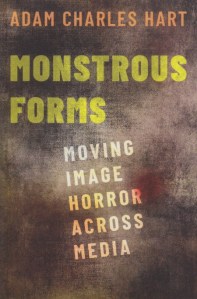
Reluctantly, almost begrudgingly, society seems to be accepting horror as a genre of more than cheap thrills, blood, and gore.  From childhood I was drawn to the gateway figure of vampires, but I’ve never been a fan of blood and gore, and not even cheap thrills.  You see, I saw something profound in horror.  A longing.  Experts might call it abjection, but to me there was a spiritual component to it, and I watch these kinds of movies to capture those moments of transcendence.  Adam Charles Hart seems to be aware of the draw horror has.  Monstrous Forms: Moving Image Horror across Media still shows its origins as a dissertation, but it has an appreciation for horror that doesn’t feel the need to make excuses for it.  Exploring the body-focus of horror, it delves into television, gaming, and other applications of the genre.

I have to admit that I don’t understand the cultural fascination with what we used to call video games.  I know they’re tremendously popular and the rights for gaming bring in even more royalties than sold movie rights do.  I just don’t get it.  Still, Hart explores how horror has become a very popular element in the gaming community.  Not only that but on the internet many young people like watching videos of other people playing games.  I’m sorry, but I’m just not that meta.  If I want to get lost in other worlds I read a book.  Or watch a movie.  And this is where Hart’s book shines.  His read on horror films is fresh and compelling.

Recently I had a conversation (virtual, of course) with some colleagues about the horror genre.  The topic of horror games came up.  I had to sit that part out.  I commended Hart’s book though.  For me time is too valuable to immerse myself into worlds where options are limited by some programmer’s imagination.  Movies will take a couple hours of your time.  If well done they’ll remain in your head for hours or days, interacting with other thoughts and experiences, and perhaps even inspiring the viewer.  If horror isn’t your thing, I get that.  I do have to say that the genre as grown up, and as Hart points out toward the end of his study, academy recognition of a couple of horror films in 2017 bodes well for the future of a genre that seems more and more applicable every day.  And when horror comes to town we’re going to need some able guides.


Believing Beyond

The closing line “I’ll come back to you—in the sunlight” is all I remembered from this little book.  Perhaps I hadn’t read it all the way through, but likely I did.  An unapologetic fan of science fiction as a kid, I must’ve picked up Beyond Belief at a fairly young age.  Although it’s a Scholastic book, it is appropriate for older readers as well.  I picked it up again because I start to get anxious when I can’t post about a book for a while.  My current reading projects are either very long or somewhat technical, meaning they take time to finish.  I’m running out of my ready stock of shorter books (mostly collections of stories from the time before book prices were hiked up and publishers felt the need to make them thicker so consumers wouldn’t feel so cheated.

I had put off reading this collection edited by Richard J. Hurley because of that one story I remembered.  As a kid I recognized the name of Isaac Asimov, but probably not that of Theodore Sturgeon, Richard Willey, or Richard Matheson.  These stories were masterpieces of sci-fi in its golden era.  Although they seem antiquated—perhaps even quaint—now, they are the kinds of stories that inspired young pioneers of space travel and may have contributed in some measure to this strange world in which we live.”Phoenix” by Clark Ashton Smith, has stayed with me for decades.  This tiny tome is old enough that I’m not going to worry about spoilers.  I’m only grasping for an emotional thread with childhood.

The sun has gone out.  Two young lovers talk on the eve of the earth mission to reignite the sun by a series of thermonuclear reactions.  The male, of course, is on the mission, but he assures his love that he will return to her in the sunshine.  Something goes wrong, of course.  The ship crashes into the sun, reigniting it, but annihilating the ship and crew.  As the future lady looks out on the newly illuminated world, she knows her love cannot have survived, yet he has returned to her in the sunlight.  That powerful story of self-sacrifice and love left unfulfilled stung my young psyche.  So much so that reading the other seven stories in this book was like reading tales I’d never heard before.  Beyond Belief was a quick read interjected in much more  complicated literary endeavors.  Like childhood, it didn’t fail to bring a warm glow after far too many years.


New Twilight

The strange thing about The Twilight Zone is its ability to endure in the minds of those exposed to it at an early age.  Often it’s more the image of it, that feeling of awe and wonder, that remains with me.  Rod Serling cut a sophisticated figure with what, for the time, was an unbounded imagination.  New Stories from the Twilight Zone was the last of the three standard collections of his tales.  Another book of stories published the same year, From the Twilight Zone, is a little difficult to pin down from online descriptions.  It’ll probably be the subject of a future nostalgia-laden post.  Reading the current collection is like déjà vu; some of the stories I remember from seeing on television, and others I’d probably read before.

In some ways these stories are time machines.  A slice of the early sixties.  The cover of my edition emphasizes that dramatically with Serling’s head hinged open and colorful ideas (“weirdies” in the copy) flying out.  Over half a century later the Zone continues to fascinate, despite the obvious context in which Serling originally wrote.  The enduring nature of his contribution somehow validates me, and probably many other kids of the sixties too.  The stories all suggest that the world isn’t quite what it seems.  It relates to what I posted on a couple days back, the weird, the eerie.  In other words, these are good stories.  Timeless in their own way.  Reaching back toward childhood, they help with the aging process.  

Weird tales have become a popular genre, and I suspect the popularity is due largely to the internet.  Those of us who liked stories such as these were an earlier generation of nerds (of the non-technical variety), those who didn’t find sports or girls or controlled substances—the more mainstream forms of diversion—to our liking.  We were perhaps misfits, but we knew we could well find a place in The Twilight Zone.  This may have been its great, subliminal draw; anyone could find her or himself in the Zone.  Some of the narratives were scary, some were funny.  Others were just odd (“weirdies”).  But they could sell books and Serling was able to make himself a household name through his imagination.  The internet has, in turn, made it more difficult to get noticed in its democracy of expression.  Indeed, it has become a twilight zone of its own.  At least it’s one where it’s a simple matter to still find the books that made us who we are.


Eerie Weird

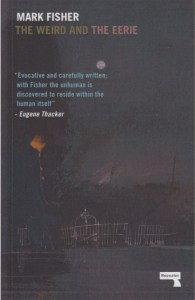
We each approach the world from a unique angle.  It’s bewildering if you stop and think about it—billions of individuals (more by orders of magnitude if we add animals) looking at the world like no-one else.  Given the numbers it’s no mystery that some individuals will share fascinations, and I was glad to learn of Mark Fisher’s book The Weird and the Eerie, since it tries to capture the essence of these two terms that characterize so much of my reading.  The introduction explores what these words might mean in regard to Freud’s unheimlich, a term with which many writers are familiar.  What makes many stories interesting is their unusualness.  Fisher considers what it means to be inside or outside, and these categories often play into our perceptions of the weird and the eerie.

The study is divided into two sections (weird and eerie) and explores these concepts through a variety of media—literature, film, and popular music, especially.  Here’s where the unique angle comes in.  While I’ve read quite a bit of “weird fiction” and certainly eerie tales, Fisher has a different spectrum of materials than I do.  We share some resources, of course, such as H. P. Lovecraft, but The Weird and the Eerie gave me a new set of books to read and movies to watch.  Or read and watch in new ways.  Fisher’s reading of these various sources is sharp and perceptive, and he has a wealth of experience on which to draw.  The intertextuality here is rich.

When I think of reading for leisure or pleasure, it occurs to me that without something unusual happening in a tale, I have little with which to gain a grip.  The unheimlich makes for compelling reading.  Fisher sheds considerable light on this—what is it that we mean by saying something is weird or eerie?  It’s not that we should avoid them.  Humans are innately curious creatures, and we’re drawn to the strange in a way that we can seldom help.  Learning to avoid the weird and eerie means missing out on opportunities to learn.  And stories that we might tell to reflect our individual experience of the world.  This brief book contains more than first appears from a cursory glance.  There’s depth here, and for those of us individuals drawn to these aspects of both human and literary expression, much to mine.  The Weird and the Eerie is a flashlight for going into areas sometimes considered dark and learning much along the way. 


Timely Terror

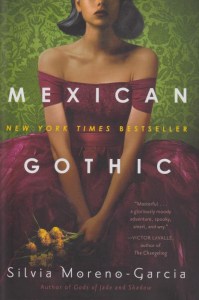
Fear comes in many colors.  Silvia Moreno-Garcia’s Mexican Gothic was getting such positive press that I didn’t wait for the paperback.  At first the title threw me a bit, but creepy old houses can be found in many places around the world, and the gothic often lurks in such structures.  The story builds slowly until the supernatural begins to seep in steadily and the reader realizes they’ve been hooked along the way.  In some ways it reminded me of Jeff VanderMeer’s Annihilation, but the setting in Mexico gives Moreno-Garcia’s tale its own kind of zest.  Having a strong hispanic, female protagonist is a nice corrective to the political rhetoric we’ve been fed for the past four years.  As I said, fear comes in many colors.

Perhaps I’m not as afraid as I used to be when I read fiction.  Gothic, however, is all about setting the right mood.  It’s a creepy sensation that boundaries are being crossed and such things often take place in isolated locations.  The house owned by the Doyles—not exactly colonialists, but symbols are seldom exact matches—is marked by greed and power.  A kind of rot is everywhere evident, but the family must keep power within its own circle.  The parallels to a Trumpian outlook were perhaps not intentional, but national trauma can make you see things in a different way.  As Noemí attempts to rescue her cousin from the house, High Place itself participates in thwarting their escape.

Reflection after reading draws out some further insights.  Not only is the white Doyle family the  oppressive element here, they do so by religion.  Secret rituals and practices have made the patriarch a god—and here let the reader ponder—who builds his power on the oppression of others.  I have no idea if Moreno-Garcia was influenced by the nepotistic White House we’ve just experienced—eager to use political office for overt personal gain, and yes, worship—but she’s laid bare the ugly truths of white power.  I dislike racializing people, but race was invented by Europeans as a mean of oppression and keeping wealth within the grasp of a few individuals who would be surrounded by an empowered “white” race.  It worked in Nazi Germany and it came close to working officially in the United States that fought to vanquish it just seventy years ago.  Mexican Gothic is a moody book indeed.  It’s also a book, whether intentionally or not, that is an object lesson for our times.


At Sea?

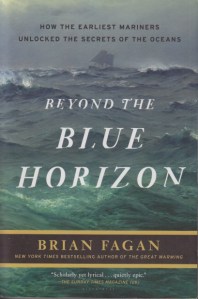
Brian Fagan is a name I’ve long known.  Not exactly the consummate stylist, he is a very prolific archaeologist and anthropologist.  I’ve read a few of his books.  Recently my wife and I read his Beyond the Blue Horizon: How the Earliest Mariners Unlocked the Secrets of the Oceans (you see what I mean about style?).  Divided into different regions of the world, the book explores early boat-craft, sketching how people without our technology navigated oceans, often reaching remote locations.  What interests me is when anthropologists make statements about ancient religions, often before the advent of writing among the peoples studied.  No doubt such peoples realized the dangers of open water—open water is still dangerous with all our tech.  It is reasonable to assume their response was religious.  What exactly it was, we don’t know.

The one that really caught my attention was on the Maya.  Coastal Mayans valued the spondylus, or spiny oyster.  This particular mollusk is seasonally toxic—itself an interesting phenomenon—that becomes a hallucinogen.  Hallucinogens have frequently been associated with religion for indigenous peoples.  If archaeology is to be believed, even temples in ancient Israel burned cannabis, so who’s to judge?  Fagan writes that this practice led to shamanistic trances, and this seems likely.  He goes on to suggest that the spondylus was thus a gateway to the supernatural world.  Of course, in the biblical world shellfish were a forbidden food.

While Fagan likes to reminisce about his own past sailing, and likes to describe boats in detail, and show off his nautical language skills, I think about the religious aspect of the great waters.  We still have only a small understanding of the oceans that cover most of our planet.  We can fly over them these days, and miss the intensity of being where no land is in sight.  It can be a transcendent experience, I’m sure.  I’ve seldom been that far from land.  On a ship bound for the Orkney Islands from John O’Groats we were on the North Sea beyond the sight of shore, if I remember correctly.  Although I can’t recall how long the voyage took, I can imagine the feeling of nerves aching for a sight of coastline.  Even with minke whales off the starboard bow, I knew my feet belonged on terra firma.  It’s more comfortable to read about the gods of the ocean in books like Beyond the Blue Horizon.  And when I’m out to sea, I always pray the mariners know what they’re doing.  


Trade Wars?

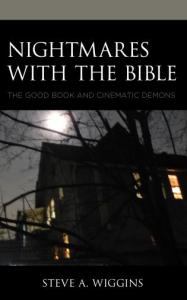
A few friends are suffering sticker shock at the cost of Nightmares with the Bible.  I offer my sincere apologies.  To those in the normal world (outside academia) such pricing appears predatory.  It is, but you’re not the intended prey.  One of the pillars upon which capitalism rests is “what the market will bear.”  You price up any product until people stop buying it, then you retreat.  I’m no fan of the dismal science, but I am certainly not in the cheering section for capitalism.  Institutionalized greed.  Still, I can explain a little of why Nightmares comes with such a high price tag.  Publishers have long indulged in “library pricing.”  Although many libraries now buy ebooks instead, the model persists.  The idea is that libraries can afford higher prices than mere mortals.  For those of you not in academia, $100 is actually on the low end.  Believe it or not.

In researching Nightmares I saw monographs I coveted.  Some of them priced at $175.  Considering that some of these were under 200 pages, my primitive math sets the rate at about 87 cents per page (single-sided).  Here’s where the disconnect comes in.  Nightmares was written for general readers.  I long ago gave up the idea that to be intelligent a book must be impenetrable.  And academics wonder why people question their utility?  Only after I signed the contract did I learn that the Horror and Scripture series, of which Nightmares is the second volume, would suffer “library pricing.”  There is a discount code for those who may not be libraries.  But please, have your library buy a copy.  That’ll give me fuel for a paperback argument.

In a “catch-22” scenario, it goes like this: a publisher tells an author, “if your book sells well enough at this price we’ll issue a paperback.”  The truth is your hardcover only sells well if you’re well known or if your choice of topic is truly compelling.  If the unit cost were actually the same as the library pricing I’d be a rich man.  Where does all that money go?  It’s a legitimate question.  It’s not royalties!  Academic publishing is an expensive business to run.  Apart from overheads—there are always overheads—you need to pay tech companies to ready your files so they can be printed.  Unless the print run (generally under 200 now) is intended to sell out you’ll have it done domestically so that you don’t have to pay warehousing costs on unsold stock.  I knew a single-man academic publisher who stored his stock in his basement.  Excuses aside, my apologies that Nightmares costs so much.  I’ll send the discount code to anyone who’d like it.


Arrival

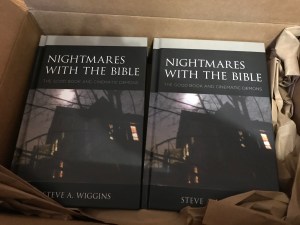
Excitement that comes during the work week gets sublimated.  Work, you see, is like a huge ship chugging ahead at about 30 knots.  It takes some time to stop, or even change direction.  So on Thursday, while I was still at my desk, Nightmares with the Bible arrived.  Since all work—even salaried—is measured by the clock by HR,  I couldn’t take off time to enjoy the birth.  I opened the box, cursorily flipped through a copy, and got back to the task for which I’m paid.  After work it’s time for supper and I can’t stay awake much beyond seven or eight, which meant I neglected my baby.  Friday was another work day, and although I wanted to do all the things marketers tell you to do, I had other duties.

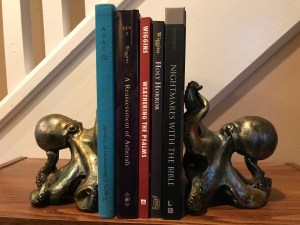
So now it’s Saturday and I can officially say Nightmares have been released.  I have a discount code flyer, about which nobody has yet emailed me, but the offer still stands.  You can get a discounted (but still expensive) copy by following the instructions below.  Feel free to share with your rich friends.  Better yet, have your library order a copy.  I’m hoping for a paperback on this one, but that’ll be a couple years and I know paperbacks seldom outsell hardcovers, even expensive ones.  Raising a child can be a costly venture, no?  Adding another book meant that my display copies had to move out of their cubby-hole onto a bookshelf.  Hopefully, if things go well, there will be more siblings.  Perhaps better priced.

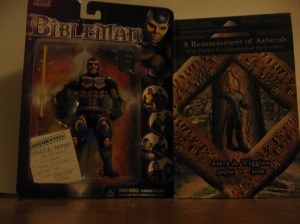
A Reassessment of Asherah was published by a European academic press and put at the incredibly high price of $78 back in 1993.  Gorgias Press reissued it, with additional material, but made it even more expensive.  I can’t even afford to buy a copy.  Weathering the Psalms was only $22, but wasn’t a gripping topic for many.  Cascade Books, at least, know how to price things.  Holy Horror, at the shockingly high $45 for a paperback (McFarland), languished.  It missed its Halloween release and no reviews have appeared.  “Nightmares” might well capture my sense of the price for my second missed Halloween release.  There are other books in the works.  If any of them get completed I’ll be seeking an agent to try to bring the prices down.  Until then, Nightmares will be the final word.  It’s out there now, for those brave enough to engage with it.


Raven Wisdom

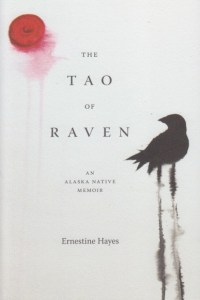
Just twenty pages in and I was reflecting on how Christianities and the cultures they cultivated have caused so much suffering in the world.  Assuming there is only one way to be, and that way is pink, European, and monotheistic, has led to so many displaced people thrown aside as collateral damage.  Ernestine Hayes’ The Tao of Raven is a remarkable book.  A native Alaskan, Hayes participated in the colonialist venture of higher education to try to also participate in the “American dream.” If this book doesn’t make you feel uncomfortable in your own skin, I don’t know that you’re human.  As I mentioned in a recent post, I have a deep interest and lasting guilt to learn about indigenous peoples of the country where I was born.  About the culture that is so Bible-driven it can’t see the human beneath.  The capitalism that takes no prisoners.

The Tao of Raven is one of the most honest books I’ve ever read.  Hayes refuses to sugar-coat the alcoholism, the broken promises, the poverty offered to native Alaskans.  Even as Trump’s final rages go on, he has opened the Alaskan Wildlife Refuge for drilling, to the highest bidder.  Apart from those whose wealth will increase as a result, we will all suffer.  Those who lived in Alaska before the colonists arrived the most.  The idea of colonizing, without which capitalism just can’t work, reveals its evil here.  When a voice like that of Hayes is able to make itself heard we cannot but feel the condemnation.  When over seventy-million people vote for a hater, we all tremble.

The book ends much as it begins.  A sincere regret for those who’d been fed the contradictory messages of missionaries.  Those told to accept suffering on earth so that they could go to the white person’s Heaven, while those inflicting the suffering lead comfortable lives with modern conveniences.  The double-standards that allow people to die on the street like dogs.  The double-standards that can’t see that you need not be Christian to upend the tables of money-changers.  Indeed, the last time someone dared to such a thing was two millennia ago.  When Christianity slipped its fingers between those of capitalism a monster would surely be born.  The cost would come in human lives, even as a quarter-million lay dead in this country from a virus a rich man can’t be bothered to address.  Do yourself, do the world a favor.  Read this book.  Read it with your eyes open and learn from Raven.


Nightmares Awake!

According to Amazon, Nightmares with the Bible has now been published.  Authors are seldom the first to see copies of their own books, strangely enough.  I probably won’t have any physical copies for a couple of weeks yet.  Until then I’ll wait like an expectant mother.  I don’t actually read my own books after they’re published.  Like some other writers I know, I’m terrified of finding mistakes.  And the older I get the less certain I am about anything.  I’m not even sure if it’s officially published yet or not.  I choose to trust Amazon’s opinion on that.

Right now I’m caught up between four or five other book projects, each a good bit along.  Since writing is often a mood-based thing, what I do in the sleepy hours of pre-dawn is what I feel like writing on any given day.  Unless you have a book contract in hand, that’s not, I suppose, that unusual.  I’m trying to guess what might most get the attention of an agent.  Both Holy Horror and Nightmares with the Bible were written for general readers.  I don’t have the name-recognition to command any kind of attention (or affordable prices), so I need to find a topic that’ll do the work for me.  I personally find religion and horror a fascinating subject.  Many other academics do as well, but general readers not so much.  It’ll feel more like reality when I have a copy I can have and hold.  I still haven’t reconciled myself with ebooks.

What usually makes me stick with a project for the dash toward the finish line is a book getting close enough to see the ribbon ahead.  I write incessantly, so I have a backlog from which to draw.  I know my tastes are odd, which means it’s a challenge to get others onboard with my likes.  I know horror fans love to read about movies.  I suspect most of them don’t care much about the religious aspect of what they’re seeing.  That’s why I write about it.  People get information about religion from popular media.  Even if they deny their interest, writers and directors will slip it in regardless.  I’m just calling them like I see them.  The nice thing about movies is you can have instant replay.  And with a fair number of us now publishing books in this niche, hopefully conversation will follow.  Until then, I’ll just be waiting here until my first copy arrives.


Documented Error

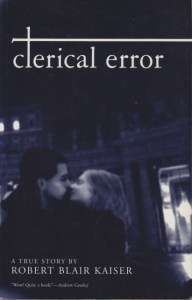
Back in September I wrote a post on documentaries.  One of those I’d watched was Hostage to the Devil, on the life of Malachi Martin.  Curious, I began looking for biographical information, only to find conflicting reports.  Robert Blair Kaiser, a journalist, was interviewed in the documentary and he claims that Martin is not to be trusted.  Given that Martin had academic credentials and academic publications, it’s clear that something is up here.  So I decided to read Kaiser’s Clerical Error.  As an award-winning journalist, Kaiser had written a book on Vatican II that sold fairly well, establishing his own credibility.  Clerical Error is a book, in large part, that was intended to discredit Malachi Martin because Martin had an affair with Kaiser’s wife.  That spices things up a bit.  (And explains the cover photo.)

It’s an odd book, overall.  Kaiser begins by describing how he became a Jesuit.  Autobiographical works are generally most interesting during the early years, and Kaiser does a good job illustrating how he was naive and probably joined the Jesuits out of fear of sexuality.  Some of the disciplines (including self-flagellation) are difficult to reconcile with the twentieth century (when they took place) but demonstrate the command religion can have over life.  Confronting church politics, he decided to become a journalist instead of a priest.  When he was assigned to Vatican II a couple things happen—his book gets lost in the weeds, and, he meets Malachi Martin (spelled Malachy throughout).  At first taken with Martin, the two became friends.  Martin helped him access places in the Vatican that would’ve otherwise been blocked to him, as a layman, even if a former Jesuit.

Then the tale becomes sordid.  According to Kaiser, Martin, still a Jesuit priest, began an affair with his wife.  The final third of the book has the draw of a soap opera as Kaiser tries to confirm what he suspects.  Overworked, he checked into a mental health facility, and this fact gave his detractors the grounds for claiming that Kaiser was mentally unbalanced and that Martin was really as he presented himself—a Jesuit priest, academic, and exorcist.  According to this book, which never made a large splash, the evidence is clear.  And the ability of the church to cover up scandals is legendary.  The most damaging parts, in my purposes for reading the book, are the allegations that Martin was a pathological liar.  (Why do we have so many of these?)  If true, nothing he wrote can really be trusted.  This is the very reason that of late I’ve been obsessed with the idea that lies are a clear sign of the one the Bible calls “the father of lies.”