Price of Learning

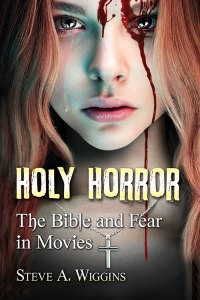
Holy Horror, as some are painfully aware, is priced at $45.  Even those of us in publishing have lessons we must learn, and one of them is that writing a trade book involves more than just a “friendly narrator” style and non-technical language.  It also involves a subject the public finds engaging (or at least what a literary agent thinks the public will find engaging).  Holy Horror throws two apparently disparate topics together: horror films and the Bible.  The fans of each don’t hang out in the same bars—the fans of the latter, in some circles, don’t go anywhere near bars!  My thinking was that this juxtaposition was odd enough to qualify as trade, but I also knew that you have to work your way up to that kind of readership.  That’s why I’m on Goodreads, Twitter, and Facebook (followers and friends welcome!).  It’s not like I’ve got tons of spare time, but platforms must be built.

Book publishers face a dilemma: they have to sell books, but as I’ve noted before, they must do so profitably.  There are people like yours truly who’ll occasionally pay essentially a dollar a page (or at least a two-page spread) for a book that’s essential to their work.  As the capitalists grin, it’s “what the market will bear.”  I never thought of myself as a market.  To me, knowledge is priceless.  The effort that it takes to write a book is truly unimaginable to those who haven’t done it.  Obstacles exist almost from the inception.  Getting the resources you need, unless your employment comes with a free library pass, involves sacrifice.  I still look at other books I must read priced at about $45 and groan—how can I justify the expense?  It’s a strange club to which to belong.

My mother asked about Weathering the Psalms: “Is it the kind of book you get money for?”  In theory, yes.  I’ve yet to see any kind of profit from it since the tax forms you need to file for royalties cost more than the actual checks contain.  At least it’s not vanity publishing.  And you truly learn what it means to rob Peter to pay Paul.  It has nothing to do with gentiles.  Publishing is the price you pay for following your curiosity.  My books are very different from each other, a fact that comes with an invisible price tag that has little to do with money exchanging hands.  Well, maybe it does.  And maybe it does have something to do with gentiles.  Or maybe it’s an appeal to a higher power.  In a capitalist nation we all know what that is; herein lies holy horror.

The Heart of Publishing

My heart goes out to academic authors.  It really does.  They labor over a book important to their field and see it come out costing near triple digits and wonder why it’s not in the local bookstore.  There is, however, a very wide gap between academic and trade publishing.  It is bridged here and there by authors who value readers over reputation, but unless you deliberately try to learn how all of this works, it is bewildering.  Academics, you see, are area specialists by and large.  You don’t write a dissertation on the Bible, for example, but on a specific part of the Bible (New Testament or Hebrew Bible).  And within that section your specialization is not a single book, but often a small part of a book, or a theme.  I’ve seen dissertations written on a single Hebrew word.  Specialization.

With all of this tight focus, it’s easy to forget what browsing in a bookstore’s like.  Even with some of the incredible brick and mortar stores in Edinburgh, technical books had to be ordered—this was before Amazon.  When you check the books of colleagues out of libraries it doesn’t always occur that you do this because libraries are the only places that buy such books.  And with the explosion of doctoral degrees in shrinking areas of studies (there are no jobs here, folks!) the number of published dissertations has skyrocketed.  Even advanced scholars forget the average reading public would find their work impenetrable.  It’s not going to be in the local bookstore, and it costs so much because it sells so few copies.  I do feel for academic authors.

In addition to all the area specialization, it would make sense to research the academic publishing industry.  Yes, it is an industry—it has to try to turn a profit when sales are minimal.  And with so many books being published, libraries can’t keep up.  The end result is high prices.  I’m as guilty as the next academic at wishing economics would just go away and leave me alone.  I want to believe in the pursuit of knowledge for knowledge’s sake.   That’s not the way the world works, however.  At least not the publishing world in a capitalistic context.  The internet itself has become competition.  Much of the information’s out there for free.  So your academic book, when it comes out, will be priced out of your comfort range (been there, done that).  It’s not that your publisher doesn’t believe in you, but that they have to try to turn a profit.  All it takes to understand why is a bit of research.

Not that kind of book.


Digging Bad?

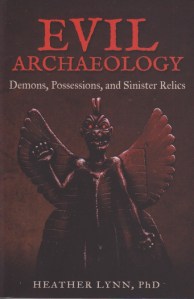
Academics, as a rule, focus on books by other academics.  Theirs is a specialized vocabulary with specific goals (tenure, then an Ivy League position).  It’s easy to see, sometimes, why they distrust books by those of us outside the academy.  We aren’t as constrained, and can say some speculative stuff.  I just finished Evil Archaeology: Demons, Possessions, and Sinister Relics, by Heather Lynn.  Now, most academics I know won’t take seriously a book where the author is cited by “Ph.D.” on the cover.  That’s a sure sign of trying to impress a lay readership.  This book is clearly heartfelt, and personal, but it does raise a host of questions regarding sources and details. I found myself wondering where the author found out so much about Pazuzu when I, who hold a doctorate in ancient West Asian studies, had such trouble locating sources.  Then I checked the bibliography.

Even academics have been known to cut a corner or two, now and then.  For my last book I didn’t have access to a university library so I had to make do with what I could get my hands on.  (JSTOR is not cheap for individuals, in case you’re wondering.  If you teach and you get free access from your library, you don’t know how lucky you are!)  So it is with my present research.  I muddle along, often buying used copies of the books I need, sometimes from eBay.  Researchers can be driven that way.  Lynn’s book covers a lot of territory, and not all of it seems related to demons.  Little of it covers archaeology in any detail.  But then, it’s not intended for academic readers.  I learned a thing or two.  I also distrust a thing or two she claim (having once been in the academy), but there’s no doubt she’s trying to do a service in this book.

Demons cut a wide swath.  Lynn discusses bits and pieces from here and there, and at times her treatment is rather a gallimaufry of anecdotes.  There are interviews, personal experiences, and urban legends.  It does seem hard to believe that scientists worldwide are studying demons in order to explain illnesses, though.  For me, finding a new book on demons just when I was finishing my draft on the same topic, it was imperative to read what she had to say.  It’s clear she’s seen some of the same movies I have.  I like to think that, as an inbetweener I can still read academese as well as regular writing.  You always find interesting things there in the middle.


A Nightmare or Two

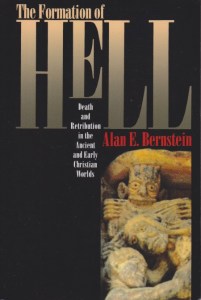
Some books are complex enough to require a slow reading.  Alan E. Bernstein’s The Formation of Hell: Death and Retribution in the Ancient and Early Christian Worlds is such a book.  For those of us raised in a faith primarily geared toward avoiding Hell, the concept becomes a lifelong nightmare.  It doesn’t help that, depending on your clergy you’re taught different, sure-fire ways of achieving that avoidance.  Often it hinges on “believing” the “right” thing.  Fundamentalists tend not to call it “doctrine” since that sounds rather Catholic, but the idea’s the same; it’s a tenet of faith.  As Bernstein shows, however, Hell is an idea that developed over a very long time with several different views of what happens after death.  There’s no single, linear progression, but rather a conglomeration of ideas from a variety of sources.

No single volume can cover all the background to Hell.  Bernstein focuses on Egypt for the early material, as well as Babylonia.  These early civilizations demonstrate that people have always wondered what comes next, and what happens to those who oppress others—the bullies of this life who don’t deserve the same eternal rest as the rest.  Usually some form of punishment awaits, but not always.  In the Hebrew Bible one of the great issues was the fact that everyone goes to Sheol, good and bad alike.  As in classical Greece and Rome (on which Bernstein spends a great number of pages) the concept of the netherworld is gloomy, but not torture.  Except in exceptional cases, of course.  The Greeks had Tartarus as a place for those who dissed the divine.

Even early Christianity didn’t have a uniform view of it.  The New Testament is decidedly divided on the topic.  Revelation seems to be the last word, but it’s not.  Later thinkers such as Origen and Augustine (who came to different conclusions) weighed in.  Catholic Christianity lavished great love on the latter and Augustinian views became disproportionately influential.  Reading his lack of compassion can cause nightmares, although he justifies it theologically.  The one thing I missed in Bernstein’s lengthy treatment was the Zoroastrians.  This religion of ancient Persia introduced a distinct dualism into the biblical world; it perhaps represents the first relatively developed concepts of Hell and Heaven.  Zoroastrianism suffers from lack of documentation, however, and it is difficult to parse it as meticulously as Bernstein does the other cultures covered.  This book requires much pondering as it’s read, and if you were raised believing this kind of thing it’s sure to bring back a nightmare or two.


On Publishing

I fear I may be transitioning.  I may actually be becoming someone who knows something about publishing.  Reading about the merger between Cengage and McGraw Hill actually seemed interesting.  What’s happening to me?  Actually, the largest impact has been the realization that scholars need to become more aware of the world around them.  As a doctoral student I was taught to find an unexplored subject and write obscurely on it.  Then, when it’s time to publish, to say to the editor that general readers will understand and find it compelling.  It took some time, however, even though I frequented Waterstones and Blackwells, to realize that the books they housed were not the kinds of books I’d been taught to write.  Back in America, where the brands were Borders and Barnes and Nobel, the same thing applied.  People want books they can understand.

Two articles that caught my attention recently addressed the plight of the academic monograph.  One was “Worried About the Future of the Monograph? So Are Publishers” from the Chronicle of Higher Education.  The other was “Making Monographs Open” from Inside Higher Ed.  Both share some common themes: scholars write books so obscure that even academic libraries won’t buy them and since it’s “publish or perish” it becomes the publisher’s problem.  Listen, I understand that mentality.  Isolated in the woods of Wisconsin with the wind howling through the trees, writing about weather in the Psalms seemed perfectly natural.  Forgetting that the average reader doesn’t know Hebrew, I assumed everyone would find my disquisition irresistible.  Even back in the early 2000s publishers disagreed.  Life is so interesting!  There are so many minutiae to explore!  If you haven’t had the pleasure of following in the tracks of a thought that won’t let you go, you’ve never been really seduced.  But then, somebody’s got to pay for all this.

Scholars are reluctant to acknowledge that publishing is a business.  Indeed, higher education is now a business as well.  Everything’s a business.  To stay solvent publishers have to sell enough books to cover the cost of making them.  As these articles point out, that cost isn’t negligible.  The scholar who explores the publishing industry (as rare as that may be) will discover plenty of resources to help rethink academic writing.  Even without reading the industry rags, just paying attention when you’re in your neighborhood bookstore can be an eye-opening experience.  I was looking for a book (hardly even academic) last time I was in Ithaca, New York.  If any town is likely to have such books on the shelf, it’s Ithaca.  I had to ask and leave empty-handed.  There are lots of books out there, colleagues!  And if you want to get yours published, it pays to do a little research.  Your time will not be wasted.  And I fear I’m becoming someone who knows a little about such things.


Writing Life

Writers are a conservative lot, in many respects.  Consider the epigraph.  I’ve written about this before—in modern-day publishing epigraphs require permission to reuse and serve little purpose beyond two negotiable factors: to prove the writer is well-read, and that someone else just summed up your chapter in a single sentence.  Most modern books have stopped using epigraphs, but scholars read old books produced before aggressive copyright laws.  There is a trick you can use, however, that brings an epigraph into the realm of the fair use doctrine.  It involves moving it into the body of your chapter.  Make it a quote.  Comment upon it.  For all their research skills, many academics do not take advantage of easily found advice on academic publishing.  Just ask an editor.

We all, I’m sure, have tunnel-vision.  Life is so incredibly busy and demanding that choices have to be made.  For most academics publishing is part of the rubric for tenure.  Perishing is the only other option.  Been there.  Done that.  Those of us who make a more modest living on the other side of the book sometimes write for different reasons.  We may need to supplement our income (as if academic publishing really ever helps with that!), and thus we must pay attention to the finer details of the business.  Write what people want to read.  Think like a reader.  And, yes, get rid of the epigraphs.  We know you’re smart; you’ve written a book.  Another reason for writing beyond the tenure-dome is the compulsion.  The need to do it.

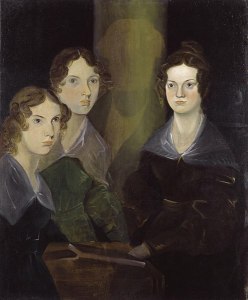
While the struggling artist is a tired trope, it’s also true.  Many of the writers most admired today had lifetimes of struggle and obstacles which often stopped them too soon in life’s tracks.  I often think of the Brontë sisters.  In a family apparently cursed with premature death, living in a time when women writers were rare, three sisters set themselves the task of becoming novelists.  Not one of them lived to forty.  Anne, who wrote The Tenant of Wildfell Hall, made it to twenty-nine.  Emily, author of Wuthering Heights, died at thirty.  Charlotte, who gave the world Jane Eyre, survived to thirty-nine.  They defined, in many ways, the English novel.  And while they lived to see some measure of success in their brief lives, they wrote against the obstacles of life and the specter of early death.  Writing is a passion.  A craft.  And even academic authors provide a favor to the world if they do it well.

Brontë sisters by brother Branwell


Final Stretch

There comes a point, in my experience of book writing, when you can think of nothing else.  This is near the end of the process.  For months and months you’ve been working at it in increments, and the sudden realization hits you that other people are (you hope) going to read what you’ve been scratching out for a couple of years.  My interlocutors tend to be in print or email form.  I don’t work day-to-day with colleagues who know about the book, nor, I suspect, would they care very much.  In my case this comes as I’m trying to generate attention for Holy Horror, with very limited results.  But I don’t have time to think about that now.  Nightmares with the Bible is almost ready to submit.  If only I had more time to read everything.  If only.

Writing is a challenging form of expression.  Let me qualify that: getting writing published is challenging.  The actual craft flows.  The book that is intended to pass scholarly muster, however, must be full of notes and quotes.  I’m trying to leave those behind as much as possible since I’ve been reading about these topics for decades and that ought to count for something.  Still, that nagging doubt awakes you—haven’t you overlooked something?  Some vital source that you should’ve cited?  Some argument that knocks your book off its stilts?  Near the end of the process it’s hard to concentrate on other things such as blog posts and tweets.  Yet you need to build your platform while you’re standing on it.  And then there’s the small matter of work that will demand well over forty of your waking hours this coming week.  And the index—you can’t forget the index!

In the intervening months you might’ve read some newspaper headlines, read some books off-topic, read other people’s blogs, kept up with social media.  Now, however, you have tunnel vision.  You’ve said what you have to say, you think.  You must check it.  And recheck it.  Did you leave a sentence open for later comment?  What chapter was that in?  Have you figured out how to close it?  Woe betide those to whom this happens at tax time.  Or before a business trip.  Making a living as a writer you do not.  This avocation, however, is your life.  Your legacy.  Editors who’ve been remembered are few.  A book is a stab at immortality.  There are meetings.  There are work deadlines.  There’s a lawn to mow.  Those, however, are mere distractions at this point.


Theofantastique Interview

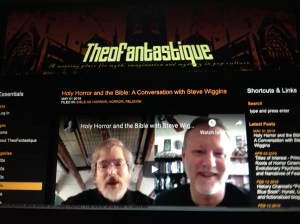
Two times.  In my “professional” life I’ve been interviewed only twice (not counting, of course, far too many job interviews).  The first time was as a talking head for Nashotah House.  This was in the days before the internet really caught on, so it was done in DVD format.  If you come over to visit I’ll dig it out and we can have a good laugh.  The second occasion was much more fun.  Although I write about horror a lot, I don’t mention Theofantastique nearly enough.  Back in the days when I started blogging, I discovered this site that featured all kinds of interesting stuff on religion and horror (and actually on all kinds of genre pop culture).  I always enjoyed the insights and got more than a few books for my own research and reading from tips I found there.

When I finally got brave enough to contact John W. Morehead, the curator of the blog, we both quickly realized we had some things in common.  John very kindly offered to post an interview with me on Theofantastique about Holy Horror.  It’s live now and it was really fun to talk to an actual person about my book.  You see, I work alone.  I knew that, leaving the classroom, I was departing my chosen career.  On those high school aptitude tests they told me that I should be an entertainer.  What professor isn’t?  I pity their students if they’re not.  I’ve been posting videos on YouTube for a few weeks now.  It’s immediately obvious how much having a live audience helps.

Unfortunately, Holy Horror isn’t exactly priced to move.  In fact, local bookstores have turned me down for free presentations based on the price alone.  It is, however, a fun book to read.  At least I intended it that way.  When life give you horror, make Bloody Marys, I guess.  By the way, John has been coming out with some interesting books also.  I posted on his The Paranormal and Popular Culture recently.  Theofantastique is often the place where I first learn of new horror films (I don’t get out much) and new books that I should read.  Of these two things there’s never a shortage—horror is a thriving genre—and talking about why you wrote a book helps to clarify things a bit.  Horror may seem a disreputable genre to many, but it has redeeming values.  To hear about them, please watch the interview.


Myth and Magic

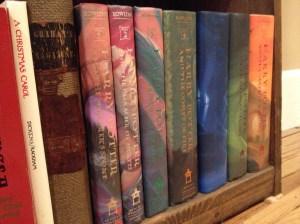
Magic and religion are difficult to tell apart.  Scholars have known this for some time, but don’t often say anything about it for fear of offending.  A few days ago Religion News Service ran a story headlined “How the ‘Harry Potter’ books are replacing the Bible as millennials’ foundational text.”  While many reacted with shock, to me the fact that a foundational text can be identified at all is a relief.  You see, reading is good for you.  Really, really good for you.  One of the most hopeful things I observed as a parent was the increased quality and volume of young adult literature available.  Of course it’s produced to make a profit, but the fact is it showed that reading is alive and thriving.  If the young make a habit of it, well, let’s hope that habit’s hard to kick.

My own reading doesn’t always keep pace with my desire to do more of it.  I go for a couple of weeks sometimes without finishing a book.  I begin to feel depleted.  There’s something spiritual about reading, and fiction can reach parts of your soul that are on guard when non-fiction’s your subject.  And that’s like magic.  It took a couple years for me to catch on to the Harry Potter craze.  Eventually my wife and I broke down and bought book one and read it together.  As millions of readers can attest, that first book was a fishhook.  We all really hope the world does contain some magic.  Many people find that solace met with religion.  Either way, fiction can enhance the experience.  We read the original series, hanging tensely until the final volume came out.

Many of those who believe in a magical religion protested the sale of magical fiction.  We were still in Wisconsin at the time, but we saw the protestors outside a local bookstore the release day for one of the later volumes.  Like Death-Eaters the protestors opposed Harry Potter.  The root of the problem seems to have been unique truth claims.  Whenever a religion declares itself the sole harbinger of “the” truth, every other way of looking at things becomes evil.  Even if it expressly declares itself to be fantasy fiction for young adults.  Years have passed, and Harry Potter, like other forms of pop culture, has grown to the status of a religion.  Even Nones want to believe in something.  Magic and religion are, after all, very difficult to tell apart.


Six Impossible Things

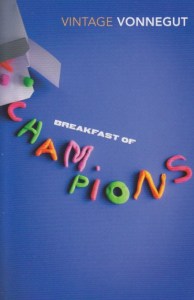
Solipsism, as a philosophy, has its attractions.  The idea behind it is that since all we can truly know is our self, the self is the only being that really exists.  This outlook is expressed in tragicomic form in Kurt Vonnegut’s Breakfast of Champions.  Written in Vonnegut’s characteristic style, there’s confusion and continuity, and almost a mockery of the gullibility of readers.  Kilgore Trout, a penurious science fiction writer, wrote a novel where one character was human amid a planet of robots programmed to act like people.  Dwayne Hoover comes to believe this is true and acts on it, with several other characters ending up in the hospital.  The story ends with the narrator realizing, I think, that he’s the only real human being because he made up this entire novel.

As someone who generally works alone, and whose lifestyle includes early rising and early sleeping, solipsism suggests itself from time to time.  Writers tend to spend quite a bit of time in their own heads, either reading or expressing their own thoughts via their craft.  Anyone who’s been a victim of a solipsist (and we all have) knows that such a viewpoint is wrong, but it does address one of consciousness’ deepest fears—how do we know what others know or experience?  We keep secrets.  We hide our weaknesses and insecurities.  We show others, most of the time, only what we want them to see.  Addressing the individualism of the late sixties and early seventies, Vonnegut takes to task a society that still promotes prejudice and wages war.

Vonnegut experienced war and it’s clear that it haunted him for the remainder of his life.  He tried, and often succeeded, in finding some hilarity in life, but it always seems to stop short with a slap of cruelty.  I’ve been reading quite a few of Vonnegut’s novels over the past few years.  He’s a writer that mixes profundity with frivolousness in such an easy way that it’s beguiling.  Breakfast of Champions is, despite being an easy read, a difficult book.  Quickly finished with its goofy doodles and swift pace, it leaves you feeling as if you’ve been poisoned with an idea, somehow.  Or maybe it’s just me.  For this year’s reading challenge I’ve selected two more of Vonnegut’s novels, but I haven’t decided which ones yet.  I think about asking others, but then I remember that if he’s right in this one, there’s really nobody else to ask.


Vapid

The smoke encircled his head like a thief.  And not in a saintly way.  I was going to have to rethink this.  You see, the culture of the early morning commute is one where you stand in line with strangers before dawn.  Having grown up a victim of second-hand smoke at home, I can’t stand it now.  Should I go wait in the line (which was growing) where the last guy was smoking, or sit in my car?  Work anxiety always wins out in such situations, so off I trudged.  I discovered, however, that the man in front of me wasn’t smoking after all.  He was vaping.  What was this chemical stew hanging in the air that had just come from his mouth?

I worry about second-hand vape.  How desperate must a person be to smoke a device?  You see, my trust in technology goes only so far.  People are slowly beginning to understand that electronics don’t solve every problem.  Vinyl records are starting to come back, even at Barnes and Noble.  Independent bookstores are returning, despite the rise of Kindle.  I’m still waiting for it, but film cameras may once again appear.  There’s something about the Ding an sich.  The tech of the stereo was invented for the analogue record.  Yes, the MP3 is faster and cheaper, and you can buy just the song you want with the click of a virtual button, but we still have our favorite LPs around.  This isn’t misplaced nostalgia, like those who long for the 1950s.  No, this is simply the recognition that faster isn’t always better.  Some things were meant to linger.

Vaping is, however, an example of how a bad habit becomes a vice with no point.  Initially meant to come to the succor of smokers who couldn’t do it indoors, vaping was also quickly relegated to the outside.  Many people, it seems, don’t want to breathe someone else’s smoke.  Do you develop artificial cancer from artificial nicotine?  Another commuter comes up to the guy in front of me.  Like a couple of kids on a 1970s schoolyard, they exchange vape flavors.  The first guy doubles up with a coughing fit.  Spits off the curb.  The second guy says, somewhat anticlimactically, that this one’s strong stuff.  I have to wonder what future generations, if there’ll be any, will think of our love affair with devices.  The bus pulls in.  I’m the only one on the whole thing who clicks on the over seat light.  I have a physical book to read.


Look Out Below

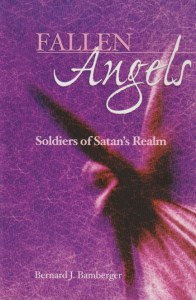
Demons are seldom what you think they are.  Bernard J. Bamberger’s Fallen Angels: Soldiers of Satan’s Realm isn’t so much about demons as it is about, well, fallen angels.  A classic in the field, it was published in 1952 and has been periodically reissued when interest revives.  There are many aspects of this book that deserve development in a place like this blog, but I need to suffice with a few.  I won’t take much of your time, I promise.

First and foremost, Bamberger, who was a prominent rabbi, presents the seldom heard Jewish perspective on the topic.  The Devil really had more explanatory value for Christians than for Jews, and it is no surprise that he appears rather abruptly in the New Testament.  There are, of course, plenty of antecedents for him both in the Hebrew Bible and in Jewish apocrypha and pseudepigrapha, but the idea, and character, grabbed his main hoof-hold in Christianity.  This dualism has periodically been a source of embarrassment, but in general it has served the Christian narrative well.  We seldom see the Jewish outlook on it.

A second noteworthy feature of this book is its wide survey of these ideas in both what is now termed Second Temple Judaism and that of Late Antiquity.  The fallen angels seem to be there in the Good Book, but close reading of the texts suggests other meanings.  Judaism has never felt the compulsion that many Christians feel toward having the one, correct outlook.  Spend a little time with the Talmud and see how dialogical the search for the truth can be.  With no Pope or supreme human authority to declare the rightness of one outlook, the search must remain a process of discussion rather than an ex cathedra pronouncement.

A third, and for now final, observation is the sheer number of characters that pick up the baton of evil in both early Judaism and Christianity.  Even Islam.  A bewildering number of names for lead fallen angels and other demonically sourced characters populate these pages.  Since Judaism tended not to buy the fallen angel narrative, other sources for demons were considered.  Few doubted that they existed in the early days, but whence exactly they came was an open question.  Bamberger explores the options here and, beyond his book many others also exist.  That evil exists in the world seems patently obvious.  Religions of all stripes ask what’s to be done about it.  Some delve into its origin myths.  In the end, however, it is how we choose to respond that matters most. 


No Refuge

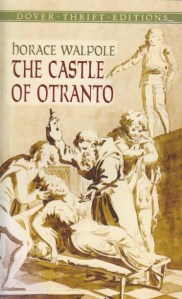
A convention in histories of the horror genre is to trace it to Gothic fiction.  Gothic fiction itself is traced to The Castle of Otranto, by Horace Walpole.  Having grown up reading Gothic stories along with religious texts, perhaps surprisingly I never came upon Walpole’s oeuvre.  Some weeks back I happened on a used bookstore, which, by convention, had its cheapest fare on sidewalk carts.  I was surprised to see a negligibly priced copy of The Castle of Otranto, which I took in to the counter.  The clerk looked puzzled a moment, then asked if it was from the carts.  “Oh,” he sniffed, “that explains it.  We don’t carry Dover editions; they’re too cheap.”  Perhaps that remark haunted me a bit, but I finally got around to reading the slim book and it left a kind of unanticipated horror in my mind.

Okay, so this was written in the eighteenth century, and set further back, in Medieval times.  A spooky castle, knights and knaves, and fainting damsels all populate its pages.  Religion, particularly in debased form, became a standard characteristic of the Gothic.  Here a monk, an erstwhile lord, holds a secret that leads to the downfall of a house of pretenders who have claimed ownership of the castle.  All pretty straightforward.  Even the ghosts and talking skeletons fail to raise fear.  One aspect, however, does hold horror.  The three princesses in the story are completely at the whim of the men.  They acknowledge as much and claim it against piety to declare any different.

It would be unfair to assert that such sexism was intentional—like most human behaviors it evolved over eons—but in this era to read it is to shudder.  We have moved beyond the horror fiction that men own women and that they have any right to determine their fate.  Especially in these days, it’s embarrassing to be reminded that such was ever the case.  Despite the word from on high we cannot hide from history.  The domination of men has been a testament to how poorly civilization has been run.  Some of its benefits can’t be denied, but on a whole we see a succession of aggression and wars, suffering and poverty, generally brought on my societies that have taken their cues from patriarchical ideals.  My reading of The Castle of Otranto brought this back with a force not unlike that of the giant ghost haunting its walls.  Is it too much to hope that some two-and-a-half centuries might show some evidence of progress?


Not-Quite-Normal Religion

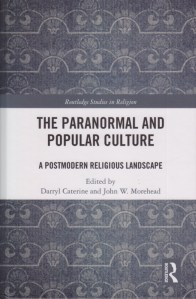
I’ve been thinking about categories quite a lot lately.  In a world connected by the internet, it seems that traditional categories don’t stretch far enough.  For example, I recently read The Paranormal and Popular Culture: A Postmodern Religious Landscape, edited by Darryl Caterine and John W. Morehead.  Published by Routledge, this is an academic study.  It contains some things, however, that many academics would find challenging.  I can’t summarize the entire book here since there are twenty very different essays included, but I can say this is a book that makes you think about categories.  Even the word “paranormal” means different things to different people.  To my way of thinking it has to tip the hat to Rod Serling and that place where fiction and fact begin to overlap.

That’s appropriate for this book: there are articles about what people perceive as factual encounters with all kinds of creatures and events, as well as studies of the decidedly fictional beings like Batman and zombies.  Our categories, in the modern world, tend to be inviolable.  Even scientists who handle Heisenberg know, however, that we are now in the postmodern world (as the subtitle indicates) and true objectivity is beyond the reach of all.  None of us stands outside the box looking in.  We’re all in the middle of it, and we look around ourselves trying to figure out what is real.  Another problematic category that, reality.  We don’t even understand what consciousness is yet, and how can we hope to know what is really real?  We all have dreams and some take them more seriously than others.

Reading books like this with an open mind is a truly po-mo experience.  After finishing more than one piece I found myself having to put the book down for a while at least so I’d have a hand free to scratch my head.  You see, we’ve been taught to laugh at those who believe in the paranormal.  It has been the only acceptable way that rationalists can deal with that which flies in the face of the system.  The internet, however, has put those isolated, ridiculed individuals into a community and the advent of reality TV (and what can be more real than what we see on the tube?) erodes the laughter factor little by little.  Plumbers can find ghosts but scientists can’t.  The average person relates more to the plumber, I think.  It all comes down to categories.  Making sense of them can, and will, impact our views of reality.


Seeing the Future

Nine.  That’s the number of people before me in line.  It’s not yet 4:30 a.m., and our day began at least an hour ago, but work won’t start for another two.  As the bus pulls up to the stop, I think about work.  Well, like most people I think about work a lot.  You see, I’m often asked about how to get into the publishing business.  There’s a cosmic irony to this because I had never planned to be an editor and never undertook any of the usual training.  The anticipated trajectory of a doctorate in the humanities used to be teaching, which is what I did for many years, but when an educational career slips off the rails in a capitalistic society you have to be willing to learn real fast.  (Fortunately the long years of schooling do help with that.)

I’m sure that I’m not the only person whose career plans didn’t pan out as anticipated.  Back in seminary one night long ago, three friends and I had a “future dinner.”  We prepared a supper and each came as who we would be twenty years down the road.  I recall that I was a world-traveling professor and the author of several books.  “Come on,” my friends complained, “be realistic!”  It’s a bit beyond those two decades now, and I was a professor for many of them.  I have written several books, although so far only three have been published.  World-travel?  Well, that’s been a bit modest in recent years, I have to admit.  One of the other friends I’ve lost track of.  Another committed suicide after graduating.  We really can’t see far into the future.

Publishing is a challenging gig.  My rapid career contortions perhaps prepared me better than I think.  I have a kinship with those who ask about how to get started in it.  Generally we’re educated people who like books and wonder what kind of career you can find with that combination these days.  (There are more of us than you’d think!)  Compared to higher education academic publishing is a small world.  I’ve come to know many more academic colleagues since being an editor than I ever did as a professor.  I have something they want—a reputable venue for publishing their latest book.  Often I have to do a lot of educating since publishing doesn’t work the way that most people think it does.  It’s like being a professor without the status.  No, I didn’t see this in my future.  As I look for a seat on the already crowded bus I wonder how many of these other early risers planned their careers just like me.

Difficult to see where this is going.