The Persistence of Unity

I came across some Ray Bradbury books while unpacking.  I recently learned that Ray Bradbury was a Unitarian.  Now, the religion of a writer is only ever an ancillary bit of information, yet for someone of my combination of interests, it’s compelling intelligence.  Having grown up reading Bradbury, my own fiction often comes out seeming like an imitation of his.  I discovered him the way I found most of my early, influential writers—through Goodwill.  Living in a town with no bookstores, Goodwill was a great venue for walking out with a good handful of books for under a buck.  Since Mom was there looking for “practical” stuff, I hovered over the book tables and discovered a new world.  Then I grew up.

Embarrassed by my childish interests, I gave away or sold most of my Bradbury books after college.  I was more sophisticated than that now.  I read Greek and was soon to learn Hebrew.  Books were meant to have footnotes, and lots of them.  Who wants to be seen with Bradbury on their shelves?  But the indiscretion of youth does come back to haunt one.  About two decades later I began to yearn for something missing from my life.  Perhaps like a good Unitarian I wasn’t exactly sure what it was, but I knew it was lacking.  Then my daughter was assigned Fahrenheit 451 for school reading.  I tried to read whatever she was assigned, and once I did memories of Bradbury flooded back.  I no longer had his books, but that could be remedied.
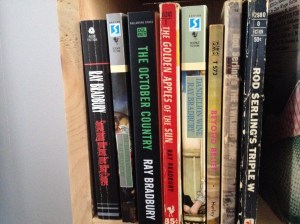
Occasionally I’m criticized for having too much in the way of books.  I’m sometimes asked if I will ever read some of them again.  The answer is how should I know?  I jettisoned Ray Bradbury with Episcopal pretention, only to find that behind the ceremonial there was a more unified version of things waiting.  A continuity with my younger self.  A lust for imagination.  A desire to remember what it was like to walk on Venus.  Or to see a man presciently covered with tattoos.  Or simply to thrill at the idea of October.  I began to acquire the old books again.  The newer editions lacked the visual resonance of the old, but the essence was still there.  Orthodoxy, I discovered, often isn’t true to life.  What’s true is what we discover early on.  Sophistication isn’t all it’s cracked up to be.  And yes, I may well just read that again after all.

Homework

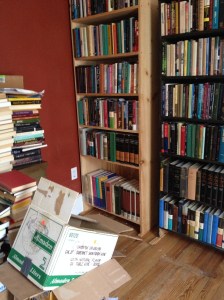
I’m trying to organize a home office.  Gone are the days that this meant a stapler and mug full of pencils.  The office is essentially a laptop since work is essentially virtual.  Oh, there are days when I have to haul myself into New York City, but even making traditional print books is an exercise done largely online.  The office is a place conducive to work.  In the case of an editor, a room of books that can be used for reference.  In our apartment we had bookshelves (mostly homemade) around the inside perimeter, covering all wall space that wasn’t claimed by more necessary furniture.  We realized, as we were packing, that no free wall space reached to the floor.  We didn’t plan it that way, but a reading life can be a complicated one.  To write books you need to read books.

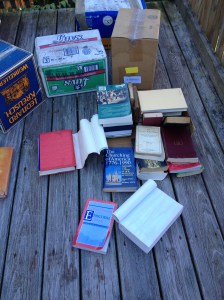
Our house has some built-in bookshelves.  Not enough to hold our surviving books, but it’s a start.  My office, however, is a spartan room.  Over the weekend I unpacked my “work books.”  That meant, for the most part, books about the Bible.  I filled three large bookshelves then ran out of room.  Not only was there that embarrassment, but there was the fact that a large number of “religion” books remained unshelved.  You see, I was a religion editor for a few years before being more narrowly slotted into the Good Book.  Some might say I should jettison these books since my career has moved on.  Those who suggest such heresy don’t understand the career of a displaced professor at all.  These books are still work books.  Job descriptions aren’t as stable as they used to be.

The complaint is an old one, at least to my wife’s ears.  In my mind I’m still a professor.  I still write—strictly on my own time—and I still research.  I do so without access to a university library so I have, over the past several years, made my own library.  This office, now out of bookshelves, is that amateur academic library.  My research has shifted from ancient Near Eastern studies (and that’s another whole discipline’s worth of books, some unfortunately washed away in the flood) to religion more broadly.  Not only is that reflected on this blog, but also in my publications.  The office isn’t done yet.  There’s a desk and a chair.  More importantly, there’s internet access.  There are some shelves, but in coming days there will need to be more.  Libraries are like minds; if they shrink they become less functional.  All books, no matter how dry, began in someone’s imagination.  That’s virtual reality.


Enoch Enough

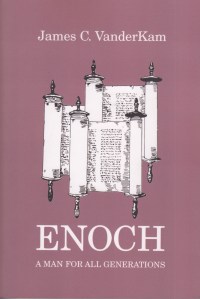
For a person referenced so little in the Bible, Enoch captured popular imagination in a way difficult to comprehend.  Even in ancient times speculation about him was rampant.  The seventh generation from Adam, and great-grandfather of Noah, Enoch lived a remarkably short 365 years before “he was not, for God took him.”  Now, there are lots of obscure people in the Bible.  Many of them have very little afterlife in later tradition.  Enoch, however, became the putative author of a collection of booklets that goes by the name of 1 Enoch.  This book fed speculation in antiquity and became a vehicle for many esoteric traditions that continue even into the present day.  It might seem that there’s little information to go on for an entire book, but James C. VanderKam’s Enoch: A Man for All Generations finds plenty of material with which to work.

A careful scholar like VanderKam doesn’t delve much into speculation, and he rather cautiously examines many of the ancient texts that discuss Enoch and draws some basic conclusions.  There’s a lot of information in this book.  With my own fascination concerning the Bible and popular culture, what stood out to me was how Enoch went from the “mere” man who didn’t die to become, in some traditions, the Metatron, or “the lesser Yahweh.”  Having been a fan of Dogma since teaching at the perhaps too sanctimonious Nashotah House, I’d never researched the late, great Alan Rickman’s character.  I supposed the Metatron was a character like the Muse—some extra-biblical quasi-divine functionary thrown in for fun.  I didn’t doubt such a figure was known in early Jewish or Christian writings, but I had no idea that Enoch had been promoted to that level.

Since I’ve been researching demons lately, the book of 1 Enoch has been a major source of interest.  One of its sections, The Book of the Watchers, expands on that odd story from Genesis 6 where the sons of God lust after the “daughters of men.”  Ever coy, the biblical passage doesn’t directly say that their offspring were giants, but this idea was developed by sources like 1 Enoch.  And these fallen angels—the nephilim—in some traditions, become demons.  Studying Enoch is a fine introduction to a mythological world every bit as rich as Dogma.  These characters—Enoch, nephilim, watchers, and demons—populated the imagination of early readers of the Good Book as much as they do modern speculators’ worlds.  Not bad for a character barely mentioned at all in the Bible.


Pretty as a Prayerbook

Stolidity.  Canons all across this deck are known for it.  Visions of unchanging texts, however, tend to be false perceptions.  Even the canon of the Bible differs, depending on who you talk to.  So it is to be applauded, I suspect, that the Episcopal Church is planning to revise the Book of Common Prayer.  The last revision was 1979, and before that, 1928.  This schedule should be telling you something—the BCP, or simply “Prayerbook” as it’s commonly called, was never a changeless canon.  We mere mortals rely on experts to change the words by which the Almighty is approached, and although Episcopalians are thin on the ground in this country, world-wide they’re a formidable sect.  They’re united mainly by their commitment to the BCP.  And with good reason.

The days of the British Empire are long gone, but when it ruled the waves (and even before) this island state contributed a number of religious elements to the world.  The Prayerbook was born out of struggles with Rome for secular power disguised as sacred.  We try to live with a fiction of separation, but churches and states have always had mutual influence—just consider the way secular Trump has changed Christianity and you’ll see.  The BCP was to define English Christianity and in doing so became a Scripture in its own right (or rite).  Phrases from the Book of Common Prayer pepper the English language so as to rival the Good Book itself.  When church attendance was an expectation, you couldn’t help but internalize it.

A certain seminary, nameless here forevermore, will not be pleased with such change.  When I taught there many still clung to the 1928, claiming the church had erred (a strange position for someone in a voluntary organization and who vows to support its decisions) by adding “inclusive language” in the ’79.  This, they averred, was a man’s religion.  And they meant biological males.  Stolid.  Or perhaps stale.  Like the fiction of unchanging canons, the myth of the rational male hierarchy exists only to be exploded.  The two longest reigning British monarchs have been queens, after all.  World wars tend to be the legacy of male rulers.  So, although a tiny seminary in the woods of Wisconsin will likely rage, the BCP could use a bit of a makeover.  The world has changed substantially since the 1970s.  Mainline churches have been steadily shrinking and redefinition with a declining financial base makes good sense.  “This is another day, O Lord. I know not what it will bring forth, but make me ready, Lord, for whatever it may be.”  Even if it be changing canons.


Be It Resolved

I’m not a believer in New Years Resolutions.  A constant and critical self-monitor, when I notice a bad behavior I try to correct it right away.  Sometimes I’m actually successful.  Now that I’ve finally removed all books from the garage—some were being held high above the water-line on plastic boxes—I’ve started to sort through systematically what is beyond redemption.  A comment of occasional visitors, however, has goaded me into a resolution; you see, people sometimes ask “Are you going to read those again?”  While aching to address the mindset betrayed by that very question, I cede a point; if I’m going to the expense of replacing a non-reference book, I should want to read it again.  My resolution—when I buy another copy, I will read it then and there.

One of the stinging parts of this resolution is that some of the books were read by me just this past year, or even earlier this year.  Jude the Obscure, although I enjoyed it, cost me a quarter year of my life of evening reading time.  On that basis alone I should replace it, but if I’m not going to reread it why should I incur the expense?  (Moving is anything but cheap.)   I will also face rereading old favorites that have been put aside for a while.  No house, for example, should be without Emily Brönte’s Wuthering Heights, although I read it again just months back, or so it feels.  

This is perhaps a way of making lemonade from a cloud.  Or finding the silver lining on a lemon.  Whichever it is, I sense that it will figure toward my reading goal for next year.  As I’ve spent the rainy weekend unpacking books, literacy is on my mind.  For those who see my literomania as some kind of disease, I was cheered to note just how many of the books on display I had indeed read.  The same goes true for a number of the academic books in the study, but, I must confess, while pulling them from their boxes I thought how boring most of them are.  Boring, however, doesn’t equate to useless when it comes to books.  Given their price points some of them may take years to replace.  That’s the point of a resolution, in any case.  It can cause some pain.  As I stuff the moldy, distorted tomes into their body-bags I hope that rereading their replacements will bring them back to life.  After all, resolution and resurrection are not so far apart.


A Few of My Favorite Monsters

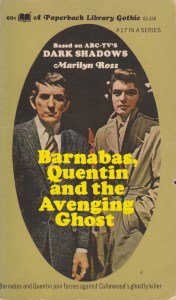
It was a guilty pleasure read.  We’d just moved and I needed a new novel for bed-time reading.  Most of our undamaged books were still boxed up and, well, enough excuses: I like Dark Shadows novels.  Hardly well written, these pulp potboilers are like extended, Gothic Scooby-Doo episodes.  I first started finding them used at Goodwill when I was a kid and I’ve re-collected a number of them as an adult.  Although they feature a vampire, and sometimes a werewolf and witch, the crisis of the story generally devolves to a hoax at Collinwood.  So it was with Barnabas, Quentin and the Avenging Ghost.  I hadn’t thought to write a blog post about it until I came across a passage mentioning Rocain.  In context, one of the characters explains how Rocain, the son of Seth, shows that sorcery goes all the way back to Genesis.

Genesis was one of my lines of research during my academic career, although I never published anything I was working on.  I didn’t, however, recall having read about Rocain.  The internet quickly pointed me to Legends of Old Testament Characters by Sabine Baring-Gould, chapter 8.  Clearly this was where Marilyn Ross, or his source, got his information.  Baring-Gould sits on my shelf as the author of The Book of Were-Wolves.  He also wrote the hymn “Onward, Christian Soldiers.”  There was an era, overlapping with Baring-Gould’s lifetime, when a minister could be an independent scholar of repute.  Although much that’s found in his many publications is now disputed, his was a lively and lifelong curiosity that led to several books.  

Upon reflection, Sabine Baring-Gould, who was a priest fascinated by occult topics, would have fit quite well into the Dark Shadows diegesis.  Although set in the late 1960s into the mod ‘70s when the television show aired, these were Victorian vignettes of a conflicted vampire and his strange, wealthy, and somewhat clueless family.  All kinds of guests, some of them quite Lovecraftian, drop into the Maine mansion and its grounds.  The writing of the novels is tepid at best, but the series was surprisingly literate.  Dark Shadows is nevertheless undergoing a kind of revival these days, and friends sometimes tell me they’ve just discovered this oddly compelling world.  I invite them in.  I’ve unpacked a few more boxes since selecting this pulp novel, and one of them, I note, holds books by Sabine Baring-Gould.  The guilty pleasure read?


Childhood’s End?

Writers are agents against chaos.  Those of you who read this blog frequently know that chaos has been one of my themes lately.  Moving, which is a process that takes months and months of time, is pure chaos.  Whenever I settle down to write, yet another moving-related task comes to me—this box needs to be unpacked, that gap in the fence must be mended, where did I put the toolbox?  Mundane things.  Writers like to think the world conforms, somehow, to their inner lives.  In reality, things are far more complex than that and don’t seem to be getting any easier.  Starting to learn about house ownership is something best left for the young, I suspect.  Every question (where should we put the television?) leads to a daisy-chain of other issues (but first we need to move that hutch, but it’s too heavy for either of us to lift, etc.).

In ancient times water symbolized chaos.  Before we left on vacation, the main issue was to get all boxes off the floor in the garage.  We haven’t had time to move them safely inside yet, what with planning for vacation and all, so plastic became the order of the day.  We do need, however, to get things inside eventually.  A slow process for two middle-aged people with full-time jobs, even without jet lag.  Writing feels like a luxury item, for what is most required is time—time to move things to their proper places.  Time to figure out what those proper places are.  Time to go to work again.

Had we thought this through, we might’ve used vacation this year to unpack.  We bought our plane tickets, however, before we bought the house.  This latter transaction is one of chaos embodied.  Who knew, for example, that the grass had to be cut so often?  That all roofs leak?  That chaos is constant, and not intermittent?  In biblical times, one of the signs of God’s greatness was the ability of the Almighty to hold chaos in constant check.  The waters were always lurking, looking for any opening—except when you need rain and it just won’t come.  Sitting here writing feels like the giddy irresponsibility of childhood where there’s so much to get done and so little time in which to do it.  And neighbors don’t appreciate the lawn being mowed before the sun is properly out of bed.  The renter pays a price for living with, for at least some stretches of time, chaos-free maintenance.  The home-owner quickly learns that any time left over for writing feels like being irresponsible, and a little bit divine.


Chaoskampf

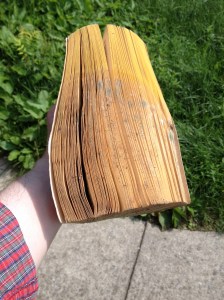
It’s a poignant thing to hold a dying book in your hands.  What was once, straight, flat, and dry, now dissolves into a pulpy mess that, if it ever recovers, will be warped and distorted out of shape forever.  The loss of dozens of books hit me hard.  I think one of the many reasons for this is that books represent, for me, order.  They stand at attention all in a row, many on shelves I built lovingly for them.  I remember where I purchased them, the thoughts and feelings of that time.  In a world that’s far too bumpy and lumpy, books represented the ultimate in orderly array.  Now The Golden Bough is melting in my palm, smearing my fingers royal blue.  The forecast for the week—more rain.

The story of creation in the Bible—more properly, stories, for there are many—is not creation out of nothing.  Creation is the making of order out of chaos.  Ancient people, including the Israelites, believed that water was chaos, if not an actual dragon, that constantly worked against order.  You can’t build on water, it attacks the shoreline, it drowns those who fall in.  Never a seafaring people, Israel equated big water with evil.  God, then, fought constantly this unruly foe.  Whether it was with word or sword, the Almighty vanquished that sloshing, thrashing element that tries to tear apart everything we build.  Read Genesis 1 closely; the water is already there when the creating starts.

Life has a way of getting out of control.  It’s not without irony, however.  A person buys a house to store their books, and before the books can be moved in, they’re destroyed.  It’s rather like a parable, don’t you think?  If that person unfortunately thinks of him or herself as a summation of the books s/he’s read then the loss is like losing a limb or two in that endless battle against the forces of confusion that attempt to overcome our world.  When this happens some of us turn to books for comfort.  The books, however, are disintegrating in our hands.  My Amazon account, it seems, is mocking me at the moment with it’s mover’s discount.  Why buy something that will only hurt me when the water gets in once again?  The people of ancient times knew that the waters of chaos had to be held in check constantly.  They look for any opportunity to get in and destroy.  Ancient writers knew that in order to defeat them, only the most powerful gods will do.  


False Memory

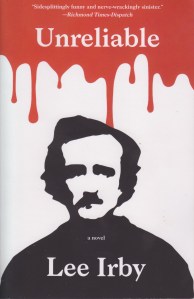
One of the reasons our recent loss of books hit me so hard is that each volume contains memories.  Among the more disturbing developments of memory studies in recent years is the fact that what we remember has a tendency to be unreliable.  In other words, our narratives about ourselves contains a good deal of fiction that we remember as fact.  Even if we write down our impressions shortly after an event, such scribbles are just that—impressions.  Lee Irby explores this dynamic in his novel Unreliable.  Now, since the narrator may be the most unreliable I’ve ever read, I don’t want to give away too much.  Irby knows what it’s like to be a professor (something that some of us share with him) and he has a good sense of Edgar Allan Poe.  It’s one of those books that touched on a number of things in my own life.  I think.

First of all, this was an impulse buy at Buffalo Street Books in Ithaca, New York.  I soon discovered why they stocked it.  Edwin Stith, the narrator, teaches at a fictional college in Ithaca.  The story, however, is set in Richmond, Virginia, where Prof. Stith has gone for his mother’s second wedding.  With characters compellingly drawn, he meets his new step-family, runs into an old-girlfriend, and tries to both avoid and hook up with a student of his that he’s dating, more or less.  He claims from the start, however, that we shouldn’t believe him.  The largest part of the story takes place over one feverish day following a very late arrival in town, with plenty of Poe references sprinkled throughout the tale.

Apart from the Ithaca and former professor connections, the book also mentioned, rather spookily, meeting a girl from Slippery Rock University—a rather obscure school from my old neighborhood.  I had dated a Slippery Rock co-ed who’d proved about as unreliable as our narrator, so this single, brief reference managed to jump-start some of my own memories, reliable or not.  Our pasts, along with the books we read, make us who we are.  I’ve lost track of how many times I’ve thought of a scene I’d supposed I’d forgotten from a book I’ve read years ago.  Just the other day I recalled, completely out of of the blue, apropos of nothing, a scene from a Doc Savage novella I’d read as a tween.  Was it a reliable memory?  I have no way to judge, I guess.  And that’s the scary part, as I’m sure Poe would’ve agreed.


High Places

I have gotten me away unto an high place.  No, that’s no biblical, but it sure sounds psalm-like.  Part of the anxiety I felt about the literary loss over the past few days is that it happened just before a long anticipated, and paid for, vacation.  As Thursday dawned, I knew I had only two days to try to rearrange the undamaged books and try to salvage what I could of those that were soaked.  And I had to do it quickly and then leave, only to see the results when I returned.  Not yet having met any neighbors, and not really being in a position to prevail upon their presumed good will, it was a test of personal endurance.  Our garage has an upper floor that remained dry.  I made well over an hundred trips up those stairs, book boxes in hand.  One cares for ones friends.

For now, however, I am at my favorite high place, in the mountains.  On a lake.  I’m having to reconcile myself with my old foe H2O, for here it is placid welcoming.  It stays outside the cabin and we remain friends.  And truth be told, there is a kind of idolatrous element involved in my visits to the lake.  You see, I covet peace.  Since childhood violence and bullies have led me to a quasi-monastic life—Paul Simon reflected that perfectly in his early song “I am a Rock.”  Even Superman had to have his fortress of solitude.  Some fear being alone with their thoughts.  Although I struggle with them, they are, like my books, who I am.

Dawn’s early light; and it only got worse as the day went on.

Prophets and deuteronomists railed against high places.  Such were locations where the God of Israel grew jealous of the attention lavished on other deities.  Perhaps religious promiscuity comes naturally to people, but we need our high places to regain perspective.  To breathe pine-scented air and feel the chill of a July morning at altitude.  Yes, even to reconcile with the splash of water that is here to make life possible rather than to destroy that which you have worked to acquire.  Ironically some of the destroyed books had been with me since college—theological classics such as Niebuhr, Gutiérrez, and Tillich, lying on the unmown grass beneath a healing sun.  Perhaps they were trying to warn me of the idolatry of such retreat.  But here I am, reflecting on loss and hope, and praying that somehow we might just all get along.


Written Resistance

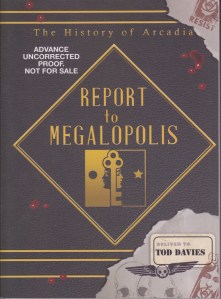
Power isn’t what you think it is.  That’s something autocrats never really learn.  Tod Davies explores this tale of our times in Report to Megalopolis, the fourth book of the History of Arcadia series.  The world is taken over by a single-minded dictator who discovers power isn’t what it seems to be.  Assuming power will bring fulfillment, the antagonist gets what he wants, but he doesn’t know what he wants.  (Like a certain rich fool whose name we can’t help but hear daily.)  Wanting for wanting’s sake, and refusing to be denied.  In that sense it’s a simple tale, but as with all of Davies’ stories, it’s more complex than it seems.  The message of resistance comes through loud and clear.

Laying out the groundwork for the tale, she describes, among other things, the religion of Arcadia.  Writers unafraid of reality will note that people have religious beliefs, no matter whether the narrator—or author—shares them.  Worlds without religion are fantasy worlds, or those of cyborgs; they’re difficult to accept.  To be human is to believe.  Not just that, however, but to believe in something more than one’s own wants.  There’s a basic morality to it.  And Report to Megalopolis is a kind of morality play in that it has a lesson that should be learned.  For those who won’t or can’t read, having the humility to admit your own insecurity might well save the world from nuclear holocaust.  If, like Pavo Vale, the antagonist, you insist that your own desire is entitlement, then the only option for all others is to resist.

Back when the harsh reality of Trump’s lackluster “win” became clear, among the artistic community there was discussion of how, from now on, creative expressions of the truth would take on a new urgency.  Songwriters, poets, painters, and novelists have been able to see what the feeble eyes of the GOP cannot—we are in trouble.  Deep trouble.  Elected leaders, caring more about their own wants than the wishes of those who elected them, power ahead to destroy the democracy that gave them power.  As Davies suggests, they have mistaken power for right.  We reach the end of Report to Megalopolis not knowing the end of the story.  We know that things are bad and they have the potential to tip either way.  We, the readers have a choice to make—remain silent and allow all that our founders worked to achieve pass away, or, as even as the cover states directly, resist.


Prelude to Chaos

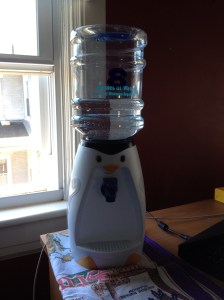
Liquids are the enemy.  Don’t let the cuteness of this little guy fool you—there’s collusion here.  For as well as creating life, and being necessary to sustain it, water destroys.  Creator, annihilator.  We moved during a time when neither of us had vacation and we told the over-tired movers that it was okay to put our boxes in the garage.  We planned to move them soon, but, you know, work.  Then the rains came.  Not just sprinkles, but downpours.  The garage isn’t water-tight.  Boxes were soaked.  Many books were damaged.  This wasn’t a flood that can be claimed on insurance, it was simply rain pooling where people usually park their (normally waterproof) cars.  In their place sat our books.

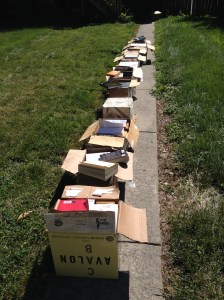
We both worked the day after the rains.  When we discovered the damage the next evening, it looked manageable.  I had to work the next day, of course, and a few breaks sufficed to get the many, many boxes of damaged books out into the sun.  It was carnage.  We don’t have much in the way of material goods; we spend a bit of money on books, however.  Now they’ve become the victims laid out on this altar of home ownership which, at the time, seemed like a good idea.  We needed a house for our books.  We needed time to move them from the garage to the house.  Yes, old friend Morpheus, “Time is always against us.”  

Job sat upon his ash-heap and pondered why he’d paid the movers so much only to have his moved goods destroyed.  And in a manner in which insurance assessors are trained to point to the fine print.  Those who store their goods in the garage reap the wrath of liquid.  You see, when water reaches cardboard, or paper, the wood pulp sucks it up.  Carefully dried, the paper remembers the compelling nature of water.  Too little, and you die.  Too much, and you die.  No wonder the ancients thought that water was a deity.  It claims all—tries to get in through your roof.  Lays insouciantly on your basement floor.  And the garage—yes, who thought of the garage when the immediate concern was to shut the windows to keep Leviathan out of the house?  I spent weeks carefully packing those books against shipping damage.  Used up my vacation days doing so.  Chaos has claimed them.  I would weep, but that would be collusion with the enemy, even if nobody sees.


Fair Weather

“I just saw God up on your ridge.”  (Kudos to anyone who can name the source of that quote!)  Many years ago I read Stewart Guthrie’s remarkable Faces in the Clouds.  The idea that he presents is that pareidolia—seeing faces or people where they don’t actually exist—may account for the belief in God.  Early people, not knowing any way to interpret such obvious examples of humans writ everywhere thought they were gods or spirits.  Since reading this book, I’ve taken to trying to capture incidents of pareidolia where I can.  The other day as I was working away in my home office, I noticed a literal face in the clouds.  I thought “I just saw God outside my window.”

Now I know this isn’t really what I saw.  I know matrixing (mistaking noise for signal) when I experience it.  I hope.  Nevertheless, the resemblance was detailed—brow ridge, nose, distinct lips, chin.  The lighting in the fair weather cumulus will likely make this difficult for you to make out, and you might see a face other than the one I saw.  Not everyone thinks of the Almighty in the same way.  Looking at the picture I snapped I can see at least two faces stacked on top of one another—the council of the gods?  Who am I to tell deities what they can or can’t do?   Or to prevent imagination from going where it will?  Religion seems to be an evolved characteristic of our biological makeup—our eyes show us what to believe about the world around us.  The rest is hermeneutics.

Gods and the skies naturally go together.  We can’t reach the heavens nor can we control them.  We can increase greenhouse gases in them, though, threatening the very illusion we see in the clouds.  The glimpse of the divine we once saw there can easily dissolve into acid rain.  Heaven and Hell, according to the story of Dives and Lazarus, aren’t very far apart.  Even as we gaze into the cerulean sky seeking serenity, others are bending laws to allow them to destroy it for profit.  There’s a reason Dives is simply called “the rich man.”  Does Scripture defend the practice of environmental destruction?  Dives’ friends claim the planet was given to us to use and use up and Jesus will swoop out of those clouds we’re manipulating at the last minute and rescue us from the mess we’ve made.  Looking into God’s face in the clouds, I interpret this all as a mere excuse.  To destroy the environment is to side with Dives as he makes his flaming bed of nails in Hell. This is why windows in an office are divine.


Bitten by Religion

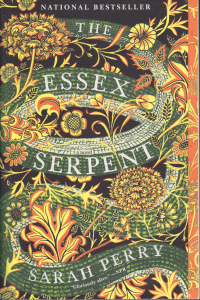
The Essex Serpent isn’t what it appears to be.  Sarah Perry’s debut American novel (although it’s her second elsewhere, publishing being the strange beast that it is) was much anticipated.  Like the serpent itself, the novel is difficult to describe.  It comes down to a minister, a widow, and the people with whom they associate.  Instead of going through the complex storyline, I would instead note that once again a novel that explores religion has garnered quite a lot of attention.  It’s difficult to believe the official narrative that we’re constantly fed that religion is well beyond its expiration date when it continues to appear in print media as a prime motivator for people in all kinds of situations.  Novels, however, aren’t popular in the way television, movies, and video games are, so this is worth pondering.

While novels are sometimes disparaged in higher education, their clientele tends to be an educated one.  It takes more commitment to sit down and read a 400-page tome than it does to flip on some device and meander from app to app, channel to channel, or website to website.  Novel reading takes some concentrated effort.  Remembering characters and connections across a span of days or weeks as you wend your way through.  And one thing novelists do, at least in my experience, is explore the way religion makes us who we are.  I don’t choose novels for that reason; I thought The Essex Serpent would be a monster story (remember, I don’t read reviews before reading the book).

My guess is that if you read this blog you’re a potential reader of novels like this, so I won’t offer any spoilers.  The book is suffused with biblical language, as befits a story with a clergyman as a major character.  The protagonist, however, is an irreligious widow on a journey of self-discovery.  Having been dominated by a wealthy husband, she now explores paleontology in a Victorian context.  Although the year is never stated, the novel manages to find that Gothic near-ghost-story feel with the close interplay of death by consumption and fear of the dark.  It’s not a scary book by any means, although there’s plenty of mist in Essex, and a little gruesome detail of what people can do to each other.  The novel caught my attention via reviews I never read and has left me pondering what I’ve just experienced.  And it has reinforced my conviction that, despite what the critics may say, religion is what motivates us, whether we admit it or not.  And serpents may not be what they seem.


Moving Books

One of my anxieties about moving is that commuting time was my reading time.  Enforced sitting for over three hours a day meant consuming book after book.  Now I have to carve out time to read.  Life has a way of filling the time you have.  I say the following fully aware that you’re on the internet now, but one of the biggest time drains is the worldwide web.  Humans are curious creatures and the web offers to answer any and all queries.  (It still hasn’t come up with a satisfactory answer to the meaning of life, however, IMHO.)  Even when I’m working on my current book, a simple fact-check can lead to surfing and before I know it, I’m out to sea.  That’s why books—paper books—are such a good option.  A footnoted source meant another trip to the library, and libraries led to more reading.

I’m a Goodreads author.  I like Goodreads quite a lot, and I actively accept new friends there.  In the past I set goals of reading 100+ books per year.  Aware back in January that a move might take place, I lowered my expectations.  I figured, even without commuting, that 65 books would be attainable in a year.  Of course, Goodreads doesn’t count the books you write, only those you read.  I had to tell even Amazon Author Central that Holy Horror was my book.  Moving, however, is a liminal time.  Every spare minute is spent packing.  And you still owe “the man” eight hours of your day.  That rumble that you feel is the moving truck growing closer.  Reading time has become scarce.  I fear I’m becoming illiterate.

And Goodreads makes me think of Twitter.  I’ll just click over there a while and wonder why I can’t seem to grow a following.  Ah, it turns out that you have to tweet often and incessantly, with erudite and trenchant things to say.  The birds chirping once a second outside my window can’t even keep up.  Problem is, I have a 9-to-5 job, and I’m trying to write Nightmares with the Bible.  And there’s just one more fact I have to check.  Wait, what’s the weather going to be like today?  Gosh, is that the time?  I have to get packing!  That moving van will be here only hours from now.  I need to calm down.  The way to do that, in my case, is to read a book.