Science and

Do science and religion have to fight? It’s not evident that they do, but some on each side of this divide like to keep the conflict going. Many religious believers feel threatened by the incredible success of scientific explanations. The gods who used to explain everything are now responsible for so little that it’s easy to feel foolish for believing. It doesn’t help that the most vocal scientists have made religion their personal court jester, adding ridicule to the mix. Krista Tippett’s book of interviews with scientists, Einstein’s God: Conversations about Science and the Human Spirit, is a refreshing counter to this trend. Although it’s a few years old now, the book just landed under my tree, so I started off the new year with it.

A blend of interviews with scientists, quotes from their books, and personal observations, Einstein’s God is a fascinating and quick read. Covering topics from the wonder many scientists feel about their discoveries to medical understandings of how spirit effects healing to the ongoing debates about evolution, this book looks at the big picture. The scientists Tippett interviews, although some are atheists, don’t dismiss religion. In fact, many of them suggest religion in some form is necessary for healthy human living. As scientists they don’t dismiss science either. It’s refreshing to read about how those with scientific bona fides sometimes come to the same conclusions that those of us without the credits have surmised.

Once I began working at age 14, one of my earliest purchases was a subscription to Discover magazine. I was a charter subscriber. I was also a Fundamentalist. Not realizing that science and religion should be squabbling, I read science that could be digested by someone without professional training. Until I felt the tug of the ministry, I had intended to be a scientist. The only professional religionist interviewed in Tippett’s book is John Polkinghorne. A physicist cum priest, Polkinghorne has come to prominence among those involved in the debate between how we know what we know (the fancy term is epistemology). I wondered as I read this how it might differ from the other direction. Some of the interviewees were raised religious—Jewish and Hindu, notably—but none started out as professional religionists who went into science. That, I learned after college, is a much harder transition. Perhaps it says something about the nature of reality that to move into science as a career you must start with the undergrad prereqs if you ever hope to make the switch. Otherwise, those who start out with A’s in high school physics end up watching from the sidelines while others set the terms of the conversation.


2017 in Books

At the end of each year I think back over the books I’ve read in the past twelve months. Since I don’t blog about every single book, I use Goodreads to keep track of my numbers. I pushed my reading challenge at that site to 105 books for last year, and the meter stopped at 111. In 2018 I’m planning on reading some bigger books, so I’ll scale the numbers back a bit, I think. In any case, what were the most memorable books of 2017? It’s perhaps best to divide these up into categories since the number of books has become unwieldy. I’ve written a book about horror movies, and much of this year’s reading has been in support of that. Since my book addresses, among other things, possession movies, I’ve read several tomes on the topic. Noteworthy among them have been the three books by Felicitas D. Goodman that I read over the year. J. H. Chajes’ Between Worlds was exceptional, and Jeffrey Burton Russell’s The Devil, was likely the overall best on the topic. Also noteworthy for purposes of my book research were Catherine Spooner’s Post-Millennial Gothic and Monstrous Progeny by Lester Friedman and Allison Kavey.

For books on religion, Stephen Prothero’s Religious Literacy was an important start. Amy Johnson Frykholm’s Rapture Culture and James William Jones’ Can Science Explain Religion? addressed aspects of the topic that will continue to bear further exploration. God’s Strange Work by David L. Rowe and American Apocalypse by Matthew Avery Sutton stand out in my mind as a memorable treatments of William Miller, and of understanding American religion respectively. Chris Hedges’ American Fascists is remarkably urgent and should be read widely, especially since he has shown where current political posturing will lead if it’s not stopped cold. We will be struggling against a situation like Nazi Germany for many decades to come, and forewarned is forearmed.

It wasn’t all doom and gloom, however. Much of the fiction I read was excellent. Bill Broun’s Night of the Animals, Auður Ava Ólafsdóttir’s Butterflies in November, Robert Repino’s D’Arc, Matt Ruff’s Lovecraft Country, Christobel Kent’s The Crooked House, and Leah Bobet’s An Inheritance of Ashes all stayed with me long after I read them. And of course, Neil Gaiman’s The Ocean at the End of the Lane. Some non-fiction read just as engagingly. The autobiographies by Carly Simon and Bruce Springsteen were deeply engrossing. The Hidden Life of Trees by Peter Wohlleneben and John Moe’s Dear Luke, We Need to Talk were great guilty pleasure reads along with Dani Shapiro’s Still Writing, W. Scott Poole’s At the Mountains of Madness, and Mathias Clasen’s Why Horror Seduces. The latter title brings us full circle. I suspect that’s appropriate for rounding out a year. Many of the other books were also quite good; I tend to rate books favorably. Read the revolution—make 2018 a memorable year with books!


Reading Preferences

How do you decide on a favorite author? The question has been looming in my head as I’ve been reading through old novels on my shelves. It’s a question that strikes me whenever I walk into a bookstore. You see, my parents weren’t readers. As a child my literature was selected from the book table at the local Goodwill. I had no literary advice of ancestral pedigree. Teachers had assigned some books I’d liked, but nothing that really grabbed me. How was I to go about finding a favorite author? My favorite novel, hands down, was discovered in seminary. Moby-Dick is, to my way of thinking, the perfect novel. But I’ve never read anything else Melville wrote. I’d discovered Edgar Allan Poe as a child, but he was no novelist. Who suggested these books on my shelf?

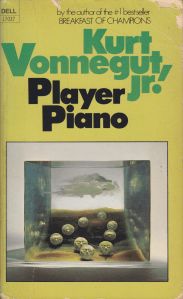
Among those responsible was a young woman I knew when I was in college. She was in high school, but she’d grown up in an educated family and she was passionate about her authors. Thomas Hardy and Kurt Vonnegut, Jr. Were among her favorites. I was startled to realize that among the books I found myself reading as 2017 draws to a close were both Hardy and Vonnegut. A blast from the past. Then, of course, my wife has suggested many books to me. We still read together—a practice we started as newlyweds (today commemorates the start of that status, by the way, which occurred 29 years ago today). There’s an intimacy involved in sharing books.

For the past few years I’ve been participating in Modern Mrs. Darcy’s reading challenge. Since it involves only a dozen books it’s seldom a problem to finish it. We go to our local independent bookstore and seek advice. I encounter writers unfamiliar to me. I still struggle, however, with that favorite author question. As I lay down each book I say to myself—was that the best I’ve ever read? Maybe the point is that there is no favorite author. If I were to sit down and try to list everything I’d ever learned from the fiction I’d read, I’d never stand again. The list would be endless. The lingering longing after closing a book, feeling as if I’d just had an intimate evening with the author, requires a certain literary promiscuousness. I enjoy many authors in many different ways. More often than not, they have changed my life. I look forward to the reading challenge of 2018. No matter the disappointments of politics and human folly, I’ll have good books to read as the world wobbles onward with no particular goal in mind.


Honest Doubt

Kurt Vonnegut was never required reading in my high school English classes. I read Slaughterhouse-Five when I was in seminary, and picked up a few of his other titles in the dearly departed Boston Book Annex. A couple of these used books have been waiting patiently over the decades, and so I selected Cat’s Cradle to be perhaps the last book I finish this year. As far as I can recollect, the Vonnegut books I purchased while in seminary had no particular order or reason. A friend had recommended The Sirens of Titan, but Cat’s Cradle was what would now be called an “impulse buy.” Reading it, I rediscovered why I like Vonnegut so much. I also found out the book revolves around religion.

Regular readers know that I tend to find religious themes in secular books. It’s partially human radar and partially an unfortunate occupational hazard. Occasionally I’m pretty certain the author had no intention of including or developing the themes I discover. Cat’s Cradle, however, places religion front and center. The story involves a journalist on the trail of one of the developers of the atomic bomb. He unintentionally coverts to Bokononism, a religion made up by a castaway on the island of San Lorenzo. The religion, based on the teachings of a still-living sage, revolves around the idea that all its sacred writings are lies. Think about that a moment.

Lies, in which we’ve all had a crash course since January, are among the most insidious of human accomplishments. We value and crave the truth. We all believe that we believe it, but there are differing opinions as to what it is. Some opinions are backed with evidence, and others with flimsy fabrications. To declare a religion based on lies is, of course, to undermine the whole enterprise. Vonnegut was a noted iconoclast, but there’s a brilliance in declaring a religion to be knowingly based on falsehood. In fact, we’re seeing it happen before our very eyes. The religion formerly known as Christianity, once upon a time, took into account the teachings of Jesus of Nazareth, as recorded in the gospels. Modern Christianity—Evangelicalism—has completely thrown Jesus out of the equation in all but name. Branding, after all, is everything. This modern faux religion suggests hating your fellow creature, taking advantage of the poor, and believing falsehoods to be the most sincere of truths. It’s alive and released on the earth even now. And it is far more scary than even ice-nine.


Investment Advice

One of the more obvious transitions to adulthood involves Christmas becoming less of a holiday for receiving gifts. As we get older we learn that very few things in life are actually free, and that gifts often have some kinds of obligations involved. My favorite gifts have always been books and movies. Each comes with a required investment of time. That doesn’t mean I’m not grateful, or that I don’t want these things—quite the opposite! It simply means that time is required to enjoy them. Or benefit from them. In the workaday world, time is the rarest gift of all. The gifts I received fell mostly into these genres, so I’ll be sharing a number of these books and movies with you over the next few months.

A knowing relative gave me a refrigerator magnet. Our fridge is covered in these, mostly from places we’ve visited. We do have one of the more colorful iceboxes around. This magnet is red and reads “Make America Read Again.” If anything can combat the evil spewing from our nation’s capital, reading can. Those who’ve decided that rhetoric from documented lying lips is more Christian than compassion for the poor need to learn to read again. The election of Trump has ushered in an era of attempted murder of the truth. The tactic of calling any news you don’t like “fake news” so that your own distorted version of reality rules is among the most dangerous in the toolbox of autocracy. Sacrificing truth on the altar of expediency seems like a very strange means of promoting the evangelical message, at least in my opinion. If people would read, they’d know when they were being lied to.

Reading forces you to confront the mind of another. This exercise is unique among human beings, as far as we know. It’s a kind of telepathy, involving the considered contents of another person’s thoughts coming directly to you. Lying is a possibility, of course. Even liars write books. The more widely you read, however, the greater likelihood of discovering the truth. Reading requires investment. It takes time and mental energy. Other activities must be laid aside. The potential benefits, however, are beyond measure. If we could make America read again, the results would be the greatest gift anyone could hope to find under any tree. It’s time to begin reading through the books that made their way to me this holiday season. This is a gift whose costs I gladly accept. It’s an investment in the future. Even Christmas trees require daily watering.


Rookie Mistakes

So now it’s got a stain on the cover. And it didn’t even come with a book jacket. Perhaps it’s symbolic? The year was 1993. I’d finished my doctorate at Edinburgh the year before, and, against all odds, had landed a full-time teaching position. That position was at Nashotah House, but never mind. Like all doctoral students I’d sent out my dissertation for publication. It’d been accepted by the prestigious series Alter Orient und Altes Testament, produced by the dual publisher Verlag Butzon & Bercker and Neukirchener Verlag. Most European houses print these books cloth-bound (mine in blue!), no dust jacket, straight to the library market. I was proud. I had my first copy in hand in time to show around at the American Academy of Religion and Society of Biblical Literature annual meeting. There I spied William Holladay, my Hebrew teacher, now deceased. He was sitting on the floor in a corridor, eating his lunch. I joined him and showed him my book. In his inimitable way, he snatched it (leaving a grease stain on the cover) and within seconds said, “there’s a word misspelled in your title.”

Crestfallen, I took my first copy back. I wrote to the publisher, but these things only ever receive one printing and I never heard back. How embarrassing! Your first foray into academic publishing, and you look like an idiot who can’t spel. Now, in my defense, the cover is simply what I thought was a photomechanical replication of the the title page. The world “Millennia” was spelled correctly where I’d proofed it inside. How they left out an “n” on the binding die is a mystery. I never got proofs of the cover. Besides, a book’s title is on the title page, right? Never judge a book by it’s cover! Mine has a stain on it.

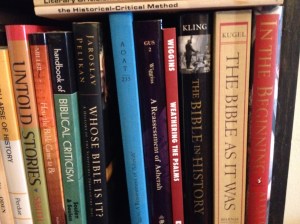
The book, although on Asherah, never got much notice. It’s still routinely overlooked. One of the truly sad things, though, came from a senior scholar in the field, nameless here, who did mention my work. In his book he put a [sic] after the ailing word on the cover. That was an intentional slight. Had he looked at the title page—from which I’d been taught to take bibliographic references—he would’ve found the word spelled correctly. Many publishers do not let authors proof the binding die for their cloth-stamped covers. A senior scholar knocking down a struggling junior with an obscure three-letter word. Welcome to academia. The book did get a kind of second life when Gorgias Press reprinted it, with additional material. I still sometimes pull that first copy off the shelf, however, and wonder what can take the stain out of blue canvas. As long as someone can feel superior citing a mistake beyond a young colleague’s control, I suspect it will remain.


Basic Catholic

One thing upon which we all might agree is that we don’t have enough time. Publishers, eager to find an angle that will help them survive an age when we believe knowledge should be free, have shown a preference for short books. (An exception to this seems to be novels—consumers appear to like getting lost in a long story.) One result of this is the brief introduction format of book. That’s what Michael Walsh’s contribution to The Basics series is. Roman Catholicism is somewhat of a challenge to explain in less than 200 pages. You have to stick to, well, the basics. Having sojourned among the Episcopalians many a year, I felt that I had a fairly good grasp on Catholicism, but as I was reading it struck me that to really understand it, you have to be it.

One thing the Roman church has going for it is direct continuity. Making claims of having been there since the beginning, as an organization they have a leg up over other groups that boast more recent origins. We respect, or at least we tend to, organizations with such longevity. Tracing itself back to Saint Peter, the Catholics have continuity with spades. Or crosses. Of course, one of the things Walsh addresses is how change happens in such a long-lived group. Councils and synods, new scientific information and new Popes. Catholicism today isn’t the same as it was in Pete’s day. Walsh does a good job of guiding us through all that up to the time of Pope John Paul II, who, it turns out, raised global awareness of the papacy in the world as it existed then.

One thing we might agree upon is that Pope Francis has changed perceptions of what it means to be Catholic. The church remains mired in medieval thinking about matters such as gender and sexuality, but since this little book was published there have been steps forward. Even this popular pontiff, however, can’t change the decrees that went against the majority opinion regarding birth control, as Walsh somewhat guardedly notes. Or the ordination of women. He observes at the very beginning of his little book that Catholics know all about and deeply respect authority. This brief introduction helps to get a sense of how things ended up the way they are. We know that Pope Francis has started to speak out on such things, but men like to keep authority, as we all know. And even Popes have just so much time.


Endings

It’s hard not to feel sorry for survivors. In a hostile world, the ability to resist the entropy lapping at your toes is a feat that inspires admiration. Although independent bookstores are making a comeback, there aren’t many around. An evening spent at Barnes and Noble, if allocated well, can evoke some sympathy even for a dying giant. While my wife had an appointment next door, I spent a good while in the fiction section—really the only part of our local B&N that is well stocked. My time among books, excessive to some, is my solace. It’s not a bad vice to have. Seeing others out shopping for books also delivers a message of hope to a world disinclined to read.

In the B section I saw an edition of A Clockwork Orange. If you read my post on Anthony Burgess’s book in the last few weeks, you’ll know that the American edition has always lacked the last chapter. I wondered if maybe, just perhaps, if this edition might contain the missing ending. It has been several decades since the original embargo. I picked it up and, indeed, the last chapter was intact. I stood in the aisle and read it. Say what you will about Barnes and Noble, but nobody thinks this kind of behavior odd. Once again I was transferred back to Alex and the world of his droogs, only to discover that the ending was something like I had anticipated. If you’ve read the standard American edition you know that it ends abruptly. Writers know how to draw a story to a close. Herewith I offer a spoiler alert.

Alex, now 18, has a new band of droogs. They sound quite a bit like his previous gang. Then he notices he doesn’t feel like the old ultra-violence one night. He goes to a coffee shop where he finds Pete, his old gang-mate, now married and holding a respectable job. He realizes with a kind of horror that having a child and wife appeals to him. He’s growing up. Critics often said Burgess was a moralist with Christian sensibilities. The original ending to A Clockwork Orange might suggest that’s true. Alex may be converted, but he’s unrepentant. Indeed, as he thinks of being a father he envisions his son being just like he was, and the cycle of violence and reform spinning on and on into the future. Shortly after I closed the cover, my wife met me in the store. I was amazed at how 15 or 20 minutes immersed in reading had shifted the mental world I inhabited. New information had changed me. This is the power of books, even when they’re found in Barnes and Noble.


Why Horror?

Some people wonder why I like horror. Well, “like” is hardly the proper verb here, I’d rather go the passive route—why I’m compelled by horror. That fits better. But isn’t compel a transitive verb? What’s the object? It really depends on the circumstance—compelled to read, watch, or look at. Quite apart from grammatical imponderables, I keep finding myself coming back to horror and I frequently wonder why. Mathias Clasen may have answered that question for me. Why Horror Seduces is a fascinating study that considers biological and psychological explanations for why we’re compelled to watch or read or play horror, even when we find it distasteful. And it’s not just excusing bad behavior!

As fairly weak creatures that are prey as well as predators, human beings have always placed a high value on security. We’ve driven most of our predators to extinction, but we still have other people to worry about. And microbes. And things that come from space. And, after all that, we still die. These are, realistic or not, things we must face. Horror allows us to confront them and assists us in considering “what would I do if…?” Clasen delves into an evolutionary theory of horror—we’ve evolved to need it. Negative emotions are some of the most ancient, leading us to self-preservation in a hostile environment (something our own government is teaching us anew even now). Watching or reading how people cope in such settings provides us with valuable information. In other words, horror is a learning opportunity.

From that perspective, it doesn’t feel so bad to have written a book about horror movies. I’m participating in the long struggle of humankind against forces that are out to get us. As with most things evolutionary, we need not know why we do them for the whole thing to make sense. Our brains reward us for behavior that is conducive to survival—we like to eat, sleep, and reproduce. Reward centers in our heads go crazy. Then we go to the theater to see the latest, greatest horror film. What may seem counterintuitive here is that we are engaging in a similar kind of activity to other atavistic survival techniques. Watching these movies, reading these books, (and for those who do so, playing these games,) has a basic biological utility. Who knew? And once I get brave enough to crawl back out from under the bed, I may feel better about myself for admitting I like horror.


Inventing Christmas

While not always classified among the most intellectual of writers, Charles Dickens was a complicated man. Able to conjure words that reflect emotions, often making readers laugh and cry, he was the undisputed bestselling author of his day. This holiday season the movie The Man Who Invented Christmas explores one of the probable reasons for Dickens’ celebrity—the resuscitory success of his first holiday novel, A Christmas Carol. The film was based on a non-fiction work by the same title, written by Les Standiford, subtitled How Charles Dickens’s A Christmas Carol Rescued His Career and Revived Our Holiday Spirits. As an author who found early fame, it might seem counterintuitive to those of us who’ve never found any that Dickens’ career would need rescuing. In the publishing world, fame has to be sustained since few books keep on selling and selling. And Dickens didn’t always help himself.

Dickens’ choice of Christmas as a theme was, obviously, driven by his own warmth regarding the season. As Standiford makes clear, however, it was also driven by money. Like many in today’s world, Dickens had established his comfort at pecuniary liability—he lived on credit. He also supported other family members and although he cared for the poor he often resented those who cost him money through irresponsibility. Christmas was a time when, he hoped, people might be encouraged to give. Some of that money, naturally, would go toward the purchase of his book. Although the story was secular, it gained the approbation of many in the church—it encourages thinking of others and being generous. Complicated.

As we get closer to Christmas this year, it seems that Dickens’ message bears loud and constant repeating. Here in the States, our government has taken on a decidedly Scrooge-like cast when it comes to the poor and unfortunate. Indeed, “bah, humbug” might well be the new motto of the Grand Old Party. Shown evidence of the guilt of the miser in chief they only claim that those who discover such truth are lovers of false truth, such as claiming that the poor really suffer with want. They close ranks to ensure that the downtrodden can never vote them out of power and claim that Bob Cratchit’s problem is that he’s lazy and Tiny Tim is a burden on the misunderstood wealthy who only ever wanted to help others. A huge difference is that Dickens knew his novel was fiction. This holiday season the ghosts visiting us will be the emaciated spirits of democracy past, present, and future, and that of human decency.


Anneliese or Emily?

If it weren’t for the movie The Exorcism of Emily Rose, the name of Anneliese Michel would undoubtedly be less recognized than it is. Probably the first exorcism movie since The Exorcist to move the genre in a new direction, Emily Rose was based on the real life case of Anneliese Michel. There were significant differences between film and reality, however. Michel was from Bavaria, and she died at the age of 23 rather than being an American teenager like Emily. The story caught media attention because it was discovered that Michel had died after an extensive, months-long exorcism. Charges were made and the priests and Anneliese’s parents were found guilty of negligent homicide. The movie plays the whole thing out in the courtroom with flashbacks of the possession.

The book which led to the film was The Exorcism of Anneliese Michel, by Felicitas D. Goodman. Goodman, who died in 2005, was a rare academic who wasn’t afraid to address the supernatural. Trained as a linguist, she had years of anthropological fieldwork experience and a medical background. She was also not dismissive of religious experiences. Naturally, this makes her suspect among academics, but her treatment of Michel’s case is both sympathetic and masterful. After narrating events pieced together from court records, diaries, tapes of the exorcism, and information supplied by some of those involved, she offers her own hypothesis of what actually happened. Anneliese Michel was a religious girl caught up in a religious altered state of consciousness that was treated scientifically by drugs. The result was fatal.

Throughout history, and even today, shamanistic persons exist. Whereas in tribal cultures they tend to become prominent, in the “developed world” they are often quite hidden. They experience what Goodman calls religious states of altered consciousness, and are sometimes misdiagnosed as requiring chemical healing. There have been many thoroughly documented cases where such individuals do “impossible” things. The rationalistic world has no place for them, however, for like capitalism, materialism takes no prisoners. Religion is part of who we are. Human beings do have spiritual needs. Such needs can be placated by other means at times, and we can continue to believe that everything in this universe is made of atoms, or super-strings, or quarks. Or we can perhaps admit that theres’s much we do not know. Goodman admits that her solution is an educated guess, but it does put all the pieces together rather nicely. And she doesn’t declare unilaterally whether demons are physical or not. In the case of Anneliese Michel, however, they were undeniably real.


Not So Gnostic

A certain, amorphous indignation comes over those of us trained in history when we encounter abuses of the same. In my case, some thought me conservative when I argued in my first book that Asherah as Yahweh’s wife wasn’t nearly the slam dunk some scholars were making it out to be. Don’t get me wrong, I wanted to see Yahweh as happily married as the next deity, but it was a matter of the evidence being weak and not thoughtfully examined. That is to say, I sympathize—maybe even empathize—with Philip Jenkins. His book, Hidden Gospels: How the Search for Jesus Lost Its Way, is an historical dressing down of many in the New Testament scholarly community who’ve perhaps let a bit of historical rigor slip in order to understand the world of early Christianity.

You see, once upon a time, scholars took the Gospels as, well, the gospel truth. Contradictions were simply harmonized or glossed over. When newer ancient material began to be discovered, however, adjustments had to be made. Perhaps the “orthodox” story of Christian origins wasn’t the only option available. In the twentieth century some spectacular manuscript finds were made, including the “library” of Nag Hammadi—largely Gnostic—and the Dead Sea Scrolls. New understandings of early Christianity were possible when these texts were considered. Some scholars engineered sweeping theories about revolutionary ideas concerning Jesus and his buds. Jenkins laments the lack of historical precision that many of these reconstructions demonstrate, and he comes across as somewhat annoyed.

Sensationalism, as we all know, sells publications and gets presidents elected. We all like a good story. In the case of Jesus, this means that the reconstructions of scholars often challenge traditional views, and popular publications love it. Jenkins finds it distasteful. Although this book is well written, as all of Jenkins’ material tends to be, it probably doesn’t do his arguments any favor to have retained the tired trope of heresy. Heresy means nothing without a supernatural bias, something that historians must avoid. Heresy, after all, assumes that one and only one version is correct (orthodox) and the four Gospels demonstrate that such a simple dichotomy is more difficult to sustain than it might appear to be. Yes, the Gnostic texts may not be as early as the traditional Gospels, but the ideas may have been circulating from near the beginning. We know surprisingly little about Jesus, so it’s not unexpected that rumors would’ve flown, even in antiquity. A solid source of information on some of the early “other gospels,” Jenkins’ book serves as a useful reminder that history is almost never as simple as it seems it should be.


More than Baptism

Few things distinguish American Christianity as much as its divisions. These aren’t precise, however, and often the borders are fuzzy and held more by cultural history than by theological outlook. One of the denominations—indeed, the umbrella for the single largest Protestant denomination in America—often faces the question of its identity. Who are the Baptists? Many Protestant groups can trace their histories to defining moments; consider Martin Luther and his hammer, according to the Lutheran origin myth. Baptists are a little tricker to pin down. Dissenters, yes, convinced that adult baptism should accompany conversation, yes, but beyond that widely divergent. Thomas S. Kidd and Barry Hankins have provided a service by writing Baptists in America: A History. Going back before America, they trace the origins of the sect and quickly bring it into the context in which it would thrive.

Persecuted early in American life, Baptists grew in numbers and recognition during the period commonly known as the Great Awakenings. Suited to frontier individualism, non-doctrinal, and advocating for freedom of conscience, the Baptists gained large sums of converts in this era. With their congregational polity, Baptist cultural influence really only took off when mass media gave its more aggressive preachers a venue not limited by church walls. As Kidd and Hankins point out, however, the denomination proved friable. Splitting apart over various issues, the number of Baptist denominations grew. Their political influence would also grow so that they would become a force with which to be reckoned even today. Few, however, really understand who the Baptists are.

The Southern Baptist Convention is the largest single Protestant denomination in the United States. It defines itself by a radical conservatism that masquerades as “orthodoxy.” Heavily biblical, many in the tradition have a strong preference for inerrancy. Social causes that appear outdated to most modern people are do-or-die issues for this sect within a sect. Baptists in America does a good job showing how contradictory Baptists can be. They were, after all, dissenters from the beginning. Their championing of religious freedom often doesn’t apply outside their own borders. The more political of the denomination know very well how to game a democratic system. Perhaps the lesson they’ve learned most acutely is that being unseen carries with it great advantages. They play the sport of legislative chess very well. In a culture that loudly and repeatedly claims that religion no longer matters, those with conviction have a natural hiding place. From there pieces are easily moved to positions of power.


Inventing Breaks

Breaks are good for many things. Time with family and friends. Hours of non-bus time for reading. Watching movies. So it was that we went to see The Man Who Invented Christmas. It really is a bit early for my taste, to think about Christmas, but the movie was quite welcome. Being a writer—I wouldn’t dare to call myself an author—one of my favorite things to do is talk about writing. Watching a movie about it, I learned, works well also. The conceit of the characters following Dickens around, and refusing to do what he wants them to should be familiar to anyone who’s tried their hand at fiction. My experience of writing is often that of being a receiver of signals. It is a transcendent exercise.

Not only that, but in this era of government hatred of all things creative and intellectual, it is wonderful to see a film about writing and books. The reminder about the importance of literacy and thought is one we constantly have to push. If we let it slip, as we’ve discovered, it may well take considerable time to recover. Getting lost in my fiction is one of my favorite avocations. Solutions to intractable problems come at most improbable times. Although publishers tend to disagree with me, I find the stories compelling. In the end, I suppose, that’s what really matters.

On an unrelated note, this is the second movie I’ve seen recently that attributes non-human actors their real names in the cast listing. What a welcome break from the blatant speciesism that pervades life! Animals have personalities and identities. Humans have often considered the privilege of being named to be theirs alone. True, animals can’t read and wouldn’t comprehend a human art form such as cinema. But when they communicate with each other, they may well have names for us. The beauty of a story such as A Christmas Carol is that it reminds of the importance of generosity. We should be generous to those who take advantage of our kindness. Our time. Our energy. We should also be generous to those who aren’t human but are nevertheless important parts of our lives. The movie may have come too early for my liking, but the holiday spirit should never be out of season. If we’ve made a world that only appreciates kindness because much of the rest of the year is misery, it means we’ve gone too far. Films can be learning experiences too, no matter the time of year.


Devolving Apes

It would be difficult to overestimate the effect the movie Planet of the Apes had on me as a child. Raised a biblical literalist, evolution was, naturally enough, anathema to me. And yet here was a movie based on the idea that evolution had taken a different course. It was a transgressive film, but the screenplay had been written by Rod Serling, so well known for his trusted work on The Twilight Zone. I was utterly fascinated by it. Until the most recent iteration, I’d seen every sequel, spinoff, and reboot ever made. So important was this story line that as a child I found a copy of the book, in English, of course. Pierre Boulle told the story somewhat differently. Spying the book on my shelf after some four decades of my own evolution, I decided to read it again.

We all evolve. I noticed the improbabilities more this time through. The fact that, unlike the movie, humans wore no clothes at all must’ve scandalized my young eyes. I would’ve agreed, however, with Ulysse Mérou’s sentiments that humans were created in the image of God, not apes. In fact, there is an undercurrent of a somewhat conservative theological outlook here. Humans may experiment on animals, but when it’s reversed, it’s evil. In many ways, the cinematic version improves the story, but Boulle’s telling grows in intensity as the novel unfolds. Mérou develops a moral sense that includes the apes as well as human beings. The story, of course, is largely about prejudice and its evils. In that respect, it’s timeless.

As a child I realized that we lose something if we accept the fact of evolution. We lose that special feeling of having been intentionally created by a deity that made us God-shaped. Ironically, I also came to realize that those who rejected evolution often treated their fellow humans like animals. They held onto prejudices against other “races.” They castigated the poor for being lazy. They wish to remove healthcare from those made in the image of God. The contradictions and cruelties simply don’t comport with the Good Book they adore and ignore. Evolution, with the realities of nature impinging on our security, is far less dangerous than what biblical literalism has evolved to be. I can’t say why this book and its cinematic renditions became so deeply embedded in my young mind. But having read the book again, it’s pretty clear that the ideas have remained there, even as they have modified, with descent, over time.