LOL Cat Bible Commentary, Part 1

It was bound to happen. Here is the first installment of the LOL Cat Bible Commentary.

Genesis 1.1 Oh hai! In teh beginning Ceiling Cat maded teh skys an teh Urfs, but he no eated them.

In teh beginnin
In teh beginnin ub teh dai — Ceiling Cat nawt wurk at nite, cuz datz wen
Basement Cat come owt to do ebil stuffz.
Ceiling Cat
Ceiling Cat writed da Bible. He’z the mos smartess an strongess kitteh ever. An him reely good — he no eat other kittehs fud, an he nebber jumpz on another kitteh in da middul ub teh nite (but for hoomuns dis ok).
maded teh skys
But first him taked a nap. Den Ceiling Cat maded teh skiez so him had place to liv. An den him putted a hole in da ceilin so him kood peep down on teh Urfs. Wait, him nawt maek teh Urfs yet! Ai sowwy, plz to furgive? Kthx.
an teh Urfs
K, nao Ceiling Cat maek teh Urfs. Urfs is where the hoomuns howse iz.
Ceiling Cat no maek teh udder Urfs, jus da wun wif da howse.
but he no eated them
Ceiling Cat can has a hunger after awl taht wurk, Aifinkso! But him no eated teh skiez, cuz den him fall owt, an den dere no moar kittehz to wurk on da Urfs. An him no eated teh Urfs howse, either. Him wanted to maek teh birdiez an teh moal an teh fishiez. An him also want to maek teh hoomuns for to maek his fud.

1.2 Teh Urfs has no shayps an has darwk fase, an Ceiling Cat roed invisible bike ovah teh wawters

Teh Urfs has no shayps
Cuz Ceiling Cat nawt evur maded a Urfs befoar. Him not no wut Urfs shayp iz!
an has darwk fase
Ceiling Cat can to seez in teh darwk, but dere nawt eny shayps to seez. The Urfs has dawrk fase liek teh howse wif no elec…elek…elekt…wif no lytes.
roed invisible bike
Liek him wuz dreemin. Invisible bike is hawrd to be finded in teh dawrk, but Ceiling Cat maded it an him finded it.
ovah teh wawters
Ceiling Cat nawt liek to get him feetz wet, so him no rided teh bike thru taht wawter. Wawters has see monsturs an stuffs.

1.3 At furst, has no lyte. An Ceiling Cat sez, “I can has lite?” An lite was.

At furst, has no lyte
Ceiling Cat nawt need lyte, but him noes taht hoomuns will to need lyte for to maek noms.
An Ceiling Cat sez
Ceiling Cat has to tawk to himself cuz of monokittehism. No udder kittehs arownd yet, not ebben Basement Cat.
I can has lite?
Ceiling Cat reely wanted a cheezburger. But him needed a hoomun for to maek cheezburger. So him has to maek teh lyte for to get noms.
An lite was.
Nao him can to see howse an da Urfs he maded. Den him maded lolz an udder stuffz, but first him taek moar napz.

(Translated into LOL Speek by the world’s greatest CATS! Fan Kthx)


Im in ur blogz

Translation. The Bible as we know it would not exist without translation. Ours is a culture of convenience — Americans want divine revelation dished out in easy-to-swallow portions in their own tongue. Going through the rigors of learning new alphabets and grammatical systems, not to mention the eerie specter of textual apparatus, are enough to frighten off all but the most stalwart of truth-seekers. This is a good thing. We would never advance as a culture if we all had to spend our time learning actually to read our religious texts as they were written, only to find out that we have no original texts at all. So we trust our translators.

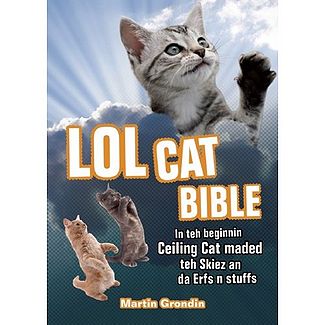
A few weeks back I posted an entry on Andrew Schlafly’s misguided (imho) Conservative Bible, devoid of liberal bias. Since then Stephen Colbert’s interview with Schlafly has been making its rounds on the internet and thousands of people are now aware of the project and its biases. I stand by my original objection that biased translations are unfair representations of the actual ancient texts. But it looks now like I’ll have to be eating crow. A new translation is scheduled to arrive in stores next month, and it looks like it may have a bias. Still, it is a translation that no internet-savvy reader can afford to ignore. Yes, the Lolcat Bible is nearly ready to pounce from the press.

The culmination of the Lolcat Bible Translation Project, over two years in the making, a Bible in Lolspeak will soon be available. Comparing what I’ve seen of the two projects, I think there is more truth in the Lolcat Bible than in the Conservative Bible. I’ve studied more ancient languages than any sane person rightfully should, but I do rely on my able research assistant (aka daughter) to help read Lolspeak. She suggested the title for this post, but the full text reads, “Im in ur blogz, postin mah wurdz of wizdum.” That’s straight from the mouth of Ceiling Cat!


Feline Angels and Demons

Happy National Cat Day! Well, to you readers in the States in any case. October 29 has been declared National Cat Day, and as a blogger who has frequently posted on ancient cats, I feel a sense of duty to include our feline friends in today’s entry.

Elsewhere on this blog I have extolled the divine nature of cats. The Egyptians revered them to the point that killing a cat was a capital crime, but the evolution of domestication was probably very practical. Domestic cats appear in the archaeological record along with the advent of grain silos, also an Egyptian invention. When the grain attracted rats, the rats attracted cats, and the cats stole Egyptian hearts. Even before the Egyptians, however, archaeology points to associations of cats and humans in Neolithic Jericho, perhaps the oldest city in the world. As early as 9000 years ago, cats were stalking the allies of the city of the moon god. They have been among our most loyal companions.

The domestic cat’s spread into Europe only began in earnest, it seems, when Christianity reached the continent and the cat was no longer considered divine. Perhaps cats had to be profaned before being admitted to the church’s roster of approved animals. Nevertheless, under the influence of a predominantly Christian milieu, in the Middle Ages Europe had come to see cats as the demonic companions of witches and vampires. Did some memory linger of the divine cat of Egypt? Did those dark days of suspected sorcery glance back to the magicians of Egypt and their suspect pets? We will never know the answer as to why cats, long encouraged to join human households, became evil in superstitious Europe. Even my stepfather in the twentieth century America counted to ten after spotting a black cat, and followed the count with a solemn cuss each and every time.

I, for one, cast my vote on the side of the felines. I don’t have cats (allergies and irate landlords, and such), but I enjoy them when I visit those who do. Sure, they rip up furniture and bring unwanted gifts of dead things to you as a kind of feline worship, but with their loving nature I simply can’t see a devil in our everlasting cats.

Swiped from Dr. Jim's Thinking Shop

(Swiped from Dr. Jim’s Thinking Shop)


Bes Leave It Alone

One of the constant enjoyments of teaching is the interactive learning that takes place. I tell my students that I learn from them just as they learn (hopefully) from me. One place this has been happening regularly is in an Ancient Near Eastern Religions class I teach. Students have to provide weekly class reports on somewhat obscure deities that I chose for them to research. One of the groups was assigned Bes, the minor Egyptian protective deity, and their research had uncovered the suggestion that Bes may have originally been a cat-deity. As Halloween approaches with its plethora of black cats, I found this connection to be fascinating.

The Egyptians domesticated the cat, and revered it. The nimble catcher of vermin (although, in all fairness, vermin are only doing what vermin have evolved to do), the cat was seen as a protector. When in need, why not call upon a deified cat, an everlasting cat, if you will? It makes sense that Bes with his stubby proportions and bewhiskered face, often portrayed poking his tongue out, might have evolved from a feline original. His iconography often features leonine imagery as well. We may never know his true origins, but Bes was widely recognized in the ancient world as an effective protector.

Bes

Back in 1987 I volunteered as a digger at Tel Dor in Israel. This was my first exposure to archaeology, and I loved every bit of it. The digging, the expectation of discovery, the honest physical work, the endless bouts of Herod’s revenge — well, some parts were better than others. One of the artifacts I discovered was a sky-blue faience head of Bes intended, apparently, to be worn on a necklace (there is a hole drilled through his head). I also found two bronze seed-beads that went with the necklace in the same matrix. Often I have wondered who, in an Israelite context, wore that amulet of Bes and what fate befell the wearer nevertheless. Bes is paradigmatic of our trust in help from beyond, but every once in a while even Bes ends up being dropped in the dirt only to be dragged out again by some future cat.


Evolution of Egyptian Cats

The Egyptians were the first people to “domesticate” cats. Perhaps taking their cue from their pets, they very early venerated cats as divine. Cats were, however, working animals that controlled vermin and poisonous creatures that violated the principle of stability that the Egyptians so valued. From the earliest records of the Old Kingdom we find the goddess Mafdet portrayed as a cat. Her name translates to “swift runner” and she was protector of Pharaoh, and thus of all Egypt. She was also associated with justice, a role reprised by Puss-in-Boots in Shrek 2. The hearts of evildoers were ripped out by Mafdet and brought, like a dead bird or mouse, to the Pharaoh.

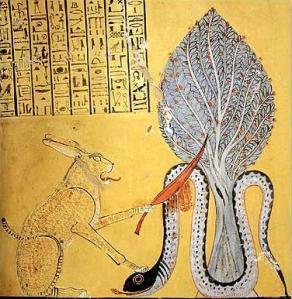
Mafdet? (Don't give your kitty knives!)

Mafdet? (Don't give your kitty knives!)

Mafdet’s fame declined with the rise of Bast, or Bastet. Bast (“devourer”) was also an early goddess, associated with the sun, and like Mafdet, she was a fierce protector. Her cult was centered in Bubastis, a city named for her. The guardian of Lower Egypt, she kept the kingdom safe from cobras, scorpions, and presumably hair-balls. Unlike the gentle kitties of today, she was also represented as a lion, a goddess of war.

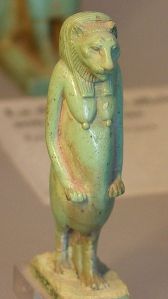
Bast, all grown up

Bast, all grown up

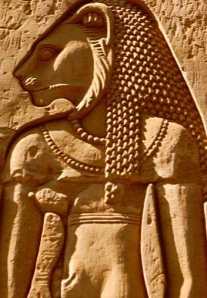
Bast’s fortunes faded with the rise of Sekhmet, the warrior goddess of Upper Egypt. With a name translating to “powerful,” Sekhmet was yet a third feline protector. She was also a lion-shaped goddess whose breath created the desert. (I have worked for human beings who could justifiably make that same claim.) Like Bast, she wore the sun on her head and became Egypt’s version of the violent goddess. Ancient peoples all feared the raging goddess, no matter what name or shape she took. Perhaps they always expected bad behavior from men, so when female deities got in on the act it was all the more powerful.

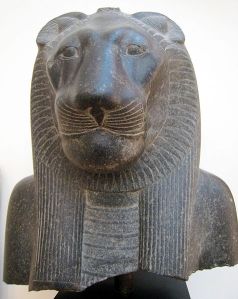
Sekmet with the breath that sank a thousand ships

Sekmet with the breath that sank a thousand ships

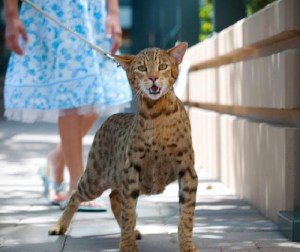
Where does evolution go from there? Is it merely coincidence that the Ashera Cat is part African Serval (as was perhaps the original Mafdet) and that it is being billed as the royal cat? I think not! Cats have a long pedigree with the divine, and from what I’ve been reading, Ceiling Cat has a very wide following. Evolution of the Egyptian cat, it seems, takes us from the Old Kingdom right up to Lolcats.


Of Cats and Goddesses

During one of my periodic forays into current Asherah lore on the web, I discovered a new breed of cat. Well, actually, I didn’t discover it, I just became aware of it. Because of a misspelling on a website I learned that the Ashera (trademarked name!) is the most expensive cat in the world, retailing for $22,000. A blend of three species (the mind boggles), the African Serval, Asian Leopard, and domestic cat, this feline comes in at least three varieties, including the especially appropriate Royal Ashera. If you’ve come into an inheritance and want to waste a few grand, take a look at Lifestyle Pets to see the wonder.

According to Kirta she has a temper!

According to Kirta she has a temper!

Curious, I searched to find if anyone would tip a hand as to where the name of the cat was derived. Choosing the name of the queen of the Ugaritic divine world seemed a little too much coincidence for me, but then again, homophones happen. When the Prince of Egypt, Dreamworks’ answer to The Ten Commandments, was released, I had several people ask me why the Israelites were singing about “Asherah” after they crossed the Red Sea. I had to watch the movie very closely, but I figured out that they were singing “I will sing,” which, in Hebrew, sounds suspiciously like “Asherah.” I never did discover Ashera’s origins.

Cats, however often maligned as associated with witches and vampires and other creatures of the night, are certainly among the most divine of domesticated pets. If I were free to purchase an animal companion the Ashera would be in the ranking (after I’d won the lottery, of course). Whether intentional or not, who would not want to own a cat named after the only goddess to be mentioned in connubial relations both to El and perhaps even to Yahweh? (The latter association, like the naming of the cat, is entirely open to question!)


The Lady or the Lion

Ancient West Asian society utilizes a striking image that causes no end of confusion — the lady and the lion. Although not always identified, the lady generally appears to have been a goddess. Pairing a female figure with the most ferocious predator known in that society ripples with significance; there can be no question that the cultures involved were patriarchal, a fact of life in that part of the world at that time. If it was a man’s world, why depict the glorious lion with the feminine? Because we fear what we cannot control?

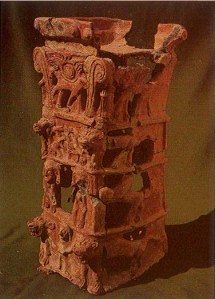
The infamous cult stand from Taanach

The infamous cult stand from Taanach

Ostensibly the rationale for this correlation may be traced back to Ishtar, the goddess sine pari of ancient Mesopotamia. The exact reason for her leonine associations is unknown yet she is among the fiercest females connected to warfare and strife in the ancient world. Her lion companions ranged over the realms of the Levant where other goddesses also assimilated her imagery. Curiously, one goddess who has no specifically leonine attributes is Asherah, the consort of the god most high, El. In Egypt the fierce goddess associated with war was Sekmet, often portrayed with a curiously male lion head.

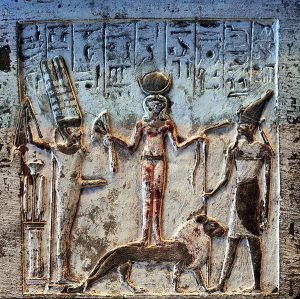
Min, Qedeshet, and Resheph — a ménage à trios?

Min, Qedeshet, and Resheph — a ménage à trios?

In an earlier post I suggested that the biblical prophet Amos may have known that lionesses generally make the kill. Could it not be that although most women were locked out of public power structures in the ancient world they still may have retained the utmost respect and reverence of the populace? Long before male monarchs claimed titles such as “Lionheart” even gods would tremble before an enraged goddess. Morphed through time and continued patriarchal culture, the connection once again recurs in Frank Stockton’s The Lady or the Tiger where the metaphor has lost its teeth and the lady is no longer the source of destruction, but of male desire. Has the male prerogative once again usurped feminine independence? If only Ishtar or Sekmet could have been behind door number three!

Behind door number 3

Behind door number 3


More Biblical Cats

In the Bible there are no cats. This silence is odd since cats have been associated with humans for over 9,000 years. Large felines, of course, appear in the Bible; lions and leopards prowl sacred writ, but nary a housecat. In a world of subsistence farmers, the concept of a “pet” is also absent — an animal as part of the household is yet another mouth to feed. The closest we get to biblical pets is in Nathan’s parable to David about Bathsheba. Here the “pet” is a lamb — a potential source of wool and almost certainly a funeral involving roasting and possibly mint sauce.

The Israelite view on animals is difficult to assess fully. Clean and unclean classifications seem to relate to predatory behavior and “fitness” for an environment. As a notorious but useful predator, cats could have been somewhat of a religious embarrassment. Having tamed feral cats, I know that the key is to make repeated offerings to a cat (by the way, this is the advice of Old Deuteronomy in Cats). Being quite self-sufficient, cats can find what they need without human, or divine intervention, thank you. Perhaps feline behavior resembles that of the gods a little too much for people inclined towards henotheism?

In the beginning was the cat

In the beginning was the cat


The problem with predators is no one knows what they’ve been eating. Predation involves bloodshed and blood pollutes. Look at what the cat dragged in! Biblical cats are victims of argumentum ex silentio — we can never know why they don’t merit a mention. As carnivores they are necessarily unclean. By the Middle Ages, for reasons still unclear, the church and superstition rendered cats as the familiars of witches. Ironically the associated killing of cats likely helped to spread the Black Death because of the removal of the flea-bearing rodents natural predators. In most ancient cultures cats are credited with supernatural powers. Since the Bible strictly guards this privilege, perhaps cats stepped just a little too close to divine prerogatives to merit a mention in the Good Book.


Everlasting Cats

“The mystical divinity of unashamed felinity, round the cathedral rang ‘Vivat!’ Life to the Everlasting Cat!” I’m not sure if this is T. S. Eliot, Andrew Lloyd Webber, or a chimeric mix of the two, but it is an interesting bit of mythology. My daughter is the consummate Cats fan and has been asking me to write a post on Cats and religion. When I read (or hear) the above lines of poetry, I must confess, my mind wanders to Xenophanes who stated that if horses could draw they would draw their gods like horses. Ditto for cats.

Everlasting cats, however, have their roots deep in religions of the ancient world. Although the word “cat” never occurs in the Bible (“dog” is there plenty of times, with even a “bitch” or two) cats are certainly within the biblical culture. Eternal Egypt knew of an everlasting cat — Bastet, the “cat goddess.”

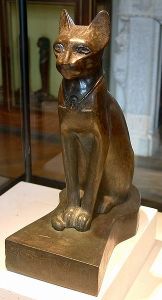
Bast to see this as an everlasting cat

Bast to see this as an everlasting cat

Hailing from Bubastis, Bastet (I just can’t call her Bast, since it sounds like slathering meat with some kind of ambiguous liquid, something I can’t stomach as a vegetarian) seems likely to have some connection with the sun. Regarding yesterday’s post, the ancient Egyptians had a plethora, a veritable superabundance even, of solar deities. Bastet was called the Eye of Ra. She was also associated with war, appropriate enough to anyone who’s read Erin Hunter’s Warrior series. As a goddess, Bastet qualifies as an everlasting cat.
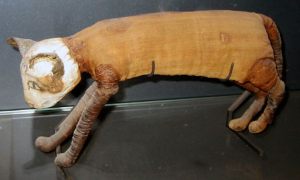
Little Bastie doesn't seem so playful any more

Little Bastie doesn't seem so playful any more


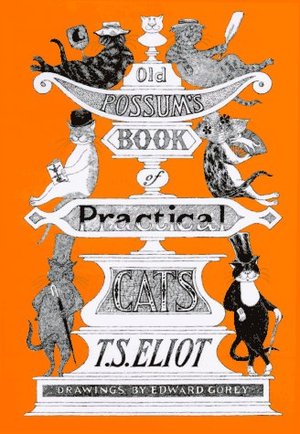
So do the numerous cat mummies from ancient Egypt. Preservation of the body was an aspect of realizing life beyond life for the Egyptians. It would also obviously help to keep the mice out of heaven. T. S. Eliot was C. of E. (Church of England, not Copt of Egypt) and had a savvy sense of wit. Ignoring the biblical snubbing of cats, he named the wisest and most respected of Old Possum’s Practical Cats with a biblical name — Old Deuteronomy. Although I am not a cat owner (is anybody really a cat owner?), I do have great respect for felines, mystical or not. And I am not alone as long as the ancient Egyptians kept a mummy or two around and an Eye of Ra to keep that solar barque on its course.


Not Lion

Being raised without much of a paternal presence, I frequently wondered at how church services were always presided over by men but populated by women. When I grew up (well, part-way at least) I became interested in feminist interpretations of the patriarchal Bible. The idea that just half of the human population seemed to have all the interpretive privileges simply struck me as unfair. Being a man myself, however, I wasn’t sure where to go with feminist interpretation, or even if I was qualified! This penchant no doubt vexed many an official in my Nashotah House days, but the conviction only grew stronger there.

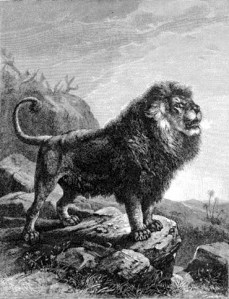
While preparing class materials on the prophet Amos, I recalled how fond the prophet was of leonine imagery for Yahweh. Amos characterizes Yahweh as roaring, hunting for prey. Curious about lions in Israel, my research revealed that the great felines are extinct in that part of the world. The Barbary lion, extinct in the wild, was the biblical lion. As usual, we kill off what we don’t comprehend.

Further research revealed that lions like to sleep even more than most teenagers. It is not unusual for a lion to sleep 20 hours a day! When they have to wake up, however, they are hungry. And here was the interesting tidbit — when lions hunt it is usually the females that do the work! Once a kill is made, the male struts in and takes the proverbial lion’s share, but the lionesses are the hunters. In the ancient world, before television, ipods, or even mindless Ann Coulter drivel, people were keenly aware of their environment. Ancient writers often made astute observations of nature. Would Amos, the shepherd, have known that it is the lioness who makes the kill? Was Amos the first feminist in the Judeo-Christian tradition?

Compare the lions.

Compare the lions.


Which is scarier?

Which is scarier?