Animal Rains

We may have been to the moon—if not personally, collectively—but we still don’t control the weather down here.  It’s probably not news that the eastern part of the country has been getting a lot of rain lately.  One of the factors that led me to write Weathering the Psalms was the overwhelming tendency for humans to attribute weather to the divine.  It used to be that we couldn’t reach the sky, so placing deities there seemed a safe bet.  Now that we’ve shot through the thin membrane of atmosphere that swaddles our planet, we’ve discovered beyond a cold, dark space liberally sprinkled with stars and planets but mostly full of dark matter.  The deity we thought lived beyond the sky somehow wasn’t anywhere our probes flew and recorded.

Still, down here on the surface, we live with the realities of weather and still think of it in terms of punishment and pleasure.  When we don’t get enough rain, God is destroying us with drought.  Too much rain, and the Almighty is washing us away with flood.  The true variable in all of this is, obviously, human perception.  Sure, animals experience the weather too, and they sometimes look to be as disgusted as humans when it snows too early or too late, or when the rain just won’t stop.  I have to wonder if somewhere in their animals brains there’s the seed of an idea that the bird, or squirrel, or woodchuck in the sky is angry at them for some unspecified faunal sin.

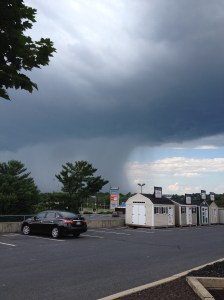
While heading to the store yesterday, after weather reports assured us the rain was finally over for the day, the skies told a different story.  The vistas around here are never what they were in the midwest—or what they are in Big Sky country—but the approaching storm was pretty obvious.  An opaque drapery of precipitation was coming our way and although a rainbow would cheekily show up afterward, knowing that we’d been caught away from home with our windows open felt like punishment for something.  Perhaps the hubris of buying a house when all I really require is a corner in which to write.  Somewhere in my reptilian brain I translated a natural event into a supernatural one.  When we got home to discover the storm had gone north of us, it felt like redemption.  I spied the birds sheltering in shadows from the sun’s heat.  Were they thinking it was some kind of divine avian displeasure, and hoping for some rain to cool things off for a bit?  If so, was our religion correct, or was theirs?


False Memory

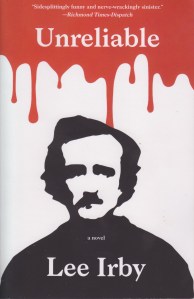
One of the reasons our recent loss of books hit me so hard is that each volume contains memories.  Among the more disturbing developments of memory studies in recent years is the fact that what we remember has a tendency to be unreliable.  In other words, our narratives about ourselves contains a good deal of fiction that we remember as fact.  Even if we write down our impressions shortly after an event, such scribbles are just that—impressions.  Lee Irby explores this dynamic in his novel Unreliable.  Now, since the narrator may be the most unreliable I’ve ever read, I don’t want to give away too much.  Irby knows what it’s like to be a professor (something that some of us share with him) and he has a good sense of Edgar Allan Poe.  It’s one of those books that touched on a number of things in my own life.  I think.

First of all, this was an impulse buy at Buffalo Street Books in Ithaca, New York.  I soon discovered why they stocked it.  Edwin Stith, the narrator, teaches at a fictional college in Ithaca.  The story, however, is set in Richmond, Virginia, where Prof. Stith has gone for his mother’s second wedding.  With characters compellingly drawn, he meets his new step-family, runs into an old-girlfriend, and tries to both avoid and hook up with a student of his that he’s dating, more or less.  He claims from the start, however, that we shouldn’t believe him.  The largest part of the story takes place over one feverish day following a very late arrival in town, with plenty of Poe references sprinkled throughout the tale.

Apart from the Ithaca and former professor connections, the book also mentioned, rather spookily, meeting a girl from Slippery Rock University—a rather obscure school from my old neighborhood.  I had dated a Slippery Rock co-ed who’d proved about as unreliable as our narrator, so this single, brief reference managed to jump-start some of my own memories, reliable or not.  Our pasts, along with the books we read, make us who we are.  I’ve lost track of how many times I’ve thought of a scene I’d supposed I’d forgotten from a book I’ve read years ago.  Just the other day I recalled, completely out of of the blue, apropos of nothing, a scene from a Doc Savage novella I’d read as a tween.  Was it a reliable memory?  I have no way to judge, I guess.  And that’s the scary part, as I’m sure Poe would’ve agreed.


Final Leg

Travel is a form of education.  You won’t get college credit for it (unless some administrative footwork is involved), but it is a means of learning.  One of the things you pick up flying coast-to-coast is how exhausting a day on a jet can be.  Quite apart from jet lag itself, the weariness of occupying your minuscule allotted space in a pressurized cabin can be intense.  And like ocean travel by ship, you have to dock at a distance to use smaller and smaller forms of transportation to reach your destination until at last you walk inside.  This was the first year that such a trip ended by returning to a house rather than somebody else’s rental unit.  It’s an odd feeling.

Work starts again tomorrow, and since I’ve been pretty much unplugged for an entire week, I know chaos awaits.  I also have the task of learning what has happened in this off-kilter world for the last week.  And then I have to make an inventory of the books that were ruined in our own personal Noah event just days before our flight.  The changing of scenes feels rather like a jump-cut in a movie.  Suddenly you find yourself somewhere different, with circumstances that have their own set of parameters.  Vacation time, in a sense, is like a dream sequence.  None of the episodes from back home can reach your sleep-addled mind.  And then you wake up.  Bills are due.  The lawn wants cutting.  The unpacking must continue.

For all that, it feels as if something transcendent happened.  Like Elijah being whisked away in his own personal whirlwind, I was on a plane that took me to a different plane of existence.  A place where no matter what decisions were made the outcome would be pleasant.  Coming home involves what theologians like to call “metanoia,” a sense of transformation—memories that give you strength to carry on the quotidian tasks that make up the vast bulk of our lives.  Lakes in the mountains are all fine and good, but society demands its pound of flesh, and the way they get it is through productive employment.  Tomorrow it’s back to work, a chance to test just how successful the metanoia might’ve been.  This is the reason we traveled on a Saturday, for the sabbath should be a day of rest.  No one knows where that whirlwind set Elijah down, but it’s virtually certain that he had plenty to do once he got there.


Hearing Nature’s Voice

Silence is a rare treat.  I enjoy music and witty repartee just as much as the next guy, but silence is revelatory.  At home and in hotels I sleep to the sound of a white noise generator.  You can’t predict the sounds of neighbors, and my hours are askew from those of the rest of the world.  Here at the lake, things are different.  I awake early, hoping to catch the sun as it trips over the mountain tops across the way, lighting successive peaks before it reaches the near horizon.  It is utterly still.  Perhaps it’s the interference of humans in the habitat, but crepuscular animals seldom wander past.  The stillness is divine.  For some the lake means loud jet skis and buzzing motorboats.  I come here seeking silence.

Our daily lives lack peace.  Even when things are good there are always more things to be done.  We cram as much as possible into days impossibly short, giving at least eight out of every twenty-four to those who deign to pay us for our efforts.  Sleep is troubled and interrupted.  There are noises in the night.  You can’t hear your soul.  As the first rays seep into the valleys across the lake the birds begin to greet it.  Their conversation may interrupt the silence, but it doesn’t break it.  Silence is finding one’s place in nature.  Taking time to be still.  To listen.

Thirty years ago I first came to the lake.  My wife had been coming here for years already before that.  There have been many changes even in my short time here.  I can, however, hear eternity in the silence, for forever is a whisper, not a shout.  As I watch the morning mist arise, skate, and dance over the surface of the water as still as the very mountains that cradle it, I strain my ears to catch any sound.  The twirling wraiths are as silent as they are ephemeral.  They spin away the last minutes before the whine of an early morning fisherman’s boat begins its sleepy journey to the deep water in the middle of the lake, herald of other daylight noises to come.  I will await tomorrow’s unction of silence, and although the baptism may be secular it’s redemptive after all.  Nature knows far more about the human soul than any measurements might reveal.  You only have to listen to hear it.


Not Final Words

When death’s not the final word, it’s hard to argue.  This is such a basic level of disagreement between religions and culture that it may be impossible to avoid conflict.  Not that I condone it, but a couple in Oregon, members of the Followers of Christ Church, let their newborn die rather than seek medical attention, according to a Washington Post article.  I have to admit that the Followers of Christ is a sect of which I’d never heard—there are thousands of such groups—but I’m guessing that at the base of their refusal to seek help was a deeply held belief in the afterlife.  Almost impossible to comprehend unless you’ve accepted it profoundly yourself, this single teaching is a game changer.  The child who dies, although tragic from our perspective, has not, in the eyes of a religion transcending death, lost anything.

It’s sometimes difficult for us to to realize just how radical a teaching Christianity was in its early days.  The myth of the martyrs may well have been overblown, but the fact is here was a sect that didn’t fear death like the vast majority of people do.  Resurrection is a powerful concept.  Those who truly believe in it have nothing to fear.  Modern-day sects that take this seriously may respond quite differently to crises than “normal” religions.  In a situation Niebuhr would’ve recognized, this “Christ against culture” outlook is never easily resolved.  True believers will accept punishment on the part of secular authorities as a form of martyrdom.  The fear of death on the part of the vast majority of people outweighs, I suspect, professed belief in the afterlife.

Place the current political climate into the mix and the colors will become even more vivid.  Extremism is the flavor of the day.  Mainstream Christianity, for all of its problems, has sought a balance between accepting the benefits of medical science—the social acknowledgment that taking an infant’s life is inherently unfair and unjust—and an official belief in an afterlife.  It allows for a fairly comfortable existence of accepting belief without becoming the radical threat to a materialistic society that more extreme sects represent.  In a nation where no controls exist because of the power of office favors those who believe in nothing so much as themselves, and even the rhetoric of right to life becomes meaningless.  Sects and violence, to go back to my roots, sleep peacefully side by side.  And when awakened, the right to be conceived can’t be extended to life beyond the womb for those who believe death’s not the final word.


Not Quite Eschatology

Realized eschatology, if you’ll pardon my French, is a term that describes the “already/not yet” aspect of the “end of the world.”  In other words, some theologians suggest that the eschaton—the end—has elements of both the present and the future in it.  The term came back to me yesterday as we returned to our old apartment to take care of things the movers left behind.  (And “left behind,” I realize, isn’t really a biblical eschatological concept at all.)  Joined by our daughter, I felt a bit resentful of her time being taken from our new home to spend in the old.  I felt an almost adulterous desire to leave the old and cleave to the new—hadn’t we already paid, and overpaid, for that apartment many times over?  The house, on the other hand, is new (to us) and still requires much attention.

As we organized the remaining items, broke down boxes we didn’t use this time around, and waited for the Got Junk guys to arrive and haul it away, I noticed our daughter gazing wistfully at the empty space that had once had our imprint all over it.  It dawned on me that she’d spent her teenage years here—after the Nashotah House debacle, this was the place she’d lived the longest.  This empty apartment was, for her, home.  I began to feel insensitive about my earlier anxiety to leave.  We all live between at least two worlds—our pasts make us who we are in the present.  The world of our teenage years is fraught with emotion and memory.  The world looked so different at that time, as I sometimes forget.

Moving is one of the most stressful situations human beings encounter.  We have a love/hate relationship with our past.  To me the apartment represented a place we occupied out of a kind of desperation.  Five states to the west, we had to move to New Jersey with little money and tons of boxes—one of them Pandora’s, with hope nestled inside.  We told ourselves the apartment was temporary—maybe a year—only until we could buy a house.  Twelve months turned into a decade, then more, with each year accreting memories in every crack and corner.  Part of us will always be in that apartment, for every place people have lived before is haunted.  On our way back to our new home at the end of the day, we were each lost in our thoughts.  Perhaps not so much realized eschatology as experienced reality, we’d spent a day in a present that will never fully arrive.


Breaking Day

When does the day start?  Years of awaking around 3 a.m. may have distorted my perceptions a bit, I suppose.  Here in the mid-Atlantic states, the sun is never up that early.  Year round I get out of bed when it’s still dark.  I’m not complaining—this is generally a peaceful time, a rarity in New Jersey.  If the bus didn’t come so early I’d get an awful lot done in a day.  But when does the day really begin?  I rise early to write.  Computers have changed my writing style quite a bit.  I used to write everything by hand.  Even as a kid with a second-hand typewriter, I preferred longhand first.  I still do, truth be told.  It’s slow, though, morning’d gone before I got too far.

So I get up and boot up.  I’m not sure that I’m crazy about my computer knowing so much about my personal life, but one thing it simply can’t understand is that I’m an early riser.  Many days my laptop will condescendingly ask me if I mind if it reboots—it’s been updating software when it thinks I’m asleep.  For the computer, day doesn’t begin this early.  Sometimes I worry that my blog doesn’t get readers because the new posts come up around 5 a.m., before I jump in the shower and head for the bus.  If things don’t appear in the feed at the top of the page, well, they’re old news.  I admit to being guilty of that myself; yet knowing when it’s day has consequences.  Maybe I should be posting a bit later?

For some reason my computer likes to send me notices.  Like I’m not already paying attention.  I’m sure there a setting someplace I could change, but I’m busy most of the time and figuring that sort of thing out takes longer than I have time for.  Birthday notices for complete strangers—maybe they’re connected on LinkedIn?—appear, at 9:00 a.m.  I’m at work already by then.  I think this is my devices’ way of letting me know that it’s a nine-to-five world.  As an erstwhile academic I never cottoned onto that.  I started getting out of bed at 4 a.m. when I was teaching so I would have time to write before daily chapel.  I also taught classes that ran from six-to-ten (p.m.) while at Rutgers.  When does the day start?  When does it end?  The decision’s not mine, as my laptop’s only too happy to remind me.


Homo Labelmaker

It’s okay to hate the white man. Mitch McConnell has become the icon of what “the white man” really is. Hatred can be just. Even the Good Book says, “I have hated them with a perfect hatred.” I am not a white man. A few months ago I took a community course on racism. The only male participant in the class, as it turned out. The teacher at one point, asked me my race. I answered that I don’t see myself as having a race, nor do I see other people as having races. We are people. I am not white. He is not black. Being “white” seems a choice to me, a mindset. To me, it is a marker of privilege. If you grew up in poverty, you’re only white if you choose to be. We must get beyond our simple labels.

Believe me, I know the counter-arguments. Our shameful history allows no one to forget. As someone “not of color”—who wants to be colorless?—I am automatically privileged. I’m treated differently by others simply because of the way I look. I don’t like that, because I believe in fairness. It’s part of evolution. The point is that since race is a human construct, we should be able to deconstruct it. Privilege thrives on feeling special, better than others. The white man is the GOP, even the female members of the party. The white man is one who gloats that checks and balances can be destroyed so that he always and forevermore will win. The white man is a slaveholder. I choose not to be a white man. I choose to join the entirety of humanity. Personhood over race.

Christianity, ironically, has been dragged into this distorted outlook. It is seen as the white man’s religion. Women, in this view, are explicitly subordinate. While the New Testament says little about race—one of the earliest converts was an Ethiopian eunuch—it was written and lived out in a Jewish milieu. White men like to select verses from the Good Book to take out of context to support their own wishes. It’s very convenient to have God on your side. If we decide to deconstruct this view we have to insist on refusing to be labeled. That’s not to condone the sins of racism past. The white man doesn’t believe in evolution because that makes race random rather than a deliberate act of God at the appropriately named tower of Babel. Besides, the thinking goes, any creature not human is here for exploitation. God, according to the Bible, is so colorless as to be spirit only. To be god-like is to reject labels, for spirit cannot be seen.


Evangelical Angst

Unless you know what it’s like to face life with no real prospects beyond making it to Heaven when you die, you can’t understand evangelical angst. That last phrase might seem odd to you. Aren’t evangelicals uber-smiley, happy people angry over the way society’s going? Yes and no. Many of them were raised (or converted into) a faith that holds out no hope for this world and that constantly reinforces the idea that what we like is bad. Having grown up in that world, I knew what it was like to be hoodwinked by an evangelist. I can’t remember the guy’s name, but he was famous. He came to my small town and packed a local Methodist Church. During his rambling, long sermon, he had us afraid for Hell burning under our feet. Grateful that we’d just managed to avoid it, he announced there would be three collections that night: the first was your normal tithe. The second time the plates came around you were to empty your pockets and purses of all change. The third time, you were to contribute to his private jet. If you gave over a thousand dollars your name would be inscribed on a plaque inside.

Almost as if nothing has changed in the decades since then, a Washington Post story expresses amazement that evangelist Jesse Duplantis is asking his followers for a fourth private jet. Uncomprehending, the world doesn’t show much curiosity as to why otherwise intelligent people would give to what is so obviously a scam. Or why such people would vote for Trump. The academic world doesn’t understand evangelical angst. As I sat in that audience that night, a poor kid from a poverty-level family, I fervently wished I had more money to give. Until he asked for his plane. My young doubts crept in, for I had more angst than most other evangelicals I knew. Was this really the Gospel?

Later I saw him on television. His personal mansion had literal streets of gold. Jesus, he said, wanted us to get ready for Heaven right here on earth. Did this turn his followers against him? Decidedly not. In fact, he may have believed it himself. You see, neuroscientists have learned that our brains have the evolved capacity to hold and dismiss reason simultaneously, for strong emotional stimuli. Sex, for example, or music. Or religion. These can motivate people beyond the realm of logic, and they often do. Evangelical angst says you’re not buying a scam artist a jet to spread the Gospel, it says your trying to avoid Hell. Rational or not. And that, it seems to me, is more than adequate ground for evangelical angst.


Rains and Bows

It’s raining and I’m here for an outdoor event. Here, in this case, is Ithaca, New York. The event is the parade that’s an integral part of the Ithaca Festival. As people have been laying out their chairs and blankets along the route since morning, it’s a fair guess that if we don’t stake out our few feet of available public space we’ll miss the parade. And yes, it will rain on my parade. The problem is waiting in the rain. With one hand holding an umbrella and water getting in anyway like a leaky roof, there’s only so much you can do. Reading a book—my default activity—is out of the question. I know very few people here and since I’m acting as a placeholder, there’s nobody to talk to. Tom Petty was right after all.

The parade itself turned out to be a celebration of diversity. Ithaca is what America could be. The various liberal organizations, eager to educate, marched by to cheers and bonhomie. There’s nobody judging here. This became clear in a particularly striking juxtaposition (for which I have no photos, because it was raining) in the parade lineup. A group of Mad Max-themed metal rockers went by in a gnarly truck decorated with torches protruding from fake human skulls. Dressed in future period costumes from the movie diegesis, they produced the guttural, primal roar that is an accusation against current society. Then, like Mel Gibson shifting to The Passion of the Christ, the group immediately behind was a Bible Baptist Church. Add water and mix.

For this I’d sat in the rain for a couple of hours. Forced to relax, I watched the water on the fabric over my head as beads crawled together, joined one another, and scurried, animal-like, from the umbrella to the ground. The drops may look uniform from a distance, but they’re diverse. They come in different sizes, and perhaps because of the distorting character of the nylon, they took different shapes. Placed together in one location, it was natural, it seemed, for them to come together for a common goal, which was the ground. There was a parable playing out here right over my head. While it didn’t seem to be the case at the time, it clearly was a lesson to be shared. Had it been sunny, I would’ve been reading a book. Sometimes it takes sitting in the rain to learn something that should be obvious no matter what the weather.


Eternity, Technically

When the robot uprising comes, we have a factor in our favor, we biological beings. That is our parts, although they do break down, generally heal themselves. I write this as kind of a forecast, because I’m not at home due to the holiday weekend, and neither is the internet at my home. You see, our internet service (which is not cheap) has been going out from time to time. Our service provider thinks it may be old parts. The box was installed in our basement over a decade ago and when the technician sent me down amid the cobwebs before leaving town I had to report to her that all cables were hardwired into the box. No clip and slip here. She thinks the cable has gone bad.

The cable just sits there. It never gets moved or jostled. How it could fail I don’t know. But the consequences are two. There may not be posts on this blog for a while once I return home. I’ve posted every day, holiday and secular-day, for years now. Technology, however, is a jealous deity and will not permit humans taking it for granted. The second consequence is more optimistic; when the robots rise up against us, their parts will wear out and they won’t be able to regenerate them organically. They’ll need to order them and hope they can find a delivery system even more efficient than Amazon’s. Good luck with that! I ordered a book the other day and less than 24 hours later it was at my door. That’s service.

I decided to post this advance warning so there may be no weeping and gnashing of teeth (please—dental work is expensive!) on Monday or Tuesday when no new post appears on this blog. It’s not that I’m not thinking of you all, it’s just technical. Robots may run system tests, but can they feel it in their bones when something’s about to go? Do they indeed sing the body electric? Can they feel the poetry they write? To be human is to think with our emotions and to reason ourselves out of irrational angst. I see the slaves to technology putting on weight as they rely more and more on labor-saving devices to make their lives automated. I’m guilty too. As I sit here many miles from home, however, I worry about the internet back there. Is it sick? Is it dying? And if so, to which mechanical god should I pray to save its technical soul?


Creating Afterlife

Once upon a time I wrote a book on commuting. It never got beyond my laptop, but I often wonder if it was simply premature. Some stories from public transit can be quite amusing. A few weeks ago I posted on how a woman spoke up after our bus missed it’s turn off the highway and made us all late for work that day. No matter what you think of developers and speculators, one thing we can say for certain is they lack imagination. If you’ve driven this stretch of highway 22 you know that the exits look very much alike. Early in my commuting days a young woman took the empty seat next to me on the way home and asked where we were. “I miss my stop because they all look alike to me,” she explained. She had a point.

So one morning last week I was in my usual seat, reading along, when the driver—new to our route—missed his turn off the highway. The same woman (for we are mostly regulars at this forsaken hour of the morning; if this doesn’t ring a bell search this blog for “commuting”) said, “No need to turn back, they have another bus coming.” I was pleasantly surprised at the learning that had taken place since the last time. I am, however, old enough to remember Greyhound commercials and their slogan, “Take the bus and leave the driving to us.” I also thought of those passengers waiting like evangelicals for the second coming for a bus that would never show up. Our gain in time was their loss. Such are the dynamics of life in a universe not built on the principle of fairness.

The bus can be a microcosm of the moral universe. Evangelists, for example, believe all people must have the opportunity to catch this express bus to Heaven. The bus that comes after the express makes more stops, somewhat like Catholic Purgatory, increasing the suffering for a while, but ultimately making the goal. Missing the bus completely are the Hell-bound for which some claim we must turn back while others insist we press on; there will be another bus. In this case, the same passenger insisted that we help those left behind just a few weeks ago. This led to lengthening of her own stay in Purgatory, so when it happened again she decided those waiting were simply too hard to reach. Or maybe she’d come to believe in predestination. Perhaps it was on some ancient bus that ideas of the afterlife emerged. Experience teaches that much depends on factors beyond your personal control.


Real Dreaming

I keep odd hours. Although we don’t live far from New York City, as the pigeon flies, public transit sets the schedule for my day. (I’m merely writing as a representative here, since I know others keep my hours as well.) Since I’m usually waking up around 3 a.m., I have to go to bed pretty early. One night recently I turned in around 8:00 p.m. and fell into a fitful sleep. When I awoke three hours later, it was as if my gray matter were a thunderhead. Ideas, worries, and memories flashing like lightning. Concerned, I watched the clock since I knew it was a work day. When three rolled around with no more sleep I hoped it would be like one of those rare days of interrupted rest when my conscious mind does just fine. Would it function that way on just three hours of sleep?

This incident brought home to me once again the mystery of consciousness. I had a meeting in New York I couldn’t miss that day, but by mid-morning (in real-people time) I was seeing things that weren’t there—an almost Trumpian dissociation from reality. Then I’d snap back to awareness and realize my mind was drifting off to steal some of the sleep it refused during the hours of darkness. Using the usual tricks I stayed awake for the workday and even for the bus ride home, with only brief momentary lapses where what had been reality had stopped making sense. Consciousness, it seems, functions best with a well-rested brain. A good night’s sleep put me back to normal the next day.

Reflecting back over that previous 24 hours, I thought how surreal they’d felt. Not to put too fine a point on it, but they were like an altered state of consciousness. Religions, some claim, began because of such altered states. They are strange and powerful. And fairly universal—almost everyone experiences them from time to time, whether by sleep deprivation, controlled substance use, or prayer and meditation. Even knowing the cause (going to bed with a lot on your mind when you have to wake early, for example) doesn’t change just how real the experience feels. This is one of the reasons that rationality doesn’t explain all of experience. In the same brain there are Jekyll and Hyde aspects to consciousness, interchanging with each other every few hours. As the movie Inception underscored, you don’t remember how you entered the dream. You’re just there. And when that world intrudes on the conscious, rationally ordered territory of wakefulness, the questions can become quite religious. Unless, of course, I’m still dreaming.


Zombie Wars

I suppose, rationally considered, most monsters can’t possibly exist. Maybe that’s the psychological relief required to enjoy the movies made about them. We can imagine the thrill, but we know we’re safe once we leave the theater. Culturally, monsters fight for supremacy. The early 2000s belonged to the vampire. They were everywhere. I once heard a literary agent advise wannabe authors to write on vampires since the publishing industry was showing no signs of slowing down on them. Then came the zombies. They’re still with us. World War Z came to my attention as a movie, but as one I never saw. I’ve watched many zombie films and none has lived up to the status of the spectacle that launched the genre, George Romero’s Night of the Living Dead. It remains a classic to this day. Still, I was curious and so I read Max Brooks’ World War Z: An Oral History of the Zombie War.

Let alone the chapter after chapter of tough-talking, cool-sounding reminiscers, I have trouble buying zombies. Yes, I get the scare factor, but maybe I’ve read too much science even to visualize myself into a fantasy world where a creature with no digestive system would be driven to eat. It just makes no sense. Human bodies can function with missing parts, of course, but without the integration of muscles, ligaments, digestion, and brain, it seems difficult to accept that they’d keep coming after you when they’ve been decaying for years. It’s all I can do to get out of bed most mornings, even as a healthy, living body. Analysts, I know, talk about zombies as metaphors, but with over 300 pages of stories in no way believable, I had to wonder about the limits of credulity. Maybe Carl Sagan was right after all.

I hope I’m not unsophisticated enough not to realize that the real point in Brooks’ novel is how the surviving humans treat each other. There is a moral to the story. We develop new and “better” weapons to kill one another. We’re smart enough to have world peace and prosperity, but wars are constantly erupting. We have a nation with many brilliant people and yet we elect a Trump. Self-destruction, it seems, is written into our genes. We consume one another. Even when the enemy is completely imaginary we find ways of believing. So I read World War Z, appreciating the irony. I still can’t get over, however, the trope that all you need is a human brain to want to destroy others.


Heavenly Questions

A lot can happen when you’re in a coma. Or nothing at all. I haven’t read Kevin and Alex Malarkey’s account of the latter’s trip to Heaven during a coma, and it looks like I never shall. A story by Kyle Swenson in The Washington Post explains how Alex Malarkey, now that he is no longer a minor, is suing Tyndale House over the publication of his Near Death Experience (NDE), penned by his father. The story, according to the Post, was a fabrication. Alex awoke from his coma recalling nothing, but Kevin knew a good thing when he saw it and wrote an account of the young boy going to Heaven. Alex says it never happened. The Boy Who Came Back from Heaven is now being pulled and pulped as a hoax.

NDEs are real (even if one didn’t happen in this case), but what they actually are is a matter of debate. The mainstream interpretation is that they are the last gasps of consciousness before a brain dies, temporarily. These often comforting thoughts can be quite similar in very different contexts and sometimes include the formerly deceased knowing details that they couldn’t possibly have witnessed in real life. Scientists willing to buck convention explore these episodes less with the intention of proving Heaven is true than with probing the idea that souls are real. That consciousness somehow continues. That life may, after all, be eternal. Since there are no scientific apparatus in the afterlife, there’s no way to measure or quantify such events. This leads most scientists to conclude that these are merely dying thoughts, or, as in the Malarkey case, hoaxes.

Ever since Raymond Moody’s Life after Life, confessional publishers—particularly of the evangelical brand—have promoted such stories. Religion and science, while not necessarily the cats and dogs they’re presented as being, don’t often coalesce around a common nucleus. Part of the problem is that spiritual events are beyond the reach of the scientific method since no laboratory conditions exist to test them. A number of scientists and medical doctors attest the reality of NDEs, but these occur in human consciousness—a realm of which we know little. Religious publishers know a good story when they see one since the doubts cast by science have to be regularly dispelled. The problem is the money such stories attracts also allures those seeking the fiduciary comforts of this material world. In this case, it seems, if you didn’t have the experience yourself you could capitalize on someone who did. Or didn’t. Those eager for proof are always willing to buy and sell the story.