Eternity, Technically

When the robot uprising comes, we have a factor in our favor, we biological beings. That is our parts, although they do break down, generally heal themselves. I write this as kind of a forecast, because I’m not at home due to the holiday weekend, and neither is the internet at my home. You see, our internet service (which is not cheap) has been going out from time to time. Our service provider thinks it may be old parts. The box was installed in our basement over a decade ago and when the technician sent me down amid the cobwebs before leaving town I had to report to her that all cables were hardwired into the box. No clip and slip here. She thinks the cable has gone bad.

The cable just sits there. It never gets moved or jostled. How it could fail I don’t know. But the consequences are two. There may not be posts on this blog for a while once I return home. I’ve posted every day, holiday and secular-day, for years now. Technology, however, is a jealous deity and will not permit humans taking it for granted. The second consequence is more optimistic; when the robots rise up against us, their parts will wear out and they won’t be able to regenerate them organically. They’ll need to order them and hope they can find a delivery system even more efficient than Amazon’s. Good luck with that! I ordered a book the other day and less than 24 hours later it was at my door. That’s service.

I decided to post this advance warning so there may be no weeping and gnashing of teeth (please—dental work is expensive!) on Monday or Tuesday when no new post appears on this blog. It’s not that I’m not thinking of you all, it’s just technical. Robots may run system tests, but can they feel it in their bones when something’s about to go? Do they indeed sing the body electric? Can they feel the poetry they write? To be human is to think with our emotions and to reason ourselves out of irrational angst. I see the slaves to technology putting on weight as they rely more and more on labor-saving devices to make their lives automated. I’m guilty too. As I sit here many miles from home, however, I worry about the internet back there. Is it sick? Is it dying? And if so, to which mechanical god should I pray to save its technical soul?

Creating Afterlife

Once upon a time I wrote a book on commuting. It never got beyond my laptop, but I often wonder if it was simply premature. Some stories from public transit can be quite amusing. A few weeks ago I posted on how a woman spoke up after our bus missed it’s turn off the highway and made us all late for work that day. No matter what you think of developers and speculators, one thing we can say for certain is they lack imagination. If you’ve driven this stretch of highway 22 you know that the exits look very much alike. Early in my commuting days a young woman took the empty seat next to me on the way home and asked where we were. “I miss my stop because they all look alike to me,” she explained. She had a point.

So one morning last week I was in my usual seat, reading along, when the driver—new to our route—missed his turn off the highway. The same woman (for we are mostly regulars at this forsaken hour of the morning; if this doesn’t ring a bell search this blog for “commuting”) said, “No need to turn back, they have another bus coming.” I was pleasantly surprised at the learning that had taken place since the last time. I am, however, old enough to remember Greyhound commercials and their slogan, “Take the bus and leave the driving to us.” I also thought of those passengers waiting like evangelicals for the second coming for a bus that would never show up. Our gain in time was their loss. Such are the dynamics of life in a universe not built on the principle of fairness.

The bus can be a microcosm of the moral universe. Evangelists, for example, believe all people must have the opportunity to catch this express bus to Heaven. The bus that comes after the express makes more stops, somewhat like Catholic Purgatory, increasing the suffering for a while, but ultimately making the goal. Missing the bus completely are the Hell-bound for which some claim we must turn back while others insist we press on; there will be another bus. In this case, the same passenger insisted that we help those left behind just a few weeks ago. This led to lengthening of her own stay in Purgatory, so when it happened again she decided those waiting were simply too hard to reach. Or maybe she’d come to believe in predestination. Perhaps it was on some ancient bus that ideas of the afterlife emerged. Experience teaches that much depends on factors beyond your personal control.


Real Dreaming

I keep odd hours. Although we don’t live far from New York City, as the pigeon flies, public transit sets the schedule for my day. (I’m merely writing as a representative here, since I know others keep my hours as well.) Since I’m usually waking up around 3 a.m., I have to go to bed pretty early. One night recently I turned in around 8:00 p.m. and fell into a fitful sleep. When I awoke three hours later, it was as if my gray matter were a thunderhead. Ideas, worries, and memories flashing like lightning. Concerned, I watched the clock since I knew it was a work day. When three rolled around with no more sleep I hoped it would be like one of those rare days of interrupted rest when my conscious mind does just fine. Would it function that way on just three hours of sleep?

This incident brought home to me once again the mystery of consciousness. I had a meeting in New York I couldn’t miss that day, but by mid-morning (in real-people time) I was seeing things that weren’t there—an almost Trumpian dissociation from reality. Then I’d snap back to awareness and realize my mind was drifting off to steal some of the sleep it refused during the hours of darkness. Using the usual tricks I stayed awake for the workday and even for the bus ride home, with only brief momentary lapses where what had been reality had stopped making sense. Consciousness, it seems, functions best with a well-rested brain. A good night’s sleep put me back to normal the next day.

Reflecting back over that previous 24 hours, I thought how surreal they’d felt. Not to put too fine a point on it, but they were like an altered state of consciousness. Religions, some claim, began because of such altered states. They are strange and powerful. And fairly universal—almost everyone experiences them from time to time, whether by sleep deprivation, controlled substance use, or prayer and meditation. Even knowing the cause (going to bed with a lot on your mind when you have to wake early, for example) doesn’t change just how real the experience feels. This is one of the reasons that rationality doesn’t explain all of experience. In the same brain there are Jekyll and Hyde aspects to consciousness, interchanging with each other every few hours. As the movie Inception underscored, you don’t remember how you entered the dream. You’re just there. And when that world intrudes on the conscious, rationally ordered territory of wakefulness, the questions can become quite religious. Unless, of course, I’m still dreaming.


Zombie Wars

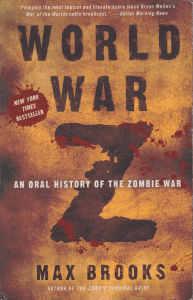
I suppose, rationally considered, most monsters can’t possibly exist. Maybe that’s the psychological relief required to enjoy the movies made about them. We can imagine the thrill, but we know we’re safe once we leave the theater. Culturally, monsters fight for supremacy. The early 2000s belonged to the vampire. They were everywhere. I once heard a literary agent advise wannabe authors to write on vampires since the publishing industry was showing no signs of slowing down on them. Then came the zombies. They’re still with us. World War Z came to my attention as a movie, but as one I never saw. I’ve watched many zombie films and none has lived up to the status of the spectacle that launched the genre, George Romero’s Night of the Living Dead. It remains a classic to this day. Still, I was curious and so I read Max Brooks’ World War Z: An Oral History of the Zombie War.

Let alone the chapter after chapter of tough-talking, cool-sounding reminiscers, I have trouble buying zombies. Yes, I get the scare factor, but maybe I’ve read too much science even to visualize myself into a fantasy world where a creature with no digestive system would be driven to eat. It just makes no sense. Human bodies can function with missing parts, of course, but without the integration of muscles, ligaments, digestion, and brain, it seems difficult to accept that they’d keep coming after you when they’ve been decaying for years. It’s all I can do to get out of bed most mornings, even as a healthy, living body. Analysts, I know, talk about zombies as metaphors, but with over 300 pages of stories in no way believable, I had to wonder about the limits of credulity. Maybe Carl Sagan was right after all.

I hope I’m not unsophisticated enough not to realize that the real point in Brooks’ novel is how the surviving humans treat each other. There is a moral to the story. We develop new and “better” weapons to kill one another. We’re smart enough to have world peace and prosperity, but wars are constantly erupting. We have a nation with many brilliant people and yet we elect a Trump. Self-destruction, it seems, is written into our genes. We consume one another. Even when the enemy is completely imaginary we find ways of believing. So I read World War Z, appreciating the irony. I still can’t get over, however, the trope that all you need is a human brain to want to destroy others.


Heavenly Questions

A lot can happen when you’re in a coma. Or nothing at all. I haven’t read Kevin and Alex Malarkey’s account of the latter’s trip to Heaven during a coma, and it looks like I never shall. A story by Kyle Swenson in The Washington Post explains how Alex Malarkey, now that he is no longer a minor, is suing Tyndale House over the publication of his Near Death Experience (NDE), penned by his father. The story, according to the Post, was a fabrication. Alex awoke from his coma recalling nothing, but Kevin knew a good thing when he saw it and wrote an account of the young boy going to Heaven. Alex says it never happened. The Boy Who Came Back from Heaven is now being pulled and pulped as a hoax.

NDEs are real (even if one didn’t happen in this case), but what they actually are is a matter of debate. The mainstream interpretation is that they are the last gasps of consciousness before a brain dies, temporarily. These often comforting thoughts can be quite similar in very different contexts and sometimes include the formerly deceased knowing details that they couldn’t possibly have witnessed in real life. Scientists willing to buck convention explore these episodes less with the intention of proving Heaven is true than with probing the idea that souls are real. That consciousness somehow continues. That life may, after all, be eternal. Since there are no scientific apparatus in the afterlife, there’s no way to measure or quantify such events. This leads most scientists to conclude that these are merely dying thoughts, or, as in the Malarkey case, hoaxes.

Ever since Raymond Moody’s Life after Life, confessional publishers—particularly of the evangelical brand—have promoted such stories. Religion and science, while not necessarily the cats and dogs they’re presented as being, don’t often coalesce around a common nucleus. Part of the problem is that spiritual events are beyond the reach of the scientific method since no laboratory conditions exist to test them. A number of scientists and medical doctors attest the reality of NDEs, but these occur in human consciousness—a realm of which we know little. Religious publishers know a good story when they see one since the doubts cast by science have to be regularly dispelled. The problem is the money such stories attracts also allures those seeking the fiduciary comforts of this material world. In this case, it seems, if you didn’t have the experience yourself you could capitalize on someone who did. Or didn’t. Those eager for proof are always willing to buy and sell the story.


Dreaming Reality

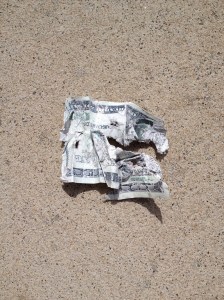
It was like that dream—you know, the one where you find a penny on the sidewalk, stoop down to pick it up, and discover that there are hundreds more of them. Maybe that’s the kind of thing those born in humble circumstances dream of, but we all recognize the draw of a windfall. People are pretty tight with their money in Manhattan, but it was early in the morning, still dark, and rainy when I saw it. A hundred dollar bill on the ground. Then I noticed more—a while bunch of them. When I reached down to pick one up, it came apart in my hand. Of course, it was a novelty replica of an actual piece of currency. When I walk through the garment district I often find great swatches of scrap cloth that have spilled out of designers’ trash bags. I’m tempted, I’ll confess, to pick them up and save them for future use. Nevertheless, this hundred dollar bill wasn’t what it appeared to be. Many things aren’t.

Religions around the world are predicated on the fact that what seems to be real isn’t. Even long before The Matrix came along. The idea that what occurs in our heads—or to use more conventional religious language, our hearts or souls—is truly real automatically takes us a step away from material reality. It’s not to say that this soggy, pulpy piece of paper in my hand has no existence, but it simply isn’t what it pretends to be. On mornings when the fates are all synched just so, I’ll look out the window of the bus from the helix and see Manhattan laid out in front of me like a picture postcard. “It’s not real,” I whisper to myself. Unlike the tourist in awe during a first visit to the city, I actually mean it. This concrete, glass, and steel world is not real. I’d feel a bit exposed suggesting such a thing on this blog had I not the biggest names in world religions behind me. One thing that they all seem to agree upon is that reality isn’t just what we experience in this corporeal vehicle that we currently call home.

Religion has been called the opium of the people. Marx wasn’t the first to suggest that the more needy among us were the driving force behind belief. Nevertheless, belief is present in all forms of thinking from extreme rationalism to naive acceptance of what your parents told you. The thing about religion is that it conscientiously advocates belief. It admits up front that it holds certain things to be true. One of those beliefs happens to be that things are not what they appear to be. Here in Manhattan we’re all so busy rushing around that who has the time to stop and think like that? I frequently walk past Holy Innocents church on my way to work. I may function, in this world, as an editor of biblical studies, but as I pass that edifice to a faith to which I don’t even belong, I feel the draw. Inside those doors—and I know this is true because I can sometimes hear the bells—a different reality awaits. Out here there may be hundreds of dollars scattered on the ground. When you look closer, however, you discover that they’re not what they appear to be.


Knowing It All

Reading about the Trump administration underscores once again the traditional American contradiction of, love of, but mostly hatred toward, experts. When you’re lying on that operating table, you stake your life that an expert is going to perform the surgery. When you buy that airline ticket, you’re banking that the pilot will be an expert. If you’re electing the most powerful individual in the world, you’ll excoriate experts and defer to the guy with the weird hair that says whatever he pleases and has never been a public servant a day in his life. This observation isn’t original with me, of course. I’m only an editor. Nevertheless, the same dilemma comes down to my little world of academic publishing as well. Most academics don’t understand this business—I was an academic at one time and I certainly didn’t—and yet don’t like to bow to the expertise of those who do.

Please don’t misunderstand. I’m making no grand claims to understanding this industry into which I unwittingly stumbled. I have been involved in it for over a decade now and I’m still learning. One of the things I’m learning is that many academics don’t trust experts. In part it’s academic culture. A doctoral program, if it’s a good one, will make you question everything. Sometimes even experts forget when to engage the brakes. When dealing with the experts at a publishing company, many academics doubt the expertise of those who do this day in and day out for a living. Books, however, have measurable sales records. There’s hard data for analysis. Not that it’s foolproof (but what is?), such metrics are time-tested and based on reasonable data sets. Often that’s not enough to convince an expert that other experts know more than they’re revealing. A personal philosophy, but one which I pursue with appropriate skepticism, is that other people should be left to do their jobs. As I frequently note, those who talk to the bus driver, freely giving advice, often make the situation worse for everyone.

The case of religion, however, is a special can of worms. There are no experts in this field, even among those of us who are experts. Had I realized this when I was younger, I’m not sure it would’ve made much of a difference in what I ended up doing with my life. You see, religion is all about ultimates. The big questions. The sine qua non of every single thing. When I read about things like politics, or entrepreneurship, I think to myself, “That’s all fine and good, but at the end of the day, is it what really matters?” If life is a search for meaning, why not grab it by both hands and try to become an expert at it? Some would say that’s the job of the philosopher, but let’s face it, religionists and philosophers deal in the same currency. One is more abstract than the other, to be sure. Still, don’t take my word for it. Please consult an expert.


Here Before

Déjà vu can be quite disorienting. Déjà vu can be quite disorienting. One of the categories for my 2018 reading challenge is a book you can read in a day. Maybe it’s just me, or creeping middle age, but books seem to be getting fatter these days. Despite the amount of time I spend reading, I’m slow at it and it’s a real struggle to find something I can actually finish on a three-hour bus ride. That’s why I thought of a play. Plays are meant to be performed in one sitting, so you should, in theory, be able to read one in a few hours. My first thought was Shakespeare, but the books of Shakespeare you can find these days all have added pages of commentary and interpretative material and the books seem to have put on weight since the Bard’s day.

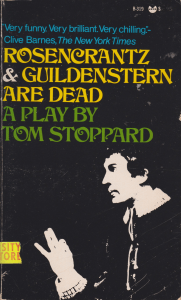
So I settled on Rosencrantz and Guildenstern Are Dead by Tom Stoppard. My wife had a used copy from college days and I’d been wanting to read it for some years. Here was my excuse. Then the bus ride began. Starting Act One I was sure I had read this before. It wasn’t just an inkling, like déjà vu often is, but an overpowering sensation. Of course I could tell what was going to happen—I’ve read Hamlet a time or two—but it was more than that. The sense that I had not long ago read this very sequence of words was nothing shy of overpowering. Uncanny even. As I moved into the latter part of the act, the feeling went away. This was new territory after all.

Consciousness is mysterious. Even with all our instruments and equations and theories, we still don’t know what it is. Materialists insist it must be simply a function of the brain, but that’s certainly not what it feels like. One of the hazards of reading a lot in middle age is that some things do start to blend together in your gray matter. Research, for example, means reading many books on the same subject with repeated ideas common among them. For fiction, however, we often hold a higher standard. Uniqueness and creativity are highly valued, even if the play you’re writing is a riff off the old Bard. In the end, I was able to finish the play in a day’s reading on the bus. Staring out the window after I’d finished, I was thinking how déjà vu can be quite disorienting.


Mediating Reality

The brain is one troubling organ. The gateway to both our thinking and our physical experience—as well as our survival—it tends to explain things in terms of narrative. Human consciousness likes a good story. Experiment after experiment has shown that if the brain doesn’t know why you do something it will make up an answer. Consciousness is far from foolproof. Those who rely too heavily on rationalism don’t like to think about such things. Logically, if your brain can fool you then you can’t believe everything evidence seems to verify. Think about that. If you dare.

Psychology has sometimes received a bad rap among the sciences for not having empirical evidence to back up some of its assertions. “Freudian” is now used as much as a slur as it is a sign of the sudden insight that strange things constantly go on inside our heads. BBC Future recently ran a story by Melissa Hogenboom titled, “The woman whose tumour made her religion deadly.” The account regards a woman who came to the hospital with serious self-inflicted wounds. Although hackneyed, the voices in her head told her to do this to herself. Brain scans indicated a tumor at the point in her brain where auditory information and religious belief come together. Paging Dr. Jaynes! Now, I know this is over-simplified. I’ve read enough neurology to know that brain functions can switch from one part of the brain to another and that mapping this kilo-and-a-half universe is one of the the most vexing of scientific enterprises. Still, in this case, the implications were clear: the woman’s self-destructive behavior was connected, in her brain, to religious commands.

Many educated people in this post-Christian world rely staunchly on reason. I don’t disagree that reason is essential. I do wonder, however, what happens when such thinking is forced to confront the fact of the irrational brain. Ever since setting our clocks forward I’ve been awaking in the midst of dreams. My usual sleep cycle hasn’t yet adjusted. I know some pretty strange stuff is going on in my brain when rationality’s taking a snooze. The other day I awoke convinced I was in my boyhood home. Rationality tells me it was razed years ago. Yet this brain with doctoral-level education was convinced it was in another state at another time. And this isn’t the result of a tumor, but normal sleeping brain functioning. It does make one wonder if putting too much faith into rationality isn’t a form of minor neurosis. To find out you have to ask a troubling organ and hope for a rational answer.


Kids These Days

I couldn’t have been an easy kid to raise. As a teen, while other kids were experimenting with drugs and sex, I started an unexpected habit. I can’t remember why or how it happened. I was the son of a professional drunk and a high school dropout. (Step dad worked in a sewage plant, so that likely wasn’t it either.) Somehow I’d discovered classical music. It wasn’t through records we had at home. If the artist didn’t have Cash or Twitty in their name you were probably tuned into the wrong station, buddy. Since this was before the internet it must’ve been something I heard on television. On Saturdays I’d beg to go to the Oil City Public Library where you could borrow LPs. I’d check out five at a time, and listen to them with headphones on at home. The general opinion in my neighborhood was that this was snob music and other people didn’t want to hear it.

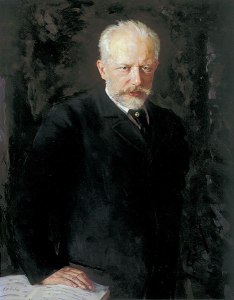
One of the pieces I discovered was Tchaikovsky’s 1812 Overture, (officially The Year 1812). This particular recording began with a chorus singing the Russian hymn, in English (hey, I was just learning!). Although I loved the bombastic ending (what boy wouldn’t?) I was haunted by that hymn. I paid no attention to the conductor—I couldn’t tell a Stravinsky from a Stokowski—so I memorized the albums I liked by their cover art. As a teen I had no idea things would ever change and that one day I’d be downloading music instead of carefully, lovingly pulling it out of a colorful sleeve, breathing in the experience.

Russia’s been on a lot of people’s minds lately. I have a great deal of respect for the Russian people. There’s a stolidity and pathos there that is rarely captured in any national music. I longed to hear that recording again. It took the better part of a day searching the internet to find it—I could walk right up to it in the Oil City Public Library four decades ago and put my hand on it. Those days are gone. When I finally located it on YouTube (Eugene Ormandy, Philadelphia Orchestra, in case you’re interested) I couldn’t stop listening. Not only did it take me back to my fractured childhood, it also made me feel a deep connection for a nation that probably looks at my own with great and earned distrust. We all need to learn to look at ourselves from the outside. That hymn! Listen to the words. I could imagine myself being oppressed by people I didn’t know and who had no reason to hate me. Unto our land bring peace. Amen.


Group Activity

While reading about various religious phenomena—both positive and negative—one of the recurring aspects that forces itself on our attention is contagion. Going back at least to the 450 prophets of Baal on Mount Carmel, the idea of crowd sourcing religious frenzy can be disturbing. It involves groups of people and loss of control. Not only is the frenzy itself frightening, but also the apparent paranormal accoutrements to such enthusiasm. In more specific terms, the revivals of the “Second Great Awakening” and the mass exorcisms described by Michael Cuneo in American Exorcism both boast supernatural elements. I’m not saying there can’t be a scientific explanation, but I am saying what happens in such circumstances has been understood to be supernatural by educated, experienced people. Both demoniacs and new religious converts display superhuman strength and atavistic behaviors that one doesn’t otherwise see in a lifetime. Once they start happening, they spread.

This is one of the draws of charismatic Christianity. Speaking in tongues can be quite contagious, I’m told. According to Cuneo’s carefully anonymized accounts, so can demonic possession with its attendant paranormal activity. Some scientists have explored the idea of consciousness as a “hive mind” phenomenon. Many “minds” brought together can produce something greater than the sum of the parts. We’re used to this in the world of insects, but since humans like to be radically individual we miss the instances where it occurs among our own species. While not always so, such events are often religious in nature. People gathered together in emotionally charged settings, personal experience draws off of that of others, and suddenly a person’s doing something they formerly believed to be “impossible.” God and demons both have explanatory value here.

Despite our tendency to want to destroy each other, humans have great potential when we work together. Our petty fears and jealousies could be contained, disassembled, and repurposed, if only we possessed the will to do so. The desire to stand out in a crowd—not to blend in but to be a unique individual—runs strong in our fractured psyches. We hate being mistaken for somebody else. Religious experiences, much maligned these days, tend to be group experiences. Yes, a mystic may have a personal and highly individualized rapture, but in the presence of others the excitement may be shared. “Mass hysteria” and group hypnosis have sometimes been posited as the culprits behind such events. Those who participate, however, use other terms to describe what has transpired. They may not call it a “hive mind,” and they won’t be alone in rejecting the phrase.


The Power of Literature

Among the uber-wealthy families that America has produced were the Dukes. Most famous for the university that bears the family name, they made their money in tobacco and then electricity. And what a lot of money it was! Although many people can point to North Carolina as the home of Duke University, many don’t realize that they liked to vacation in New Jersey. A large property, regally landscaped, rests just outside the unlikely town of Hillsborough. When the last Duke heir died, the foundation opened the property to the public, taking Green initiatives to heart. It’s good to see money with a conscience once in a while. Since we’re not far from Hillsborough, when cabin fever sets in and there’s actually sunshine on a late winter weekend, Duke Farms is a convenient getaway for a few hours.

Surrounded by a rock wall, the main property once housed luxury that most people will never experience. Ancient sycamores line one avenue that leads to a coach barn far nicer than the houses hoi polloi live in. Although we’ve visited the grounds many times, we haven’t seen all of it by a long stretch. Over the weekend we came across a gravel trail we’d never taken. The main avenues are wide, blacktop, pedestrianized boulevards that lead past aging structures, fountains, ponds, statues, and quaint bridges. The gravel trail meanders back and forth through small hills and glens, and it’s easy to believe you’re in the middle of the woods from time to time. At the top of one of these hills we came to the pet cemetery, amid the leafless trees.

We can all understand the emotional attachment to pets. Even the wealthy feel it. The cemetery was large for non-humans, with stones going back to 1953. Even a pair of camels were buried there. I can’t visit a pet cemetery, however, without thinking of Stephen King. It was a blustery, chilly day. We were alone on this remote trail we’d just discovered, and thoughts of resurrection didn’t seem that far fetched. The rich, after all, can do anything they please. Nevertheless, there was a pathos here. We were being given a glimpse into private lives. The names of other people’s pets, and sometimes their species. The things that had touched the monied class deeply. I’ve buried a few pets in my time, and it is always a solemn activity. One from which not even wealth can protect anyone. And here was another testament to the power of literature. Groping for a way to understand this place, a favorite horror novel seemed just about right.


Great Communicators

Perhaps you’ve encountered it too. You’re in a major city. You’re in a hurry. The person in front of you is plodding along, staring at the device in his or her hand and you can’t get around him or her. You’re being held up by technology. I just want to get to the Port Authority before my bus leaves. The late Jonathan Z. Smith called cell phones “an absolute abomination.” I wouldn’t go quite that far—my bus pass, after all, is on my phone, and I’ve been saved from embarrassing conversations on the desk phone in my cubicle by being able to walk away and find a quiet corner in a corridor where I can talk freely—but I do see his point. While technology has had many benefits, in real life it can slow you down.

A news source I recently read said that heavy smart phone users are more prone to psychological problems than, say, those people who live raw in the bush of southern Africa. Phones isolate as well as connect. Instead of asking somebody for directions, you can turn to your monotoned electronic friend and find out. What you lose is the nuance of human communication. On my first interview in New York City—I was still living in Wisconsin at the time—I was disoriented. Which way was Fifth Avenue? I asked a stranger on the street and learned something in the process. New Yorkers weren’t the rude people I’d been told to expect. In fact, I quite frequently see strangers asking others for directions. I’ve never seen someone refuse to help in those circumstances. Although I’m in a hurry if someone asks me “which direction is Penn Station?” I’ll stop and try to help. It’s a people thing.

One of the distorting lenses of a large city is the acceleration of time. Many of us depend on public transit in its many forms, and none of it is terribly reliable. Being late through no fault of your own is part of the territory in a city like New York. It’s become harder to stay on time because of smartphones, however. A few years back I saw it with the Pokémon Go release. Groups of phoners wandering around, slowing the flow of foot traffic on sidewalks that are somehow never wide enough. If only I could communicate with people! How does one do that when they’re riveted to the device in their hand? I wouldn’t say they’re an absolute abomination, but I agree with the dear departed Smith that there are hidden costs to being so connected that we can’t talk to one another. I would say more, but I think my phone’s ringing.

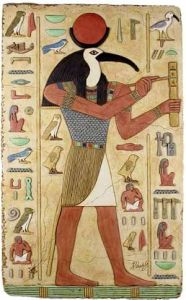
Even Thoth can’t help walking and texting.


Weather Psalm

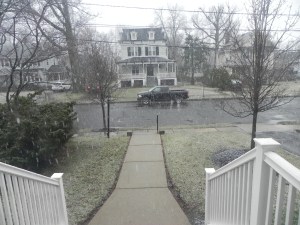
As the northeast coast digs out from yesterday’s nor’easter at least we can thank God that no business days were lost. At least none based on the status of New York City schools. Some NYC businesses base their decision on whether an adult snow day is in effect or not on the decision of whether or not to close the public schools. If kids are expected to make it to school, well, pull your socks up, thrash through the snow, and get some work done. I was fortunate enough to be able to work from home during the event that began like a snoreaster. By the time I would’ve usually been on the bus it wasn’t snowing. Roads were wet, but it seemed like a normal day. So it continued until about 10:00 a.m. Then it really did snow.

I’ve commuted long enough to know that, as grueling as getting up early and trying to get to the city may be, the evening commute is always worse. It may seem hard to believe that there are traffic jams before 7:00 a.m. most days, but around 5:00 p.m. all bets are off. The news vendors were lamenting the fate of those who had to find their way home in a foot of snow, even as it was still coming down swiftly. Nature doesn’t abide by our work schedules. Many companies don’t care if you can’t get out—you chose to work in the city. If it takes you three hours to get home, that’s not a work problem. It’s a personal thing. On personal time. Choose wisely.

All of this makes me reflect on the way we think of work these days. Commuting into the city shouldn’t be a dangerous job like being on an Alaskan fishing boat is. Chances are the actual daily work consists of sitting in a cubicle staring at a screen. Eye strain, carpal-tunnel syndrome, and boredom are the only real dangers here. Unless you’re taking the George Washington Bridge, carpool tunnel is a far more sinister threat. If you make it home in time to come back in tomorrow, then it’s all good. We do this so that we can earn money to spend, mostly online. We haven’t quite got to the point yet where we can wire our physical bodies to the internet so that we can stay at home and work 24/7. But it’s coming, just like the next nor’easter. In the meantime, I have a bus to catch.


Exercising Exorcism

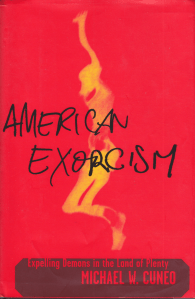
About the last people, ironically, that you’ll find researching demons are religion scholars. That’s perhaps a slight exaggeration, but there’s an embarrassment to the topic that serious academics just can’t shake. Nobody wants to be thought truly believing in that stuff. Michael W. Cuneo, who teaches sociology and anthropology at Fordham University, isn’t afraid to look. His American Exorcism: Expelling Demons in the Land of Plenty is a user-friendly, often witty look at what is an amazing phenomenon. Exorcism had pretty much gone extinct by the middle of the twentieth century. Then The Exorcist happened. Cuneo makes no bones about it—Hollywood wrote the script on what was to become a somewhat bustling business through the end of the millennium and beyond. And it wasn’t limited to Catholics. Protestants, mainly of Evangelical stripe, cottoned onto Deliverance ministry and joined the fray against the demonic.

American Exorcism reflects Cuneo’s personal account of attending exorcisms. As he puts it at the end, no fireworks occurred. In fact, he’s skeptical that demons exist and he strongly suspects exorcisms work in the same way that a placebo does. He’s well aware that the majority of people he met and talked with in the making of this book disagree on that point. Cuneo himself attended at least fifty exorcisms, both Catholic and Protestant, and shysters among the exorcists were rare. Most were sincere, devoted people who are helping others in distress for no fees, no glory, and no promotion. They see a need, believe they know the diabolical cause, and take the devil by the horns (metaphorically speaking).

There is a solid mistrust between academics with their studied skepticism and exorcists with their eyewitness accounts that defy belief. Cuneo suggests that even what they think they see may not really be happening in the real world. My question, coming down to the end of the fascinating book, revolves around what exactly this real world is. There can be no doubt that present day concepts of exorcism are largely based on “the movie.” Cuneo seems just a bit reluctant to say what I also declared in my forthcoming book—pop culture, the movies, dictate reality for many people. At least in the realm of religion. Sacred institutions have lost their authority to make ex cathedra pronouncements about what is real and what is not. Few bother to, or can, delve into the tedious work of reading academic studies on the subject. It’s far easier to let the unseen presences behind the camera take over. Isn’t that what possession is about, after all?