Kids These Days

I couldn’t have been an easy kid to raise. As a teen, while other kids were experimenting with drugs and sex, I started an unexpected habit. I can’t remember why or how it happened. I was the son of a professional drunk and a high school dropout. (Step dad worked in a sewage plant, so that likely wasn’t it either.) Somehow I’d discovered classical music. It wasn’t through records we had at home. If the artist didn’t have Cash or Twitty in their name you were probably tuned into the wrong station, buddy. Since this was before the internet it must’ve been something I heard on television. On Saturdays I’d beg to go to the Oil City Public Library where you could borrow LPs. I’d check out five at a time, and listen to them with headphones on at home. The general opinion in my neighborhood was that this was snob music and other people didn’t want to hear it.

One of the pieces I discovered was Tchaikovsky’s 1812 Overture, (officially The Year 1812). This particular recording began with a chorus singing the Russian hymn, in English (hey, I was just learning!). Although I loved the bombastic ending (what boy wouldn’t?) I was haunted by that hymn. I paid no attention to the conductor—I couldn’t tell a Stravinsky from a Stokowski—so I memorized the albums I liked by their cover art. As a teen I had no idea things would ever change and that one day I’d be downloading music instead of carefully, lovingly pulling it out of a colorful sleeve, breathing in the experience.
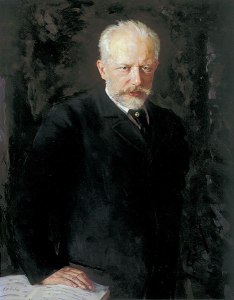
Russia’s been on a lot of people’s minds lately. I have a great deal of respect for the Russian people. There’s a stolidity and pathos there that is rarely captured in any national music. I longed to hear that recording again. It took the better part of a day searching the internet to find it—I could walk right up to it in the Oil City Public Library four decades ago and put my hand on it. Those days are gone. When I finally located it on YouTube (Eugene Ormandy, Philadelphia Orchestra, in case you’re interested) I couldn’t stop listening. Not only did it take me back to my fractured childhood, it also made me feel a deep connection for a nation that probably looks at my own with great and earned distrust. We all need to learn to look at ourselves from the outside. That hymn! Listen to the words. I could imagine myself being oppressed by people I didn’t know and who had no reason to hate me. Unto our land bring peace. Amen.
Group Activity

While reading about various religious phenomena—both positive and negative—one of the recurring aspects that forces itself on our attention is contagion. Going back at least to the 450 prophets of Baal on Mount Carmel, the idea of crowd sourcing religious frenzy can be disturbing. It involves groups of people and loss of control. Not only is the frenzy itself frightening, but also the apparent paranormal accoutrements to such enthusiasm. In more specific terms, the revivals of the “Second Great Awakening” and the mass exorcisms described by Michael Cuneo in American Exorcism both boast supernatural elements. I’m not saying there can’t be a scientific explanation, but I am saying what happens in such circumstances has been understood to be supernatural by educated, experienced people. Both demoniacs and new religious converts display superhuman strength and atavistic behaviors that one doesn’t otherwise see in a lifetime. Once they start happening, they spread.

This is one of the draws of charismatic Christianity. Speaking in tongues can be quite contagious, I’m told. According to Cuneo’s carefully anonymized accounts, so can demonic possession with its attendant paranormal activity. Some scientists have explored the idea of consciousness as a “hive mind” phenomenon. Many “minds” brought together can produce something greater than the sum of the parts. We’re used to this in the world of insects, but since humans like to be radically individual we miss the instances where it occurs among our own species. While not always so, such events are often religious in nature. People gathered together in emotionally charged settings, personal experience draws off of that of others, and suddenly a person’s doing something they formerly believed to be “impossible.” God and demons both have explanatory value here.

Despite our tendency to want to destroy each other, humans have great potential when we work together. Our petty fears and jealousies could be contained, disassembled, and repurposed, if only we possessed the will to do so. The desire to stand out in a crowd—not to blend in but to be a unique individual—runs strong in our fractured psyches. We hate being mistaken for somebody else. Religious experiences, much maligned these days, tend to be group experiences. Yes, a mystic may have a personal and highly individualized rapture, but in the presence of others the excitement may be shared. “Mass hysteria” and group hypnosis have sometimes been posited as the culprits behind such events. Those who participate, however, use other terms to describe what has transpired. They may not call it a “hive mind,” and they won’t be alone in rejecting the phrase.


The Power of Literature

Among the uber-wealthy families that America has produced were the Dukes. Most famous for the university that bears the family name, they made their money in tobacco and then electricity. And what a lot of money it was! Although many people can point to North Carolina as the home of Duke University, many don’t realize that they liked to vacation in New Jersey. A large property, regally landscaped, rests just outside the unlikely town of Hillsborough. When the last Duke heir died, the foundation opened the property to the public, taking Green initiatives to heart. It’s good to see money with a conscience once in a while. Since we’re not far from Hillsborough, when cabin fever sets in and there’s actually sunshine on a late winter weekend, Duke Farms is a convenient getaway for a few hours.

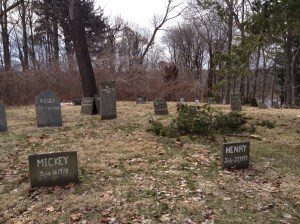
Surrounded by a rock wall, the main property once housed luxury that most people will never experience. Ancient sycamores line one avenue that leads to a coach barn far nicer than the houses hoi polloi live in. Although we’ve visited the grounds many times, we haven’t seen all of it by a long stretch. Over the weekend we came across a gravel trail we’d never taken. The main avenues are wide, blacktop, pedestrianized boulevards that lead past aging structures, fountains, ponds, statues, and quaint bridges. The gravel trail meanders back and forth through small hills and glens, and it’s easy to believe you’re in the middle of the woods from time to time. At the top of one of these hills we came to the pet cemetery, amid the leafless trees.

We can all understand the emotional attachment to pets. Even the wealthy feel it. The cemetery was large for non-humans, with stones going back to 1953. Even a pair of camels were buried there. I can’t visit a pet cemetery, however, without thinking of Stephen King. It was a blustery, chilly day. We were alone on this remote trail we’d just discovered, and thoughts of resurrection didn’t seem that far fetched. The rich, after all, can do anything they please. Nevertheless, there was a pathos here. We were being given a glimpse into private lives. The names of other people’s pets, and sometimes their species. The things that had touched the monied class deeply. I’ve buried a few pets in my time, and it is always a solemn activity. One from which not even wealth can protect anyone. And here was another testament to the power of literature. Groping for a way to understand this place, a favorite horror novel seemed just about right.


Great Communicators

Perhaps you’ve encountered it too. You’re in a major city. You’re in a hurry. The person in front of you is plodding along, staring at the device in his or her hand and you can’t get around him or her. You’re being held up by technology. I just want to get to the Port Authority before my bus leaves. The late Jonathan Z. Smith called cell phones “an absolute abomination.” I wouldn’t go quite that far—my bus pass, after all, is on my phone, and I’ve been saved from embarrassing conversations on the desk phone in my cubicle by being able to walk away and find a quiet corner in a corridor where I can talk freely—but I do see his point. While technology has had many benefits, in real life it can slow you down.

A news source I recently read said that heavy smart phone users are more prone to psychological problems than, say, those people who live raw in the bush of southern Africa. Phones isolate as well as connect. Instead of asking somebody for directions, you can turn to your monotoned electronic friend and find out. What you lose is the nuance of human communication. On my first interview in New York City—I was still living in Wisconsin at the time—I was disoriented. Which way was Fifth Avenue? I asked a stranger on the street and learned something in the process. New Yorkers weren’t the rude people I’d been told to expect. In fact, I quite frequently see strangers asking others for directions. I’ve never seen someone refuse to help in those circumstances. Although I’m in a hurry if someone asks me “which direction is Penn Station?” I’ll stop and try to help. It’s a people thing.

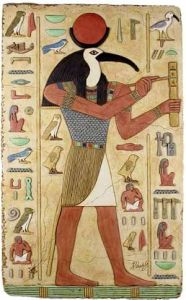
One of the distorting lenses of a large city is the acceleration of time. Many of us depend on public transit in its many forms, and none of it is terribly reliable. Being late through no fault of your own is part of the territory in a city like New York. It’s become harder to stay on time because of smartphones, however. A few years back I saw it with the Pokémon Go release. Groups of phoners wandering around, slowing the flow of foot traffic on sidewalks that are somehow never wide enough. If only I could communicate with people! How does one do that when they’re riveted to the device in their hand? I wouldn’t say they’re an absolute abomination, but I agree with the dear departed Smith that there are hidden costs to being so connected that we can’t talk to one another. I would say more, but I think my phone’s ringing.

Even Thoth can’t help walking and texting.


Weather Psalm

As the northeast coast digs out from yesterday’s nor’easter at least we can thank God that no business days were lost. At least none based on the status of New York City schools. Some NYC businesses base their decision on whether an adult snow day is in effect or not on the decision of whether or not to close the public schools. If kids are expected to make it to school, well, pull your socks up, thrash through the snow, and get some work done. I was fortunate enough to be able to work from home during the event that began like a snoreaster. By the time I would’ve usually been on the bus it wasn’t snowing. Roads were wet, but it seemed like a normal day. So it continued until about 10:00 a.m. Then it really did snow.

I’ve commuted long enough to know that, as grueling as getting up early and trying to get to the city may be, the evening commute is always worse. It may seem hard to believe that there are traffic jams before 7:00 a.m. most days, but around 5:00 p.m. all bets are off. The news vendors were lamenting the fate of those who had to find their way home in a foot of snow, even as it was still coming down swiftly. Nature doesn’t abide by our work schedules. Many companies don’t care if you can’t get out—you chose to work in the city. If it takes you three hours to get home, that’s not a work problem. It’s a personal thing. On personal time. Choose wisely.

All of this makes me reflect on the way we think of work these days. Commuting into the city shouldn’t be a dangerous job like being on an Alaskan fishing boat is. Chances are the actual daily work consists of sitting in a cubicle staring at a screen. Eye strain, carpal-tunnel syndrome, and boredom are the only real dangers here. Unless you’re taking the George Washington Bridge, carpool tunnel is a far more sinister threat. If you make it home in time to come back in tomorrow, then it’s all good. We do this so that we can earn money to spend, mostly online. We haven’t quite got to the point yet where we can wire our physical bodies to the internet so that we can stay at home and work 24/7. But it’s coming, just like the next nor’easter. In the meantime, I have a bus to catch.


Exercising Exorcism

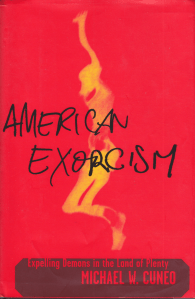
About the last people, ironically, that you’ll find researching demons are religion scholars. That’s perhaps a slight exaggeration, but there’s an embarrassment to the topic that serious academics just can’t shake. Nobody wants to be thought truly believing in that stuff. Michael W. Cuneo, who teaches sociology and anthropology at Fordham University, isn’t afraid to look. His American Exorcism: Expelling Demons in the Land of Plenty is a user-friendly, often witty look at what is an amazing phenomenon. Exorcism had pretty much gone extinct by the middle of the twentieth century. Then The Exorcist happened. Cuneo makes no bones about it—Hollywood wrote the script on what was to become a somewhat bustling business through the end of the millennium and beyond. And it wasn’t limited to Catholics. Protestants, mainly of Evangelical stripe, cottoned onto Deliverance ministry and joined the fray against the demonic.

American Exorcism reflects Cuneo’s personal account of attending exorcisms. As he puts it at the end, no fireworks occurred. In fact, he’s skeptical that demons exist and he strongly suspects exorcisms work in the same way that a placebo does. He’s well aware that the majority of people he met and talked with in the making of this book disagree on that point. Cuneo himself attended at least fifty exorcisms, both Catholic and Protestant, and shysters among the exorcists were rare. Most were sincere, devoted people who are helping others in distress for no fees, no glory, and no promotion. They see a need, believe they know the diabolical cause, and take the devil by the horns (metaphorically speaking).

There is a solid mistrust between academics with their studied skepticism and exorcists with their eyewitness accounts that defy belief. Cuneo suggests that even what they think they see may not really be happening in the real world. My question, coming down to the end of the fascinating book, revolves around what exactly this real world is. There can be no doubt that present day concepts of exorcism are largely based on “the movie.” Cuneo seems just a bit reluctant to say what I also declared in my forthcoming book—pop culture, the movies, dictate reality for many people. At least in the realm of religion. Sacred institutions have lost their authority to make ex cathedra pronouncements about what is real and what is not. Few bother to, or can, delve into the tedious work of reading academic studies on the subject. It’s far easier to let the unseen presences behind the camera take over. Isn’t that what possession is about, after all?


After Darkness

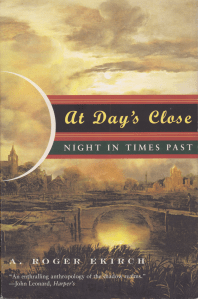
Some historians, I suspect, despair of the volumes already written on all periods, ancient and modern. History, however, can cover a variety of segments of time. A. Roger Ekirch, for example, thought to write a fascinating history of darkness. At Day’s Close: Night in Times Past is a thoughtful exploration of what night has historically meant. For those of us born in the era of constant light, the realities of what it was like after dark in the past are almost unimaginable. I’m sure Ekirch didn’t intend it to be so somber, but the reality of frequent crime in unlit regions made reading much of this book a sober experience. Confident of their ability to get away with it, many up until modern times took advantage of the night to commit all kinds of crimes. Makes you kind of want to check the door locks once again before turning in.

Much, but increasingly less, of our lives is spent in sleep. The advent of artificial light has led to changes in lifestyle that, according to biology, aren’t terribly healthy. The natural rhythms of sleep and wakefulness may be challenged by jobs or enticements to stay up late and surf the web or any number of other factors. Now that light has become so very portable in the form of smart phones and tablets, even less of darkness remains. Although it’s a bit repetitive and not laid out chronologically, At Day’s Close contains many provocative observations about the dark. There’s even a bit about monsters.

Night has always been symbolic. Death and fear were associated with night early on, and we still call the era of scientific progress the Enlightenment. Churchmen (for it was an age of such) tended to condemn night as evil, the Devil’s time. Not all agreed, for some considered the dark a creature of God and complained of the hubris of setting up lights at night. The religious symbolism of night is very rich and very ancient. Those of us used to artificial light have difficulty imagining what it took to navigate after dark in ages past. More than an annoyance, night could be a truly dangerous time. Dreams, once mainly the products of the night, also had religious significance before being rationally explained. The industry of banishing night also has, in some respects, the effect of banishing dreams. We should stop and think before we put night to flight. Half of our time is spent in darkness, and all of our time is highly symbolic.


On Time

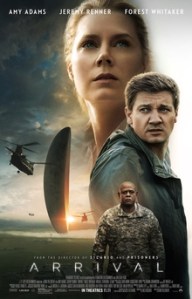
Getting to the movie theater is not only costly, but increasingly difficult to schedule. This can be problematic for someone who likes to write about movies, but the realities of the commuting life aren’t very malleable. So it was that I finally had a chance to watch Arrival, on the small screen. It had been recommended, of course, and although it’s not horror it has aliens and a linguist as the hero—my kind of flick. Once it began, I wondered if religion would play any role in the story. Alien contact would certainly rate as one of the more formative religious events of all time. The only reference that was obvious, however, was the suicide cult shown on a news story in the background, immolating themselves as the aliens became known.

Louise Banks, a linguist who has security clearance, has a sad story. Spoiler alert here! If you’re even more tardy than me you might want to fire up Amazon Prime and read on afterward! The movie opens with her watching her daughter grow up, only to watch her succumb to a rare disease as a young woman. Then the aliens arrive and she’s whisked off to Montana to try to communicate with them. It’s only after repeated encounters, learning the written language of another race, that she asks who this little girl she keeps dreaming about is. The child is in her future. The aliens see time as cyclical, not linear, and by learning their language she begins to think like them—knowing the future holds a tragedy for her. The intensity of the experience makes her fall in love with Ian Donnelly, another academic, who will become the father of her child but who will leave when she reveals the future to him.

Just as the aliens prepare to leave, not religion but philosophy takes over. A question posed by none other than Nietzsche goes: if you could live your life over exactly the same as you lived it this time, would you? Nietzsche’s point was that those who say “no” deny life while those who answer in the affirmative, well, affirm it. Ian says what he would change. Louise, however, embraces life with the tragedy she knows will inevitably come. While religion is off in a corner doing something that shows just how nonsensical belief can be, philosophy stands tall and faces the difficult question head-on. Although the movie follows some expected conventions—aliens bring peace but militaries want war—it rests on a profound question to which, I’ll admit, I haven’t got an answer.


Science of Unbelief

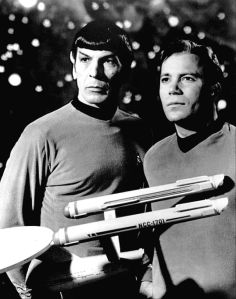
An article a friend sent me from Science Alert back in December recently came to mind. Titled “Thinking About God Might Make You Sweat, Even if You’re Not Religious,” the article by Brittany Cardwell and Jamin Halberstadt discusses how religious ideas are deeply engrained in human psychology. Like people who say they’re not afraid of spiders or snakes, people who don’t believe in the supernatural have made an effort to become this way. For reasons poorly understood, human beings are natural believers. As the article takes pains to state, that doesn’t mean a non-believer isn’t sincere. Thinking, however, doesn’t come only from rationality. Many people hold to the Mr. Spock fallacy—the belief that reasoning can solve anything. We all know from experience that it can’t. The big decisions in life—whom should I marry? What house should I buy? For whom shall I vote?—are often made with the emotions rather than rationally.

Which one’s the captain?

Reason has taught us to be expert deniers. We can learn to overcome our natural aversion to snakes and spiders and we can learn not to believe in God. Sometimes that belief can even be knocked out of us by the silly, unthinking behavior of “true believers.” But deep down it’s still there. Funnily, those who claim that reason alone answers all things are in denial about their own evolution. The human brain is a direct adaptation of the “reptilian brain” with its fight or flight impulses. That viper doesn’t plan to bite your ankle—it’s reacting to fear. Emotions are an integral part of thinking. Crimes of passion are committed by otherwise rational people sometimes. That thing you keep on bumping into in the room is, in fact an elephant. As irrational as that may seem.

The Science Alert article discusses the empirical proof that people fear to dis the Almighty. Were the brain a computer I’d say it was hardwired into us. We’re not wire and circuits, however. We’re messy, organic, evolving stuff that at one time lived beneath the waves. It took a certain amount of lungfish faith to believe we could survive on dry land. As mates approved of such irrational behavior, the trait multiplied and became more common. Today our smart phones and our cubicle window posters tell us there’s no such thing as a deity beyond our own scientific rules. The truth is, however, at some level we don’t really believe it. You can learn not to believe, but you’ll still sweat the big stuff, even in laboratory conditions.


Of Our Being

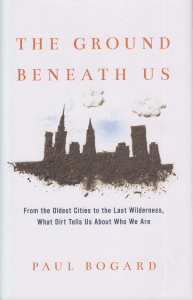
It happens every year. What with my commute schedule and personal disposition, I read a lot. This blog and Goodreads are my accounting system for keeping track of the thoughts that arise during all of this. Every year I get stopped by my first really important book that I’ve read since December’s roundup of last year’s titles. Paul Bogard’s The Ground beneath Us is this year’s first such book. Subtitled From the Oldest Cities to the Last Wilderness, What Dirt Tells Us about Who We Are, this tour of several fascinating locations is a wake-up call. Divided into three sections—Paved and Hallowed, Farmed and Wild, Hell and Sacred—Bogard’s book offers a kind of travelogue with the additional reminder that how we’re treating the land is the most terrifying example of what lack of foresight imaginable (why, Prometheus?) looks like. In a world with a rapidly growing population, we’re paving and building at unprecedented rates. World harvests, experts say, will last only another sixty years. Then we starve.

A dilemma I’ve struggle with here before is the fact that nobody owns this world. Nobody but those driven by money. There’s little that can stop them. This is exemplified by his chapter on fracking in my native Appalachia. Companies protected by loopholes—nooses, actually—devised by Dick Cheney can take over a town and destroy its environment. And this was even before Trump. And this is only but one example. Those who look soberly at where we’re going—and the melting permafrost in the northern hemisphere is about to make the globe nearly uninhabitable for our species—are ignored because they stand in the way of profits. Everybody loses. As a species we have neither the will nor the power to prevent it. Epimetheus reigns.

Not just doom and gloom, The Ground beneath Us is a thoughtful reflection on the human spirit. The titles of the subsections reveal that sacred ground—one of my recurring themes on this blog—is very real. Bogard isn’t a religionist, so you can’t accuse him of special pleading. His moving accounts of visiting sites hallowed by any number of factors, whether violence or simple belonging, reveal what home really means. What a dangerous, maybe even sinful, concept ownership can be. With chapters covering areas as diverse as Mexico City sinking under its own weight, to Ames, Iowa where what we’re doing to the soil is studied, to parts of Alaska accessible only by air, Heaven and Hell are daily and plainly played out before us. This is a very important book. We can only hope enough people will read it before it’s too late.


Spectral Parable

1692. The Enlightenment is reaching toward full swing. In what will become blue Massachusetts, women are condemned for being witches. The proof to make such a conviction is difficult to obtain without resorting to “spectral evidence.” The Republicans of the era, who would otherwise reject such obvious speculation, greedily swallow the fake news by the mouthful. This is just the kind of smoking musket they’ve been seeking. Spectral evidence can’t be reproduced in court because it’s supernatural. Anything can be fake news if you bluster loudly enough. Even the judges, one can imagine, could put the accusations made against their own wives and selves into that category. The Devil, they say, is a shape-shifter.

Menelaus had Proteus pinned. The water god also known as “the Old Man of the Sea” could change shapes at will. Shifting from tree to snake to lion to water, Proteus couldn’t escape Menelaus’ grasp. At last the Old Man had to reveal the truth. Such is the nature of evidence. Speculative ideas are as easily built as walls to separate countries—easier, in fact. With a certain amount of braggadocio anything is believable. They say there are still mammoths roaming in the Russian steppe. Did Watergate really happen at all? Isn’t this evidence just spectral? Meanwhile we’ve got all these women here waiting to be hanged—shouldn’t we just get on with it?

The rule of law, I heard in a discussion in Jeff Bezos’ boathouse one summer, is inevitable. Once the concept takes hold it won’t be undone. At the far end of the table I disagreed. Nobody liked what I said, and I took my solace with Cassandra. Who reads Greek mythology any more anyway? The greatest minds of Massachusetts Bay Colony, even those with Harvard educations, admitted that what was seen in adolescent visions of the night was just as real as what happened in the cold light of day. What do you think we are—gullible or something? Meanwhile the Old Man of the Sea gave his name to an adjective most useful for white men in authority. The rule of law, indeed the concept of Truth itself, is a most protean entity. Like water it can be a man or it can be a god. It all depends on your perspective. A fox can be as dangerous as a lion. Proteus even changed into a pig when the need became great. What say you, judges of Oyer and Terminer? Do you accept the evidence or not?


Frankenfear

While re-reading Frankenstein the uncomfortable thought kept recurring that our tendency to save lives leads to undiscovered fears. I’m not suggesting that we should just let people die, but even from my own experience of doctors, the sense of personal agency has become somewhat eroded. You go to the doctor and s/he tells you, “You should have this done.” I’m still too busy trying to figure out what this box that’s attached to my TV should be called, so how am I qualified to assess a professional opinion about my health? We mend bodies with plastic and metals and chemicals. Some modifications, like fillings and glasses, seem no brainers. But what about plastic tubes and computers to regulate body functions? They’re all good, but have we thought this through, I can hear Mary Shelley asking.

Religion, which is now also eroding, was a traditional way of coping with the fact of our own mortality. Everyone dies. From the beginning of the world, with the possible exception of Elijah—and even he had to come back—everyone has died. Religion traditionally said that it wasn’t the last word. The body wears out, and in a materialist world there’s nothing that can be left. Technology can prolong life, but some may not want it to be prolonged beyond a certain point. I’m not being morbid; I just don’t like arguing with what can’t be changed. Religion, it’s easy to forget, is about finding peace. Some people misunderstand that, for sure, but that doesn’t change the facts.

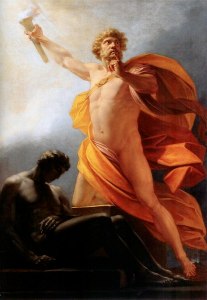
Did Prometheus overstep his bounds? Mary Shelley seemed to think so. In her recollections the story was intended to scare, not to predict. Victor Frankenstein creates the monster simply because he can. He does it alone, without thinking through the consequences even with a convenient Igor. Religion has often been cast as that annoying, moralizing sibling to science. (Philosophy could well join the ranks too, as some prefer it to religious thinking.) Without that sibling, however, how can we make informed decisions? Science, by its very definition, can’t tell us what should be done. The only values it knows are quantifiers. We live in a piecemeal world where some parts have been removed while others have been added. We don’t know if this is right or wrong since religion is one of the pieces excised without being replaced. Prometheus, ironically, translates to “forethought.” The problem with Frankenstein is precisely that Prometheus is missing.


Frankenstein and Co.

Authors, I expect, don’t anticipate that their work will be annotated. Since I deal with annotated Bibles on a daily basis, I often ponder that the anonymous writers—we know of few biblical writers with any degree of certainty—had no idea that they were writing the Bible. Nor did they realize that some day many people would make their livelihood from interpreting that book. Among the interpreters are annotators. When my wife gave me Mary Shelley’s Frankenstein for Christmas I was at first puzzled. I have a copy of Frankenstein already. In fact, I read it again just last year. Then I realized it was an annotated edition: Annotated for Scientists, Engineers, and Creators of All Kinds. Edited by David H. Guston, Ed Finn, and Jason Scott Robert, the book contains the original text and an introduction, as well as the said annotations. Like a typical study Bible, it also contains essays. The editors joke that it’s kind of like a Frankenstein monster itself.

The “value added” material isn’t all about science. In fact, quite a lot of it has to do with human relationships, and particularly women’s rights. Mary Shelley was an early feminist and her novel shows what goes wrong when men try to reproduce without women. Another recurring theme that, amazingly, had never dawned on me while reading Frankenstein was the Adam and Eve story. Victor Frankenstein, like God, creates a man. Then he creates a woman. Well, almost. Afraid what might happen should his creature find a companion too companionable, he destroys the second creature before she’s finished. The biblical parallels are nevertheless there.

Originally subtitled The Modern Prometheus, the novel was based on pre-Christian myth as much as on Holy Writ. Nevertheless, the Bible suffused British culture in the nineteenth century just as it has continued to overwhelm American culture to the present day. We ignore it at our peril. Morality in science is a major focus of the essays in this volume, but I wondered how many scientists might be enticed to read a piece of feminist fiction in order to learn some ethics. The largest ethical conundrum we face in the United States is that so few people read for personal growth. Spending time with a book is a sacred activity for those committed to the principles of literacy. Frankenstein isn’t a prefect novel; the pacing is pretty slow even for a gothic masterpiece. There are loose ends left hanging. The protagonist is often insufferable. Still, as the editors and annotators have demonstrated, there’s much to learn from this old story. All it takes is the willingness to read and deeply reflect. And perhaps read the annotations.


My Bee’s Keeper

I’m not proud of it. In fact, truth be told, I tear up a little bit when I think about it. It happened so long ago, but it was a casual act of violence that made me feel big at the time. It wracks me with guilt even today. I killed a bee. For no reason. It was a summer’s day and I was following after my step-father, who’d just taken us for a haircut. Step-dad always wore a crew-cut and disliked hair on boys and men. I’ve always hated haircuts and when I saw a honey bee on a clover flower after leaving the barber shop shorn I stomped on it. I was maybe twelve. That act of senseless violence has never left me.

I’d been stung, you see. Many times, in fact. One incident was particularly dramatic. My mother had driven my brothers and me out to the woods to play with our dog. We made up a game, the way kids will, where my brothers would throw a stick and I’d race our dog to try to fetch it first. I was actually in the lead this time and stepped on a rotting stump to keep my marginal edge. The stump was home to a colony of yellow-jackets and they swarmed out, just like in the cartoons I used to watch. Before I realized what was happening I fell to the ground with multiple stingers burrowing into my bare legs. Our dog was covered with bees and we weren’t sure he’d even survive. At home Mom had me soak in a hot bath because there was a prayer meeting that night at church that we couldn’t miss. I was allowed to take a pillow to sit on over the plain wooden pew.

That incident was in my mind as I stepped on the innocent bee, gathering nectar that summer day. Immediately I regretted what I’d done. Its little body lay twitching in the grass. It had no idea who had killed it or why. My reason for doing so was lame, and long gone. All creatures on this planet are interconnected. We are killing off bees at unprecedented rates. Insect populations the world over are falling at truly alarming speed. We need our bees. We’ve tampered with nature to make it more productive and have ended up with killer bees instead. We’re now warming our globe so they can spread even as we kill off their more docile siblings. That summer sun of memory beats down on me as I consider what I’ve done, and I sincerely repent.

Photo credit: Jon Sullivan, Wikimedia Commons


Heal and Farewell

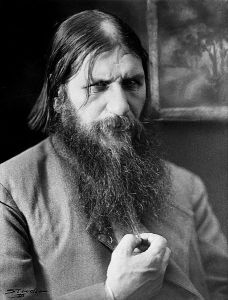
What could Aimee Semple McPherson have in common with the devious Russian monk Rasputin? Apart from being contemporaries for a couple decades, they were both faith healers. Well documented cases exist for both of them, and the medical profession has started to come around to the idea that belief can, and does, heal. The stories of Sister Aimee’s healings, witnessed by thousands, make me fear being thought gullible just for bringing it up. That doesn’t mean it didn’t happen. Cases exist even today where healing inexplicably takes place before scientific eyes. Often it occurs in response to religious stimulus. We may have proof that it happens, but we tend not to believe. This is a curious state of affairs. We trust in reason to the point that it may prevent us from being healed by faith.

Some object, of course, to the theological element. It’s pretty tricky to believe God has healed you if you don’t believe in God. The thing about faith healing, though, is that it seems to work no matter the religion of the person healed. This, it would seem, suggests we should be applying our rational minds to understanding belief. Instead we use it to find new ways to make money or to build smarter weapons to kill one another more efficiently. The more we come to understand the physical world around us, the less we know. As our research institutions take on the shape of the businesses that increasingly fund them, interest in this phenomenon shrinks. Medicine, in all its forms, is big money. Living in central New Jersey you can’t help but notice the palatial campuses of the pharmaceutical companies, nor ignore the mansions on the hill they have built. If only we could believe.

Faith healing was this aspect of her ministry that propelled Sister Aimee to fame. She constantly underplayed it, not wanting to be considered a healer of bodies so much as a healer of souls. Rasputin, of course, had political motives. Both lived—not so long ago—when faith was taken very seriously. Judging from the posturing around the least religious president in decades, whatever faith is left has been sorely effaced. Maybe it’s our minds that have the capacity to heal, but even that well seems to have been drained with the leaky bucket of rhetoric. History can teach us so much, if we’re willing to invest in it. How does faith healing work? I have no idea. Nor, it seems, does anybody else. So it will remain until it becomes commodified.