Our Pigeons, Ourselves

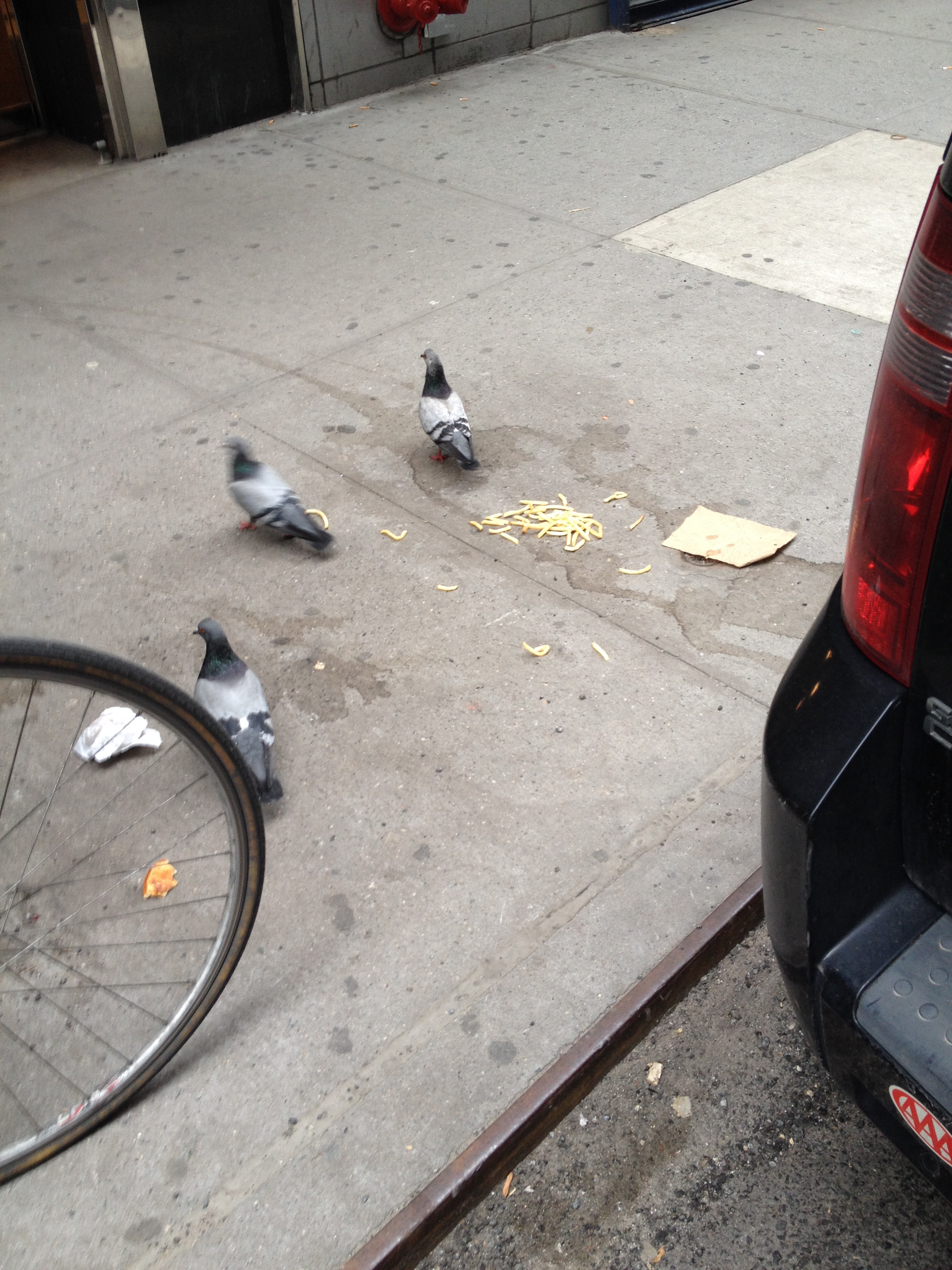
You don’t have to be in New York City long to begin to see yourself as an expert on pigeons. The ubiquitous avians are ruthlessly castigated as “flying rats” and “filthy birds,” primarily because they like people food and poop everywhere. I have it on the authority of Gomi and Stinchecum that everybody poops. From what I’ve seen walking through the city early on the morning after a holiday, not everyone is discriminate about where—and I’m not talking only about the pigeons. Still, I can’t help thinking that pigeons are unfairly maligned. They are pretty birds, when examined individually. They have iridescent throat feathers and a pleasing, portly gait—almost jaunty. They manage well, despite hardships. Often I see one hobbling about missing a foot or otherwise physically challenged, and yet ebullient in their pullastrine way.
IMG_1287

Yesterday as the NJ Transit behemoth in which I was riding rounded the helix into the Port Authority Bus Terminal, I saw two depressed pigeons. Unlike the jolly bobbing and pecking they usually seem to enjoy, this pair was simply standing. On the ground before them was a dead pigeon. Now I don’t know the backstory here, but the two standing around didn’t look like murderers to me. It seemed that they’d come upon a fallen comrade and were, in their own way, offering respects. In the ongoing debate separating ourselves from other animals, I often wonder if we have by-passed many of the basics. I do know that many animals find dead of their own species distressing. This is well documented. Why not pigeons?

Pigeons—related to doves, which, according to some religious traditions have sacred qualities, eh, Mary?—are seldom classed as the brightest of birds. I’ve written about the intelligence of corvids before, but pigeons have uniquely adapted themselves to our polluting ways. I grew up in a small town where pigeons weren’t especially abundant. They gather in large numbers where many people congregate and drop their litter. And, based on my recent experience, contemplate the mysteries of death. Peregrine falcons lurk overhead, doling out death at over 200 miles an hour. All the pigeons want to do, it seems to me, is to get a free lunch in an uncertain world where those whose presence has conjured them despise them. Unlike their sacred cousins, they are, like us, utterly pedestrian. Maybe they too appreciate the simple value of life.
Waking Up in Galilee

One voice can’t be heard. Unless, of course, it has a publicist. For years, it seems, I have been suggesting in my obscure corner of the internet that we’re not quite ready for the death of religion yet. I’ve never really doubted science, but I have noticed that science frequently draws the same conclusions as religion. Evolutionary biologists and neuroscientists exclaim, with some surprise, that religion has a survival advantage. Of course, big men with white beards sitting on thrones in the sky just won’t do, but the underlying concept has utility. So we’re told. Now Sam Harris, author of The End of Faith, one of the four horsemen of the new atheists, tells us that it’s okay to experience what has been known as, conventionally, a religious experience. Call it transcendent (I always do), but no matter what the chemical mix you concoct in the brain, it will feel good. Perhaps better than anything merely biological ever will. You’ll sell a million books. If you’ve got a publicist.

To me it seems that the religion question is a no-brainer. It wouldn’t persist if we had no need of it. Unlike the appendix, which seems not to have taken the hint that it is entirely vestigial, religion helps people (and perhaps some animals) survive. It doesn’t have to be sitting on an uncomfortable pew on a Sunday morning. It might be in the giddy heights of the Rocky Mountains where you can see to eternity and beyond and the rarity of the oxygen makes you lightheaded with a hologram of immortality. It might be the piercing peace that comes with light refracted through a glass so blue that superlatives fail you. It might be in imaginary vistas of an ice-bound Arctic where, you’re just certain, Nordic gods linger just out of sight. Transcendence can even come from traditional religious experiences, or so the stories of the saints proclaim. Anyone can participate. Those who have never forget.

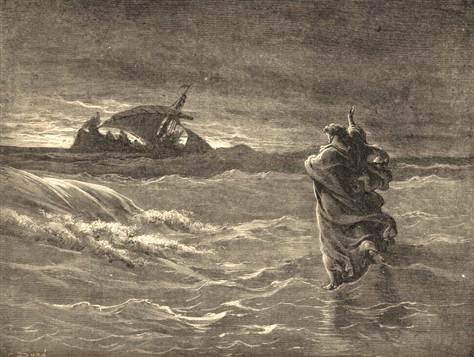
The New York Times, in the Sunday Review piece by Frank Brunl (Between Godliness and Godlessness) introduces Sam Harris’s new book, Waking Up. I know I’ll read it. According to the article, Harris discusses his own experience of transcendence. When Harris has such a revelation, it is a best seller. Or it will be. For those of us who quietly suggest moderation between bombastic religion and bombastic science, it is merely another day in the life of the quiet ones who observe without being heard. True, it takes courage in this culture to dole religion a knock on the head. It is not, however, going to send faith to a premature grave. We still need our religion. We might not call it that any more. Name it spirituality, or transcendence, or mystic mumbo-jumbo, but when it hits you it’s like an atheist in Galilee. Some call it a electrochemical reaction in the brain. Others call it walking on water.

Dore Walk on Water


Quantum Uncertainty

Physics has moved beyond the point of comprehension for the average citizen, if I might be permitted to class myself as that. I got the concept of the atom, although I always wondered about the spaces in-between. No god-of-the-gaps there, but it didn’t fit with experience that everything was full of holes. An article my wife sent me now has me wondering if I’m a hologram. Physicists began to lose me with quarks—I can understand atoms being made of something, but what of ups and downs and leptons every way to Sunday? Then string theory. Then those particles that can be two places at once, until you look. And now I’m being told that The Matrix may be more fact than fiction and quantum uncertainty rules the day. Indeed. Physics tells us what we’re really made of. Religion used to tell us what it all means. That precarious balance seems to have tipped and religion has no other role than to motivate violence and science will save us. Help me, Neo!

I can’t even figure out my taxes any more, let alone what the universe is made of. How we could all be jittery two-dimensional particles is unclear to me. Well, the jittery part I get. I was never really satisfied being limited to three dimensions of motion. Is it ever clear which way is really forward? Height and depth seem terribly geocentric, and even a circle could be divided into more than 360 degrees, a legacy of our Mesopotamian forebears. Spheres—my primitive view of atoms—only touch at the edges. I think there must be something more. Then comes the math. The truth is in the numbers, it seems. Glad I have a calculator.

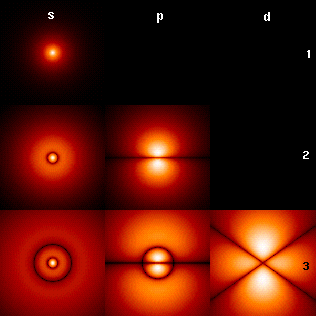
Although I don’t have the weak nuclear force at my disposal, I have tried to build with marbles many times. You can’t build upward without the bottom row rolling away. Perhaps in our world spheres just don’t balance that way. They don’t hold together. Pixels, however, have edges. They seem to fit together more fully, but leave the universe full of jagged edges. That fits much better with my experience, I guess. Shards of reality lie all around me. Religion used to be the way of putting the pieces together, but, I’m told, that’s all a myth. Instead we have a universe that the average person is incapable of understanding, and that seems to be held together by forces that are fully explainable only by math. Once upon a time, Hell was a mythical, fiery place underfoot. Now it is a universe of formulas and equations that are held together only by quantum uncertainty.

"HAtomOrbitals". Licensed under Creative Commons Attribution-Share Alike 3.0 via Wikimedia Commons - http://commons.wikimedia.org/wiki/File:HAtomOrbitals.png#mediaviewer/File:HAtomOrbitals.png

“HAtomOrbitals”. Licensed under Creative Commons Attribution-Share Alike 3.0 via Wikimedia Commons – http://commons.wikimedia.org/wiki/File:HAtomOrbitals.png#mediaviewer/File:HAtomOrbitals.png


Stamp Act

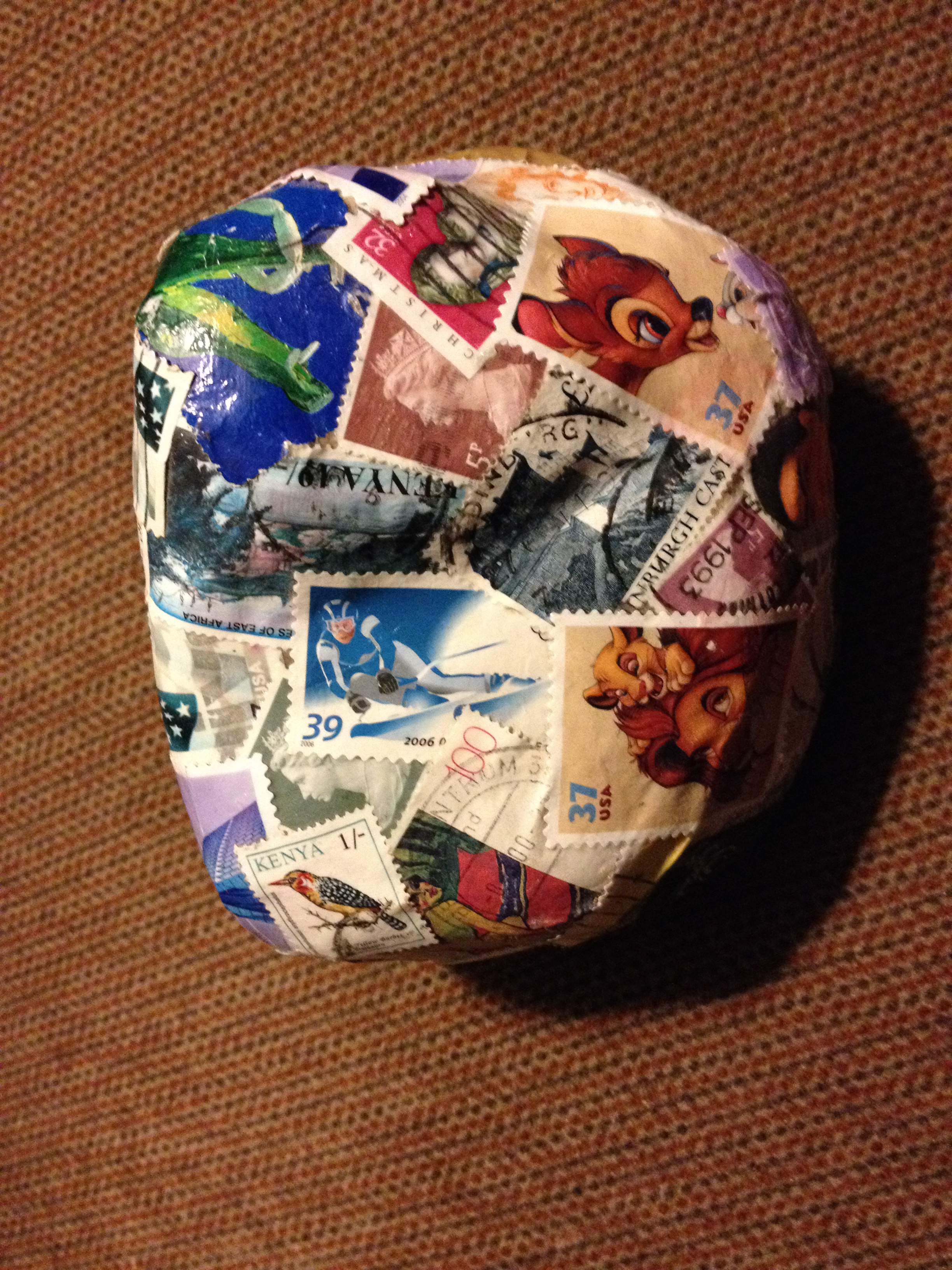
Reality seems more and more intangible all the time. Perhaps this is because I can remember a time, not so long ago, when sitting in front of a computer all day would have been unthinkable. Or maybe it is because when I stepped outside to go for a jog, I found a piece of yesterday’s mail lying on the front lawn. Not that it was terribly important, but it was a stamped piece of mail with my name on it. Soaked with dew. Unread. To err is human, so I wouldn’t have worried about it so much if it hadn’t have happened before. In my days of unemployment, I could hear the postal carrier come onto the stoop, talking away on a cell phone, negotiating the mailbox as if it were a nuisance. Then one day I found a bill that I had put out to be delivered on the sidewalk. The landlord once called, wondering where the rent was. We’d mailed it a week ago, but to this day, years later, it never arrived. I know I’m old fashioned, but a stamp used to mean something.

As a child I was a half-hearted philatelist. At the local hobby store you could buy photo-album knock-offs specifically for stamp collecting. Stamps were a promise from the government. I always considered the fact that they were engraved—like dollar bills and liquor bottle labels—to mean that they were serious. There was more than an implied contract here. A stamp meant delivery. Long I would linger over the empty spaces of my stamp album preprinted with the images of the missing stamps. I thrilled to find one of the Grange, although I had no idea what a Grange was. The one with the legend of Sleepy Hollow I coveted with all my youthful imagination: Ichabod Crane being forever chased by the headless horseman. Stamps from other parts of the world were virtually unknown in my small town. When they came, it was like visiting an exotic location in our own living room.

IMG_1539

A few years back I noticed that stamps were no longer engraved. Printed on a printer not so different from the one that sits on my desk, they have lost their souls. Although their costs have continued to rise, they no longer guarantee delivery like they used to. There was a covenant involved. You licked the stamp, putting it in intimate contact with your body, and the government would ensure the recipient would receive it. I’m outside holding a soggy postcard with my name on it. This one made it to within just yards of its goal before falling, unnoticed from the hand or bag of a mail carrier. We all use email anyway, don’t we? I remember a day as a college sophomore when I had never sat before a computer screen. The world was right there in front of me, inescapably real. Something has happened since then, but I have to admit that I don’t miss licking stamps. I just wonder if reality has really changed.


Who Do You Say?

DMZ. What acronym inspires more terror? Or did I mean DMV? I can’t keep my acronyms straight. Nothing reveals the layers of bureaucracy in clearer cross-section than the Motor Vehicle Agency. A trip to the DMV with every conceivable form of identification (usually inadequate) inevitably becomes a multi-trip visit as I’m sent home again and again to excavate some forgotten form to prove my identity. Who am I? Is there any more religious a question? Moral rights, civil rights, human rights, all define who we are. Reading about war recently, I came across the concept of the soldier giving up life for country—a profoundly religious act—based on nation as a kind of deity. A deity that can demand sacrifice. The cost for the nation is slight while the cost for the individual is unsurpassable. It all revolves around the identity of I.

Religion is often presented in terms of the worship of gods or the belief in supernatural powers. Undoubtedly those elements are often involved, but religion is a human enterprise, and at the center of all human enterprises is, well, humanity. Religion is generally associated with a Latin root that means “binding.” The nature of that binding and the easiest religions have no word for religion itself. One way to conceptualize it is the binding of an individual to some cause greater than the self. Community, humanity, deity—something that gives meaning to an existence that remains unsatisfying if it is only individual-focused. In a consumer market that involves choice—we choose our religion. In ancient times, up until modernity, actually, you were born into it. The self may not have existed in the same way that it does now. We install complex rules to ensure that no self (except the rich and powerful) is able to benefit from the system at the expense of the whole.

DSCN4694

In the eyes of most ancient religions humans are identified as those who are in trouble. We’re lost, reincarnated, suffering, fallen and some kind of help is required. In return our response should be one of gratitude. Humanity the subservient. Now that we’ve recognized ourselves as the creators of religion—are not the gods just ourselves writ large?—we once again face an identity crisis. There is no larger religion that binds us. Generals, however, don’t want to die on the field so we need privates. And if ever the police should stop you while driving, there’s no assurance you’ll give them your real name just because it is the responsible thing to do. So we make licenses to prove we can drive and to prove we are who we say we are. No religion need be involved, just papers that prove I am who I say I am. I think of Pilate’s question and ponder this bit of plastic bearing my likeness. I am who the government says I am.


Religion Fiction

Children brought up in a religious environment, according to a recent BBC story, are more prone to believe in fictional characters. The story, based on research from my alma mater, Boston University, suggests that if children are taught to believe miraculous stories at a young age, they will more likely believe that fictional figures are based in reality too. Undoubtedly this will be seen as yet another brick in Montresor’s wall by those who can find no good in religion. The reasoning will go something like this: believing in no religion is the “neutral” position. If we raise children in a religious context, we are inclining them toward a fictional belief system and making them less likely to reason their way out of it. Therefore, we should raise children secular.

Even in the BBC story there are dissenting voices. Perhaps children who learn about Jesus find Thor a more compelling character. Perhaps they are open to possibilities that logic shuts out. Our brains have two hemispheres for a reason. I often wonder whether it is possible to be fully human while ignoring about half of what evolution gave us to work with. Logic tells me that religious belief serves a survival function. And my creative side still appreciates the possibilities that my Manhattan brain is forced to shut down every day when I punch the clock. If there’s nothing more than work, perhaps believing in fiction serves a valuable function after all. But I suspect this is playing right into the rationalists’ hand. Pass me another brick, will you, Fortunato?

The jury, however, is still out on the nature of reality. Even for materialists. Gods of the gaps tend not to survive very well. The question is actually much larger than that. We don’t know the nature of ultimate reality. We’re not even sure what reality is yet. Can a parent who believes in God, after the experience of growing to maturity in a heartless universe, be blamed for teaching their children the same? No humane parent raises their child purposefully teaching them falsehoods. Yes, some children are damaged by religious upbringings. Some are damaged by materialist upbringings as well. What seems to have shifted, in my humble opinion, is the popular perceptions of religion. What used to be understood as the foundation of a civil society is now challenged as a harmful fantasy that encourages children to grow up into terrorists or non-functioning adults. The belief that we can raise children with no biases, however, is clearly fiction. Until we have the full truth, there should be room for both Gilligan and the Professor on this island. But then again, I was raised to believe in the divine world, so what do I know?

Fact or fiction?

Fact or fiction?


As a Child

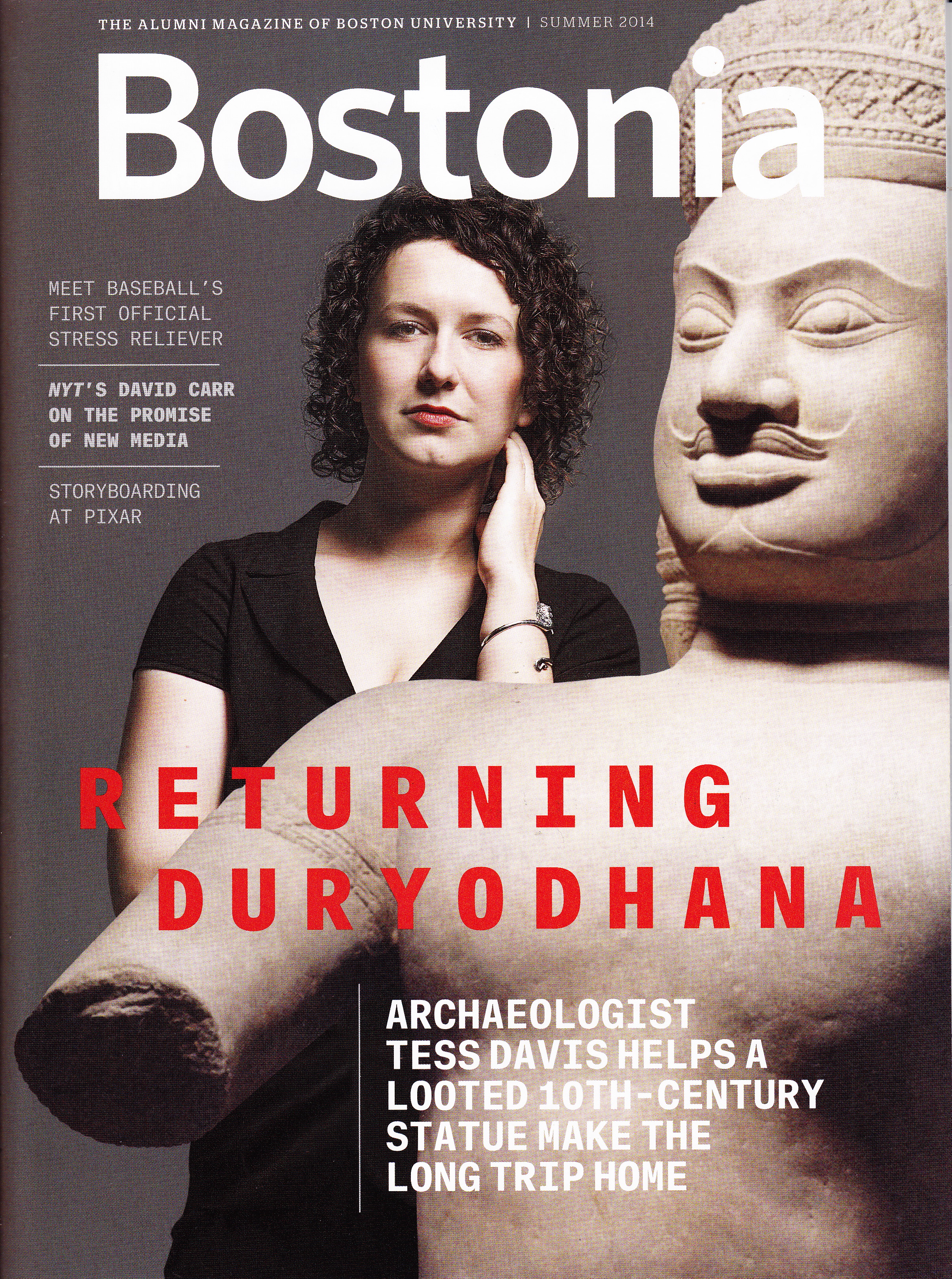
At a certain age, when alumni magazines arrive (and they will), one starts first by opening to the necrology. Who didn’t make it as far as me, after all? There’s a poignancy to it—knowing that at any age we’re vulnerable—but many of us felt a kind of immortality in our younger years that is only belied and effaced with the passing of time. The articles in the alumni magazines feature those who made it better than you, fellow students and faculty who made a genuine breakthrough. You should be proud of having the privilege, they seem to say, of having attended in her or his shadow. But once in a while, those self-serving articles do touch on the issues of the necrology where I always start. Boston University’s most recent edition boasts an article “You Are What You Feel” by Barbara Moran.

Bost

Intellectuals, in what I like to call the Spock Fallacy, frequently suggest that rationality is the whole story. Or at least the better part of it. If the left brain could only just subdue the right, and all decisions could be logical, wouldn’t this world be a better place? Better, maybe perhaps, but not human. We require our emotions for more than just feeling good. Studies suggest that thinking would be difficult, if not impossible, without them. So Bostonia profiles the work of Natalie Emmons, suggesting that ideas of immortality are more than just cultural relics. Perhaps our brains reason eternity for ourselves from some deep well we’ve not yet discovered. Emmons, and co-author Deborah Kelemen, are psychologists who study children’s idea of prelife—where we were before this. It is pretty difficult to imagine the world getting along without us. But the research suggests that intuition, rather than culture, gives us religious concepts such as immortality.

Substituting intuition for an actual essence, however, puts us in that odd place of using a word we can’t define. Scientists frequently fall back on intuition as an explanation for animal behavior that, in most instances, seems to suggest thinking that couldn’t have been acquired the usual way. How do salmon, fish that hardly seem like doctoral material, know to return home and swim upstream? How do newly hatched sea turtles know to crawl toward the water? Birds and butterflies to migrate? Instinct is a handy fallback, for sure. The research of Emmons and Kelemen suggest that children reason (note) prelife based on observations of actual life. The mind is the product of the brain. In my department at Boston University, another set of variables applied, focused mainly on surviving through the other end of the journey. It is with those in mind that I thumb through the necrology and hope, irrational as it may be to do so, that maybe the children are right.


Secular Sacred

IMG_1472On a family walk in the woods, along came a spider. Actually, the spider had already been there quite a while, given the amount of work that its web represented. Few sing the virtues of spider brains, but there is a captivating symmetry here, an aesthetic that nature endows on the work of one of its most feared yet skillful creatures. As I ponder this web, I can’t help but to consider the word sacred. Oh, I don’t suppose the spider is worshipping an eight-legged, arachnid deity, but there is something more than simply utilitarian about its creation. And I wonder why the sacred is so often shuffled off to the realm only of the religious. Increasingly scientists and philosophers are using the word sacred for a trope when superlatives fail. They don’t mean a guy with a beard on a throne in the sky, but rather those things that give us pause in a busy life to stop and think that something more is going on than just the electro-chemical storm in our heads.

At the risk of offending some, the sacred need not be tied to the gods at all. It is, rather, a sense of reverence toward the amazing world in which we find ourselves. Yes, this web can be measured with precision. Its arachnid host captured and studied. We can count the number of insects it catches as a measure of its efficiency. All this and we still won’t have encapsulated the web in its entirety. The sacred is like that. I don’t know why it is that I find some places special. Why it is I linger outside where my childhood homes once stood, or on the hill where stood the hospital in which I entered the world. Although I’m not divine, these places are sacred. So I pull the car to the side of the road and stare at that lot where our house once stood. It was a web. Fragile and necessary. And it was on the edge of the woods.

A walk in the woods is a form of rebirth. Some of my earliest memories are wandering among the trees. I was, like many children, terrified of spiders. No doubt there were thousands of them here. And yet I cannot keep away. Perhaps it is because nearly every day of the week I trundle to Manhattan and there is nothing around me that doesn’t bear the scars of artificiality. I don’t recall the last time I saw a spider in New York City, apart from a man in a blue-and-red costume pretending to be one. I’m sure they’re here. I’m sure they spin their webs and there are those who marvel at how complex and beautiful they are. The unexpected spider will always frighten me, I suppose. That doesn’t mean, however, when I come upon a web, that I haven’t met the secular sacred once more. Especially if it’s on a stroll in the woods.


Tongues of Fire

“Do you want to see?” she asked me, fraught with all the emotions of a teen far from home. I’ve often questioned the wisdom of church groups sending large numbers of high school students to retreats or conferences where shear ratios of chaperones to teens guarantees intrigue. She was an attractive girl, and despite my commitments to asexuality early in life, I found her plea compelling. We weren’t supposed to meet after hours without the adults around. I was insanely curious, however. “A few of us will be gathering behind the gym,” she said. I demurred, afraid to break the rules. “Do you want to see now?” she insistently asked. We were in a room largely empty, as the adults were headed toward the food, the way adults always seem to do. I agreed. Nervously she closed her eyes in prayer. When she opened them, they were glassy and far away. A stream of nonsense words effortlessly bubbled from her mouth. This went on for what seemed like minutes, although I knew it was only seconds stolen from a scheduled curriculum. She closed her eyes, and coming back to herself, looked exhausted. “What did you say?” I asked, breathless. “I don’t know,” she admitted.

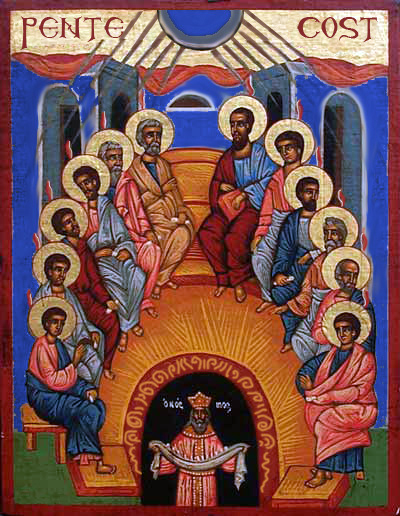
This was my first experience of glossolalia, or speaking in tongues. I was at the United Methodist Youth Annual Conference, and I’d just met the girl who’d revealed so much. Methodists, as a rule, aren’t much into glossolalia, but the Pentecostal movement has Methodist roots, and teens are the great experimenters of the human race. I can’t recall how I met her, or even her name. I felt an incredible attraction to a girl who could let herself be so possessed, however; so vulnerable to an Almighty deity. I decided not to go to the after dark gathering. Instead I sought out a minister I trusted. He explained that such signs, if truly divine, are only done in the presence of an interpreter. She was misguided. Yet I couldn’t get those glassy eyes out of my mind. Where had she been in those fleeting seconds when her mouth spoke a language she didn’t know?

While reading David Kling’s The Bible in History’s chapter on Pentecostalism, this all came back to me with incredible force. A few years later I attended a Pentecostal service with one of my college roommates who belonged to that tradition. Being in a room full of true believers speaking in tongues at the same time unnerved me. I never went back. Psychologists and neurologists have explanations for how glossolalia occurs. The standard evangelical explanation is quite different. For one young lady whose name I can’t recall, it was a sign she wanted desperately to share. A personal assurance that John Wesley himself encouraged his followers to seek. Not that Wesley ever suggested speaking in tongues. That only began in 1901, after a hiatus of nearly two millennia. To a teenage spiritual seeker in the presence of a young lady, away from home, it was a mystical experience indeed. The assurance, however, would have to wait.

Image credit: Phiddipus

Image credit: Phiddipus


Trans-Human

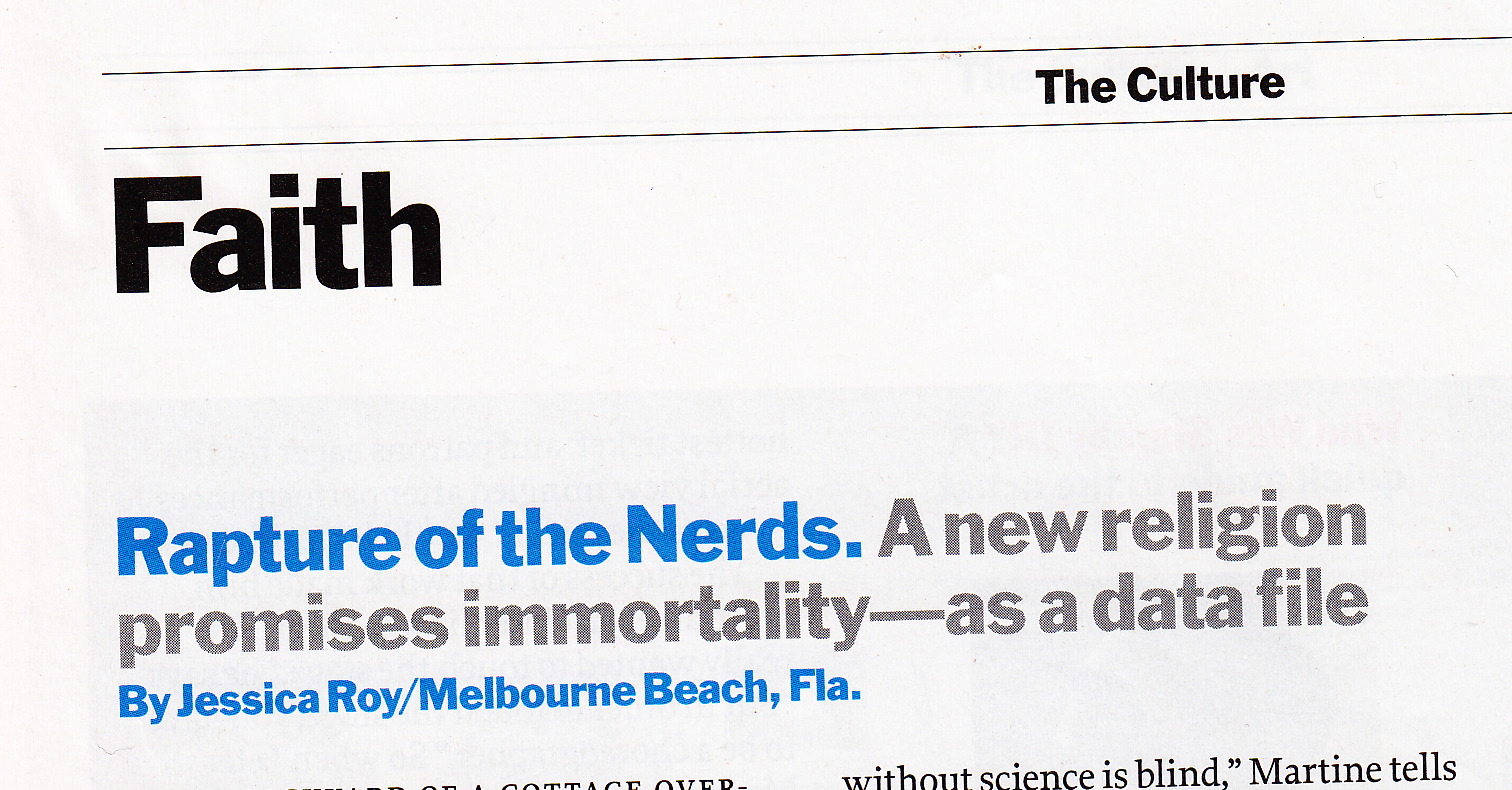
“Rapture of the Nerds,” an article in this week’s Time magazine by Jessica Roy, has me scratching my head. Or it would if I had a head. That is, if I were an uploaded consciousness in a machine. A transhuman. The idea that consciousness is transferable to hardware has been gaining momentum over the last several years during which humans have evolved into illogical machines. Roy’s article about Terasem, which is being called a new religion, explores what the leaders of the movement teach about human consciousness. You write down your thoughts in most intimate detail, download, and viola, send them out to the cosmos. Your soul has been saved. If only we knew what a soul was. Transhumanism has been promising an attenuated kind of immortality for its adherents, but as I sit down to write out my thoughts, I’m aware that there’s always a lot more going on in my brain than the simple ideas I can scrawl down before they evaporate. There’s quick wisps of thoughts about my loved ones, my schedule (what do I have to do today?), what I ate for supper last night, how I feel—all of this while I’m putatively thinking about writing a blog post. Schizophrenia of the soul?

Faith

So much of thought is having a biological body. From early days I have been aware that this body will die. I was taught that the soul would live on, but this thing I call consciousness seems pretty closely tied with this thing I call life. And once the biological input ends, that part will be over. I think. In other words, my thoughts are tied to my biological existence. How can I even begin to write a minute fraction of them down accurately? I used to toy with an idea called meta-thinking. It was something I came up with as a plot element in a science fiction story. The idea was that those who can think two thoughts at once would eventually take over from those of us with lesser mentalities. Those who have two minds in one brain are, it seems, a step closer to the divine.

I use technology on a daily basis, but I am a disingenuous advocate. Some of the most transcendent moments I’ve experienced have been outdoors with technology left behind, under a sunny sky with an ocean breeze blowing in my face and those I love walking beside me. I think I’ve already broadcast that out into the universe by simply being a part of it. I don’t need circuits and motherboards to make me more of what I am. Technology is the follower. It is consciousness that will always remain in the lead. And we still really don’t even have an idea of what consciousness actually is. It’s certainly not this computer that’s sitting on my lap. And I do have to wonder, once my consciousness becomes a robot, what it will do with this strange, primate urge I have, when I’m puzzled, to scratch my head.


Medjugorje Matrix

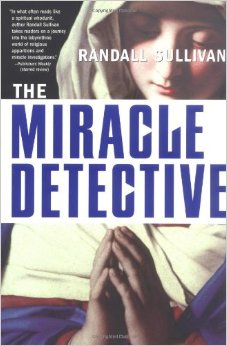
Miracle Detective“Expect a miracle,” Oral Roberts used to sign off, “and a miracle is yours today.” Physicists tend to be a bit more hard-nosed about the issue. In a mechanistic universe miracles are disallowed. How can you predict the outcome of any experiment or scenario when the whim of the divine could change the results? Nevertheless, most churches at least hold out the possibility of the rare miracle either set in centuries far past, or even occurring today. Randall Sullivan’s The Miracle Detective is, therefore, an almost unbelievable book. A reporter for Rolling Stone, Sullivan began investigating Marian apparitions. Although in the popular mindset, even among skeptics, such things are seen as promotions by the church to shore up the faithful, as Sullivan points out, the Catholic church is extremely cagey regarding miracles. It might be easier to convince a physicist than it is the Vatican, that a miracle is occurring.

Spending part of the tragic war in Bosnia-Herzegovina, Sullivan interviewed most of the six children who claimed to have visions of Mary at Medjugorje. While he remained skeptical of what he found, it is at times a decided head-rush to read his book. We tend to dismiss non-academic reporting of events by hoi polloi as unsophisticated, or superstitious. The events at Medjugorje, however, have been thoroughly tested by physicians and communist-appointed scientists and have left them scratching their heads. In some cases, getting them to convert to Catholicism. Rome, however, did not give its seal of approval to what was happening there. Sullivan, not religious himself, but open-minded, found the investigation compelling, if not life-changing. In this lengthy account, the reader is drawn into a rational world where something mysterious is clearly happening. A world that both the church and the academy deny might exist. And yet, something incredible stands on record nevertheless.

Lourdes, Fatima, and numerous lesser-known locations boast erstwhile visions of Mary that include miracles in their wake. Although the events in Medjugorje were unfolding the year I started college, majoring in religion, I had never heard of them until I read The Miracle Detective. As Sullivan notes, at times it seems better not to know about such events because they disturb a comfortable worldview where intrusions from the outside just don’t happen. Life, however, includes many incidents which we simply take off the table because they don’t fit into our scientific paradigm. The implications are just too discomfiting. Climbing off the bus after having read several chapters of the book was like stepping back into a world somehow so effaced that I felt there must be something on the other side. Many of those experiencing these miracles were barely Catholic, or were not religious at all. And yet something happened to them, causing them to wonder. And that wonder is catching for those who read the strangely compelling account of an open-minded, if accidental, miracle detective.


Programming God

Robots have been part of my world far longer than I ever recognized. Still, growing up in a small town in the 1960s, their impact was fairly minimal—they may have had a part in the manufacture of the car we drove, and perhaps helped prepare some of the products we bought—but those robots were far away. Far more present were those on television who, for the most part, were funny and helpful. This month’s Wired magazine runs a story entitled “Trusting Our Robots,” by Emily Anthes. The point of her short article is that people feel more comfortable with robots that are programmed to appear uncertain. We don’t trust robots to drive our cars, as she points out, but we give them more, old-fashioned primate sympathy when we make them look like they’re having a hard time. Just a couple weeks back Time magazine had a blurb on how we’re now at the point of programming drones to kill without human input. Add a dose of uncertainty and we get a glimpse of what it must be like to be gods.

Underneath our exteriors, we all know that robots do what they are programmed to do. In many respects—physically, especially—they are superior to us. Nevertheless, human knowledge is not perfect. We, too, are prone to uncertainty. Our robots aren’t better than we are, only more efficient. Doubt is a human quality. Perhaps our most endearing. As Ms. Anthes notes, “even when confronted with evidence of our own inferiority, we resist a robot’s help.” We have evolved over millions of years to interact with other creatures. Those non-biological entities we’ve created and endowed with artificial intelligence (sound familiar?) somehow can’t equal the right we’ve earned from struggling against, and along with, nature for these many eons. Would God really trust us with the keys to the universe?

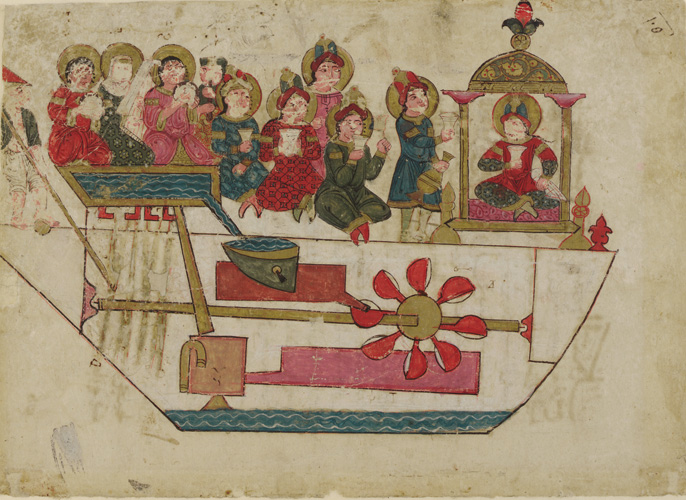
An early plan for a robot.

An early plan for a robot.

Robots, we are told, are our inevitable future. Some visionaries look forward to uploading human consciousness (even though we have no idea what it is) into a machine and, with replaceable parts, living forever. Before the dead and resurrected Jesus, according to the gospel of John, stood Thomas—the man some traditions said was Jesus’ very twin—and yet he doubted. As much as we claim otherwise, we adore Thomas for it. Evolving even in a world full of religion—itself a product of our evolution—we are so unsure. Our robots, however, programmed by us, have no doubts. Even when they act confused, it’s only because we tell them too. Our minds, as Wired tells us, resist letting robots drive the car for us. We let them pull the trigger, however, and pray our programmers got it right.


Double Blind

When I read Isaac Asimov’s three laws of robotics as a child, I assumed that I’d not live to worry about them in real life. What we don’t know can indeed hurt us. Time magazine frightens me sometimes. This week’s offerings include a small blurb about drones. When I was a kid, a drone was a bee—dangerous in its own right—or it was a verb used to describe an uninspired teacher or preacher’s monotoned wisdom. Now drones are robotic planes that can operate themselves without human input. Time reveals that technology has been developed that would allow drones to kill without human input. Asimov’s laws have become truly science fiction. Proponents argue that “collateral damage” might be minimized if we allow robots to kill with precision, and some have argued that the research should be prohibited. The fact that it has been developed, however, means the line in the sand has been crossed. If it has been done once, it will be done again.

800px-MQ-9_Reaper_in_flight_(2007)

Even as a daily user of technology, a deep ambivalence besets me. Maybe if it weren’t for the fact that every once in a while my computer (most often at work) freezes up and issues a command I can’t understand, I might feel a little more secure. Instead I issue a ticket for IT and when they call on me sometimes even a specialist can’t figure out what went wrong. Once the bullets are flying it’s a little too late to reboot. Maybe I’m just not yet ready to crawl into bed with a technology that might kill me, without feeling.

Just five pages earlier Time notes that 1 in 5 is the “Ratio of people who would have sex with a robot, according to a U.K. study.” All things are fair, it seems, in love and war. The part of the equation that we haven’t accounted for in our artificial intelligence is that thought requires emotion—which we don’t understand—as much as it requires reason, upon which we have only a toddler’s grasp. And yet we continue to build more and more powerful devices that might kill us with ease. Isaac Asimov was a prescient writer and a forward thinker. He was from the generation that aspired to ethics being in place before technology was implemented. At least as an ideal. We’ve reversed the order in our world, where ethics is continually playing catch-up to the new technologies we’ve invented. Now it’s time to decide whether to make love to it or to say our final prayers.


Real Life

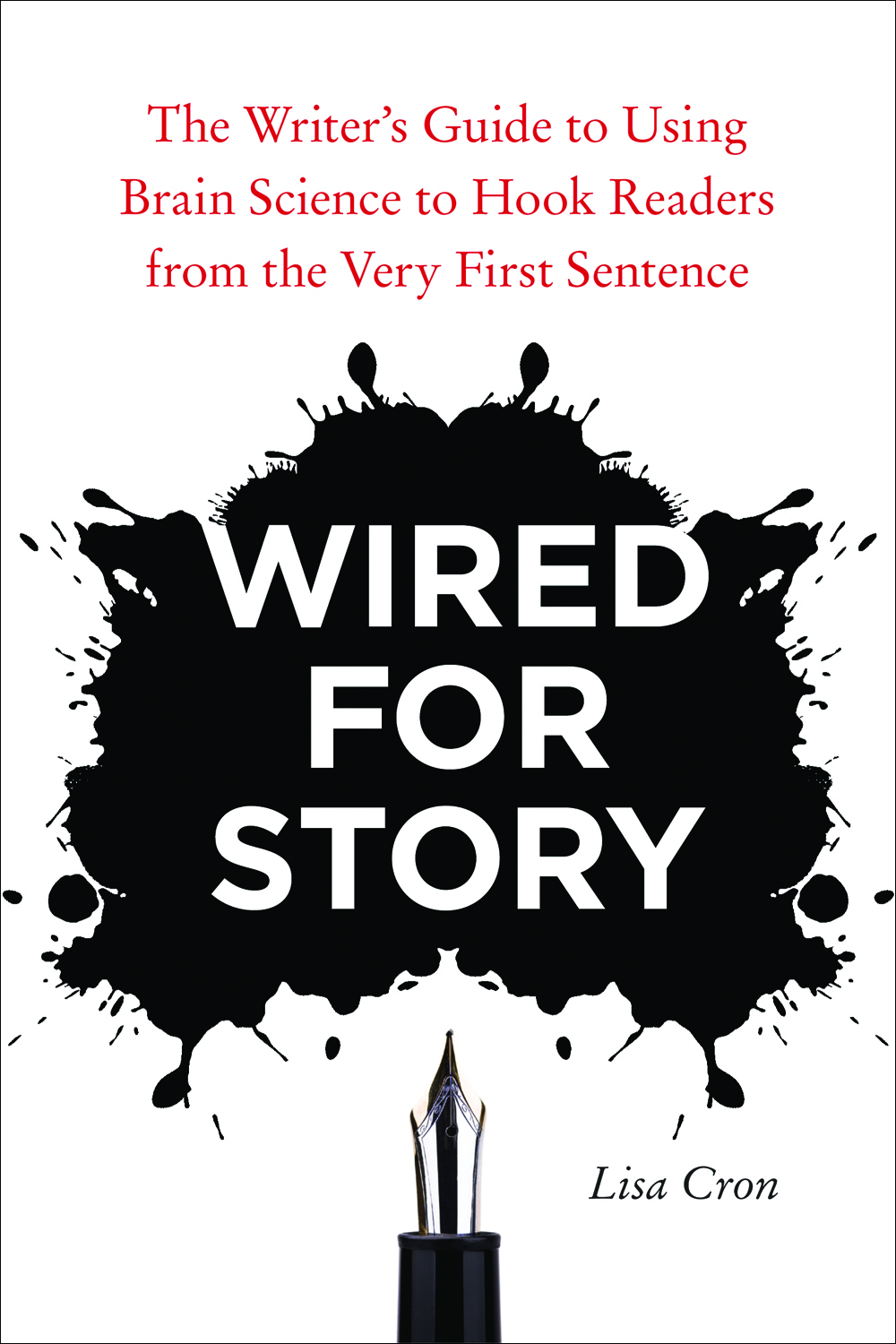
WiredForStoryThe brain, it seems to me, holds all of the cards. After all, what we call “reality” is actually a perception of what’s “really” there mediated by our brains. Philosophers and scientists have long warned us that direct participation with the universe is a figment of the, um, brain. This kind of thinking may have led me to trouble in certain jobs I’ve held, but there is no escaping it, unless we posit that there is another thinking center in the body. If there is, it must be invisible. As a dabbler in the literary arts, I couldn’t therefore pass up Lisa Cron’s Wired for Story. The premise spawns one of those “aha” moments so large that you wonder why nobody had tripped upon it before: brain science can reveal what makes a good story. For example, were I smarter, I would’ve begun with that wonderfully witty story told by Uncle Frank that kept us engrossed as kids, and left us roaring with leonine laughter. Only I don’t have an Uncle Frank, and the stories I grew up with were of the written species.

Cron, however, reminds us of a very important point: if it weren’t for feeling, thought would not be possible. This isn’t telling tales out of school. Even the most Spock-like rationalists know it’s true: emotions are essential to the thought process. Even the most proficient of thinkers can be stopped by the vague, “I don’t feel like—” (fill in the blank). To think well, we must feel that we can. When we greet someone we don’t lead with “how are you thinking?” but with “how are you feeling?” (often apocopated to “how are you?”). We interpret our world through a combination of reason and emotion. Both are necessary for survival. Think about it: does the world really make sense?

In writing, emotion plays an essential role. We lay aside the story that makes us feel nothing. Reductionistic materialists often espouse that getting down to the smallest piece of the smallest particle will eventually explain it all. The more spiritually inclined will ask them how it makes them feel. Emotion is the under-appreciated of these twins. While great ideas may come through in a novel (I can’t help but mention Moby Dick again), it is the feeling of the protagonist—the spiritual (call it what you will) struggle—that draws us in and keeps us reading. It may be secular or religious, but the realm of emotion reminds us that to be human is to feel. And if by chance you’re still reading this, I have a feeling that you might agree.


Heaven Can Wait

“Like a good neighbor, State Farm is there.” So the jingle goes. Or went. I’ve only met my upstairs neighbors once. Twice now. Apparently last weekend I slept through the fire alarm—one of the dangers of awaking ridiculously early on a daily basis. The neighbors found the source of the smoke and turned off the furnace in the basement, but told me first thing in the morning before the coffee really kicked in. I avoided a close call, perhaps. What if they’d not been home?

I have no delusions about understanding how the Internet works. I’m still trying to figure out the telegraph. Perhaps having this inconsequential blog has put me on somebody’s radar, or maybe it’s just some bored robot that searches for strange combinations of words in the wee hours of the night. In any case, I ended up with an email with the trailer for Heaven Is For Real embedded in it. I recall when the book was on the New York Times bestseller list, and I suppose the Easter weekend release date is no coincidence, but the trailer still bothered me a bit. It’s not the resurrection part—the film industry wouldn’t get very far without that trope—but it is the implications of what heaven would be like. I haven’t read the book, but apparently Colton Burpo had a near-death experience and then for a considerable time afterward began describing things that were impossible for him to know. A miscarriage where his sister died, what his grandfather looked like as a young man, what his parents were doing when he was dead in the hospital. Talk about your spooky effects at a distance!

Despite my penchant for watching scary movies, I don’t think I’ll see Heaven Is For Real. There’s just too much emotional build-up here, and Life After Life traumatized me for weeks a couple decades back. Still, I am very interested in the possible explanations for what might have been going on. Near-death experiences have never been adequately explained. Scientists suggest that a lot can happen in a complex brain in a matter of nano-seconds, and we have no chronograph precise enough to know whether the thoughts and images happened before death, during death, or during resuscitation. Still, how people frequently know precisely where others were, who were not in the room at the time, and how they heard things that, medically speaking, they couldn’t have heard, remains eerie and hopeful at the same time. What does appear to be without question is that consciousness is far from being explained.

Botticini's vision

Botticini’s vision

Heaven is always described as pleasant. That concept differs radically for people, and you have to wonder how it can be one-size-fits-all. Some people prefer to be in crowds, while others like to be alone. Some like it hot. Some like it cold. And those who experience near-death phenomena often report having a body of some sort “up there.” Some people would prefer a different body. According to the trailer, Colton says we’re all young over yonder. For me, such things are far more about questions than answers. We don’t know what goes on after death. Nearly every religion ever invented says that clearly there’s more to the story. Some say we come back, others say we stay away. Maybe it is different for each. Maybe it is just a matter of having good neighbors after all.